Relationships and Convergences Found in the 
Common Core State Standards in Mathematics (practices), 
Common Core State Standards in ELA/Literacy*(student portraits), and 
A Framework for K-12 Science Education (science & engineering practices) 
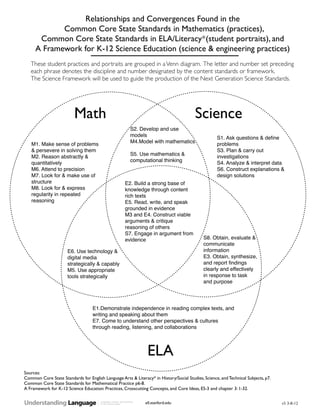
These student practices and portraits are grouped in a Venn diagram. The letter and number set preceding 
each phrase denotes the discipline and number designated by the content standards or framework. 
The Science Framework will be used to guide the production of the Next Generation Science Standards. 
Math Science 
S2. Develop and use 
models 
M4.Model with mathematics 
S5. Use mathematics & 
computational thinking 
E2. Build a strong base of 
knowledge through content 
rich texts 
E5. Read, write, and speak 
grounded in evidence 
M3 and E4. Construct viable 
arguments & critique 
reasoning of others 
S7. Engage in argument from 
evidence 
S8. Obtain, evaluate & 
communicate 
information 
E3. Obtain, synthesize, 
and report findings 
clearly and effectively 
in response to task 
and purpose 
E6. Use technology & 
digital media 
strategically & capably 
M5. Use appropriate 
tools strategically 
E1.Demonstrate independence in reading complex texts, and 
writing and speaking about them 
E7. Come to understand other perspectives & cultures 
through reading, listening, and collaborations 
ELA 
S1. Ask questions & define 
problems 
S3. Plan & carry out 
investigations 
S4. Analyze & interpret data 
S6. Construct explanations & 
design solutions 
M1. Make sense of problems 
& persevere in solving them 
M2. Reason abstractly & 
quantitatively 
M6. Attend to precision 
M7. Look for & make use of 
structure 
M8. Look for & express 
regularity in repeated 
reasoning 
Sources: 
Common Core State Standards for English Language Arts & Literacy* in History/Social Studies, Science, and Technical Subjects, p7. 
Common Core State Standards for Mathematical Practice p6-8. 
A Framework for K-12 Science Education: Practices, Crosscutting Concepts, and Core Ideas, ES-3 and chapter 3: 1-32. 
ell.stanford.edu v5 3-8-12
( 
Relationships,and,Convergences,Found,in,the,Common,Core,State, 
Standards(in(Mathematics((practices),(Common(Core(State(Standards( 
in#ELA/Literacy*(student(portraits),(and(A(Framework(for(K.12# 
Science&Education&(science&&&engineering&practices).( 
These(student(practices(and(portraits(are(grouped(in(a(modified(Venn(diagram.((The(letter(and( 
number(set(preceding(each(phrase(denotes(the(discipline(and(number(designated(by(the( 
content(standards(or(framework.(The(Science(Framework(was(used(to(guide(the(production(of( 
the(Next(Generation(Science(Standards.( 
( 
Our(team(at(Understanding+Language(wanted(to(examine(the(nature(of(the(relationships(and( 
convergences(of(student(expectations1(found(in(and(across(the(three(sets(of(the(new(standards:( 
(1)(English(Language(Arts(&(Literacy(in(History/Social(Studies,(Science,(and(Technical(Subjects,( 
(2)(Mathematics,(and((3)(Science.((This(short(brief(details(the(analysis(of(these(student.centered( 
expectations(in(and(across(the(three(disciplines(and(begins(a(discussion(of(language(demands( 
found(in(these(new(standards(as(well(as(their(implications(for(students,(teachers,(and(teacher( 
educators.( 
I.(What%is%the%relationship,%if%any,%across%these%student4centered%expectations?% 
In(this(Venn(diagram,(our(team(has(attempted(to(cluster(practices(and(capacities(that(have( 
similar(tenets(and/or(significant(overlaps(in(the(student(expectations.((Likewise,(we(have(placed( 
practices(and(capacities(within(the(disciplinary(domains(if(there(was(not(a(significant(overlap(or( 
relationship(to(another(discipline.(One(could(argue(certain(practices/capacities(could(be(placed( 
in(other(positions(within(the(Venn(diagram.(These(placements(are(not(definitive(and(the( 
intention(of(the(Standards(documents(may(not(have(conceptualized(the(three(disciplinary(areas( 
in(this(manner.(( 
II.((What%are%these%student%centered%expectations%and%how%are%they%represented%in%each%of% 
the%disciplines?( 
Each(set(of(these(student(expectations(in(the(three(disciplines(is(represented(in(various(forms.( 
This(section(discusses(the(student(expectations(found(in(each(discipline.( 
Common%Core%State%Standards%for%English%Language%Arts%&%Literacy%in%History/Social%Studies,% 
Science,%and%Technical%Subjects% 
Found(on(page(7(of(the(ELA(Standards,(these(student.centered(expectations(are(“portrait(of( 
students(who(meet(the(standards.”(The(student(portrait(detailed(within(the(ELA(standards(is( 
Working(Draft(5.30.12(by(T.(Cheuk( 
ell.stanford.edu( 
1 
1 In the ELA Standards, student expectations are termed “portraits of students” whereas in the Mathematics and 
Science Standards, they are termed as student “practices.”
Working(Draft(5.30.12(by(T.(Cheuk( 
ell.stanford.edu( 
2 
termed(student(“capacities”,(not(the(same(labeling(as(“practices”(as(seen(in(both(the( 
Mathematics(and(Science(Standards.(These(ELA(capacities(include2:( 
E1. They(demonstrate(independence.( 
E2. They(build(strong(content(knowledge.( 
E3. They(respond(to(the(varying(demands(of(audience,(task,(purpose,(and(discipline.( 
E4. They(comprehend(as(well(as(critique.( 
E5. They(value(evidence.( 
E6. They(use(technology(and(digital(media(strategically(and(capably.( 
E7. They(come(to(understanding(other(perspectives(and(cultures.( 
Within(each(of(these(capacities,(there(is(explicit(reference(to(what(students(are(expected(to(do( 
within(the(ELA(discipline.(E1(is(the(most(broad(and(encompassing(of(the(student(capacities.(( 
Within(E1,(students(are(expected(to:(“comprehend(and(evaluate(complex(texts,(…(construct( 
effective(arguments,(and(convey(…(information.(…(discern(a(speaker’s(key(points,(request( 
clarification,(and(ask(relevant(questions.([Students](build+on(others’(ideas,(articulate+their(own( 
ideas,(and(confirm(they(have(been(understood.(…([Students](demonstrate(command(of( 
standard(English(and(acquire(and(use(a(wide.ranging(vocabulary.(…”(The(italicized(verbs((added( 
by(author)(found(in(the(E1(descriptor(attend(to(the(language(demands(expected(from(students.( 
Within(the(Venn(diagram,(we’ve(summarized(capacity((E1)(as(the(following,(“Demonstrate( 
independence(in(reading(complex(texts,(and(writing(and(speaking(about(them.”( 
Capacity(E2(is(centered(around(building(“strong(content(knowledge”(“by(engaging(with(works( 
of(quality(and(substance.”(This(capacity(sits(clearly(at(the(intersection(of(the(three(disciplines(as( 
the(focus(is(on(how(students(interact(with(and(“gain(both(general(knowledge(and(discipline. 
specific(expertise”(through(reading,(listening,(writing,(and(speaking.( 
Capacity(E3(has(been(paraphrased(to(“Obtain,(synthesize,(and(report(findings(clearly(and( 
effectively(in(response(to(task(and(purpose.”((The(intent(of(this(paraphrase(was(to(clarify(how( 
students(would(“respond(to(the(varying(demands(of(audience,(task,(purpose,(and(discipline.”( 
Capacity(E4(and(E5(centers(around(the(issue(of(argumentation(and(evidence.((Students(are( 
expected(to(“question(…(assumptions(and(premises(and(assess(the(veracity(of(claims(and( 
soundness(of(reasoning((E4)([and](constructively(evaluate(others’(use(of(evidence.”(This(level(of( 
student(engagement(with(the(content(cross.cuts(all(three(disciplines.(As(seen(in(the(Venn( 
diagram,(argumentation(and(reasoning(from(evidence(are(also(highlighted(in(the(Mathematics( 
and(Science(Standards.(( 
Capacity(E6(advantages(the(use(of(technology(and(digital(media(tools(to(support(student( 
learning(and(communications(with(others.(These(tools(are(meant(to(assist(in(amplified(student( 
learning,(and(provide(addition(access(to(rich(content(learning(opportunities.( 
Capacity(E7(is(centered(around(the(importance(of(perspective(taking(and(diversity(of(cultures.( 
2 The numbering of these capacities has been added by the author for reference purposes.
Working(Draft(5.30.12(by(T.(Cheuk( 
ell.stanford.edu( 
3 
Common%Core%State%Standards%for%Mathematics:%Standards%for%Mathematical%Practice( 
In(the(new(Mathematics(Standards,(the(Standards(for(Mathematical(Practice(are(detailed(on( 
pages(6.8.(These(practices(“describe(varieties(of(expertise(that(mathematics(educators(at(all( 
levels(should(seek(to(develop(in(their(students.”(Stated(on(page(5,(the(content(standards(“are( 
potential(points+of+intersections(between(the(Standards(for(Mathematical(Content(and(the( 
Standards(for(Mathematical(Practice.”(( 
These(mathematical(practices(include3:( 
M1. Make(sense(of(problems(and(persevere(in(solving(them.( 
M2. Reason(abstractly(and(quantitatively.( 
M3. Construct(viable(arguments(and(critique(the(reasoning(of(others.( 
M4. Model(with(mathematics.( 
M5. Use(appropriate(tools(strategically.( 
M6. Attend(to(precision.( 
M7. Look(for(and(make(use(of(structure.( 
M8. Look(for(and(express(regularity(in(repeated(reasoning.( 
Similar(to(E1,(students(in(practice(M1(are(expected(to(“explain…(the(meaning(of(a(problem,(look+ 
for(entry(points,(…(analyze+givens….(make+conjectures,(…(plan+a+solution,(…(consider+analogous+ 
problems,(…(try+special+cases,(…(monitor(and(evaluate(their(progress….”(Again,(the(italicized( 
verbs(and(verb(phrases((added(by(author)(in(the(found(in(the(M1(practice(attend(to(the( 
language(demands(expected(from(students.( 
Practice(M2(describes(the(mathematical(reasoning(through(the(processes(of(decontextualizing( 
and(contextualizing+flexibly(in(problem(situations.(The(abstract(and(quantitative(reasoning(that( 
is(required(in(mathematics(is(not(the(same(as(it(is(described(in(ELA(or(Science.(However,( 
reasoning(does(entail(meaning(making,(building(connections(as(well(as(building(understanding( 
of(the(relationships(among(various(parts(the(text(provided.((In(mathematics,(that(text(most( 
likely(revolves(around(the(problem(situation.( 
Practice(M3(builds(on(practice(M2(as(students(make(sense(of(“stated(assumptions,(definitions,( 
and(previously(established(results(in(constructing(arguments.”(Students(are(also(expected(to( 
“reason(inductively(about(data,(making(plausible(arguments(that(take(into(account(the(context( 
from(which(the(data(arose.”( 
Practice(M4(describes(the(use(of(modeling(in(mathematics.(In(mathematics,(students(“apply( 
what(they(know([and](are(comfortable(making(assumptions(and(approximations(to(simplify(a( 
complicated(situation….”(Mathematical(models(have(significant(implications(in(the(science( 
standards(as(science(and(engineering(practices(also(explicit(describes(the(development(and(use( 
of(models.(Further(discussion(of(these(relationships(can(be(found(in(part(II.+ 
3 The letter “M” in front of the numbers has been added by the author for reference purposes.
Practice(M5(describes(the(use(of(tools(“when(solving(a(mathematical(problem.”(The(intent(of( 
the(tools(is(to(“explore(and(deepen(their([students’](understanding(of(concepts.”(M5(overlaps( 
most(closely(with(E6(in(using(tools(to(access(and(extend(learning(opportunities.( 
Practices(M6,(M7,(and(M8(focuses(on(areas(that(are(more(specific(to(mathematics.((Although( 
one(could(argue(that(science(and(engineering(practices(include(elements(of(the(mathematic( 
practices(applied(in(their(own(context.(( 
Next%Generation%Science%Standards:%Scientific%and%Engineering%Practices( 
The(analysis(of(the(Scientific(and(Engineering(Practices(is(derived(from(Chapter(3(of(A+ 
Framework+for+KA12+Science+Education:+Practices,+Crosscutting+Concepts,+and+Core+Ideas.(These( 
eight(practices(include4:( 
S1. Asking(questions((for(science)(and(defining(problems((for(engineering).( 
S2. Developing(and(using(models.( 
S3. Planning(and(carrying(out(investigations.( 
S4. Analyzing(and(interpreting(data.( 
S5. Using(mathematics,(information(and(computer(technology,(and(computational(thinking.( 
S6. Constructing(explanations((for(science)(and(designing(solutions((for(engineering).( 
S7. Engaging(in(argument(from(evidence.( 
S8. Obtaining,(evaluating,(and(communicating(information.( 
( 
The(distinctive(practices(found(in(science(and(engineering(relate(to(S1,(S3,(and(S4.(The(work(of( 
asking(questions(and(defining(problems((S1),(planning(and(carrying(out(investigations((S3),(and( 
analyzing(and(interpreting(data((S4)(are(distinctive(practices(found(in(science(and(engineering.(( 
Practice(S2(attends(to(how(scientists(“construct(mental(and(conceptual(models(of(phenomenon”( 
and(serves(as(“a(tool(for(thinking(with,(making(predictions,(and(making(sense(of(experience”( 
(page(3.8).(This(practice(is(a(broader(conceptualization(of(modeling(as(it(includes(“mathematical( 
representations”(as(one(of(may(types(of(models(that(exist(in(science(and(engineering.((Similar( 
to(mathematics,(models(do(“contain(approximations(and(assumptions(that(limit(the(range(of( 
validity(of(their(application(and(the(precision(of(their(predictive(power.”(( 
Practice(S5(advantages(mathematics(and(computational(tools(that(clarifies(and(builds( 
relationships(and(models(among(the(various(representations(found(in(mathematics,(science,( 
and(engineering.(Again,(practice(S5(is(a(broader(conceptualization(of(tool(use(that(includes( 
many(of(the(ideas(found(in(modeling(in(mathematics.(( 
Practice(S6(and(S8(centers(around(getting(students(to(synthesize(their(understanding(and( 
produce(new(knowledge(for(others.(( 
In(practice(S7,(“the(production(of(knowledge(is(dependent(on(a(process(of(reasoning(that( 
requires(a(scientist(to(make(a(justified(claim(about(the(world”((page(3.17).(Practice(S7(shares( 
Working(Draft(5.30.12(by(T.(Cheuk( 
ell.stanford.edu( 
4 
4 The letter “S” in front of the numbers has been added by the author for reference purposes.
Working(Draft(5.30.12(by(T.(Cheuk( 
ell.stanford.edu( 
5 
the(common(feature(of(argumentation(and(reasoning(with(M3(and(E4.((While(we(are(not( 
claiming(that(the(forms(of(argumentation(in(each(discipline(contain(the(same(features,(we(are( 
only(making(note(that(students(are(expected,(in(these(new(Standards,(to(reason(and(make+ 
arguments(in(each(of(the(disciplines.( 
(

Common core venn diagram

  • 1.
    Relationships and ConvergencesFound in the Common Core State Standards in Mathematics (practices), Common Core State Standards in ELA/Literacy*(student portraits), and A Framework for K-12 Science Education (science & engineering practices) These student practices and portraits are grouped in a Venn diagram. The letter and number set preceding each phrase denotes the discipline and number designated by the content standards or framework. The Science Framework will be used to guide the production of the Next Generation Science Standards. Math Science S2. Develop and use models M4.Model with mathematics S5. Use mathematics & computational thinking E2. Build a strong base of knowledge through content rich texts E5. Read, write, and speak grounded in evidence M3 and E4. Construct viable arguments & critique reasoning of others S7. Engage in argument from evidence S8. Obtain, evaluate & communicate information E3. Obtain, synthesize, and report findings clearly and effectively in response to task and purpose E6. Use technology & digital media strategically & capably M5. Use appropriate tools strategically E1.Demonstrate independence in reading complex texts, and writing and speaking about them E7. Come to understand other perspectives & cultures through reading, listening, and collaborations ELA S1. Ask questions & define problems S3. Plan & carry out investigations S4. Analyze & interpret data S6. Construct explanations & design solutions M1. Make sense of problems & persevere in solving them M2. Reason abstractly & quantitatively M6. Attend to precision M7. Look for & make use of structure M8. Look for & express regularity in repeated reasoning Sources: Common Core State Standards for English Language Arts & Literacy* in History/Social Studies, Science, and Technical Subjects, p7. Common Core State Standards for Mathematical Practice p6-8. A Framework for K-12 Science Education: Practices, Crosscutting Concepts, and Core Ideas, ES-3 and chapter 3: 1-32. ell.stanford.edu v5 3-8-12
  • 2.
    ( Relationships,and,Convergences,Found,in,the,Common,Core,State, Standards(in(Mathematics((practices),(Common(Core(State(Standards( in#ELA/Literacy*(student(portraits),(and(A(Framework(for(K.12# Science&Education&(science&&&engineering&practices).( These(student(practices(and(portraits(are(grouped(in(a(modified(Venn(diagram.((The(letter(and( number(set(preceding(each(phrase(denotes(the(discipline(and(number(designated(by(the( content(standards(or(framework.(The(Science(Framework(was(used(to(guide(the(production(of( the(Next(Generation(Science(Standards.( ( Our(team(at(Understanding+Language(wanted(to(examine(the(nature(of(the(relationships(and( convergences(of(student(expectations1(found(in(and(across(the(three(sets(of(the(new(standards:( (1)(English(Language(Arts(&(Literacy(in(History/Social(Studies,(Science,(and(Technical(Subjects,( (2)(Mathematics,(and((3)(Science.((This(short(brief(details(the(analysis(of(these(student.centered( expectations(in(and(across(the(three(disciplines(and(begins(a(discussion(of(language(demands( found(in(these(new(standards(as(well(as(their(implications(for(students,(teachers,(and(teacher( educators.( I.(What%is%the%relationship,%if%any,%across%these%student4centered%expectations?% In(this(Venn(diagram,(our(team(has(attempted(to(cluster(practices(and(capacities(that(have( similar(tenets(and/or(significant(overlaps(in(the(student(expectations.((Likewise,(we(have(placed( practices(and(capacities(within(the(disciplinary(domains(if(there(was(not(a(significant(overlap(or( relationship(to(another(discipline.(One(could(argue(certain(practices/capacities(could(be(placed( in(other(positions(within(the(Venn(diagram.(These(placements(are(not(definitive(and(the( intention(of(the(Standards(documents(may(not(have(conceptualized(the(three(disciplinary(areas( in(this(manner.(( II.((What%are%these%student%centered%expectations%and%how%are%they%represented%in%each%of% the%disciplines?( Each(set(of(these(student(expectations(in(the(three(disciplines(is(represented(in(various(forms.( This(section(discusses(the(student(expectations(found(in(each(discipline.( Common%Core%State%Standards%for%English%Language%Arts%&%Literacy%in%History/Social%Studies,% Science,%and%Technical%Subjects% Found(on(page(7(of(the(ELA(Standards,(these(student.centered(expectations(are(“portrait(of( students(who(meet(the(standards.”(The(student(portrait(detailed(within(the(ELA(standards(is( Working(Draft(5.30.12(by(T.(Cheuk( ell.stanford.edu( 1 1 In the ELA Standards, student expectations are termed “portraits of students” whereas in the Mathematics and Science Standards, they are termed as student “practices.”
  • 3.
    Working(Draft(5.30.12(by(T.(Cheuk( ell.stanford.edu( 2 termed(student(“capacities”,(not(the(same(labeling(as(“practices”(as(seen(in(both(the( Mathematics(and(Science(Standards.(These(ELA(capacities(include2:( E1. They(demonstrate(independence.( E2. They(build(strong(content(knowledge.( E3. They(respond(to(the(varying(demands(of(audience,(task,(purpose,(and(discipline.( E4. They(comprehend(as(well(as(critique.( E5. They(value(evidence.( E6. They(use(technology(and(digital(media(strategically(and(capably.( E7. They(come(to(understanding(other(perspectives(and(cultures.( Within(each(of(these(capacities,(there(is(explicit(reference(to(what(students(are(expected(to(do( within(the(ELA(discipline.(E1(is(the(most(broad(and(encompassing(of(the(student(capacities.(( Within(E1,(students(are(expected(to:(“comprehend(and(evaluate(complex(texts,(…(construct( effective(arguments,(and(convey(…(information.(…(discern(a(speaker’s(key(points,(request( clarification,(and(ask(relevant(questions.([Students](build+on(others’(ideas,(articulate+their(own( ideas,(and(confirm(they(have(been(understood.(…([Students](demonstrate(command(of( standard(English(and(acquire(and(use(a(wide.ranging(vocabulary.(…”(The(italicized(verbs((added( by(author)(found(in(the(E1(descriptor(attend(to(the(language(demands(expected(from(students.( Within(the(Venn(diagram,(we’ve(summarized(capacity((E1)(as(the(following,(“Demonstrate( independence(in(reading(complex(texts,(and(writing(and(speaking(about(them.”( Capacity(E2(is(centered(around(building(“strong(content(knowledge”(“by(engaging(with(works( of(quality(and(substance.”(This(capacity(sits(clearly(at(the(intersection(of(the(three(disciplines(as( the(focus(is(on(how(students(interact(with(and(“gain(both(general(knowledge(and(discipline. specific(expertise”(through(reading,(listening,(writing,(and(speaking.( Capacity(E3(has(been(paraphrased(to(“Obtain,(synthesize,(and(report(findings(clearly(and( effectively(in(response(to(task(and(purpose.”((The(intent(of(this(paraphrase(was(to(clarify(how( students(would(“respond(to(the(varying(demands(of(audience,(task,(purpose,(and(discipline.”( Capacity(E4(and(E5(centers(around(the(issue(of(argumentation(and(evidence.((Students(are( expected(to(“question(…(assumptions(and(premises(and(assess(the(veracity(of(claims(and( soundness(of(reasoning((E4)([and](constructively(evaluate(others’(use(of(evidence.”(This(level(of( student(engagement(with(the(content(cross.cuts(all(three(disciplines.(As(seen(in(the(Venn( diagram,(argumentation(and(reasoning(from(evidence(are(also(highlighted(in(the(Mathematics( and(Science(Standards.(( Capacity(E6(advantages(the(use(of(technology(and(digital(media(tools(to(support(student( learning(and(communications(with(others.(These(tools(are(meant(to(assist(in(amplified(student( learning,(and(provide(addition(access(to(rich(content(learning(opportunities.( Capacity(E7(is(centered(around(the(importance(of(perspective(taking(and(diversity(of(cultures.( 2 The numbering of these capacities has been added by the author for reference purposes.
  • 4.
    Working(Draft(5.30.12(by(T.(Cheuk( ell.stanford.edu( 3 Common%Core%State%Standards%for%Mathematics:%Standards%for%Mathematical%Practice( In(the(new(Mathematics(Standards,(the(Standards(for(Mathematical(Practice(are(detailed(on( pages(6.8.(These(practices(“describe(varieties(of(expertise(that(mathematics(educators(at(all( levels(should(seek(to(develop(in(their(students.”(Stated(on(page(5,(the(content(standards(“are( potential(points+of+intersections(between(the(Standards(for(Mathematical(Content(and(the( Standards(for(Mathematical(Practice.”(( These(mathematical(practices(include3:( M1. Make(sense(of(problems(and(persevere(in(solving(them.( M2. Reason(abstractly(and(quantitatively.( M3. Construct(viable(arguments(and(critique(the(reasoning(of(others.( M4. Model(with(mathematics.( M5. Use(appropriate(tools(strategically.( M6. Attend(to(precision.( M7. Look(for(and(make(use(of(structure.( M8. Look(for(and(express(regularity(in(repeated(reasoning.( Similar(to(E1,(students(in(practice(M1(are(expected(to(“explain…(the(meaning(of(a(problem,(look+ for(entry(points,(…(analyze+givens….(make+conjectures,(…(plan+a+solution,(…(consider+analogous+ problems,(…(try+special+cases,(…(monitor(and(evaluate(their(progress….”(Again,(the(italicized( verbs(and(verb(phrases((added(by(author)(in(the(found(in(the(M1(practice(attend(to(the( language(demands(expected(from(students.( Practice(M2(describes(the(mathematical(reasoning(through(the(processes(of(decontextualizing( and(contextualizing+flexibly(in(problem(situations.(The(abstract(and(quantitative(reasoning(that( is(required(in(mathematics(is(not(the(same(as(it(is(described(in(ELA(or(Science.(However,( reasoning(does(entail(meaning(making,(building(connections(as(well(as(building(understanding( of(the(relationships(among(various(parts(the(text(provided.((In(mathematics,(that(text(most( likely(revolves(around(the(problem(situation.( Practice(M3(builds(on(practice(M2(as(students(make(sense(of(“stated(assumptions,(definitions,( and(previously(established(results(in(constructing(arguments.”(Students(are(also(expected(to( “reason(inductively(about(data,(making(plausible(arguments(that(take(into(account(the(context( from(which(the(data(arose.”( Practice(M4(describes(the(use(of(modeling(in(mathematics.(In(mathematics,(students(“apply( what(they(know([and](are(comfortable(making(assumptions(and(approximations(to(simplify(a( complicated(situation….”(Mathematical(models(have(significant(implications(in(the(science( standards(as(science(and(engineering(practices(also(explicit(describes(the(development(and(use( of(models.(Further(discussion(of(these(relationships(can(be(found(in(part(II.+ 3 The letter “M” in front of the numbers has been added by the author for reference purposes.
  • 5.
    Practice(M5(describes(the(use(of(tools(“when(solving(a(mathematical(problem.”(The(intent(of( the(tools(is(to(“explore(and(deepen(their([students’](understanding(of(concepts.”(M5(overlaps( most(closely(with(E6(in(using(tools(to(access(and(extend(learning(opportunities.( Practices(M6,(M7,(and(M8(focuses(on(areas(that(are(more(specific(to(mathematics.((Although( one(could(argue(that(science(and(engineering(practices(include(elements(of(the(mathematic( practices(applied(in(their(own(context.(( Next%Generation%Science%Standards:%Scientific%and%Engineering%Practices( The(analysis(of(the(Scientific(and(Engineering(Practices(is(derived(from(Chapter(3(of(A+ Framework+for+KA12+Science+Education:+Practices,+Crosscutting+Concepts,+and+Core+Ideas.(These( eight(practices(include4:( S1. Asking(questions((for(science)(and(defining(problems((for(engineering).( S2. Developing(and(using(models.( S3. Planning(and(carrying(out(investigations.( S4. Analyzing(and(interpreting(data.( S5. Using(mathematics,(information(and(computer(technology,(and(computational(thinking.( S6. Constructing(explanations((for(science)(and(designing(solutions((for(engineering).( S7. Engaging(in(argument(from(evidence.( S8. Obtaining,(evaluating,(and(communicating(information.( ( The(distinctive(practices(found(in(science(and(engineering(relate(to(S1,(S3,(and(S4.(The(work(of( asking(questions(and(defining(problems((S1),(planning(and(carrying(out(investigations((S3),(and( analyzing(and(interpreting(data((S4)(are(distinctive(practices(found(in(science(and(engineering.(( Practice(S2(attends(to(how(scientists(“construct(mental(and(conceptual(models(of(phenomenon”( and(serves(as(“a(tool(for(thinking(with,(making(predictions,(and(making(sense(of(experience”( (page(3.8).(This(practice(is(a(broader(conceptualization(of(modeling(as(it(includes(“mathematical( representations”(as(one(of(may(types(of(models(that(exist(in(science(and(engineering.((Similar( to(mathematics,(models(do(“contain(approximations(and(assumptions(that(limit(the(range(of( validity(of(their(application(and(the(precision(of(their(predictive(power.”(( Practice(S5(advantages(mathematics(and(computational(tools(that(clarifies(and(builds( relationships(and(models(among(the(various(representations(found(in(mathematics,(science,( and(engineering.(Again,(practice(S5(is(a(broader(conceptualization(of(tool(use(that(includes( many(of(the(ideas(found(in(modeling(in(mathematics.(( Practice(S6(and(S8(centers(around(getting(students(to(synthesize(their(understanding(and( produce(new(knowledge(for(others.(( In(practice(S7,(“the(production(of(knowledge(is(dependent(on(a(process(of(reasoning(that( requires(a(scientist(to(make(a(justified(claim(about(the(world”((page(3.17).(Practice(S7(shares( Working(Draft(5.30.12(by(T.(Cheuk( ell.stanford.edu( 4 4 The letter “S” in front of the numbers has been added by the author for reference purposes.
  • 6.
    Working(Draft(5.30.12(by(T.(Cheuk( ell.stanford.edu( 5 the(common(feature(of(argumentation(and(reasoning(with(M3(and(E4.((While(we(are(not( claiming(that(the(forms(of(argumentation(in(each(discipline(contain(the(same(features,(we(are( only(making(note(that(students(are(expected,(in(these(new(Standards,(to(reason(and(make+ arguments(in(each(of(the(disciplines.( (