
Christy Stanley  English/Language Arts  Common Core Training  “ Building the Base” with  Common Core State Standards
  As you arrive… 1) Log in to a computer. 2) Access the Wiki  http:// pcsmsla.pbworks.com
How will we work together today? Active Participation Positive Attitude Sense of responsibility for the group as a community of learners Valuing Differences
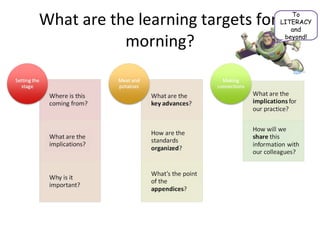
What are the learning targets for  morning? To LITERACY and beyond!
What is the Common  Core Standard Initiative? * Pre-Assessment- 1 through 4   The Common Core State Standard Initiative is a significant and  historic opportunity for states to collectively develop and adopt a core set of standards in Mathematics and English Language   Arts  including literacy standards for Science and Social Studies and Technology
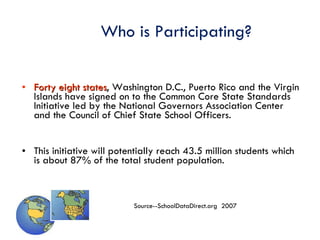
Who is Participating? Forty eight states , Washington D.C., Puerto Rico and the Virgin Islands have signed on to the Common Core State Standards Initiative led by the National Governors Association Center and the Council of Chief State School Officers. This initiative will potentially reach 43.5 million students which is about 87% of the total student population. Source--SchoolDataDirect.org  2007
“ Silent Marker” Activity On your own, please write down the skills and understandings (at least 3) you believe a twenty-first century  literate  person needs to have. Share with the whole group on the “silent “marker wall
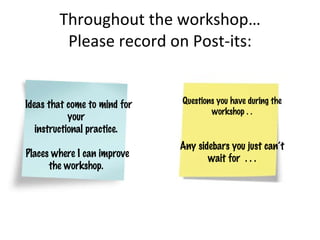
Throughout the workshop… Please record on Post-its: Ideas that come to mind for your  instructional practice.  Places where I can improve the workshop.  Questions you have during the workshop . . Any sidebars you just can’t wait for  . . .
Setting the stage
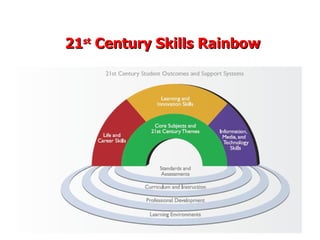
21 st  Century Skills Rainbow
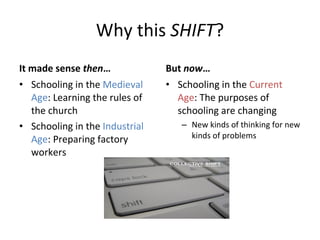
Why this  SHIFT ? It made sense  then … Schooling in the  Medieval Age : Learning the rules of the church Schooling in the  Industrial Age : Preparing factory workers But  now … Schooling in the  Current Age : The purposes of schooling are changing New kinds of thinking for new kinds of problems
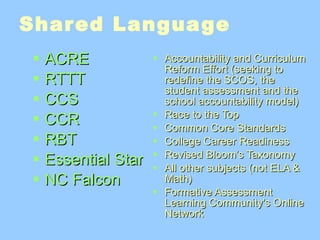
Shared Language  ACRE  RTTT   CCS CCR RBT Essential Standards NC Falcon Accountability and Curriculum Reform Effort (seeking to redefine the SCOS, the student assessment and the school accountability model)   Race to the Top Common Core Standards College Career Readiness Revised Bloom’s Taxonomy All other subjects (not ELA & Math) Formative Assessment Learning Community's Online Network
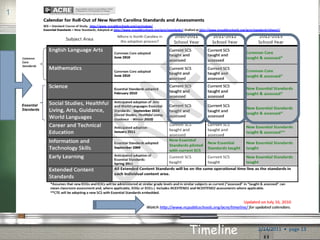
Timeline 2/14/2011  •  page  Essential Standards 1
Want to Learn About the Assessments?  Summative Assessment of the  Common Core State Standards for English Language Arts &  Literacy in History/Social Studies, Science, and Technical Subjects
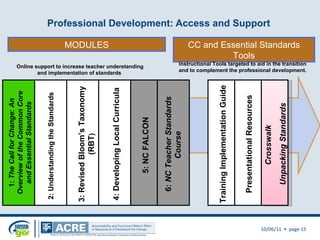
Professional Development: Access and Support  10/06/11   •  page  MODULES Online support to increase teacher understanding and implementation of standards  1:  The Call for Change :  An Overview of the Common Core and Essential Standards 2:  Understanding the Standards 3: Revised Bloom’s Taxonomy (RBT ) 2: Understanding the Standards CC and Essential Standards Tools Training Implementation Guide Presentational Resources Crosswalk  Unpacking Standards Instructional Tools targeted to aid in the transition and to complement the professional development. 4: Developing Local Curricula 5: NC FALCON  6:  NC Teacher Standards Course
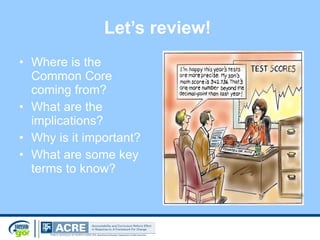
Let’s review!   Where is the Common Core coming from? What are the implications? Why is it important?  What are some key terms to know?
That’s nice, but… What will this  actually  look like for my school?
“ Face the brutal facts with unwavering optimism.”
And now…
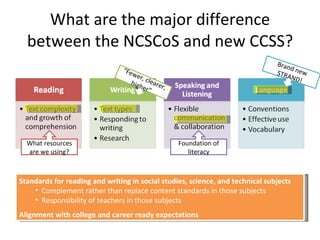
What are the major difference between the NCSCoS and new CCSS? Standards for reading and writing in social studies, science, and technical subjects Complement rather than replace content standards in those subjects Responsibility of teachers in those subjects Alignment with college and career ready expectations Foundation of literacy What resources are we using? “ Fewer, clearer, higher” Brand new STRAND!
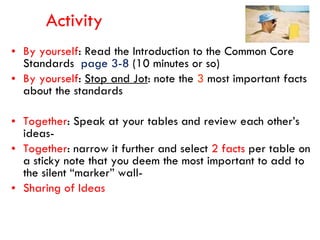
Activity By yourself : Read the Introduction to the Common Core Standards  page 3-8  (10 minutes or so) By yourself :  Stop and Jot : note the  3  most important facts about the standards Together : Speak at your tables and review each other’s ideas- Together : narrow it further and select  2 facts  per table on a sticky note that you deem the most important to add to the silent “marker” wall- Sharing of Ideas
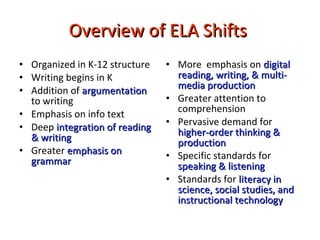
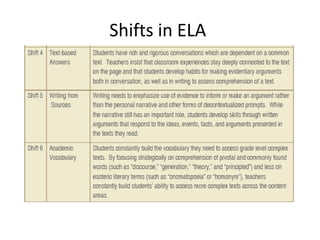
Overview of ELA Shifts   Organized in K-12 structure Writing begins in K Addition of  argumentation  to writing Emphasis on info text Deep  integration of reading & writing Greater  emphasis on grammar  More  emphasis on  digital reading, writing, & multi-media production Greater attention to comprehension Pervasive demand for  higher-order thinking & production Specific standards for  speaking & listening Standards for  literacy in science, social studies, and instructional technology
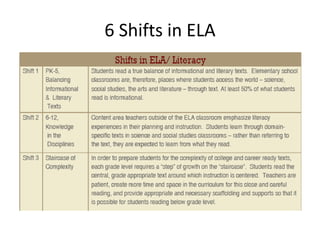
6 Shifts in ELA
Shifts in ELA
See for yourself…
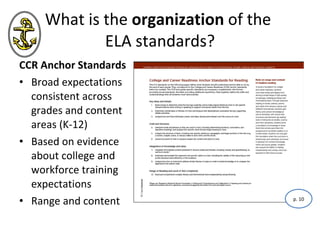
What is the  organization  of the  ELA standards? CCR Anchor Standards Broad expectations  consistent across grades and content areas (K-12) Based on evidence about college and workforce training expectations Range and content p. 10
Further Considerations… Fewer, clearer, higher: (NC DPI Language) produce a set of  fewer, clearer and higher  standards.  cover only those  areas that are critical  for student success scaffolded and developmental Internationally benchmarked:  informed by the content, rigor and organization of standards of high-performing countries and states  all students are prepared to succeed in a global economy and society.  Special populations:  the inclusion of  all types of learners was  a priority recognized that special populations may require additional time and appropriate instructional support with aligned assessments  selected language intended to make the standards documents accessible to different learners
Annotating the Anchors K-12 College & Career Readiness Draw a box around each  STRAND Underline each  CLUSTER Star the most challenging  STANDARD  within each  STRAND
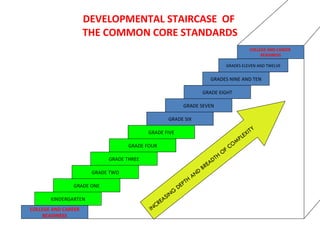
DEVELOPMENTAL STAIRCASE  OF  THE COMMON CORE STANDARDS KINDERGARTEN GRADE ONE GRADE TWO GRADE THREE GRADE FOUR GRADE FIVE GRADE SIX GRADE SEVEN GRADE EIGHT GRADES NINE AND TEN GRADES ELEVEN AND TWELVE INCREASING DEPTH AND BREADTH OF COMPLEXITY COLLEGE AND CAREER  READINESS COLLEGE AND CAREER READINESS
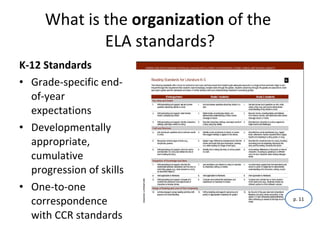
What is the  organization  of the  ELA standards? K-12 Standards Grade-specific end-of-year expectations Developmentally appropriate, cumulative progression of skills One-to-one correspondence with CCR standards p. 11
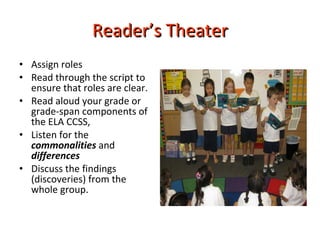
Reader’s Theater Assign roles Read through the script to ensure that roles are clear.  Read aloud your grade or grade-span components of the ELA CCSS,  Listen for the  commonalities  and  differences  Discuss the findings (discoveries) from the whole group.
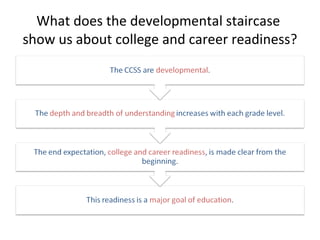
What does the developmental staircase  show us about college and career readiness?
Vertical Alignment of Standards In a small group, determine to which  ANCHOR  the  STANDARDS  belong Arrange the  STANDARDS  in order of developmental skill  What do you NOTICE? What questions do you have?
Are you ready to dig deeper?
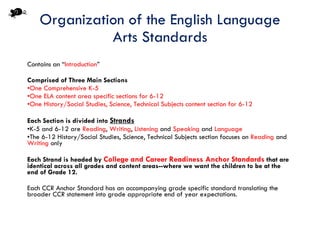
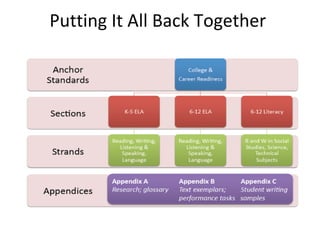
Organization of the English Language Arts Standards Contains an “ Introduction ”  Comprised of Three Main Sections One Comprehensive K-5 One ELA content area specific sections for 6-12 One History/Social Studies, Science, Technical Subjects content section for 6-12 Each Section is divided into  Strands K-5 and 6-12 are  Reading ,  Writing ,  Listening  and  Speaking  and  Language The 6-12 History/Social Studies, Science, Technical Subjects section focuses on  Reading  and  Writing  only Each Strand is headed by  College and Career Readiness Anchor Standards   that are identical across all grades and content areas--where we want the children to be at the end of Grade 12. Each CCR Anchor Standard has an accompanying grade specific standard translating the broader CCR statement into grade appropriate end of year expectations.
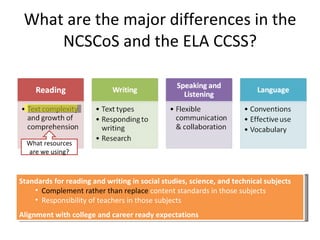
What are the major differences in the NCSCoS and the ELA CCSS? Standards for reading and writing in social studies, science, and technical subjects Complement rather than replace  content standards in those subjects Responsibility of teachers in those subjects Alignment with college and career ready expectations What resources are we using?
An Overview of  Common Core Standards  Appendices A,B,C
Text Complexity   What does this term mean to you? What do you currently do to determine text complexity?  THINK- WRITE- PAIR- SHARE
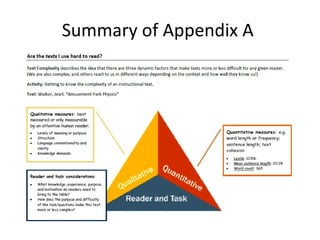
Appendix A Research Supporting Key Elements of the Standards Why text complexity matters Increasing complexity of texts and tasks in college, careers and citizenship Declining complexity of texts and a lack of reading complex texts independently Consequences – growing numbers of students reading at lower levels Explanation: the standards approach to measuring text complexity Glossary of Terms
Appendix A Levels of Meaning-  Structure Language Conventionality Knowledge Demands – life experiences, cultural knowledge, content or discipline
Summary of Appendix A
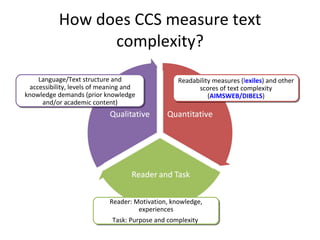
How does CCS measure text complexity? Language/Text structure and accessibility, levels of meaning and knowledge demands (prior knowledge and/or academic content) Readability measures ( l exiles ) and other scores of text complexity ( AIMSWEB/DIBELS ) Reader: Motivation, knowledge, experiences Task: Purpose and complexity
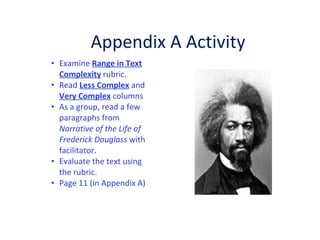
Examine  Range in Text Complexity  rubric.  Read  Less Complex  and  Very Complex  columns As a group, read a few paragraphs from  Narrative of the Life of  Frederick Douglass  with facilitator.  Evaluate the text using the rubric.  Page 11 (in Appendix A)  Appendix A Activity
Text Complexity Video  Please use your critical viewing lens Record ideas that make you say “Hmmm”
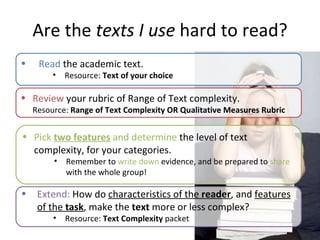
Are the  texts I use  hard to read? Review  your rubric of Range of Text complexity.  Resource:  Range of Text Complexity OR Qualitative Measures Rubric Pick  two features  and determine  the level of text complexity, for your categories.  Remember to  write down  evidence, and be prepared to  share  with the whole group! Extend:  How do  characteristics of the  reader , and  features of the  task , make the  text  more or less complex? Resource:  Text Complexity  packet Read  the academic text. Resource:  Text of your choice
Processing New Information   3  things you learned 2  things you have a question about 1  thing that will impact your instruction and/or your thinking about texts Think- Pair-Share Activity
Time for a brain break!
Appendix B  Text Exemplars and Sample Performance Tasks Texts chosen based upon Complexity, Quality, & Range Browse Appendix B (Preview Sample Performance Tasks) In partnerships… (page 8- Exemplar 6-8 texts) Select a sample text and create a  new  performance assessment that supports general population, special needs, enrichment and ELL learners.  Use the  blank performance task draft template Make sure that the text you choose is well matched to the grade levels and needs of your students.
Reflection on Part I Glow   (Tell some things you liked) Grow   (Tell some things you still need to learn or investigate) Go   (Tell some things you will do because of this workshop) Give   (give me explicit feedback on which activities/information was the  most clear and WHY )  AND  which areas of the presentation/workshop  need to be revised for clarity  (shortened/ lengthened/pacing?)
Time for a LUNCH break!
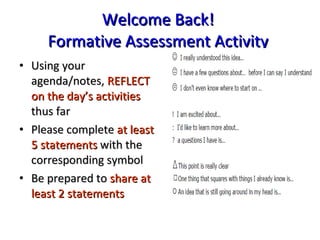
Welcome Back!  Formative Assessment Activity   Using your agenda/notes,  REFLECT on the day’s activities  thus far Please complete  at least 5 statements  with the corresponding symbol  Be prepared to  share at least 2 statements
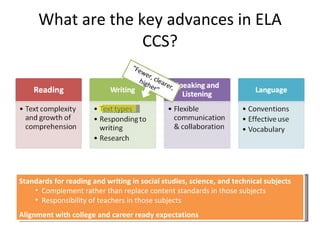
What are the key advances in ELA CCS? Standards for reading and writing in social studies, science, and technical subjects Complement rather than replace content standards in those subjects Responsibility of teachers in those subjects Alignment with college and career ready expectations “ Fewer, clearer, higher”
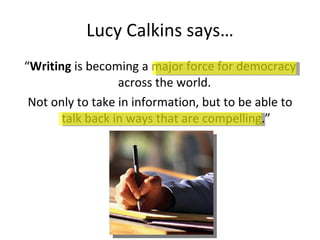
Lucy Calkins says… “ Writing  is becoming a major force for democracy across the world.  Not only to take in information, but to be able to talk back in ways that are compelling.”
 
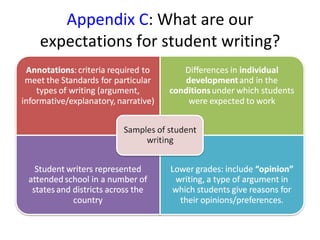
Appendix C : What are our expectations for student writing?
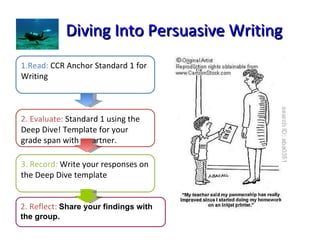
Diving Into Persuasive Writing   2. Evaluate:  Standard 1 using the Deep Dive! Template for your grade span with a partner. 3. Record:  Write your responses on the Deep Dive template 1.Read:  CCR Anchor Standard 1 for Writing 2. Reflect:  Share your findings with the group.
 
Putting It All Back Together
Speaking and Listening Gallery Walk Activity   Preview S&L  Independently brainstorm ways you  currently address  the 6 SL standards Record future ideas  to meet the standard.  Record your ideas on chart paper Walk around record NEW ideas  Put in SONG
LANGUAGE   Conventions of Standard English Knowledge of Language Vocabulary Acquisition and Use Examine page 30 in your CC packet Page 51 CCR Language Anchor Standards Pages 52-53 6-8 progression Identify areas where you will need support Target areas during my rotations
What are our challenges and responsibilities for this year? Brainstorm the following:  Ideas for PD needs at your school Resources you’ll need Vertical teaming ideas Interdisciplinary ideas  Put on your chart paper
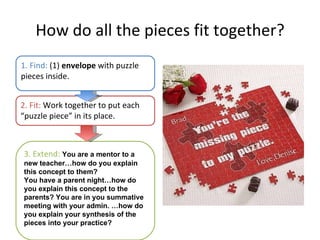
How do all the pieces fit together? 2. Fit:  Work together to put each “puzzle piece” in its place. 3. Extend:  You are a mentor to a new teacher…how do you explain this concept to them? You have a parent night…how do you explain this concept to the parents? You are in you summative meeting with your admin. …how do you explain your synthesis of the pieces into your practice? 1. Find:  (1)  envelope  with puzzle pieces inside.
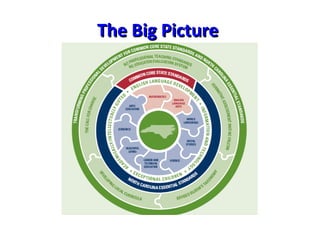
The Big Picture
So…
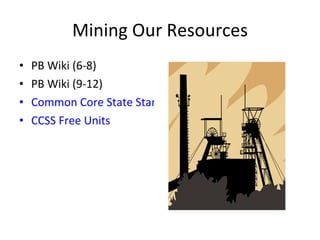
Mining Our Resources PB Wiki (6-8) PB Wiki (9-12) Common Core State Standards  CCSS Free Units
Getting Your Feet Wet   Examine an example Common Core Unit  Pick an  exemplar informational text Identify 2 to 4 standards from (RI, W, and SL and/or L) as your focus Create performance tasks  for each standard  Determine what the assessment will be for the tasks (formative, etc.)  USE it this year ! HAVE a product within the next hour; these will be posted to the Wiki
Elementary PD Dates & Writing Portfolio Planning Dates Kindergarten PD (9.13.11 & 9.29.11) 1 st  Grade PD  (10.4. & 10.11) 2 nd  Grade PD (10.18 & 10.25) 3 rd  Grade (10.28) 4 th  Grade (10.27) 5 th  Grade (1.23.12)  Expectations January 23, 2012  (9 AM-12 PM)  Meet as grade level/ vertical teams to begin 2012-13 Writing Portfolio Planning  Grade level chairs will post plans to the Wiki
Middle School Homework  Dates  6 th  Grade PD (9.15.11) 7 th  Grade PD (9.29.11) 8 th  Grade PD (10.6.11) January 23, 2012 work on school based vertical units FOCUS on informational text & writing
 
Let’s refresh our memory…
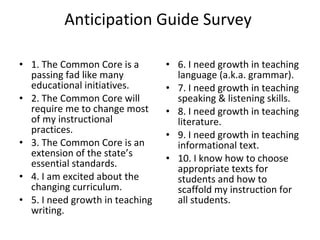
Anticipation Guide Survey  1. The Common Core is a passing fad like many educational initiatives.  2. The Common Core will require me to change most of my instructional practices.  3. The Common Core is an extension of the state’s essential standards.  4. I am excited about the changing curriculum. 5. I need growth in teaching writing.  6. I need growth in teaching language (a.k.a. grammar).  7. I need growth in teaching speaking & listening skills. 8. I need growth in teaching literature. 9. I need growth in teaching informational text.  10. I know how to choose appropriate texts for students and how to scaffold my instruction for all students.
Developing a Common Language What’s the difference between a section, a strand, standard components and standards? What are college and career anchor standards? HUH????
Time for a brain break!
Line Up: Call Out  Activity Find  a “standard ticket” from inside your folder  Come on up and  receive a standard Read  the standard to yourself Meet  up with colleagues who also have cards  Discuss Holding your card –  Line up :   arrange yourselves in a line that  shows developmental progression Call out  your standard from most fundamental to most challenging Noticings?  Implications?
As you are settling in… Please record on Post-its and help yourself to some chocolate: What activities or information have  sparked your interest today? What  question(s)   do you have so far?
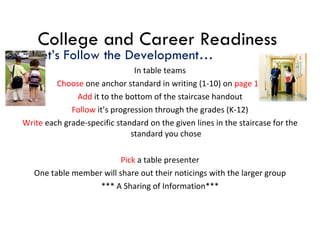
College and Career Readiness Let’s Follow the Development… In table teams Choose  one anchor standard in writing (1-10) on  page 18 Add  it to the bottom of the staircase handout Follow  it’s progression through the grades (K-12) Write  each grade-specific standard on the given lines in the staircase for the standard you chose Pick  a table presenter One table member will share out their noticings with the larger group *** A Sharing of Information***

Common core 2

  • 1.
    Christy Stanley English/Language Arts Common Core Training “ Building the Base” with Common Core State Standards
  • 2.
    Asyou arrive… 1) Log in to a computer. 2) Access the Wiki http:// pcsmsla.pbworks.com
  • 3.
    How will wework together today? Active Participation Positive Attitude Sense of responsibility for the group as a community of learners Valuing Differences
  • 4.
    What are thelearning targets for morning? To LITERACY and beyond!
  • 5.
    What is theCommon Core Standard Initiative? * Pre-Assessment- 1 through 4 The Common Core State Standard Initiative is a significant and historic opportunity for states to collectively develop and adopt a core set of standards in Mathematics and English Language Arts including literacy standards for Science and Social Studies and Technology
  • 6.
    Who is Participating?Forty eight states , Washington D.C., Puerto Rico and the Virgin Islands have signed on to the Common Core State Standards Initiative led by the National Governors Association Center and the Council of Chief State School Officers. This initiative will potentially reach 43.5 million students which is about 87% of the total student population. Source--SchoolDataDirect.org 2007
  • 7.
    “ Silent Marker”Activity On your own, please write down the skills and understandings (at least 3) you believe a twenty-first century literate person needs to have. Share with the whole group on the “silent “marker wall
  • 8.
    Throughout the workshop…Please record on Post-its: Ideas that come to mind for your instructional practice. Places where I can improve the workshop. Questions you have during the workshop . . Any sidebars you just can’t wait for . . .
  • 9.
  • 10.
    21 st Century Skills Rainbow
  • 11.
    Why this SHIFT ? It made sense then … Schooling in the Medieval Age : Learning the rules of the church Schooling in the Industrial Age : Preparing factory workers But now … Schooling in the Current Age : The purposes of schooling are changing New kinds of thinking for new kinds of problems
  • 12.
    Shared Language ACRE RTTT CCS CCR RBT Essential Standards NC Falcon Accountability and Curriculum Reform Effort (seeking to redefine the SCOS, the student assessment and the school accountability model) Race to the Top Common Core Standards College Career Readiness Revised Bloom’s Taxonomy All other subjects (not ELA & Math) Formative Assessment Learning Community's Online Network
  • 13.
    Timeline 2/14/2011 • page Essential Standards 1
  • 14.
    Want to LearnAbout the Assessments? Summative Assessment of the Common Core State Standards for English Language Arts & Literacy in History/Social Studies, Science, and Technical Subjects
  • 15.
    Professional Development: Accessand Support 10/06/11 • page MODULES Online support to increase teacher understanding and implementation of standards 1: The Call for Change : An Overview of the Common Core and Essential Standards 2: Understanding the Standards 3: Revised Bloom’s Taxonomy (RBT ) 2: Understanding the Standards CC and Essential Standards Tools Training Implementation Guide Presentational Resources Crosswalk Unpacking Standards Instructional Tools targeted to aid in the transition and to complement the professional development. 4: Developing Local Curricula 5: NC FALCON 6: NC Teacher Standards Course
  • 16.
    Let’s review! Where is the Common Core coming from? What are the implications? Why is it important? What are some key terms to know?
  • 17.
    That’s nice, but…What will this actually look like for my school?
  • 18.
    “ Face thebrutal facts with unwavering optimism.”
  • 19.
  • 20.
    What are themajor difference between the NCSCoS and new CCSS? Standards for reading and writing in social studies, science, and technical subjects Complement rather than replace content standards in those subjects Responsibility of teachers in those subjects Alignment with college and career ready expectations Foundation of literacy What resources are we using? “ Fewer, clearer, higher” Brand new STRAND!
  • 21.
    Activity By yourself: Read the Introduction to the Common Core Standards page 3-8 (10 minutes or so) By yourself : Stop and Jot : note the 3 most important facts about the standards Together : Speak at your tables and review each other’s ideas- Together : narrow it further and select 2 facts per table on a sticky note that you deem the most important to add to the silent “marker” wall- Sharing of Ideas
  • 22.
    Overview of ELAShifts Organized in K-12 structure Writing begins in K Addition of argumentation to writing Emphasis on info text Deep integration of reading & writing Greater emphasis on grammar More emphasis on digital reading, writing, & multi-media production Greater attention to comprehension Pervasive demand for higher-order thinking & production Specific standards for speaking & listening Standards for literacy in science, social studies, and instructional technology
  • 23.
  • 24.
  • 25.
  • 26.
    What is the organization of the ELA standards? CCR Anchor Standards Broad expectations consistent across grades and content areas (K-12) Based on evidence about college and workforce training expectations Range and content p. 10
  • 27.
    Further Considerations… Fewer,clearer, higher: (NC DPI Language) produce a set of fewer, clearer and higher standards. cover only those areas that are critical for student success scaffolded and developmental Internationally benchmarked: informed by the content, rigor and organization of standards of high-performing countries and states all students are prepared to succeed in a global economy and society. Special populations: the inclusion of all types of learners was a priority recognized that special populations may require additional time and appropriate instructional support with aligned assessments selected language intended to make the standards documents accessible to different learners
  • 28.
    Annotating the AnchorsK-12 College & Career Readiness Draw a box around each STRAND Underline each CLUSTER Star the most challenging STANDARD within each STRAND
  • 29.
    DEVELOPMENTAL STAIRCASE OF THE COMMON CORE STANDARDS KINDERGARTEN GRADE ONE GRADE TWO GRADE THREE GRADE FOUR GRADE FIVE GRADE SIX GRADE SEVEN GRADE EIGHT GRADES NINE AND TEN GRADES ELEVEN AND TWELVE INCREASING DEPTH AND BREADTH OF COMPLEXITY COLLEGE AND CAREER READINESS COLLEGE AND CAREER READINESS
  • 30.
    What is the organization of the ELA standards? K-12 Standards Grade-specific end-of-year expectations Developmentally appropriate, cumulative progression of skills One-to-one correspondence with CCR standards p. 11
  • 31.
    Reader’s Theater Assignroles Read through the script to ensure that roles are clear. Read aloud your grade or grade-span components of the ELA CCSS, Listen for the commonalities and differences Discuss the findings (discoveries) from the whole group.
  • 32.
    What does thedevelopmental staircase show us about college and career readiness?
  • 33.
    Vertical Alignment ofStandards In a small group, determine to which ANCHOR the STANDARDS belong Arrange the STANDARDS in order of developmental skill What do you NOTICE? What questions do you have?
  • 34.
    Are you readyto dig deeper?
  • 35.
    Organization of theEnglish Language Arts Standards Contains an “ Introduction ” Comprised of Three Main Sections One Comprehensive K-5 One ELA content area specific sections for 6-12 One History/Social Studies, Science, Technical Subjects content section for 6-12 Each Section is divided into Strands K-5 and 6-12 are Reading , Writing , Listening and Speaking and Language The 6-12 History/Social Studies, Science, Technical Subjects section focuses on Reading and Writing only Each Strand is headed by College and Career Readiness Anchor Standards that are identical across all grades and content areas--where we want the children to be at the end of Grade 12. Each CCR Anchor Standard has an accompanying grade specific standard translating the broader CCR statement into grade appropriate end of year expectations.
  • 36.
    What are themajor differences in the NCSCoS and the ELA CCSS? Standards for reading and writing in social studies, science, and technical subjects Complement rather than replace content standards in those subjects Responsibility of teachers in those subjects Alignment with college and career ready expectations What resources are we using?
  • 37.
    An Overview of Common Core Standards Appendices A,B,C
  • 38.
    Text Complexity What does this term mean to you? What do you currently do to determine text complexity? THINK- WRITE- PAIR- SHARE
  • 39.
    Appendix A ResearchSupporting Key Elements of the Standards Why text complexity matters Increasing complexity of texts and tasks in college, careers and citizenship Declining complexity of texts and a lack of reading complex texts independently Consequences – growing numbers of students reading at lower levels Explanation: the standards approach to measuring text complexity Glossary of Terms
  • 40.
    Appendix A Levelsof Meaning- Structure Language Conventionality Knowledge Demands – life experiences, cultural knowledge, content or discipline
  • 41.
  • 42.
    How does CCSmeasure text complexity? Language/Text structure and accessibility, levels of meaning and knowledge demands (prior knowledge and/or academic content) Readability measures ( l exiles ) and other scores of text complexity ( AIMSWEB/DIBELS ) Reader: Motivation, knowledge, experiences Task: Purpose and complexity
  • 43.
    Examine Rangein Text Complexity rubric. Read Less Complex and Very Complex columns As a group, read a few paragraphs from Narrative of the Life of Frederick Douglass with facilitator. Evaluate the text using the rubric. Page 11 (in Appendix A) Appendix A Activity
  • 44.
    Text Complexity Video Please use your critical viewing lens Record ideas that make you say “Hmmm”
  • 45.
    Are the texts I use hard to read? Review your rubric of Range of Text complexity. Resource: Range of Text Complexity OR Qualitative Measures Rubric Pick two features and determine the level of text complexity, for your categories. Remember to write down evidence, and be prepared to share with the whole group! Extend: How do characteristics of the reader , and features of the task , make the text more or less complex? Resource: Text Complexity packet Read the academic text. Resource: Text of your choice
  • 46.
    Processing New Information 3 things you learned 2 things you have a question about 1 thing that will impact your instruction and/or your thinking about texts Think- Pair-Share Activity
  • 47.
    Time for abrain break!
  • 48.
    Appendix B Text Exemplars and Sample Performance Tasks Texts chosen based upon Complexity, Quality, & Range Browse Appendix B (Preview Sample Performance Tasks) In partnerships… (page 8- Exemplar 6-8 texts) Select a sample text and create a new performance assessment that supports general population, special needs, enrichment and ELL learners. Use the blank performance task draft template Make sure that the text you choose is well matched to the grade levels and needs of your students.
  • 49.
    Reflection on PartI Glow (Tell some things you liked) Grow (Tell some things you still need to learn or investigate) Go (Tell some things you will do because of this workshop) Give (give me explicit feedback on which activities/information was the most clear and WHY ) AND which areas of the presentation/workshop need to be revised for clarity (shortened/ lengthened/pacing?)
  • 50.
    Time for aLUNCH break!
  • 51.
    Welcome Back! Formative Assessment Activity Using your agenda/notes, REFLECT on the day’s activities thus far Please complete at least 5 statements with the corresponding symbol Be prepared to share at least 2 statements
  • 52.
    What are thekey advances in ELA CCS? Standards for reading and writing in social studies, science, and technical subjects Complement rather than replace content standards in those subjects Responsibility of teachers in those subjects Alignment with college and career ready expectations “ Fewer, clearer, higher”
  • 53.
    Lucy Calkins says…“ Writing is becoming a major force for democracy across the world. Not only to take in information, but to be able to talk back in ways that are compelling.”
  • 54.
  • 55.
    Appendix C :What are our expectations for student writing?
  • 56.
    Diving Into PersuasiveWriting 2. Evaluate: Standard 1 using the Deep Dive! Template for your grade span with a partner. 3. Record: Write your responses on the Deep Dive template 1.Read: CCR Anchor Standard 1 for Writing 2. Reflect: Share your findings with the group.
  • 57.
  • 58.
    Putting It AllBack Together
  • 59.
    Speaking and ListeningGallery Walk Activity Preview S&L Independently brainstorm ways you currently address the 6 SL standards Record future ideas to meet the standard. Record your ideas on chart paper Walk around record NEW ideas Put in SONG
  • 60.
    LANGUAGE Conventions of Standard English Knowledge of Language Vocabulary Acquisition and Use Examine page 30 in your CC packet Page 51 CCR Language Anchor Standards Pages 52-53 6-8 progression Identify areas where you will need support Target areas during my rotations
  • 61.
    What are ourchallenges and responsibilities for this year? Brainstorm the following: Ideas for PD needs at your school Resources you’ll need Vertical teaming ideas Interdisciplinary ideas Put on your chart paper
  • 62.
    How do allthe pieces fit together? 2. Fit: Work together to put each “puzzle piece” in its place. 3. Extend: You are a mentor to a new teacher…how do you explain this concept to them? You have a parent night…how do you explain this concept to the parents? You are in you summative meeting with your admin. …how do you explain your synthesis of the pieces into your practice? 1. Find: (1) envelope with puzzle pieces inside.
  • 63.
  • 64.
  • 65.
    Mining Our ResourcesPB Wiki (6-8) PB Wiki (9-12) Common Core State Standards CCSS Free Units
  • 66.
    Getting Your FeetWet Examine an example Common Core Unit Pick an exemplar informational text Identify 2 to 4 standards from (RI, W, and SL and/or L) as your focus Create performance tasks for each standard Determine what the assessment will be for the tasks (formative, etc.) USE it this year ! HAVE a product within the next hour; these will be posted to the Wiki
  • 67.
    Elementary PD Dates& Writing Portfolio Planning Dates Kindergarten PD (9.13.11 & 9.29.11) 1 st Grade PD (10.4. & 10.11) 2 nd Grade PD (10.18 & 10.25) 3 rd Grade (10.28) 4 th Grade (10.27) 5 th Grade (1.23.12) Expectations January 23, 2012 (9 AM-12 PM) Meet as grade level/ vertical teams to begin 2012-13 Writing Portfolio Planning Grade level chairs will post plans to the Wiki
  • 68.
    Middle School Homework Dates 6 th Grade PD (9.15.11) 7 th Grade PD (9.29.11) 8 th Grade PD (10.6.11) January 23, 2012 work on school based vertical units FOCUS on informational text & writing
  • 69.
  • 70.
  • 71.
    Anticipation Guide Survey 1. The Common Core is a passing fad like many educational initiatives. 2. The Common Core will require me to change most of my instructional practices. 3. The Common Core is an extension of the state’s essential standards. 4. I am excited about the changing curriculum. 5. I need growth in teaching writing. 6. I need growth in teaching language (a.k.a. grammar). 7. I need growth in teaching speaking & listening skills. 8. I need growth in teaching literature. 9. I need growth in teaching informational text. 10. I know how to choose appropriate texts for students and how to scaffold my instruction for all students.
  • 72.
    Developing a CommonLanguage What’s the difference between a section, a strand, standard components and standards? What are college and career anchor standards? HUH????
  • 73.
    Time for abrain break!
  • 74.
    Line Up: CallOut Activity Find a “standard ticket” from inside your folder Come on up and receive a standard Read the standard to yourself Meet up with colleagues who also have cards Discuss Holding your card – Line up : arrange yourselves in a line that shows developmental progression Call out your standard from most fundamental to most challenging Noticings? Implications?
  • 75.
    As you aresettling in… Please record on Post-its and help yourself to some chocolate: What activities or information have sparked your interest today? What question(s) do you have so far?
  • 76.
    College and CareerReadiness Let’s Follow the Development… In table teams Choose one anchor standard in writing (1-10) on page 18 Add it to the bottom of the staircase handout Follow it’s progression through the grades (K-12) Write each grade-specific standard on the given lines in the staircase for the standard you chose Pick a table presenter One table member will share out their noticings with the larger group *** A Sharing of Information***

Editor's Notes

  • #4 2 min
  • #5 Use Christy’s handout to record response 3 min
  • #6 The CCSS initiative is an exiting opportunity for educational goals to be aligned across the US 48 states with the exception of… *****
  • #7 These standards reflect global educational standards as the writers have used countries like, New Z, GB, AUS as resources. Part of international conversation – business community driving this - people who are really not ready for the workforce.
  • #8 First activity Jot down the skills you feel a 21 st century literate person needs Share, add to silent marker wall (no repeats) Three Words ***
  • #9 As we go through workshop jot down any ideas or questions.
  • #11 Teachers will view video and identify examples of 21 st century skills being practiced.
  • #12 Video—4 ½ min Think Pair Share
  • #13 Flash Cards to review periodically! (3-4 min) I hyperlinked all the terms
  • #14 2-5 min
  • #16 2-3min overview
  • #17 Stand up—have a seat if….one purpose of the CCS Scaffold questions as you proceed (5 min) Ask Learning Target Questions for review—get from slide.
  • #21 1-2 min Focus on 4 strands and these are expectations K-12 and ALL content areas
  • #22 Read the intro pages 3-8 (ESL/EC skills- chunking/scaffolding info- reading with a purpose Stop and jot 5 most important facts Speak at your tables Narrow it further to 2 Add to the wall Three Words ***
  • #27 1 min
  • #28 Fewer, clearer, higher It’s developmental and scaffolds student learning As we read through it U will see Internationally benchmarked – New Z, Aus, Singapore, Canada, Ireland, China ***
  • #29 Remind about ESL skills/strategies
  • #30 Pulling it all together—seeing how all the pieces work together to achieve goals. 1-2 min Reader’s Theater Choose /Assign strand to analyze –Literature progression 15 min
  • #33 1-2 min
  • #35 Get music –Christy get a clip!!
  • #36 We’re going to talk about how the standards are organized
  • #37 Prior Knowledge about text complexity -shout out 2min
  • #38 ***
  • #40 Appendix A includes a section on why text complexity matters and its connection to the reading STRAND How college texts have become increasingly complex How schools and classrooms have seen a decline in the rigor of having students read complex texts independently It also includes a section on consequences and an explanation to measuring text complexity – which we will work with today. It ends with a glossary ***
  • #41 Appendix A includes a section on why text complexity matters How college texts have become increasingly complex How schools and classrooms have seen a decline in the rigor of having students read complex texts independently It also includes a section on consequences and an explanation to measuring text complexity – which we will work with today. It ends with a glossary ***
  • #43 2 min
  • #44 Find the text complexity analysis template in your AUSSIE folder Read page 11-12 in appendix A Three words ***
  • #46 Keep this 10-15 min.
  • #48 5 min
  • #49 Now try it for your own grade or a grade you’d like to create one for Three Words ***
  • #51 5 min
  • #53 1min
  • #54 1min
  • #56 2-4min
  • #60 Brain Dump competition---1 min How many ways can you get kids speaking and listening for authentic/real world purposes.
  • #63 Random choice out of bag for which question to answer. 10 min
  • #66 Show them how to access pbwiki and better unit. Using template –essential question, learning targets, content area integration (standards) , writing/language-with rubric using CCS language, speaking/listening component, technology, resources, 21 st century skills addressed (global awareness, civic responsibility, etc)
  • #74 5 min
  • #75 ***
  • #76 Put outside of room—Pull in and use as review before continuing. Review Vocabulary.
  • #77 Okay for this activity you’ll need to go to the writing anchor standards on page 18. You’ll also need the staircase sheet from the AUSSIE folder