6th Grade Social Studies
     TEKS Overview
       August 2012
“Guess My Region”
                 Activity
• On your index card, write 3 geographical facts
  about your region.
• Write 2 other facts about your region.
• Write 1 question that your students might
  have about your region.
Our Objective for Today:
• Analyze the changes made to the Texas
  Essential Knowledge and Skills for the course
  that you are teaching.
• Evaluate how the changes made to the TEKS
  will affect your instruction.
The Social Studies TEKS & the Law
• The Texas Education Code 28.002(C)
  states, “The State Board of Education, with
  the direct participation of
  educators, parents, business and industry
  representatives, and employers shall by rule
  identify the essential knowledge and skills of
  each subject…that all students should be able
  to demonstrate…”
Newly Adopted TEKS
• Proposed revisions for the TEKS were
  approved by the SBOE on May 21, 2010
• New TEKS implemented during the 2011-2012
  school year
Some words to know…
• Strands: There are eight strands of TEKS in each
  social studies course. They are the same for all.
   –   History
   –   Geography
   –   Economics
   –   Government
   –   Citizenship
   –   Culture
   –   Science, Technology, & Society
   –   Skills
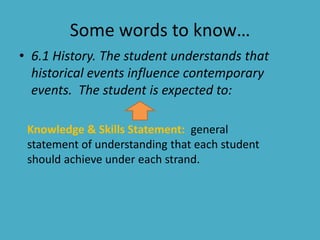
Some words to know…
• 6.1 History. The student understands that
  historical events influence contemporary
  events. The student is expected to:

 Knowledge & Skills Statement: general
 statement of understanding that each student
 should achieve under each strand.
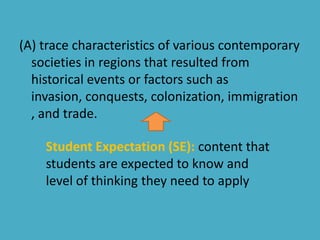
(A) trace characteristics of various contemporary
  societies in regions that resulted from
  historical events or factors such as
  invasion, conquests, colonization, immigration
  , and trade.

    Student Expectation (SE): content that
    students are expected to know and
    level of thinking they need to apply
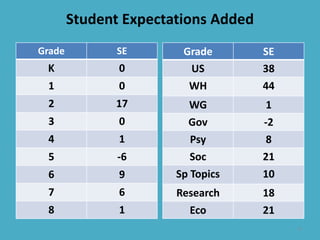
Student Expectations Added
Grade          SE       Grade        SE
 K             0         US          38
 1             0         WH          44
 2            17          WG          1
 3             0         Gov         -2
 4             1          Psy         8
 5             -6         Soc        21
 6             9       Sp Topics     10
 7             6       Research      18
 8             1         Eco         21
                                          9
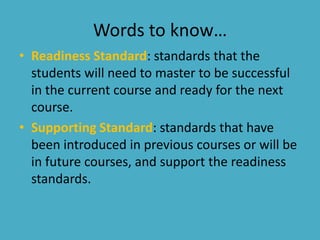
Words to know…
• Readiness Standard: standards that the
  students will need to master to be successful
  in the current course and ready for the next
  course.
• Supporting Standard: standards that have
  been introduced in previous courses or will be
  in future courses, and support the readiness
  standards.
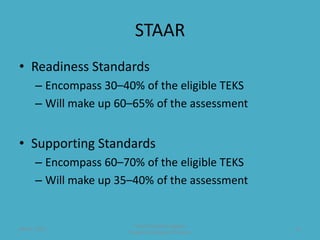
STAAR
• Readiness Standards
     – Encompass 30–40% of the eligible TEKS
     – Will make up 60–65% of the assessment


• Supporting Standards
     – Encompass 60–70% of the eligible TEKS
     – Will make up 35–40% of the assessment


                        Texas Education Agency
March 2011                                          11
                      Student Assessment Division
STAAR
             Eligible Content Standards                            Assessment Blueprint
                      From TEKS


                              30%                                  35%

               70%                                                              65%


               Readiness Standards                                    Readiness Standards
               Supporting Standards                                   Supporting Standards
                                       Texas Education Agency
March 2011                                                                                   12
                                     Student Assessment Division
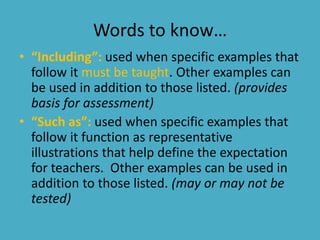
Words to know…
• “Including”: used when specific examples that
  follow it must be taught. Other examples can
  be used in addition to those listed. (provides
  basis for assessment)
• “Such as”: used when specific examples that
  follow it function as representative
  illustrations that help define the expectation
  for teachers. Other examples can be used in
  addition to those listed. (may or may not be
  tested)
College & Career Readiness Standards
• Expectations that students should reach by
  their senior year in high school to be ready for
  college and careers.
• Correlate with process skills
• Written into the district curriculum
Vertical Alignment
• District curriculum is written conceptually
• Grade 6 and Grade 9 World Geography are
  vertically aligned
• “Mastering the TEKS in World Geography”
  book – use it during planning
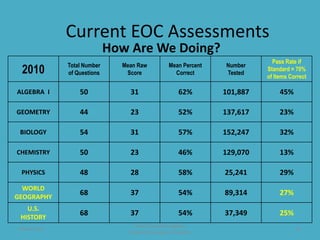
Current EOC Assessments
                             How Are We Doing?
                                                                             Pass Rate if
              Total Number     Mean Raw           Mean Percent   Number
  2010        of Questions      Score               Correct      Tested
                                                                           Standard = 70%
                                                                           of Items Correct

ALGEBRA I         50             31                   62%        101,887        45%

GEOMETRY          44             23                   52%        137,617        23%

 BIOLOGY          54             31                   57%        152,247        32%

CHEMISTRY         50             23                   46%        129,070        13%

 PHYSICS          48             28                   58%        25,241         29%
  WORLD
GEOGRAPHY
                  68             37                   54%        89,314         27%
   U.S.
 HISTORY
                  68             37                   54%        37,349         25%
                                   Texas Education Agency
 March 2011                                                                           16
                                 Student Assessment Division
Changes to the TEKS

The Introduction
• What are the major changes that you notice?
• How will these changes impact your
  instruction?
Constitution Day: September 17
    Freedom Week: September 12 – 16

Share with your group ideas that you use for
        recognizing Freedom Week.
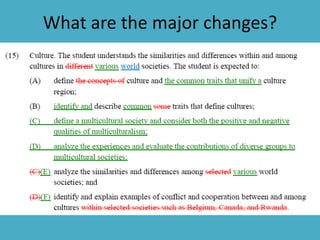
What are the major changes?
“Gallery Walk” Activity
• Each group will focus on one strand
• Communicate the major changes for that
  strand on your butcher paper
• One person from the group will stay and
  explain the changes to the incoming groups
• The others will rotate and take notes of
  changes for each strand.
Colored Dots

• What changes do you think will impact
  you the most? (discuss at tables)
• Attach each colored dot to the strand
  chart that contains the new material that
  will impact your teaching the most.
Major Changes per Strand
• Note the major changes in the student
  expectations of each strand that will affect
  your instruction the most.
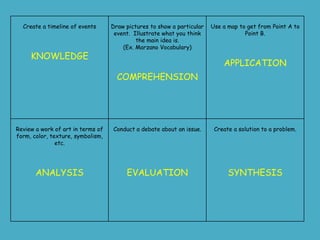
Guess the Cognitive Level
   (Use your Bloom’s Chart)
Create a timeline of events      Draw pictures to show a particular   Use a map to get from Point A to
                                    event. Illustrate what you think                Point B.
                                            the main idea is.
                                       (Ex. Marzano Vocabulary)
     KNOWLEDGE
                                                                            APPLICATION
                                     COMPREHENSION


Review a work of art in terms of   Conduct a debate about an issue.      Create a solution to a problem.
form, color, texture, symbolism,
               etc.


       ANALYSIS                         EVALUATION                            SYNTHESIS
Verbs/Cognitive Level
• 6.1 (B) analyze the historical background of
  various contemporary societies to evaluate
  relationships between past conflicts and
  current conditions.
• What level of Bloom’s are these verbs at?
• What does that mean for your instruction?

  Highlight the verbs/cognitive level in each
  student expectation
6.4 (E) Draw sketch maps that illustrate various
  places and regions.

• How does this affect your instruction?
• What is the difference between labeling a
  map and drawing a sketch map?
• What do you think the cognitive level is for
  each?
Design a Learning Experience

6th grade teks overview

  • 1.
    6th Grade SocialStudies TEKS Overview August 2012
  • 2.
    “Guess My Region” Activity • On your index card, write 3 geographical facts about your region. • Write 2 other facts about your region. • Write 1 question that your students might have about your region.
  • 3.
    Our Objective forToday: • Analyze the changes made to the Texas Essential Knowledge and Skills for the course that you are teaching. • Evaluate how the changes made to the TEKS will affect your instruction.
  • 4.
    The Social StudiesTEKS & the Law • The Texas Education Code 28.002(C) states, “The State Board of Education, with the direct participation of educators, parents, business and industry representatives, and employers shall by rule identify the essential knowledge and skills of each subject…that all students should be able to demonstrate…”
  • 5.
    Newly Adopted TEKS •Proposed revisions for the TEKS were approved by the SBOE on May 21, 2010 • New TEKS implemented during the 2011-2012 school year
  • 6.
    Some words toknow… • Strands: There are eight strands of TEKS in each social studies course. They are the same for all. – History – Geography – Economics – Government – Citizenship – Culture – Science, Technology, & Society – Skills
  • 7.
    Some words toknow… • 6.1 History. The student understands that historical events influence contemporary events. The student is expected to: Knowledge & Skills Statement: general statement of understanding that each student should achieve under each strand.
  • 8.
    (A) trace characteristicsof various contemporary societies in regions that resulted from historical events or factors such as invasion, conquests, colonization, immigration , and trade. Student Expectation (SE): content that students are expected to know and level of thinking they need to apply
  • 9.
    Student Expectations Added Grade SE Grade SE K 0 US 38 1 0 WH 44 2 17 WG 1 3 0 Gov -2 4 1 Psy 8 5 -6 Soc 21 6 9 Sp Topics 10 7 6 Research 18 8 1 Eco 21 9
  • 10.
    Words to know… •Readiness Standard: standards that the students will need to master to be successful in the current course and ready for the next course. • Supporting Standard: standards that have been introduced in previous courses or will be in future courses, and support the readiness standards.
  • 11.
    STAAR • Readiness Standards – Encompass 30–40% of the eligible TEKS – Will make up 60–65% of the assessment • Supporting Standards – Encompass 60–70% of the eligible TEKS – Will make up 35–40% of the assessment Texas Education Agency March 2011 11 Student Assessment Division
  • 12.
    STAAR Eligible Content Standards Assessment Blueprint From TEKS 30% 35% 70% 65% Readiness Standards Readiness Standards Supporting Standards Supporting Standards Texas Education Agency March 2011 12 Student Assessment Division
  • 13.
    Words to know… •“Including”: used when specific examples that follow it must be taught. Other examples can be used in addition to those listed. (provides basis for assessment) • “Such as”: used when specific examples that follow it function as representative illustrations that help define the expectation for teachers. Other examples can be used in addition to those listed. (may or may not be tested)
  • 14.
    College & CareerReadiness Standards • Expectations that students should reach by their senior year in high school to be ready for college and careers. • Correlate with process skills • Written into the district curriculum
  • 15.
    Vertical Alignment • Districtcurriculum is written conceptually • Grade 6 and Grade 9 World Geography are vertically aligned • “Mastering the TEKS in World Geography” book – use it during planning
  • 16.
    Current EOC Assessments How Are We Doing? Pass Rate if Total Number Mean Raw Mean Percent Number 2010 of Questions Score Correct Tested Standard = 70% of Items Correct ALGEBRA I 50 31 62% 101,887 45% GEOMETRY 44 23 52% 137,617 23% BIOLOGY 54 31 57% 152,247 32% CHEMISTRY 50 23 46% 129,070 13% PHYSICS 48 28 58% 25,241 29% WORLD GEOGRAPHY 68 37 54% 89,314 27% U.S. HISTORY 68 37 54% 37,349 25% Texas Education Agency March 2011 16 Student Assessment Division
  • 17.
    Changes to theTEKS The Introduction • What are the major changes that you notice? • How will these changes impact your instruction?
  • 18.
    Constitution Day: September17 Freedom Week: September 12 – 16 Share with your group ideas that you use for recognizing Freedom Week.
  • 19.
    What are themajor changes?
  • 20.
    “Gallery Walk” Activity •Each group will focus on one strand • Communicate the major changes for that strand on your butcher paper • One person from the group will stay and explain the changes to the incoming groups • The others will rotate and take notes of changes for each strand.
  • 21.
    Colored Dots • Whatchanges do you think will impact you the most? (discuss at tables) • Attach each colored dot to the strand chart that contains the new material that will impact your teaching the most.
  • 22.
    Major Changes perStrand • Note the major changes in the student expectations of each strand that will affect your instruction the most.
  • 23.
    Guess the CognitiveLevel (Use your Bloom’s Chart)
  • 24.
    Create a timelineof events Draw pictures to show a particular Use a map to get from Point A to event. Illustrate what you think Point B. the main idea is. (Ex. Marzano Vocabulary) KNOWLEDGE APPLICATION COMPREHENSION Review a work of art in terms of Conduct a debate about an issue. Create a solution to a problem. form, color, texture, symbolism, etc. ANALYSIS EVALUATION SYNTHESIS
  • 25.
    Verbs/Cognitive Level • 6.1(B) analyze the historical background of various contemporary societies to evaluate relationships between past conflicts and current conditions. • What level of Bloom’s are these verbs at? • What does that mean for your instruction? Highlight the verbs/cognitive level in each student expectation
  • 26.
    6.4 (E) Drawsketch maps that illustrate various places and regions. • How does this affect your instruction? • What is the difference between labeling a map and drawing a sketch map? • What do you think the cognitive level is for each?
  • 27.