Te a m W o r k M a k e s t h e D R E A M W o r k !
33rd Annual NRCP Conference
April 1-3, 2016
Oak Brook
Digging Deeper into the Common Core
Anthony Brisson
NEA Education Support Professional Quality
Senior Policy Analyst
Te a m W o r k M a k e s t h e D R E A M W o r k !
33rd Annual NRCP Conference
April 1-3, 2016
Oak Brook
Outcomes
• Develop an understanding of the Common
Core State Standards.
• Consider the impact the CCSS will have on
your role.
• Review unwrapping standards.
Te a m W o r k M a k e s t h e D R E A M W o r k !
33rd Annual NRCP Conference
April 1-3, 2016
Oak Brook
Three-Minute Video
Explaining the CCSS
• http://vimeo.com/51933492
Te a m W o r k M a k e s t h e D R E A M W o r k !
33rd Annual NRCP Conference
April 1-3, 2016
Oak Brook
CCSS ELA/Math Background
What They Are…
• 46 states and the District of
Columbia have adopted
CCSS
• Designed to provide shared
expectations of knowledge
& skills students need to be
“college and career ready”
• An integrated literacy model
What They are Not…
• A guideline of HOW
teachers should teach
• An all-inclusive list of what
should be taught K-12
• A definition of intervention
methods or materials
www.corestandards.org (CCSS for ELA & Literacy in History/SS, Science, & Technical Subjects)
Te a m W o r k M a k e s t h e D R E A M W o r k !
33rd Annual NRCP Conference
April 1-3, 2016
Oak Brook
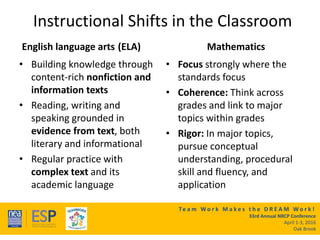
Instructional Shifts in the Classroom
English language arts (ELA)
• Building knowledge through
content-rich nonfiction and
information texts
• Reading, writing and
speaking grounded in
evidence from text, both
literary and informational
• Regular practice with
complex text and its
academic language
Mathematics
• Focus strongly where the
standards focus
• Coherence: Think across
grades and link to major
topics within grades
• Rigor: In major topics,
pursue conceptual
understanding, procedural
skill and fluency, and
application
Te a m W o r k M a k e s t h e D R E A M W o r k !
33rd Annual NRCP Conference
April 1-3, 2016
Oak Brook
How are the standards organized?
Te a m W o r k M a k e s t h e D R E A M W o r k !
33rd Annual NRCP Conference
April 1-3, 2016
Oak Brook
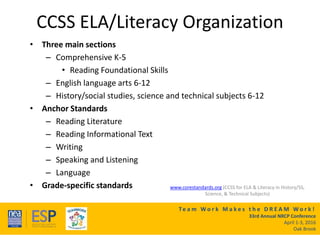
CCSS ELA/Literacy Organization
• Three main sections
– Comprehensive K-5
• Reading Foundational Skills
– English language arts 6-12
– History/social studies, science and technical subjects 6-12
• Anchor Standards
– Reading Literature
– Reading Informational Text
– Writing
– Speaking and Listening
– Language
• Grade-specific standards www.corestandards.org (CCSS for ELA & Literacy in History/SS,
Science, & Technical Subjects)
Te a m W o r k M a k e s t h e D R E A M W o r k !
33rd Annual NRCP Conference
April 1-3, 2016
Oak Brook
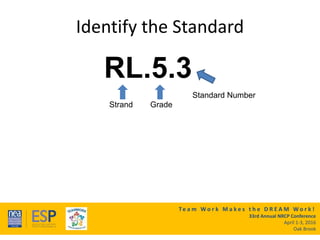
Identify the Standard
RL.5.3
Strand Grade
Standard Number
Te a m W o r k M a k e s t h e D R E A M W o r k !
33rd Annual NRCP Conference
April 1-3, 2016
Oak Brook
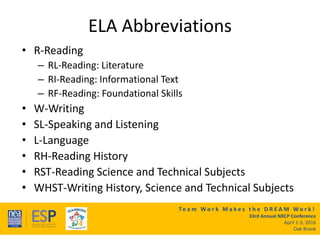
ELA Abbreviations
• R-Reading
– RL-Reading: Literature
– RI-Reading: Informational Text
– RF-Reading: Foundational Skills
• W-Writing
• SL-Speaking and Listening
• L-Language
• RH-Reading History
• RST-Reading Science and Technical Subjects
• WHST-Writing History, Science and Technical Subjects
Te a m W o r k M a k e s t h e D R E A M W o r k !
33rd Annual NRCP Conference
April 1-3, 2016
Oak Brook
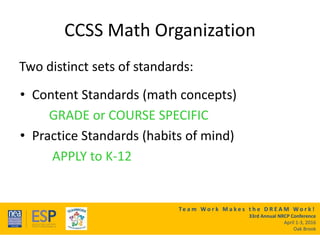
CCSS Math Organization
Two distinct sets of standards:
• Content Standards (math concepts)
GRADE or COURSE SPECIFIC
• Practice Standards (habits of mind)
APPLY to K-12
Te a m W o r k M a k e s t h e D R E A M W o r k !
33rd Annual NRCP Conference
April 1-3, 2016
Oak Brook
Structure of the Standards
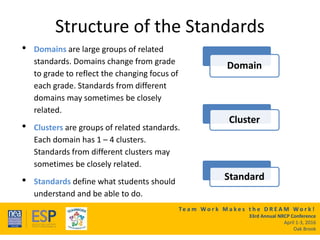
• Domains are large groups of related
standards. Domains change from grade
to grade to reflect the changing focus of
each grade. Standards from different
domains may sometimes be closely
related.
• Clusters are groups of related standards.
Each domain has 1 – 4 clusters.
Standards from different clusters may
sometimes be closely related.
• Standards define what students should
understand and be able to do.
Domain
Cluster
Standard
Te a m W o r k M a k e s t h e D R E A M W o r k !
33rd Annual NRCP Conference
April 1-3, 2016
Oak Brook
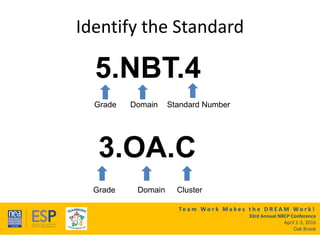
Identify the Standard
5.NBT.4
Grade Domain Standard Number
3.OA.C
Grade Domain Cluster
Te a m W o r k M a k e s t h e D R E A M W o r k !
33rd Annual NRCP Conference
April 1-3, 2016
Oak Brook
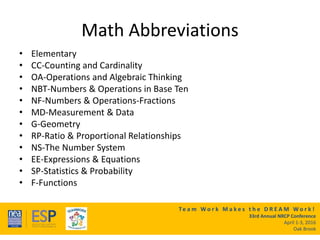
Math Abbreviations
• Elementary
• CC-Counting and Cardinality
• OA-Operations and Algebraic Thinking
• NBT-Numbers & Operations in Base Ten
• NF-Numbers & Operations-Fractions
• MD-Measurement & Data
• G-Geometry
• RP-Ratio & Proportional Relationships
• NS-The Number System
• EE-Expressions & Equations
• SP-Statistics & Probability
• F-Functions
Te a m W o r k M a k e s t h e D R E A M W o r k !
33rd Annual NRCP Conference
April 1-3, 2016
Oak Brook
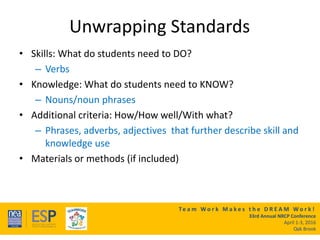
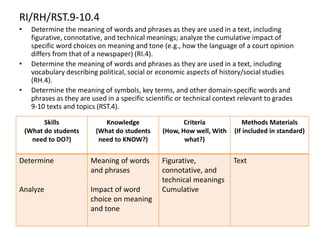
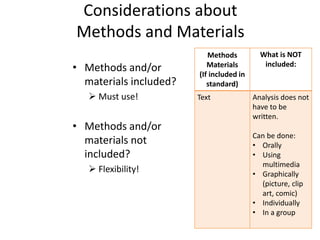
Unwrapping Standards
• Skills: What do students need to DO?
– Verbs
• Knowledge: What do students need to KNOW?
– Nouns/noun phrases
• Additional criteria: How/How well/With what?
– Phrases, adverbs, adjectives that further describe skill and
knowledge use
• Materials or methods (if included)
14
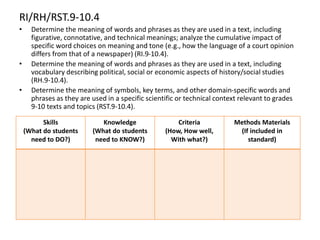
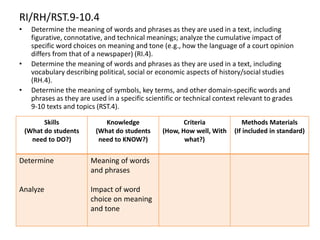
RI/RH/RST.9-10.4
• Determine the meaning of words and phrases as they are used in a text, including
figurative, connotative, and technical meanings; analyze the cumulative impact of
specific word choices on meaning and tone (e.g., how the language of a court opinion
differs from that of a newspaper) (RI.9-10.4).
• Determine the meaning of words and phrases as they are used in a text, including
vocabulary describing political, social or economic aspects of history/social studies
(RH.9-10.4).
• Determine the meaning of symbols, key terms, and other domain-specific words and
phrases as they are used in a specific scientific or technical context relevant to grades
9-10 texts and topics (RST.9-10.4).
Skills
(What do students
need to DO?)
Knowledge
(What do students
need to KNOW?)
Criteria
(How, How well,
With what?)
Methods Materials
(If included in
standard)
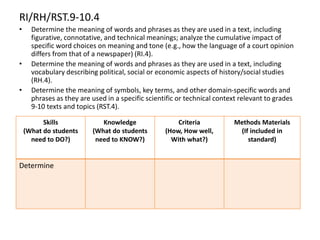
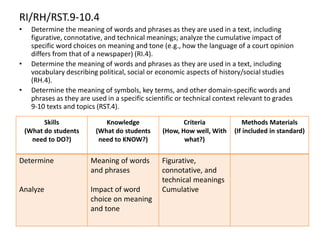
RI/RH/RST.9-10.4
• Determine the meaning of words and phrases as they are used in a text, including
figurative, connotative, and technical meanings; analyze the cumulative impact of
specific word choices on meaning and tone (e.g., how the language of a court opinion
differs from that of a newspaper) (RI.4).
• Determine the meaning of words and phrases as they are used in a text, including
vocabulary describing political, social or economic aspects of history/social studies
(RH.4).
• Determine the meaning of symbols, key terms, and other domain-specific words and
phrases as they are used in a specific scientific or technical context relevant to grades
9-10 texts and topics (RST.4).
Skills
(What do students
need to DO?)
Knowledge
(What do students
need to KNOW?)
Criteria
(How, How well,
With what?)
Methods Materials
(If included in
standard)
Determine
RI/RH/RST.9-10.4
• Determine the meaning of words and phrases as they are used in a text, including
figurative, connotative, and technical meanings; analyze the cumulative impact of
specific word choices on meaning and tone (e.g., how the language of a court opinion
differs from that of a newspaper) (RI.4).
• Determine the meaning of words and phrases as they are used in a text, including
vocabulary describing political, social or economic aspects of history/social studies
(RH.4).
• Determine the meaning of symbols, key terms, and other domain-specific words and
phrases as they are used in a specific scientific or technical context relevant to grades
9-10 texts and topics (RST.4).
Skills
(What do students
need to DO?)
Knowledge
(What do students
need to KNOW?)
Criteria
(How, How well, With
what?)
Methods Materials
(If included in standard)
Determine
Analyze
Meaning of words
and phrases
Impact of word
choice on meaning
and tone
RI/RH/RST.9-10.4
• Determine the meaning of words and phrases as they are used in a text, including
figurative, connotative, and technical meanings; analyze the cumulative impact of
specific word choices on meaning and tone (e.g., how the language of a court opinion
differs from that of a newspaper) (RI.4).
• Determine the meaning of words and phrases as they are used in a text, including
vocabulary describing political, social or economic aspects of history/social studies
(RH.4).
• Determine the meaning of symbols, key terms, and other domain-specific words and
phrases as they are used in a specific scientific or technical context relevant to grades
9-10 texts and topics (RST.4).
Skills
(What do students
need to DO?)
Knowledge
(What do students
need to KNOW?)
Criteria
(How, How well, With
what?)
Methods Materials
(If included in standard)
Determine
Analyze
Meaning of words
and phrases
Impact of word
choice on meaning
and tone
Figurative,
connotative, and
technical meanings
Cumulative
RI/RH/RST.9-10.4
• Determine the meaning of words and phrases as they are used in a text, including
figurative, connotative, and technical meanings; analyze the cumulative impact of
specific word choices on meaning and tone (e.g., how the language of a court opinion
differs from that of a newspaper) (RI.4).
• Determine the meaning of words and phrases as they are used in a text, including
vocabulary describing political, social or economic aspects of history/social studies
(RH.4).
• Determine the meaning of symbols, key terms, and other domain-specific words and
phrases as they are used in a specific scientific or technical context relevant to grades
9-10 texts and topics (RST.4).
Skills
(What do students
need to DO?)
Knowledge
(What do students
need to KNOW?)
Criteria
(How, How well, With
what?)
Methods Materials
(If included in standard)
Determine
Analyze
Meaning of words
and phrases
Impact of word
choice on meaning
and tone
Figurative,
connotative, and
technical meanings
Cumulative
Text
Considerations about
Methods and Materials
• Methods and/or
materials included?
 Must use!
• Methods and/or
materials not
included?
 Flexibility!
Methods
Materials
(If included in
standard)
What is NOT
included:
Text Analysis does not
have to be
written.
Can be done:
• Orally
• Using
multimedia
• Graphically
(picture, clip
art, comic)
• Individually
• In a group
Te a m W o r k M a k e s t h e D R E A M W o r k !
33rd Annual NRCP Conference
April 1-3, 2016
Oak Brook
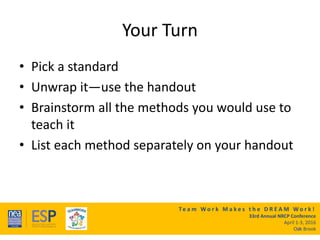
Your Turn
• Pick a standard
• Unwrap it—use the handout
• Brainstorm all the methods you would use to
teach it
• List each method separately on your handout
21
Te a m W o r k M a k e s t h e D R E A M W o r k !
33rd Annual NRCP Conference
April 1-3, 2016
Oak Brook
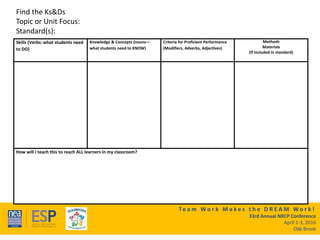
Skills (Verbs: what students need
to DO)
Knowledge & Concepts (nouns—
what students need to KNOW)
Criteria for Proficient Performance
(Modifiers, Adverbs, Adjectives)
Methods
Materials
(If included in standard)
How will I teach this to reach ALL learners in my classroom?
Find the Ks&Ds
Topic or Unit Focus:
Standard(s):
22
Te a m W o r k M a k e s t h e D R E A M W o r k !
33rd Annual NRCP Conference
April 1-3, 2016
Oak Brook
Contact the NEA
Anthony Brisson
NEA ESPQ
1201 Sixteenth St., NW
Suite 613
Washington, DC 20036
abrisson@nea.org
Credit: State Education Resource Center, Middletown, CT. – www.ctserc.org

Digging Deeper into the Common Core

  • 1.
    Te a mW o r k M a k e s t h e D R E A M W o r k ! 33rd Annual NRCP Conference April 1-3, 2016 Oak Brook Digging Deeper into the Common Core Anthony Brisson NEA Education Support Professional Quality Senior Policy Analyst
  • 2.
    Te a mW o r k M a k e s t h e D R E A M W o r k ! 33rd Annual NRCP Conference April 1-3, 2016 Oak Brook Outcomes • Develop an understanding of the Common Core State Standards. • Consider the impact the CCSS will have on your role. • Review unwrapping standards.
  • 3.
    Te a mW o r k M a k e s t h e D R E A M W o r k ! 33rd Annual NRCP Conference April 1-3, 2016 Oak Brook Three-Minute Video Explaining the CCSS • http://vimeo.com/51933492
  • 4.
    Te a mW o r k M a k e s t h e D R E A M W o r k ! 33rd Annual NRCP Conference April 1-3, 2016 Oak Brook CCSS ELA/Math Background What They Are… • 46 states and the District of Columbia have adopted CCSS • Designed to provide shared expectations of knowledge & skills students need to be “college and career ready” • An integrated literacy model What They are Not… • A guideline of HOW teachers should teach • An all-inclusive list of what should be taught K-12 • A definition of intervention methods or materials www.corestandards.org (CCSS for ELA & Literacy in History/SS, Science, & Technical Subjects)
  • 5.
    Te a mW o r k M a k e s t h e D R E A M W o r k ! 33rd Annual NRCP Conference April 1-3, 2016 Oak Brook Instructional Shifts in the Classroom English language arts (ELA) • Building knowledge through content-rich nonfiction and information texts • Reading, writing and speaking grounded in evidence from text, both literary and informational • Regular practice with complex text and its academic language Mathematics • Focus strongly where the standards focus • Coherence: Think across grades and link to major topics within grades • Rigor: In major topics, pursue conceptual understanding, procedural skill and fluency, and application
  • 6.
    Te a mW o r k M a k e s t h e D R E A M W o r k ! 33rd Annual NRCP Conference April 1-3, 2016 Oak Brook How are the standards organized?
  • 7.
    Te a mW o r k M a k e s t h e D R E A M W o r k ! 33rd Annual NRCP Conference April 1-3, 2016 Oak Brook CCSS ELA/Literacy Organization • Three main sections – Comprehensive K-5 • Reading Foundational Skills – English language arts 6-12 – History/social studies, science and technical subjects 6-12 • Anchor Standards – Reading Literature – Reading Informational Text – Writing – Speaking and Listening – Language • Grade-specific standards www.corestandards.org (CCSS for ELA & Literacy in History/SS, Science, & Technical Subjects)
  • 8.
    Te a mW o r k M a k e s t h e D R E A M W o r k ! 33rd Annual NRCP Conference April 1-3, 2016 Oak Brook Identify the Standard RL.5.3 Strand Grade Standard Number
  • 9.
    Te a mW o r k M a k e s t h e D R E A M W o r k ! 33rd Annual NRCP Conference April 1-3, 2016 Oak Brook ELA Abbreviations • R-Reading – RL-Reading: Literature – RI-Reading: Informational Text – RF-Reading: Foundational Skills • W-Writing • SL-Speaking and Listening • L-Language • RH-Reading History • RST-Reading Science and Technical Subjects • WHST-Writing History, Science and Technical Subjects
  • 10.
    Te a mW o r k M a k e s t h e D R E A M W o r k ! 33rd Annual NRCP Conference April 1-3, 2016 Oak Brook CCSS Math Organization Two distinct sets of standards: • Content Standards (math concepts) GRADE or COURSE SPECIFIC • Practice Standards (habits of mind) APPLY to K-12
  • 11.
    Te a mW o r k M a k e s t h e D R E A M W o r k ! 33rd Annual NRCP Conference April 1-3, 2016 Oak Brook Structure of the Standards • Domains are large groups of related standards. Domains change from grade to grade to reflect the changing focus of each grade. Standards from different domains may sometimes be closely related. • Clusters are groups of related standards. Each domain has 1 – 4 clusters. Standards from different clusters may sometimes be closely related. • Standards define what students should understand and be able to do. Domain Cluster Standard
  • 12.
    Te a mW o r k M a k e s t h e D R E A M W o r k ! 33rd Annual NRCP Conference April 1-3, 2016 Oak Brook Identify the Standard 5.NBT.4 Grade Domain Standard Number 3.OA.C Grade Domain Cluster
  • 13.
    Te a mW o r k M a k e s t h e D R E A M W o r k ! 33rd Annual NRCP Conference April 1-3, 2016 Oak Brook Math Abbreviations • Elementary • CC-Counting and Cardinality • OA-Operations and Algebraic Thinking • NBT-Numbers & Operations in Base Ten • NF-Numbers & Operations-Fractions • MD-Measurement & Data • G-Geometry • RP-Ratio & Proportional Relationships • NS-The Number System • EE-Expressions & Equations • SP-Statistics & Probability • F-Functions
  • 14.
    Te a mW o r k M a k e s t h e D R E A M W o r k ! 33rd Annual NRCP Conference April 1-3, 2016 Oak Brook Unwrapping Standards • Skills: What do students need to DO? – Verbs • Knowledge: What do students need to KNOW? – Nouns/noun phrases • Additional criteria: How/How well/With what? – Phrases, adverbs, adjectives that further describe skill and knowledge use • Materials or methods (if included) 14
  • 15.
    RI/RH/RST.9-10.4 • Determine themeaning of words and phrases as they are used in a text, including figurative, connotative, and technical meanings; analyze the cumulative impact of specific word choices on meaning and tone (e.g., how the language of a court opinion differs from that of a newspaper) (RI.9-10.4). • Determine the meaning of words and phrases as they are used in a text, including vocabulary describing political, social or economic aspects of history/social studies (RH.9-10.4). • Determine the meaning of symbols, key terms, and other domain-specific words and phrases as they are used in a specific scientific or technical context relevant to grades 9-10 texts and topics (RST.9-10.4). Skills (What do students need to DO?) Knowledge (What do students need to KNOW?) Criteria (How, How well, With what?) Methods Materials (If included in standard)
  • 16.
    RI/RH/RST.9-10.4 • Determine themeaning of words and phrases as they are used in a text, including figurative, connotative, and technical meanings; analyze the cumulative impact of specific word choices on meaning and tone (e.g., how the language of a court opinion differs from that of a newspaper) (RI.4). • Determine the meaning of words and phrases as they are used in a text, including vocabulary describing political, social or economic aspects of history/social studies (RH.4). • Determine the meaning of symbols, key terms, and other domain-specific words and phrases as they are used in a specific scientific or technical context relevant to grades 9-10 texts and topics (RST.4). Skills (What do students need to DO?) Knowledge (What do students need to KNOW?) Criteria (How, How well, With what?) Methods Materials (If included in standard) Determine
  • 17.
    RI/RH/RST.9-10.4 • Determine themeaning of words and phrases as they are used in a text, including figurative, connotative, and technical meanings; analyze the cumulative impact of specific word choices on meaning and tone (e.g., how the language of a court opinion differs from that of a newspaper) (RI.4). • Determine the meaning of words and phrases as they are used in a text, including vocabulary describing political, social or economic aspects of history/social studies (RH.4). • Determine the meaning of symbols, key terms, and other domain-specific words and phrases as they are used in a specific scientific or technical context relevant to grades 9-10 texts and topics (RST.4). Skills (What do students need to DO?) Knowledge (What do students need to KNOW?) Criteria (How, How well, With what?) Methods Materials (If included in standard) Determine Analyze Meaning of words and phrases Impact of word choice on meaning and tone
  • 18.
    RI/RH/RST.9-10.4 • Determine themeaning of words and phrases as they are used in a text, including figurative, connotative, and technical meanings; analyze the cumulative impact of specific word choices on meaning and tone (e.g., how the language of a court opinion differs from that of a newspaper) (RI.4). • Determine the meaning of words and phrases as they are used in a text, including vocabulary describing political, social or economic aspects of history/social studies (RH.4). • Determine the meaning of symbols, key terms, and other domain-specific words and phrases as they are used in a specific scientific or technical context relevant to grades 9-10 texts and topics (RST.4). Skills (What do students need to DO?) Knowledge (What do students need to KNOW?) Criteria (How, How well, With what?) Methods Materials (If included in standard) Determine Analyze Meaning of words and phrases Impact of word choice on meaning and tone Figurative, connotative, and technical meanings Cumulative
  • 19.
    RI/RH/RST.9-10.4 • Determine themeaning of words and phrases as they are used in a text, including figurative, connotative, and technical meanings; analyze the cumulative impact of specific word choices on meaning and tone (e.g., how the language of a court opinion differs from that of a newspaper) (RI.4). • Determine the meaning of words and phrases as they are used in a text, including vocabulary describing political, social or economic aspects of history/social studies (RH.4). • Determine the meaning of symbols, key terms, and other domain-specific words and phrases as they are used in a specific scientific or technical context relevant to grades 9-10 texts and topics (RST.4). Skills (What do students need to DO?) Knowledge (What do students need to KNOW?) Criteria (How, How well, With what?) Methods Materials (If included in standard) Determine Analyze Meaning of words and phrases Impact of word choice on meaning and tone Figurative, connotative, and technical meanings Cumulative Text
  • 20.
    Considerations about Methods andMaterials • Methods and/or materials included?  Must use! • Methods and/or materials not included?  Flexibility! Methods Materials (If included in standard) What is NOT included: Text Analysis does not have to be written. Can be done: • Orally • Using multimedia • Graphically (picture, clip art, comic) • Individually • In a group
  • 21.
    Te a mW o r k M a k e s t h e D R E A M W o r k ! 33rd Annual NRCP Conference April 1-3, 2016 Oak Brook Your Turn • Pick a standard • Unwrap it—use the handout • Brainstorm all the methods you would use to teach it • List each method separately on your handout 21
  • 22.
    Te a mW o r k M a k e s t h e D R E A M W o r k ! 33rd Annual NRCP Conference April 1-3, 2016 Oak Brook Skills (Verbs: what students need to DO) Knowledge & Concepts (nouns— what students need to KNOW) Criteria for Proficient Performance (Modifiers, Adverbs, Adjectives) Methods Materials (If included in standard) How will I teach this to reach ALL learners in my classroom? Find the Ks&Ds Topic or Unit Focus: Standard(s): 22
  • 23.
    Te a mW o r k M a k e s t h e D R E A M W o r k ! 33rd Annual NRCP Conference April 1-3, 2016 Oak Brook Contact the NEA Anthony Brisson NEA ESPQ 1201 Sixteenth St., NW Suite 613 Washington, DC 20036 abrisson@nea.org Credit: State Education Resource Center, Middletown, CT. – www.ctserc.org

Editor's Notes

  • #2 1
  • #5 Research and evidence based Aligned with college and work expectations Rigorous Internationally benchmarked Organized into
  • #6 Encourage participants to think of ways to support across content areas. Science, tech, computers, PE, art, music all have math implications. Likewise, text/media dependency for evidence based questions go across all content areas. Everyone writes, everyone finds evidence. Turn and talk! In discussing the Common Core State Standards, it is exceptionally helpful to be mindful of the “big picture” implications. These implications have been commonly referred to as “The Shifts.” You can think of these as understanding the forest from the trees. There is certainly a lot of detail not included here and yet very important to the Standards. Understanding these shifts deeply is a very powerful way to start. There are three shifts in ELA/Literacy and three in mathematics. The idea here is not just to hear these shifts, but to internalize them. Listen closely and learn so that you know these shifts and what they mean for you in your role. Let’s start with the first two: The first shift in ELA/Literacy is to build knowledge through content-rich nonfiction. Think of the two parts of this statement– first, we are building knowledge from text. Students use the text as a source of knowledge. This of course means that in addition to reading stories, students are reading nonfiction. The CCSS requires that in elementary school about half of what students read should be fiction and about half of what they read should be nonfiction. In order for these texts to support the building of knowledge, students should read a coherent set of texts that actually support the building of knowledge through text. This is different from what is typically happening in classrooms now. Currently as much as 80% of what students read is fiction and when they do read nonfiction, it is often as an isolated “experience in reading nonfiction” such as in a weekly news magazine. These texts don’t build knowledge through a series of nonfiction texts and they rely on a great deal of knowledge outside of the text. In middle and high schools the standards require attention to literacy across the content areas. In order to work toward college and career readiness students need the specific literacy skills of science and social studies. This means that science teachers and social studies support student literacy as a way to enhance knowledge and skills in the content area. There are standards included in the Common Core that specifically describe these expectations. They are an important component - not a suggestion for implementation, not an appendix, but an essential part. In looking at a student’s reading requirements across the school year, across all classes middle and high school students should be reading about 70% nonfiction and 30% fiction. When the content areas are on board, this means that the English class still focuses on literature with some addition of nonfiction. The second shift may seem rather obvious, but incredibly it is a significant shift from current typical practice. In this second shift students work with the text as a source of evidence. This is a strong college and career-ready skill. In response to text, students are actually required to use evidence from the text. This is contrasted with typical current practice in which students are often asked to answer questions, make arguments, give opinions, construct projects in response to text while requiring no knowledge, comprehension or experience with actually reading the text. We often refer to this with the slogan of reading like a detective and writing like a reporter.
  • #8 How to read “secret” code of standards. W.9-10.2
  • #9 Ask participants to identify the specific standard noted on the slide. Note that C represents the third cluster in the domain of OA. The letter designation of the clusters are not labeled in the printed form of the CCSS. A=first cluster, B=second cluster, etc. Grade 5; Number & Operations in Base Ten; Standard #4 “Use place value understanding to round decimals to any place.” Grade 3; Operations and Algebraic Thinking; Third Cluster “Multiply and divide within 100.”
  • #12 {THE NEXT TWO SLIDES ARE INCLUDED TO PROVIDE PARTICIPANTS WITH AN OVERVIEW OF THE OVERALL STRUCTURE AND CONTENT OF THE STANDARDS} There are five domains for each grade K-8: Counting and Cardinality, Operations and Algebraic Thinking, Number and Operations in Base Ten, Number and Operations – Fractions, Ratios and Proportional Relationships, The Number System, Expressions and Equations, Measurement and Data, Geometry, Statistics and Probability and Functions. The high school standards are listed in conceptual categories: Number and Quantity, Algebra, Functions, Modeling, Geometry, and Statistics and Probability.
  • #13 Ask participants to identify the specific standard noted on the slide. Note that C represents the third cluster in the domain of OA. The letter designation of the clusters are not labeled in the printed form of the CCSS. A=first cluster, B=second cluster, etc. Grade 5; Number & Operations in Base Ten; Standard #4 “Use place value understanding to round decimals to any place.” Grade 3; Operations and Algebraic Thinking; Third Cluster “Multiply and divide within 100.”
  • #14 Not a complete list
  • #16 Ask participants to identify the verbs that indicate skills Ss need to perform
  • #17 Ask participants to identify the verbs that indicate skills Ss need to perform
  • #18 Ask participants to identify the verbs that indicate skills Ss need to perform
  • #19 Ask participants to identify the verbs that indicate skills Ss need to perform
  • #20 Ask participants to identify the verbs that indicate skills Ss need to perform
  • #23 Use a Literacy standard (or a Math standard) and unwrap it. Then brainstorm a list of exactly how the knows and the dos would be TAUGHT Your Turn! Pick a standard that’s part of an upcoming unit of instruction or lesson. Feel free to put yourselves in a grouping that would be useful. You will have the option of working with this standard or unwrapping this one and another one. As you unwrap the standard, be thinking about what teaching the “knows” could look like Pull KNOWs and DOs into practice What are barriers? What are extensions? What are pre-teaching opportunities? How can the “Ks” & “Ds” be scaffolded up?