COUNCIL OF CHIEF STATE SCHOOL OFFICERS
                (CCSSO)
                   &
   NATIONAL GOVERNORS ASSOCIATION
      CENTER FOR BEST PRACTICES
             (NGA CENTER)

              JUNE 2010
Standards Development Process


 College
and
career
readiness
standards
developed

  in
summer
2009
 Based
on
the
college
and
career
readiness

  standards,
K‐12
learning
progressions
developed
 Mul=ple
rounds
of
feedback
from
states,
teachers,

  researchers,
higher
educa=on,
and
the
general

  public
 Final
Common
Core
State
Standards
released
on

  June
2,
2010
What are the Common Core State Standards?


  Aligned
with
college
and
work
expecta=ons


  Focused
and
coherent


  Include
rigorous
content
and
applica=on
of
knowledge
through
high‐order

   skills

  Build
upon
strengths
and
lessons
of
current
state
standards


  Interna=onally
benchmarked
so
that
all
students
are
prepared
to
succeed
in

   our
global
economy
and
society

  Based
on
evidence
and
research

  State
led
–
coordinated
by
NGA
Center
and
CCSSO
Why is this important?


 Currently,
every
state
has
its
own
set
of
academic

  standards,
meaning
public
educa=on
students
in
each
state

  are
learning
to
different
levels

 All
students
must
be
prepared
to
compete
with
not
only

  their
American
peers
in
the
next
state,
but
with
students

  from
around
the
world

More Information


www.corestandards.org
    For
more
informa=on

and
to
post
a
video
of
support
STANDARDS FOR
      ENGLISH LANGUAGE ARTS
                 &
LITERACY IN HISTORY/SOCIAL STUDIES,
  SCIENCE, AND TECHNICAL SUBJECTS

            JUNE 2010
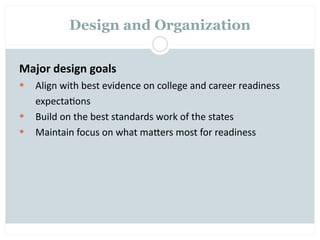
Design and Organization


Major
design
goals
   Align
with
best
evidence
on
college
and
career
readiness

   expecta=ons
   Build
on
the
best
standards
work
of
the
states
   Maintain
focus
on
what
maOers
most
for
readiness
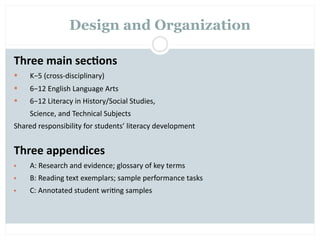
Design and Organization

Three
main
sec2ons
   K−5
(cross‐disciplinary)
   6−12
English
Language
Arts
   6−12
Literacy
in
History/Social
Studies,

   Science,
and
Technical
Subjects
Shared
responsibility
for
students’
literacy
development


Three
appendices
•   A:
Research
and
evidence;
glossary
of
key
terms
•   B:
Reading
text
exemplars;
sample
performance
tasks
•   C:
Annotated
student
wri=ng
samples
Design and Organization


Four
strands
   Reading
(including
Reading
Founda=onal
Skills)
   Wri=ng
   Speaking
and
Listening
   Language

An
integrated
model
of
literacy

Media
requirements
blended
throughout
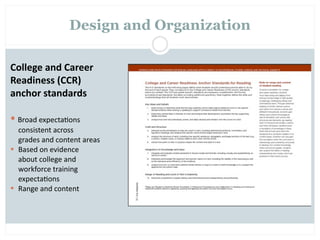
Design and Organization

College
and
Career

Readiness
(CCR)

anchor
standards


Broad
expecta=ons


 consistent
across


 grades
and
content
areas


Based
on
evidence

 about
college
and

 workforce
training

 expecta=ons


Range
and
content
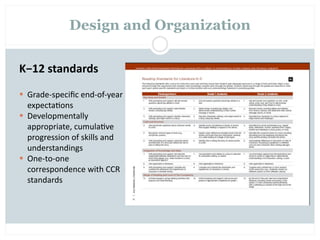
Design and Organization


K−12
standards
 Grade‐specific
end‐of‐year

  expecta=ons
 Developmentally

  appropriate,
cumula=ve

  progression
of
skills
and

  understandings
 One‐to‐one

  correspondence
with
CCR

  standards
Reading


Comprehension
(standards
1−9)



Standards
for
reading
literature
and
informa=onal
texts



Strong
and
growing
across‐the‐curriculum
emphasis
on

     students’
ability
to
read
and
comprehend
informa=onal
texts



Aligned
with
NAEP
Reading
framework


Range
of
reading
and
level
of
text
complexity
(standard
10,
Appendices
A
and
B)

 “Staircase”
of
growing
text
complexity
across
grades

   High‐quality
literature
and
informa=onal
texts
in
a
range

    of
genres
and
subgenres
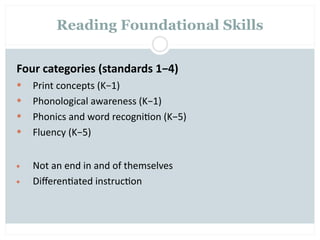
Reading Foundational Skills


Four
categories
(standards
1−4)
   Print
concepts
(K−1)
   Phonological
awareness
(K−1)
   Phonics
and
word
recogni=on
(K−5)
   Fluency
(K−5)


•   Not
an
end
in
and
of
themselves
•   Differen=ated
instruc=on
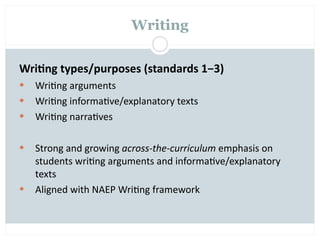
Writing


Wri2ng
types/purposes
(standards
1−3)
   Wri=ng
arguments
   Wri=ng
informa=ve/explanatory
texts
   Wri=ng
narra=ves

   Strong
and
growing
across‐the‐curriculum
emphasis
on

    students
wri=ng
arguments
and
informa=ve/explanatory

    texts
   Aligned
with
NAEP
Wri=ng
framework
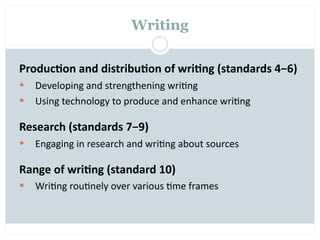
Writing


Produc2on
and
distribu2on
of
wri2ng
(standards
4−6)
   Developing
and
strengthening
wri=ng
   Using
technology
to
produce
and
enhance
wri=ng

Research
(standards
7−9)
   Engaging
in
research
and
wri=ng
about
sources

Range
of
wri2ng
(standard
10)
   Wri=ng
rou=nely
over
various
=me
frames
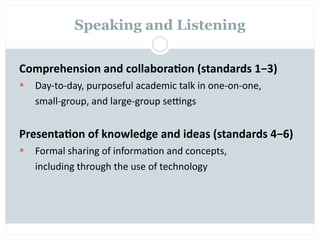
Speaking and Listening


Comprehension
and
collabora2on
(standards
1−3)

 Day‐to‐day,
purposeful
academic
talk
in
one‐on‐one,

   small‐group,
and
large‐group
segngs


Presenta2on
of
knowledge
and
ideas
(standards
4−6)

 Formal
sharing
of
informa=on
and
concepts,


   including
through
the
use
of
technology
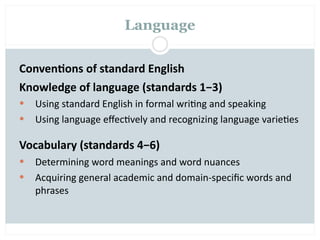
Language


Conven2ons
of
standard
English
Knowledge
of
language
(standards
1−3)
   Using
standard
English
in
formal
wri=ng
and
speaking
   Using
language
effec=vely
and
recognizing
language
varie=es

Vocabulary
(standards
4−6)
   Determining
word
meanings
and
word
nuances
   Acquiring
general
academic
and
domain‐specific
words
and

    phrases
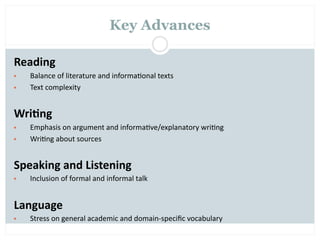
Key Advances

Reading
•   Balance
of
literature
and
informa=onal
texts
•   Text
complexity


Wri2ng
•   Emphasis
on
argument
and
informa=ve/explanatory
wri=ng
•   Wri=ng
about
sources


Speaking
and
Listening
•   Inclusion
of
formal
and
informal
talk


Language
•   Stress
on
general
academic
and
domain‐specific
vocabulary
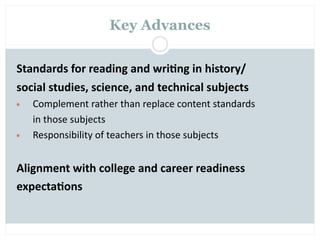
Key Advances


Standards
for
reading
and
wri2ng
in
history/
social
studies,
science,
and
technical
subjects
•   Complement
rather
than
replace
content
standards

   in
those
subjects
•   Responsibility
of
teachers
in
those
subjects


Alignment
with
college
and
career
readiness
expecta2ons
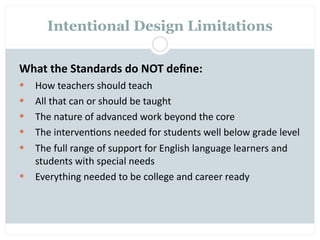
Intentional Design Limitations

What
the
Standards
do
NOT
define:
   How
teachers
should
teach
   All
that
can
or
should
be
taught
   The
nature
of
advanced
work
beyond
the
core
   The
interven=ons
needed
for
students
well
below
grade
level
   The
full
range
of
support
for
English
language
learners
and

    students
with
special
needs
   Everything
needed
to
be
college
and
career
ready
Conclusion

Standards:
Important
but
insufficient
   To
be
effec=ve
in
improving
educa=on
and
gegng
all
students

    ready
for
college,
workforce
training,
and
life,
the
Standards

    must
be
partnered
with
a
content‐rich
curriculum
and
robust

    assessments,
both
aligned
to
the
Standards.
STANDARDS FOR
 MATHEMATICS

  JUNE 2010
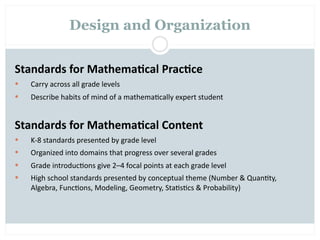
Design and Organization


Standards
for
Mathema2cal
Prac2ce
   Carry
across
all
grade
levels
   Describe
habits
of
mind
of
a
mathema=cally
expert
student


Standards
for
Mathema2cal
Content
   K‐8
standards
presented
by
grade
level
   Organized
into
domains
that
progress
over
several
grades
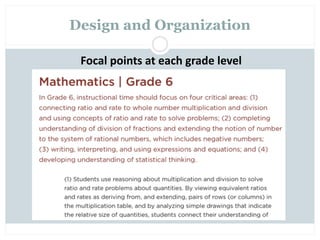
   Grade
introduc=ons
give
2–4
focal
points
at
each
grade
level
   High
school
standards
presented
by
conceptual
theme
(Number
&
Quan=ty,

    Algebra,
Func=ons,
Modeling,
Geometry,
Sta=s=cs
&
Probability)
Design and Organization

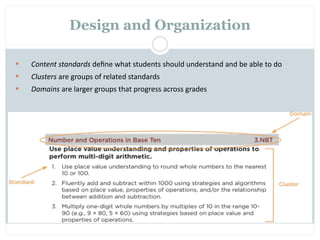
   Content
standards
define
what
students
should
understand
and
be
able
to
do
   Clusters
are
groups
of
related
standards
   Domains
are
larger
groups
that
progress
across
grades
Design and Organization

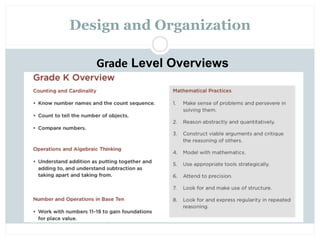
   Grade Level Overviews
Design and Organization

 Focal
points
at
each
grade
level
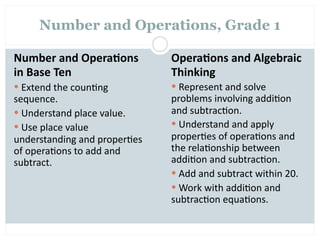
Number and Operations, Grade 1

Number
and
Opera2ons
          Opera2ons
and
Algebraic

in
Base
Ten                    Thinking

Extend
the
coun=ng
          
Represent
and
solve

sequence.                      problems
involving
addi=on


Understand
place
value.      and
subtrac=on.

Use
place
value
             
Understand
and
apply

understanding
and
proper=es
   proper=es
of
opera=ons
and

of
opera=ons
to
add
and
       the
rela=onship
between

subtract.                      addi=on
and
subtrac=on.
                               
Add
and
subtract
within
20.
                               
Work
with
addi=on
and

                               subtrac=on
equa=ons.
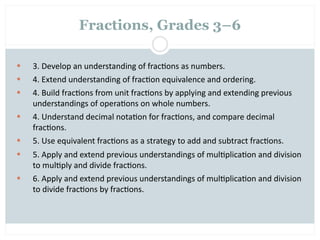
Fractions, Grades 3–6

   3.
Develop
an
understanding
of
frac=ons
as
numbers.
   4.
Extend
understanding
of
frac=on
equivalence
and
ordering.
   4.
Build
frac=ons
from
unit
frac=ons
by
applying
and
extending
previous

    understandings
of
opera=ons
on
whole
numbers.
   4.
Understand
decimal
nota=on
for
frac=ons,
and
compare
decimal

    frac=ons.
   5.
Use
equivalent
frac=ons
as
a
strategy
to
add
and
subtract
frac=ons.
   5.
Apply
and
extend
previous
understandings
of
mul=plica=on
and
division

    to
mul=ply
and
divide
frac=ons.
   6.
Apply
and
extend
previous
understandings
of
mul=plica=on
and
division

    to
divide
frac=ons
by
frac=ons.
Statistics and Probability, Grade 6


Develop
understanding
of
sta2s2cal
variability
   Recognize
a
sta=s=cal
ques=on
as
one
that
an=cipates
variability
in
the
data

    related
to
the
ques=on
and
accounts
for
it
in
the
answers.
For
example,
“How

    old
am
I?”
is
not
a
sta=s=cal
ques=on,
but
“How
old
are
the
students
in
my

    school?”
is
a
sta=s=cal
ques=on
because
one
an=cipates
variability
in
students’

    ages.
   Understand
that
a
set
of
data
collected
to
answer
a
sta=s=cal
ques=on
has
a

    distribu=on
which
can
be
described
by
its
center,
spread,
and
overall
shape.
   Recognize
that
a
measure
of
center
for
a
numerical
data
set
summarizes
all
of

    its
values
with
a
single
number,
while
a
measure
of
varia=on
describes
how
its

    values
vary
with
a
single
number.
Algebra, Grade 8

Graded
ramp
up
to
Algebra
in
Grade
8

  Proper=es
of
opera=ons,
similarity,
ra=o
and
propor=onal
rela=onships,

ra=onal
number
system.
Focus
on
linear
equa2ons
and
func2ons
in
Grade
8

     Expressions
and
Equa=ons
     
Work
with
radicals
and
integer
exponents.

     
Understand
the
connec=ons
between
propor=onal
rela=onships,
lines,
and
linear

     equa=ons.
     
Analyze
and
solve
linear
equa=ons
and
pairs
of
simultaneous
linear
equa=ons.


 Func=ons
     
Define,
evaluate,
and
compare
func=ons.

     
Use
func=ons
to
model
rela=onships
between
quan==es.
High School


Conceptual
themes
in
high
school
   Number
and
Quan=ty
   Algebra
   Func=ons
   Modeling
   Geometry
   Sta=s=cs
and
Probability
College
and
career
readiness
threshold
   (+)
standards
indicate
material
beyond
the
threshold;
can
be
in

    courses
required
for
all
students.
Geometry, High School


Middle
school
founda2ons
   Hands‐on
experience
with
transforma=ons.
   Low
tech
(transparencies)
or
high
tech
(dynamic
geometry

    sooware).
High
school
rigor
and
applica2ons
   Proper=es
of
rota=ons,
reflec=ons,
transla=ons,
and
dila=ons

    are
assumed,
proofs
start
from
there.
   Connec=ons
with
algebra
and
modeling
Key Advances


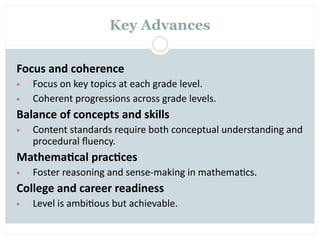
Focus
and
coherence
•   Focus
on
key
topics
at
each
grade
level.
•   Coherent
progressions
across
grade
levels.
Balance
of
concepts
and
skills
•   Content
standards
require
both
conceptual
understanding
and

    procedural
fluency.
Mathema2cal
prac2ces
•   Foster
reasoning
and
sense‐making
in
mathema=cs.
College
and
career
readiness
•   Level
is
ambi=ous
but
achievable.
Conclusion

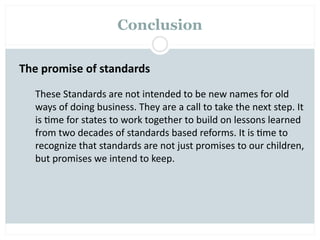
The
promise
of
standards


   These
Standards
are
not
intended
to
be
new
names
for
old

    ways
of
doing
business.
They
are
a
call
to
take
the
next
step.
It

    is
=me
for
states
to
work
together
to
build
on
lessons
learned

    from
two
decades
of
standards
based
reforms.
It
is
=me
to

    recognize
that
standards
are
not
just
promises
to
our
children,

    but
promises
we
intend
to
keep.
You
can
ask
ques=ons
by
typing
your
ques=on

           into
the
Q&A
panel
and

                clicking
"send.“


   Webinar
recording
will
be
available
at

       www.corestandards.org

Common Core Presentation

  • 1.
    COUNCIL OF CHIEFSTATE SCHOOL OFFICERS (CCSSO) & NATIONAL GOVERNORS ASSOCIATION CENTER FOR BEST PRACTICES (NGA CENTER) JUNE 2010
  • 2.
    Standards Development Process College
and
career
readiness
standards
developed
 in
summer
2009  Based
on
the
college
and
career
readiness
 standards,
K‐12
learning
progressions
developed  Mul=ple
rounds
of
feedback
from
states,
teachers,
 researchers,
higher
educa=on,
and
the
general
 public  Final
Common
Core
State
Standards
released
on
 June
2,
2010
  • 3.
    What are theCommon Core State Standards?  Aligned
with
college
and
work
expecta=ons  Focused
and
coherent  Include
rigorous
content
and
applica=on
of
knowledge
through
high‐order
 skills  Build
upon
strengths
and
lessons
of
current
state
standards  Interna=onally
benchmarked
so
that
all
students
are
prepared
to
succeed
in
 our
global
economy
and
society  Based
on
evidence
and
research  State
led
–
coordinated
by
NGA
Center
and
CCSSO
  • 4.
    Why is thisimportant?  Currently,
every
state
has
its
own
set
of
academic
 standards,
meaning
public
educa=on
students
in
each
state
 are
learning
to
different
levels  All
students
must
be
prepared
to
compete
with
not
only
 their
American
peers
in
the
next
state,
but
with
students
 from
around
the
world

  • 5.
    More Information www.corestandards.org For
more
informa=on
 and
to
post
a
video
of
support
  • 6.
    STANDARDS FOR ENGLISH LANGUAGE ARTS & LITERACY IN HISTORY/SOCIAL STUDIES, SCIENCE, AND TECHNICAL SUBJECTS JUNE 2010
  • 7.
    Design and Organization Major
design
goals  Align
with
best
evidence
on
college
and
career
readiness 
 expecta=ons  Build
on
the
best
standards
work
of
the
states  Maintain
focus
on
what
maOers
most
for
readiness
  • 8.
    Design and Organization Three
main
sec2ons  K−5
(cross‐disciplinary)  6−12
English
Language
Arts  6−12
Literacy
in
History/Social
Studies, 
 Science,
and
Technical
Subjects Shared
responsibility
for
students’
literacy
development Three
appendices • A:
Research
and
evidence;
glossary
of
key
terms • B:
Reading
text
exemplars;
sample
performance
tasks • C:
Annotated
student
wri=ng
samples
  • 9.
    Design and Organization Four
strands  Reading
(including
Reading
Founda=onal
Skills)  Wri=ng  Speaking
and
Listening  Language An
integrated
model
of
literacy Media
requirements
blended
throughout
  • 10.
    Design and Organization College
and
Career
 Readiness
(CCR)
 anchor
standards 
Broad
expecta=ons


consistent
across
 
 grades
and
content
areas 

Based
on
evidence 
 about
college
and 
 workforce
training 
 expecta=ons 

Range
and
content
  • 11.
    Design and Organization K−12
standards Grade‐specific
end‐of‐year
 expecta=ons  Developmentally
 appropriate,
cumula=ve
 progression
of
skills
and
 understandings  One‐to‐one
 correspondence
with
CCR
 standards
  • 12.
    Reading Comprehension
(standards
1−9) 


Standards
for
reading
literature
and
informa=onal
texts 


Strong
and
growing
across‐the‐curriculum
emphasis
on 
 students’
ability
to
read
and
comprehend
informa=onal
texts 


Aligned
with
NAEP
Reading
framework Range
of
reading
and
level
of
text
complexity (standard
10,
Appendices
A
and
B) 
 “Staircase”
of
growing
text
complexity
across
grades 
 High‐quality
literature
and
informa=onal
texts
in
a
range 
 of
genres
and
subgenres
  • 13.
    Reading Foundational Skills Four
categories
(standards
1−4)  Print
concepts
(K−1)  Phonological
awareness
(K−1)  Phonics
and
word
recogni=on
(K−5)  Fluency
(K−5) • Not
an
end
in
and
of
themselves • Differen=ated
instruc=on
  • 14.
    Writing Wri2ng
types/purposes
(standards
1−3)  Wri=ng
arguments  Wri=ng
informa=ve/explanatory
texts  Wri=ng
narra=ves  Strong
and
growing
across‐the‐curriculum
emphasis
on
 students
wri=ng
arguments
and
informa=ve/explanatory
 texts  Aligned
with
NAEP
Wri=ng
framework
  • 15.
    Writing Produc2on
and
distribu2on
of
wri2ng
(standards
4−6)  Developing
and
strengthening
wri=ng  Using
technology
to
produce
and
enhance
wri=ng Research
(standards
7−9)  Engaging
in
research
and
wri=ng
about
sources Range
of
wri2ng
(standard
10)  Wri=ng
rou=nely
over
various
=me
frames
  • 16.
    Speaking and Listening Comprehension
and
collabora2on
(standards
1−3) 
Day‐to‐day,
purposeful
academic
talk
in
one‐on‐one, 
 small‐group,
and
large‐group
segngs Presenta2on
of
knowledge
and
ideas
(standards
4−6) 
 Formal
sharing
of
informa=on
and
concepts,
 
 including
through
the
use
of
technology
  • 17.
    Language Conven2ons
of
standard
English Knowledge
of
language
(standards
1−3)  Using
standard
English
in
formal
wri=ng
and
speaking  Using
language
effec=vely
and
recognizing
language
varie=es Vocabulary
(standards
4−6)  Determining
word
meanings
and
word
nuances  Acquiring
general
academic
and
domain‐specific
words
and
 phrases
  • 18.
    Key Advances Reading • Balance
of
literature
and
informa=onal
texts • Text
complexity Wri2ng • Emphasis
on
argument
and
informa=ve/explanatory
wri=ng • Wri=ng
about
sources Speaking
and
Listening • Inclusion
of
formal
and
informal
talk Language • Stress
on
general
academic
and
domain‐specific
vocabulary
  • 19.
    Key Advances Standards
for
reading
and
wri2ng
in
history/ social
studies,
science,
and
technical
subjects • Complement
rather
than
replace
content
standards 
 in
those
subjects • Responsibility
of
teachers
in
those
subjects Alignment
with
college
and
career
readiness expecta2ons
  • 20.
    Intentional Design Limitations What
the
Standards
do
NOT
define:  How
teachers
should
teach  All
that
can
or
should
be
taught  The
nature
of
advanced
work
beyond
the
core  The
interven=ons
needed
for
students
well
below
grade
level  The
full
range
of
support
for
English
language
learners
and
 students
with
special
needs  Everything
needed
to
be
college
and
career
ready
  • 21.
    Conclusion Standards:
Important
but
insufficient  To
be
effec=ve
in
improving
educa=on
and
gegng
all
students
 ready
for
college,
workforce
training,
and
life,
the
Standards
 must
be
partnered
with
a
content‐rich
curriculum
and
robust
 assessments,
both
aligned
to
the
Standards.
  • 22.
  • 23.
    Design and Organization Standards
for
Mathema2cal
Prac2ce  Carry
across
all
grade
levels  Describe
habits
of
mind
of
a
mathema=cally
expert
student Standards
for
Mathema2cal
Content  K‐8
standards
presented
by
grade
level  Organized
into
domains
that
progress
over
several
grades  Grade
introduc=ons
give
2–4
focal
points
at
each
grade
level  High
school
standards
presented
by
conceptual
theme
(Number
&
Quan=ty,
 Algebra,
Func=ons,
Modeling,
Geometry,
Sta=s=cs
&
Probability)
  • 24.
    Design and Organization  Content
standards
define
what
students
should
understand
and
be
able
to
do  Clusters
are
groups
of
related
standards  Domains
are
larger
groups
that
progress
across
grades
  • 25.
    Design and Organization Grade Level Overviews
  • 26.
    Design and Organization Focal
points
at
each
grade
level
  • 27.
    Number and Operations,Grade 1 Number
and
Opera2ons
 Opera2ons
and
Algebraic
 in
Base
Ten Thinking 
Extend
the
coun=ng
 
Represent
and
solve
 sequence. problems
involving
addi=on
 
Understand
place
value. and
subtrac=on. 
Use
place
value
 
Understand
and
apply
 understanding
and
proper=es
 proper=es
of
opera=ons
and
 of
opera=ons
to
add
and
 the
rela=onship
between
 subtract. addi=on
and
subtrac=on. 
Add
and
subtract
within
20. 
Work
with
addi=on
and
 subtrac=on
equa=ons.
  • 28.
    Fractions, Grades 3–6  3.
Develop
an
understanding
of
frac=ons
as
numbers.  4.
Extend
understanding
of
frac=on
equivalence
and
ordering.  4.
Build
frac=ons
from
unit
frac=ons
by
applying
and
extending
previous
 understandings
of
opera=ons
on
whole
numbers.  4.
Understand
decimal
nota=on
for
frac=ons,
and
compare
decimal
 frac=ons.  5.
Use
equivalent
frac=ons
as
a
strategy
to
add
and
subtract
frac=ons.  5.
Apply
and
extend
previous
understandings
of
mul=plica=on
and
division
 to
mul=ply
and
divide
frac=ons.  6.
Apply
and
extend
previous
understandings
of
mul=plica=on
and
division
 to
divide
frac=ons
by
frac=ons.
  • 29.
    Statistics and Probability,Grade 6 Develop
understanding
of
sta2s2cal
variability  Recognize
a
sta=s=cal
ques=on
as
one
that
an=cipates
variability
in
the
data
 related
to
the
ques=on
and
accounts
for
it
in
the
answers.
For
example,
“How
 old
am
I?”
is
not
a
sta=s=cal
ques=on,
but
“How
old
are
the
students
in
my
 school?”
is
a
sta=s=cal
ques=on
because
one
an=cipates
variability
in
students’
 ages.  Understand
that
a
set
of
data
collected
to
answer
a
sta=s=cal
ques=on
has
a
 distribu=on
which
can
be
described
by
its
center,
spread,
and
overall
shape.  Recognize
that
a
measure
of
center
for
a
numerical
data
set
summarizes
all
of
 its
values
with
a
single
number,
while
a
measure
of
varia=on
describes
how
its
 values
vary
with
a
single
number.
  • 30.
    Algebra, Grade 8 Graded
ramp
up
to
Algebra
in
Grade
8 
 Proper=es
of
opera=ons,
similarity,
ra=o
and
propor=onal
rela=onships,
 ra=onal
number
system. Focus
on
linear
equa2ons
and
func2ons
in
Grade
8 
 Expressions
and
Equa=ons 
Work
with
radicals
and
integer
exponents. 
Understand
the
connec=ons
between
propor=onal
rela=onships,
lines,
and
linear
 equa=ons. 
Analyze
and
solve
linear
equa=ons
and
pairs
of
simultaneous
linear
equa=ons. 
 Func=ons 
Define,
evaluate,
and
compare
func=ons. 
Use
func=ons
to
model
rela=onships
between
quan==es.
  • 31.
    High School Conceptual
themes
in
high
school  Number
and
Quan=ty  Algebra  Func=ons  Modeling  Geometry  Sta=s=cs
and
Probability College
and
career
readiness
threshold  (+)
standards
indicate
material
beyond
the
threshold;
can
be
in
 courses
required
for
all
students.
  • 32.
    Geometry, High School Middle
school
founda2ons  Hands‐on
experience
with
transforma=ons.  Low
tech
(transparencies)
or
high
tech
(dynamic
geometry
 sooware). High
school
rigor
and
applica2ons  Proper=es
of
rota=ons,
reflec=ons,
transla=ons,
and
dila=ons
 are
assumed,
proofs
start
from
there.  Connec=ons
with
algebra
and
modeling
  • 33.
    Key Advances Focus
and
coherence • Focus
on
key
topics
at
each
grade
level. • Coherent
progressions
across
grade
levels. Balance
of
concepts
and
skills • Content
standards
require
both
conceptual
understanding
and
 procedural
fluency. Mathema2cal
prac2ces • Foster
reasoning
and
sense‐making
in
mathema=cs. College
and
career
readiness • Level
is
ambi=ous
but
achievable.
  • 34.
    Conclusion The
promise
of
standards 
 These
Standards
are
not
intended
to
be
new
names
for
old
 ways
of
doing
business.
They
are
a
call
to
take
the
next
step.
It
 is
=me
for
states
to
work
together
to
build
on
lessons
learned
 from
two
decades
of
standards
based
reforms.
It
is
=me
to
 recognize
that
standards
are
not
just
promises
to
our
children,
 but
promises
we
intend
to
keep.
  • 35.
    You
can
ask
ques=ons
by
typing
your
ques=on
 into
the
Q&A
panel
and
 clicking
"send.“
 Webinar
recording
will
be
available
at
 www.corestandards.org