   First section, typical instruction in the United
    States K-8 science classrooms.

   Second section, the contrasting view of science
    as practice

   Third section
    ◦ common forms of scientific practice
    ◦ the different types of instruction design
    ◦ the challenges students encounter

   Fourth section, strategies that teachers and
    curriculum developers can use to promote
    students learning of science through practice.
   The dynamics of the discipline:
    ◦   asking questions,
    ◦   finding ways to explore them empirically,
    ◦   Investigating
    ◦   evaluating challenging alternative models,
    ◦   arguing

   severely lacking :
    ◦ The U.S. curriculum and classrooms.
    ◦ Most importantly, in the expectations the
      students have about science and what it
      means to learn and do science in schools.
Activities offered everyday in
 class only cover a narrow
 portion of Science, so this
 practice is leaving students with
 limited sense of science and
 what it means to understand
 and use science.
 Whatcan be done to
structure, support, and
develop student’s
knowledge, and use and
understanding of
science?
Provide students with the
opportunity to:
 learn topics in depth
 to use science in meaningful
 contexts
 to engage in scientific practices
   Instructional programs that scaffold
    science as practice.
   Students:
    ◦   develop scientific explanations and models
    ◦   Participate in scientific argumentation
    ◦   Design and conduct scientific investigations
    ◦   work on Meaningful problems
    ◦   learn the skills in the context of their application
 Designing and conducting
  empirical investigations
 argumentation, explanation, and
  model building
 Interacting with texts
 Evidence of student learning
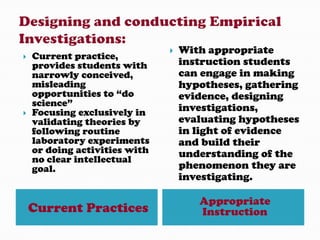
   With appropriate
   Current practice,
    provides students with         instruction students
    narrowly conceived,            can engage in making
    misleading                     hypotheses, gathering
    opportunities to “do           evidence, designing
    science”                       investigations,
   Focusing exclusively in
    validating theories by         evaluating hypotheses
    following routine              in light of evidence
    laboratory experiments         and build their
    or doing activities with       understanding of the
    no clear intellectual
    goal.                          phenomenon they are
                                   investigating.

                                      Appropriate
    Current Practices                 Instruction
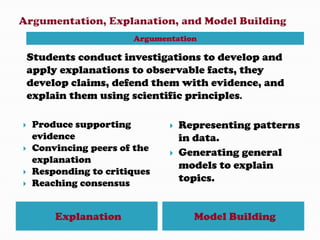
Argumentation

    Students conduct investigations to develop and
    apply explanations to observable facts, they
    develop claims, defend them with evidence, and
    explain them using scientific principles.

   Produce supporting           Representing patterns
    evidence                      in data.
   Convincing peers of the      Generating general
    explanation
                                  models to explain
   Responding to critiques
   Reaching consensus            topics.


         Explanation                Model Building
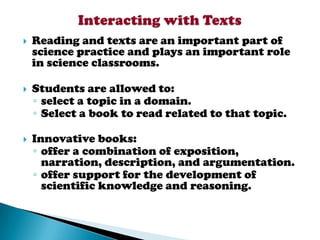
   Reading and texts are an important part of
    science practice and plays an important role
    in science classrooms.

   Students are allowed to:
    ◦ select a topic in a domain.
    ◦ Select a book to read related to that topic.

   Innovative books:
    ◦ offer a combination of exposition,
      narration, description, and argumentation.
    ◦ offer support for the development of
      scientific knowledge and reasoning.
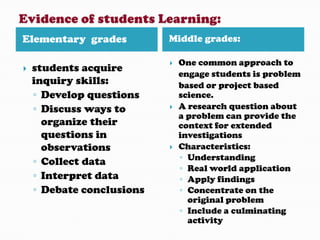
Elementary grades          Middle grades:

                              One common approach to
   students acquire
                               engage students is problem
    inquiry skills:            based or project based
    ◦ Develop questions        science.
    ◦ Discuss ways to         A research question about
                               a problem can provide the
      organize their           context for extended
      questions in             investigations
      observations            Characteristics:
                               ◦ Understanding
    ◦ Collect data
                               ◦ Real world application
    ◦ Interpret data           ◦ Apply findings
    ◦ Debate conclusions       ◦ Concentrate on the
                                 original problem
                               ◦ Include a culminating
                                 activity
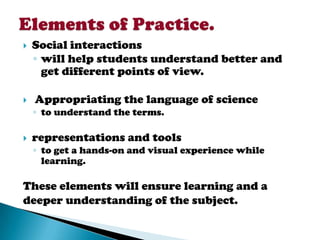
   Social interactions
    ◦ will help students understand better and
      get different points of view.

   Appropriating the language of science
    ◦ to understand the terms.

   representations and tools
    ◦ to get a hands-on and visual experience while
      learning.

These elements will ensure learning and a
deeper understanding of the subject.
   Science is better understood when it is
    presented and examined in social
    interactions.

   Social interactions:
    ◦ seeing everyone's point of view
    ◦ seeing everyone's opinions
    ◦ Having discussions to get ideas and
      thoughts running
   Science terms tend to throw students off
    track due to the lack of usage.
    Words like “variable” and “hypothesis” are
    not used in their daily life so students don’t
    recognize them.
    Once the teacher explains the meaning of
    these words get a better understanding of
    the concepts.
   Scientific representations like
    diagrams and charts show how things
    are done or how they work.

   Some of these give real life examples, to
    which students can relate to.

   Actual science equipment can be
    helpful since the student is
    experiencing what they are studying
    using hands-on activities.
   There are many methods for learning, as
    well as learning aids.
    However, the teacher has to contribute in
    order for the student to learn successfully.
   The students still needs assistance from the
    teacher at some points.
   Teachers also have to adjust the learning
    tools so that students can learn little by
    little instead of having everything thrown
    at them at once.
   Sequencing down or breaking down units
    of study is very helpful for learning better.
    Students cant do everything at once since
    the beginning, so the teacher breaks down
    their unit of study into little parts.
    As the student goes through all the small
    parts of learning, the students fits them all
    together like a puzzle.
   This provides the students with a more
    meaningful experience.
   Science is in students daily lives, but not
    strictly as to the point where their life
    revolves around science.
   However, when learning about science,
    students sometimes get confused during the
    process.
   An actual scientific task or experience can
    change a students initial thoughts about
    science.
   Scaffolding is used to facilitate learning
    for students.
    Scaffolding goes in a process:
    ◦ first the teacher explains the objective
      to the whole class.
    ◦ Next, the whole class works on it
      together,
    ◦ Then, the class is broken down into
      groups so that students can help each
      other out
    ◦ Finally the students work on their own.
   Students can become puzzled when
    learning about science.
   Students tend to have doubts in science,
    questioning its principles.
   Teachers break down the scientific
    processes and the reasons why things
    happen with science so that in the end
    they can fit it all together.
   basically students working together.
    Students are often placed in teams by the
    teacher or they pick their own team.
   This can be effective if:
    ◦ Students can help each other
    ◦ Some students understand better the
      topic
    ◦ Teacher provides one- on- one assistance
   Methods and tools:
     Technology for example can make
      learning a lot simpler. Computer
      programs and websites with educational
      resources for example, can show how
      things are done.

   Your students can see patterns and trends
    by using these tools and get a better
    understanding of the concepts.
   Articulation is helpful in science when you
    have an idea and need to put it into the
    appropriate terms for your assignment. It is
    also helpful for saying things clearly and in
    a way that everyone will understand.

   Reflections in science help students track
    what is going on in an experiment and how
    it changes.
   Formative Assessment helps both the
    teacher and the student improve their
    learning as they move through their
    content of instruction.

   The fact that the teacher knows what their
    doing can give a student confidence that
    their work is right and has a purpose.
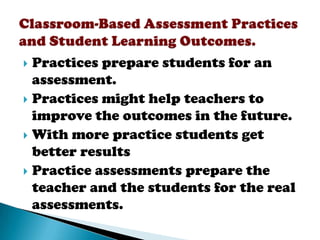
 Practices prepare students for an
  assessment.
 Practices might help teachers to
  improve the outcomes in the future.
 With more practice students get
  better results
 Practice assessments prepare the
  teacher and the students for the real
  assessments.

Teaching science as practice 2

  • 2.
    First section, typical instruction in the United States K-8 science classrooms.  Second section, the contrasting view of science as practice  Third section ◦ common forms of scientific practice ◦ the different types of instruction design ◦ the challenges students encounter  Fourth section, strategies that teachers and curriculum developers can use to promote students learning of science through practice.
  • 3.
    The dynamics of the discipline: ◦ asking questions, ◦ finding ways to explore them empirically, ◦ Investigating ◦ evaluating challenging alternative models, ◦ arguing  severely lacking : ◦ The U.S. curriculum and classrooms. ◦ Most importantly, in the expectations the students have about science and what it means to learn and do science in schools.
  • 4.
    Activities offered everydayin class only cover a narrow portion of Science, so this practice is leaving students with limited sense of science and what it means to understand and use science.
  • 5.
     Whatcan bedone to structure, support, and develop student’s knowledge, and use and understanding of science?
  • 6.
    Provide students withthe opportunity to:  learn topics in depth  to use science in meaningful contexts  to engage in scientific practices
  • 7.
    Instructional programs that scaffold science as practice.  Students: ◦ develop scientific explanations and models ◦ Participate in scientific argumentation ◦ Design and conduct scientific investigations ◦ work on Meaningful problems ◦ learn the skills in the context of their application
  • 8.
     Designing andconducting empirical investigations  argumentation, explanation, and model building  Interacting with texts  Evidence of student learning
  • 9.
    With appropriate  Current practice, provides students with instruction students narrowly conceived, can engage in making misleading hypotheses, gathering opportunities to “do evidence, designing science” investigations,  Focusing exclusively in validating theories by evaluating hypotheses following routine in light of evidence laboratory experiments and build their or doing activities with understanding of the no clear intellectual goal. phenomenon they are investigating. Appropriate Current Practices Instruction
  • 10.
    Argumentation Students conduct investigations to develop and apply explanations to observable facts, they develop claims, defend them with evidence, and explain them using scientific principles.  Produce supporting  Representing patterns evidence in data.  Convincing peers of the  Generating general explanation models to explain  Responding to critiques  Reaching consensus topics. Explanation Model Building
  • 11.
    Reading and texts are an important part of science practice and plays an important role in science classrooms.  Students are allowed to: ◦ select a topic in a domain. ◦ Select a book to read related to that topic.  Innovative books: ◦ offer a combination of exposition, narration, description, and argumentation. ◦ offer support for the development of scientific knowledge and reasoning.
  • 12.
    Elementary grades Middle grades:  One common approach to  students acquire engage students is problem inquiry skills: based or project based ◦ Develop questions science. ◦ Discuss ways to  A research question about a problem can provide the organize their context for extended questions in investigations observations  Characteristics: ◦ Understanding ◦ Collect data ◦ Real world application ◦ Interpret data ◦ Apply findings ◦ Debate conclusions ◦ Concentrate on the original problem ◦ Include a culminating activity
  • 13.
    Social interactions ◦ will help students understand better and get different points of view.  Appropriating the language of science ◦ to understand the terms.  representations and tools ◦ to get a hands-on and visual experience while learning. These elements will ensure learning and a deeper understanding of the subject.
  • 14.
    Science is better understood when it is presented and examined in social interactions.  Social interactions: ◦ seeing everyone's point of view ◦ seeing everyone's opinions ◦ Having discussions to get ideas and thoughts running
  • 15.
    Science terms tend to throw students off track due to the lack of usage.  Words like “variable” and “hypothesis” are not used in their daily life so students don’t recognize them.  Once the teacher explains the meaning of these words get a better understanding of the concepts.
  • 16.
    Scientific representations like diagrams and charts show how things are done or how they work.  Some of these give real life examples, to which students can relate to.  Actual science equipment can be helpful since the student is experiencing what they are studying using hands-on activities.
  • 17.
    There are many methods for learning, as well as learning aids.  However, the teacher has to contribute in order for the student to learn successfully.  The students still needs assistance from the teacher at some points.  Teachers also have to adjust the learning tools so that students can learn little by little instead of having everything thrown at them at once.
  • 18.
    Sequencing down or breaking down units of study is very helpful for learning better.  Students cant do everything at once since the beginning, so the teacher breaks down their unit of study into little parts.  As the student goes through all the small parts of learning, the students fits them all together like a puzzle.  This provides the students with a more meaningful experience.
  • 19.
    Science is in students daily lives, but not strictly as to the point where their life revolves around science.  However, when learning about science, students sometimes get confused during the process.  An actual scientific task or experience can change a students initial thoughts about science.
  • 20.
    Scaffolding is used to facilitate learning for students.  Scaffolding goes in a process: ◦ first the teacher explains the objective to the whole class. ◦ Next, the whole class works on it together, ◦ Then, the class is broken down into groups so that students can help each other out ◦ Finally the students work on their own.
  • 21.
    Students can become puzzled when learning about science.  Students tend to have doubts in science, questioning its principles.  Teachers break down the scientific processes and the reasons why things happen with science so that in the end they can fit it all together.
  • 22.
    basically students working together.  Students are often placed in teams by the teacher or they pick their own team.  This can be effective if: ◦ Students can help each other ◦ Some students understand better the topic ◦ Teacher provides one- on- one assistance
  • 23.
    Methods and tools:  Technology for example can make learning a lot simpler. Computer programs and websites with educational resources for example, can show how things are done.  Your students can see patterns and trends by using these tools and get a better understanding of the concepts.
  • 24.
    Articulation is helpful in science when you have an idea and need to put it into the appropriate terms for your assignment. It is also helpful for saying things clearly and in a way that everyone will understand.  Reflections in science help students track what is going on in an experiment and how it changes.
  • 25.
    Formative Assessment helps both the teacher and the student improve their learning as they move through their content of instruction.  The fact that the teacher knows what their doing can give a student confidence that their work is right and has a purpose.
  • 26.
     Practices preparestudents for an assessment.  Practices might help teachers to improve the outcomes in the future.  With more practice students get better results  Practice assessments prepare the teacher and the students for the real assessments.