GRADE 1 to 12
DAILY LESSON LOG
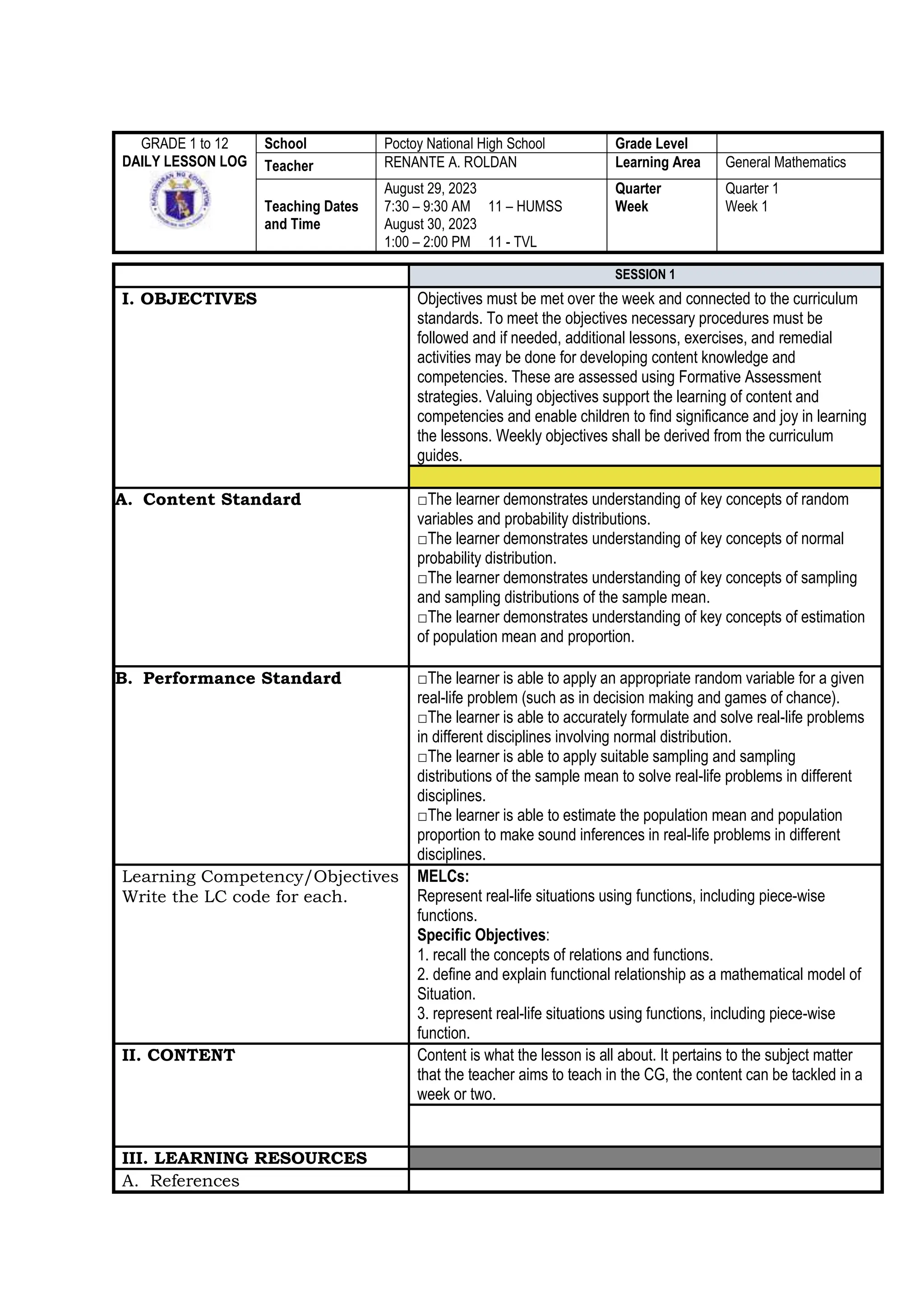
School Poctoy National High School Grade Level
Teacher RENANTE A. ROLDAN Learning Area General Mathematics
Teaching Dates
and Time
August 29, 2023
7:30 – 9:30 AM 11 – HUMSS
August 30, 2023
1:00 – 2:00 PM 11 - TVL
Quarter
Week
Quarter 1
Week 1
SESSION 1
I. OBJECTIVES Objectives must be met over the week and connected to the curriculum
standards. To meet the objectives necessary procedures must be
followed and if needed, additional lessons, exercises, and remedial
activities may be done for developing content knowledge and
competencies. These are assessed using Formative Assessment
strategies. Valuing objectives support the learning of content and
competencies and enable children to find significance and joy in learning
the lessons. Weekly objectives shall be derived from the curriculum
guides.
A. Content Standard □The learner demonstrates understanding of key concepts of random
variables and probability distributions.
□The learner demonstrates understanding of key concepts of normal
probability distribution.
□The learner demonstrates understanding of key concepts of sampling
and sampling distributions of the sample mean.
□The learner demonstrates understanding of key concepts of estimation
of population mean and proportion.
B. Performance Standard □The learner is able to apply an appropriate random variable for a given
real-life problem (such as in decision making and games of chance).
□The learner is able to accurately formulate and solve real-life problems
in different disciplines involving normal distribution.
□The learner is able to apply suitable sampling and sampling
distributions of the sample mean to solve real-life problems in different
disciplines.
□The learner is able to estimate the population mean and population
proportion to make sound inferences in real-life problems in different
disciplines.
Learning Competency/Objectives
Write the LC code for each.
MELCs:
Represent real-life situations using functions, including piece-wise
functions.
Specific Objectives:
1. recall the concepts of relations and functions.
2. define and explain functional relationship as a mathematical model of
Situation.
3. represent real-life situations using functions, including piece-wise
function.
II. CONTENT Content is what the lesson is all about. It pertains to the subject matter
that the teacher aims to teach in the CG, the content can be tackled in a
week or two.
III. LEARNING RESOURCES
A. References
1. Teacher’s Guide pages
2. Learner’s Materials pages
3. Textbook pages
4. Additional Materials from
Learning Resource
(LR)portal
B. Other Learning Resource
IV. PROCEDURES These steps should be done across the week. Spread out the activities
appropriately so that students will learn well. Always be guided by
demonstration of learning by the students which you can infer from
formative assessment activities. Sustain learning systematically by
providing students with multiple ways to learn new things, practice their
learning, question their learning processes, and draw conclusions about
what they learned in relation to their life experiences and previous
knowledge. Indicate the time allotment for each step.
A. Reviewing previous lesson or
presenting the new lesson
□ Ask the learners about their learning about relations and
functions on their previous studies of mathematics.
B. Establishing a purpose for
the
lesson
Task #1. Mind Blow:
□ Ask the learners about the statement:
All FUNCTIONS are REALATIONS but not all RELATIONS are
FUNCTIONS
C. Presenting
examples/Instances of the
new lesson
Task #2
Present to the class different scenario and ask them which of them are
function.
Scenario 3: As part of their requirements in Statistics class, Andrei made
a survey on the religion of his classmates and here’s what he found out.
Andrei: Good morning classmates, as our requirement in Statistics may I
know your religion. This data will be part of my input in the survey that I
am doing.
Ana 1: I am a Catholic.
Kevin: I am also a Catholic.
Sam: I am a member of the Iglesia ni Cristo.
Joey: I am a Born Again Christian.
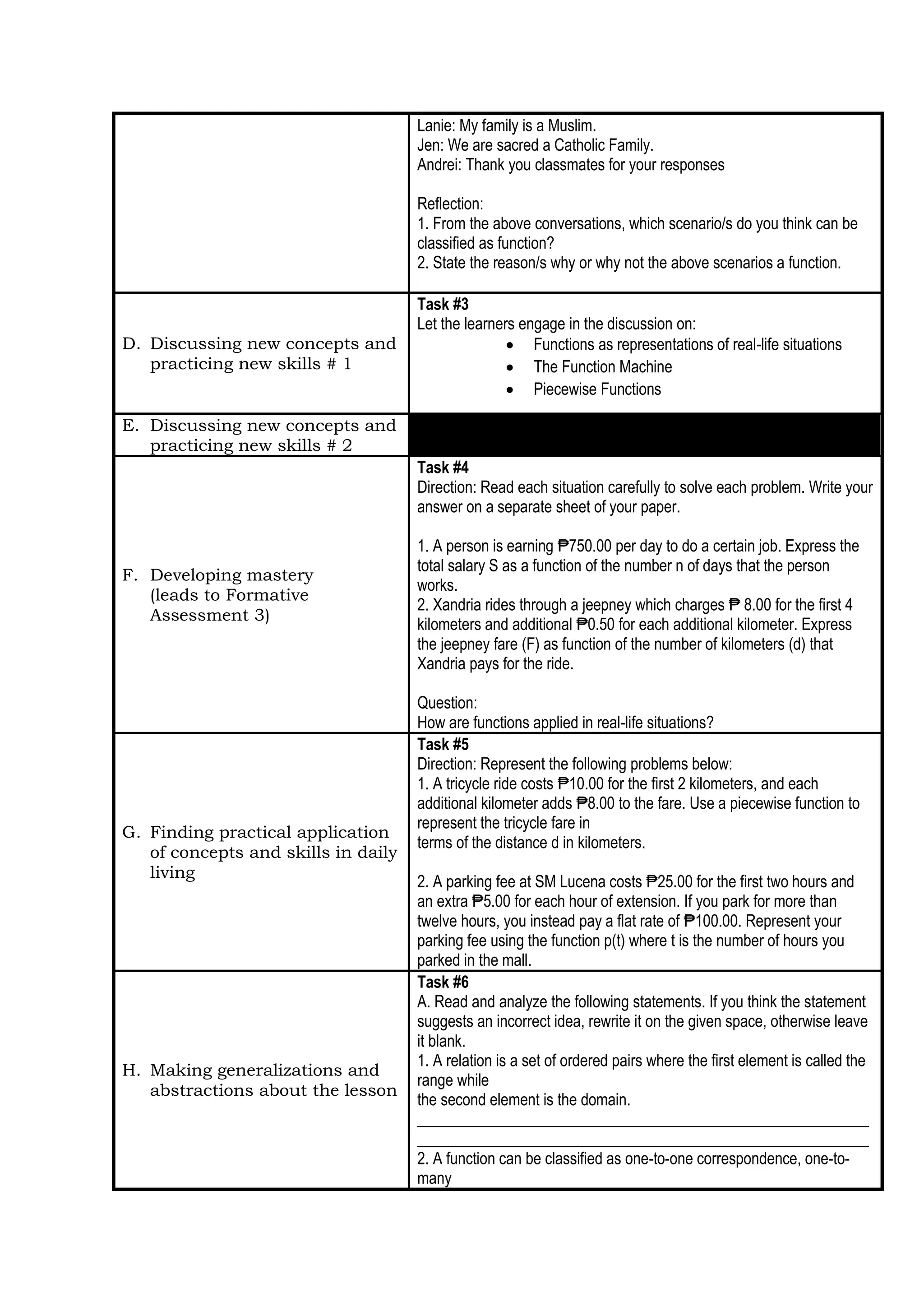
Lanie: My family is a Muslim.
Jen: We are sacred a Catholic Family.
Andrei: Thank you classmates for your responses
Reflection:
1. From the above conversations, which scenario/s do you think can be
classified as function?
2. State the reason/s why or why not the above scenarios a function.
D. Discussing new concepts and
practicing new skills # 1
Task #3
Let the learners engage in the discussion on:
 Functions as representations of real-life situations
 The Function Machine
 Piecewise Functions
E. Discussing new concepts and
practicing new skills # 2
F. Developing mastery
(leads to Formative
Assessment 3)
Task #4
Direction: Read each situation carefully to solve each problem. Write your
answer on a separate sheet of your paper.
1. A person is earning ₱750.00 per day to do a certain job. Express the
total salary S as a function of the number n of days that the person
works.
2. Xandria rides through a jeepney which charges ₱ 8.00 for the first 4
kilometers and additional ₱0.50 for each additional kilometer. Express
the jeepney fare (F) as function of the number of kilometers (d) that
Xandria pays for the ride.
Question:
How are functions applied in real-life situations?
G. Finding practical application
of concepts and skills in daily
living
Task #5
Direction: Represent the following problems below:
1. A tricycle ride costs ₱10.00 for the first 2 kilometers, and each
additional kilometer adds ₱8.00 to the fare. Use a piecewise function to
represent the tricycle fare in
terms of the distance d in kilometers.
2. A parking fee at SM Lucena costs ₱25.00 for the first two hours and
an extra ₱5.00 for each hour of extension. If you park for more than
twelve hours, you instead pay a flat rate of ₱100.00. Represent your
parking fee using the function p(t) where t is the number of hours you
parked in the mall.
H. Making generalizations and
abstractions about the lesson
Task #6
A. Read and analyze the following statements. If you think the statement
suggests an incorrect idea, rewrite it on the given space, otherwise leave
it blank.
1. A relation is a set of ordered pairs where the first element is called the
range while
the second element is the domain.
__________________________________________________________
__________________________________________________________
2. A function can be classified as one-to-one correspondence, one-to-
many
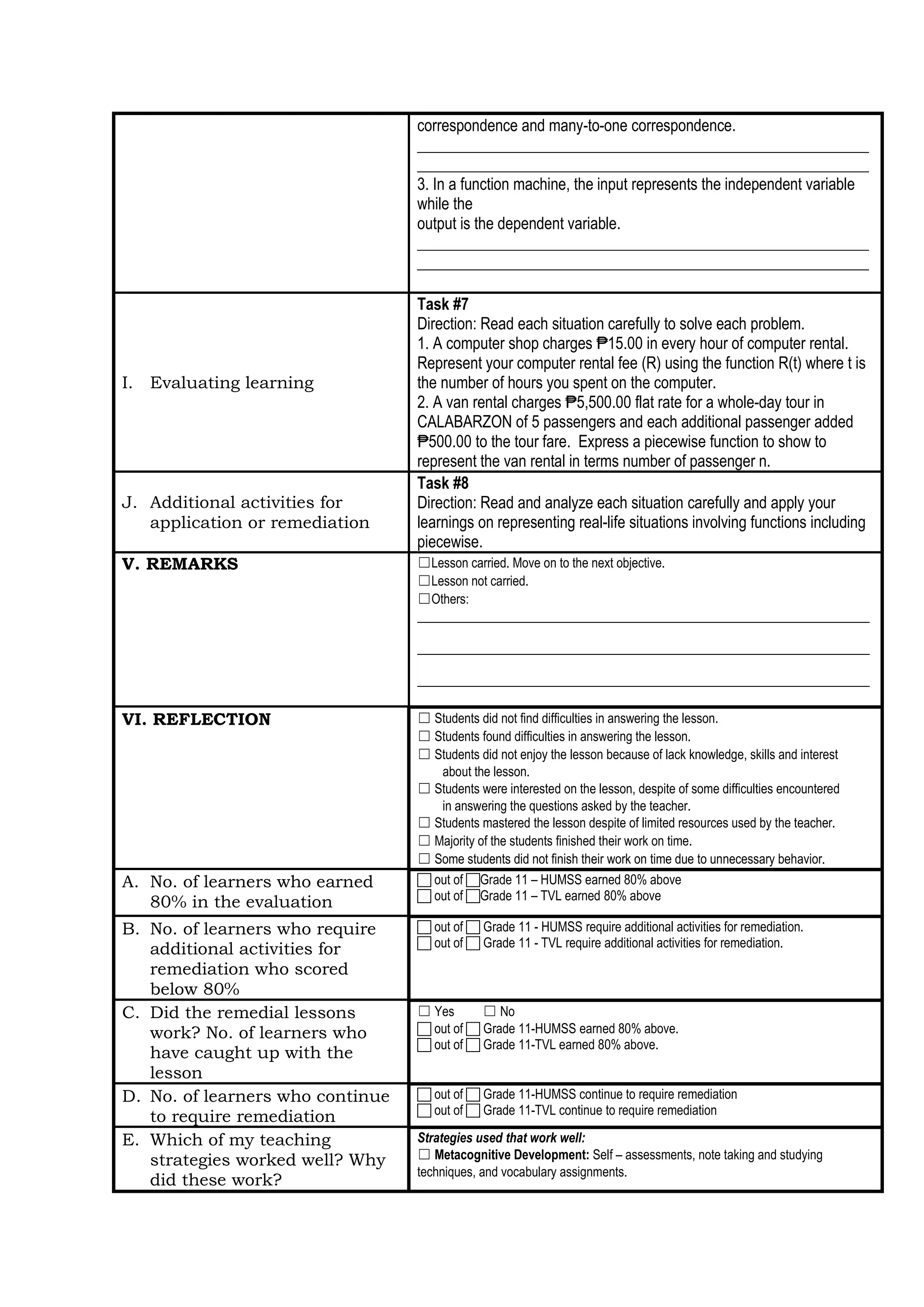
correspondence and many-to-one correspondence.
__________________________________________________________
__________________________________________________________
3. In a function machine, the input represents the independent variable
while the
output is the dependent variable.
__________________________________________________________
__________________________________________________________
I. Evaluating learning
Task #7
Direction: Read each situation carefully to solve each problem.
1. A computer shop charges ₱15.00 in every hour of computer rental.
Represent your computer rental fee (R) using the function R(t) where t is
the number of hours you spent on the computer.
2. A van rental charges ₱5,500.00 flat rate for a whole-day tour in
CALABARZON of 5 passengers and each additional passenger added
₱500.00 to the tour fare. Express a piecewise function to show to
represent the van rental in terms number of passenger n.
J. Additional activities for
application or remediation
Task #8
Direction: Read and analyze each situation carefully and apply your
learnings on representing real-life situations involving functions including
piecewise.
V. REMARKS ☐Lesson carried. Move on to the next objective.
☐Lesson not carried.
☐Others:
_______________________________________________________________________
_______________________________________________________________________
_______________________________________________________________________
VI. REFLECTION ☐ Students did not find difficulties in answering the lesson.
☐ Students found difficulties in answering the lesson.
☐ Students did not enjoy the lesson because of lack knowledge, skills and interest
about the lesson.
☐ Students were interested on the lesson, despite of some difficulties encountered
in answering the questions asked by the teacher.
☐ Students mastered the lesson despite of limited resources used by the teacher.
☐ Majority of the students finished their work on time.
☐ Some students did not finish their work on time due to unnecessary behavior.
A. No. of learners who earned
80% in the evaluation
 out of Grade 11 – HUMSS earned 80% above
 out of Grade 11 – TVL earned 80% above
B. No. of learners who require
additional activities for
remediation who scored
below 80%
 out of  Grade 11 - HUMSS require additional activities for remediation.
 out of  Grade 11 - TVL require additional activities for remediation.
C. Did the remedial lessons
work? No. of learners who
have caught up with the
lesson
☐ Yes ☐ No
 out of  Grade 11-HUMSS earned 80% above.
 out of  Grade 11-TVL earned 80% above.
D. No. of learners who continue
to require remediation
 out of  Grade 11-HUMSS continue to require remediation
 out of  Grade 11-TVL continue to require remediation
E. Which of my teaching
strategies worked well? Why
did these work?
Strategies used that work well:
☐ Metacognitive Development: Self – assessments, note taking and studying
techniques, and vocabulary assignments.
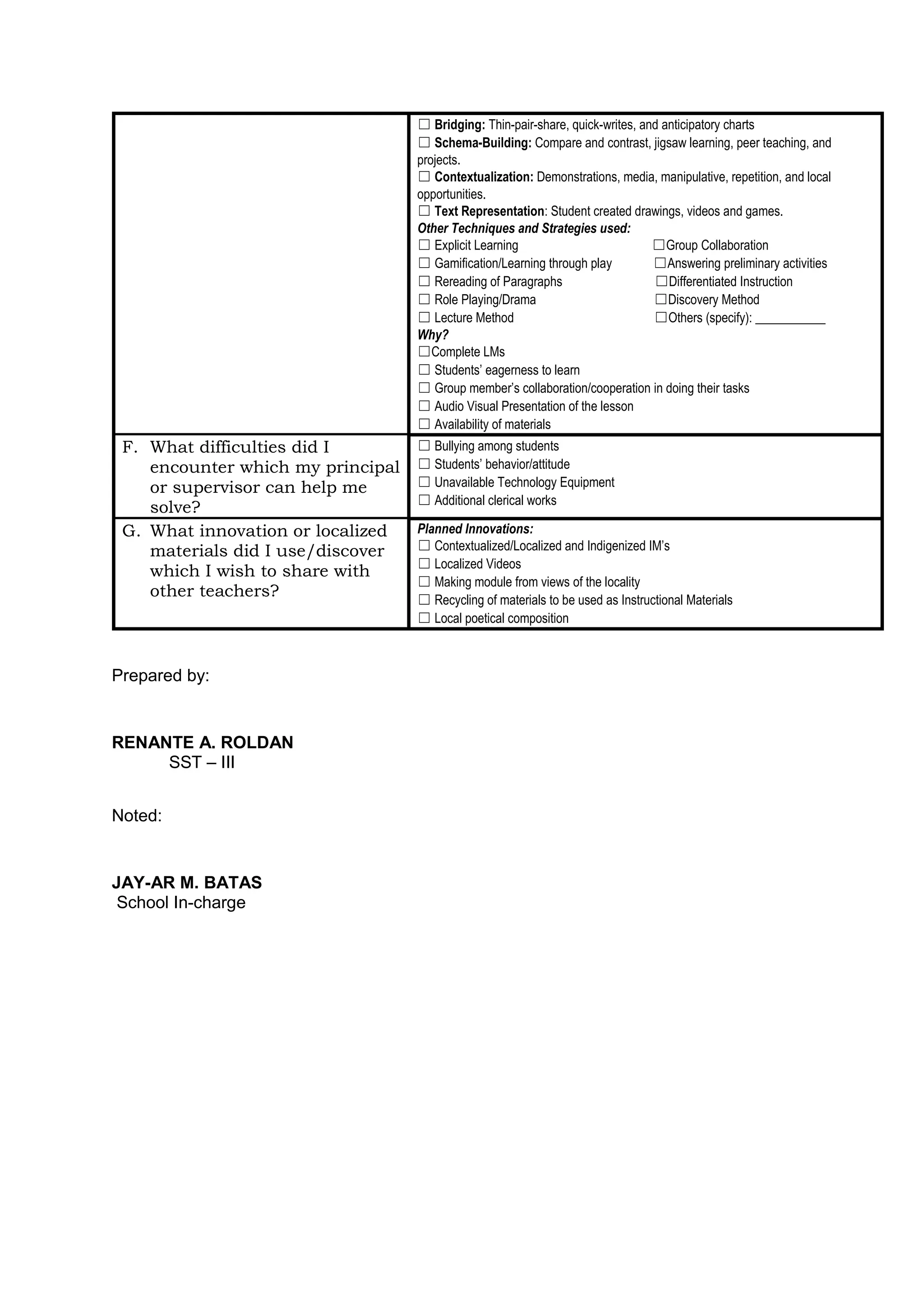
☐ Bridging: Thin-pair-share, quick-writes, and anticipatory charts
☐ Schema-Building: Compare and contrast, jigsaw learning, peer teaching, and
projects.
☐ Contextualization: Demonstrations, media, manipulative, repetition, and local
opportunities.
☐ Text Representation: Student created drawings, videos and games.
Other Techniques and Strategies used:
☐ Explicit Learning ☐Group Collaboration
☐ Gamification/Learning through play ☐Answering preliminary activities
☐ Rereading of Paragraphs ☐Differentiated Instruction
☐ Role Playing/Drama ☐Discovery Method
☐ Lecture Method ☐Others (specify): ___________
Why?
☐Complete LMs
☐ Students’ eagerness to learn
☐ Group member’s collaboration/cooperation in doing their tasks
☐ Audio Visual Presentation of the lesson
☐ Availability of materials
F. What difficulties did I
encounter which my principal
or supervisor can help me
solve?
☐ Bullying among students
☐ Students’ behavior/attitude
☐ Unavailable Technology Equipment
☐ Additional clerical works
G. What innovation or localized
materials did I use/discover
which I wish to share with
other teachers?
Planned Innovations:
☐ Contextualized/Localized and Indigenized IM’s
☐ Localized Videos
☐ Making module from views of the locality
☐ Recycling of materials to be used as Instructional Materials
☐ Local poetical composition
Prepared by:
RENANTE A. ROLDAN
SST – III
Noted:
JAY-AR M. BATAS
School In-charge

Daily Lesson Plan in General Mathematics

  • 1.
    GRADE 1 to12 DAILY LESSON LOG School Poctoy National High School Grade Level Teacher RENANTE A. ROLDAN Learning Area General Mathematics Teaching Dates and Time August 29, 2023 7:30 – 9:30 AM 11 – HUMSS August 30, 2023 1:00 – 2:00 PM 11 - TVL Quarter Week Quarter 1 Week 1 SESSION 1 I. OBJECTIVES Objectives must be met over the week and connected to the curriculum standards. To meet the objectives necessary procedures must be followed and if needed, additional lessons, exercises, and remedial activities may be done for developing content knowledge and competencies. These are assessed using Formative Assessment strategies. Valuing objectives support the learning of content and competencies and enable children to find significance and joy in learning the lessons. Weekly objectives shall be derived from the curriculum guides. A. Content Standard □The learner demonstrates understanding of key concepts of random variables and probability distributions. □The learner demonstrates understanding of key concepts of normal probability distribution. □The learner demonstrates understanding of key concepts of sampling and sampling distributions of the sample mean. □The learner demonstrates understanding of key concepts of estimation of population mean and proportion. B. Performance Standard □The learner is able to apply an appropriate random variable for a given real-life problem (such as in decision making and games of chance). □The learner is able to accurately formulate and solve real-life problems in different disciplines involving normal distribution. □The learner is able to apply suitable sampling and sampling distributions of the sample mean to solve real-life problems in different disciplines. □The learner is able to estimate the population mean and population proportion to make sound inferences in real-life problems in different disciplines. Learning Competency/Objectives Write the LC code for each. MELCs: Represent real-life situations using functions, including piece-wise functions. Specific Objectives: 1. recall the concepts of relations and functions. 2. define and explain functional relationship as a mathematical model of Situation. 3. represent real-life situations using functions, including piece-wise function. II. CONTENT Content is what the lesson is all about. It pertains to the subject matter that the teacher aims to teach in the CG, the content can be tackled in a week or two. III. LEARNING RESOURCES A. References
  • 2.
    1. Teacher’s Guidepages 2. Learner’s Materials pages 3. Textbook pages 4. Additional Materials from Learning Resource (LR)portal B. Other Learning Resource IV. PROCEDURES These steps should be done across the week. Spread out the activities appropriately so that students will learn well. Always be guided by demonstration of learning by the students which you can infer from formative assessment activities. Sustain learning systematically by providing students with multiple ways to learn new things, practice their learning, question their learning processes, and draw conclusions about what they learned in relation to their life experiences and previous knowledge. Indicate the time allotment for each step. A. Reviewing previous lesson or presenting the new lesson □ Ask the learners about their learning about relations and functions on their previous studies of mathematics. B. Establishing a purpose for the lesson Task #1. Mind Blow: □ Ask the learners about the statement: All FUNCTIONS are REALATIONS but not all RELATIONS are FUNCTIONS C. Presenting examples/Instances of the new lesson Task #2 Present to the class different scenario and ask them which of them are function. Scenario 3: As part of their requirements in Statistics class, Andrei made a survey on the religion of his classmates and here’s what he found out. Andrei: Good morning classmates, as our requirement in Statistics may I know your religion. This data will be part of my input in the survey that I am doing. Ana 1: I am a Catholic. Kevin: I am also a Catholic. Sam: I am a member of the Iglesia ni Cristo. Joey: I am a Born Again Christian.
  • 3.
    Lanie: My familyis a Muslim. Jen: We are sacred a Catholic Family. Andrei: Thank you classmates for your responses Reflection: 1. From the above conversations, which scenario/s do you think can be classified as function? 2. State the reason/s why or why not the above scenarios a function. D. Discussing new concepts and practicing new skills # 1 Task #3 Let the learners engage in the discussion on:  Functions as representations of real-life situations  The Function Machine  Piecewise Functions E. Discussing new concepts and practicing new skills # 2 F. Developing mastery (leads to Formative Assessment 3) Task #4 Direction: Read each situation carefully to solve each problem. Write your answer on a separate sheet of your paper. 1. A person is earning ₱750.00 per day to do a certain job. Express the total salary S as a function of the number n of days that the person works. 2. Xandria rides through a jeepney which charges ₱ 8.00 for the first 4 kilometers and additional ₱0.50 for each additional kilometer. Express the jeepney fare (F) as function of the number of kilometers (d) that Xandria pays for the ride. Question: How are functions applied in real-life situations? G. Finding practical application of concepts and skills in daily living Task #5 Direction: Represent the following problems below: 1. A tricycle ride costs ₱10.00 for the first 2 kilometers, and each additional kilometer adds ₱8.00 to the fare. Use a piecewise function to represent the tricycle fare in terms of the distance d in kilometers. 2. A parking fee at SM Lucena costs ₱25.00 for the first two hours and an extra ₱5.00 for each hour of extension. If you park for more than twelve hours, you instead pay a flat rate of ₱100.00. Represent your parking fee using the function p(t) where t is the number of hours you parked in the mall. H. Making generalizations and abstractions about the lesson Task #6 A. Read and analyze the following statements. If you think the statement suggests an incorrect idea, rewrite it on the given space, otherwise leave it blank. 1. A relation is a set of ordered pairs where the first element is called the range while the second element is the domain. __________________________________________________________ __________________________________________________________ 2. A function can be classified as one-to-one correspondence, one-to- many
  • 4.
    correspondence and many-to-onecorrespondence. __________________________________________________________ __________________________________________________________ 3. In a function machine, the input represents the independent variable while the output is the dependent variable. __________________________________________________________ __________________________________________________________ I. Evaluating learning Task #7 Direction: Read each situation carefully to solve each problem. 1. A computer shop charges ₱15.00 in every hour of computer rental. Represent your computer rental fee (R) using the function R(t) where t is the number of hours you spent on the computer. 2. A van rental charges ₱5,500.00 flat rate for a whole-day tour in CALABARZON of 5 passengers and each additional passenger added ₱500.00 to the tour fare. Express a piecewise function to show to represent the van rental in terms number of passenger n. J. Additional activities for application or remediation Task #8 Direction: Read and analyze each situation carefully and apply your learnings on representing real-life situations involving functions including piecewise. V. REMARKS ☐Lesson carried. Move on to the next objective. ☐Lesson not carried. ☐Others: _______________________________________________________________________ _______________________________________________________________________ _______________________________________________________________________ VI. REFLECTION ☐ Students did not find difficulties in answering the lesson. ☐ Students found difficulties in answering the lesson. ☐ Students did not enjoy the lesson because of lack knowledge, skills and interest about the lesson. ☐ Students were interested on the lesson, despite of some difficulties encountered in answering the questions asked by the teacher. ☐ Students mastered the lesson despite of limited resources used by the teacher. ☐ Majority of the students finished their work on time. ☐ Some students did not finish their work on time due to unnecessary behavior. A. No. of learners who earned 80% in the evaluation  out of Grade 11 – HUMSS earned 80% above  out of Grade 11 – TVL earned 80% above B. No. of learners who require additional activities for remediation who scored below 80%  out of  Grade 11 - HUMSS require additional activities for remediation.  out of  Grade 11 - TVL require additional activities for remediation. C. Did the remedial lessons work? No. of learners who have caught up with the lesson ☐ Yes ☐ No  out of  Grade 11-HUMSS earned 80% above.  out of  Grade 11-TVL earned 80% above. D. No. of learners who continue to require remediation  out of  Grade 11-HUMSS continue to require remediation  out of  Grade 11-TVL continue to require remediation E. Which of my teaching strategies worked well? Why did these work? Strategies used that work well: ☐ Metacognitive Development: Self – assessments, note taking and studying techniques, and vocabulary assignments.
  • 5.
    ☐ Bridging: Thin-pair-share,quick-writes, and anticipatory charts ☐ Schema-Building: Compare and contrast, jigsaw learning, peer teaching, and projects. ☐ Contextualization: Demonstrations, media, manipulative, repetition, and local opportunities. ☐ Text Representation: Student created drawings, videos and games. Other Techniques and Strategies used: ☐ Explicit Learning ☐Group Collaboration ☐ Gamification/Learning through play ☐Answering preliminary activities ☐ Rereading of Paragraphs ☐Differentiated Instruction ☐ Role Playing/Drama ☐Discovery Method ☐ Lecture Method ☐Others (specify): ___________ Why? ☐Complete LMs ☐ Students’ eagerness to learn ☐ Group member’s collaboration/cooperation in doing their tasks ☐ Audio Visual Presentation of the lesson ☐ Availability of materials F. What difficulties did I encounter which my principal or supervisor can help me solve? ☐ Bullying among students ☐ Students’ behavior/attitude ☐ Unavailable Technology Equipment ☐ Additional clerical works G. What innovation or localized materials did I use/discover which I wish to share with other teachers? Planned Innovations: ☐ Contextualized/Localized and Indigenized IM’s ☐ Localized Videos ☐ Making module from views of the locality ☐ Recycling of materials to be used as Instructional Materials ☐ Local poetical composition Prepared by: RENANTE A. ROLDAN SST – III Noted: JAY-AR M. BATAS School In-charge