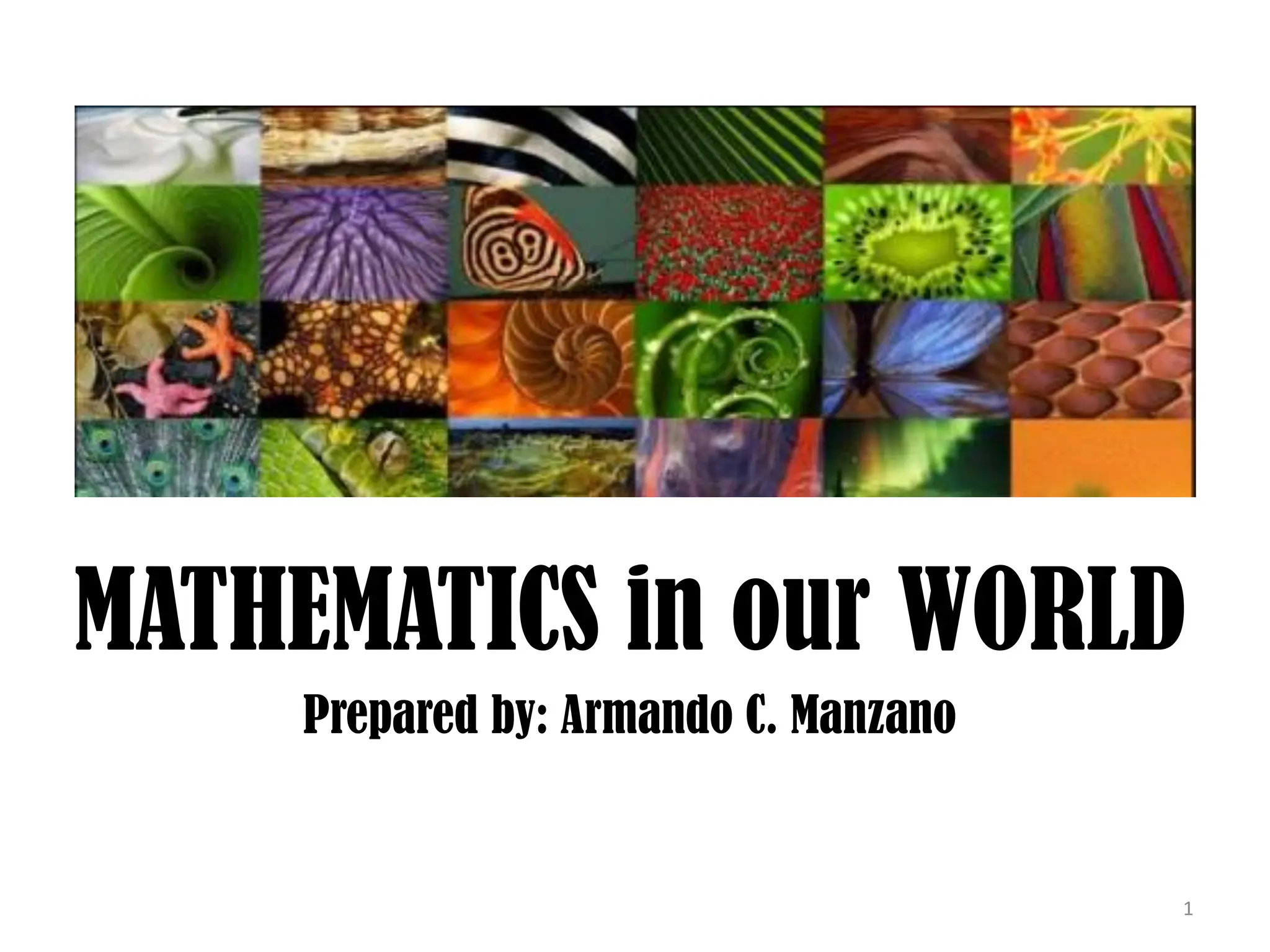
MATHEMATICS in our WORLD
Prepared by: Armando C. Manzano
1
Video watching
Nature by Numbers by Cristobal Vila
Nature by Numbers - Cristóbal Vila
(2010).mp4
https://www.youtube.com/watch?v=tnkLDFpgix4
https://www.youtube.com/watch?v=Ig9RUaJe00c
https://www.youtube.com/watch?v=Mpvy36S6jEU
https://www.youtube.com/watch?v=QEzlsjAqADA
click https://www.youtube.com/watch?v=QEzlsjAqADA
2
Pair - sharing
What is Mathematics?
• Mathematics is defined as the study of numbers and
arithmetic operations. Others describe mathematics as a
set of tools or a collection of skills that can be applied
to questions of ‘how many” or “how much.” Still,
others view it is a science which involves logical
reasoning, drawing conclusions from assumed
premises, and strategic reasoning based on accepted
rules, laws, or probabilities. Mathematics is also
considered an art which studies patters for
predictive purposes or a specialized language which
deals with form, size, and quantity.
3
• Whatever point of view is taken, there is no denying the fact that mathematics is
universal. People from around the world use math to get things done. It helps them
perform daily tasks as well as make important decisions like buying wisely,
choosing the most appropriate insurance plan, or even betting on an outcome with
the highest chance of actually occurring. The same mathematical concepts and
language are applied regardless of whether the users are Asians, Americans,
Africans or Europeans.
•
4
• In examining the development of mathematics from historical perspective, it
can be seen that much has been directed towards describing patterns of relationship
that are of interest to various individuals. Patterns arouse curiosity because they can
be directly related to common human experiences.
5
• mathematics as study of patterns and
mathematics as a language.
6
A Study of Patterns
• A pattern is arrangement which helps observes anticipate what they might
see or what happen next. A pattern also shown what may have come before. A
pattern organizes information so that it becomes more useful. The human mind is
programmed to make sense of data to bring or to bring order where there is
disorder. It seeks discover relationships and connections between seemingly
unrelated bits of information. In doings so, it sees patterns.
7
A. Patterns and Numbers in Nature
and the World
• Human mind and culture have developed a
formal system of thought for recognizing,
classifying, and exploiting patterns called
mathematics.
• By using mathematics to organize and
systematize our ideas about patterns, we have
discovered a great secret: nature’s patterns are
not just there to be admired, they are vital clues
to the rules that governs natural processes.
8
Here are examples of pattern-seeking behavior of humans from childhood to adulthood:
• A toddler separates blue blocks from red blocks.
• A kindergarten student learns to count.
• A first grader does skip counting.
• A third grader notices that multiplies of two are even numbers.
• A sixth grader creates patterns that cover a plane.
• A junior high school student learns that a function is essentially a pattern of how
one number is transformed to another.
• A college biology undergraduate studies the sequence of DNA and proteins.
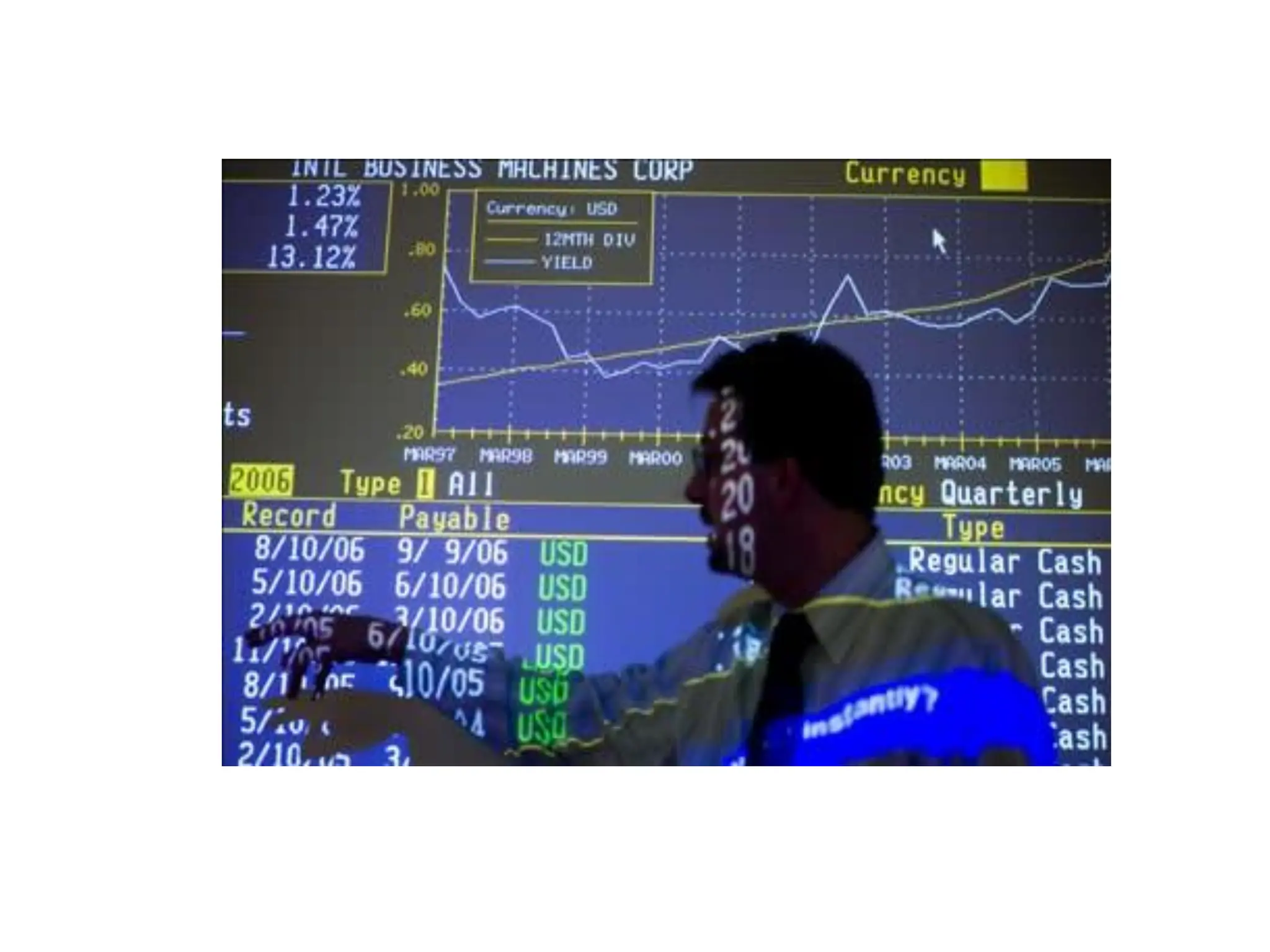
• A stock trader studies trends in the stock market.
• A weatherman makes weather forecast based on atmospheric patterns.
• A doctor decides who is healthy and who is not by recognizing a certain health
patterns.
9
A. Patterns and Numbers in Nature and the
World
We live in a universe of patterns!
1. The snowflake
2. The honeycomb
3. The sunflower
4. The snail’s shell
5. Flower’s petals
6. Weather
10
DESIGNS IN NATURE
Bilateral Symmetry
ANG
KALIKASAN
Matematika sa MakabagongDaigdig-
DMMSU
NG
MATEMATIKA
Radial Symmetry
The Snowflakes
12
Tiger’s stripes
(guhit sa balat ng
tigre)
Hyena’s spots
(batik ng
hyena)
Honeycomb
(bahay-
pukyutan)
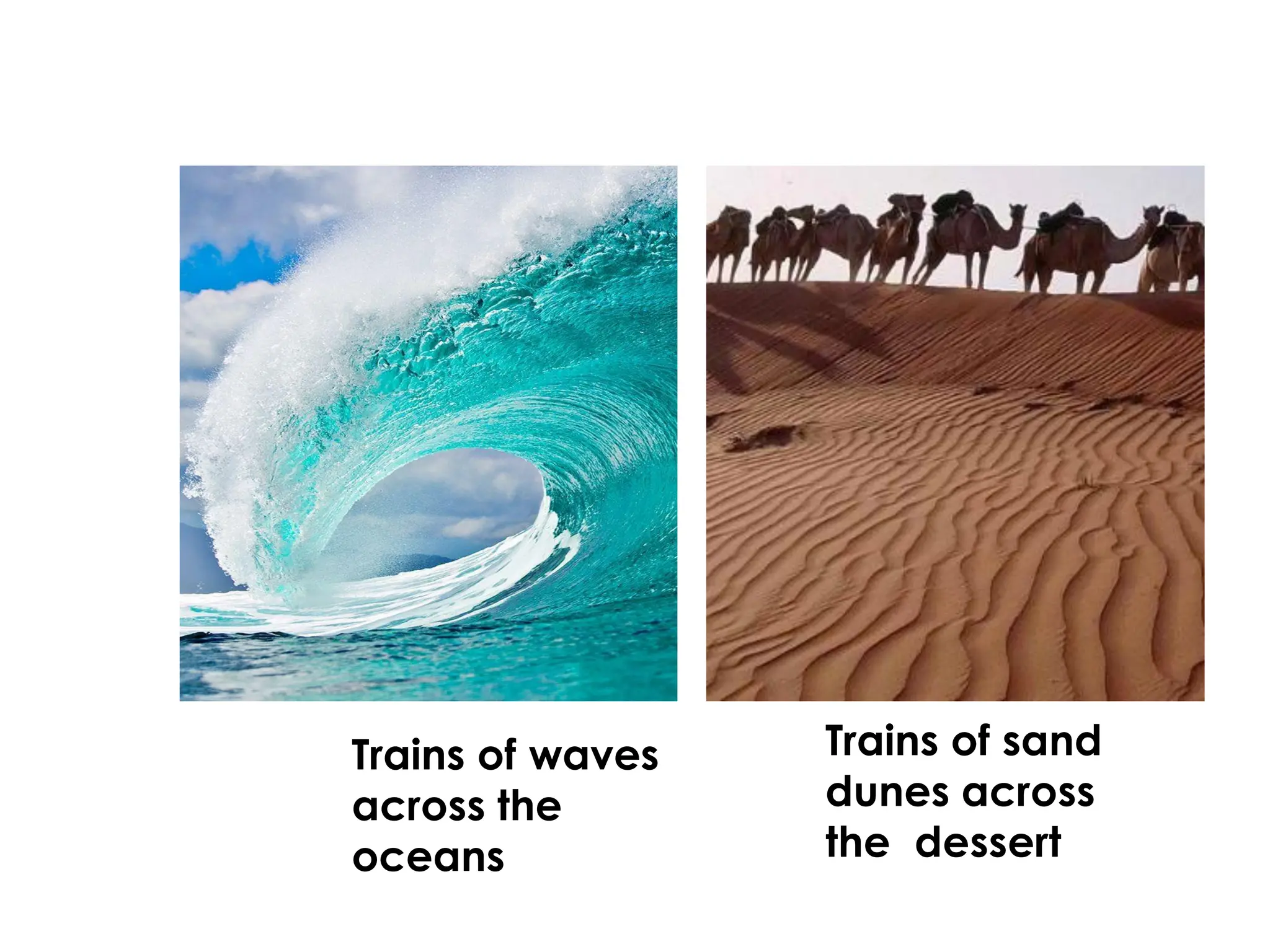
Trains of waves
across the
oceans
Trains of sand
dunes across
the dessert
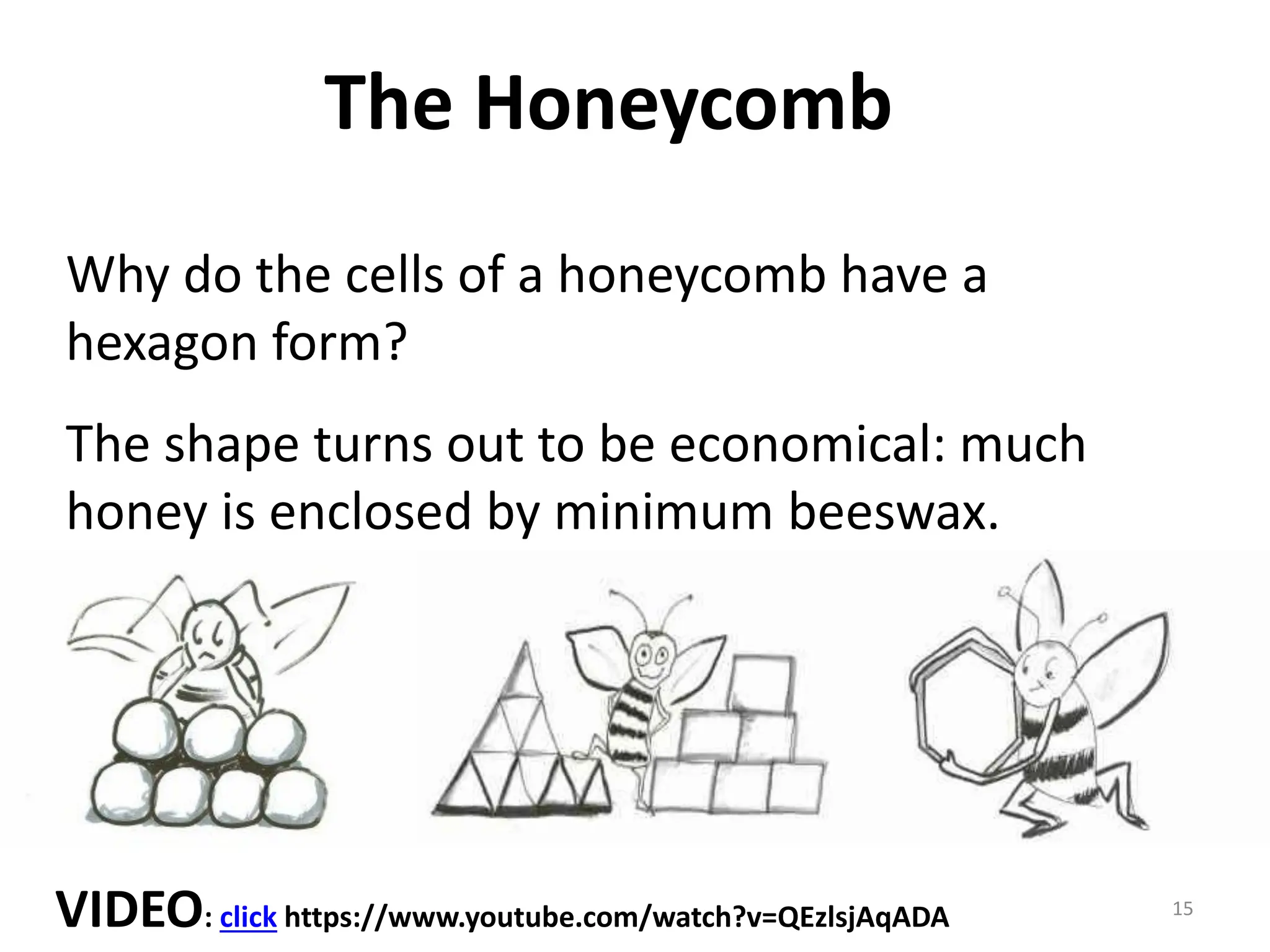
The Honeycomb
15
Why do the cells of a honeycomb have a
hexagon form?
The shape turns out to be economical: much
honey is enclosed by minimum beeswax.
VIDEO: click https://www.youtube.com/watch?v=QEzlsjAqADA
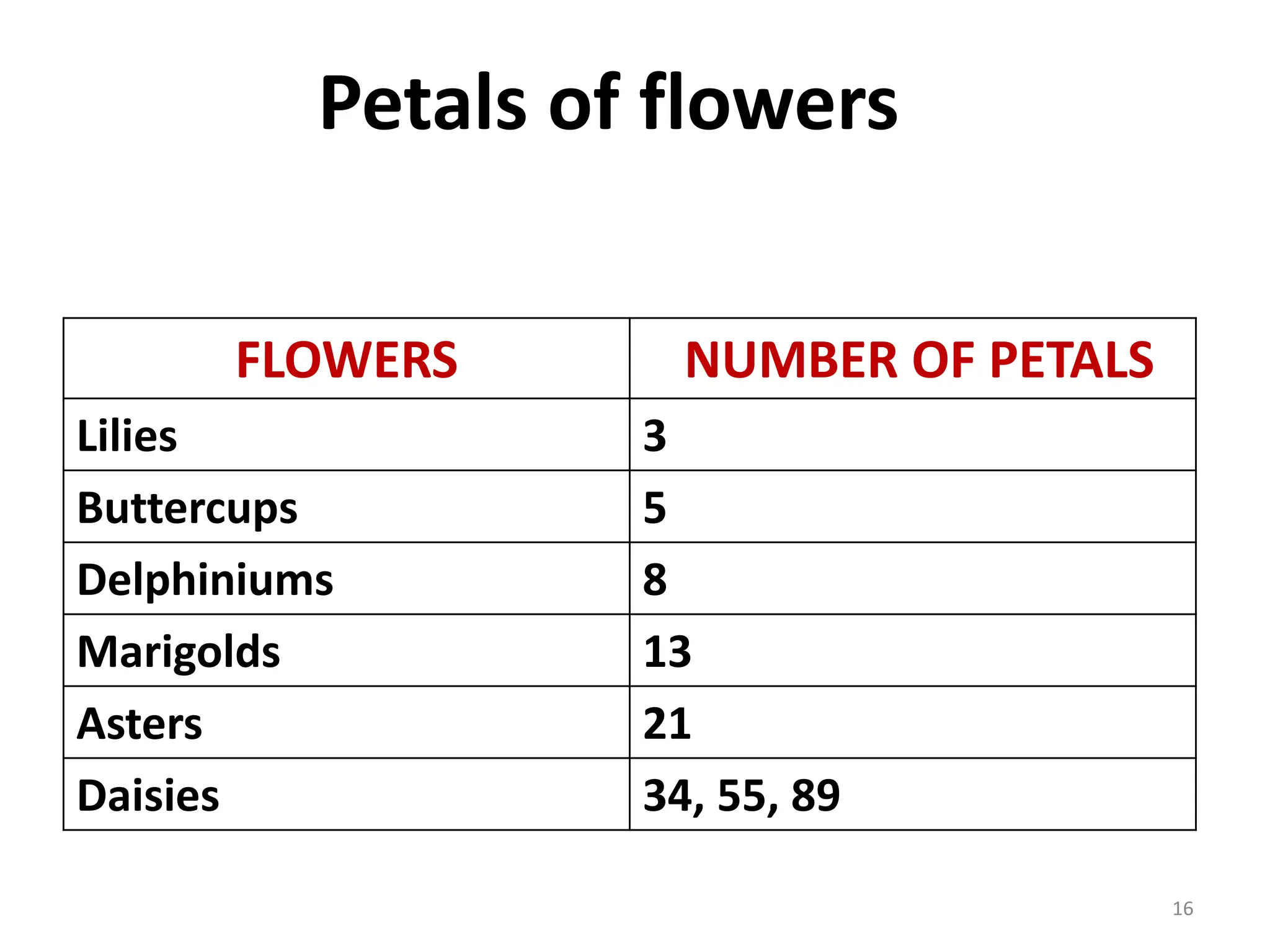
Petals of flowers
FLOWERS NUMBER OF PETALS
Lilies 3
Buttercups 5
Delphiniums 8
Marigolds 13
Asters 21
Daisies 34, 55, 89
16
Sa mga
bulaklak…
One- petalled
White calla
lily
Two-
petalled
Euphorbia
more
…
Three-
petalled
Trillium
Five-
petalled
Columbine
Eight-
petalled
Bloodroot
ANG KALIASAN
More
…
Thirteen-
petalled Black-
eyed susan
21-
petalled
shasta
daisy
34-
petalled
Field
daisy
AN KALIKASAN
NG MATEATIKA
The Sunflower
20
Seed patterns of sunflower
All the sunflowers in the world show a number
of spirals that are within the Fibonacci sequence
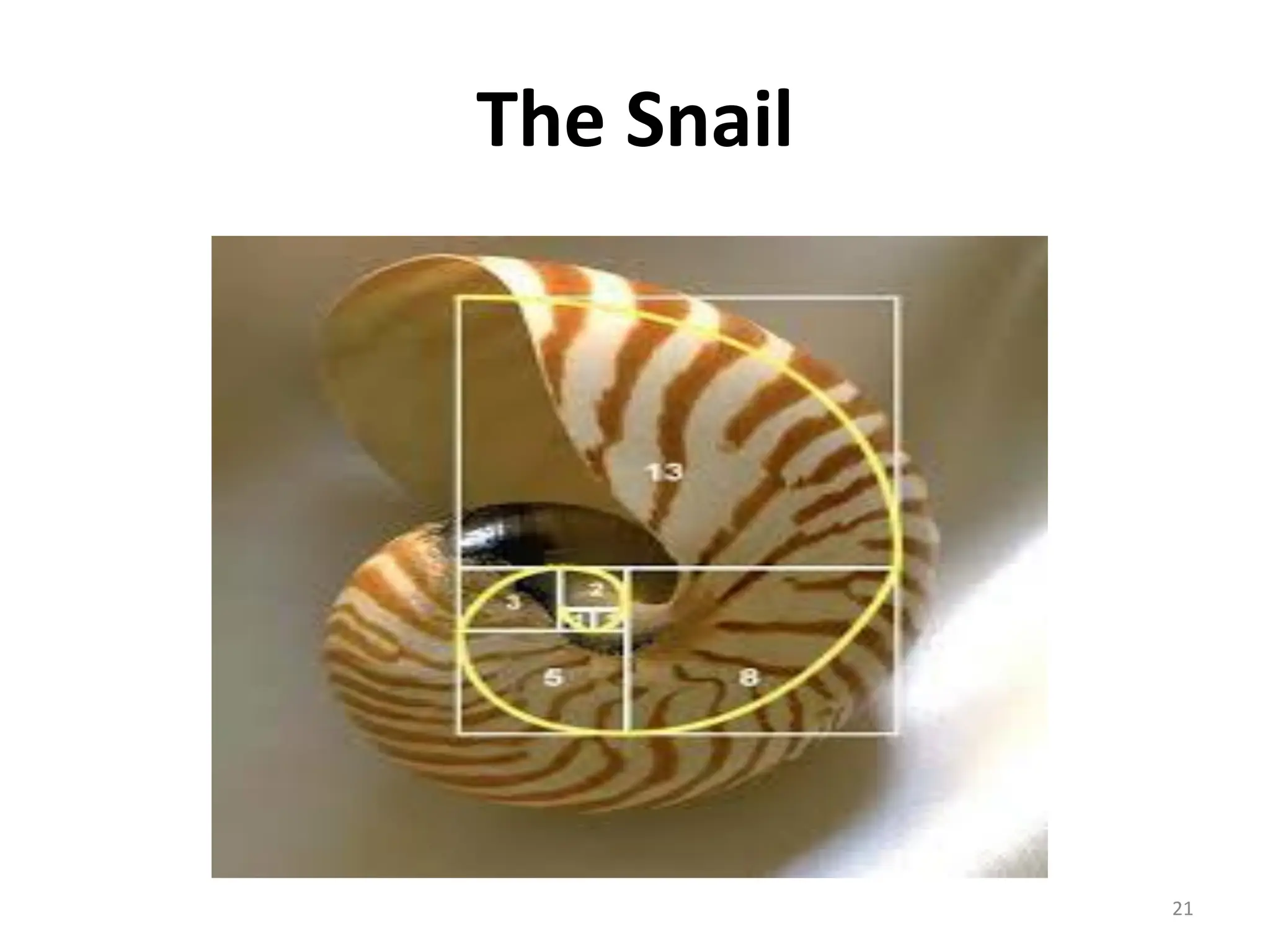
The Snail
21
Cycle of Seasons
22
Mathematics is the study of patterns
That is one reason why those who use patterns to analyze and solve problems often
find success.
Examples of various patterns.
1. Logic Patterns. Logic patterns are usually the first to be
observed. Classifying things, for example, comes before
numeration. Being able to tell which things are blocks and
which are not precedes learning to count blocks. One kind of
logic pattern deals with the characteristics of various objects
while another deals with order. These patterns are seen on
aptitude tests in which takers are shown a sequence of pictures
and asked to select which figure comes next among several
choices.
23
2. Geometric Patterns- A geometric patterns is a motif or design that
depicts abstract shapes like lines, polygons, and circles, and typically
repeats like a wallpaper. Visual patterns are observed in nature and in art. In
art, patterns present objects in a consistent, regular manners. They appear in
paintings, drawings, tapestries, wallpapers, tilings, and carpets. A pattern
does not repeat exactly as long as long as it provides a way of “organizing”
the artwork. Patterns in nature are often more chaotic. Nature provides many
examples patterns, including symmetries, spirals, tilings, stripes, and
fractional dimensions.
3. Word Patterns- Patterns can also be found in language like the
morphological rules in pluralizing nouns or conjugating verbs for tense, as
well as the metrical rules of poetry. Each of these examples supports
mathematical and natural language understanding. The focus here is patterns
in form and syntax, which lead directly to the study of language in general
and digital communication in particular.
• Knife: knives life: lives wife: ?
24
• It cannot be overstated that it is important to
understand how mathematics regarded as the
study of patterns to become familiar with some
of those patterns and use them in daily life. For
most people, learning mathematics as an
abstract concept before understanding how to
use it does not work. More effort must be
exerted to expose students to mathematical
patterns in various context before, during, and
after its introduction in the subject.
25
Example of Different Pattern
Logic Pattern
26
Geometric Pattern
27
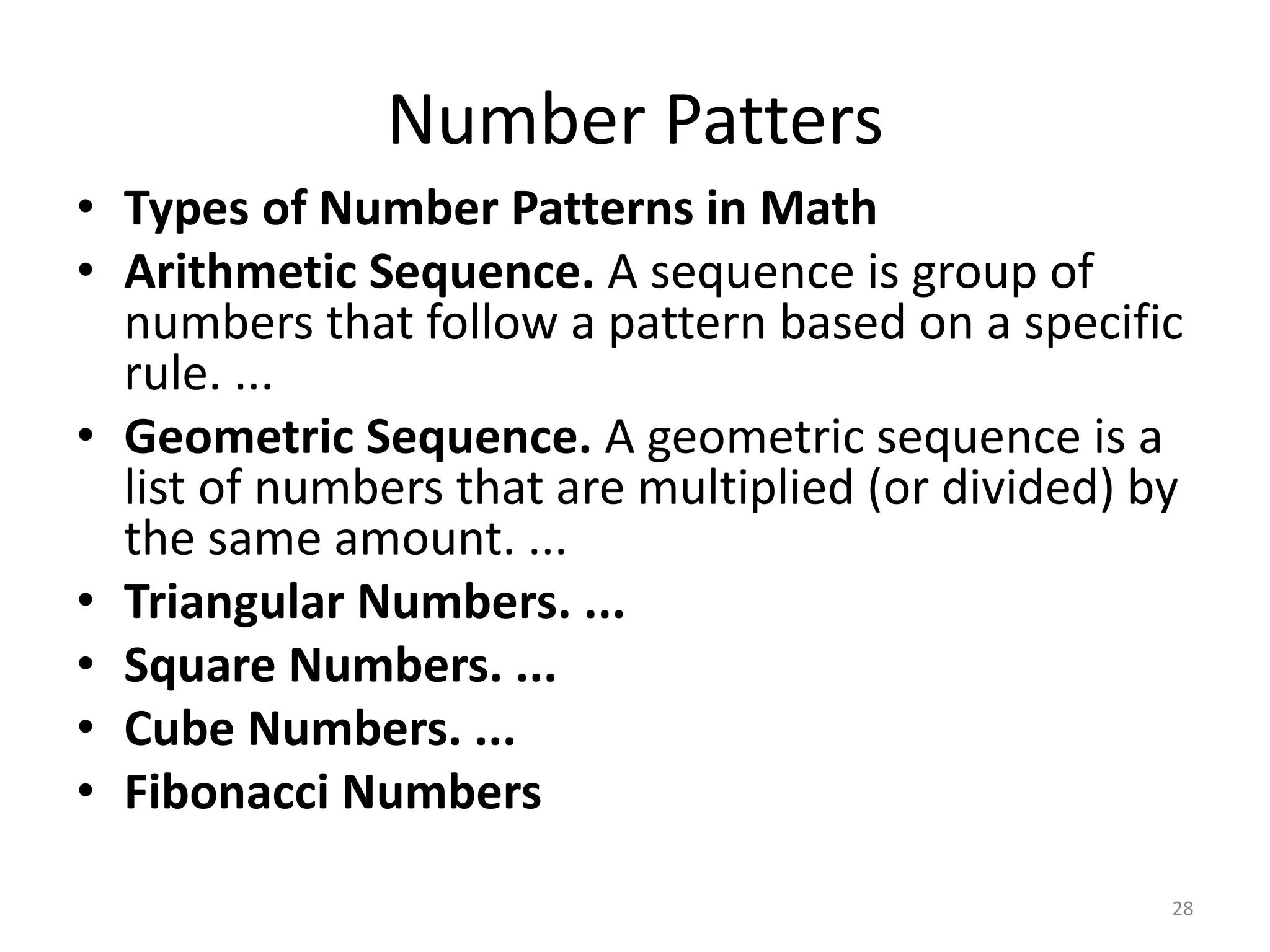
Number Patters
28
• Types of Number Patterns in Math
• Arithmetic Sequence. A sequence is group of
numbers that follow a pattern based on a specific
rule. ...
• Geometric Sequence. A geometric sequence is a
list of numbers that are multiplied (or divided) by
the same amount. ...
• Triangular Numbers. ...
• Square Numbers. ...
• Cube Numbers. ...
• Fibonacci Numbers
B. The Fibonacci Sequence
Think of this!
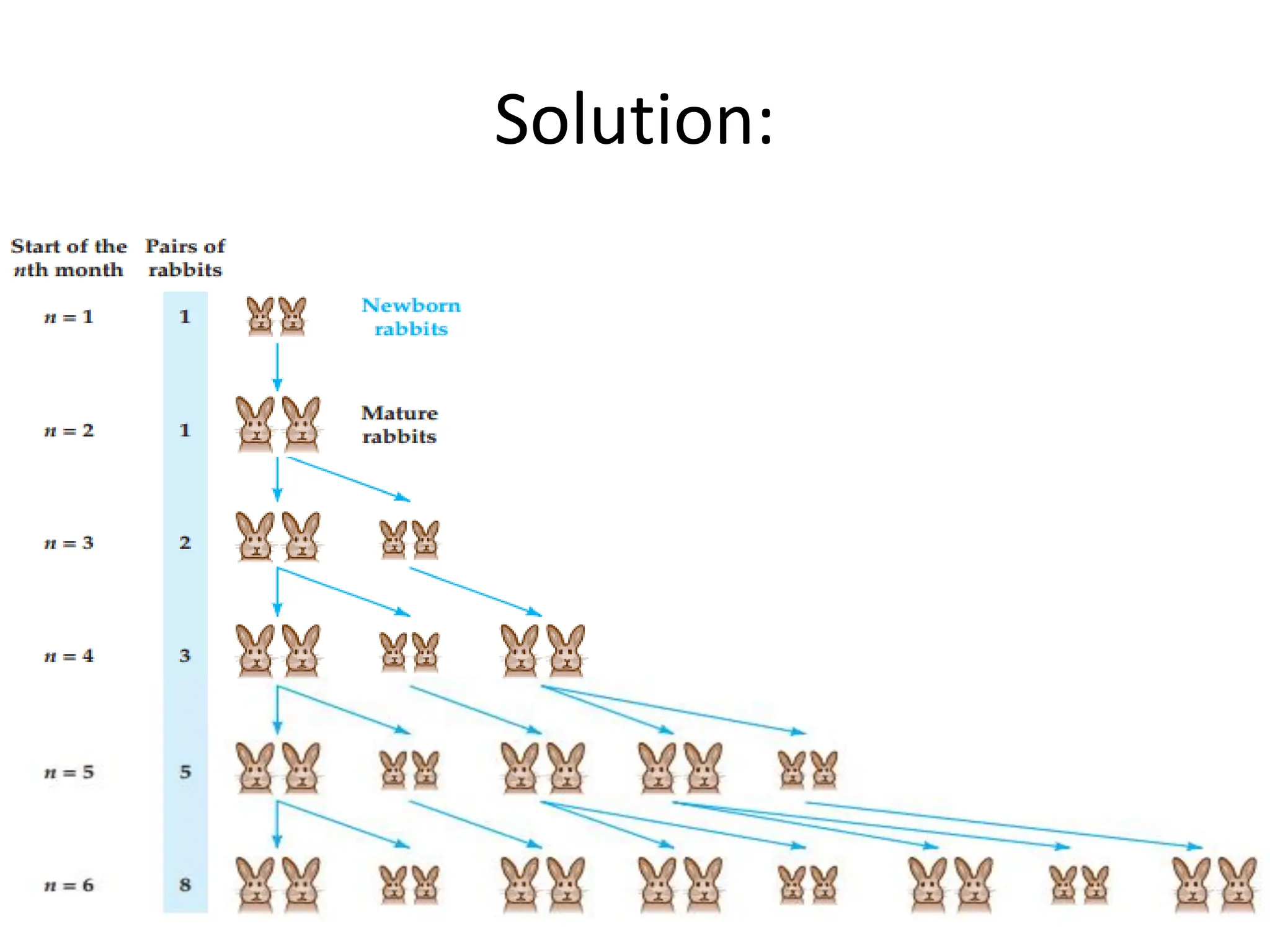
At the beginning of a month, you are given a
pair of newborn rabbits. After a month the rabbits
have produced no offspring; however, every month
thereafter, the pair of rabbits produces another pair
of rabbits. The offspring reproduce in exactly the
same manner. If none of the rabbits dies, how many
pairs of rabbits will there be at the start of each
succeeding month?
At the start of 4th month, how many pairs of
rabbits will there be?
How about at the start of the 5th and 6th
months? 29
Solution:
30
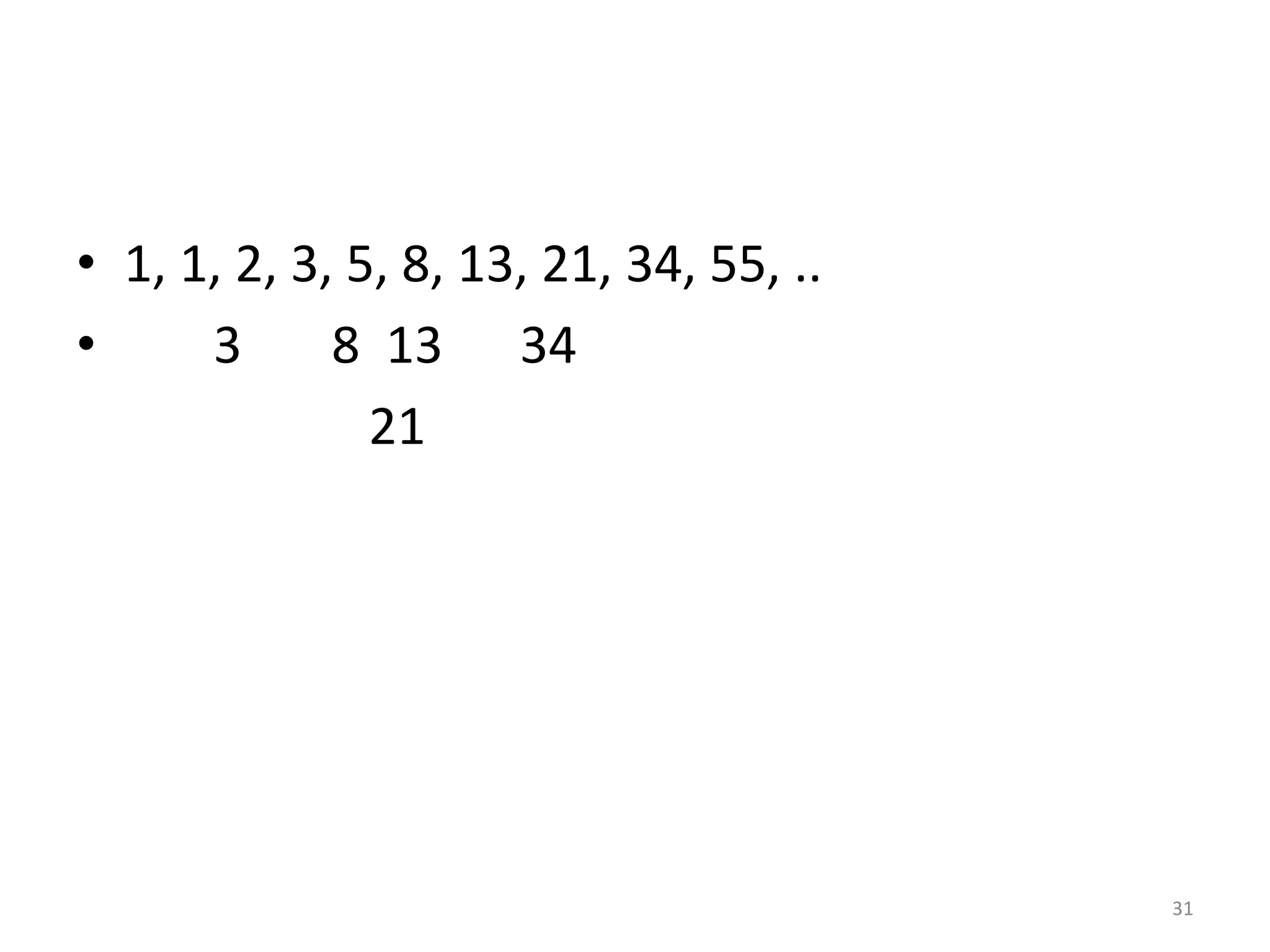
• 1, 1, 2, 3, 5, 8, 13, 21, 34, 55, ..
• 3 8 13 34
21
31
Fibonacci Numbers
• Fibonacci Number is an integer in the
infinite sequence of which the first two
terms are 1 and 1 and each succeeding
term is the sum of the two immediately
preceding.
• The numbers are named after Fibonacci
also known as Leonardo of Pisa or
Leonardo Pisano.
32
• Fibonacci discovered that the number of
pairs of rabbits for any month after the
first two months can be determined by
adding the numbers of pairs of rabbits in
each of the two previous months. For
instance, the number of pairs of rabbits
at the start of the sixth month is 3 + 5 =
8.
33
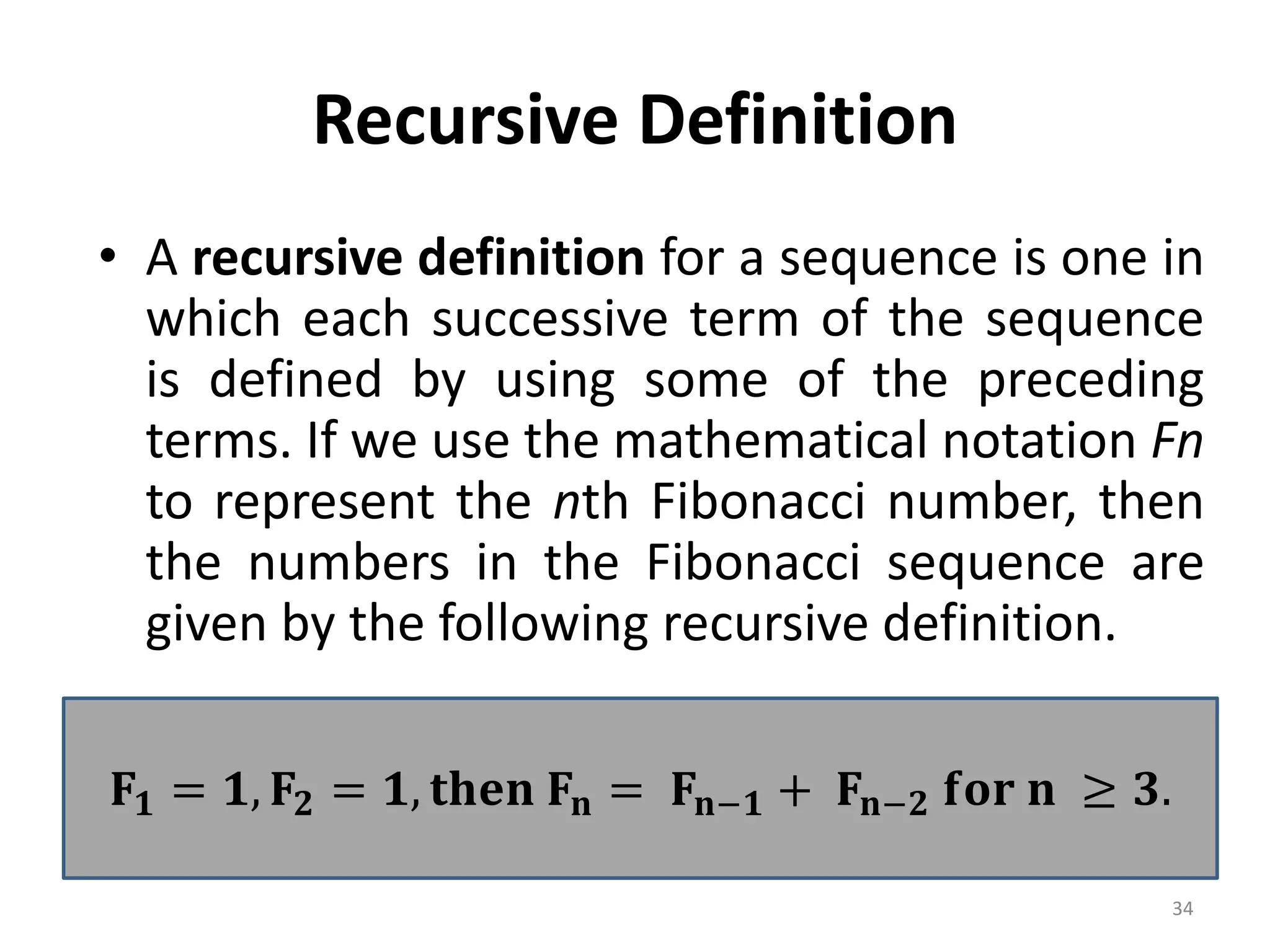
Recursive Definition
• A recursive definition for a sequence is one in
which each successive term of the sequence
is defined by using some of the preceding
terms. If we use the mathematical notation Fn
to represent the nth Fibonacci number, then
the numbers in the Fibonacci sequence are
given by the following recursive definition.
34
𝐅𝟏 = 𝟏, 𝐅𝟐 = 𝟏, 𝐭𝐡𝐞𝐧 𝐅𝐧 = 𝐅𝐧−𝟏 + 𝐅𝐧−𝟐 𝐟𝐨𝐫 𝐧 ≥ 𝟑.
Binet’s Formula
• The following formula is known as Binet’s formula for
the nth Fibonacci number.
𝐅𝐧 =
𝟏
𝟓
𝟏 + 𝟓
𝟐
𝐧
−
𝟏 − 𝟓
𝟐
𝐧
The advantage of this formula over the recursive formula
𝐅𝐧 = 𝐅𝐧−𝟏 + 𝐅𝐧−𝟐
is that you can determine the nth Fibonacci number
without finding the two preceding Fibonacci numbers.
35
Exercise 1
• Use the definition of Fibonacci
numbers to find the eleventh and
twelfth Fibonacci numbers.
Answers:
Eleventh = 89
Twelfth = 144
36
Exercise 2
• Use Binet’s formula and a calculator to
find the 20th, 30th, and 40th Fibonacci
numbers.
Answers:
• 20th = 6,765
• 30th = 832,040
• 40th = 102,334,155
37
Exercise 2
• Use Binet’s formula and a calculator to
find the 20th, 30th, and 40th Fibonacci
numbers.
Answers:
• 20th = 6,765
• 30th = 832,040
• 40th = 102,334,155
38
Fibonacci in Pineapple or Pine
cone
Pineapples have spirals formed by their
hexagonal nubs. The nubs on many pineapples
form 8 spirals that rotate diagonally upward to
the left and 13 spirals that rotate diagonally
upward to the right. The numbers 8 and 13 are
consecutive Fibonacci numbers.
39
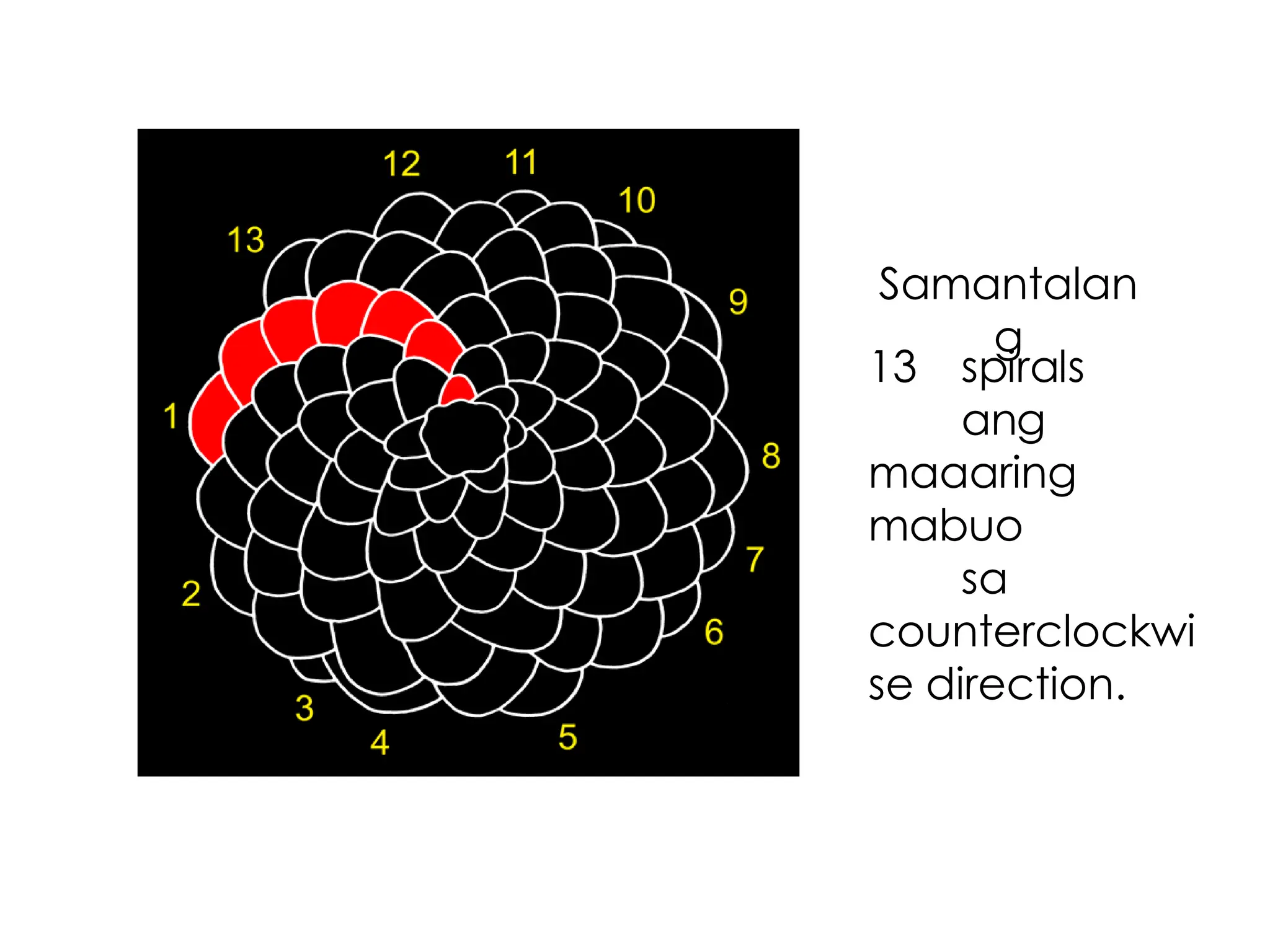
Fibonacci numbers on the scalesof pinecones.
8 spirals ang maaaring mabuo sa clockwise
direction.
Samantalan
g
13 spirals
ang
maaaring
mabuo
sa
counterclockwi
se direction.
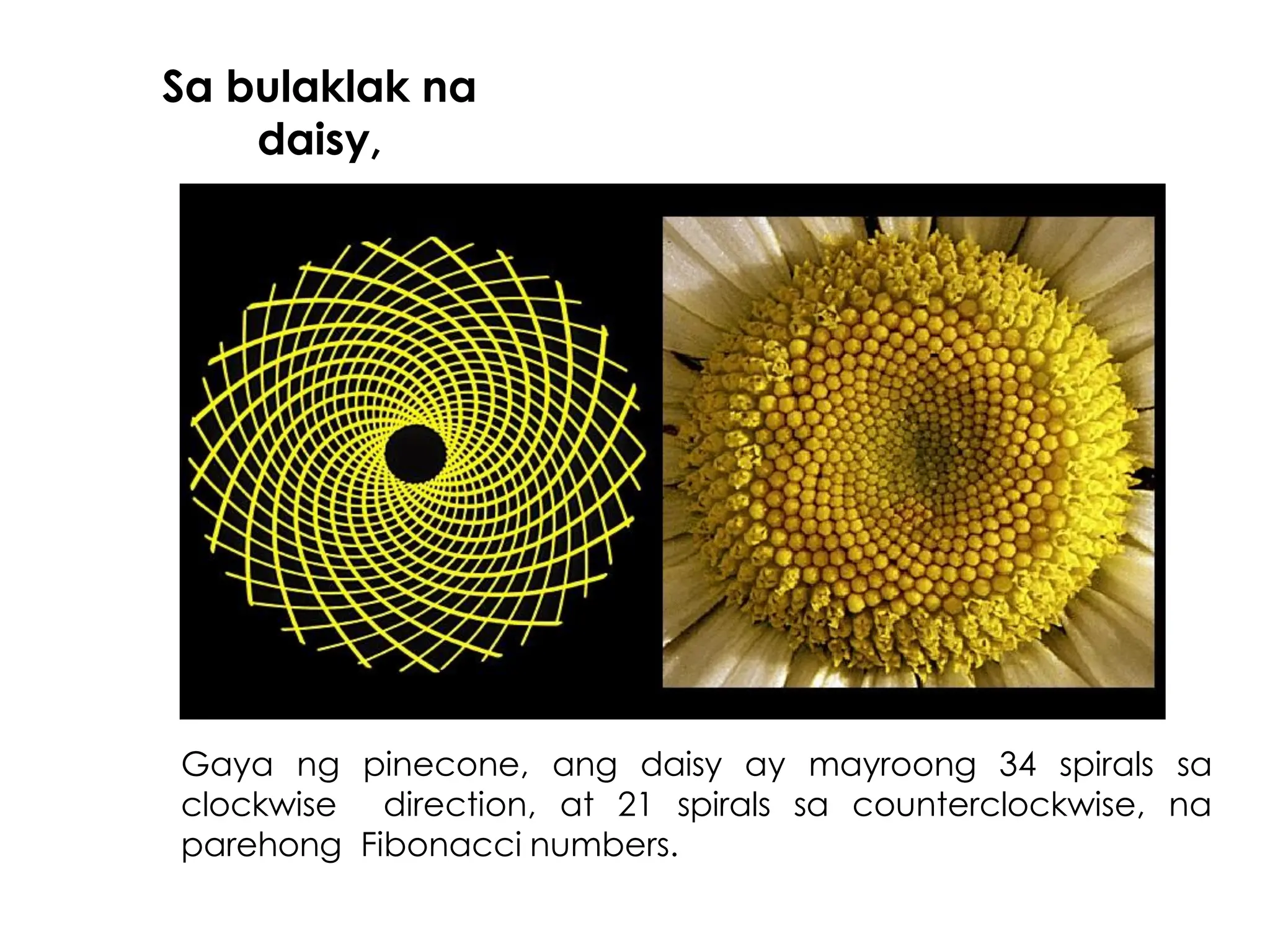
Sa bulaklak na
daisy,
Gaya ng pinecone, ang daisy ay mayroong 34 spirals sa
clockwise direction, at 21 spirals sa counterclockwise, na
parehong Fibonacci numbers.
Fibonacci in Sunflower
The seeds on a sunflower are arranged in
spirals that curve both clockwise and
counterclockwise from the center of the
sunflower’s head to its outer edge. In many
sunflowers, the number of clockwise spirals and
the number of counterclockwise spirals are
consecutive Fibonacci numbers. The number of
clockwise spirals is 34 and the number of
counterclockwise spirals is 55.
43
Fibonacci in Plants
44
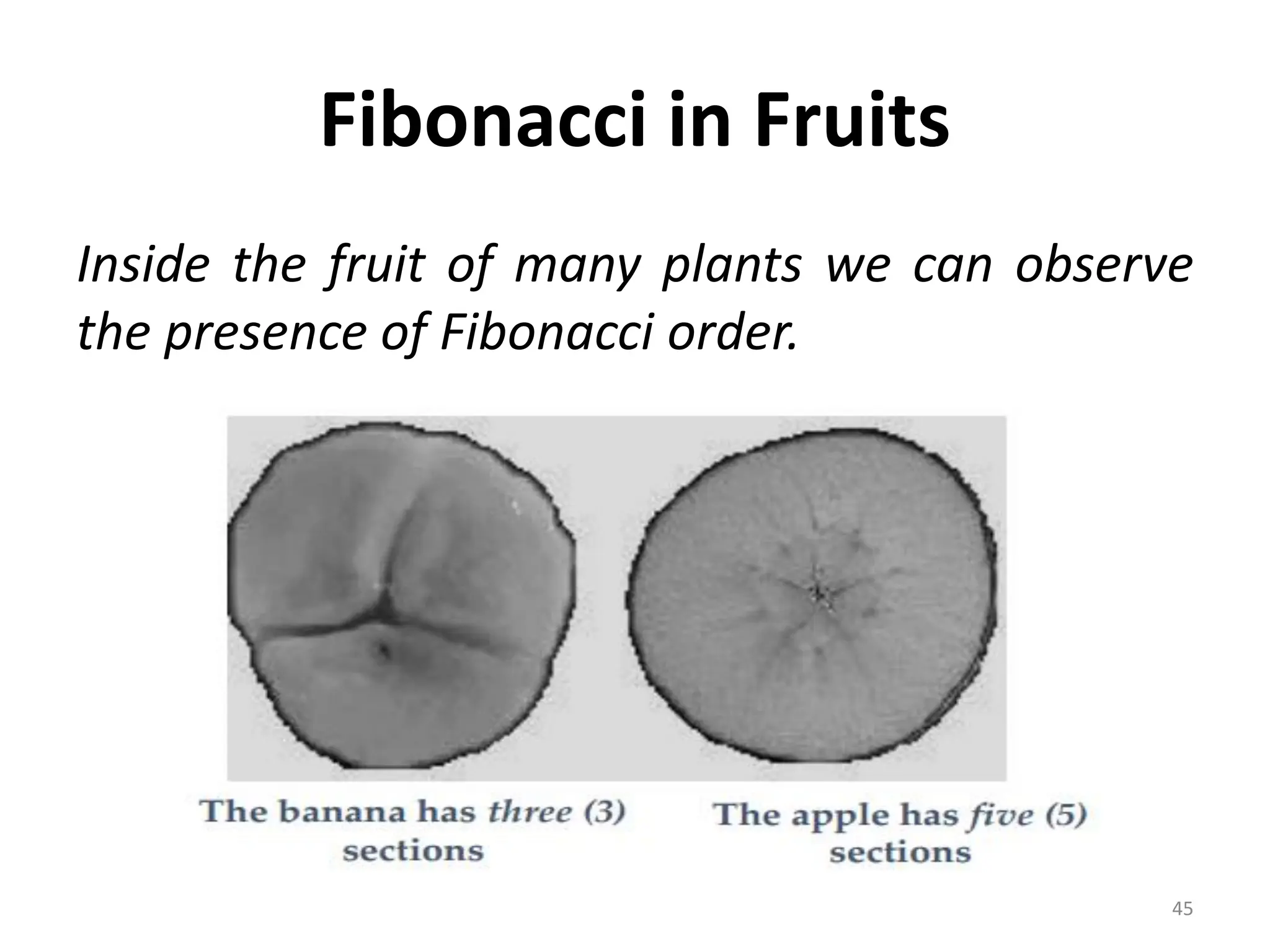
Fibonacci in Fruits
Inside the fruit of many plants we can observe
the presence of Fibonacci order.
45
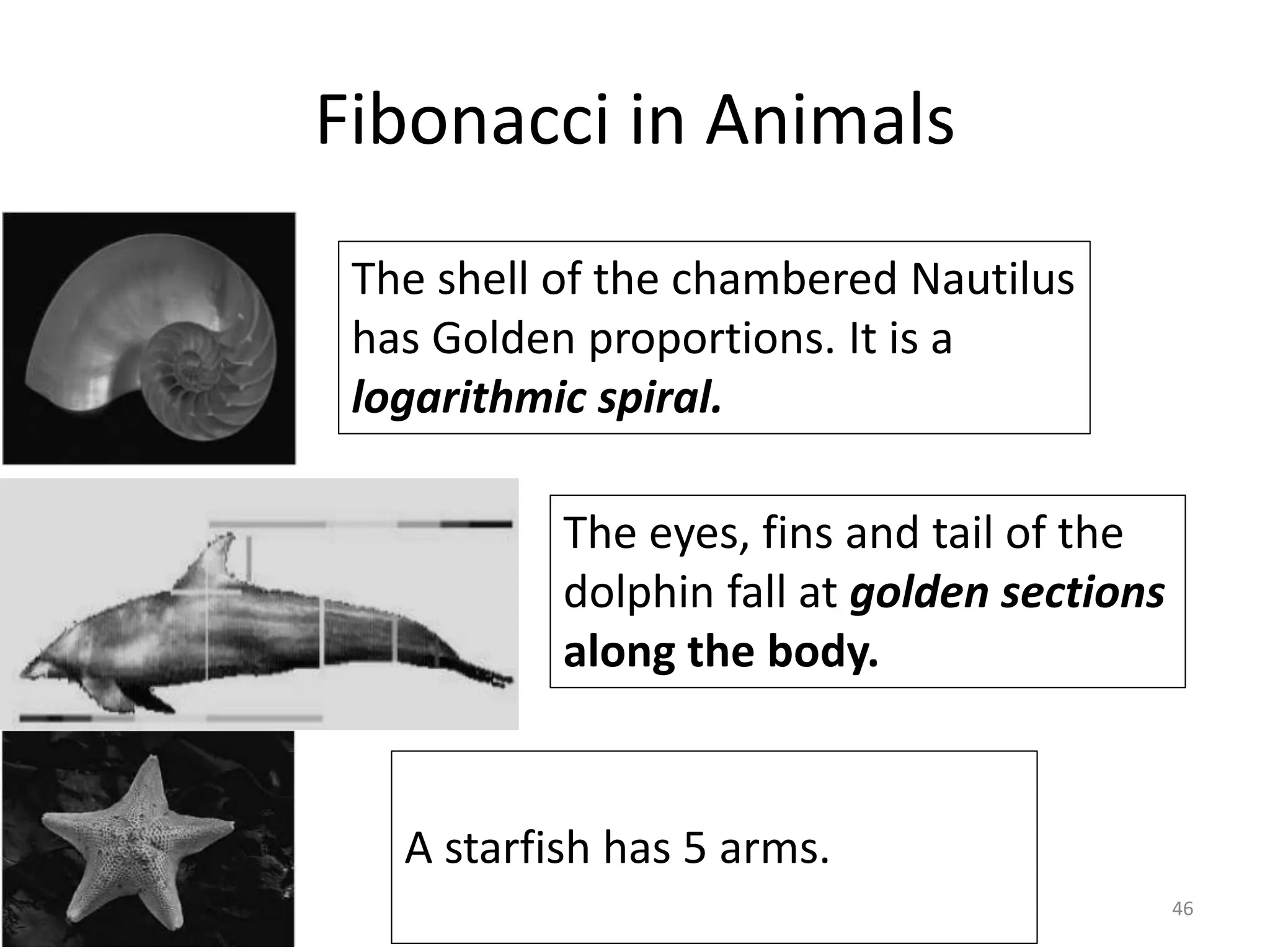
Fibonacci in Animals
46
The shell of the chambered Nautilus
has Golden proportions. It is a
logarithmic spiral.
A starfish has 5 arms.
The eyes, fins and tail of the
dolphin fall at golden sections
along the body.
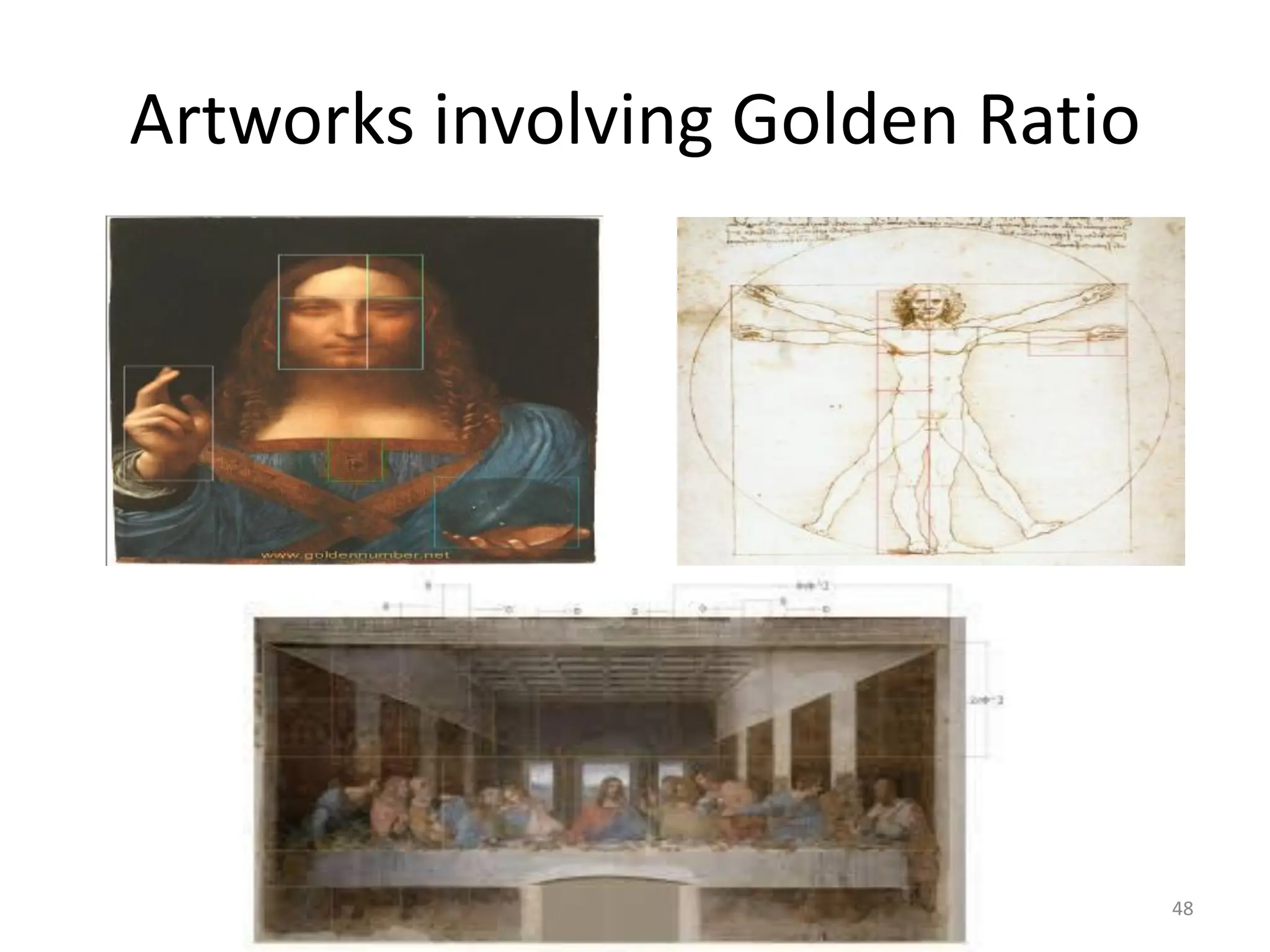
The Golden Ratio
47
Golden ratio is sometimes called “golden
number, golden mean, golden proportion,
golden section, divine section and divine
proportion.”
Artworks involving Golden Ratio
48
Fibonacci in Human
49
C. Mathematics Helps Organize Patterns
and Regularities in the World
• Patterns have underlying mathematical
structures
• Every living or nonliving thing in the
world may seem to follow a certain
pattern on their own.
• The mystery of Fibonacci sequence and
the golden ratio as common patterns in
nature.
51
Activity
• Explore patterns in nature and
present them as photo album, photo
exhibit, portfolio, etc. with written
reports.
• Video- presentation
52
Mathematics Helps Predict the
Behavior of Nature and the World
• Mathematics help predict the location, size and
timing of natural disasters
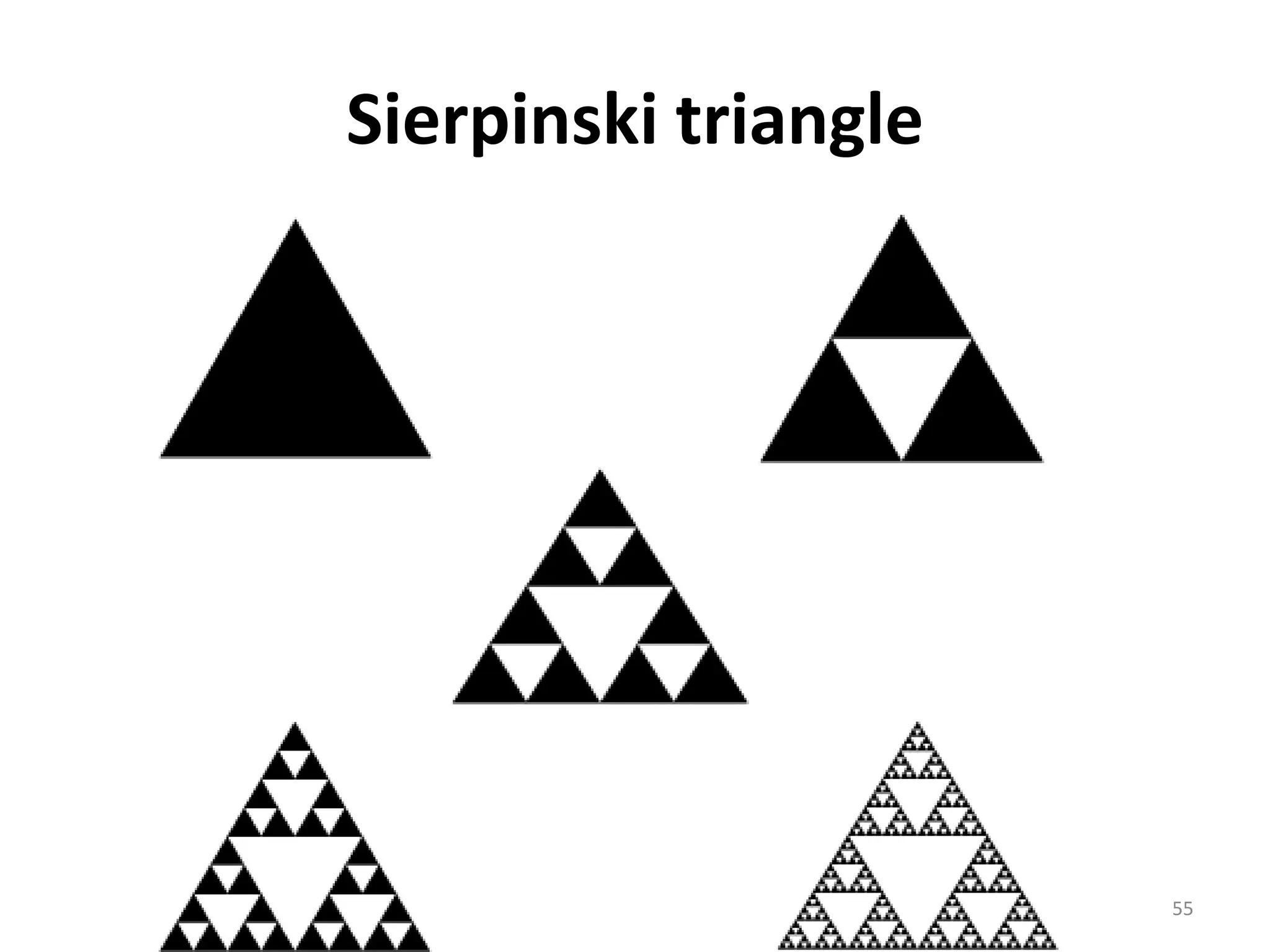
• Made possible by the study of fractals.
A fractal is a mathematical formula of a
pattern that repeats over a wide range of size and
time scales. These patterns are hidden within more
complex systems.
❑Benoit Mandelbrot is the father of fractals, who
described how he has been using fractals to find
order within the complex systems in nature, such
as the shape of coastlines.
53
Mathematics Helps Control Nature and
Occurrences in the World for our Own Ends
• Fractal Geometry has been
applied in different fields of
knowledge such as in
engineering, computer graphics,
medicine, etc.
54
Sierpinski triangle
55
Other Fractals
56
Koch Snowflake Mandelbrot Set
Julia Set
Mandelbrot Set
Mathematics Has Numerous Applications
in the World Making it Indispensable
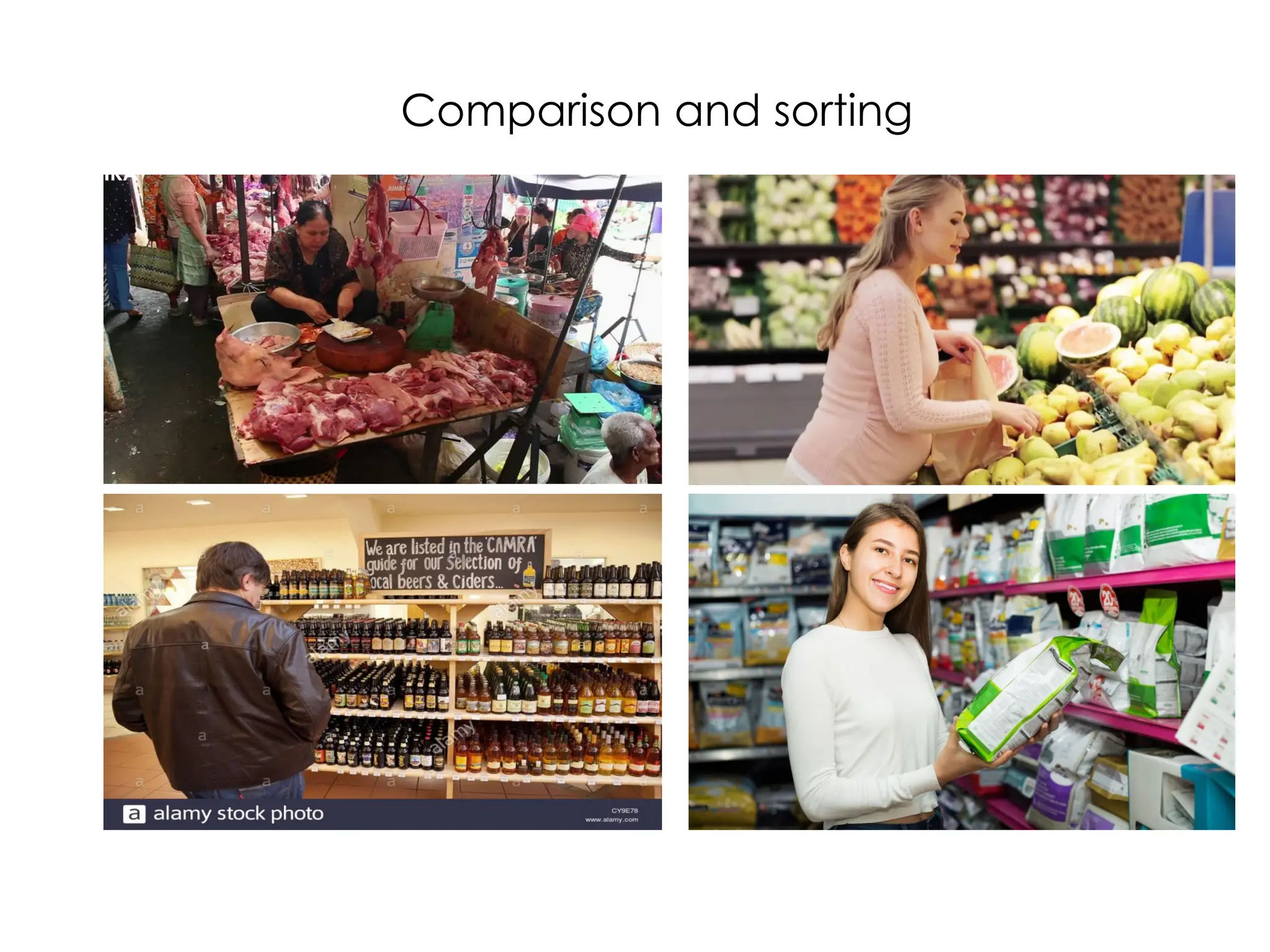
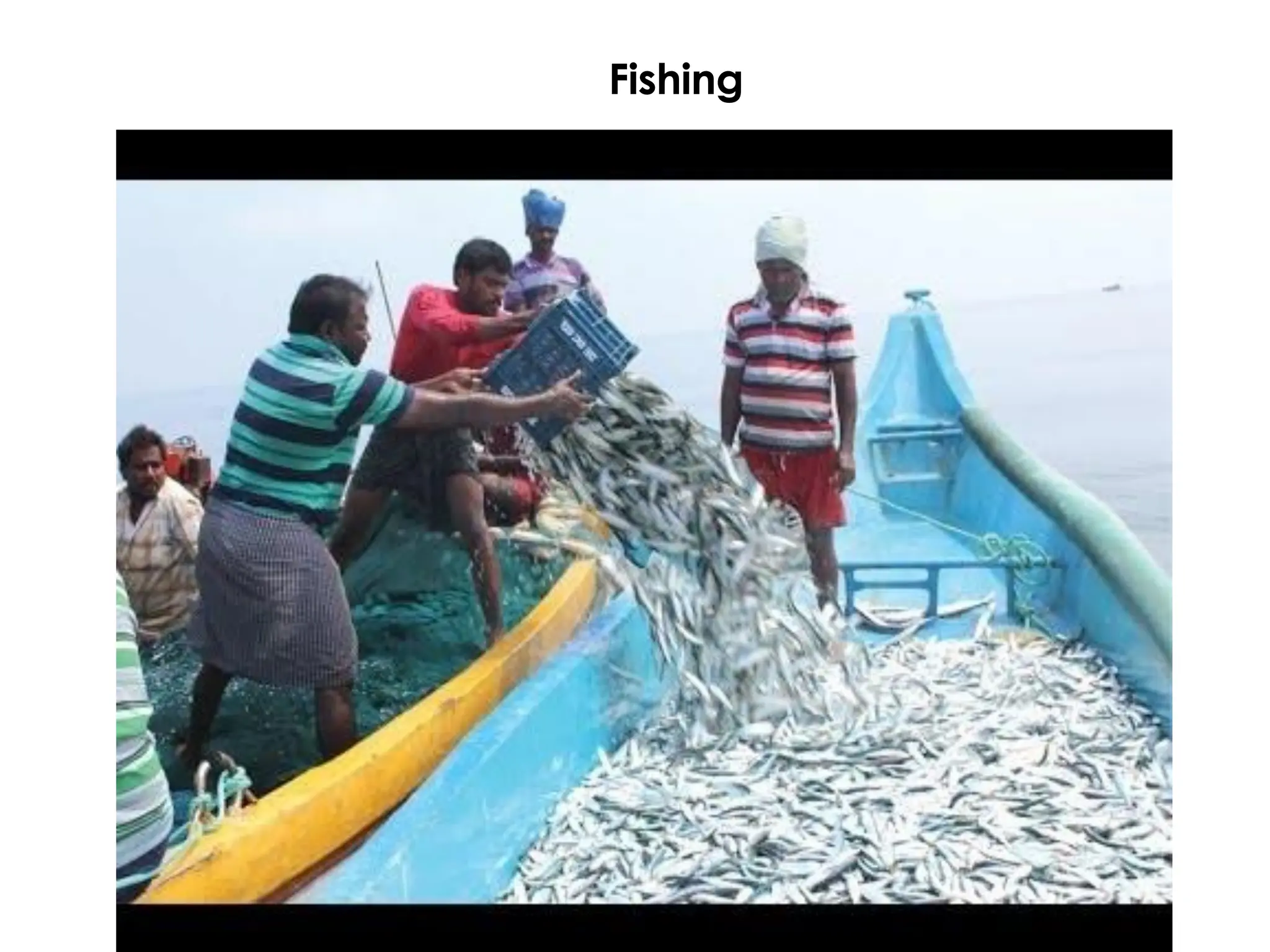
• Mathematics helps you build things
• Mathematics is helpful in managing financial
matters
• Many more…
57
Budgeting Counting
ANG
KALIKASAN
NG
MATEMATIKA
Comparison and sorting
ANG
KALIKASAN
NG
MATEMATIKA
Daily task, etc Solve puzzles
ANG
KALIKASAN
NG
MATEMATIKA
Fishing
Farming
ANG
KALIKASAN
NG
MATEMATIKA
Constructions
Sa mga kaganapan sa paligid.
Pag-uulit-ulit (cycle) ng panahon
ANG
KALIKASAN
NG
MATEMATIKA
❖Sa arts, musika, medisina at iba’t-
ibang larangan o disiplina.
Uses ofMathematics
❖ It helps us to understand the puzzles of nature.
❖ Good way of looking atnature.
❖ Helps to create designs,
regularitiesand irregularities
❖ It can make predictions
❖ Manages time and epidemics (mathematical
modeling]..
❖ Serves as a computational tools
❖ It can create or form other questions.
].
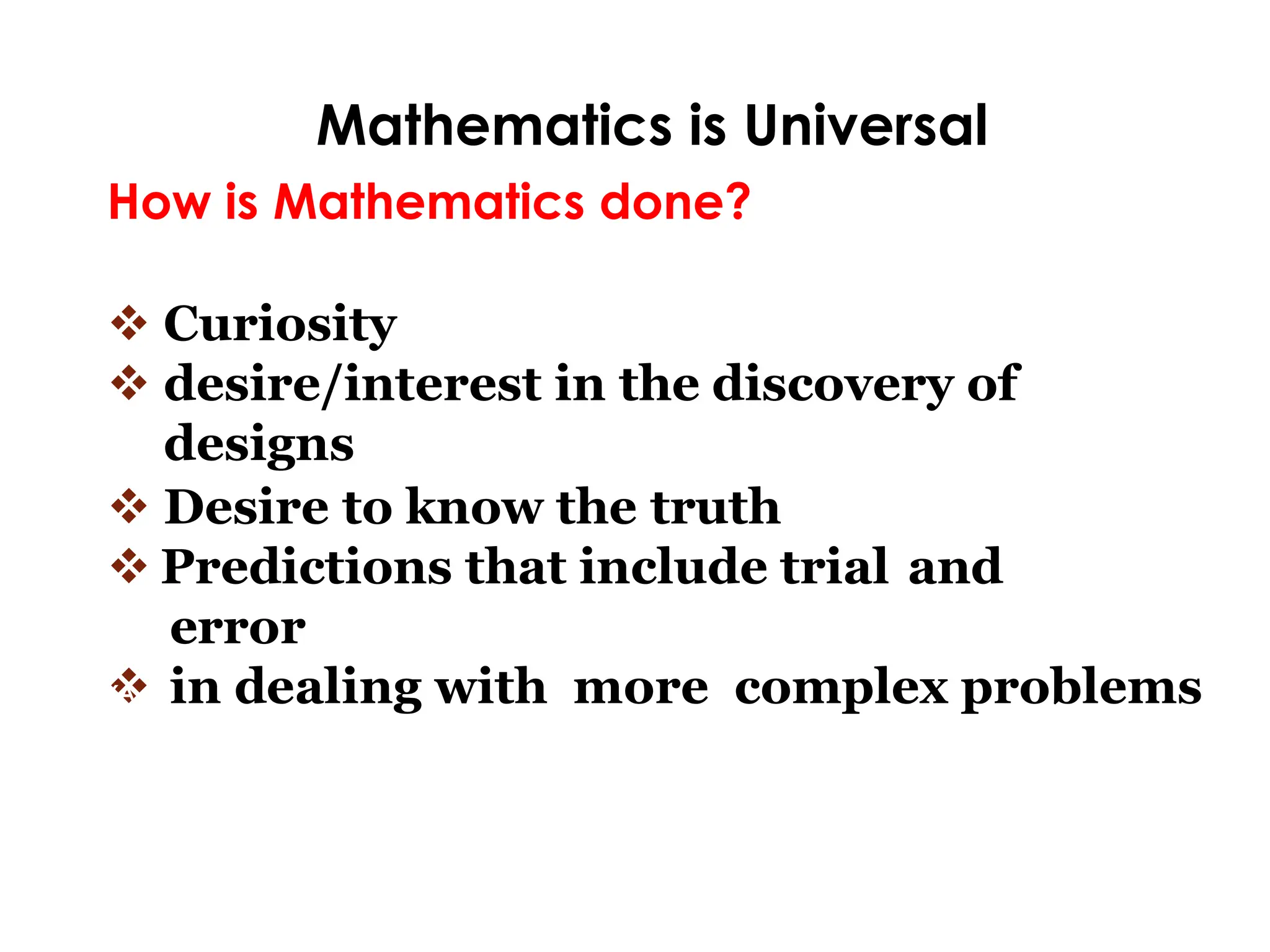
Mathematics is Universal
How is Mathematics done?
❖ Curiosity
❖ desire/interest in the discovery of
designs
❖ Desire to know the truth
❖ Predictions that include trial and
error
❖ in dealing with more complex problems
ANG
KALIKASAN
NG
MATEMATIKA
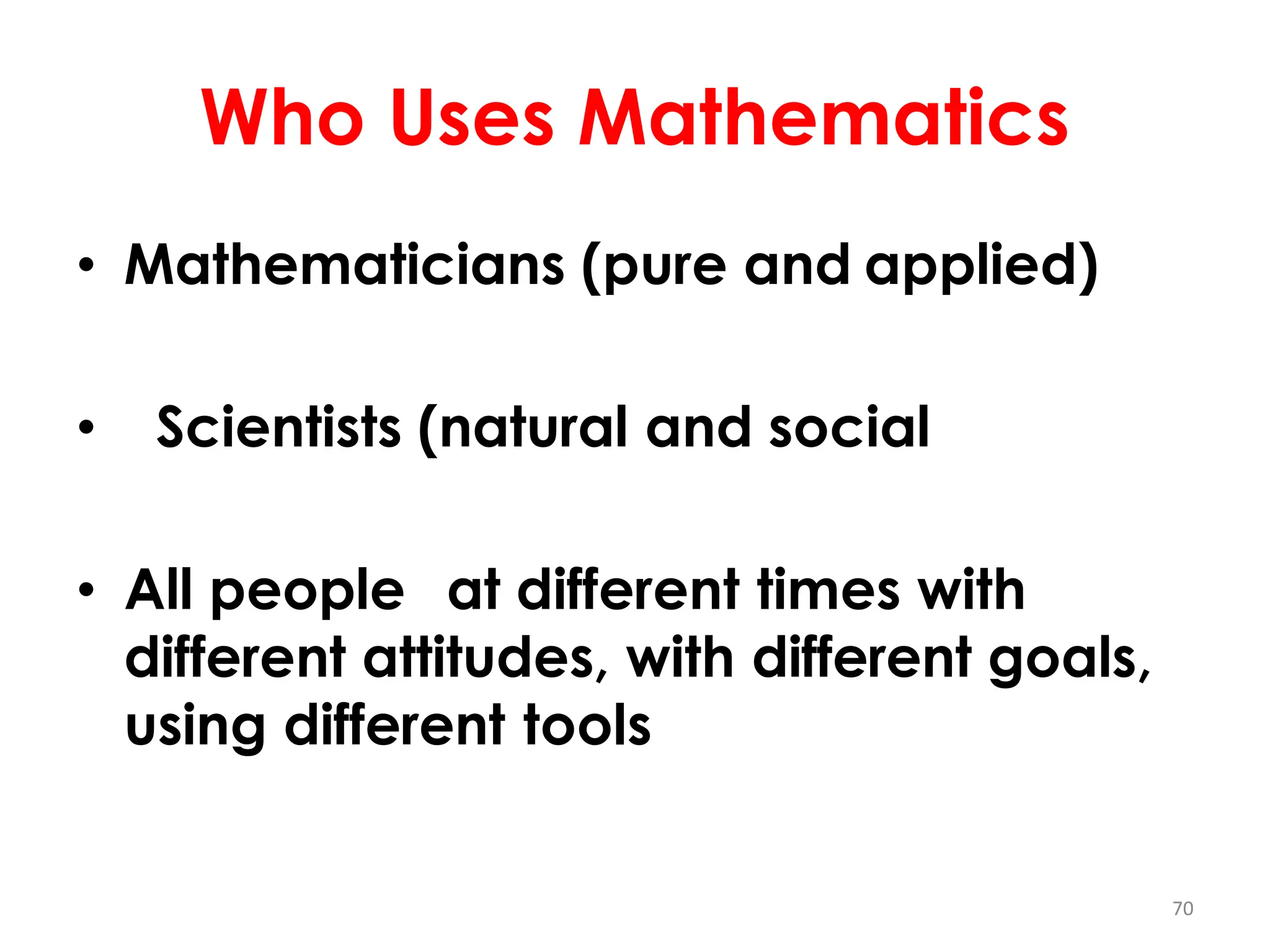
Who Uses Mathematics
• Mathematicians (pure and applied)
• Scientists (natural and social
• All people at different times with
different attitudes, with different goals,
using different tools
70
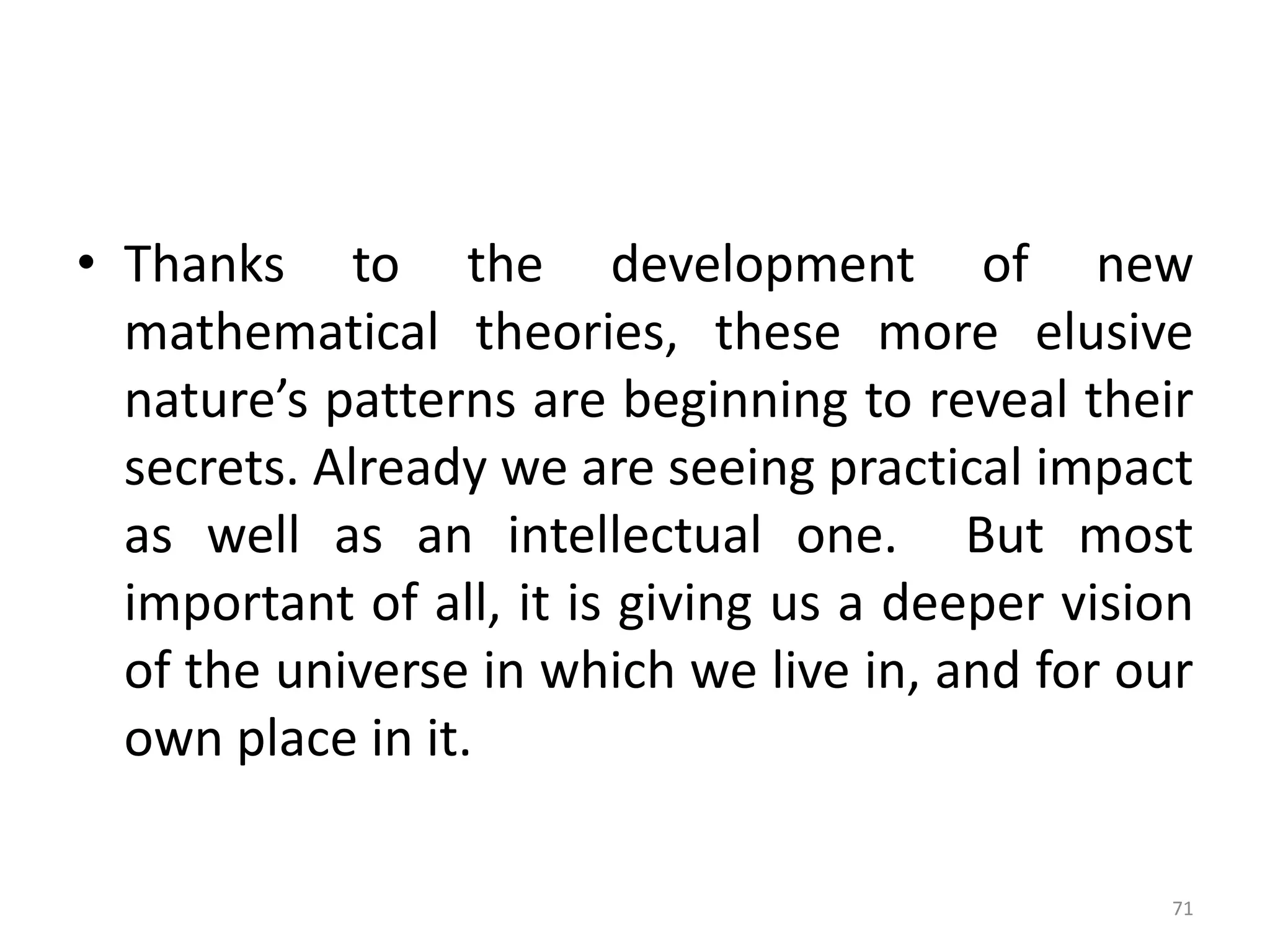
• Thanks to the development of new
mathematical theories, these more elusive
nature’s patterns are beginning to reveal their
secrets. Already we are seeing practical impact
as well as an intellectual one. But most
important of all, it is giving us a deeper vision
of the universe in which we live in, and for our
own place in it.
71
References
72
Stewart, I (1995). Nature’s Numbers. Basic
Books
Nocon, R. and Nocon, E. Essential
Mathematics for the Modern World
Vistru-Yu, C. PowerPoint Presentation.
CHED-GET AdMUTraining
Nature in Numbers. youtube.com
www.google.com
• https://www.vectorstock.com/royalty-free-
vector/mathematical-logic-puzzle-game-solve-
examples-vector-32416164
• https://www.aptitudeprep.com/free-logical-
reasoning-practice-test/
• https://www.assessmentday.co.uk/resources/logi
cal-reasoning-tips.html
• https://www.geogebra.org/m/DbpdfWFg
• https://sciencing.com/types-number-patterns-
math-8093943.html
73

1.-Mathematics-in-the modern world pdfff

  • 1.
    MATHEMATICS in ourWORLD Prepared by: Armando C. Manzano 1
  • 2.
    Video watching Nature byNumbers by Cristobal Vila Nature by Numbers - Cristóbal Vila (2010).mp4 https://www.youtube.com/watch?v=tnkLDFpgix4 https://www.youtube.com/watch?v=Ig9RUaJe00c https://www.youtube.com/watch?v=Mpvy36S6jEU https://www.youtube.com/watch?v=QEzlsjAqADA click https://www.youtube.com/watch?v=QEzlsjAqADA 2 Pair - sharing
  • 3.
    What is Mathematics? •Mathematics is defined as the study of numbers and arithmetic operations. Others describe mathematics as a set of tools or a collection of skills that can be applied to questions of ‘how many” or “how much.” Still, others view it is a science which involves logical reasoning, drawing conclusions from assumed premises, and strategic reasoning based on accepted rules, laws, or probabilities. Mathematics is also considered an art which studies patters for predictive purposes or a specialized language which deals with form, size, and quantity. 3
  • 4.
    • Whatever pointof view is taken, there is no denying the fact that mathematics is universal. People from around the world use math to get things done. It helps them perform daily tasks as well as make important decisions like buying wisely, choosing the most appropriate insurance plan, or even betting on an outcome with the highest chance of actually occurring. The same mathematical concepts and language are applied regardless of whether the users are Asians, Americans, Africans or Europeans. • 4
  • 5.
    • In examiningthe development of mathematics from historical perspective, it can be seen that much has been directed towards describing patterns of relationship that are of interest to various individuals. Patterns arouse curiosity because they can be directly related to common human experiences. 5
  • 6.
    • mathematics asstudy of patterns and mathematics as a language. 6
  • 7.
    A Study ofPatterns • A pattern is arrangement which helps observes anticipate what they might see or what happen next. A pattern also shown what may have come before. A pattern organizes information so that it becomes more useful. The human mind is programmed to make sense of data to bring or to bring order where there is disorder. It seeks discover relationships and connections between seemingly unrelated bits of information. In doings so, it sees patterns. 7
  • 8.
    A. Patterns andNumbers in Nature and the World • Human mind and culture have developed a formal system of thought for recognizing, classifying, and exploiting patterns called mathematics. • By using mathematics to organize and systematize our ideas about patterns, we have discovered a great secret: nature’s patterns are not just there to be admired, they are vital clues to the rules that governs natural processes. 8
  • 9.
    Here are examplesof pattern-seeking behavior of humans from childhood to adulthood: • A toddler separates blue blocks from red blocks. • A kindergarten student learns to count. • A first grader does skip counting. • A third grader notices that multiplies of two are even numbers. • A sixth grader creates patterns that cover a plane. • A junior high school student learns that a function is essentially a pattern of how one number is transformed to another. • A college biology undergraduate studies the sequence of DNA and proteins. • A stock trader studies trends in the stock market. • A weatherman makes weather forecast based on atmospheric patterns. • A doctor decides who is healthy and who is not by recognizing a certain health patterns. 9
  • 10.
    A. Patterns andNumbers in Nature and the World We live in a universe of patterns! 1. The snowflake 2. The honeycomb 3. The sunflower 4. The snail’s shell 5. Flower’s petals 6. Weather 10
  • 11.
    DESIGNS IN NATURE BilateralSymmetry ANG KALIKASAN Matematika sa MakabagongDaigdig- DMMSU NG MATEMATIKA
  • 12.
  • 13.
    Tiger’s stripes (guhit sabalat ng tigre) Hyena’s spots (batik ng hyena) Honeycomb (bahay- pukyutan)
  • 14.
    Trains of waves acrossthe oceans Trains of sand dunes across the dessert
  • 15.
    The Honeycomb 15 Why dothe cells of a honeycomb have a hexagon form? The shape turns out to be economical: much honey is enclosed by minimum beeswax. VIDEO: click https://www.youtube.com/watch?v=QEzlsjAqADA
  • 16.
    Petals of flowers FLOWERSNUMBER OF PETALS Lilies 3 Buttercups 5 Delphiniums 8 Marigolds 13 Asters 21 Daisies 34, 55, 89 16
  • 17.
    Sa mga bulaklak… One- petalled Whitecalla lily Two- petalled Euphorbia
  • 18.
  • 19.
  • 20.
    The Sunflower 20 Seed patternsof sunflower All the sunflowers in the world show a number of spirals that are within the Fibonacci sequence
  • 21.
  • 22.
  • 23.
    Mathematics is thestudy of patterns That is one reason why those who use patterns to analyze and solve problems often find success. Examples of various patterns. 1. Logic Patterns. Logic patterns are usually the first to be observed. Classifying things, for example, comes before numeration. Being able to tell which things are blocks and which are not precedes learning to count blocks. One kind of logic pattern deals with the characteristics of various objects while another deals with order. These patterns are seen on aptitude tests in which takers are shown a sequence of pictures and asked to select which figure comes next among several choices. 23
  • 24.
    2. Geometric Patterns-A geometric patterns is a motif or design that depicts abstract shapes like lines, polygons, and circles, and typically repeats like a wallpaper. Visual patterns are observed in nature and in art. In art, patterns present objects in a consistent, regular manners. They appear in paintings, drawings, tapestries, wallpapers, tilings, and carpets. A pattern does not repeat exactly as long as long as it provides a way of “organizing” the artwork. Patterns in nature are often more chaotic. Nature provides many examples patterns, including symmetries, spirals, tilings, stripes, and fractional dimensions. 3. Word Patterns- Patterns can also be found in language like the morphological rules in pluralizing nouns or conjugating verbs for tense, as well as the metrical rules of poetry. Each of these examples supports mathematical and natural language understanding. The focus here is patterns in form and syntax, which lead directly to the study of language in general and digital communication in particular. • Knife: knives life: lives wife: ? 24
  • 25.
    • It cannotbe overstated that it is important to understand how mathematics regarded as the study of patterns to become familiar with some of those patterns and use them in daily life. For most people, learning mathematics as an abstract concept before understanding how to use it does not work. More effort must be exerted to expose students to mathematical patterns in various context before, during, and after its introduction in the subject. 25
  • 26.
    Example of DifferentPattern Logic Pattern 26
  • 27.
  • 28.
    Number Patters 28 • Typesof Number Patterns in Math • Arithmetic Sequence. A sequence is group of numbers that follow a pattern based on a specific rule. ... • Geometric Sequence. A geometric sequence is a list of numbers that are multiplied (or divided) by the same amount. ... • Triangular Numbers. ... • Square Numbers. ... • Cube Numbers. ... • Fibonacci Numbers
  • 29.
    B. The FibonacciSequence Think of this! At the beginning of a month, you are given a pair of newborn rabbits. After a month the rabbits have produced no offspring; however, every month thereafter, the pair of rabbits produces another pair of rabbits. The offspring reproduce in exactly the same manner. If none of the rabbits dies, how many pairs of rabbits will there be at the start of each succeeding month? At the start of 4th month, how many pairs of rabbits will there be? How about at the start of the 5th and 6th months? 29
  • 30.
  • 31.
    • 1, 1,2, 3, 5, 8, 13, 21, 34, 55, .. • 3 8 13 34 21 31
  • 32.
    Fibonacci Numbers • FibonacciNumber is an integer in the infinite sequence of which the first two terms are 1 and 1 and each succeeding term is the sum of the two immediately preceding. • The numbers are named after Fibonacci also known as Leonardo of Pisa or Leonardo Pisano. 32
  • 33.
    • Fibonacci discoveredthat the number of pairs of rabbits for any month after the first two months can be determined by adding the numbers of pairs of rabbits in each of the two previous months. For instance, the number of pairs of rabbits at the start of the sixth month is 3 + 5 = 8. 33
  • 34.
    Recursive Definition • Arecursive definition for a sequence is one in which each successive term of the sequence is defined by using some of the preceding terms. If we use the mathematical notation Fn to represent the nth Fibonacci number, then the numbers in the Fibonacci sequence are given by the following recursive definition. 34 𝐅𝟏 = 𝟏, 𝐅𝟐 = 𝟏, 𝐭𝐡𝐞𝐧 𝐅𝐧 = 𝐅𝐧−𝟏 + 𝐅𝐧−𝟐 𝐟𝐨𝐫 𝐧 ≥ 𝟑.
  • 35.
    Binet’s Formula • Thefollowing formula is known as Binet’s formula for the nth Fibonacci number. 𝐅𝐧 = 𝟏 𝟓 𝟏 + 𝟓 𝟐 𝐧 − 𝟏 − 𝟓 𝟐 𝐧 The advantage of this formula over the recursive formula 𝐅𝐧 = 𝐅𝐧−𝟏 + 𝐅𝐧−𝟐 is that you can determine the nth Fibonacci number without finding the two preceding Fibonacci numbers. 35
  • 36.
    Exercise 1 • Usethe definition of Fibonacci numbers to find the eleventh and twelfth Fibonacci numbers. Answers: Eleventh = 89 Twelfth = 144 36
  • 37.
    Exercise 2 • UseBinet’s formula and a calculator to find the 20th, 30th, and 40th Fibonacci numbers. Answers: • 20th = 6,765 • 30th = 832,040 • 40th = 102,334,155 37
  • 38.
    Exercise 2 • UseBinet’s formula and a calculator to find the 20th, 30th, and 40th Fibonacci numbers. Answers: • 20th = 6,765 • 30th = 832,040 • 40th = 102,334,155 38
  • 39.
    Fibonacci in Pineappleor Pine cone Pineapples have spirals formed by their hexagonal nubs. The nubs on many pineapples form 8 spirals that rotate diagonally upward to the left and 13 spirals that rotate diagonally upward to the right. The numbers 8 and 13 are consecutive Fibonacci numbers. 39
  • 40.
    Fibonacci numbers onthe scalesof pinecones. 8 spirals ang maaaring mabuo sa clockwise direction.
  • 41.
  • 42.
    Sa bulaklak na daisy, Gayang pinecone, ang daisy ay mayroong 34 spirals sa clockwise direction, at 21 spirals sa counterclockwise, na parehong Fibonacci numbers.
  • 43.
    Fibonacci in Sunflower Theseeds on a sunflower are arranged in spirals that curve both clockwise and counterclockwise from the center of the sunflower’s head to its outer edge. In many sunflowers, the number of clockwise spirals and the number of counterclockwise spirals are consecutive Fibonacci numbers. The number of clockwise spirals is 34 and the number of counterclockwise spirals is 55. 43
  • 44.
  • 45.
    Fibonacci in Fruits Insidethe fruit of many plants we can observe the presence of Fibonacci order. 45
  • 46.
    Fibonacci in Animals 46 Theshell of the chambered Nautilus has Golden proportions. It is a logarithmic spiral. A starfish has 5 arms. The eyes, fins and tail of the dolphin fall at golden sections along the body.
  • 47.
    The Golden Ratio 47 Goldenratio is sometimes called “golden number, golden mean, golden proportion, golden section, divine section and divine proportion.”
  • 48.
  • 49.
  • 51.
    C. Mathematics HelpsOrganize Patterns and Regularities in the World • Patterns have underlying mathematical structures • Every living or nonliving thing in the world may seem to follow a certain pattern on their own. • The mystery of Fibonacci sequence and the golden ratio as common patterns in nature. 51
  • 52.
    Activity • Explore patternsin nature and present them as photo album, photo exhibit, portfolio, etc. with written reports. • Video- presentation 52
  • 53.
    Mathematics Helps Predictthe Behavior of Nature and the World • Mathematics help predict the location, size and timing of natural disasters • Made possible by the study of fractals. A fractal is a mathematical formula of a pattern that repeats over a wide range of size and time scales. These patterns are hidden within more complex systems. ❑Benoit Mandelbrot is the father of fractals, who described how he has been using fractals to find order within the complex systems in nature, such as the shape of coastlines. 53
  • 54.
    Mathematics Helps ControlNature and Occurrences in the World for our Own Ends • Fractal Geometry has been applied in different fields of knowledge such as in engineering, computer graphics, medicine, etc. 54
  • 55.
  • 56.
    Other Fractals 56 Koch SnowflakeMandelbrot Set Julia Set Mandelbrot Set
  • 57.
    Mathematics Has NumerousApplications in the World Making it Indispensable • Mathematics helps you build things • Mathematics is helpful in managing financial matters • Many more… 57
  • 58.
  • 59.
  • 60.
    Daily task, etcSolve puzzles ANG KALIKASAN NG MATEMATIKA
  • 62.
  • 63.
  • 64.
  • 65.
    Sa mga kaganapansa paligid. Pag-uulit-ulit (cycle) ng panahon ANG KALIKASAN NG MATEMATIKA
  • 66.
    ❖Sa arts, musika,medisina at iba’t- ibang larangan o disiplina.
  • 68.
    Uses ofMathematics ❖ Ithelps us to understand the puzzles of nature. ❖ Good way of looking atnature. ❖ Helps to create designs, regularitiesand irregularities ❖ It can make predictions ❖ Manages time and epidemics (mathematical modeling].. ❖ Serves as a computational tools ❖ It can create or form other questions. ].
  • 69.
    Mathematics is Universal Howis Mathematics done? ❖ Curiosity ❖ desire/interest in the discovery of designs ❖ Desire to know the truth ❖ Predictions that include trial and error ❖ in dealing with more complex problems ANG KALIKASAN NG MATEMATIKA
  • 70.
    Who Uses Mathematics •Mathematicians (pure and applied) • Scientists (natural and social • All people at different times with different attitudes, with different goals, using different tools 70
  • 71.
    • Thanks tothe development of new mathematical theories, these more elusive nature’s patterns are beginning to reveal their secrets. Already we are seeing practical impact as well as an intellectual one. But most important of all, it is giving us a deeper vision of the universe in which we live in, and for our own place in it. 71
  • 72.
    References 72 Stewart, I (1995).Nature’s Numbers. Basic Books Nocon, R. and Nocon, E. Essential Mathematics for the Modern World Vistru-Yu, C. PowerPoint Presentation. CHED-GET AdMUTraining Nature in Numbers. youtube.com www.google.com
  • 73.
    • https://www.vectorstock.com/royalty-free- vector/mathematical-logic-puzzle-game-solve- examples-vector-32416164 • https://www.aptitudeprep.com/free-logical- reasoning-practice-test/ •https://www.assessmentday.co.uk/resources/logi cal-reasoning-tips.html • https://www.geogebra.org/m/DbpdfWFg • https://sciencing.com/types-number-patterns- math-8093943.html 73