Implementing the Common Core
          Standards
        Presentation to the
      2011 MSEA Convention
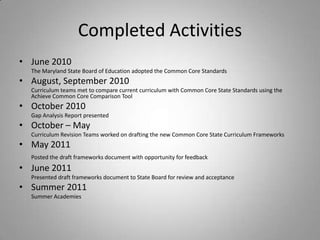
Completed Activities
• June 2010
  The Maryland State Board of Education adopted the Common Core Standards
• August, September 2010
  Curriculum teams met to compare current curriculum with Common Core State Standards using the
  Achieve Common Core Comparison Tool
• October 2010
  Gap Analysis Report presented
• October – May
  Curriculum Revision Teams worked on drafting the new Common Core State Curriculum Frameworks
• May 2011
  Posted the draft frameworks document with opportunity for feedback
• June 2011
  Presented draft frameworks document to State Board for review and acceptance
• Summer 2011
  Summer Academies
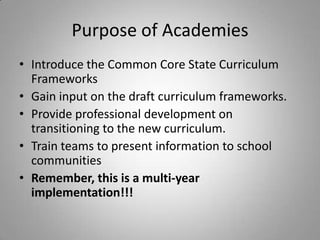
Purpose of Academies
• Introduce the Common Core State Curriculum
  Frameworks
• Gain input on the draft curriculum frameworks.
• Provide professional development on
  transitioning to the new curriculum.
• Train teams to present information to school
  communities
• Remember, this is a multi-year
  implementation!!!
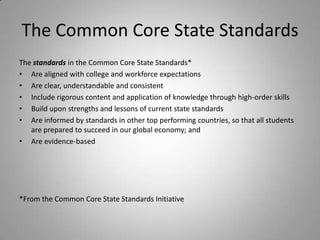
The Common Core State Standards
The standards in the Common Core State Standards*
• Are aligned with college and workforce expectations
• Are clear, understandable and consistent
• Include rigorous content and application of knowledge through high-order skills
• Build upon strengths and lessons of current state standards
• Are informed by standards in other top performing countries, so that all students
   are prepared to succeed in our global economy; and
• Are evidence-based


*From the Common Core State Standards Initiative
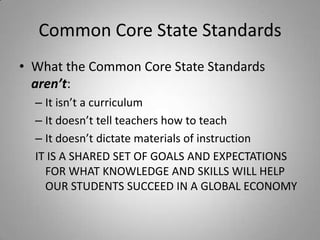
Common Core State Standards
• What the Common Core State Standards
  aren’t:
  – It isn’t a curriculum
  – It doesn’t tell teachers how to teach
  – It doesn’t dictate materials of instruction
  IT IS A SHARED SET OF GOALS AND EXPECTATIONS
    FOR WHAT KNOWLEDGE AND SKILLS WILL HELP
    OUR STUDENTS SUCCEED IN A GLOBAL ECONOMY
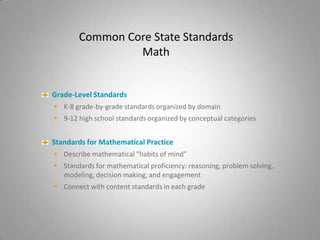
Common Core State Standards
                Math


Grade-Level Standards
 K-8 grade-by-grade standards organized by domain
 9-12 high school standards organized by conceptual categories


Standards for Mathematical Practice
 Describe mathematical “habits of mind”
 Standards for mathematical proficiency: reasoning, problem solving,
  modeling, decision making, and engagement
 Connect with content standards in each grade
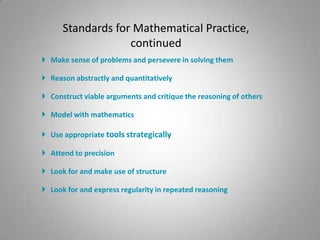
Standards for Mathematical Practice,
                   continued
 Make sense of problems and persevere in solving them

 Reason abstractly and quantitatively

 Construct viable arguments and critique the reasoning of others

 Model with mathematics

 Use appropriate tools strategically

 Attend to precision

 Look for and make use of structure

 Look for and express regularity in repeated reasoning
Common Core State Standards for English Language Arts
   and Literacy in History/Social Studies, Science and
                    Technical Subjects

College and Career Readiness (CCR) Standards
    Overarching standards for each strand that are further defined by grade-
     specific standards
Grade-Level Standards in English Language Arts
    K-8, grade-by-grade
    9-10 and 11-12 grade bands for high school
    Four strands: Reading, Writing, Speaking and Listening, and Language
Standards for Literacy in History/Social Studies, Science, and Technical
   Subjects
    Standards are embedded at grades K-5
    Content-specific literacy standards are provided for grades 6-8, 9-10, and
     11-12
Overview of Standards for History/Social Studies, Science, and
                           Technical Subjects


Reading Standards for History/Social Studies, Science, and Technical Subjects
 • Knowledge of domain-specific vocabulary
 • Analyze, evaluate, and differentiate primary and secondary sources
 • Synthesize quantitative and technical information, including facts
   presented in maps, timelines, flowcharts, or diagrams
Writing Standards for History/Social Studies, Science, and Technical Subjects
 • Write arguments on discipline-specific content and
   informative/explanatory texts
 • Use of data, evidence, and reason to support arguments and claims
 • Use of domain-specific vocabulary
What Does This Mean for Teachers?
• Today’s students will be taking MSA’s in 2011, 2012, 2013
  and 2014.
• In 2012-2013, and 2013-2014 there is planned field testing
  of the new assessments, with the first operational
  assessments in 2014-2015.
• Decisions regarding HSA’s have not been made yet
• We must thoughtfully transition to the new CCSC so that
  our students and teachers are prepared for the future.
Additional Information about the
Common Core State Standards and
     Curriculum Frameworks


      www.corestandards.org
         www.mdk12.org
       www.parcconline.org
Questions????

  My contact information:
        Judy Jenkins
jjenkins@msde.state.md.us

MSDE Presentation: Implementing the Common Core Standards

  • 1.
    Implementing the CommonCore Standards Presentation to the 2011 MSEA Convention
  • 2.
    Completed Activities • June2010 The Maryland State Board of Education adopted the Common Core Standards • August, September 2010 Curriculum teams met to compare current curriculum with Common Core State Standards using the Achieve Common Core Comparison Tool • October 2010 Gap Analysis Report presented • October – May Curriculum Revision Teams worked on drafting the new Common Core State Curriculum Frameworks • May 2011 Posted the draft frameworks document with opportunity for feedback • June 2011 Presented draft frameworks document to State Board for review and acceptance • Summer 2011 Summer Academies
  • 3.
    Purpose of Academies •Introduce the Common Core State Curriculum Frameworks • Gain input on the draft curriculum frameworks. • Provide professional development on transitioning to the new curriculum. • Train teams to present information to school communities • Remember, this is a multi-year implementation!!!
  • 4.
    The Common CoreState Standards The standards in the Common Core State Standards* • Are aligned with college and workforce expectations • Are clear, understandable and consistent • Include rigorous content and application of knowledge through high-order skills • Build upon strengths and lessons of current state standards • Are informed by standards in other top performing countries, so that all students are prepared to succeed in our global economy; and • Are evidence-based *From the Common Core State Standards Initiative
  • 5.
    Common Core StateStandards • What the Common Core State Standards aren’t: – It isn’t a curriculum – It doesn’t tell teachers how to teach – It doesn’t dictate materials of instruction IT IS A SHARED SET OF GOALS AND EXPECTATIONS FOR WHAT KNOWLEDGE AND SKILLS WILL HELP OUR STUDENTS SUCCEED IN A GLOBAL ECONOMY
  • 6.
    Common Core StateStandards Math Grade-Level Standards  K-8 grade-by-grade standards organized by domain  9-12 high school standards organized by conceptual categories Standards for Mathematical Practice  Describe mathematical “habits of mind”  Standards for mathematical proficiency: reasoning, problem solving, modeling, decision making, and engagement  Connect with content standards in each grade
  • 7.
    Standards for MathematicalPractice, continued  Make sense of problems and persevere in solving them  Reason abstractly and quantitatively  Construct viable arguments and critique the reasoning of others  Model with mathematics  Use appropriate tools strategically  Attend to precision  Look for and make use of structure  Look for and express regularity in repeated reasoning
  • 8.
    Common Core StateStandards for English Language Arts and Literacy in History/Social Studies, Science and Technical Subjects College and Career Readiness (CCR) Standards  Overarching standards for each strand that are further defined by grade- specific standards Grade-Level Standards in English Language Arts  K-8, grade-by-grade  9-10 and 11-12 grade bands for high school  Four strands: Reading, Writing, Speaking and Listening, and Language Standards for Literacy in History/Social Studies, Science, and Technical Subjects  Standards are embedded at grades K-5  Content-specific literacy standards are provided for grades 6-8, 9-10, and 11-12
  • 9.
    Overview of Standardsfor History/Social Studies, Science, and Technical Subjects Reading Standards for History/Social Studies, Science, and Technical Subjects • Knowledge of domain-specific vocabulary • Analyze, evaluate, and differentiate primary and secondary sources • Synthesize quantitative and technical information, including facts presented in maps, timelines, flowcharts, or diagrams Writing Standards for History/Social Studies, Science, and Technical Subjects • Write arguments on discipline-specific content and informative/explanatory texts • Use of data, evidence, and reason to support arguments and claims • Use of domain-specific vocabulary
  • 10.
    What Does ThisMean for Teachers? • Today’s students will be taking MSA’s in 2011, 2012, 2013 and 2014. • In 2012-2013, and 2013-2014 there is planned field testing of the new assessments, with the first operational assessments in 2014-2015. • Decisions regarding HSA’s have not been made yet • We must thoughtfully transition to the new CCSC so that our students and teachers are prepared for the future.
  • 11.
    Additional Information aboutthe Common Core State Standards and Curriculum Frameworks www.corestandards.org www.mdk12.org www.parcconline.org
  • 12.
    Questions???? Mycontact information: Judy Jenkins jjenkins@msde.state.md.us