Angle Measurements
Exp.4
١٤٣٦/٠٦/٢٥Exp.4 : Angle Measurements1
Objectives
١٤٣٦/٠٦/٢٥Exp.4 : Angle Measurements2
 To be familiar with the tools used for angle
measurement.
 To know how to use the block gauges to measure
angles and to calibrate measuring tools.
 To learn how to measure angles using different
methods
Block Gauges
١٤٣٦/٠٦/٢٥Exp.4 : Angle Measurements3
 Gauge blocks are a necessity in any testing environment that requires
linear dimensional accuracy and/or calibration of measuring tools, such as
micrometers and calipers.
 Each block is engraved with an individual serial number and the size of the
gauge for calibration purposes.
 The purpose of gauge blocks is to provide linear dimensions known to
within a given tolerance.
Block Gauges
١٤٣٦/٠٦/٢٥Exp.4 : Angle Measurements4
 The requirements of gauge blocks are,
 The actual size must be known
 The faces must be parallel
 The surface must have a smooth finish
 The surfaces must be flat
 The materials gauge blocks are made from are
selected for, hardness, temperature stability, corrosion
resistance, and high quality finish.
Gauge blocks groups
١٤٣٦/٠٦/٢٥Exp.4 : Angle Measurements5
Increasing of each block (mm( Blocks Lengths Numbers of blocks
0 .5 1
0.001 1.000- 1.009 10
0.01 1.01- 1.049 49
0.5 1.5- 9.5 17
10 10 - 100 10
How to select gauge blocks for an application
١٤٣٦/٠٦/٢٥Exp.4 : Angle Measurements6
5.324
-1.004 = 4.320
-1.32= 3.000
- 3.000 = 0.000
Sine bars
١٤٣٦/٠٦/٢٥Exp.4 : Angle Measurements7
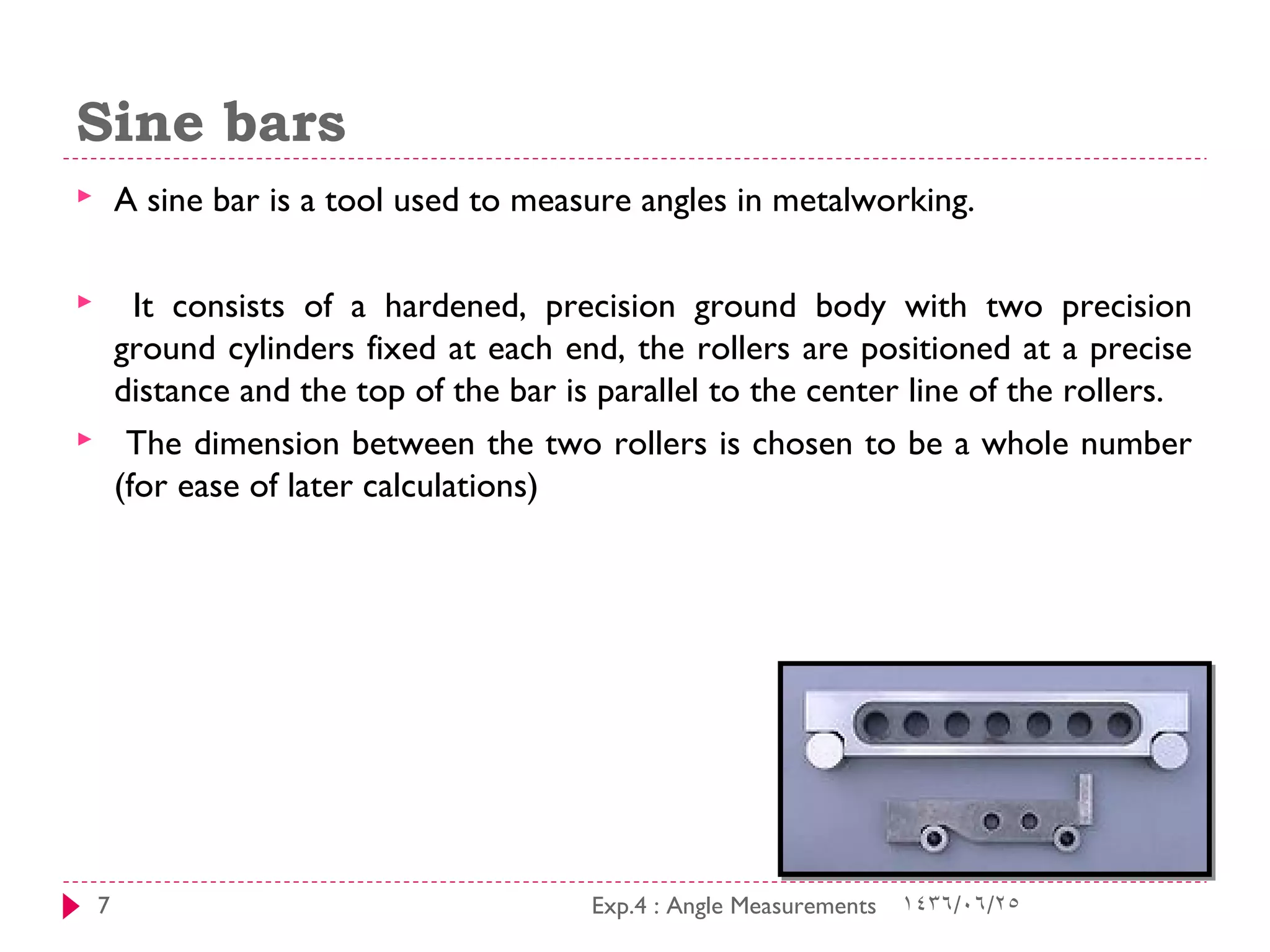
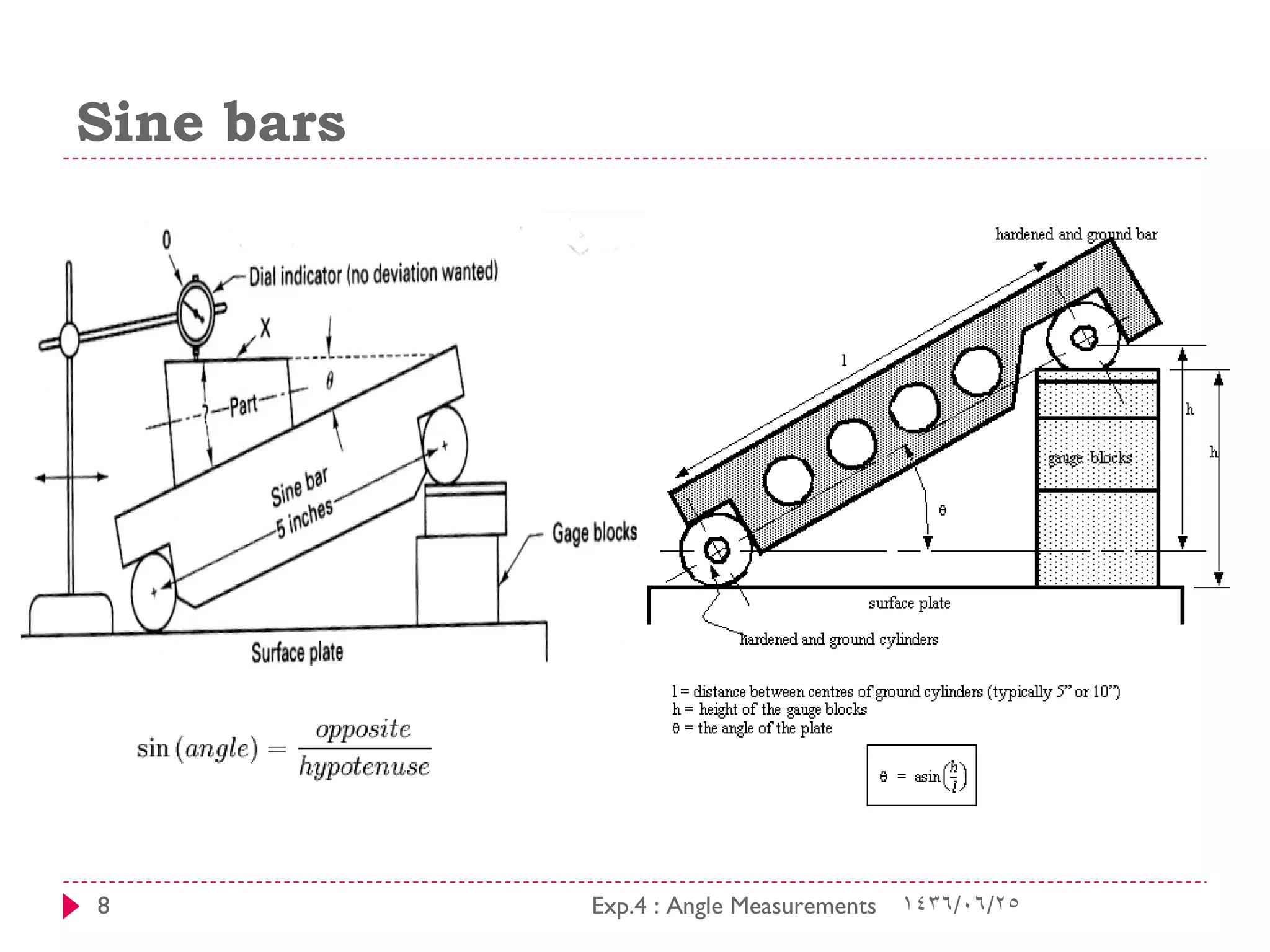
 A sine bar is a tool used to measure angles in metalworking.
 It consists of a hardened, precision ground body with two precision
ground cylinders fixed at each end, the rollers are positioned at a precise
distance and the top of the bar is parallel to the center line of the rollers.
 The dimension between the two rollers is chosen to be a whole number
(for ease of later calculations)
Sine bars
١٤٣٦/٠٦/٢٥Exp.4 : Angle Measurements8
Combination Set
١٤٣٦/٠٦/٢٥Exp.4 : Angle Measurements9
 It is used as a rule, a square, a miter, a depth gage, a height gage, and a
level.
Combination Set Applications
١٤٣٦/٠٦/٢٥Exp.4 : Angle Measurements10
 Measuring angles 90° and 45° angles.
 Determining flatness
 Measuring the center of a circular bar.
 Protractor head allows angles to be set and measured
between the base and ruler.
 A rudimentary level for approximating level surfaces is
incorporated in the protractor and also the 45° holder.
USING A COMBINATION SQUARE
 Using   as   a   center   head
  to   find   the   diameter   of   a
cylinder
Using as a protractor head to determine an
angle
 1.  3.
 2.  4.
Combination square
١٤٣٦/٠٦/٢٥Exp.4 : Angle Measurements14
 A Combination Square consisting of the ruler, 45° holder, protractor
and center square.
 Marking the work surface; with the included Scribe Point stored in a
drilled hole in the Square Base.
Protractors
١٤٣٦/٠٦/٢٥Exp.4 : Angle Measurements15
 Plate Protractor: capable of measuring to within 1-degree
 Protractor heads: have revolving turrets with direct-reading double
graduations, 0-180 degrees in opposite directions.
 Bevel protractor :Made to high quality standards it’s an angle
measurement tool reads to 5 minutes
 Square Head: 45 and 90 degree
 Center Head : V- shape for centering
Examples
١٤٣٦/٠٦/٢٥Exp.4 : Angle Measurements16
 The reading is 46° - 20‘
Your Report
 Your report should have a lot of details about angle
measurement tools (List the parts and the function of
each part).

Angle measurements

  • 1.
  • 2.
    Objectives ١٤٣٦/٠٦/٢٥Exp.4 : AngleMeasurements2  To be familiar with the tools used for angle measurement.  To know how to use the block gauges to measure angles and to calibrate measuring tools.  To learn how to measure angles using different methods
  • 3.
    Block Gauges ١٤٣٦/٠٦/٢٥Exp.4 :Angle Measurements3  Gauge blocks are a necessity in any testing environment that requires linear dimensional accuracy and/or calibration of measuring tools, such as micrometers and calipers.  Each block is engraved with an individual serial number and the size of the gauge for calibration purposes.  The purpose of gauge blocks is to provide linear dimensions known to within a given tolerance.
  • 4.
    Block Gauges ١٤٣٦/٠٦/٢٥Exp.4 :Angle Measurements4  The requirements of gauge blocks are,  The actual size must be known  The faces must be parallel  The surface must have a smooth finish  The surfaces must be flat  The materials gauge blocks are made from are selected for, hardness, temperature stability, corrosion resistance, and high quality finish.
  • 5.
    Gauge blocks groups ١٤٣٦/٠٦/٢٥Exp.4: Angle Measurements5 Increasing of each block (mm( Blocks Lengths Numbers of blocks 0 .5 1 0.001 1.000- 1.009 10 0.01 1.01- 1.049 49 0.5 1.5- 9.5 17 10 10 - 100 10
  • 6.
    How to selectgauge blocks for an application ١٤٣٦/٠٦/٢٥Exp.4 : Angle Measurements6 5.324 -1.004 = 4.320 -1.32= 3.000 - 3.000 = 0.000
  • 7.
    Sine bars ١٤٣٦/٠٦/٢٥Exp.4 :Angle Measurements7  A sine bar is a tool used to measure angles in metalworking.  It consists of a hardened, precision ground body with two precision ground cylinders fixed at each end, the rollers are positioned at a precise distance and the top of the bar is parallel to the center line of the rollers.  The dimension between the two rollers is chosen to be a whole number (for ease of later calculations)
  • 8.
  • 9.
    Combination Set ١٤٣٦/٠٦/٢٥Exp.4 :Angle Measurements9  It is used as a rule, a square, a miter, a depth gage, a height gage, and a level.
  • 10.
    Combination Set Applications ١٤٣٦/٠٦/٢٥Exp.4: Angle Measurements10  Measuring angles 90° and 45° angles.  Determining flatness  Measuring the center of a circular bar.  Protractor head allows angles to be set and measured between the base and ruler.  A rudimentary level for approximating level surfaces is incorporated in the protractor and also the 45° holder.
  • 11.
  • 12.
    USING A COMBINATIONSQUARE  Using   as   a   center   head   to   find   the   diameter   of   a cylinder
  • 13.
    Using as aprotractor head to determine an angle  1.  3.  2.  4.
  • 14.
    Combination square ١٤٣٦/٠٦/٢٥Exp.4 :Angle Measurements14  A Combination Square consisting of the ruler, 45° holder, protractor and center square.  Marking the work surface; with the included Scribe Point stored in a drilled hole in the Square Base.
  • 15.
    Protractors ١٤٣٦/٠٦/٢٥Exp.4 : AngleMeasurements15  Plate Protractor: capable of measuring to within 1-degree  Protractor heads: have revolving turrets with direct-reading double graduations, 0-180 degrees in opposite directions.  Bevel protractor :Made to high quality standards it’s an angle measurement tool reads to 5 minutes  Square Head: 45 and 90 degree  Center Head : V- shape for centering
  • 16.
    Examples ١٤٣٦/٠٦/٢٥Exp.4 : AngleMeasurements16  The reading is 46° - 20‘
  • 17.
    Your Report  Yourreport should have a lot of details about angle measurement tools (List the parts and the function of each part).

Editor's Notes

  • #13 1.Slide  center  head  (1)  on  rule  (2)  and  fasten  by tightening setscrew (3). 2. Put the center head flush against the cylinder. 3. Mark the diameter on the cylinder using a pencil or   marking   crayon   by   drawing   a   straight   line along the inside edge (4).  Make sure the square does not slip while marking.
  • #14 1.Slide  protractor  head  (1)  on  rule  (2)  and  fasten by tightening setscrew (3). 2. Loosen  the  protractor  adjustment  screws  (4)  so the  protractor  may  be  pivoted  about  the  rule. Angle being measured is already marked . 3. Place  the  rule  on  the  angle  being  measured  and pivot   the protractor   head   against   the   edge. 4. Remove and read measured angle on protractor scale.