Formal and Familiar Direct
Commands, Suggestion Commands, and Indirect
                                 Commands
   Formal direct commands are formed by
    adding the third person singular and plural
    (Usted and Ustedes) endings of the present
    subjunctive to the first person singular form
    (yo form) of the present indicative after
    dropping the -o.
   Examples: Hablar (to speak) – Hablo (I speak)
    – Hable (Speak)
   Comer (to eat) – Como (I eat) – Coma (Eat)
   Vivir (to live) – Vivo (I live) – Viva (Live)
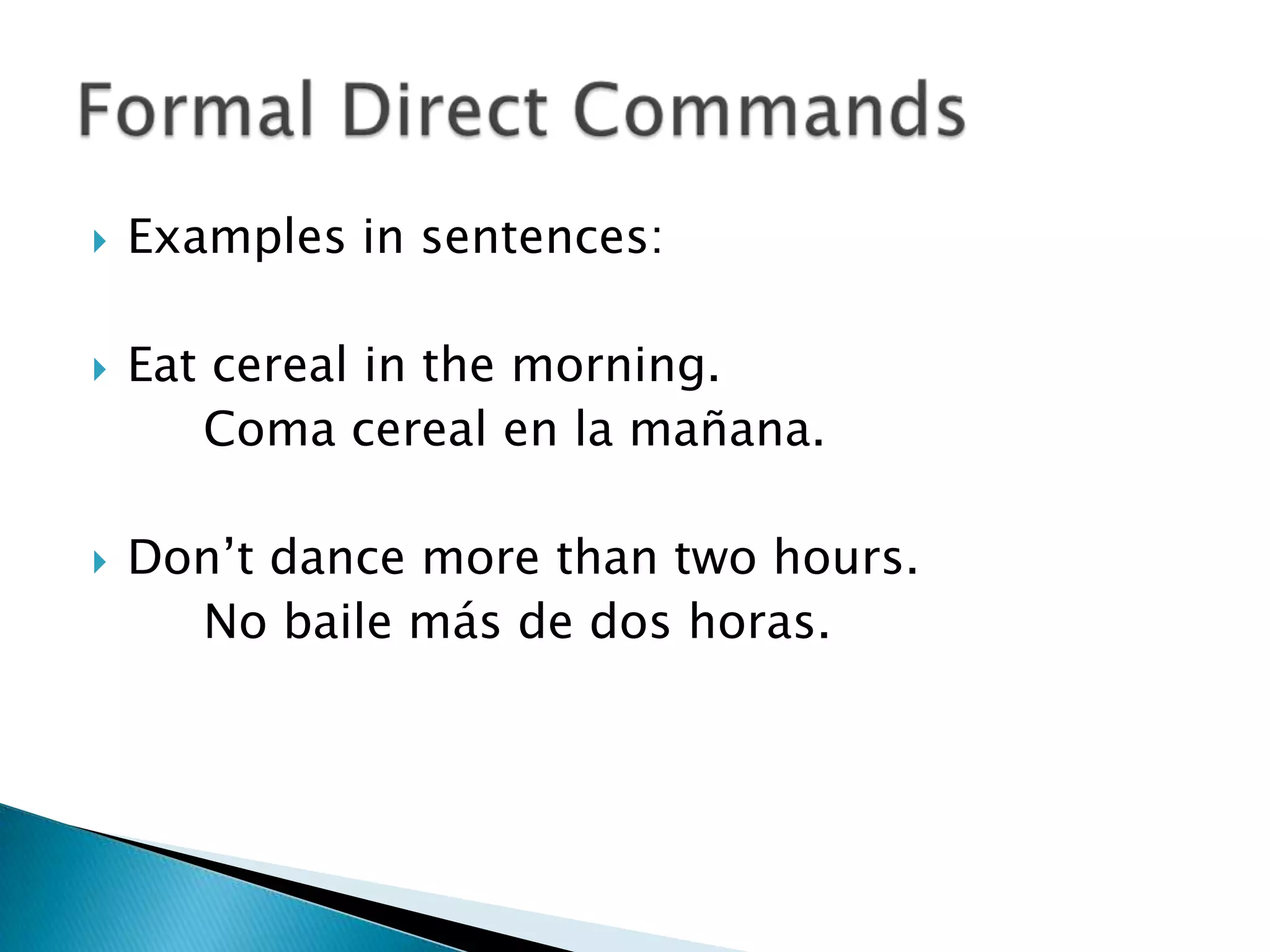
   Examples in sentences:

   Eat cereal in the morning.
       Coma cereal en la mañana.

   Don’t dance more than two hours.
      No baile más de dos horas.
   Irregularities and stem changes in the first
    person singular (yo) form of the present tense
    usually remain in the command form.

   Example: Sleep at least eight hours.

   Dormir (to sleep) – Duermo (I sleep)

   Duerma por lo menos ocho horas.
   If an object pronoun is involved, it attaches to
    an affirmative command and precedes a
    negative one.

   Examples: Tell me the truth.
      Dígame la verdad.

   Don’t tell me that you don’t know.
     No me diga que no sabes.
   If both an indirect and direct object pronoun
    are used, they attach to the affirmative
    command with the IOP coming before the
    DOP, and a diacritical mark is added to the
    command.
   Example: Give it (masculine) to me.
       Démelo.
   Give it (masculine) to him/her/you/them.
       Déselo.
   Give it (masculine) to us.
       Dénoslo.
   The following are some formal direct
    commands that are irregular:
   Dar - to give
      Dé
   Decir - to tell/say
      Diga
   Estar - to be (temporary)
      Esté
   Hacer - to do/make
      Haga
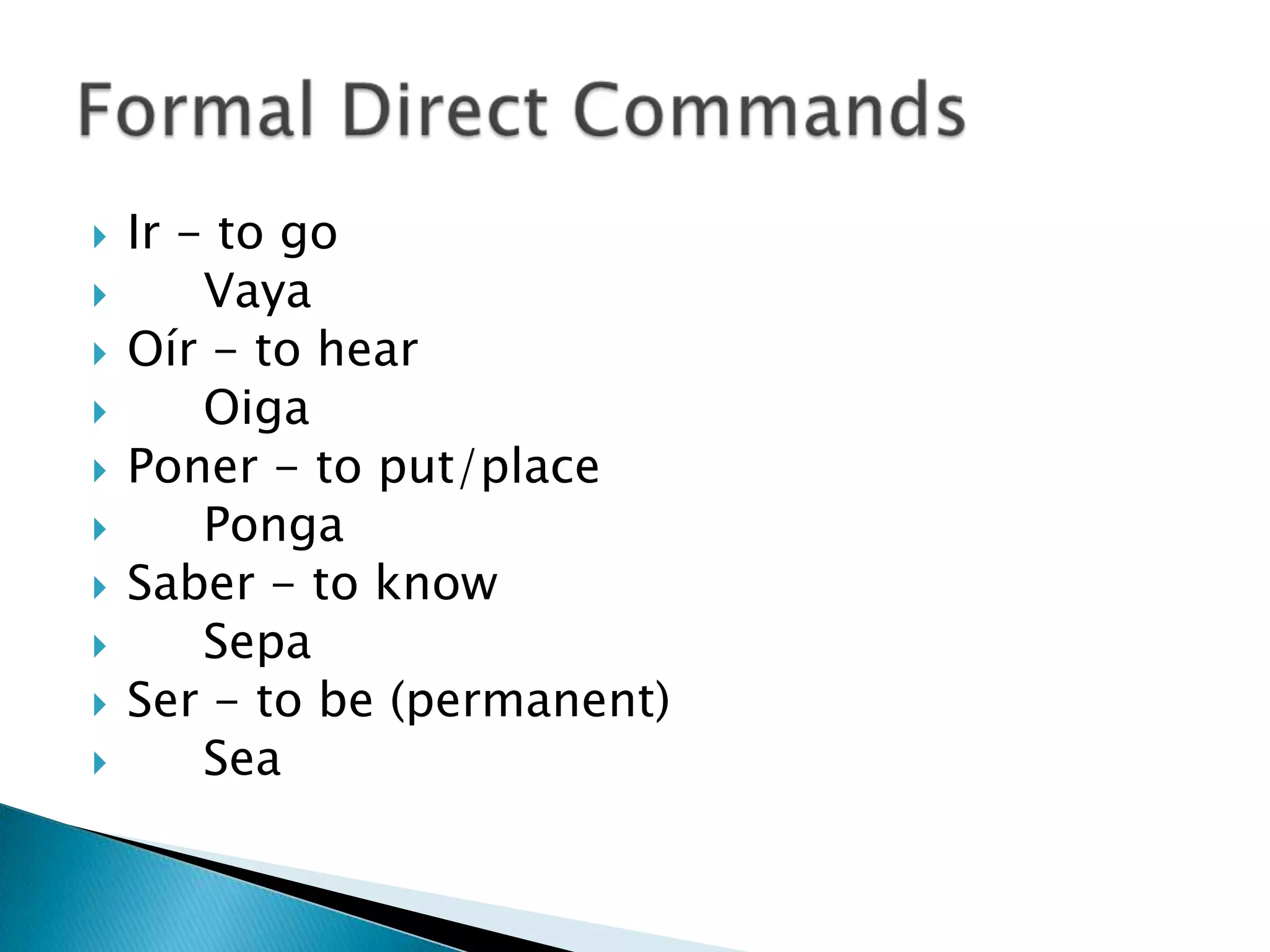
   Ir - to go
       Vaya
   Oír - to hear
       Oiga
   Poner - to put/place
       Ponga
   Saber - to know
       Sepa
   Ser - to be (permanent)
       Sea
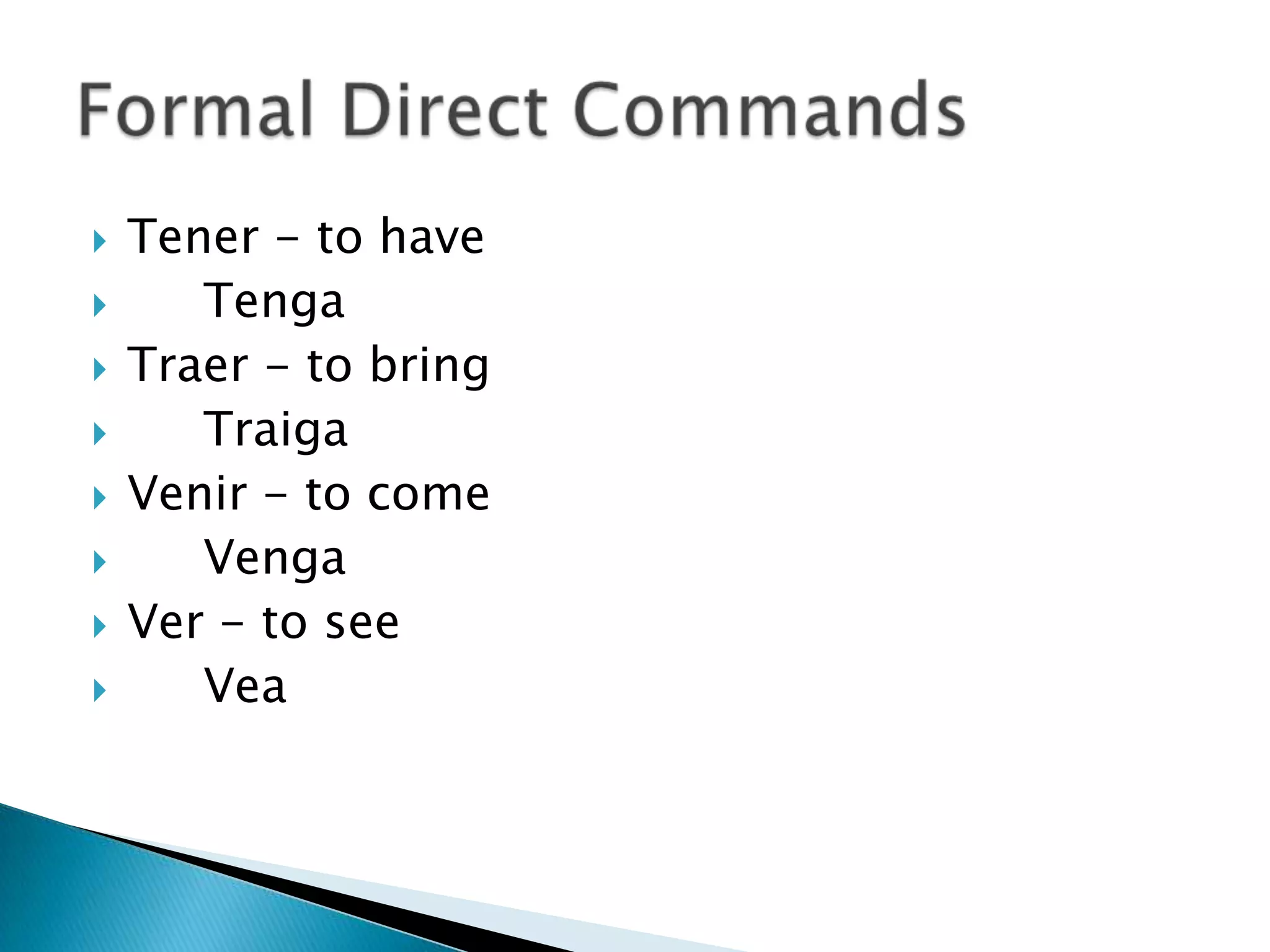
   Tener - to have
      Tenga
   Traer - to bring
      Traiga
   Venir - to come
      Venga
   Ver - to see
      Vea
   Formal Commands of Direction
   Stop - pare(n)
   Follow me - siga(n)me
   Continue - siga(n)
   Go up - suba(n)
   Pass - pase(n)
   Go down - baje(n)
   Take - tome(n)
   Get in/on (bus, etc.) - suba(n)se a
   Turn - doble(n)
   Get off (bus, etc.) - baje(n)se de
   Informal commands are formed with the
    second person singular (tu) form of the
    present tense.
   Affirmative commands: drop -s from the
    second person singular form of the present
    indicative.
   Examples: Mirar (to look [at]) – Miras (you
    look [at]) – Mira – (look [at])
   Comer (to eat) – Comes (you eat) – Come (Eat)
   Asistir (to attend) – Asistes (you attend) –
    Asiste (attend)
   Negative Commands: Use second person
    singular form of the present subjunctive.

   Examples: Don’t look.
      No mires.
   Don’t eat.
      No comas.
   Don’t attend.
      No asistas.
   The following are some common irregular
    familiar commands in the affirmative and the
    negative:
   Decir - to tell/say
       Di                  No digas
   Hacer - to do/make
       Haz                 No hagas
   Ir - to go
       Ve                  No vayas
   Poner - to put/place
       Pon                   No pongas
   Salir - to leave
       Sal                   No salgas
   Ser - to be (permanent)
       Sé                    No seas
   Tener - to have
       Ten                   No tengas
   Valer - to value
      Val             No valgas
   Venir - to come
      Ven             No vengas
   The first person plural of the present
    subjunctive is used in suggestion (or “Let’s”)
    commands.
   Examples: Let’s work.
      Trabajemos.
   Let’s read.
      Leamos.
   Let’s have a drink.
      Tomemos un refresco.
   Pronouns attach to affirmative suggestion
    commands and precede negative ones.

   Examples: Let’s invite him.
      Invitémoslo.

   Let’s not invite him.
      No lo invitemos.
   Indirect Commands are formed by omitting
    the initial word or words of the impersonal
    verb phrase in a soft command.

   Examples: I want them to drive.
          Quiero que manejen.

   Have them drive!
      ¡Que manejen!
   I want him to finish.
      Quiero que termine.

   Let him finish!
      ¡Que termine!
   Irregulars for Formal Direct Commands:
   Ir – to go
   Go with God.
   Vaya con Dios.
   Decir – to tell/say
   Tell the truth.
   Diga la verdad.
   Hacer – to make/do
   Make a sandwich.
   Haga un sandwich.
   Irregular Familiar Direct Commands:
   Decir – to tell/say
   Tell the truth.
   Di la verdad.
   Hacer – to make/do
   Don’t make a sandwich.
   No hagas un sandwich.

Commands - Spanish II

  • 1.
    Formal and FamiliarDirect Commands, Suggestion Commands, and Indirect Commands
  • 2.
    Formal direct commands are formed by adding the third person singular and plural (Usted and Ustedes) endings of the present subjunctive to the first person singular form (yo form) of the present indicative after dropping the -o.  Examples: Hablar (to speak) – Hablo (I speak) – Hable (Speak)  Comer (to eat) – Como (I eat) – Coma (Eat)  Vivir (to live) – Vivo (I live) – Viva (Live)
  • 3.
    Examples in sentences:  Eat cereal in the morning. Coma cereal en la mañana.  Don’t dance more than two hours. No baile más de dos horas.
  • 4.
    Irregularities and stem changes in the first person singular (yo) form of the present tense usually remain in the command form.  Example: Sleep at least eight hours.  Dormir (to sleep) – Duermo (I sleep)  Duerma por lo menos ocho horas.
  • 5.
    If an object pronoun is involved, it attaches to an affirmative command and precedes a negative one.  Examples: Tell me the truth.  Dígame la verdad.  Don’t tell me that you don’t know.  No me diga que no sabes.
  • 6.
    If both an indirect and direct object pronoun are used, they attach to the affirmative command with the IOP coming before the DOP, and a diacritical mark is added to the command.  Example: Give it (masculine) to me.  Démelo.  Give it (masculine) to him/her/you/them.  Déselo.  Give it (masculine) to us.  Dénoslo.
  • 7.
    The following are some formal direct commands that are irregular:  Dar - to give  Dé  Decir - to tell/say  Diga  Estar - to be (temporary)  Esté  Hacer - to do/make  Haga
  • 8.
    Ir - to go  Vaya  Oír - to hear  Oiga  Poner - to put/place  Ponga  Saber - to know  Sepa  Ser - to be (permanent)  Sea
  • 9.
    Tener - to have  Tenga  Traer - to bring  Traiga  Venir - to come  Venga  Ver - to see  Vea
  • 10.
    Formal Commands of Direction  Stop - pare(n)  Follow me - siga(n)me  Continue - siga(n)  Go up - suba(n)  Pass - pase(n)  Go down - baje(n)  Take - tome(n)  Get in/on (bus, etc.) - suba(n)se a  Turn - doble(n)  Get off (bus, etc.) - baje(n)se de
  • 11.
    Informal commands are formed with the second person singular (tu) form of the present tense.  Affirmative commands: drop -s from the second person singular form of the present indicative.  Examples: Mirar (to look [at]) – Miras (you look [at]) – Mira – (look [at])  Comer (to eat) – Comes (you eat) – Come (Eat)  Asistir (to attend) – Asistes (you attend) – Asiste (attend)
  • 12.
    Negative Commands: Use second person singular form of the present subjunctive.  Examples: Don’t look.  No mires.  Don’t eat.  No comas.  Don’t attend.  No asistas.
  • 13.
    The following are some common irregular familiar commands in the affirmative and the negative:  Decir - to tell/say  Di No digas  Hacer - to do/make  Haz No hagas  Ir - to go  Ve No vayas
  • 14.
    Poner - to put/place  Pon No pongas  Salir - to leave  Sal No salgas  Ser - to be (permanent)  Sé No seas  Tener - to have  Ten No tengas
  • 15.
    Valer - to value  Val No valgas  Venir - to come  Ven No vengas
  • 16.
    The first person plural of the present subjunctive is used in suggestion (or “Let’s”) commands.  Examples: Let’s work.  Trabajemos.  Let’s read.  Leamos.  Let’s have a drink.  Tomemos un refresco.
  • 17.
    Pronouns attach to affirmative suggestion commands and precede negative ones.  Examples: Let’s invite him.  Invitémoslo.  Let’s not invite him.  No lo invitemos.
  • 18.
    Indirect Commands are formed by omitting the initial word or words of the impersonal verb phrase in a soft command.  Examples: I want them to drive.  Quiero que manejen.  Have them drive!  ¡Que manejen!
  • 19.
    I want him to finish.  Quiero que termine.  Let him finish!  ¡Que termine!
  • 20.
    Irregulars for Formal Direct Commands:  Ir – to go  Go with God.  Vaya con Dios.  Decir – to tell/say  Tell the truth.  Diga la verdad.  Hacer – to make/do  Make a sandwich.  Haga un sandwich.
  • 21.
    Irregular Familiar Direct Commands:  Decir – to tell/say  Tell the truth.  Di la verdad.  Hacer – to make/do  Don’t make a sandwich.  No hagas un sandwich.