INVERSIONS
Explanations

               Source: Advanced Language Practice. Heinemann
INVERSION

The term ‘inversion’ covers two different grammatical
  operations.
 Using a question form of the main verb.


    Not only did he fail to report the absence, but also later
        denied that he had not been in class.
    Never have I had such a wonderful time!


   Changing the normal positions of verb and
    subject.

    Along the street came a strange individual.
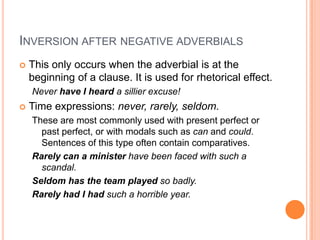
INVERSION AFTER NEGATIVE ADVERBIALS
   This only occurs when the adverbial is at the
    beginning of a clause. It is used for rhetorical effect.
    Never have I heard a sillier excuse!
   Time expressions: never, rarely, seldom.
    These are most commonly used with present perfect or
      past perfect, or with modals such as can and could.
      Sentences of this type often contain comparatives.
    Rarely can a minister have been faced with such a
      scandal.
    Seldom has the team played so badly.
    Rarely had I had such a horrible year.
INVERSION AFTER NEGATIVE ADVERBIALS
   Time expressions: hardly, barely, scarcely, no
    sooner.
    These refer to an event which quickly follows another in
      the past. They are usually used with past perfect,
      although no sooner can be followed by past simple.

    Hardly had the train left the station, when there was an
      accident.
    Scarcely had I entered the room when the phone rang.
    No sooner had I reached the office than I realised it was
      locked.
    No sooner was the singer back on the stage than it
      began to rain.
INVERSION AFTER NEGATIVE ADVERBIALS
   After only
    Here only combines with other time expressions and is
      usually used with past simple.

    Only after posting the letter did I remember that I had
     written the wrong address.

    Other examples are only if/when, only then, only later.

    Only if you come to the party will you be able to meet
     her.
    Only then did I find out about his real identity.
    Only later did she learn that he was her boss.
INVERSION AFTER NEGATIVE ADVERBIALS
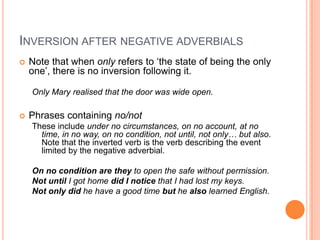
   Note that when only refers to ‘the state of being the only
    one’, there is no inversion following it.

    Only Mary realised that the door was wide open.

   Phrases containing no/not
    These include under no circumstances, on no account, at no
      time, in no way, on no condition, not until, not only… but also.
      Note that the inverted verb is the verb describing the event
      limited by the negative adverbial.

    On no condition are they to open the safe without permission.
    Not until I got home did I notice that I had lost my keys.
    Not only did he have a good time but he also learned English.
INVERSION AFTER NEGATIVE ADVERBIALS
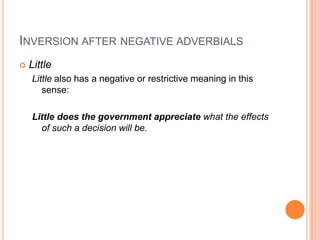
   Little
    Little also has a negative or restrictive meaning in this
       sense:

    Little does the government appreciate what the effects
      of such a decision will be.
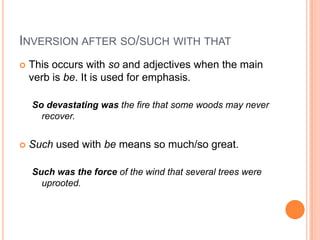
INVERSION AFTER SO/SUCH WITH THAT
   This occurs with so and adjectives when the main
    verb is be. It is used for emphasis.

    So devastating was the fire that some woods may never
      recover.


   Such used with be means so much/so great.

    Such was the force of the wind that several trees were
      uprooted.
INVERTED CONDITIONAL SENTENCES WITHOUT
IF -

   Three types of If- sentences can be inverted without
    If-. This makes the sentences more formal and the
    event less likely.

    If they were to escape, there would be a demonstration.
    Were they to escape, there would be a demonstration.

    If you should hear from them, let me know.
    Should you hear from them, let me know.

    If I had known, I would have complained.
    Had I known, I would have complained.
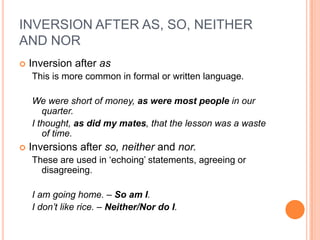
INVERSION AFTER AS, SO, NEITHER
AND NOR
   Inversion after as
    This is more common in formal or written language.

    We were short of money, as were most people in our
       quarter.
    I thought, as did my mates, that the lesson was a waste
       of time.
   Inversions after so, neither and nor.
    These are used in ‘echoing’ statements, agreeing or
      disagreeing.

    I am going home. – So am I.
    I don’t like rice. – Neither/Nor do I.

Inversions

  • 1.
    INVERSIONS Explanations Source: Advanced Language Practice. Heinemann
  • 2.
    INVERSION The term ‘inversion’covers two different grammatical operations.  Using a question form of the main verb. Not only did he fail to report the absence, but also later denied that he had not been in class. Never have I had such a wonderful time!  Changing the normal positions of verb and subject. Along the street came a strange individual.
  • 3.
    INVERSION AFTER NEGATIVEADVERBIALS  This only occurs when the adverbial is at the beginning of a clause. It is used for rhetorical effect. Never have I heard a sillier excuse!  Time expressions: never, rarely, seldom. These are most commonly used with present perfect or past perfect, or with modals such as can and could. Sentences of this type often contain comparatives. Rarely can a minister have been faced with such a scandal. Seldom has the team played so badly. Rarely had I had such a horrible year.
  • 4.
    INVERSION AFTER NEGATIVEADVERBIALS  Time expressions: hardly, barely, scarcely, no sooner. These refer to an event which quickly follows another in the past. They are usually used with past perfect, although no sooner can be followed by past simple. Hardly had the train left the station, when there was an accident. Scarcely had I entered the room when the phone rang. No sooner had I reached the office than I realised it was locked. No sooner was the singer back on the stage than it began to rain.
  • 5.
    INVERSION AFTER NEGATIVEADVERBIALS  After only Here only combines with other time expressions and is usually used with past simple. Only after posting the letter did I remember that I had written the wrong address. Other examples are only if/when, only then, only later. Only if you come to the party will you be able to meet her. Only then did I find out about his real identity. Only later did she learn that he was her boss.
  • 6.
    INVERSION AFTER NEGATIVEADVERBIALS  Note that when only refers to ‘the state of being the only one’, there is no inversion following it. Only Mary realised that the door was wide open.  Phrases containing no/not These include under no circumstances, on no account, at no time, in no way, on no condition, not until, not only… but also. Note that the inverted verb is the verb describing the event limited by the negative adverbial. On no condition are they to open the safe without permission. Not until I got home did I notice that I had lost my keys. Not only did he have a good time but he also learned English.
  • 7.
    INVERSION AFTER NEGATIVEADVERBIALS  Little Little also has a negative or restrictive meaning in this sense: Little does the government appreciate what the effects of such a decision will be.
  • 8.
    INVERSION AFTER SO/SUCHWITH THAT  This occurs with so and adjectives when the main verb is be. It is used for emphasis. So devastating was the fire that some woods may never recover.  Such used with be means so much/so great. Such was the force of the wind that several trees were uprooted.
  • 9.
    INVERTED CONDITIONAL SENTENCESWITHOUT IF -  Three types of If- sentences can be inverted without If-. This makes the sentences more formal and the event less likely. If they were to escape, there would be a demonstration. Were they to escape, there would be a demonstration. If you should hear from them, let me know. Should you hear from them, let me know. If I had known, I would have complained. Had I known, I would have complained.
  • 10.
    INVERSION AFTER AS,SO, NEITHER AND NOR  Inversion after as This is more common in formal or written language. We were short of money, as were most people in our quarter. I thought, as did my mates, that the lesson was a waste of time.  Inversions after so, neither and nor. These are used in ‘echoing’ statements, agreeing or disagreeing. I am going home. – So am I. I don’t like rice. – Neither/Nor do I.