Grammar Book2nd semesterBenjamin Blackburn
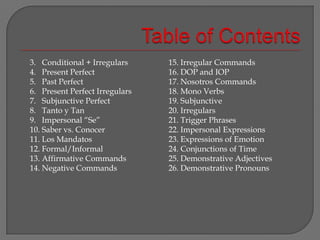
Table of ContentsConditional + IrregularsPresent PerfectPast PerfectPresent Perfect IrregularsSubjunctive PerfectTanto y TanImpersonal “Se”Saber vs. ConocerLos MandatosFormal/InformalAffirmative CommandsNegative Commands 15. Irregular Commands16. DOP and IOP 17. Nosotros Commands18. Mono Verbs19. Subjunctive20. Irregulars21. Trigger Phrases 22. Impersonal Expressions23. Expressions of Emotion24. Conjunctions of Time 25. Demonstrative Adjectives26. Demonstrative Pronouns
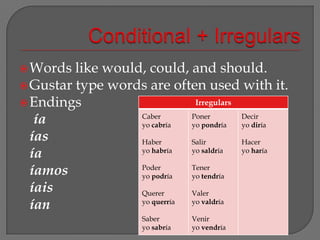
Conditional + IrregularsWords like would, could, and should.Gustar type words are often used with it.Endingsíaíasíaíamosíaisían
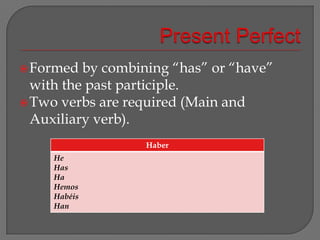
Present Perfect Formed by combining “has” or “have” with the past participle.Two verbs are required (Main and Auxiliary verb).
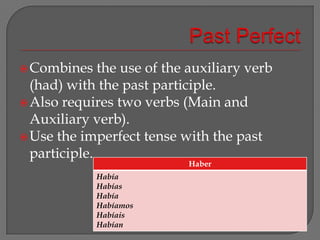
Past PerfectCombines the use of the auxiliary verb (had) with the past participle.Also requires two verbs (Main and Auxiliary verb).Use the imperfect tense with the past participle.
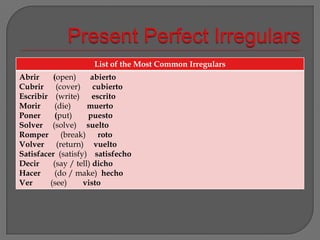
Present Perfect Irregulars
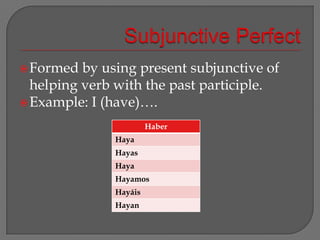
Subjunctive PerfectFormed by using present subjunctive of helping verb with the past participle.Example: I (have)….
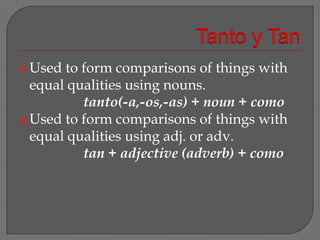
Tanto y TanUsed to form comparisons of things with equal qualities using nouns.			tanto(-a,-os,-as) + noun + comoUsed to form comparisons of things with equal qualities using adj. or adv.			tan + adjective (adverb) + como
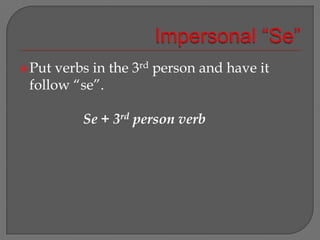
Impersonal “Se”Put verbs in the 3rd person and have it follow “se”.Se + 3rd person verb
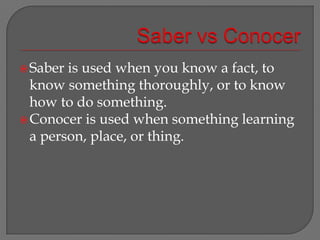
Saber vsConocerSaber is used when you know a fact, to know something thoroughly, or to know how to do something.Conocer is used when something learning a person, place, or thing.
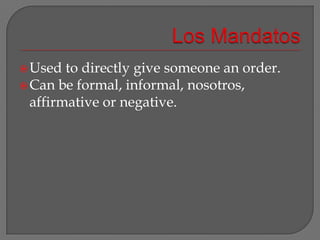
Los MandatosUsed to directly give someone an order.Can be formal, informal, nosotros, affirmative or negative.
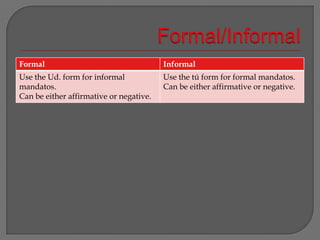
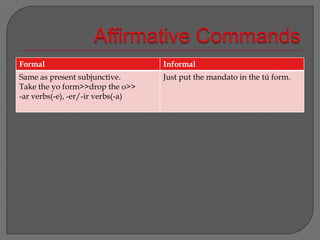
Formal/Informal
Affirmative Commands
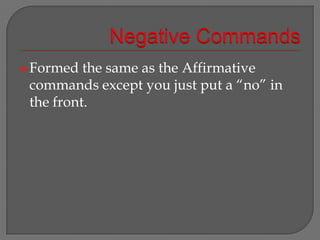
Negative Commands Formed the same as the Affirmative commands except you just put a “no” in the front.
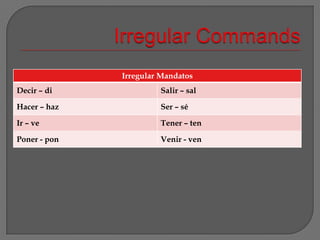
Irregular Commands
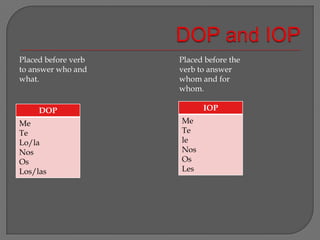
DOP and IOPPlaced before verb to answer who and what.Placed before the verb to answer whom and for whom.
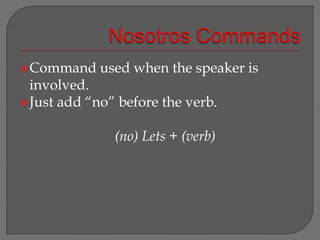
Nosotros CommandsCommand used when the speaker is involved.Just add “no” before the verb.(no) Lets + (verb)
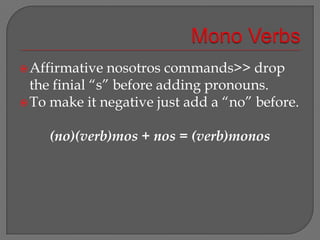
Mono VerbsAffirmative nosotros commands>> drop the finial “s” before adding pronouns.To make it negative just add a “no” before.(no)(verb)mos + nos = (verb)monos
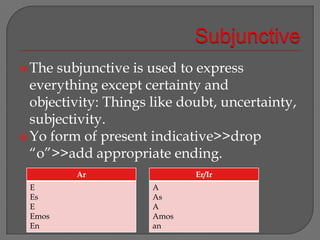
SubjunctiveThe subjunctive is used to express everything except certainty and objectivity: Things like doubt, uncertainty, subjectivity.Yo form of present indicative>>drop “o”>>add appropriate ending.
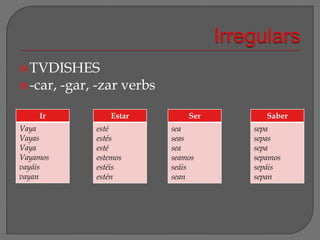
IrregularsTVDISHES-car, -gar, -zar verbs
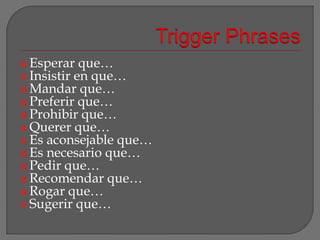
Trigger PhrasesEsperarque…Insistiren que…Mandarque… Preferirque… Prohibirque… Quererque…Es aconsejableque…Es necesarioque…Pedirque…Recomendarque…Rogarque…Sugerirque…
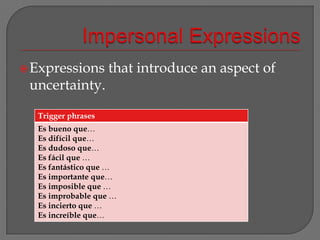
Impersonal ExpressionsExpressions that introduce an aspect of uncertainty.
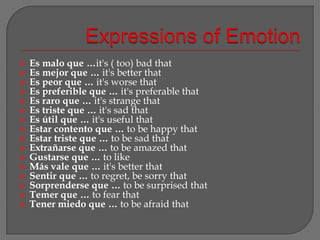
Expressions of EmotionEs maloque …it's ( too) bad thatEs mejorque … it's better thatEs peorque … it's worse thatEs preferibleque … it's preferable thatEs raroque … it's strange thatEs tristeque … it's sad thatEs útilque … it's useful thatEstarcontentoque … to be happy thatEstartristeque … to be sad thatExtrañarseque … to be amazed thatGustarseque … to likeMásvale que … it's better thatSentirque … to regret, be sorry thatSorprenderseque … to be surprised thatTemerque … to fear thatTenermiedoque … to be afraid that
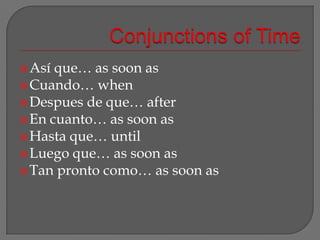
Conjunctions of TimeAsí que… as soonasCuando… whenDespuesde que… afterEn cuanto… as soonasHasta que… untilLuego que… as soonasTan pronto como… as soon as
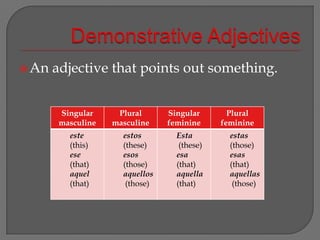
 Demonstrative AdjectivesAn adjective that points out something.
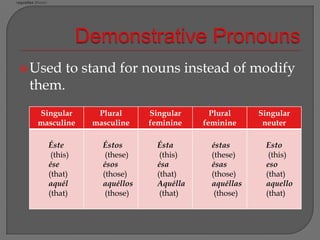
Demonstrative PronounsUsed to stand for nouns instead of modify them.estas (those)
esas (that)

Grammar book 2nd semester

  • 1.
  • 2.
    Table of ContentsConditional+ IrregularsPresent PerfectPast PerfectPresent Perfect IrregularsSubjunctive PerfectTanto y TanImpersonal “Se”Saber vs. ConocerLos MandatosFormal/InformalAffirmative CommandsNegative Commands 15. Irregular Commands16. DOP and IOP 17. Nosotros Commands18. Mono Verbs19. Subjunctive20. Irregulars21. Trigger Phrases 22. Impersonal Expressions23. Expressions of Emotion24. Conjunctions of Time 25. Demonstrative Adjectives26. Demonstrative Pronouns
  • 3.
    Conditional + IrregularsWordslike would, could, and should.Gustar type words are often used with it.Endingsíaíasíaíamosíaisían
  • 4.
    Present Perfect Formedby combining “has” or “have” with the past participle.Two verbs are required (Main and Auxiliary verb).
  • 5.
    Past PerfectCombines theuse of the auxiliary verb (had) with the past participle.Also requires two verbs (Main and Auxiliary verb).Use the imperfect tense with the past participle.
  • 6.
  • 7.
    Subjunctive PerfectFormed byusing present subjunctive of helping verb with the past participle.Example: I (have)….
  • 8.
    Tanto y TanUsedto form comparisons of things with equal qualities using nouns. tanto(-a,-os,-as) + noun + comoUsed to form comparisons of things with equal qualities using adj. or adv. tan + adjective (adverb) + como
  • 9.
    Impersonal “Se”Put verbsin the 3rd person and have it follow “se”.Se + 3rd person verb
  • 10.
    Saber vsConocerSaber isused when you know a fact, to know something thoroughly, or to know how to do something.Conocer is used when something learning a person, place, or thing.
  • 11.
    Los MandatosUsed todirectly give someone an order.Can be formal, informal, nosotros, affirmative or negative.
  • 12.
  • 13.
  • 14.
    Negative Commands Formedthe same as the Affirmative commands except you just put a “no” in the front.
  • 15.
  • 16.
    DOP and IOPPlacedbefore verb to answer who and what.Placed before the verb to answer whom and for whom.
  • 17.
    Nosotros CommandsCommand usedwhen the speaker is involved.Just add “no” before the verb.(no) Lets + (verb)
  • 18.
    Mono VerbsAffirmative nosotroscommands>> drop the finial “s” before adding pronouns.To make it negative just add a “no” before.(no)(verb)mos + nos = (verb)monos
  • 19.
    SubjunctiveThe subjunctive is usedto express everything except certainty and objectivity: Things like doubt, uncertainty, subjectivity.Yo form of present indicative>>drop “o”>>add appropriate ending.
  • 20.
  • 21.
    Trigger PhrasesEsperarque…Insistiren que…Mandarque…Preferirque… Prohibirque… Quererque…Es aconsejableque…Es necesarioque…Pedirque…Recomendarque…Rogarque…Sugerirque…
  • 22.
    Impersonal ExpressionsExpressions thatintroduce an aspect of uncertainty.
  • 23.
    Expressions of EmotionEsmaloque …it's ( too) bad thatEs mejorque … it's better thatEs peorque … it's worse thatEs preferibleque … it's preferable thatEs raroque … it's strange thatEs tristeque … it's sad thatEs útilque … it's useful thatEstarcontentoque … to be happy thatEstartristeque … to be sad thatExtrañarseque … to be amazed thatGustarseque … to likeMásvale que … it's better thatSentirque … to regret, be sorry thatSorprenderseque … to be surprised thatTemerque … to fear thatTenermiedoque … to be afraid that
  • 24.
    Conjunctions of TimeAsíque… as soonasCuando… whenDespuesde que… afterEn cuanto… as soonasHasta que… untilLuego que… as soonasTan pronto como… as soon as
  • 25.
    Demonstrative AdjectivesAnadjective that points out something.
  • 26.
    Demonstrative PronounsUsed tostand for nouns instead of modify them.estas (those)
  • 27.