Grammar
Book
Augusto Melnick
Table of Contents
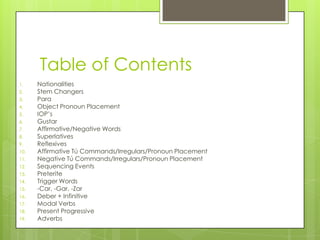
1.    Nationalities
2.    Stem Changers
3.    Para
4.    Object Pronoun Placement
5.    IOP’s
6.    Gustar
7.    Affirmative/Negative Words
8.    Superlatives
9.    Reflexives
10.   Affirmative Tú Commands/Irregulars/Pronoun Placement
11.   Negative Tú Commands/Irregulars/Pronoun Placement
12.   Sequencing Events
13.   Preterite
14.   Trigger Words
15.   -Car, -Gar, -Zar
16.   Deber + Infinitive
17.   Modal Verbs
18.   Present Progressive
19.   Adverbs
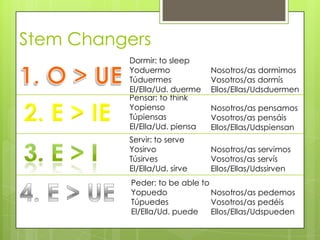
Stem Changers
          Dormir: to sleep
          Yoduermo             Nosotros/as dormimos
          Túduermes            Vosotros/as dormís
          El/Ella/Ud. duerme   Ellos/Ellas/Udsduermen
          Pensar: to think
          Yopienso             Nosotros/as pensamos
          Túpiensas            Vosotros/as pensáis
          El/Ella/Ud. piensa   Ellos/Ellas/Udspiensan
          Servir: to serve
          Yosirvo              Nosotros/as servimos
          Túsirves             Vosotros/as servís
          El/Ella/Ud. sirve    Ellos/Ellas/Udssirven
           Peder: to be able to
           Yopuedo              Nosotros/as pedemos
           Túpuedes             Vosotros/as pedéis
           El/Ella/Ud. puede    Ellos/Ellas/Udspueden
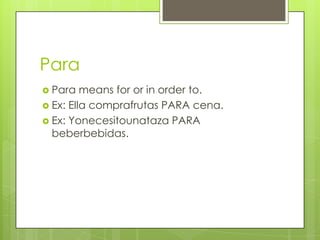
Para
 Para   means for or in order to.
 Ex: Ella comprafrutas PARA cena.
 Ex: Yonecesitounataza PARA
  beberbebidas.
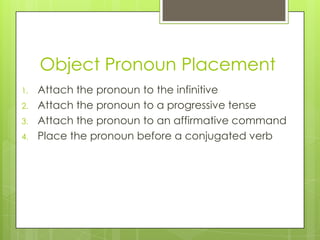
Object Pronoun Placement
1.   Attach the pronoun to the infinitive
2.   Attach the pronoun to a progressive tense
3.   Attach the pronoun to an affirmative command
4.   Place the pronoun before a conjugated verb
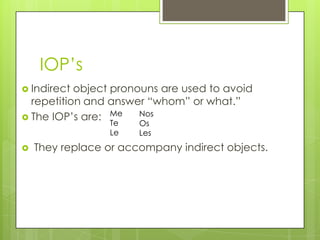
IOP’s
 Indirect object pronouns are used to avoid
  repetition and answer “whom” or what.”
                  Me   Nos
 The IOP’s are:
                 Te    Os
                 Le    Les
   They replace or accompany indirect objects.
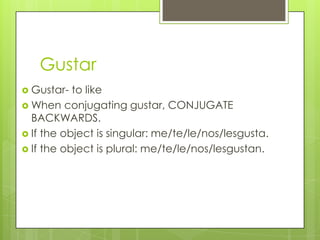
Gustar
 Gustar-  to like
 When conjugating gustar, CONJUGATE
  BACKWARDS.
 If the object is singular: me/te/le/nos/lesgusta.
 If the object is plural: me/te/le/nos/lesgustan.
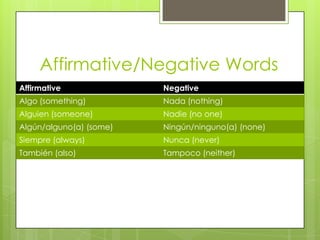
Affirmative/Negative Words
Affirmative              Negative
Algo (something)         Nada (nothing)
Alguien (someone)        Nadie (no one)
Algún/alguno(a) (some)   Ningún/ninguno(a) (none)
Siempre (always)         Nunca (never)
También (also)           Tampoco (neither)
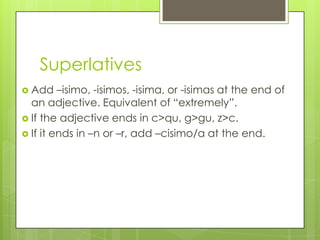
Superlatives
 Add    –isimo, -isimos, -isima, or -isimas at the end of
  an adjective. Equivalent of “extremely”.
 If the adjective ends in c>qu, g>gu, z>c.
 If it ends in –n or –r, add –cisimo/a at the end.
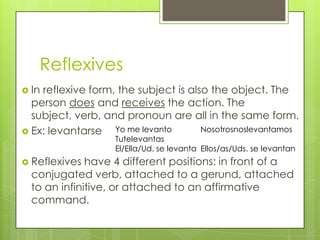
Reflexives
 Inreflexive form, the subject is also the object. The
  person does and receives the action. The
  subject, verb, and pronoun are all in the same form.
 Ex: levantarse   Yo me levanto      Nosotrosnoslevantamos
                   Tutelevantas
                   El/Ella/Ud. se levanta Ellos/as/Uds. se levantan
 Reflexives  have 4 different positions: in front of a
  conjugated verb, attached to a gerund, attached
  to an infinitive, or attached to an affirmative
  command.
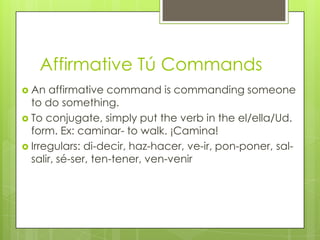
Affirmative Tú Commands
 An  affirmative command is commanding someone
  to do something.
 To conjugate, simply put the verb in the el/ella/Ud.
  form. Ex: caminar- to walk. ¡Camina!
 Irregulars: di-decir, haz-hacer, ve-ir, pon-poner, sal-
  salir, sé-ser, ten-tener, ven-venir
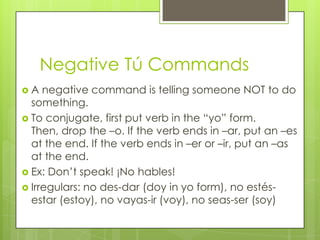
Negative Tú Commands
A   negative command is telling someone NOT to do
  something.
 To conjugate, first put verb in the “yo” form.
  Then, drop the –o. If the verb ends in –ar, put an –es
  at the end. If the verb ends in –er or –ir, put an –as
  at the end.
 Ex: Don’t speak! ¡No hables!
 Irregulars: no des-dar (doy in yo form), no estés-
  estar (estoy), no vayas-ir (voy), no seas-ser (soy)
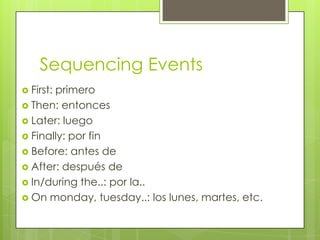
Sequencing Events
 First:
       primero
 Then: entonces
 Later: luego
 Finally: por fin
 Before: antes de
 After: después de
 In/during the..: por la..
 On monday, tuesday..: los lunes, martes, etc.
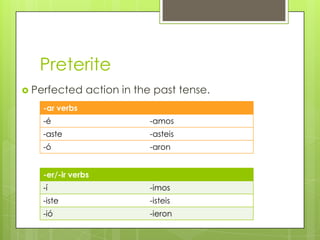
Preterite
 Perfected    action in the past tense.
   -ar verbs
   -é                      -amos
   -aste                   -asteis
   -ó                      -aron


   -er/-ir verbs
   -í                      -imos
   -iste                   -isteis
   -ió                     -ieron
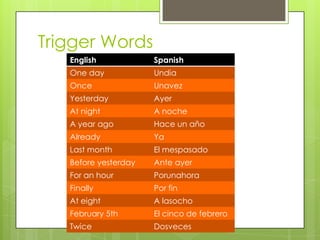
Trigger Words
   English            Spanish
   One day            Undia
   Once               Unavez
   Yesterday          Ayer
   At night           A noche
   A year ago         Hace un año
   Already            Ya
   Last month         El mespasado
   Before yesterday   Ante ayer
   For an hour        Porunahora
   Finally            Por fin
   At eight           A lasocho
   February 5th       El cinco de febrero
   Twice              Dosveces
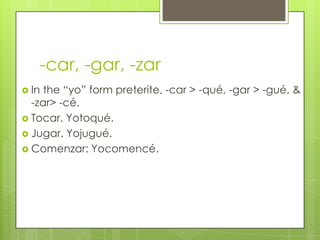
-car, -gar, -zar
 In the “yo” form preterite, -car > -qué, -gar > -gué, &
  -zar> -cé.
 Tocar. Yotoqué.
 Jugar. Yojugué.
 Comenzar: Yocomencé.
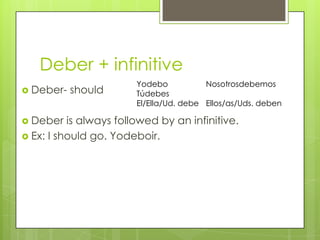
Deber + infinitive
                        Yodebo           Nosotrosdebemos
 Deber-   should       Túdebes
                        El/Ella/Ud. debe Ellos/as/Uds. deben

 Deber   is always followed by an infinitive.
 Ex: I should go. Yodeboir.
Modal Verbs
 Thesecond verb is never conjugated in a modal
 verb combination. You wouldn’t say
 “yopuedonado”, you would say “yopuedonadar.”
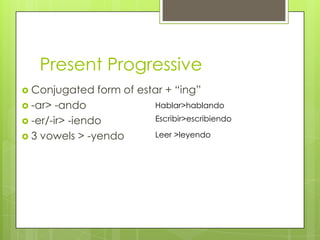
Present Progressive
 Conjugated   form of estar + “ing”
 -ar>  -ando             Hablar>hablando
 -er/-ir> -iendo         Escribir>escribiendo

 3 vowels > -yendo       Leer >leyendo
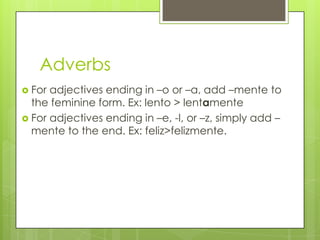
Adverbs
 For adjectives ending in –o or –a, add –mente to
  the feminine form. Ex: lento > lentamente
 For adjectives ending in –e, -l, or –z, simply add –
  mente to the end. Ex: feliz>felizmente.

Spanish grammar book

  • 1.
  • 2.
    Table of Contents 1. Nationalities 2. Stem Changers 3. Para 4. Object Pronoun Placement 5. IOP’s 6. Gustar 7. Affirmative/Negative Words 8. Superlatives 9. Reflexives 10. Affirmative Tú Commands/Irregulars/Pronoun Placement 11. Negative Tú Commands/Irregulars/Pronoun Placement 12. Sequencing Events 13. Preterite 14. Trigger Words 15. -Car, -Gar, -Zar 16. Deber + Infinitive 17. Modal Verbs 18. Present Progressive 19. Adverbs
  • 4.
    Stem Changers Dormir: to sleep Yoduermo Nosotros/as dormimos Túduermes Vosotros/as dormís El/Ella/Ud. duerme Ellos/Ellas/Udsduermen Pensar: to think Yopienso Nosotros/as pensamos Túpiensas Vosotros/as pensáis El/Ella/Ud. piensa Ellos/Ellas/Udspiensan Servir: to serve Yosirvo Nosotros/as servimos Túsirves Vosotros/as servís El/Ella/Ud. sirve Ellos/Ellas/Udssirven Peder: to be able to Yopuedo Nosotros/as pedemos Túpuedes Vosotros/as pedéis El/Ella/Ud. puede Ellos/Ellas/Udspueden
  • 5.
    Para  Para means for or in order to.  Ex: Ella comprafrutas PARA cena.  Ex: Yonecesitounataza PARA beberbebidas.
  • 6.
    Object Pronoun Placement 1. Attach the pronoun to the infinitive 2. Attach the pronoun to a progressive tense 3. Attach the pronoun to an affirmative command 4. Place the pronoun before a conjugated verb
  • 7.
    IOP’s  Indirect objectpronouns are used to avoid repetition and answer “whom” or what.” Me Nos  The IOP’s are: Te Os Le Les  They replace or accompany indirect objects.
  • 8.
    Gustar  Gustar- to like  When conjugating gustar, CONJUGATE BACKWARDS.  If the object is singular: me/te/le/nos/lesgusta.  If the object is plural: me/te/le/nos/lesgustan.
  • 9.
    Affirmative/Negative Words Affirmative Negative Algo (something) Nada (nothing) Alguien (someone) Nadie (no one) Algún/alguno(a) (some) Ningún/ninguno(a) (none) Siempre (always) Nunca (never) También (also) Tampoco (neither)
  • 10.
    Superlatives  Add –isimo, -isimos, -isima, or -isimas at the end of an adjective. Equivalent of “extremely”.  If the adjective ends in c>qu, g>gu, z>c.  If it ends in –n or –r, add –cisimo/a at the end.
  • 11.
    Reflexives  Inreflexive form,the subject is also the object. The person does and receives the action. The subject, verb, and pronoun are all in the same form.  Ex: levantarse Yo me levanto Nosotrosnoslevantamos Tutelevantas El/Ella/Ud. se levanta Ellos/as/Uds. se levantan  Reflexives have 4 different positions: in front of a conjugated verb, attached to a gerund, attached to an infinitive, or attached to an affirmative command.
  • 12.
    Affirmative Tú Commands An affirmative command is commanding someone to do something.  To conjugate, simply put the verb in the el/ella/Ud. form. Ex: caminar- to walk. ¡Camina!  Irregulars: di-decir, haz-hacer, ve-ir, pon-poner, sal- salir, sé-ser, ten-tener, ven-venir
  • 13.
    Negative Tú Commands A negative command is telling someone NOT to do something.  To conjugate, first put verb in the “yo” form. Then, drop the –o. If the verb ends in –ar, put an –es at the end. If the verb ends in –er or –ir, put an –as at the end.  Ex: Don’t speak! ¡No hables!  Irregulars: no des-dar (doy in yo form), no estés- estar (estoy), no vayas-ir (voy), no seas-ser (soy)
  • 14.
    Sequencing Events  First: primero  Then: entonces  Later: luego  Finally: por fin  Before: antes de  After: después de  In/during the..: por la..  On monday, tuesday..: los lunes, martes, etc.
  • 15.
    Preterite  Perfected action in the past tense. -ar verbs -é -amos -aste -asteis -ó -aron -er/-ir verbs -í -imos -iste -isteis -ió -ieron
  • 16.
    Trigger Words English Spanish One day Undia Once Unavez Yesterday Ayer At night A noche A year ago Hace un año Already Ya Last month El mespasado Before yesterday Ante ayer For an hour Porunahora Finally Por fin At eight A lasocho February 5th El cinco de febrero Twice Dosveces
  • 17.
    -car, -gar, -zar In the “yo” form preterite, -car > -qué, -gar > -gué, & -zar> -cé.  Tocar. Yotoqué.  Jugar. Yojugué.  Comenzar: Yocomencé.
  • 18.
    Deber + infinitive Yodebo Nosotrosdebemos  Deber- should Túdebes El/Ella/Ud. debe Ellos/as/Uds. deben  Deber is always followed by an infinitive.  Ex: I should go. Yodeboir.
  • 19.
    Modal Verbs  Thesecondverb is never conjugated in a modal verb combination. You wouldn’t say “yopuedonado”, you would say “yopuedonadar.”
  • 20.
    Present Progressive  Conjugated form of estar + “ing”  -ar> -ando Hablar>hablando  -er/-ir> -iendo Escribir>escribiendo  3 vowels > -yendo Leer >leyendo
  • 21.
    Adverbs  For adjectivesending in –o or –a, add –mente to the feminine form. Ex: lento > lentamente  For adjectives ending in –e, -l, or –z, simply add – mente to the end. Ex: feliz>felizmente.