Embed presentation
Downloaded 97 times


This document discusses how to form affirmative commands in Spanish using tú forms. To make an affirmative command, take the tú form of the present tense verb and drop the -s. Some common verbs like poner, tener, and decir use the yo form instead. Verbs like hacer, ser, and ir have irregular tú command forms. Reflexive verbs take the reflexive pronoun as part of the command.


Introduction to affirmative tú commands, a fundamental aspect of Spanish language commands.
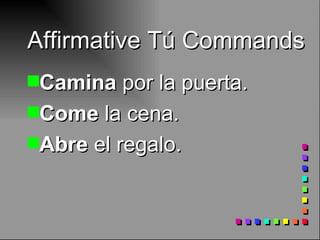
To form commands, use the tú form of the verb in the present tense and drop the 's'.
Examples include 'Camina por la puerta', 'Come la cena', and 'Abre el regalo'.
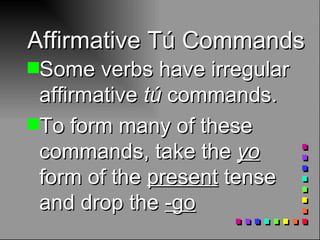
Some verbs have irregular commands; drop the '-go' from the yo form.
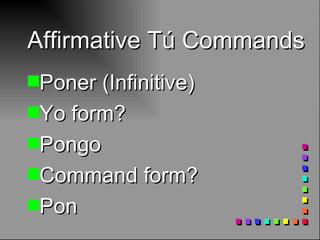
Poner (Infinitive): Yo form is 'pongo', command form is 'pon'.
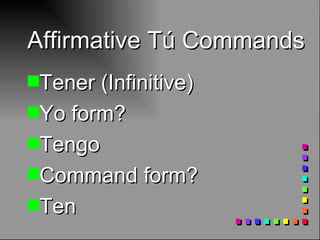
Tener (Infinitive): Yo form is 'tengo', command form is 'ten'.
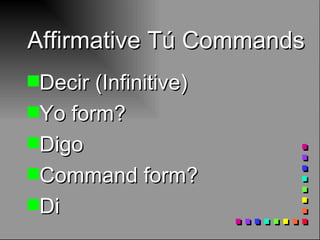
Decir (Infinitive): Yo form is 'digo', command form is 'di'.
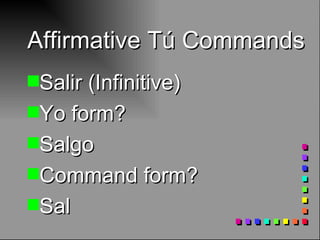
Salir (Infinitive): Yo form is 'salgo', command form is 'sal'.
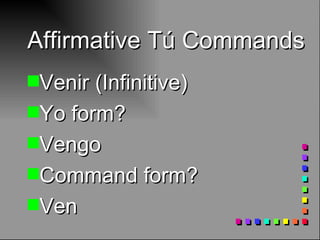
Venir (Infinitive): Yo form is 'vengo', command form is 'ven'.
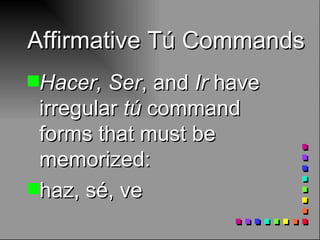
Commands for hacer, ser, and ir are 'haz', 'sé', 've' respectively and must be memorized.
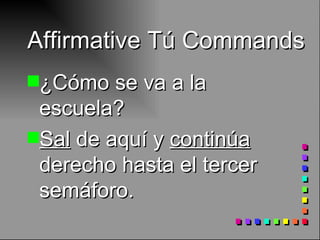
Example of asking for directions: 'Sal de aquí y continúa derecho hasta el tercer semáforo'.
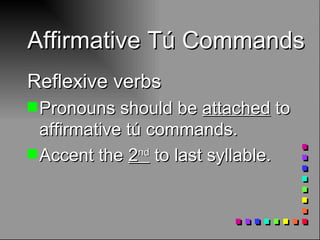
In affirmative commands, pronouns must be attached, accenting the second to last syllable.
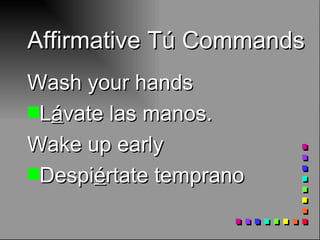
Commands include 'Lávate las manos' and 'Despiértate temprano'.
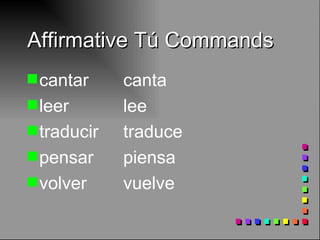
More examples of commands: 'cantar' (canta), 'leer' (lee), 'traducir' (traduce), etc.
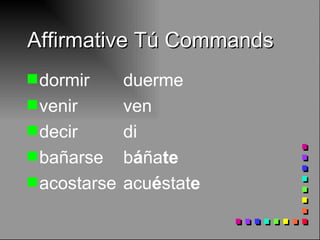
Continued examples: 'dormir' (duerme), 'venir' (ven), 'decir' (di), 'bañarse' (báñate), 'acostarse' (acuéstate).