Progressive Tenses
Present Progressive and Imperfect
Progressive
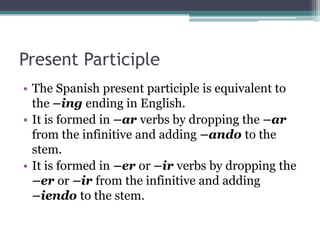
Present Participle
• The Spanish present participle is equivalent to
  the –ing ending in English.
• It is formed in –ar verbs by dropping the –ar
  from the infinitive and adding –ando to the
  stem.
• It is formed in –er or –ir verbs by dropping the
  –er or –ir from the infinitive and adding
  –iendo to the stem.
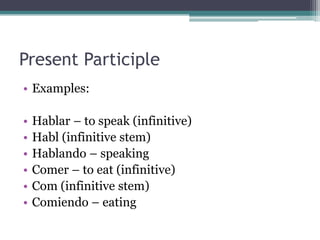
Present Participle
• Examples:

•   Hablar – to speak (infinitive)
•   Habl (infinitive stem)
•   Hablando – speaking
•   Comer – to eat (infinitive)
•   Com (infinitive stem)
•   Comiendo – eating
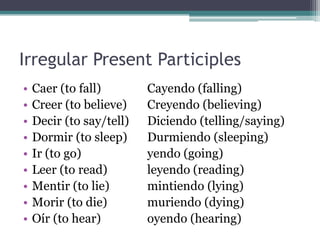
Irregular Present Participles
•   Caer (to fall)        Cayendo (falling)
•   Creer (to believe)    Creyendo (believing)
•   Decir (to say/tell)   Diciendo (telling/saying)
•   Dormir (to sleep)     Durmiendo (sleeping)
•   Ir (to go)            yendo (going)
•   Leer (to read)        leyendo (reading)
•   Mentir (to lie)       mintiendo (lying)
•   Morir (to die)        muriendo (dying)
•   Oír (to hear)         oyendo (hearing)
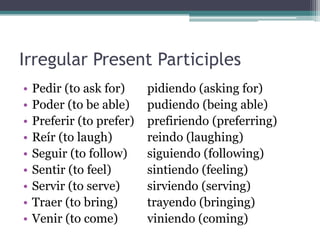
Irregular Present Participles
•   Pedir (to ask for)     pidiendo (asking for)
•   Poder (to be able)     pudiendo (being able)
•   Preferir (to prefer)   prefiriendo (preferring)
•   Reír (to laugh)        reindo (laughing)
•   Seguir (to follow)     siguiendo (following)
•   Sentir (to feel)       sintiendo (feeling)
•   Servir (to serve)      sirviendo (serving)
•   Traer (to bring)       trayendo (bringing)
•   Venir (to come)        viniendo (coming)
“Estar” in the present tense


•   Estar – to be
•   Estoy           Estamos
•   Estás
•   Está            Están
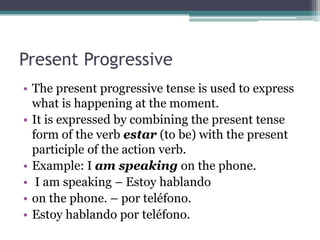
Present Progressive
• The present progressive tense is used to express
  what is happening at the moment.
• It is expressed by combining the present tense
  form of the verb estar (to be) with the present
  participle of the action verb.
• Example: I am speaking on the phone.
• I am speaking – Estoy hablando
• on the phone. – por teléfono.
• Estoy hablando por teléfono.
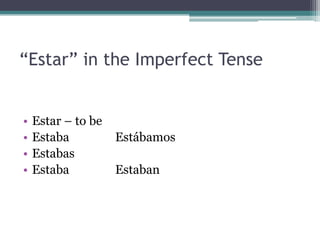
“Estar” in the Imperfect Tense


•   Estar – to be
•   Estaba          Estábamos
•   Estabas
•   Estaba          Estaban
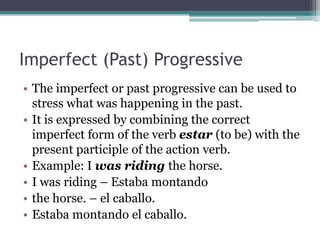
Imperfect (Past) Progressive
• The imperfect or past progressive can be used to
  stress what was happening in the past.
• It is expressed by combining the correct
  imperfect form of the verb estar (to be) with the
  present participle of the action verb.
• Example: I was riding the horse.
• I was riding – Estaba montando
• the horse. – el caballo.
• Estaba montando el caballo.
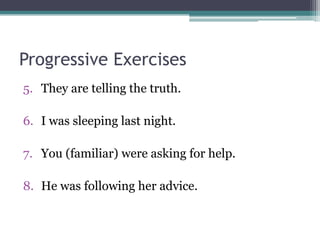
Progressive Exercises
1. I am speaking with my parents.

2. You (familiar) are leaving right now.

3. She is running with her boyfriend.

4. We are looking for his dog.
Progressive Exercises
5. They are telling the truth.

6. I was sleeping last night.

7. You (familiar) were asking for help.

8. He was following her advice.
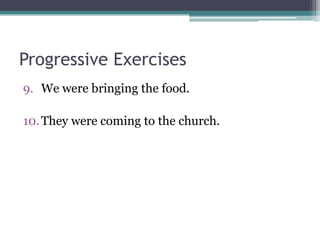
Progressive Exercises
9. We were bringing the food.

10. They were coming to the church.

Progressive tenses

  • 1.
    Progressive Tenses Present Progressiveand Imperfect Progressive
  • 2.
    Present Participle • TheSpanish present participle is equivalent to the –ing ending in English. • It is formed in –ar verbs by dropping the –ar from the infinitive and adding –ando to the stem. • It is formed in –er or –ir verbs by dropping the –er or –ir from the infinitive and adding –iendo to the stem.
  • 3.
    Present Participle • Examples: • Hablar – to speak (infinitive) • Habl (infinitive stem) • Hablando – speaking • Comer – to eat (infinitive) • Com (infinitive stem) • Comiendo – eating
  • 4.
    Irregular Present Participles • Caer (to fall) Cayendo (falling) • Creer (to believe) Creyendo (believing) • Decir (to say/tell) Diciendo (telling/saying) • Dormir (to sleep) Durmiendo (sleeping) • Ir (to go) yendo (going) • Leer (to read) leyendo (reading) • Mentir (to lie) mintiendo (lying) • Morir (to die) muriendo (dying) • Oír (to hear) oyendo (hearing)
  • 5.
    Irregular Present Participles • Pedir (to ask for) pidiendo (asking for) • Poder (to be able) pudiendo (being able) • Preferir (to prefer) prefiriendo (preferring) • Reír (to laugh) reindo (laughing) • Seguir (to follow) siguiendo (following) • Sentir (to feel) sintiendo (feeling) • Servir (to serve) sirviendo (serving) • Traer (to bring) trayendo (bringing) • Venir (to come) viniendo (coming)
  • 6.
    “Estar” in thepresent tense • Estar – to be • Estoy Estamos • Estás • Está Están
  • 7.
    Present Progressive • Thepresent progressive tense is used to express what is happening at the moment. • It is expressed by combining the present tense form of the verb estar (to be) with the present participle of the action verb. • Example: I am speaking on the phone. • I am speaking – Estoy hablando • on the phone. – por teléfono. • Estoy hablando por teléfono.
  • 8.
    “Estar” in theImperfect Tense • Estar – to be • Estaba Estábamos • Estabas • Estaba Estaban
  • 9.
    Imperfect (Past) Progressive •The imperfect or past progressive can be used to stress what was happening in the past. • It is expressed by combining the correct imperfect form of the verb estar (to be) with the present participle of the action verb. • Example: I was riding the horse. • I was riding – Estaba montando • the horse. – el caballo. • Estaba montando el caballo.
  • 10.
    Progressive Exercises 1. Iam speaking with my parents. 2. You (familiar) are leaving right now. 3. She is running with her boyfriend. 4. We are looking for his dog.
  • 11.
    Progressive Exercises 5. Theyare telling the truth. 6. I was sleeping last night. 7. You (familiar) were asking for help. 8. He was following her advice.
  • 12.
    Progressive Exercises 9. Wewere bringing the food. 10. They were coming to the church.