GERUND AND INFINITIVE VERB
República Bolivariana de Venezuela
Ministerio Del Poder Popular Para
La Educación Universitaria
Instituto Universitario Politécnico Santiago
Mariño –
Extensión Valencia
Asignatura:
Ingles II
Estudiante:
Luis José Jiménez.
C.I. 30.342.385
Clase 47
The gerund and the infinitive
The gerund and the infinitive
are forms of verbs that act as
nouns. The gerund is formed
with “-ing” (walk, eat, etc.). As
we have seen in the lesson on
verbs, the infinitive is formed
with the preposition “to” (walk,
eat, etc.).
When a verb follows another
verb, we always need to use
the infinitive or the gerund.
Normally we use the infinitive
after some verbs and the
gerund after others. There are
also verbs with which we can
use the gerund or the infinitive.
Ejemplos y características
We can use the gerund or the
infinitive as an object, subject or
complement of a sentence, but in
general, it is much more
common to use the gerund as a
subject.
Objeto:
I like cooking. / I like to cook.(Me gusta cocinar)
She continued working. / She continued to
work.(Continuó trabajando.)
Sujeto:
Swimming is good exercise.(Nadar es un buen
ejercicio)
Drinking and driving is dangerous.(Beber y
conducir es peligroso.)
Complemento:
The best thing to do when you are sick is to
drink a lot of water.(Lo mejor que puedes hacer cuando estás
enfermo es beber mucha agua.)
My favorite exercise is swimming.(Mi ejercicio
favorito es la natación.)
With some verbs, when we
use the gerund and the
infinitive, the meaning
changes.
Gerundio:
I forgot writing that email.(Me olvidé que escribí
ese correo electrónico.)
Infinitivo:
I forgot to write that email.(Me olvidé de escribir
el correo electrónico.)
Gerundio:
Stop watching the news.(Deja de ver las
noticias)
Infinitivo:
Stop to watch the news.(Para, para ver las
noticias.)
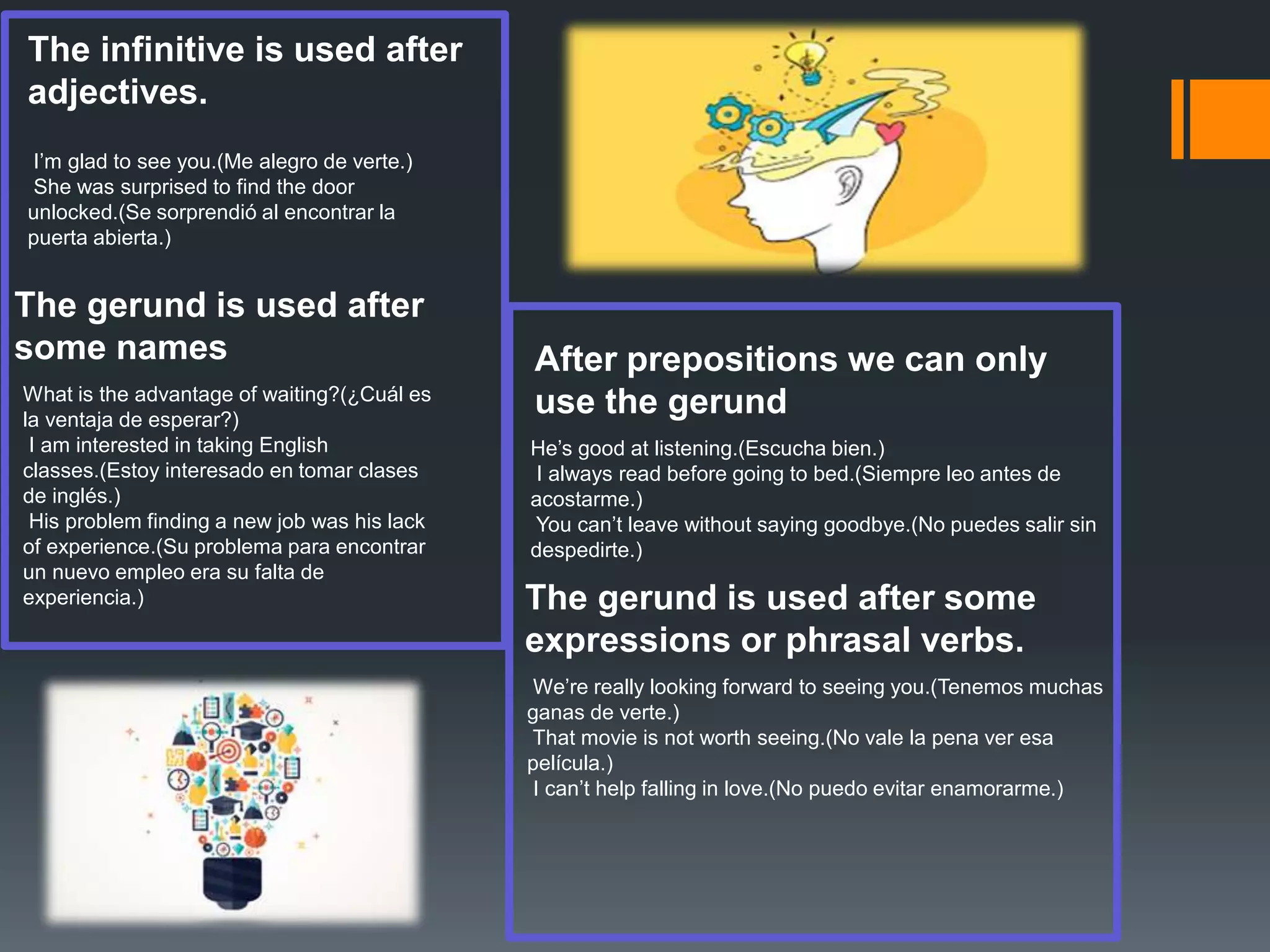
The infinitive is used after
adjectives.
I’m glad to see you.(Me alegro de verte.)
She was surprised to find the door
unlocked.(Se sorprendió al encontrar la
puerta abierta.)
After prepositions we can only
use the gerund
He’s good at listening.(Escucha bien.)
I always read before going to bed.(Siempre leo antes de
acostarme.)
You can’t leave without saying goodbye.(No puedes salir sin
despedirte.)
The gerund is used after
some names
What is the advantage of waiting?(¿Cuál es
la ventaja de esperar?)
I am interested in taking English
classes.(Estoy interesado en tomar clases
de inglés.)
His problem finding a new job was his lack
of experience.(Su problema para encontrar
un nuevo empleo era su falta de
experiencia.) The gerund is used after some
expressions or phrasal verbs.
We’re really looking forward to seeing you.(Tenemos muchas
ganas de verte.)
That movie is not worth seeing.(No vale la pena ver esa
película.)
I can’t help falling in love.(No puedo evitar enamorarme.)
Both can be used as verbs or as objects, it is
common to use the infinitive as the subject while
the gerund is used as a verb:
-He asked me not to be late. (The Infinitive
Verb is used as Object while that the Gerund is
used as a verb)
-She is reading her new book in her room.
In certain cases, the meaning may change
depending on how the verb is used
GRAMATICAL RULES
GRAMATICAL RULES
En gerundios, -ing se agrega cuando:
Cuando termine la última letra en "e", quite esa letra y
coloque la-ing
Cuando las ultimas letras son "consonante, vocal,
consonante", se repite la ultima letra y se agrega –ing:
-Stop+ing=stopping
-Plan+ing=planning
Cuando la ultima letra sea una consonante, se agrega –ing:
-Cry+ing=crying
-Walk+ing=walking
GRAMATICAL RULES
The infinitive verb is used after adjectives:
-He was surprised to eat in the
Kitchen.
-Nice to meet you
You can only use the gerund after
prepositions:
- She is really good at playing the
guitar.
- I everyday read a book before
going

GERUND AND INFINITIVE VERB

  • 1.
    GERUND AND INFINITIVEVERB República Bolivariana de Venezuela Ministerio Del Poder Popular Para La Educación Universitaria Instituto Universitario Politécnico Santiago Mariño – Extensión Valencia Asignatura: Ingles II Estudiante: Luis José Jiménez. C.I. 30.342.385 Clase 47
  • 2.
    The gerund andthe infinitive The gerund and the infinitive are forms of verbs that act as nouns. The gerund is formed with “-ing” (walk, eat, etc.). As we have seen in the lesson on verbs, the infinitive is formed with the preposition “to” (walk, eat, etc.). When a verb follows another verb, we always need to use the infinitive or the gerund. Normally we use the infinitive after some verbs and the gerund after others. There are also verbs with which we can use the gerund or the infinitive.
  • 3.
    Ejemplos y características Wecan use the gerund or the infinitive as an object, subject or complement of a sentence, but in general, it is much more common to use the gerund as a subject. Objeto: I like cooking. / I like to cook.(Me gusta cocinar) She continued working. / She continued to work.(Continuó trabajando.) Sujeto: Swimming is good exercise.(Nadar es un buen ejercicio) Drinking and driving is dangerous.(Beber y conducir es peligroso.) Complemento: The best thing to do when you are sick is to drink a lot of water.(Lo mejor que puedes hacer cuando estás enfermo es beber mucha agua.) My favorite exercise is swimming.(Mi ejercicio favorito es la natación.) With some verbs, when we use the gerund and the infinitive, the meaning changes. Gerundio: I forgot writing that email.(Me olvidé que escribí ese correo electrónico.) Infinitivo: I forgot to write that email.(Me olvidé de escribir el correo electrónico.) Gerundio: Stop watching the news.(Deja de ver las noticias) Infinitivo: Stop to watch the news.(Para, para ver las noticias.)
  • 4.
    The infinitive isused after adjectives. I’m glad to see you.(Me alegro de verte.) She was surprised to find the door unlocked.(Se sorprendió al encontrar la puerta abierta.) After prepositions we can only use the gerund He’s good at listening.(Escucha bien.) I always read before going to bed.(Siempre leo antes de acostarme.) You can’t leave without saying goodbye.(No puedes salir sin despedirte.) The gerund is used after some names What is the advantage of waiting?(¿Cuál es la ventaja de esperar?) I am interested in taking English classes.(Estoy interesado en tomar clases de inglés.) His problem finding a new job was his lack of experience.(Su problema para encontrar un nuevo empleo era su falta de experiencia.) The gerund is used after some expressions or phrasal verbs. We’re really looking forward to seeing you.(Tenemos muchas ganas de verte.) That movie is not worth seeing.(No vale la pena ver esa película.) I can’t help falling in love.(No puedo evitar enamorarme.)
  • 5.
    Both can beused as verbs or as objects, it is common to use the infinitive as the subject while the gerund is used as a verb: -He asked me not to be late. (The Infinitive Verb is used as Object while that the Gerund is used as a verb) -She is reading her new book in her room. In certain cases, the meaning may change depending on how the verb is used GRAMATICAL RULES
  • 6.
    GRAMATICAL RULES En gerundios,-ing se agrega cuando: Cuando termine la última letra en "e", quite esa letra y coloque la-ing Cuando las ultimas letras son "consonante, vocal, consonante", se repite la ultima letra y se agrega –ing: -Stop+ing=stopping -Plan+ing=planning Cuando la ultima letra sea una consonante, se agrega –ing: -Cry+ing=crying -Walk+ing=walking
  • 7.
    GRAMATICAL RULES The infinitiveverb is used after adjectives: -He was surprised to eat in the Kitchen. -Nice to meet you You can only use the gerund after prepositions: - She is really good at playing the guitar. - I everyday read a book before going