Colour
Why do you need to understand
colour?
Because the world is full of colour.
It affects how we view the world.
It can tell us when something is right
It can tell us when something is wrong
It can even affect our moods.
Imagine having a bedroom where everything is
bright red or bright orange.
Colour is Complicated
• Why are bananas yellow, roses red etc?
• How can we see colour?
• What is a spectrum?
• What is a natural order?
• What are Primary, Secondary and Tertiary
colours?
• What is additive colour?
• What is subtractive colour?
• What are Light and Pigment primaries?
• What are Achromatic, Monochromatic and
complimentary colours?
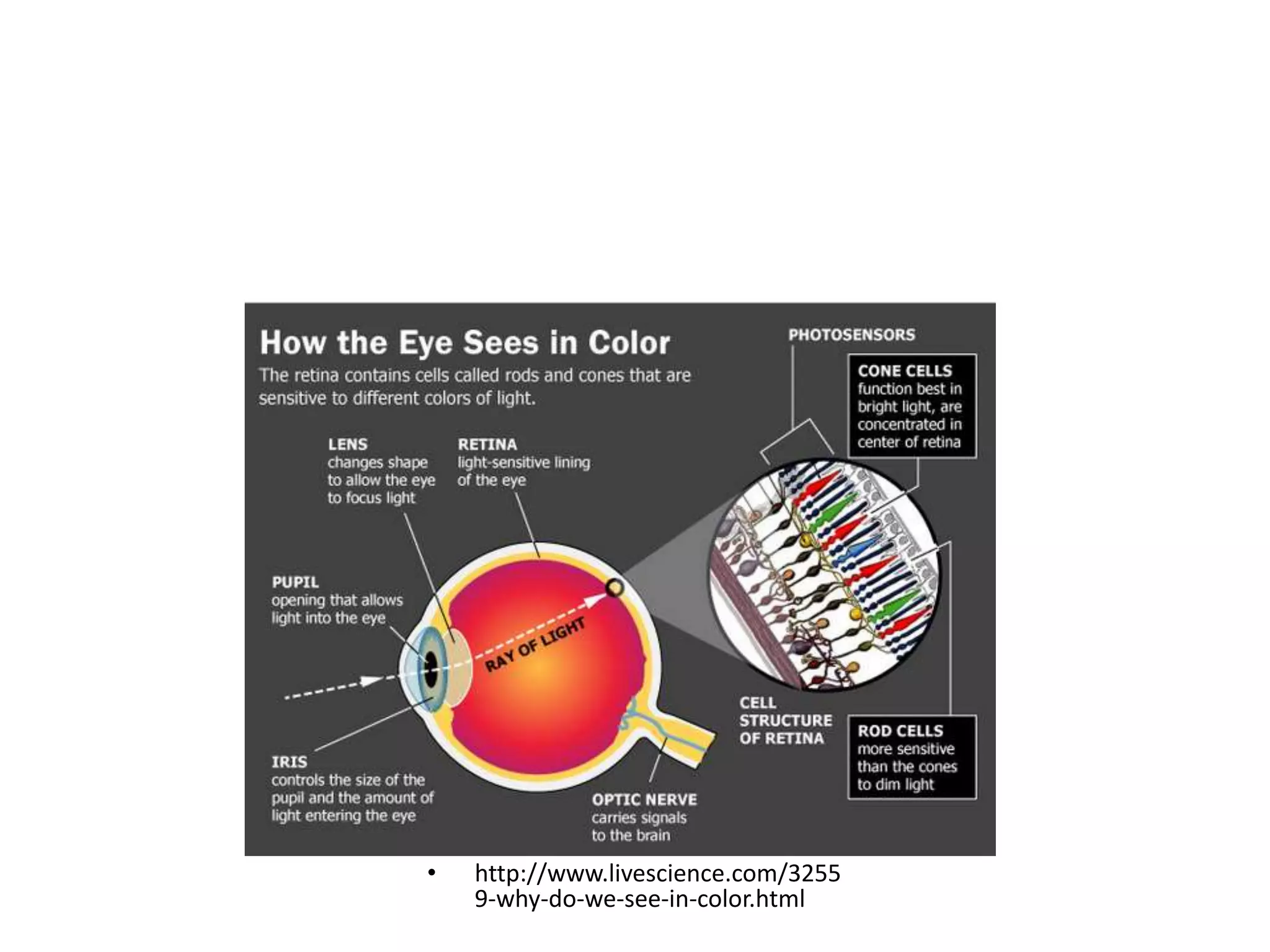
• http://www.livescience.com/3255
9-why-do-we-see-in-color.html
What is Colour?
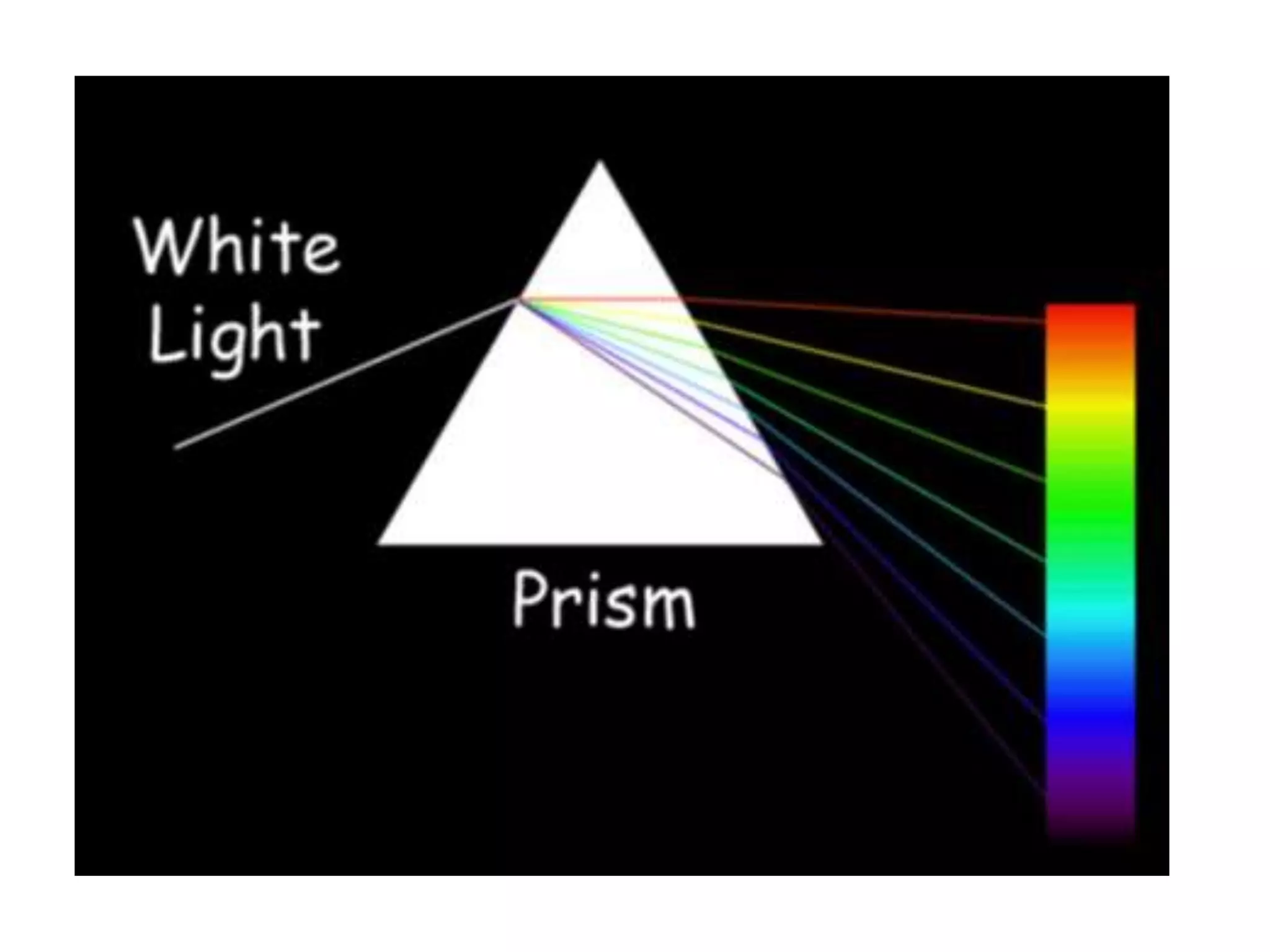
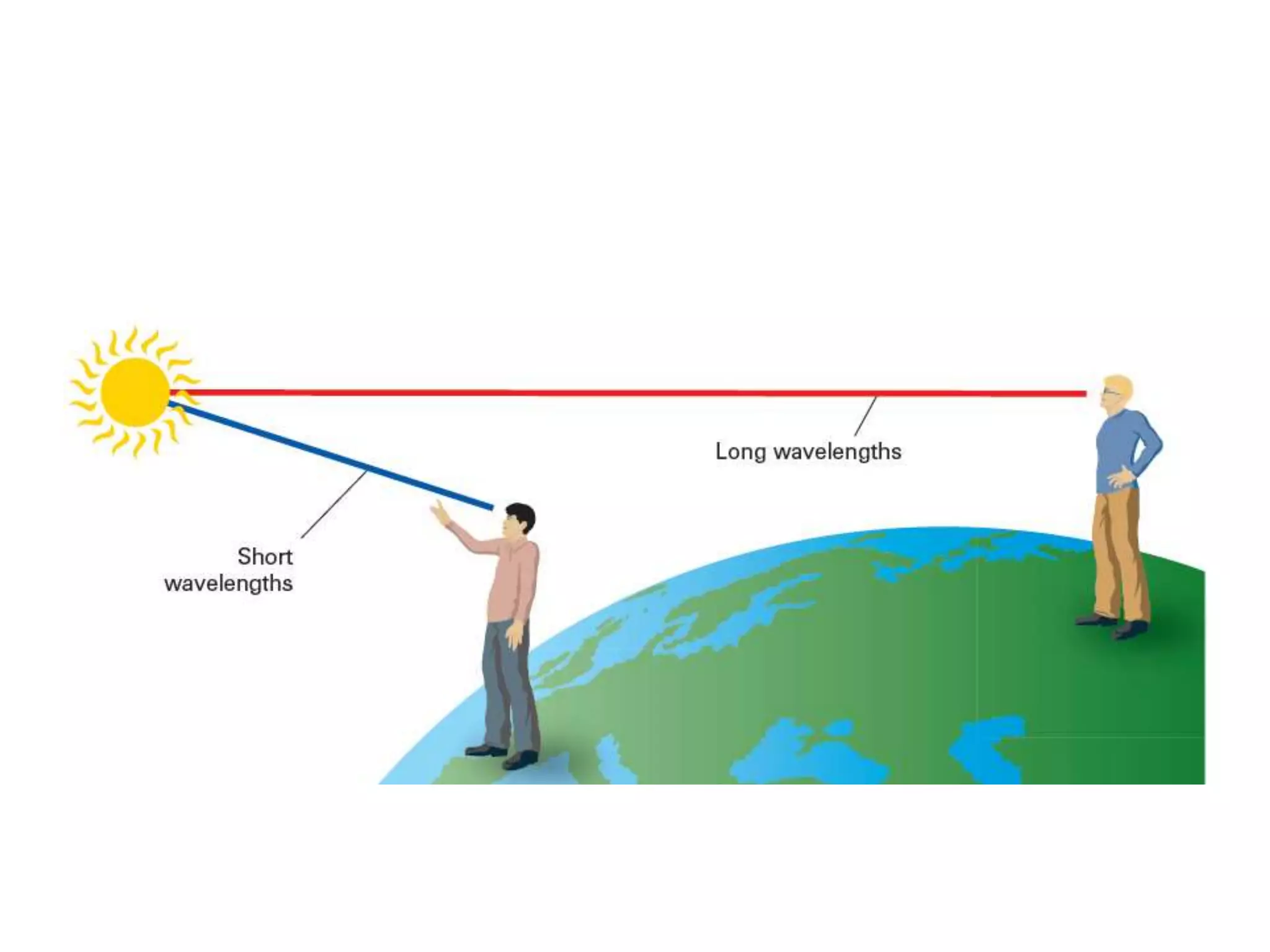
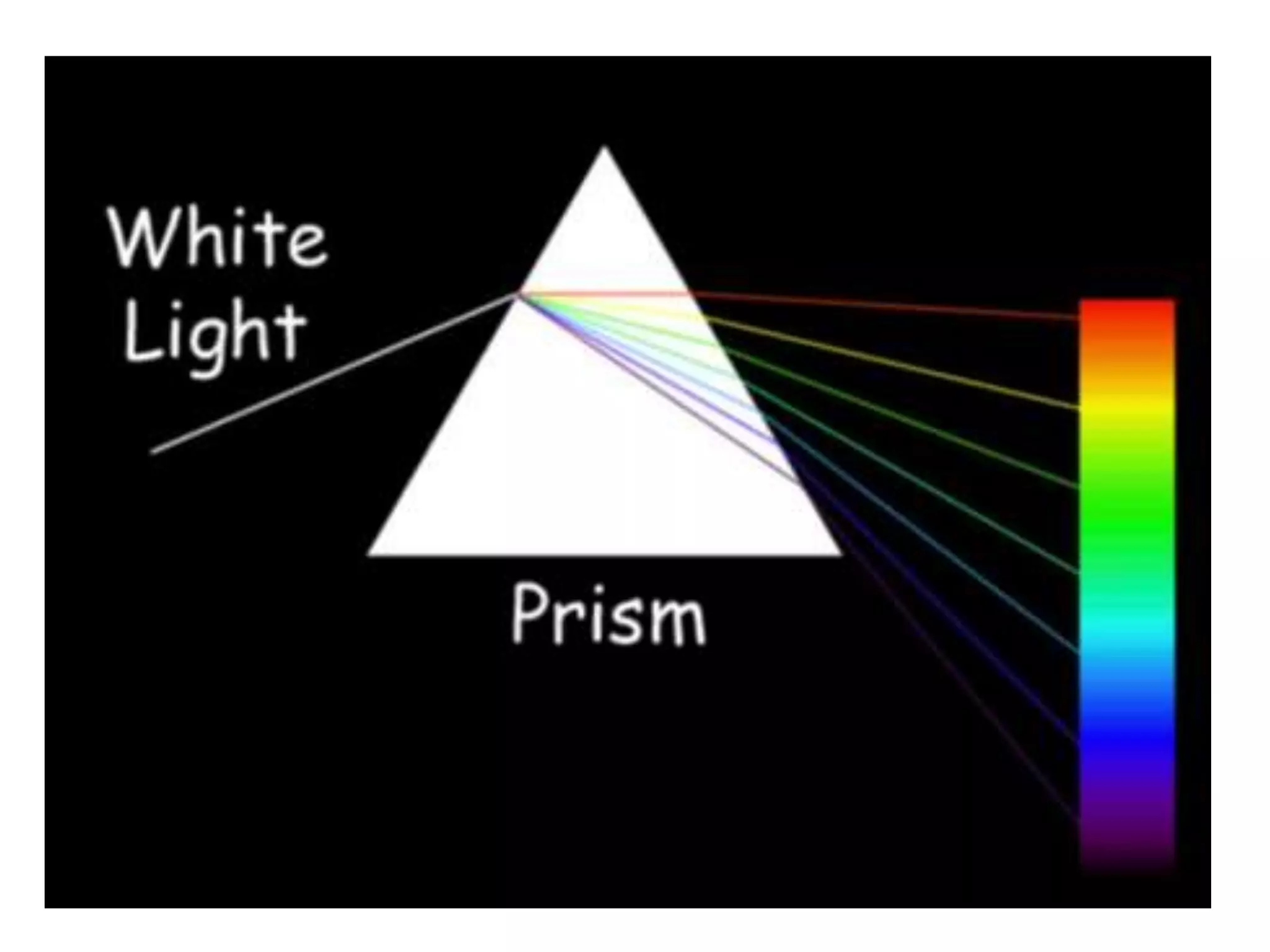
• Colour is just white light split up into different
wavelengths and frequencies.
• Sir Isaac Newton found out by experimenting
that white light can be split up into 7 basic
colours – Red – Orange – Yellow – Green –
Blue – Indigo – Violet by refracting through a
prism or similar.
• A useful mnemonic to help you remember is:
How we see colour
• There are three things which will affect how
we see colour.
• These are :
• Absorption ( if an object absorbs all the light it will
appear black)
• Reflection (if an object reflects all the light it will
appear white)
• Refraction ( how much light it refracts will make it
shiny or dull)
• If an objects absorbs all the Orange, Yellow,
Green, Blue, Indigo and Violet light, what
colour will it reflect and therefore appear to
be?
• If an object absorbs all the Red, Orange,
Green, Blue, Indigo and Violet light, what
colour will it reflect and therefore appear to
be?
explanation of colour video
http://www.livescience.com/32559-why-do-
we-see-in-color.html
Questions
Natural Order
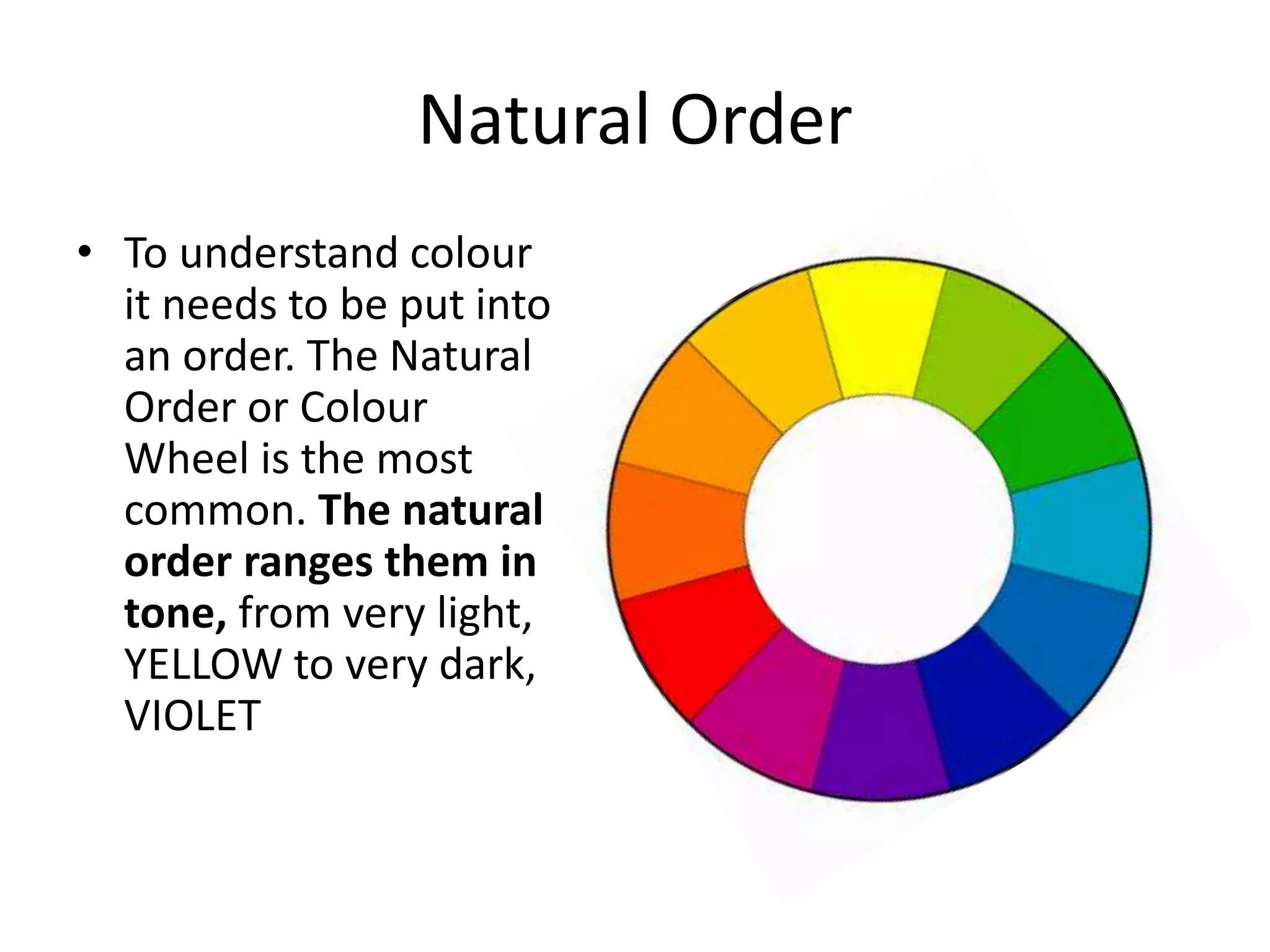
• To understand colour
it needs to be put into
an order. The Natural
Order or Colour
Wheel is the most
common. The natural
order ranges them in
tone, from very light,
YELLOW to very dark,
VIOLET
Primary Colours
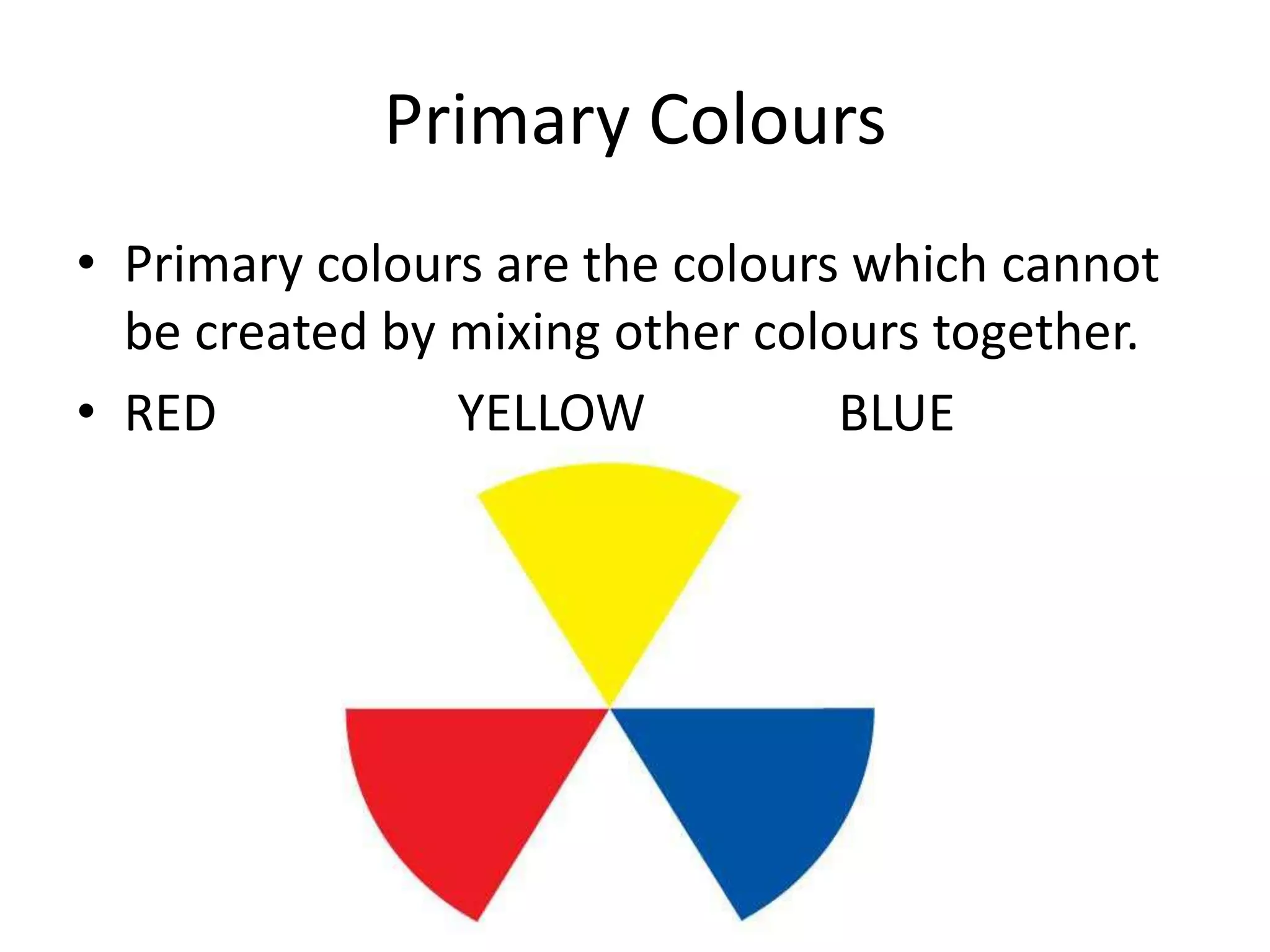
• Primary colours are the colours which cannot
be created by mixing other colours together.
• RED YELLOW BLUE
Secondary Colours
• Secondary colours are made by mixing two
Primary colours together.
Tertiary Colours
• Tertiary colours are made by mixing a Primary
and a secondary colour together.
Different primary colours
Hues
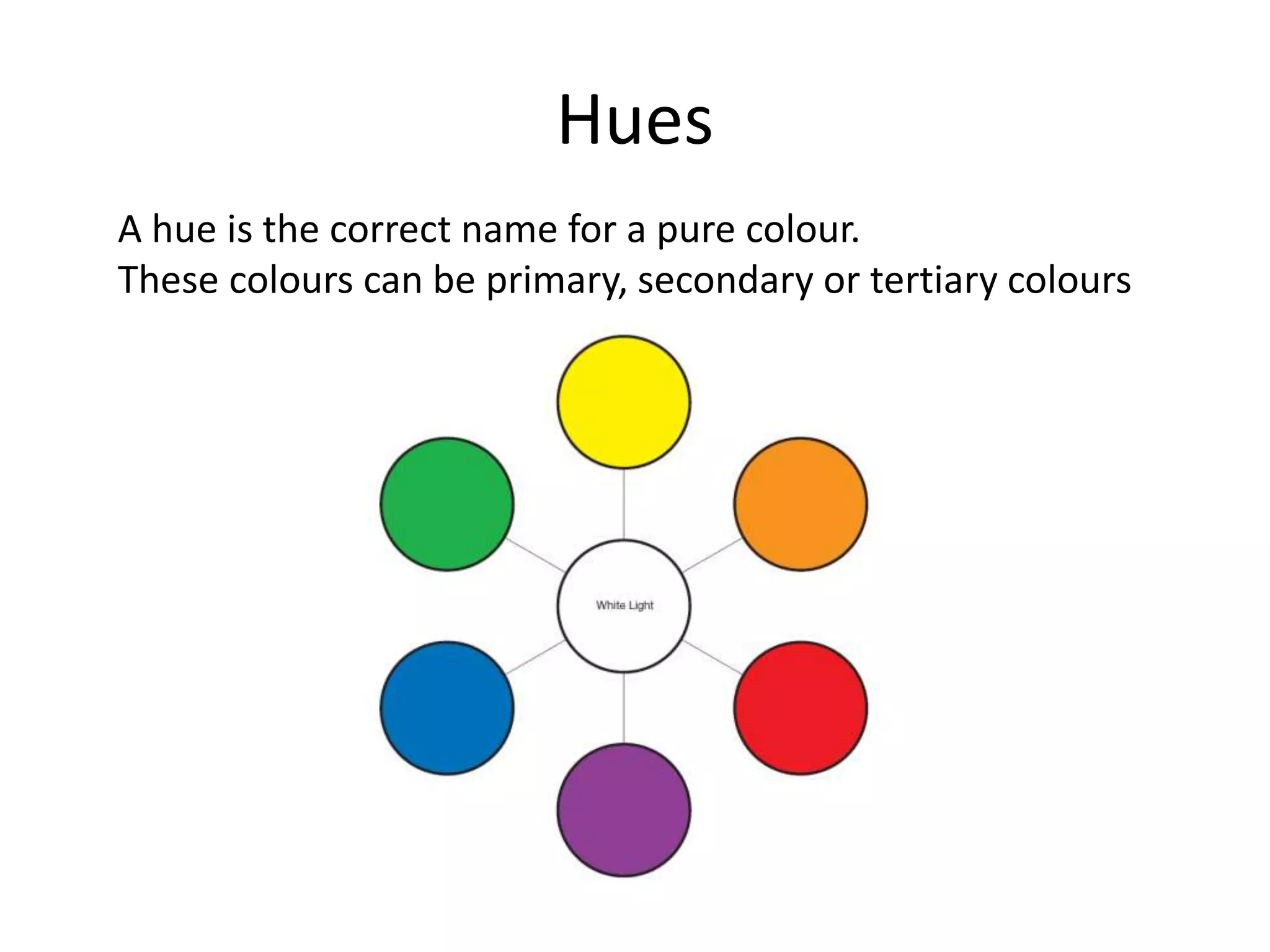
A hue is the correct name for a pure colour.
These colours can be primary, secondary or tertiary colours
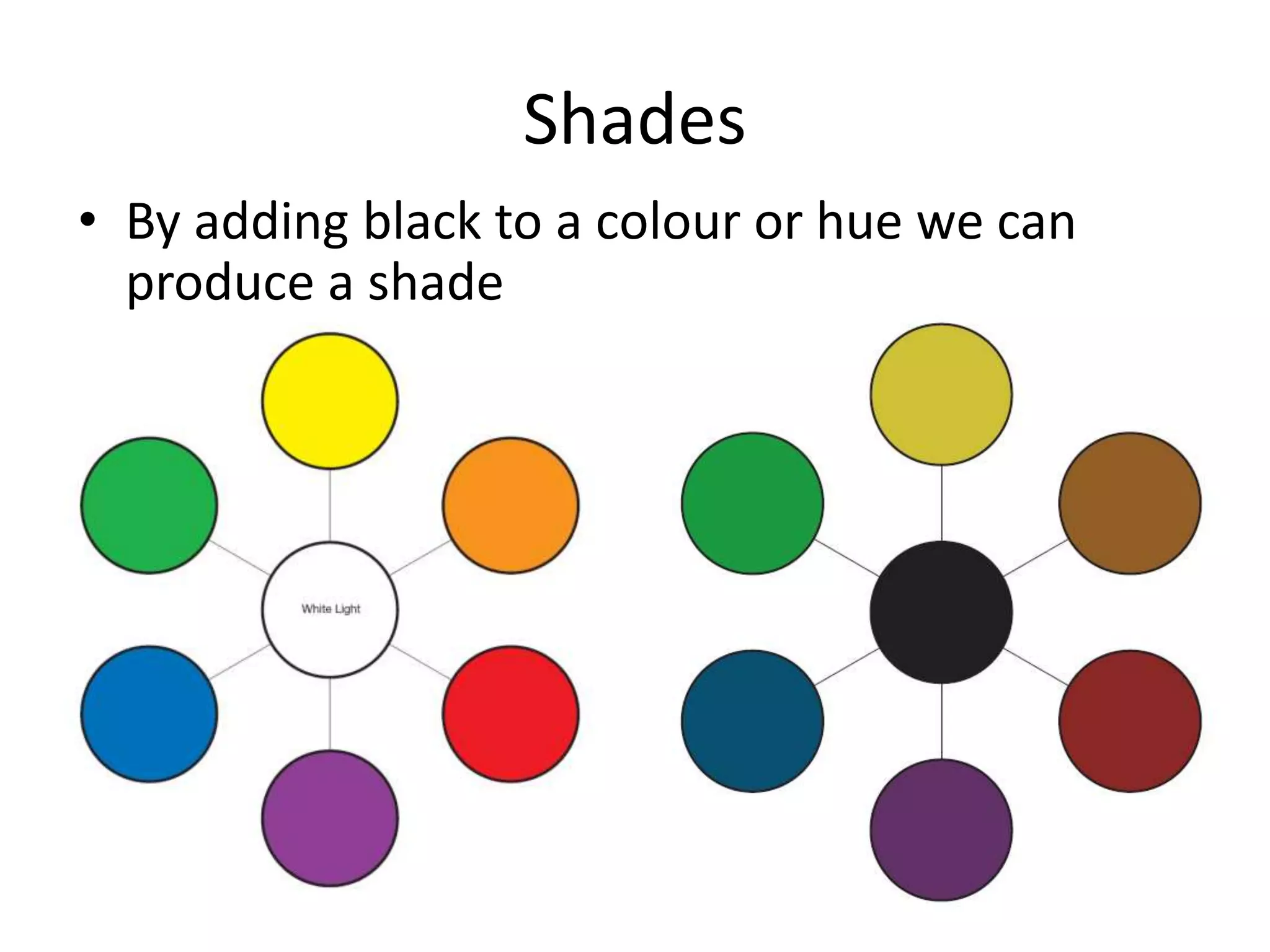
Shades
• By adding black to a colour or hue we can
produce a shade
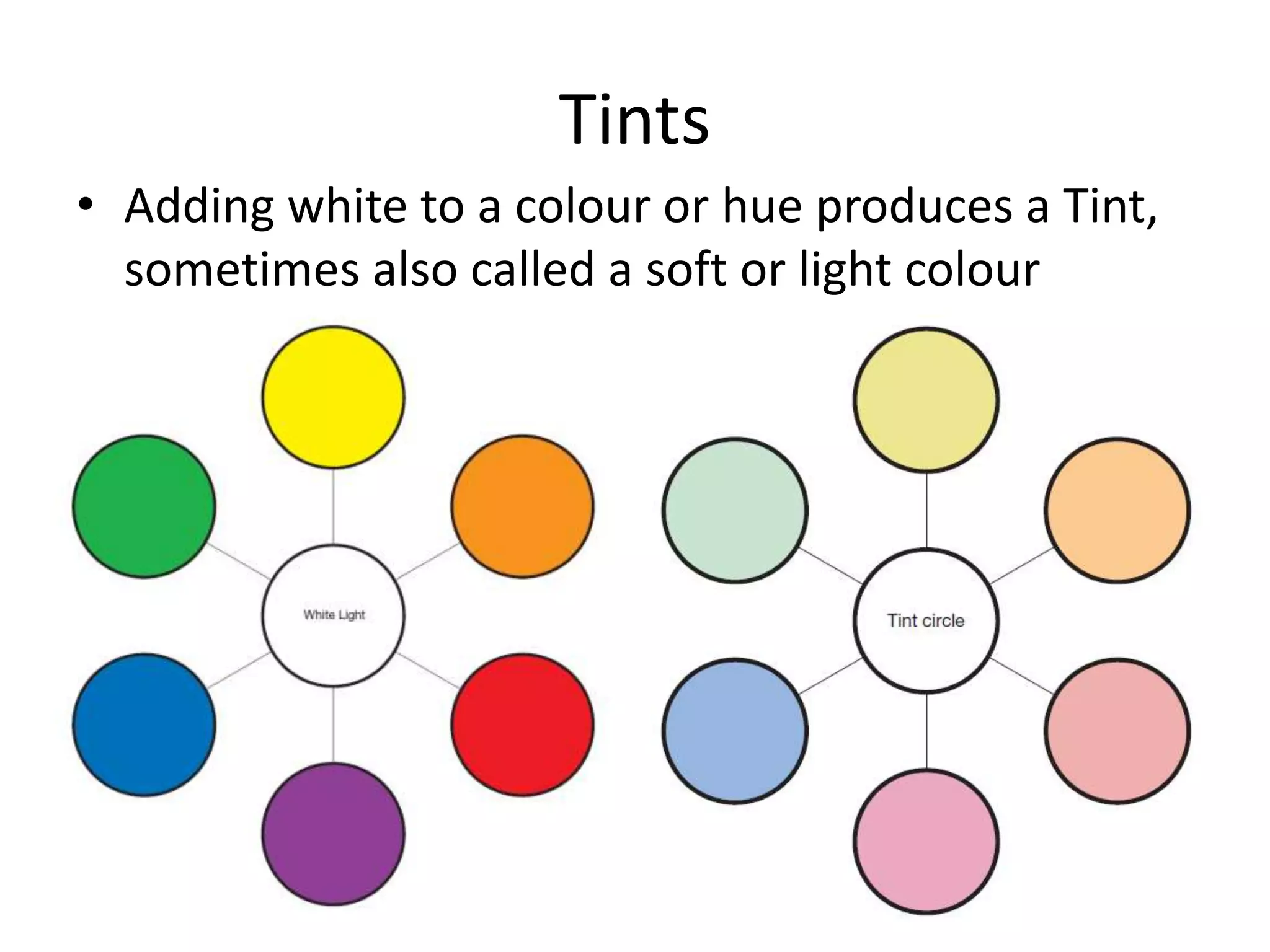
Tints
• Adding white to a colour or hue produces a Tint,
sometimes also called a soft or light colour
Absorbancy
• As light colours absorb more light a room
paint in a darker colour will appear to be
darker
Achromatic Colours
• Achromatic do not have a hue and are based
on greys, blacks and whites. Neutral colours.
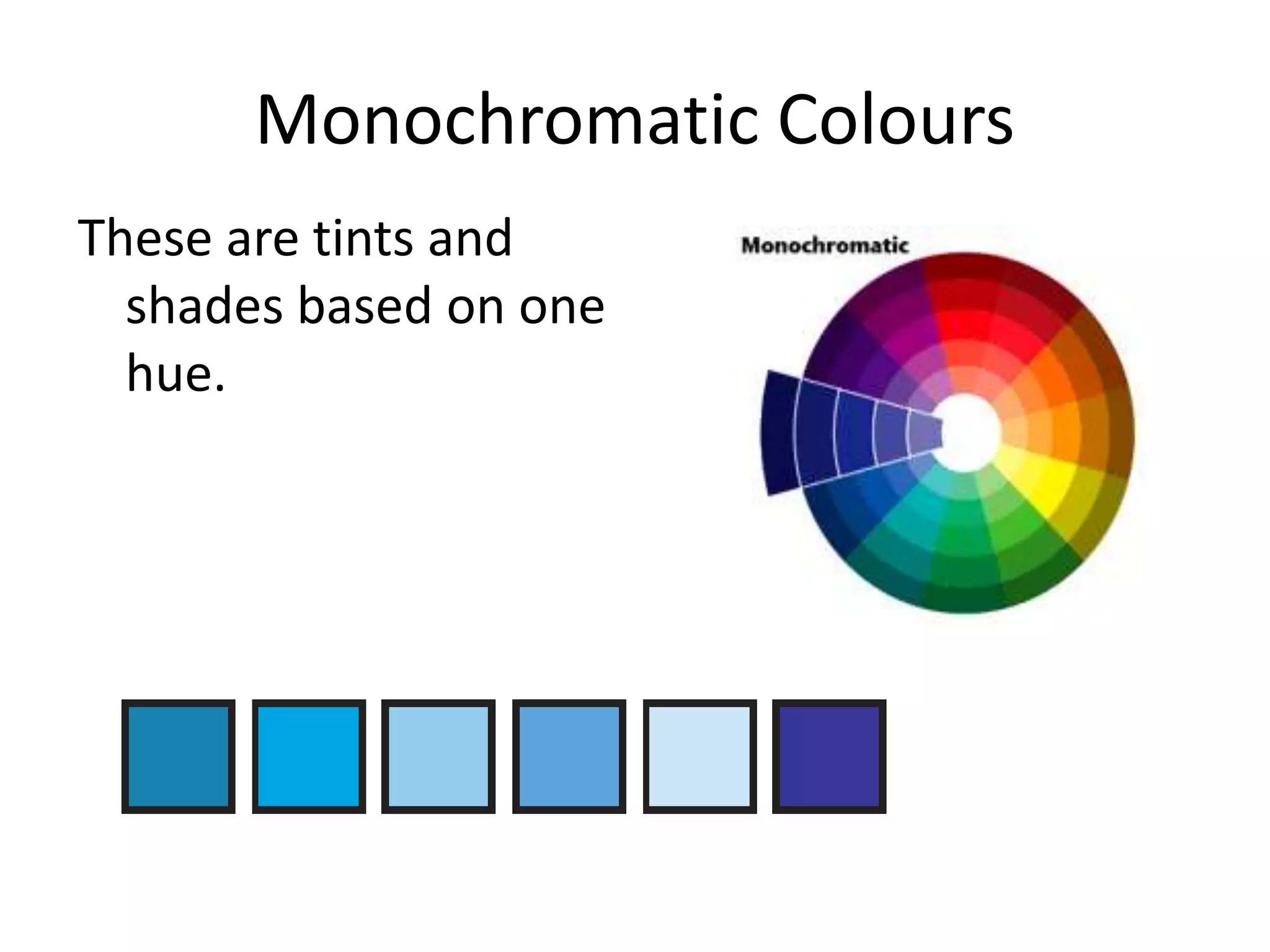
Monochromatic Colours
These are tints and
shades based on one
hue.
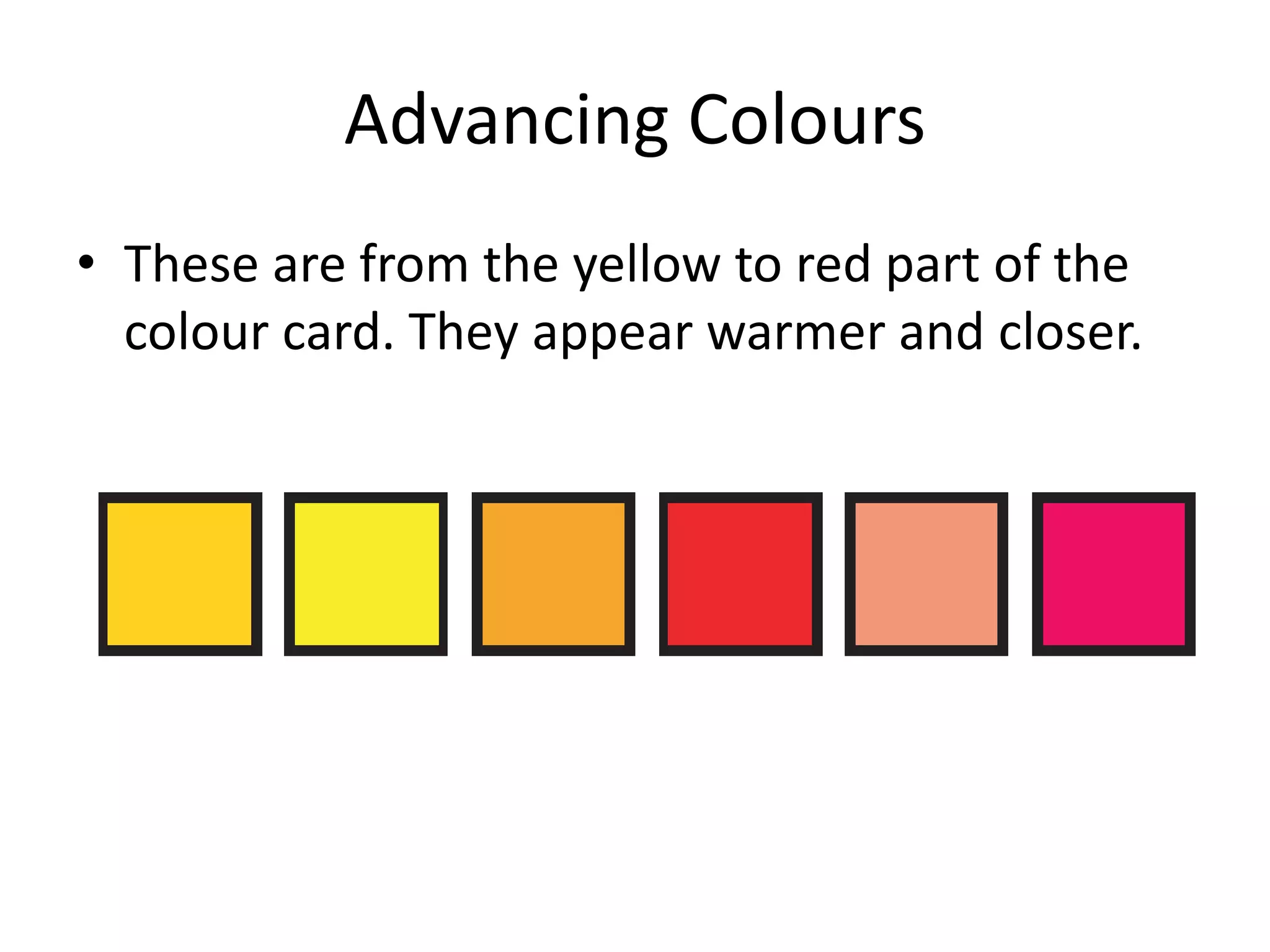
Advancing Colours
• These are from the yellow to red part of the
colour card. They appear warmer and closer.
Complementary colours
• Colours that lie
opposite each other
in the Colour circle
that look pleasing
together
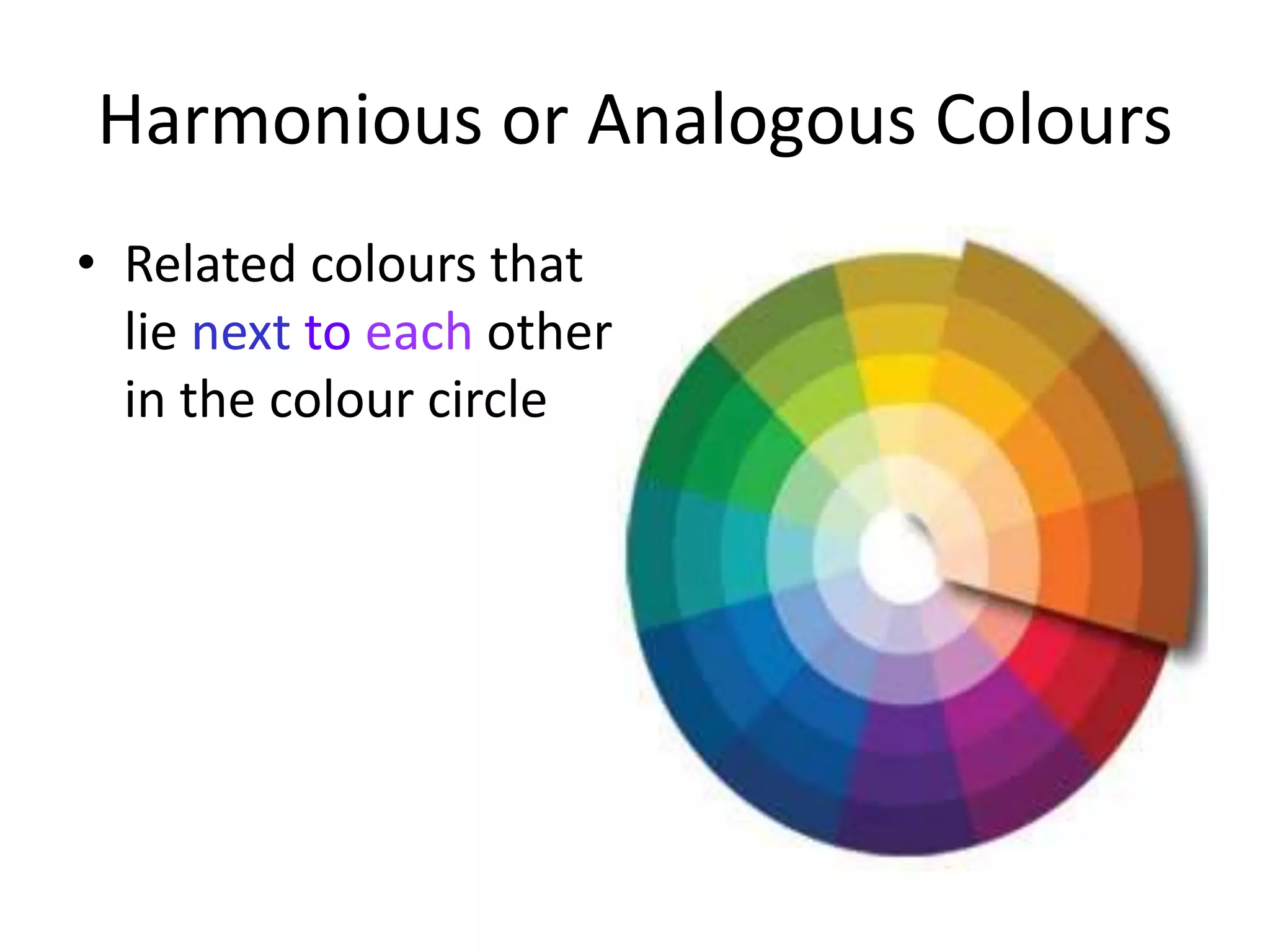
Harmonious or Analogous Colours
• Related colours that
lie next to each other
in the colour circle
Warm and Cold colours
• Warm colours from
the Yellow-Red half of
the colour circle give
the impression of
warmth
• Cold colours from the
Green-Purple half of
the colour circle give
the impression of
Coldness
Videos and websites
• Dulux colour video
• Visualiser app video
• Paint quality site
• Interactive colour wheel
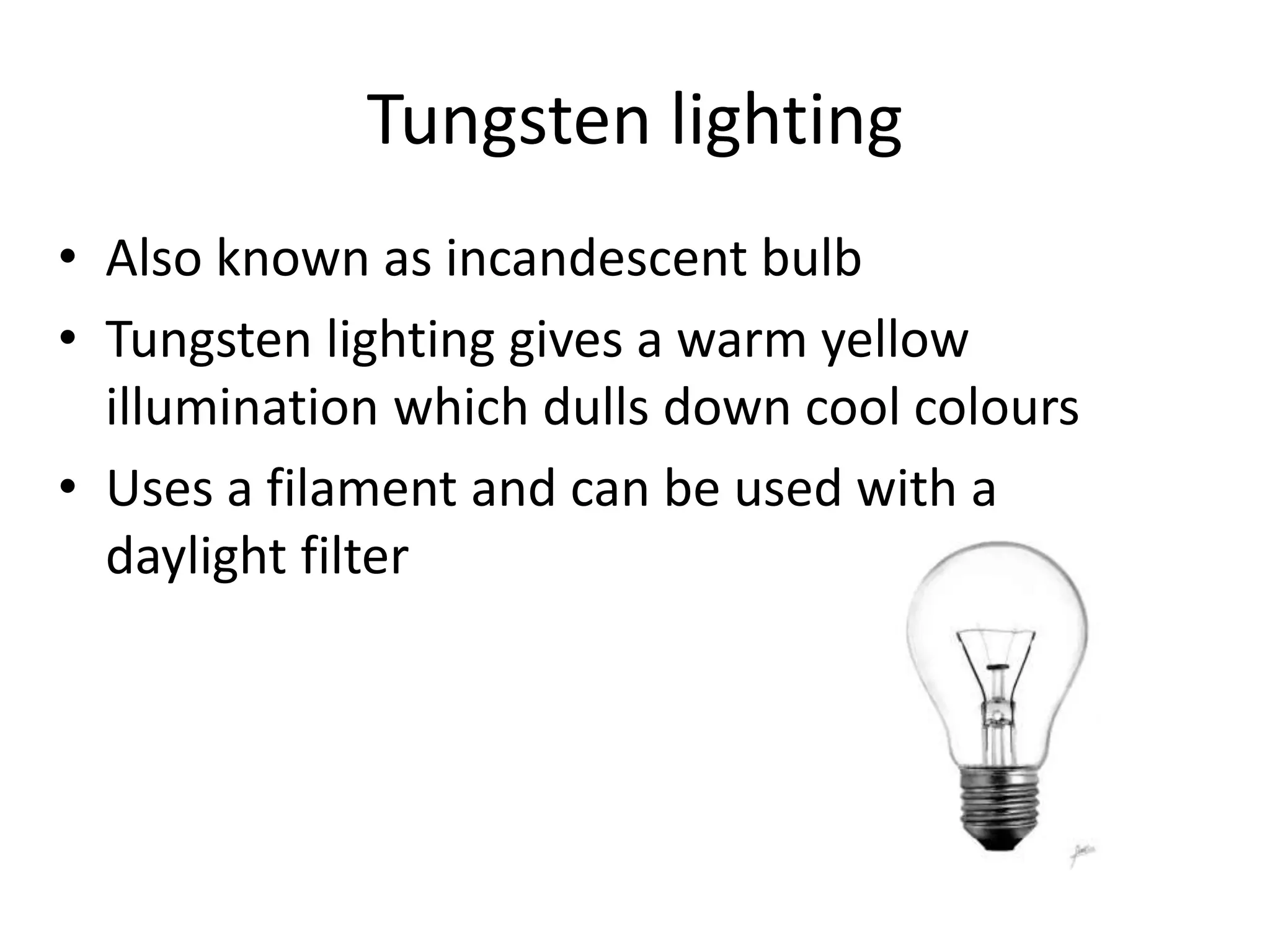
Tungsten lighting
• Also known as incandescent bulb
• Tungsten lighting gives a warm yellow
illumination which dulls down cool colours
• Uses a filament and can be used with a
daylight filter
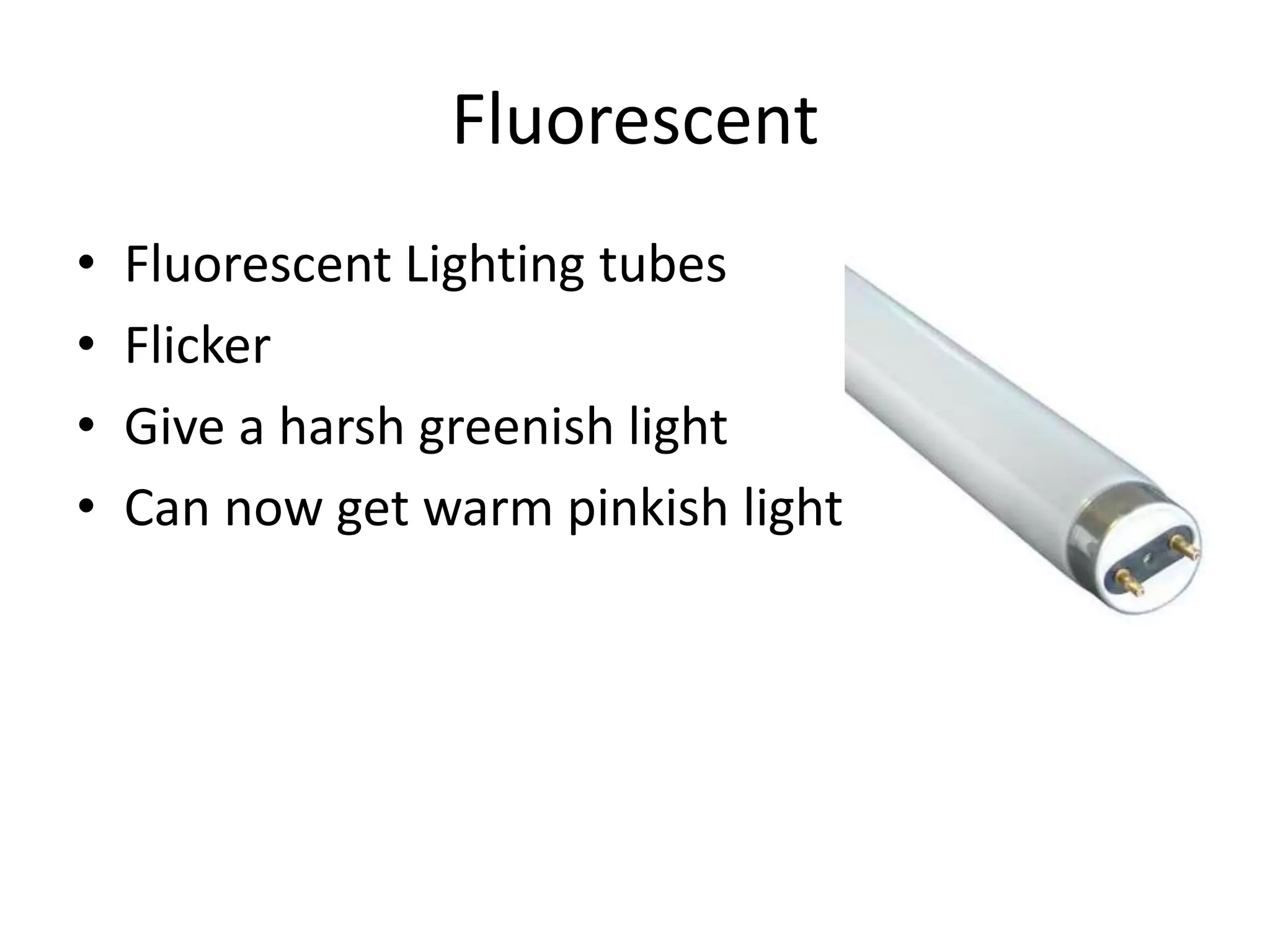
Fluorescent
• Fluorescent Lighting tubes
• Flicker
• Give a harsh greenish light
• Can now get warm pinkish light
Low Pressure Sodium
• Low Pressure Sodium
Vapour lamp
• Soft Yellow light,
• Used in street lamps
• Cheap to run
High Pressure Sodium
• High Pressure
Sodium Vapour
lamp
• Pinkish orange light
• Used in cafes and
restaurants.
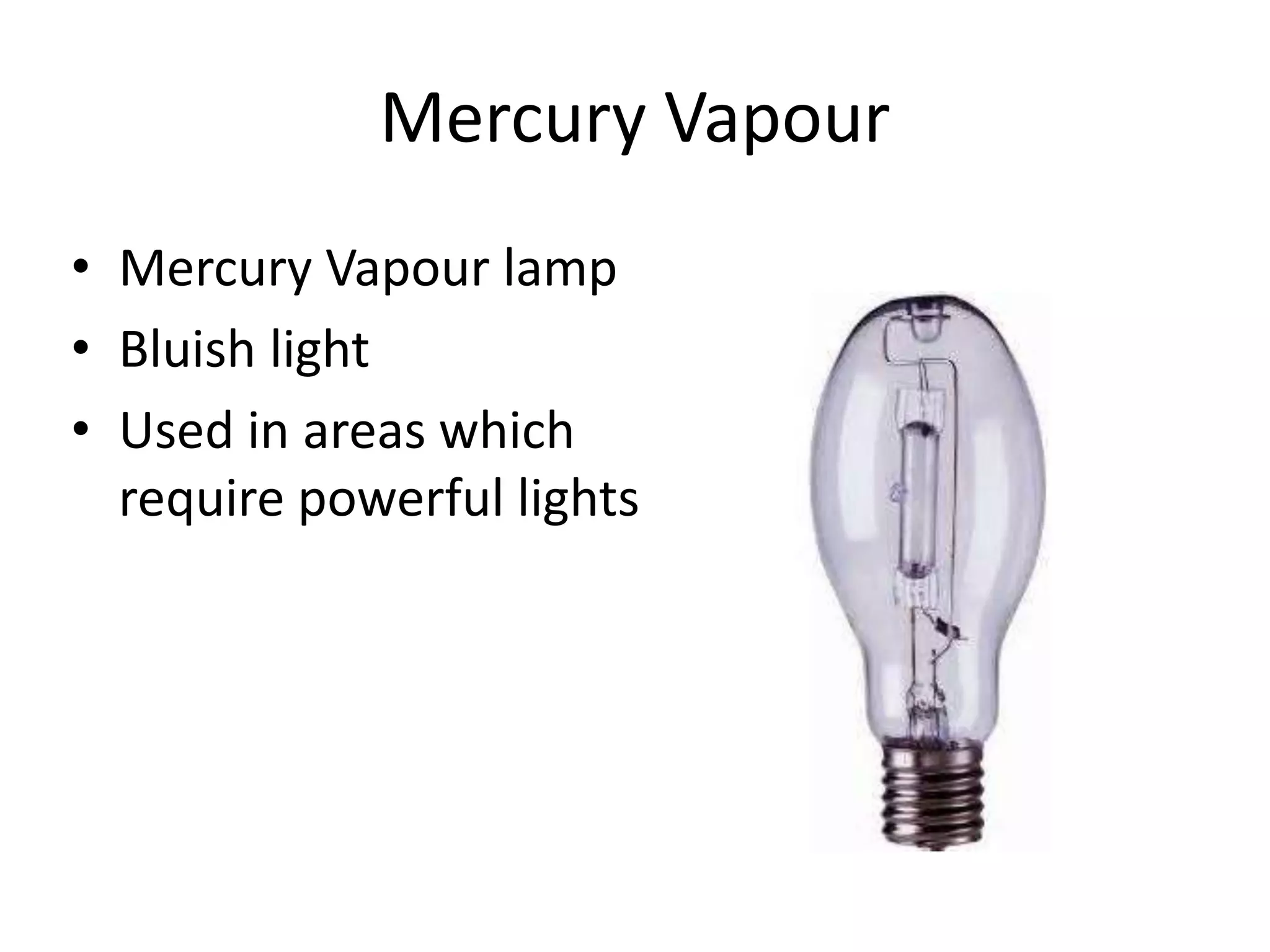
Mercury Vapour
• Mercury Vapour lamp
• Bluish light
• Used in areas which
require powerful lights
LED
• LED (Light Emitting Diode)-
emits light when an electrical
current is passed through it.
• Directional beam of light, used
for task lighting.
• Fittings often use multiple LEDs
for larger spread of light.
• Typically white light enhancing
all colours
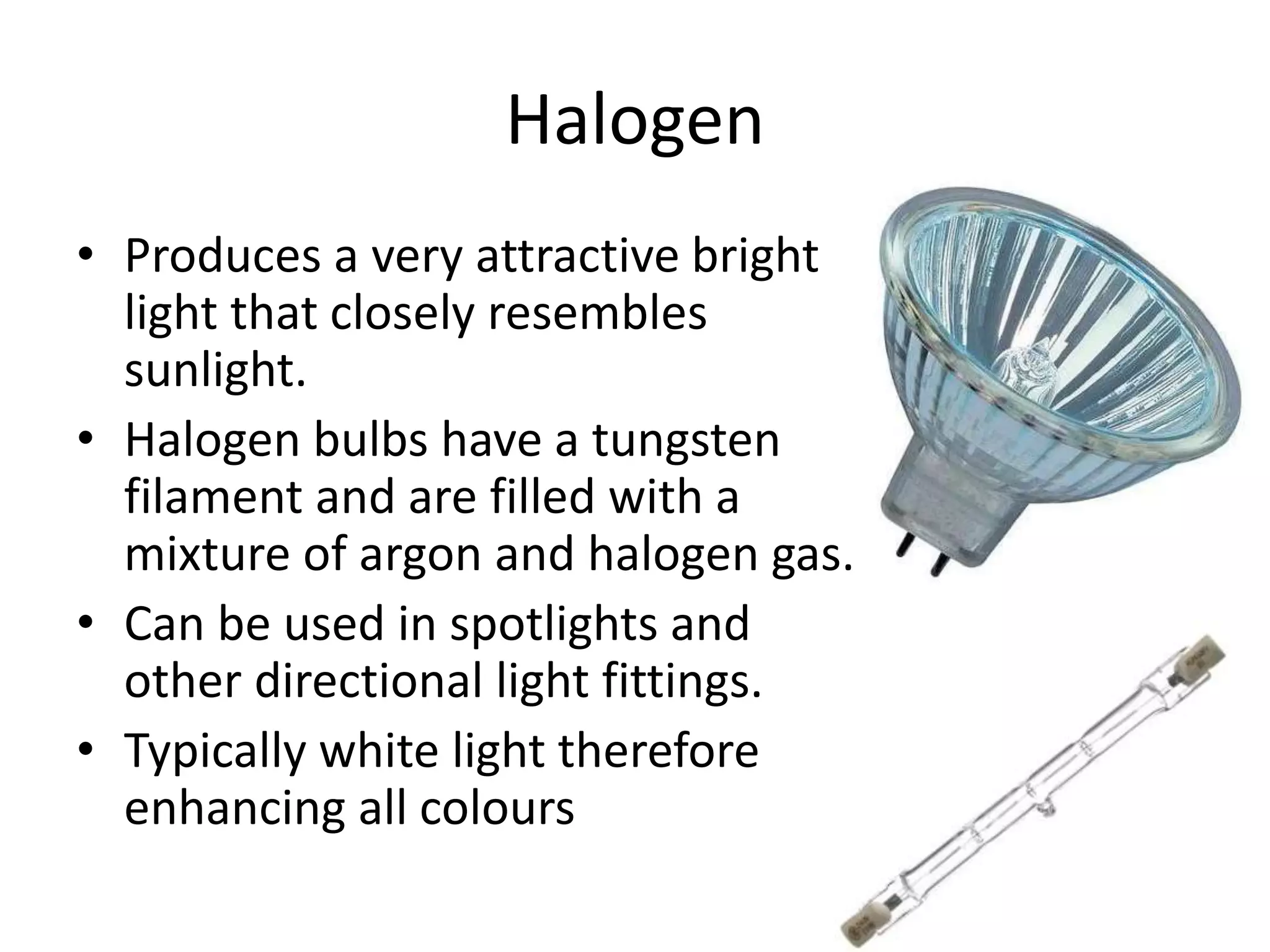
Halogen
• Produces a very attractive bright
light that closely resembles
sunlight.
• Halogen bulbs have a tungsten
filament and are filled with a
mixture of argon and halogen gas.
• Can be used in spotlights and
other directional light fittings.
• Typically white light therefore
enhancing all colours
Eco Lighting
• ECO efficient, energy saving,
long lasting, replacement for
standard tungsten bulbs and
fluorescent tubes
• CFC – (compact fluorescent)
range of colours, often warm
glow from fluorescent type.
• LED and Halogen, generally
white light
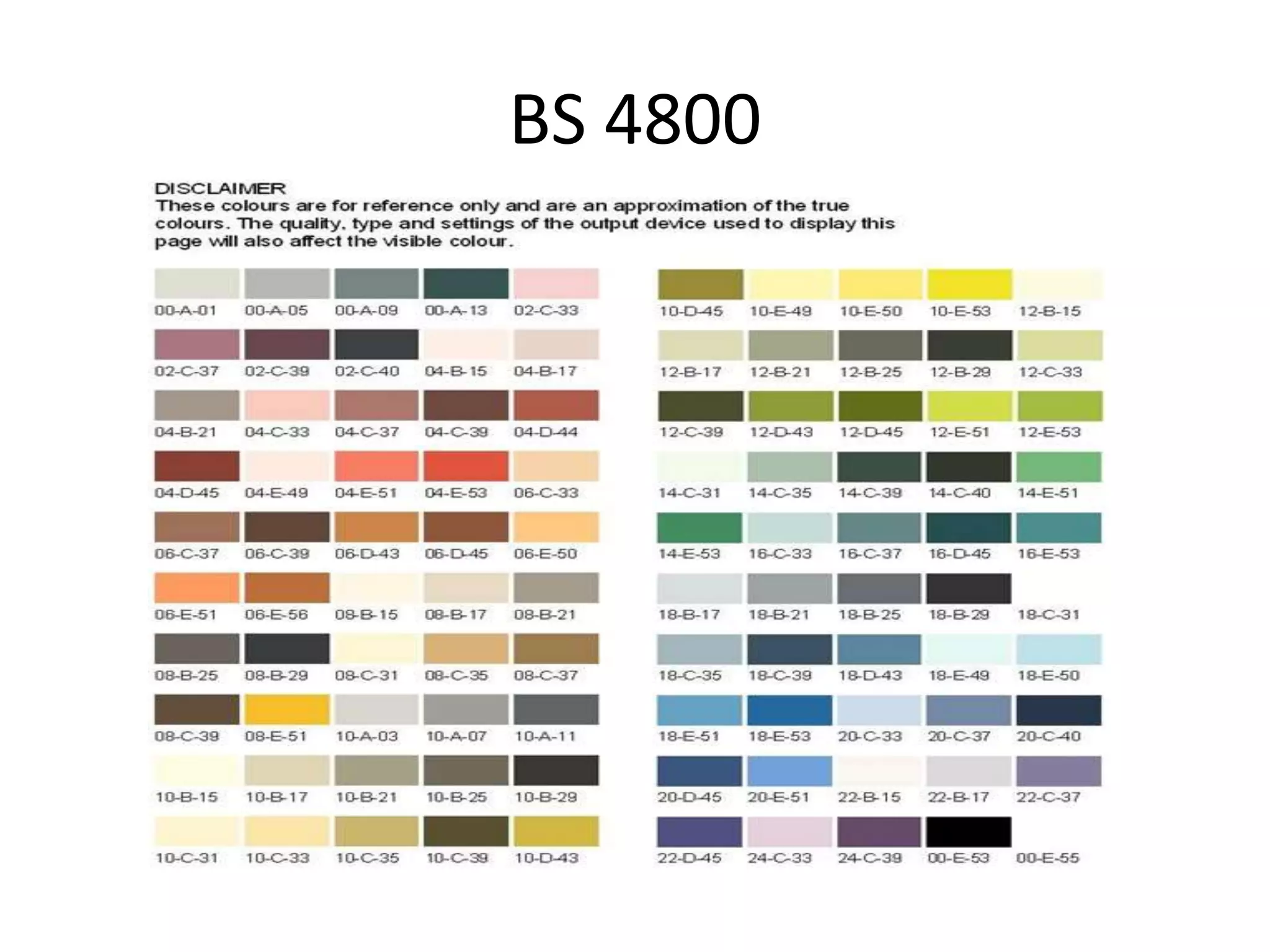
BS 4800 Paint colours for building
purposes
BS 4800
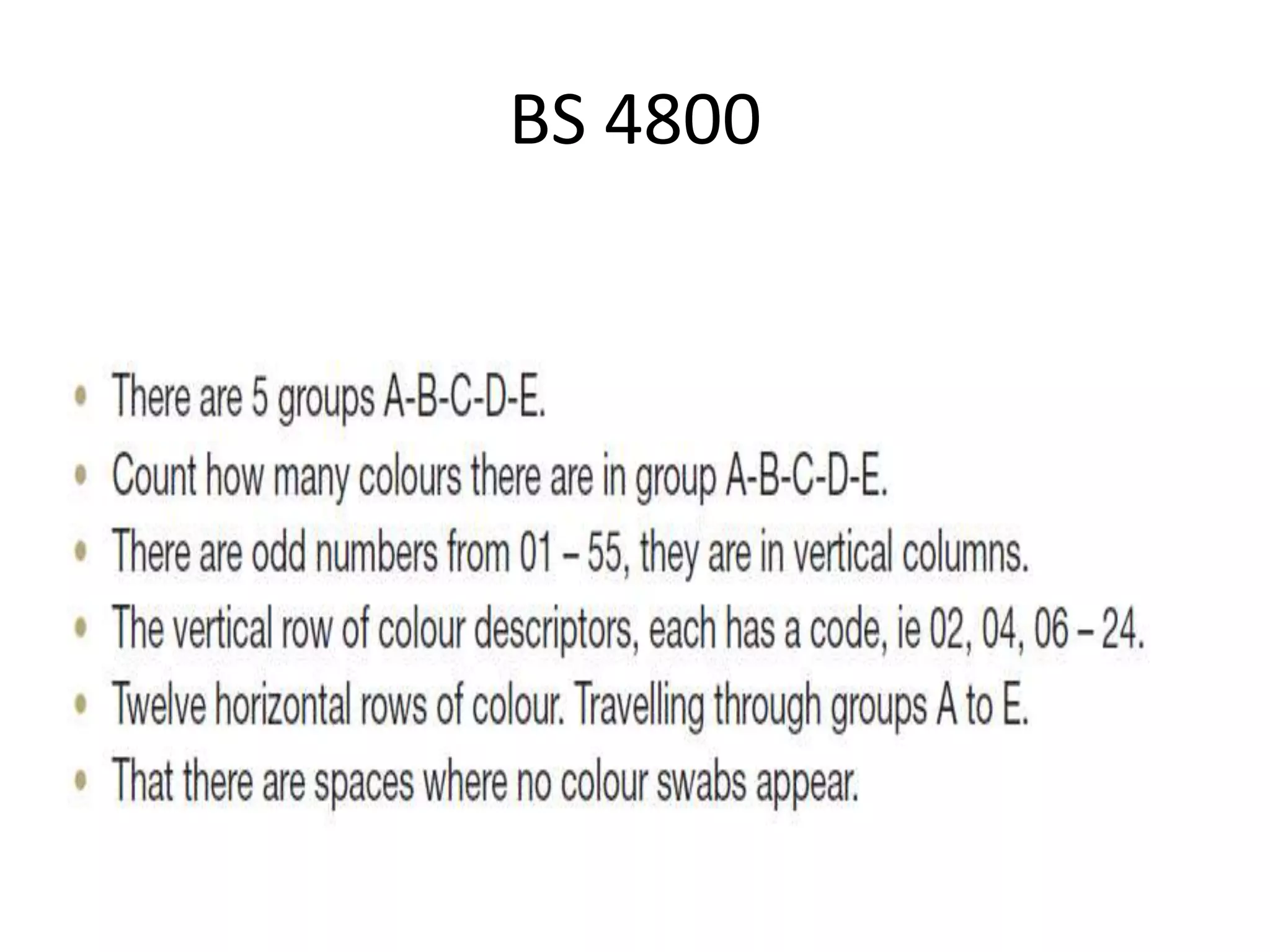
BS 4800
BS 4800 Range
• 02 Red/Purple 16 Blue/Green
• 04 Red 18 Blue
• 06 Red/Yellow 20 Blue/Purple
• 08 Yellow/Red 22 Purple
• 10 Yellow 24 Purple/Red
• 12 Yellow/Green
• 14 Green
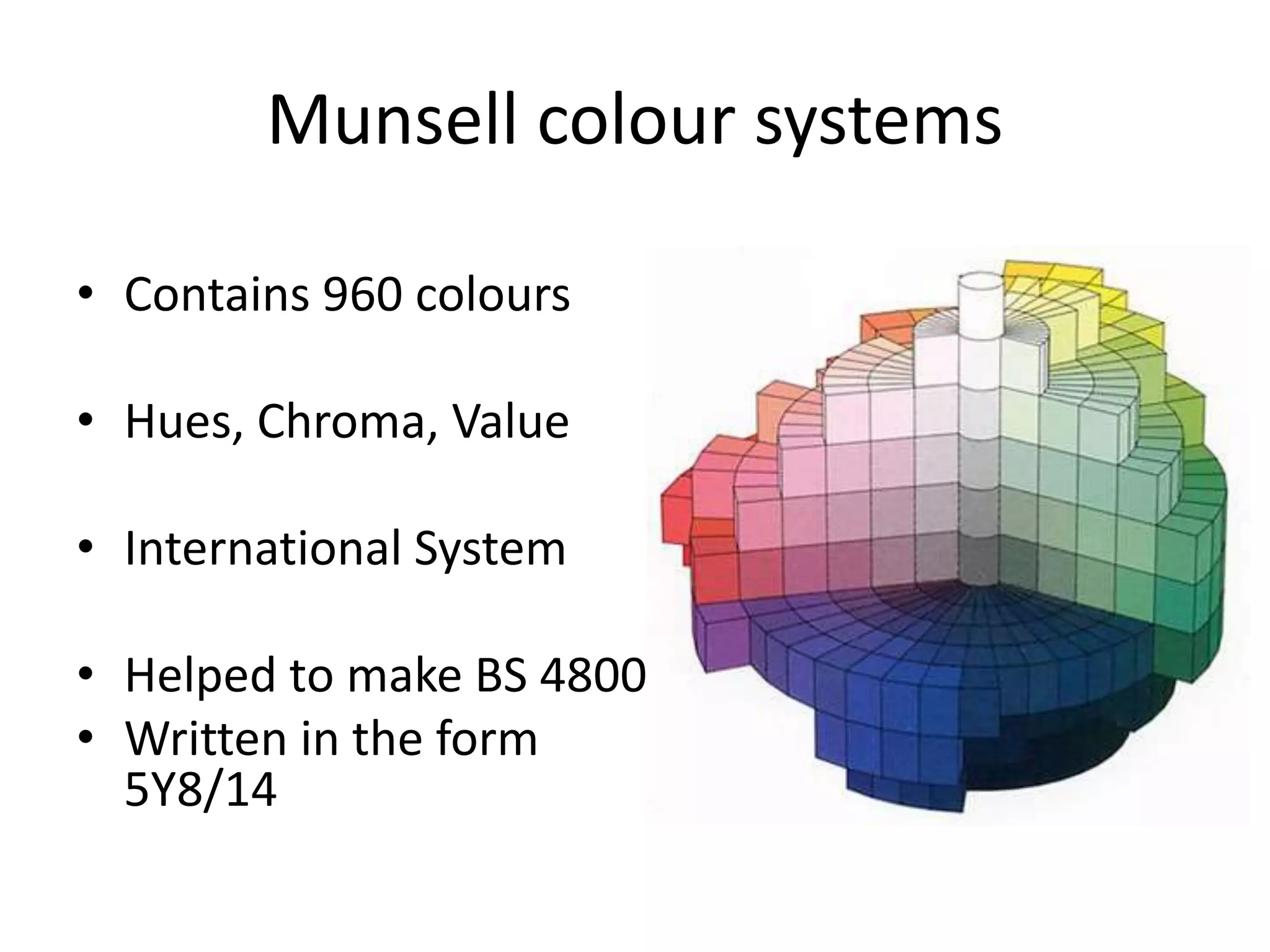
Munsell colour systems
• Contains 960 colours
• Hues, Chroma, Value
• International System
• Helped to make BS 4800
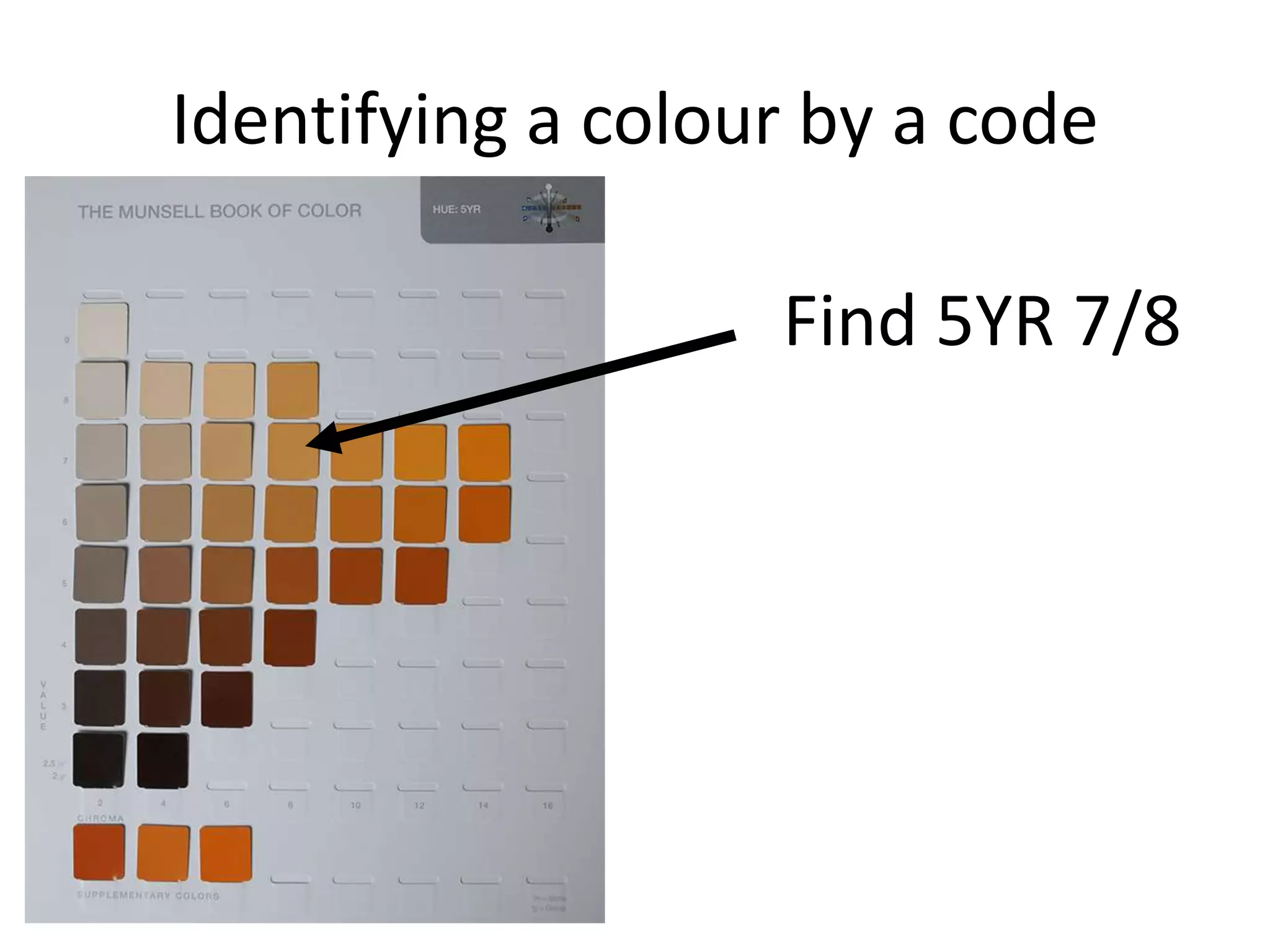
• Written in the form
5Y8/14
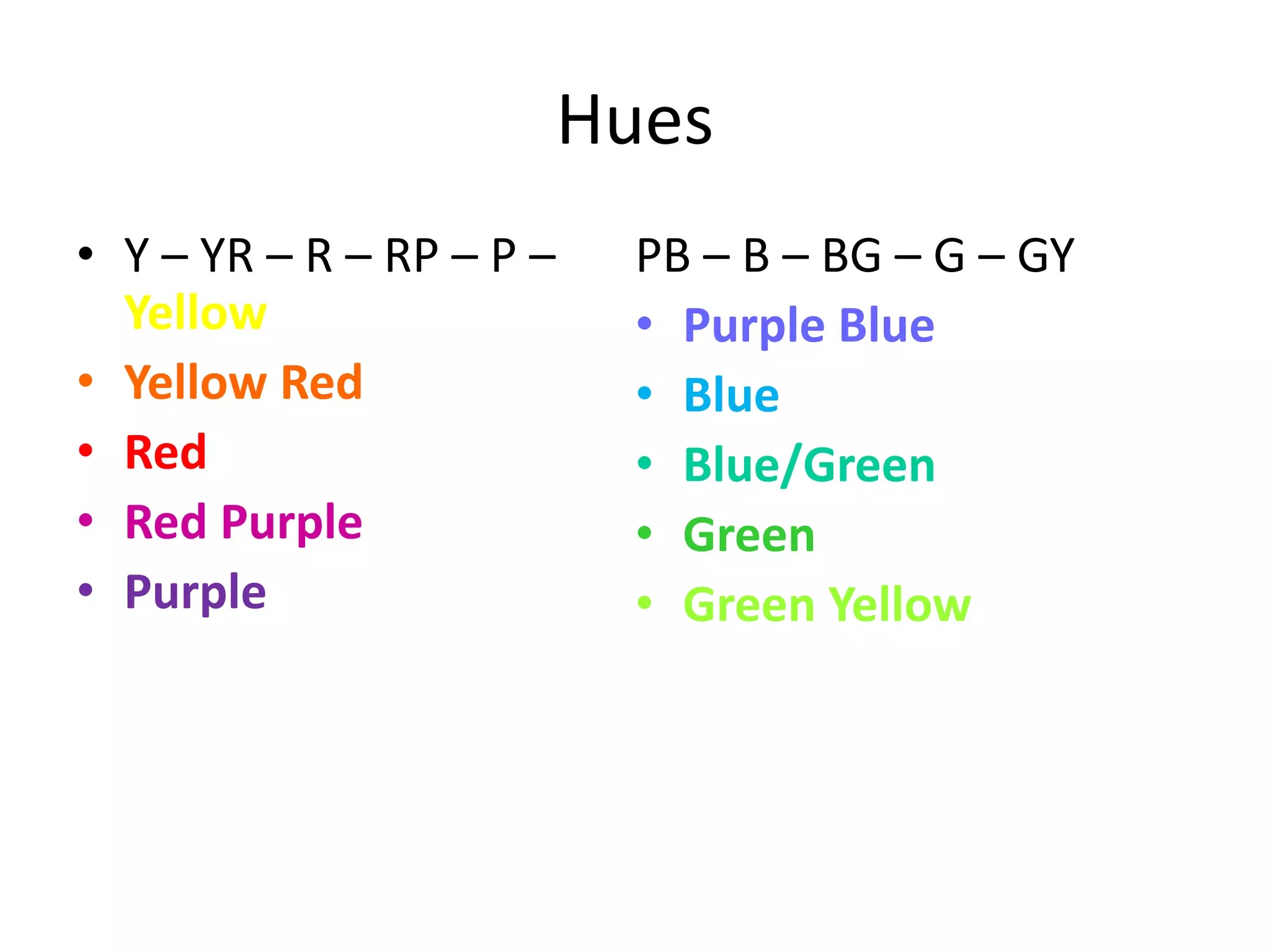
Hues
• Y – YR – R – RP – P –
Yellow
• Yellow Red
• Red
• Red Purple
• Purple
PB – B – BG – G – GY
• Purple Blue
• Blue
• Blue/Green
• Green
• Green Yellow
Value
• Value represents light and darkness
• Split from 0 – 10 0 = Black 10 = White
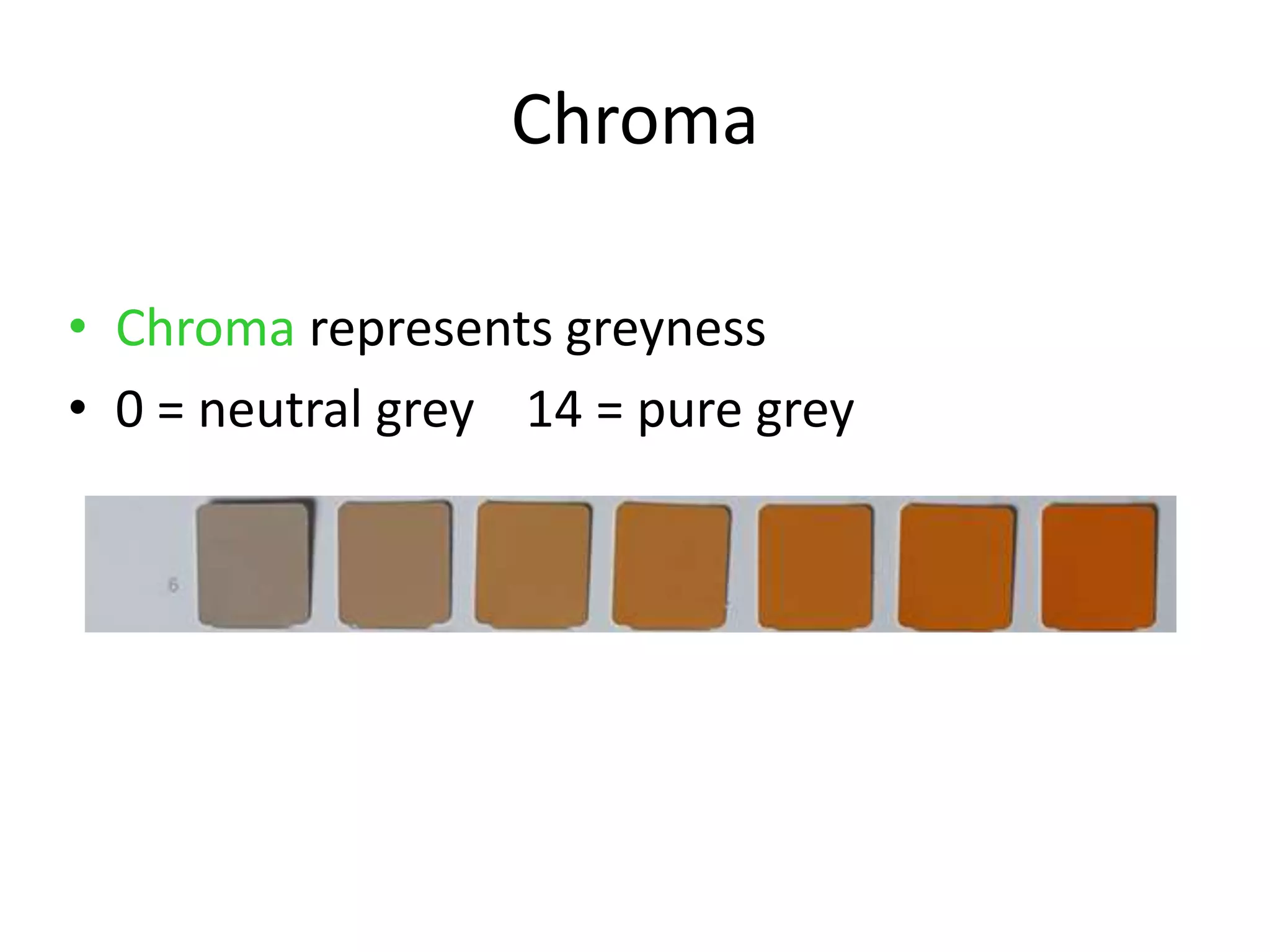
Chroma
• Chroma represents greyness
• 0 = neutral grey 14 = pure grey
Identifying a colour by a code
Find 5YR 7/8
Knowledge check
• Question 1: Describe what is meant by
Monochromatic colour scheme ?
• Question 2: Describe what is meant by an
Achromatic colour scheme ?
• Question 3: Describe what is meant by a
Complementary colour scheme ?
• Question 4: Describe what is meant by a
Harmonious colour scheme ?
• Question 5: Give another name for a Harmonious
colour scheme ?
Close one eye and hold a finger up to cover the
join between the two squares
If you are interested in COLOUR…
• http://www.worqx.com/color/index.htm
• http://www.dulux.co.uk/studio/mousepainter/index.jsp
• http://colorschemedesigner.com/
• http://www.jaimetreadwell.com/Dccc-Munsell-color-chart-
system.htm
• http://www.daicolor.co.jp/english/color_e/color_e01.html
Hue test
• Munsell Hue Test

Colour 2

  • 1.
  • 2.
    Why do youneed to understand colour? Because the world is full of colour. It affects how we view the world. It can tell us when something is right It can tell us when something is wrong It can even affect our moods. Imagine having a bedroom where everything is bright red or bright orange.
  • 3.
    Colour is Complicated •Why are bananas yellow, roses red etc? • How can we see colour? • What is a spectrum? • What is a natural order? • What are Primary, Secondary and Tertiary colours? • What is additive colour? • What is subtractive colour? • What are Light and Pigment primaries? • What are Achromatic, Monochromatic and complimentary colours?
  • 4.
  • 5.
    What is Colour? •Colour is just white light split up into different wavelengths and frequencies. • Sir Isaac Newton found out by experimenting that white light can be split up into 7 basic colours – Red – Orange – Yellow – Green – Blue – Indigo – Violet by refracting through a prism or similar. • A useful mnemonic to help you remember is:
  • 10.
    How we seecolour • There are three things which will affect how we see colour. • These are : • Absorption ( if an object absorbs all the light it will appear black) • Reflection (if an object reflects all the light it will appear white) • Refraction ( how much light it refracts will make it shiny or dull)
  • 11.
    • If anobjects absorbs all the Orange, Yellow, Green, Blue, Indigo and Violet light, what colour will it reflect and therefore appear to be? • If an object absorbs all the Red, Orange, Green, Blue, Indigo and Violet light, what colour will it reflect and therefore appear to be?
  • 12.
    explanation of colourvideo http://www.livescience.com/32559-why-do- we-see-in-color.html
  • 14.
  • 15.
    Natural Order • Tounderstand colour it needs to be put into an order. The Natural Order or Colour Wheel is the most common. The natural order ranges them in tone, from very light, YELLOW to very dark, VIOLET
  • 16.
    Primary Colours • Primarycolours are the colours which cannot be created by mixing other colours together. • RED YELLOW BLUE
  • 17.
    Secondary Colours • Secondarycolours are made by mixing two Primary colours together.
  • 18.
    Tertiary Colours • Tertiarycolours are made by mixing a Primary and a secondary colour together.
  • 19.
  • 20.
    Hues A hue isthe correct name for a pure colour. These colours can be primary, secondary or tertiary colours
  • 21.
    Shades • By addingblack to a colour or hue we can produce a shade
  • 22.
    Tints • Adding whiteto a colour or hue produces a Tint, sometimes also called a soft or light colour
  • 23.
    Absorbancy • As lightcolours absorb more light a room paint in a darker colour will appear to be darker
  • 24.
    Achromatic Colours • Achromaticdo not have a hue and are based on greys, blacks and whites. Neutral colours.
  • 25.
    Monochromatic Colours These aretints and shades based on one hue.
  • 26.
    Advancing Colours • Theseare from the yellow to red part of the colour card. They appear warmer and closer.
  • 27.
    Complementary colours • Coloursthat lie opposite each other in the Colour circle that look pleasing together
  • 28.
    Harmonious or AnalogousColours • Related colours that lie next to each other in the colour circle
  • 29.
    Warm and Coldcolours • Warm colours from the Yellow-Red half of the colour circle give the impression of warmth • Cold colours from the Green-Purple half of the colour circle give the impression of Coldness
  • 30.
    Videos and websites •Dulux colour video • Visualiser app video • Paint quality site • Interactive colour wheel
  • 31.
    Tungsten lighting • Alsoknown as incandescent bulb • Tungsten lighting gives a warm yellow illumination which dulls down cool colours • Uses a filament and can be used with a daylight filter
  • 32.
    Fluorescent • Fluorescent Lightingtubes • Flicker • Give a harsh greenish light • Can now get warm pinkish light
  • 33.
    Low Pressure Sodium •Low Pressure Sodium Vapour lamp • Soft Yellow light, • Used in street lamps • Cheap to run
  • 34.
    High Pressure Sodium •High Pressure Sodium Vapour lamp • Pinkish orange light • Used in cafes and restaurants.
  • 35.
    Mercury Vapour • MercuryVapour lamp • Bluish light • Used in areas which require powerful lights
  • 36.
    LED • LED (LightEmitting Diode)- emits light when an electrical current is passed through it. • Directional beam of light, used for task lighting. • Fittings often use multiple LEDs for larger spread of light. • Typically white light enhancing all colours
  • 37.
    Halogen • Produces avery attractive bright light that closely resembles sunlight. • Halogen bulbs have a tungsten filament and are filled with a mixture of argon and halogen gas. • Can be used in spotlights and other directional light fittings. • Typically white light therefore enhancing all colours
  • 38.
    Eco Lighting • ECOefficient, energy saving, long lasting, replacement for standard tungsten bulbs and fluorescent tubes • CFC – (compact fluorescent) range of colours, often warm glow from fluorescent type. • LED and Halogen, generally white light
  • 39.
    BS 4800 Paintcolours for building purposes
  • 40.
  • 41.
  • 42.
    BS 4800 Range •02 Red/Purple 16 Blue/Green • 04 Red 18 Blue • 06 Red/Yellow 20 Blue/Purple • 08 Yellow/Red 22 Purple • 10 Yellow 24 Purple/Red • 12 Yellow/Green • 14 Green
  • 43.
    Munsell colour systems •Contains 960 colours • Hues, Chroma, Value • International System • Helped to make BS 4800 • Written in the form 5Y8/14
  • 44.
    Hues • Y –YR – R – RP – P – Yellow • Yellow Red • Red • Red Purple • Purple PB – B – BG – G – GY • Purple Blue • Blue • Blue/Green • Green • Green Yellow
  • 45.
    Value • Value representslight and darkness • Split from 0 – 10 0 = Black 10 = White
  • 46.
    Chroma • Chroma representsgreyness • 0 = neutral grey 14 = pure grey
  • 47.
    Identifying a colourby a code Find 5YR 7/8
  • 48.
    Knowledge check • Question1: Describe what is meant by Monochromatic colour scheme ? • Question 2: Describe what is meant by an Achromatic colour scheme ? • Question 3: Describe what is meant by a Complementary colour scheme ? • Question 4: Describe what is meant by a Harmonious colour scheme ? • Question 5: Give another name for a Harmonious colour scheme ?
  • 49.
    Close one eyeand hold a finger up to cover the join between the two squares
  • 50.
    If you areinterested in COLOUR… • http://www.worqx.com/color/index.htm • http://www.dulux.co.uk/studio/mousepainter/index.jsp • http://colorschemedesigner.com/ • http://www.jaimetreadwell.com/Dccc-Munsell-color-chart- system.htm • http://www.daicolor.co.jp/english/color_e/color_e01.html
  • 51.