Colour Theory:
Symbolism
Free Art Lessons from Artyfactory
http://www.artyfactory.com/color_theory/color_theory_2.htm
Colour Theory
• Colours have always been recognized for their
symbolic powers. An appreciation of this
reaches back to ancient times.
• However, the understanding and
interpretation of colour symbolism has
changed over time and varies from culture to
country.
RED
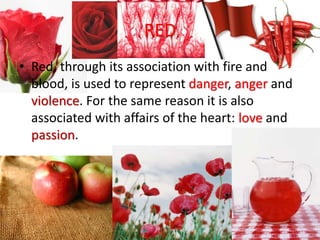
• Red, through its association with fire and
blood, is used to represent danger, anger and
violence. For the same reason it is also
associated with affairs of the heart: love and
passion.
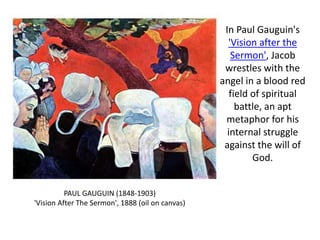
In Paul Gauguin's
'Vision after the
Sermon', Jacob
wrestles with the
angel in a blood red
field of spiritual
battle, an apt
metaphor for his
internal struggle
against the will of
God.
PAUL GAUGUIN (1848-1903)
'Vision After The Sermon', 1888 (oil on canvas)
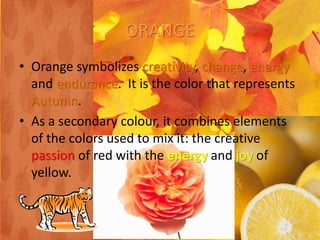
ORANGE
• Orange symbolizes creativity, change, energy
and endurance. It is the color that represents
Autumn.
• As a secondary colour, it combines elements
of the colors used to mix it: the creative
passion of red with the energy and joy of
yellow.
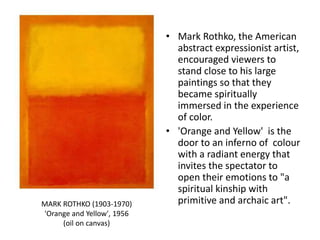
• Mark Rothko, the American
abstract expressionist artist,
encouraged viewers to
stand close to his large
paintings so that they
became spiritually
immersed in the experience
of color.
• 'Orange and Yellow' is the
door to an inferno of colour
with a radiant energy that
invites the spectator to
open their emotions to "a
spiritual kinship with
primitive and archaic art".MARK ROTHKO (1903-1970)
'Orange and Yellow', 1956
(oil on canvas)
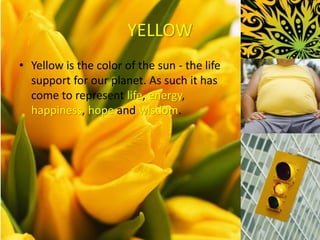
YELLOW
• Yellow is the color of the sun - the life
support for our planet. As such it has
come to represent life, energy,
happiness, hope and wisdom.
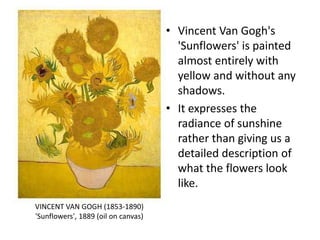
• Vincent Van Gogh's
'Sunflowers' is painted
almost entirely with
yellow and without any
shadows.
• It expresses the
radiance of sunshine
rather than giving us a
detailed description of
what the flowers look
like.
VINCENT VAN GOGH (1853-1890)
'Sunflowers', 1889 (oil on canvas)
GREEN
• Green, as the color of plants and grass, is the
color of nature and all that is associated
with health and growth.
• However, it is also used to represent
more negative traits such as envy and
inexperience.
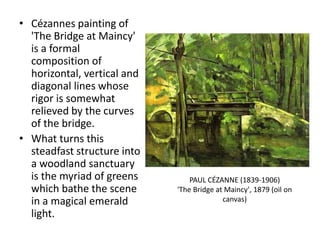
• Cézannes painting of
'The Bridge at Maincy'
is a formal
composition of
horizontal, vertical and
diagonal lines whose
rigor is somewhat
relieved by the curves
of the bridge.
• What turns this
steadfast structure into
a woodland sanctuary
is the myriad of greens
which bathe the scene
in a magical emerald
light.
PAUL CÉZANNE (1839-1906)
'The Bridge at Maincy', 1879 (oil on
canvas)
BLUE
• Blue is the coolest and most calming of all the
colors.
• As the color of the sky, it has been used since
ancient times to represent heaven.
• As the color of the ocean, it is also suggests
qualities like freshness, purity and hygiene.
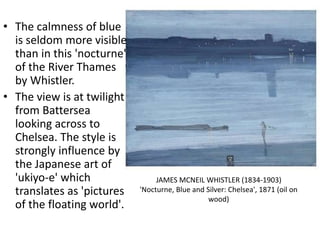
• The calmness of blue
is seldom more visible
than in this 'nocturne'
of the River Thames
by Whistler.
• The view is at twilight
from Battersea
looking across to
Chelsea. The style is
strongly influence by
the Japanese art of
'ukiyo-e' which
translates as 'pictures
of the floating world'.
JAMES MCNEIL WHISTLER (1834-1903)
'Nocturne, Blue and Silver: Chelsea', 1871 (oil on
wood)
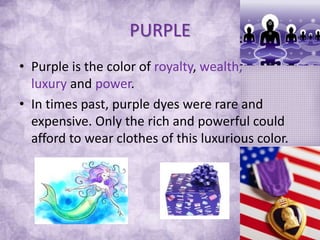
PURPLE
• Purple is the color of royalty, wealth,
luxury and power.
• In times past, purple dyes were rare and
expensive. Only the rich and powerful could
afford to wear clothes of this luxurious color.
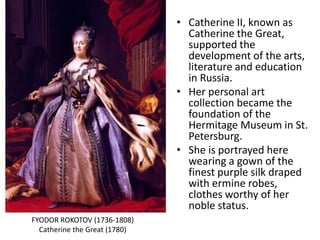
• Catherine II, known as
Catherine the Great,
supported the
development of the arts,
literature and education
in Russia.
• Her personal art
collection became the
foundation of the
Hermitage Museum in St.
Petersburg.
• She is portrayed here
wearing a gown of the
finest purple silk draped
with ermine robes,
clothes worthy of her
noble status.
FYODOR ROKOTOV (1736-1808)
Catherine the Great (1780)
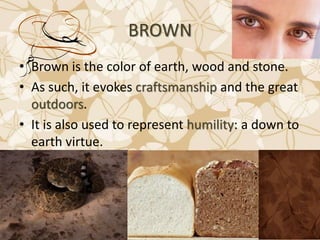
BROWN
• Brown is the color of earth, wood and stone.
• As such, it evokes craftsmanship and the great
outdoors.
• It is also used to represent humility: a down to
earth virtue.
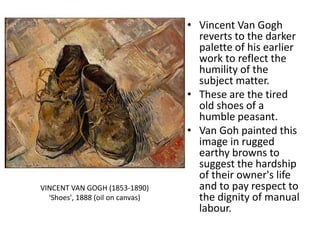
• Vincent Van Gogh
reverts to the darker
palette of his earlier
work to reflect the
humility of the
subject matter.
• These are the tired
old shoes of a
humble peasant.
• Van Goh painted this
image in rugged
earthy browns to
suggest the hardship
of their owner's life
and to pay respect to
the dignity of manual
labour.
VINCENT VAN GOGH (1853-1890)
'Shoes', 1888 (oil on canvas)
BLACK
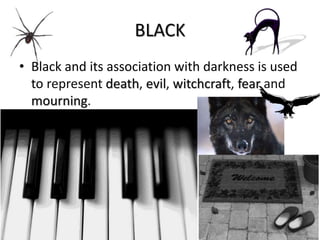
• Black and its association with darkness is used
to represent death, evil, witchcraft, fear and
mourning.
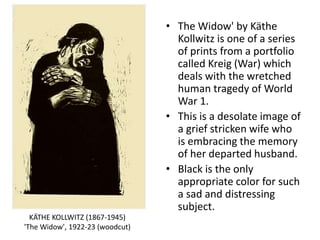
• The Widow' by Käthe
Kollwitz is one of a series
of prints from a portfolio
called Kreig (War) which
deals with the wretched
human tragedy of World
War 1.
• This is a desolate image of
a grief stricken wife who
is embracing the memory
of her departed husband.
• Black is the only
appropriate color for such
a sad and distressing
subject.
KÄTHE KOLLWITZ (1867-1945)
'The Widow', 1922-23 (woodcut)
GREY
• Grey is the natural color of some metals and
stone, but it also has some negative
associations with the weather, boredom,
decay and old age.
• Grey is a mixture of black (death) and white
(peace) and is the color of ashes and dust.
As such it is also associated with death
and mourning.
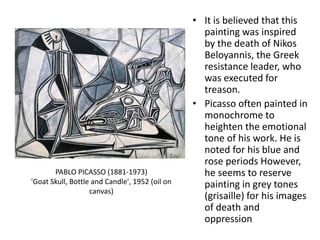
• It is believed that this
painting was inspired
by the death of Nikos
Beloyannis, the Greek
resistance leader, who
was executed for
treason.
• Picasso often painted in
monochrome to
heighten the emotional
tone of his work. He is
noted for his blue and
rose periods However,
he seems to reserve
painting in grey tones
(grisaille) for his images
of death and
oppression
PABLO PICASSO (1881-1973)
'Goat Skull, Bottle and Candle', 1952 (oil on
canvas)
WHITE
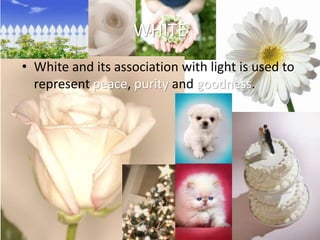
• White and its association with light is used to
represent peace, purity and goodness.
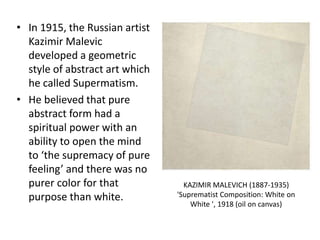
• In 1915, the Russian artist
Kazimir Malevic
developed a geometric
style of abstract art which
he called Supermatism.
• He believed that pure
abstract form had a
spiritual power with an
ability to open the mind
to ‘the supremacy of pure
feeling’ and there was no
purer color for that
purpose than white.
KAZIMIR MALEVICH (1887-1935)
'Suprematist Composition: White on
White ', 1918 (oil on canvas)

Colour Theory Symbolism

  • 1.
    Colour Theory: Symbolism Free ArtLessons from Artyfactory http://www.artyfactory.com/color_theory/color_theory_2.htm
  • 2.
    Colour Theory • Colourshave always been recognized for their symbolic powers. An appreciation of this reaches back to ancient times. • However, the understanding and interpretation of colour symbolism has changed over time and varies from culture to country.
  • 3.
    RED • Red, throughits association with fire and blood, is used to represent danger, anger and violence. For the same reason it is also associated with affairs of the heart: love and passion.
  • 4.
    In Paul Gauguin's 'Visionafter the Sermon', Jacob wrestles with the angel in a blood red field of spiritual battle, an apt metaphor for his internal struggle against the will of God. PAUL GAUGUIN (1848-1903) 'Vision After The Sermon', 1888 (oil on canvas)
  • 5.
    ORANGE • Orange symbolizescreativity, change, energy and endurance. It is the color that represents Autumn. • As a secondary colour, it combines elements of the colors used to mix it: the creative passion of red with the energy and joy of yellow.
  • 6.
    • Mark Rothko,the American abstract expressionist artist, encouraged viewers to stand close to his large paintings so that they became spiritually immersed in the experience of color. • 'Orange and Yellow' is the door to an inferno of colour with a radiant energy that invites the spectator to open their emotions to "a spiritual kinship with primitive and archaic art".MARK ROTHKO (1903-1970) 'Orange and Yellow', 1956 (oil on canvas)
  • 7.
    YELLOW • Yellow isthe color of the sun - the life support for our planet. As such it has come to represent life, energy, happiness, hope and wisdom.
  • 8.
    • Vincent VanGogh's 'Sunflowers' is painted almost entirely with yellow and without any shadows. • It expresses the radiance of sunshine rather than giving us a detailed description of what the flowers look like. VINCENT VAN GOGH (1853-1890) 'Sunflowers', 1889 (oil on canvas)
  • 9.
    GREEN • Green, asthe color of plants and grass, is the color of nature and all that is associated with health and growth. • However, it is also used to represent more negative traits such as envy and inexperience.
  • 10.
    • Cézannes paintingof 'The Bridge at Maincy' is a formal composition of horizontal, vertical and diagonal lines whose rigor is somewhat relieved by the curves of the bridge. • What turns this steadfast structure into a woodland sanctuary is the myriad of greens which bathe the scene in a magical emerald light. PAUL CÉZANNE (1839-1906) 'The Bridge at Maincy', 1879 (oil on canvas)
  • 11.
    BLUE • Blue isthe coolest and most calming of all the colors. • As the color of the sky, it has been used since ancient times to represent heaven. • As the color of the ocean, it is also suggests qualities like freshness, purity and hygiene.
  • 12.
    • The calmnessof blue is seldom more visible than in this 'nocturne' of the River Thames by Whistler. • The view is at twilight from Battersea looking across to Chelsea. The style is strongly influence by the Japanese art of 'ukiyo-e' which translates as 'pictures of the floating world'. JAMES MCNEIL WHISTLER (1834-1903) 'Nocturne, Blue and Silver: Chelsea', 1871 (oil on wood)
  • 13.
    PURPLE • Purple isthe color of royalty, wealth, luxury and power. • In times past, purple dyes were rare and expensive. Only the rich and powerful could afford to wear clothes of this luxurious color.
  • 14.
    • Catherine II,known as Catherine the Great, supported the development of the arts, literature and education in Russia. • Her personal art collection became the foundation of the Hermitage Museum in St. Petersburg. • She is portrayed here wearing a gown of the finest purple silk draped with ermine robes, clothes worthy of her noble status. FYODOR ROKOTOV (1736-1808) Catherine the Great (1780)
  • 15.
    BROWN • Brown isthe color of earth, wood and stone. • As such, it evokes craftsmanship and the great outdoors. • It is also used to represent humility: a down to earth virtue.
  • 16.
    • Vincent VanGogh reverts to the darker palette of his earlier work to reflect the humility of the subject matter. • These are the tired old shoes of a humble peasant. • Van Goh painted this image in rugged earthy browns to suggest the hardship of their owner's life and to pay respect to the dignity of manual labour. VINCENT VAN GOGH (1853-1890) 'Shoes', 1888 (oil on canvas)
  • 17.
    BLACK • Black andits association with darkness is used to represent death, evil, witchcraft, fear and mourning.
  • 18.
    • The Widow'by Käthe Kollwitz is one of a series of prints from a portfolio called Kreig (War) which deals with the wretched human tragedy of World War 1. • This is a desolate image of a grief stricken wife who is embracing the memory of her departed husband. • Black is the only appropriate color for such a sad and distressing subject. KÄTHE KOLLWITZ (1867-1945) 'The Widow', 1922-23 (woodcut)
  • 19.
    GREY • Grey isthe natural color of some metals and stone, but it also has some negative associations with the weather, boredom, decay and old age. • Grey is a mixture of black (death) and white (peace) and is the color of ashes and dust. As such it is also associated with death and mourning.
  • 20.
    • It isbelieved that this painting was inspired by the death of Nikos Beloyannis, the Greek resistance leader, who was executed for treason. • Picasso often painted in monochrome to heighten the emotional tone of his work. He is noted for his blue and rose periods However, he seems to reserve painting in grey tones (grisaille) for his images of death and oppression PABLO PICASSO (1881-1973) 'Goat Skull, Bottle and Candle', 1952 (oil on canvas)
  • 21.
    WHITE • White andits association with light is used to represent peace, purity and goodness.
  • 22.
    • In 1915,the Russian artist Kazimir Malevic developed a geometric style of abstract art which he called Supermatism. • He believed that pure abstract form had a spiritual power with an ability to open the mind to ‘the supremacy of pure feeling’ and there was no purer color for that purpose than white. KAZIMIR MALEVICH (1887-1935) 'Suprematist Composition: White on White ', 1918 (oil on canvas)