COLORIMETER
BP231507
SWETHA. S
I M.SC.
MICROBIOLOGY
DEFINITION
 A colorimeter is a device that measures the absorbance of particular wavelengths of light by a
specific solution. This device is most commonly used to determine the concentration of a
known solute in a given solution by the application of the Beer- Lambert law.
 According to Beer’s law when monochromatic light passes through the coloured solution, the
amount of light transmitted decreases exponentially with increase in concentration of the
coloured substance.
 Lambert’s Law: According to Lambert’s law the amounts of light transmitted decreases
exponentially with increase in thickness of the coloured solution.
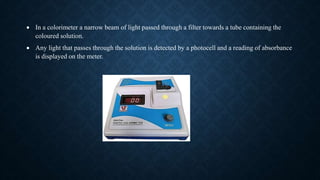
 In a colorimeter a narrow beam of light passed through a filter towards a tube containing the
coloured solution.
 Any light that passes through the solution is detected by a photocell and a reading of absorbance
is displayed on the meter.
PARTS OF COLORIMETER
 Light source
 Filter (the device that selects the desired wavelength)
 Cuvette chamber (the transmitted light passes through compartment where in the solution
containing the coloured solution are kept in cuvette, made of glass or disposable plastic)
 Detector (photosensitive element that converts light into electrical energy)
 Galvanometer (measures electrical signal quantitatively)
TYPES OF COLORIMETER
• There are three main types of colorimeters:
1. Spectrophotometer : This is the most accurate type of colorimeter and can be used
to measure the spectral reflectance of a suface.
2. Densitometer : This type of colorimeter is used to measure the density of a material.
3. Tristimulus colorimeter : This is the most common type of colorimeter and is used
to measure the tristimulus values of a colour.
PRINCIPLE OF COLORIMETER
 A colorimeter is based on the photometric technique which states that when a beam of incident light of
intensity I0 passes through a solution, a part of the incident light is reflected (Ir), a part is absorbed
(Ia) and rest of the light is transmitted (It) thus,
I0 = Ir + Ia + It
 In colorimeter, (Ir) is eliminated because of the measurement of (I0) and it is sufficient to determine
the (Ia).
 For this purpose, the amount of light reflected (Ir) is kept constant by using cells that have identical
properties. (I0) & (It) is them measured.
 The mathematical relationship between the amount of light absorbed and the concentration of the
substance can be shown by the two fundamental laws of photometry on which the colorimeter is based.
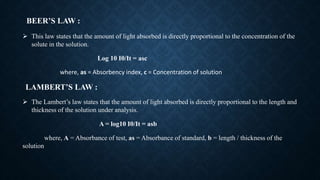
BEER’S LAW :
 This law states that the amount of light absorbed is directly proportional to the concentration of the
solute in the solution.
Log 10 I0/It = asc
where, as = Absorbency index, c = Concentration of solution
LAMBERT’S LAW :
 The Lambert’s law states that the amount of light absorbed is directly proportional to the length and
thickness of the solution under analysis.
A = log10 I0/It = asb
where, A = Absorbance of test, as = Absorbance of standard, b = length / thickness of the
solution
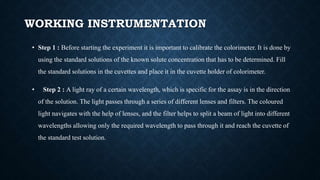
WORKING INSTRUMENTATION
• Step 1 : Before starting the experiment it is important to calibrate the colorimeter. It is done by
using the standard solutions of the known solute concentration that has to be determined. Fill
the standard solutions in the cuvettes and place it in the cuvette holder of colorimeter.
• Step 2 : A light ray of a certain wavelength, which is specific for the assay is in the direction
of the solution. The light passes through a series of different lenses and filters. The coloured
light navigates with the help of lenses, and the filter helps to split a beam of light into different
wavelengths allowing only the required wavelength to pass through it and reach the cuvette of
the standard test solution.
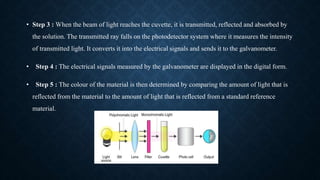
• Step 3 : When the beam of light reaches the cuvette, it is transmitted, reflected and absorbed by
the solution. The transmitted ray falls on the photodetector system where it measures the intensity
of transmitted light. It converts it into the electrical signals and sends it to the galvanometer.
• Step 4 : The electrical signals measured by the galvanometer are displayed in the digital form.
• Step 5 : The colour of the material is then determined by comparing the amount of light that is
reflected from the material to the amount of light that is reflected from a standard reference
material.
USES OF COLORIMETER
 Colorimeter device is used to test the water quality by screening chemicals such as
chlorine, cyanide, fluoride, dissolved oxygen, iron, zinc, hydrazine, and molybdenum.
 Used in hospitals and medical laboratories to estimate biochemical samples, including
plasma, urine, CSF, serum.
 Most of the food industries use this device. Paints and textile manufacturers use a
colorimeter.
APPLICATIONS
 The spectral response of a colorimeter can be used to calculate the tristimulus value of a color.
This information can be used in a variety of applications, including:
* Printing and dyeing
* Textile and apparel
* Food and beverages
* Paint and coatings
* Inks and toners
* Plastics
THINGS TO TAKE CARE BEFORE USING
COLORIMETER
• Some precautionary steps to be taken care before using colorimeter are as follows:
1. Always calibrate the colorimeter before use.
2. Do not use the colorimeter if it is damaged in any way.
3. Avoid exposing the colorimeter to direct sunlight or other harsh lighting conditions.
4. Keep the colorimeter in a cool, dry place when not in use.
ADVANTAGES
• There are many advantages to using colorimetry, including:
1. Precise and accurate colour measurement
2. Allows for the measuremeter of a wide range of colours
3. Can be used to measure colours in both in visible and invisible spectrum
4. Can be used to measure the colour of both solid and liquid samples
5. Easy to use
THANK YOU

Colorimeter(Bioinstrumentation). pptx.ppt

  • 1.
  • 2.
    DEFINITION  A colorimeteris a device that measures the absorbance of particular wavelengths of light by a specific solution. This device is most commonly used to determine the concentration of a known solute in a given solution by the application of the Beer- Lambert law.  According to Beer’s law when monochromatic light passes through the coloured solution, the amount of light transmitted decreases exponentially with increase in concentration of the coloured substance.  Lambert’s Law: According to Lambert’s law the amounts of light transmitted decreases exponentially with increase in thickness of the coloured solution.
  • 3.
     In acolorimeter a narrow beam of light passed through a filter towards a tube containing the coloured solution.  Any light that passes through the solution is detected by a photocell and a reading of absorbance is displayed on the meter.
  • 4.
    PARTS OF COLORIMETER Light source  Filter (the device that selects the desired wavelength)  Cuvette chamber (the transmitted light passes through compartment where in the solution containing the coloured solution are kept in cuvette, made of glass or disposable plastic)  Detector (photosensitive element that converts light into electrical energy)  Galvanometer (measures electrical signal quantitatively)
  • 5.
    TYPES OF COLORIMETER •There are three main types of colorimeters: 1. Spectrophotometer : This is the most accurate type of colorimeter and can be used to measure the spectral reflectance of a suface. 2. Densitometer : This type of colorimeter is used to measure the density of a material. 3. Tristimulus colorimeter : This is the most common type of colorimeter and is used to measure the tristimulus values of a colour.
  • 6.
    PRINCIPLE OF COLORIMETER A colorimeter is based on the photometric technique which states that when a beam of incident light of intensity I0 passes through a solution, a part of the incident light is reflected (Ir), a part is absorbed (Ia) and rest of the light is transmitted (It) thus, I0 = Ir + Ia + It  In colorimeter, (Ir) is eliminated because of the measurement of (I0) and it is sufficient to determine the (Ia).  For this purpose, the amount of light reflected (Ir) is kept constant by using cells that have identical properties. (I0) & (It) is them measured.  The mathematical relationship between the amount of light absorbed and the concentration of the substance can be shown by the two fundamental laws of photometry on which the colorimeter is based.
  • 7.
    BEER’S LAW : This law states that the amount of light absorbed is directly proportional to the concentration of the solute in the solution. Log 10 I0/It = asc where, as = Absorbency index, c = Concentration of solution LAMBERT’S LAW :  The Lambert’s law states that the amount of light absorbed is directly proportional to the length and thickness of the solution under analysis. A = log10 I0/It = asb where, A = Absorbance of test, as = Absorbance of standard, b = length / thickness of the solution
  • 8.
    WORKING INSTRUMENTATION • Step1 : Before starting the experiment it is important to calibrate the colorimeter. It is done by using the standard solutions of the known solute concentration that has to be determined. Fill the standard solutions in the cuvettes and place it in the cuvette holder of colorimeter. • Step 2 : A light ray of a certain wavelength, which is specific for the assay is in the direction of the solution. The light passes through a series of different lenses and filters. The coloured light navigates with the help of lenses, and the filter helps to split a beam of light into different wavelengths allowing only the required wavelength to pass through it and reach the cuvette of the standard test solution.
  • 9.
    • Step 3: When the beam of light reaches the cuvette, it is transmitted, reflected and absorbed by the solution. The transmitted ray falls on the photodetector system where it measures the intensity of transmitted light. It converts it into the electrical signals and sends it to the galvanometer. • Step 4 : The electrical signals measured by the galvanometer are displayed in the digital form. • Step 5 : The colour of the material is then determined by comparing the amount of light that is reflected from the material to the amount of light that is reflected from a standard reference material.
  • 10.
    USES OF COLORIMETER Colorimeter device is used to test the water quality by screening chemicals such as chlorine, cyanide, fluoride, dissolved oxygen, iron, zinc, hydrazine, and molybdenum.  Used in hospitals and medical laboratories to estimate biochemical samples, including plasma, urine, CSF, serum.  Most of the food industries use this device. Paints and textile manufacturers use a colorimeter.
  • 11.
    APPLICATIONS  The spectralresponse of a colorimeter can be used to calculate the tristimulus value of a color. This information can be used in a variety of applications, including: * Printing and dyeing * Textile and apparel * Food and beverages * Paint and coatings * Inks and toners * Plastics
  • 12.
    THINGS TO TAKECARE BEFORE USING COLORIMETER • Some precautionary steps to be taken care before using colorimeter are as follows: 1. Always calibrate the colorimeter before use. 2. Do not use the colorimeter if it is damaged in any way. 3. Avoid exposing the colorimeter to direct sunlight or other harsh lighting conditions. 4. Keep the colorimeter in a cool, dry place when not in use.
  • 13.
    ADVANTAGES • There aremany advantages to using colorimetry, including: 1. Precise and accurate colour measurement 2. Allows for the measuremeter of a wide range of colours 3. Can be used to measure colours in both in visible and invisible spectrum 4. Can be used to measure the colour of both solid and liquid samples 5. Easy to use
  • 14.