DISPERSION SYSTEMS
COLLOIDS
PART 1
www.medacademy.org.in
2
www.medacademy.org.in
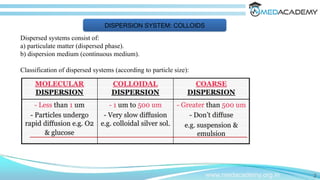
Dispersed systems consist of:
a) particulate matter (dispersed phase).
b) dispersion medium (continuous medium).
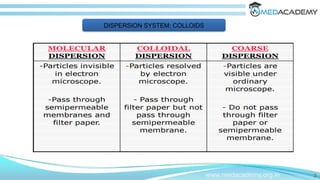
Classification of dispersed systems (according to particle size):
DISPERSION SYSTEM: COLLOIDS
3
www.medacademy.org.in
DISPERSION SYSTEM: COLLOIDS
4
www.medacademy.org.in
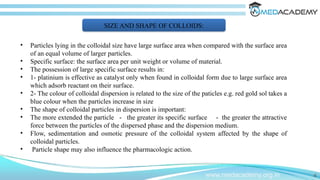
• Particles lying in the colloidal size have large surface area when compared with the surface area
of an equal volume of larger particles.
• Specific surface: the surface area per unit weight or volume of material.
• The possession of large specific surface results in:
• 1- platinium is effective as catalyst only when found in colloidal form due to large surface area
which adsorb reactant on their surface.
• 2- The colour of colloidal dispersion is related to the size of the paticles e.g. red gold sol takes a
blue colour when the particles increase in size
• The shape of colloidal particles in dispersion is important:
• The more extended the particle - the greater its specific surface - the greater the attractive
force between the particles of the dispersed phase and the dispersion medium.
• Flow, sedimentation and osmotic pressure of the colloidal system affected by the shape of
colloidal particles.
• Particle shape may also influence the pharmacologic action.
SIZE AND SHAPE OF COLLOIDS:
5
www.medacademy.org.in
• Colloidal dispersions consist of two distinct phases - a dispersed phase and a dispersion phase
or medium. The dispersed phase is also called the internal or discontinuous phase and the
dispersion medium, as the external or continuous phase.
• Colloidality is due to a state of subdivision of the dispersed phase, Thus, it is the particle size
that distinguishes colloidal dispersions from solutions and coarse dispersions. Dispersed phase
in the colloidal state may have dimensions in the range of 0.001 μ to 0.5 μ.
• Colloidal system is dispersion where in internal phase dispersed particles are distributed
uniformly in a dispersion medium (External/continuous Phase).
• Solids may be dispersed in colloidal state into solid (zinc oxide paste zinc oxide and starch in
petrolatum, toothpaste containing dicalcium phosphate or calcium carbonate with sodium
carboxy methyl cellulose binder or liquid (bentonite magma) or gas (smoke, dust etc.). Liquids
may also be dispersed into solid (absorption bases), in aqueous medium (hydrophilic
petrolatum USP) or in liquid (mineral oil emulsion) or in gas. Gases form colloidal dispersion
with solids and with liquids.
COLLOIDS / COLLOIDAL DISPERSIONS
6
www.medacademy.org.in
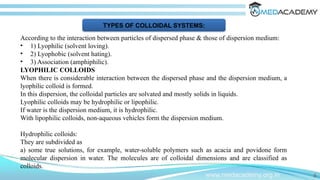
According to the interaction between particles of dispersed phase & those of dispersion medium:
• 1) Lyophilic (solvent loving).
• 2) Lyophobic (solvent hating).
• 3) Association (amphiphilic).
LYOPHILIC COLLOIDS
When there is considerable interaction between the dispersed phase and the dispersion medium, a
lyophilic colloid is formed.
In this dispersion, the colloidal particles are solvated and mostly solids in liquids.
Lyophilic colloids may be hydrophilic or lipophilic.
If water is the dispersion medium, it is hydrophilic.
With lipophilic colloids, non-aqueous vehicles form the dispersion medium.
Hydrophilic colloids:
They are subdivided as
a) some true solutions, for example, water-soluble polymers such as acacia and povidone form
molecular dispersion in water. The molecules are of colloidal dimensions and are classified as
colloids.
TYPES OF COLLOIDAL SYSTEMS:
7
www.medacademy.org.in
• b) gelled solutions are solutions of polymers at high concentrations. They are also formed at a
temperature at which their solubility in water is low. Solutions of gelatin and starch are set to
get on cooling whereas the solution of methyl cellulose acts as a gel on heating. If water is the
dispersion medium, they are called hydrogels.
• c) particulate dispersion does not form molecular dispersions but they are present as minute
particles of colloidal dimensions. Bentonite forms hydrosol with water.
• Lipophilic colloids exhibit an affinity for oils and hence are called oleophilic. Oils are non-
polar and some examples are mineral oil, vegetable oils such as cotton seed oil and essential
oils such as lemon oil.
• Thus, lipophilic colloids may be true solutions, gelled solutions or particulate dispersions.
• Polystyrene and gum rubber form colloidal solutions with benzene. Aluminium stearate
dissolves or disperses in cottonseed oil.
• Lyophilic colloidal dispersions are thermodynamically stable. Lyophilic substances form
colloidal dispersions spontaneously with the dispersion medium. They are also reversible i.e.,
they can be formed after the dispersion medium has been removed. The residue obtained after
the removal of the dispersion medium forms again a colloidal dispersion upon adding to the
dispersion medium.
TYPES OF COLLOIDAL SYSTEMS:
8
www.medacademy.org.in
• Lyophobic means solvent-hating. In lyophobic dispersions, the colloidal particles exhibit little
interaction or affinity with the dispersion medium. Hence in lyophobic colloidal dispersions,
the particles are not solvated.
• Lyophobic colloids may be hydrophobic and lipophobic.
• Hydrophobic dispersion has water as a dispersion medium and the particles are not hydrated.
• Hydrophobic colloids may have lipophilic substances as a dispersed phase in water. For
example, polystyrene, steroids, and magnesium stearate form hydrophobic colloidal dispersions
with water.
• Hydrophobic colloids are formed with substances like gold, silver and sulphur which are not
lipophilic.
• Lipophobic dispersions are water-in-oil emulsions.
LYOPHOBIC COLLOIDS
9
www.medacademy.org.in
• Association colloids result from the formation of ‘micelles’ ( a micelle is formed by a group of
surfactant molecules) when a surfactant in sufficient amount is added to the dispersion medium
(water).
• As a surfactant has two distinct portions of opposing solution affinities within its molecule, the
molecules tend to associate to form groups called micelles within the medium.
• The micelles are of colloidal dimensions.
• Such micelles are formed at and above a concentration called the critical micellar concentration
of the surfactant.
• Some 50 or more molecules aggregate together to form micelles which are of the order of 0.005
µ in diameter.
• They are thermodynamically stable and also reversible.
ASSOCIATION COLLOIDS
10
www.medacademy.org.in
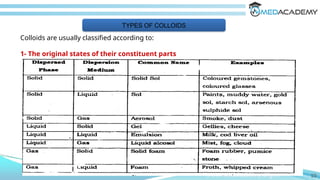
Colloids are usually classified according to:
1- The original states of their constituent parts
TYPES OF COLLOIDS
11
www.medacademy.org.in
• Properties of colloids may be classified into optical properties, kinetic properties and electric
properties.
• Optical properties:
• a) Faraday Tyndall effect
• b) electron microscope
• c) light scattering
a) The FARADAY TYNDALL EFFECT:
When a narrow strong beam of light is passed through a colloidal dispersion, the path of the light
can be observed at right angles under an ultramicroscope. These colloidal particles appear as bright
spots against a dark background due to the scattering of light by the colloidal particles on the path
of the beam. This optical property is actually due to discrete variations in the refractive index
caused by the presence of particles.
PROPERTIES OF COLLOIDS
12
www.medacademy.org.in
The ordinary light microscope cannot reveal the structural details of particles which are separated
by smaller distances since the resolving power is 2000o
A. The electron microscope has a higher
resolving power of about 5 o
A as it employs an electron beam with a wavelength of about 0.1 o
A.
The resolving power is directly related to the wavelength of the radiation. The shorter the
wavelength, the more efficient the resolving power.
The electron microscope is used to get pictures of actual particles. It is used to study the size, shape
and structure of colloidal particles.
b) ELECTRON MICROSCOPE
13
www.medacademy.org.in
LIGHT SCATTERING:
The scattering of light and the intensity of the scattered light depend upon the following factors.
1. wavelength of the incident beam
2. intensity of incident beam
3. difference in the refractive index between the particles and the medium.
This is based on the Faraday-Tyndall effect it is widely used in the determination of
a) The Molecular weight of the colloids
b) The Size and shape of the colloids.
c) Used to study proteins, association colloids and lyophobic sols.
- Scattering described in terms of turbidity, T.
Principle: Scattering method: in terms of turbidity, the fractional decrease in the intensity due to
scattering as the incident light passes through 1 cm of solution.
LIGHT SCATTERING
14
www.medacademy.org.in
The turbidity can be calculated as follows:
Hc/ τ =1/M +2Bc
Τ=turbidity in cm-1
c= concentration of the solute in gm/cm3 at wave length in cm-1
M=weight of the average molecular weight, in g/mol or Daltons.
LIGHT SCATTERING
15
www.medacademy.org.in
• The kinetic properties of colloids are classified as follows:
BROWNIAN MOVEMENT
• The macromolecules or the colloidal particles are engaged continuously
• and randomly in motion within the medium.
• These molecules or particles are buffeted by the molecules of the dispersion medium. This
random movement and bombardment with the molecules of the dispersion medium are
unceasing and erratic and such a movement of colloidal particles (zig-zag movement) within
the medíum is termed Brownian motion. Brownian motion is decreased by an increase in the
viscosity of the medium and the motion may also be stopped by increasing this viscosity to a
certain level.
KINETIC PROPERTIES:
16
www.medacademy.org.in
BROWNIAN MOVEMENT
17
www.medacademy.org.in
• As a result of Brownian motion particles passes (diffuse) from a region of higher
concentration to one with a lower concentration.
• The rate of diffusion is expressed by;
• Fick’s first law:
• dm/dt = -DA dc/dx
• Where dm is the mass of substance diffusing in time dt across an area.
• An under the influence of a concentration gradient dC/dx.
• The minus sign denotes that diffusion takes place in the direction of decreasing
concentration.
• D is the diffusion coefficient.
• The expression to calculate the molecular weight is given as
DIFFUSION
18
www.medacademy.org.in
• D = diffusion coefficient of polymer
• R = ideal gas constant
• T = absolute temperature.
• = viscosity of dispersion medium
Ƞ
• N= Avogadro number
• M = molecular weight of polymer
• V = partial specific volume of
• particles.
• Using this method, the molecular weight of egg albumin and haemoglobin have been
obtained.
DIFFUSION
19
www.medacademy.org.in
- This method is based on the van't hoff equation:
π = cRT
- Can be used to determine the molecular weight of colloid in a dilute solution.
- Replacing c by C / M (where C = the grams of solute / litre of solution, M = molecular weight)
π/C = RT/M
π = osmotic pressure
R= molar gas constant
OSMOTIC PRESSURE
20
www.medacademy.org.in
Stoke’s law;
V = 2r2
( p-pO) g / 9 η
• v: velocity of sedimentation of spherical particles.
•p: density of the spherical particles.
•pO: density of the medium.
•η: viscosity of the medium.
• g: acceleration due to gravity.
At small particle size (less than 0.5 um) Brownian motion is significant & tends to prevent
sedimentation due to gravity & promote mixing instead.
• so, we use an ultracentrifuge which provides a stronger force to promote sedimentation in a
measurable manner.
SEDIMENTATION
21
www.medacademy.org.in
The viscosity is an expression of the resistance to flow of a system under an applied stress.
In this section concerned with the flow properties of dilute colloidal systems.
1. We can determine the molecular weight of the molecules in the dispersed system
2. shape of the particles in solution
Einstein equation for dilute colloidal dispersions
= o (1+ 2.5 Ǿ)
This is based on hydrodynamic theory ,
o= viscosity of the dispersion medium
= viscosity of the dispersion when the volume fraction of colloidal particles present is Ǿ
From the above equation we can determine the Relative viscosity rel = /o =2.5Ǿ
Specific viscosity sp = /o-1=n-o/o=2.5 Ǿ or sp/Ǿ =2.5
Since volume fraction is directly related to concentration, then the above equation becomes:
sp/c=k
From this equation we can calculate the approximate molecular weight of the polymers.
VISCOSITY
Thank You
www.medacademy.org.in
“MAKING PROFESSIONALS, PROFESSIONALLY”

DISPERSED SYSTEM COLLOIDS part1 .pptx

  • 1.
  • 2.
    2 www.medacademy.org.in Dispersed systems consistof: a) particulate matter (dispersed phase). b) dispersion medium (continuous medium). Classification of dispersed systems (according to particle size): DISPERSION SYSTEM: COLLOIDS
  • 3.
  • 4.
    4 www.medacademy.org.in • Particles lyingin the colloidal size have large surface area when compared with the surface area of an equal volume of larger particles. • Specific surface: the surface area per unit weight or volume of material. • The possession of large specific surface results in: • 1- platinium is effective as catalyst only when found in colloidal form due to large surface area which adsorb reactant on their surface. • 2- The colour of colloidal dispersion is related to the size of the paticles e.g. red gold sol takes a blue colour when the particles increase in size • The shape of colloidal particles in dispersion is important: • The more extended the particle - the greater its specific surface - the greater the attractive force between the particles of the dispersed phase and the dispersion medium. • Flow, sedimentation and osmotic pressure of the colloidal system affected by the shape of colloidal particles. • Particle shape may also influence the pharmacologic action. SIZE AND SHAPE OF COLLOIDS:
  • 5.
    5 www.medacademy.org.in • Colloidal dispersionsconsist of two distinct phases - a dispersed phase and a dispersion phase or medium. The dispersed phase is also called the internal or discontinuous phase and the dispersion medium, as the external or continuous phase. • Colloidality is due to a state of subdivision of the dispersed phase, Thus, it is the particle size that distinguishes colloidal dispersions from solutions and coarse dispersions. Dispersed phase in the colloidal state may have dimensions in the range of 0.001 μ to 0.5 μ. • Colloidal system is dispersion where in internal phase dispersed particles are distributed uniformly in a dispersion medium (External/continuous Phase). • Solids may be dispersed in colloidal state into solid (zinc oxide paste zinc oxide and starch in petrolatum, toothpaste containing dicalcium phosphate or calcium carbonate with sodium carboxy methyl cellulose binder or liquid (bentonite magma) or gas (smoke, dust etc.). Liquids may also be dispersed into solid (absorption bases), in aqueous medium (hydrophilic petrolatum USP) or in liquid (mineral oil emulsion) or in gas. Gases form colloidal dispersion with solids and with liquids. COLLOIDS / COLLOIDAL DISPERSIONS
  • 6.
    6 www.medacademy.org.in According to theinteraction between particles of dispersed phase & those of dispersion medium: • 1) Lyophilic (solvent loving). • 2) Lyophobic (solvent hating). • 3) Association (amphiphilic). LYOPHILIC COLLOIDS When there is considerable interaction between the dispersed phase and the dispersion medium, a lyophilic colloid is formed. In this dispersion, the colloidal particles are solvated and mostly solids in liquids. Lyophilic colloids may be hydrophilic or lipophilic. If water is the dispersion medium, it is hydrophilic. With lipophilic colloids, non-aqueous vehicles form the dispersion medium. Hydrophilic colloids: They are subdivided as a) some true solutions, for example, water-soluble polymers such as acacia and povidone form molecular dispersion in water. The molecules are of colloidal dimensions and are classified as colloids. TYPES OF COLLOIDAL SYSTEMS:
  • 7.
    7 www.medacademy.org.in • b) gelledsolutions are solutions of polymers at high concentrations. They are also formed at a temperature at which their solubility in water is low. Solutions of gelatin and starch are set to get on cooling whereas the solution of methyl cellulose acts as a gel on heating. If water is the dispersion medium, they are called hydrogels. • c) particulate dispersion does not form molecular dispersions but they are present as minute particles of colloidal dimensions. Bentonite forms hydrosol with water. • Lipophilic colloids exhibit an affinity for oils and hence are called oleophilic. Oils are non- polar and some examples are mineral oil, vegetable oils such as cotton seed oil and essential oils such as lemon oil. • Thus, lipophilic colloids may be true solutions, gelled solutions or particulate dispersions. • Polystyrene and gum rubber form colloidal solutions with benzene. Aluminium stearate dissolves or disperses in cottonseed oil. • Lyophilic colloidal dispersions are thermodynamically stable. Lyophilic substances form colloidal dispersions spontaneously with the dispersion medium. They are also reversible i.e., they can be formed after the dispersion medium has been removed. The residue obtained after the removal of the dispersion medium forms again a colloidal dispersion upon adding to the dispersion medium. TYPES OF COLLOIDAL SYSTEMS:
  • 8.
    8 www.medacademy.org.in • Lyophobic meanssolvent-hating. In lyophobic dispersions, the colloidal particles exhibit little interaction or affinity with the dispersion medium. Hence in lyophobic colloidal dispersions, the particles are not solvated. • Lyophobic colloids may be hydrophobic and lipophobic. • Hydrophobic dispersion has water as a dispersion medium and the particles are not hydrated. • Hydrophobic colloids may have lipophilic substances as a dispersed phase in water. For example, polystyrene, steroids, and magnesium stearate form hydrophobic colloidal dispersions with water. • Hydrophobic colloids are formed with substances like gold, silver and sulphur which are not lipophilic. • Lipophobic dispersions are water-in-oil emulsions. LYOPHOBIC COLLOIDS
  • 9.
    9 www.medacademy.org.in • Association colloidsresult from the formation of ‘micelles’ ( a micelle is formed by a group of surfactant molecules) when a surfactant in sufficient amount is added to the dispersion medium (water). • As a surfactant has two distinct portions of opposing solution affinities within its molecule, the molecules tend to associate to form groups called micelles within the medium. • The micelles are of colloidal dimensions. • Such micelles are formed at and above a concentration called the critical micellar concentration of the surfactant. • Some 50 or more molecules aggregate together to form micelles which are of the order of 0.005 µ in diameter. • They are thermodynamically stable and also reversible. ASSOCIATION COLLOIDS
  • 10.
    10 www.medacademy.org.in Colloids are usuallyclassified according to: 1- The original states of their constituent parts TYPES OF COLLOIDS
  • 11.
    11 www.medacademy.org.in • Properties ofcolloids may be classified into optical properties, kinetic properties and electric properties. • Optical properties: • a) Faraday Tyndall effect • b) electron microscope • c) light scattering a) The FARADAY TYNDALL EFFECT: When a narrow strong beam of light is passed through a colloidal dispersion, the path of the light can be observed at right angles under an ultramicroscope. These colloidal particles appear as bright spots against a dark background due to the scattering of light by the colloidal particles on the path of the beam. This optical property is actually due to discrete variations in the refractive index caused by the presence of particles. PROPERTIES OF COLLOIDS
  • 12.
    12 www.medacademy.org.in The ordinary lightmicroscope cannot reveal the structural details of particles which are separated by smaller distances since the resolving power is 2000o A. The electron microscope has a higher resolving power of about 5 o A as it employs an electron beam with a wavelength of about 0.1 o A. The resolving power is directly related to the wavelength of the radiation. The shorter the wavelength, the more efficient the resolving power. The electron microscope is used to get pictures of actual particles. It is used to study the size, shape and structure of colloidal particles. b) ELECTRON MICROSCOPE
  • 13.
    13 www.medacademy.org.in LIGHT SCATTERING: The scatteringof light and the intensity of the scattered light depend upon the following factors. 1. wavelength of the incident beam 2. intensity of incident beam 3. difference in the refractive index between the particles and the medium. This is based on the Faraday-Tyndall effect it is widely used in the determination of a) The Molecular weight of the colloids b) The Size and shape of the colloids. c) Used to study proteins, association colloids and lyophobic sols. - Scattering described in terms of turbidity, T. Principle: Scattering method: in terms of turbidity, the fractional decrease in the intensity due to scattering as the incident light passes through 1 cm of solution. LIGHT SCATTERING
  • 14.
    14 www.medacademy.org.in The turbidity canbe calculated as follows: Hc/ τ =1/M +2Bc Τ=turbidity in cm-1 c= concentration of the solute in gm/cm3 at wave length in cm-1 M=weight of the average molecular weight, in g/mol or Daltons. LIGHT SCATTERING
  • 15.
    15 www.medacademy.org.in • The kineticproperties of colloids are classified as follows: BROWNIAN MOVEMENT • The macromolecules or the colloidal particles are engaged continuously • and randomly in motion within the medium. • These molecules or particles are buffeted by the molecules of the dispersion medium. This random movement and bombardment with the molecules of the dispersion medium are unceasing and erratic and such a movement of colloidal particles (zig-zag movement) within the medíum is termed Brownian motion. Brownian motion is decreased by an increase in the viscosity of the medium and the motion may also be stopped by increasing this viscosity to a certain level. KINETIC PROPERTIES:
  • 16.
  • 17.
    17 www.medacademy.org.in • As aresult of Brownian motion particles passes (diffuse) from a region of higher concentration to one with a lower concentration. • The rate of diffusion is expressed by; • Fick’s first law: • dm/dt = -DA dc/dx • Where dm is the mass of substance diffusing in time dt across an area. • An under the influence of a concentration gradient dC/dx. • The minus sign denotes that diffusion takes place in the direction of decreasing concentration. • D is the diffusion coefficient. • The expression to calculate the molecular weight is given as DIFFUSION
  • 18.
    18 www.medacademy.org.in • D =diffusion coefficient of polymer • R = ideal gas constant • T = absolute temperature. • = viscosity of dispersion medium Ƞ • N= Avogadro number • M = molecular weight of polymer • V = partial specific volume of • particles. • Using this method, the molecular weight of egg albumin and haemoglobin have been obtained. DIFFUSION
  • 19.
    19 www.medacademy.org.in - This methodis based on the van't hoff equation: π = cRT - Can be used to determine the molecular weight of colloid in a dilute solution. - Replacing c by C / M (where C = the grams of solute / litre of solution, M = molecular weight) π/C = RT/M π = osmotic pressure R= molar gas constant OSMOTIC PRESSURE
  • 20.
    20 www.medacademy.org.in Stoke’s law; V =2r2 ( p-pO) g / 9 η • v: velocity of sedimentation of spherical particles. •p: density of the spherical particles. •pO: density of the medium. •η: viscosity of the medium. • g: acceleration due to gravity. At small particle size (less than 0.5 um) Brownian motion is significant & tends to prevent sedimentation due to gravity & promote mixing instead. • so, we use an ultracentrifuge which provides a stronger force to promote sedimentation in a measurable manner. SEDIMENTATION
  • 21.
    21 www.medacademy.org.in The viscosity isan expression of the resistance to flow of a system under an applied stress. In this section concerned with the flow properties of dilute colloidal systems. 1. We can determine the molecular weight of the molecules in the dispersed system 2. shape of the particles in solution Einstein equation for dilute colloidal dispersions = o (1+ 2.5 Ǿ) This is based on hydrodynamic theory , o= viscosity of the dispersion medium = viscosity of the dispersion when the volume fraction of colloidal particles present is Ǿ From the above equation we can determine the Relative viscosity rel = /o =2.5Ǿ Specific viscosity sp = /o-1=n-o/o=2.5 Ǿ or sp/Ǿ =2.5 Since volume fraction is directly related to concentration, then the above equation becomes: sp/c=k From this equation we can calculate the approximate molecular weight of the polymers. VISCOSITY
  • 22.