Prepared By
Prof. Ashish Makwana
Civil Engg. Dept.
Prof. Ashish Makwana 1
PRESENTATION
OUTLINE…
• Definition
• Uses of Cofferdams
• Selection of type of cofferdams
• Type of cofferdams
• Design features of cofferdams
• Prevention of leakage in cofferdams
• Economic height of cofferdams
• Piping in single-wall cofferdams
Prof. Ashish Makwana 2
INTRODUCTION
DEFINITION
• A cofferdam is a temporary structure, which is
constructed to remove water from an area of excavation,
either ground water or water lying above ground level,
and make it possible to carry out the construction work
under reasonably dry conditions.
Prof. Ashish Makwana 3
USES OF COFFERDAMS
• The cofferdams are constructed to facilitate pile driving
operations.
• It is used to place grillage as well as the raft foundations.
• It is constructed to provide working platform for the
foundations of buildings.
• It is used, when the foundations for piers and abutments
of a bridge, dams etc. are to be constructed.
• It is constructed to enclose a space for the removal of
sunken vessels.
Prof. Ashish Makwana 4
SELECTION OF TYPE OF
COFFERDAMS
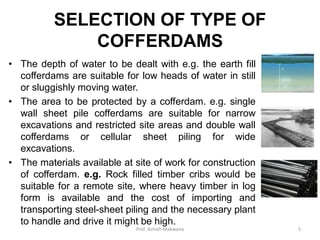
• The depth of water to be dealt with e.g. the earth fill
cofferdams are suitable for low heads of water in still
or sluggishly moving water.
• The area to be protected by a cofferdam. e.g. single
wall sheet pile cofferdams are suitable for narrow
excavations and restricted site areas and double wall
cofferdams or cellular sheet piling for wide
excavations.
• The materials available at site of work for construction
of cofferdam. e.g. Rock filled timber cribs would be
suitable for a remote site, where heavy timber in log
form is available and the cost of importing and
transporting steel-sheet piling and the necessary plant
to handle and drive it might be high.
Prof. Ashish Makwana 5
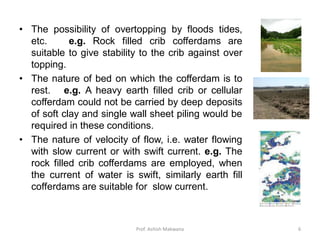
• The possibility of overtopping by floods tides,
etc. e.g. Rock filled crib cofferdams are
suitable to give stability to the crib against over
topping.
• The nature of bed on which the cofferdam is to
rest. e.g. A heavy earth filled crib or cellular
cofferdam could not be carried by deep deposits
of soft clay and single wall sheet piling would be
required in these conditions.
• The nature of velocity of flow, i.e. water flowing
with slow current or with swift current. e.g. The
rock filled crib cofferdams are employed, when
the current of water is swift, similarly earth fill
cofferdams are suitable for slow current.
Prof. Ashish Makwana 6
• The chances of bed erosion due to reduction of water
way caused by the construction of a cofferdam. e.g. Ohio
river type or double wall cofferdams are suitable for hard
bed, where there is no problem of erosion.
• The facilities available for the transport of equipment and
materials required for the construction of a cofferdam.
Prof. Ashish Makwana 7
TYPE OF COFFERDAMS
1. Earth fill cofferdams
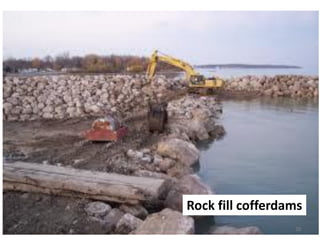
2. Rock fill cofferdams
3. Timber crib or Rock filled crib cofferdams
4. Sheet pile cofferdams
– Single wall cofferdams
– Double wall cofferdams
– Cellular cofferdams
5. Movable or suspended cofferdams
Prof. Ashish Makwana 8
Earth fill cofferdamsProf. Ashish Makwana 9
Rock fill cofferdams
Prof. Ashish Makwana 10
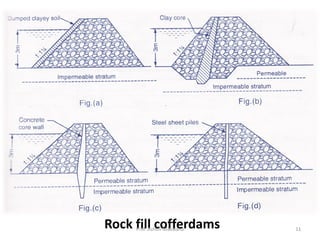
Rock fill cofferdamsProf. Ashish Makwana 11
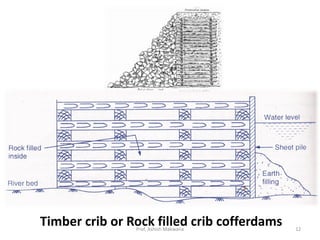
Timber crib or Rock filled crib cofferdamsProf. Ashish Makwana 12
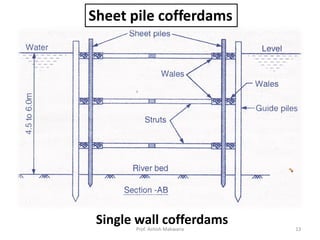
Single wall cofferdams
Sheet pile cofferdams
Prof. Ashish Makwana 13
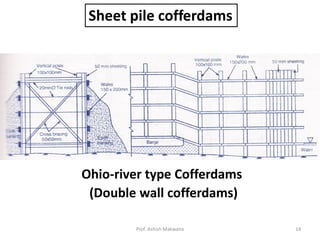
(Double wall cofferdams)
Sheet pile cofferdams
Ohio-river type Cofferdams
Prof. Ashish Makwana 14
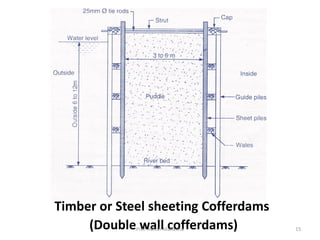
(Double wall cofferdams)
Timber or Steel sheeting Cofferdams
Prof. Ashish Makwana 15
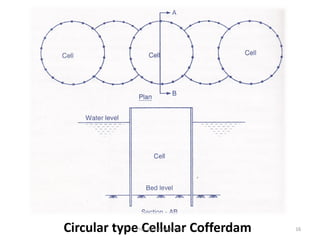
Circular type Cellular CofferdamProf. Ashish Makwana 16
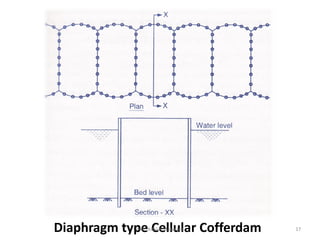
Diaphragm type Cellular CofferdamProf. Ashish Makwana 17
Prof. Ashish Makwana 18
Prof. Ashish Makwana 19
Prof. Ashish Makwana 20
Prof. Ashish Makwana 21
Prof. Ashish Makwana 22
Prof. Ashish Makwana 23
Prof. Ashish Makwana 24
Prof. Ashish Makwana 25
DESIGN FEATURES OF COFFERDAMS
(i) Hydrostatic head of water
(ii) Dimensions of the area to be covered by the cofferdam
(iii) Subsoil conditions
(iv) Fluctuations of outside water level
(v) Possibility of erosion
(vi) Presence of ice
(vii) Floating logs, etc.
Prof. Ashish Makwana 26
THANK YOU
Prof. Ashish Makwana 27

Cofferdams_Advanced Construction Technology

  • 1.
    Prepared By Prof. AshishMakwana Civil Engg. Dept. Prof. Ashish Makwana 1
  • 2.
    PRESENTATION OUTLINE… • Definition • Usesof Cofferdams • Selection of type of cofferdams • Type of cofferdams • Design features of cofferdams • Prevention of leakage in cofferdams • Economic height of cofferdams • Piping in single-wall cofferdams Prof. Ashish Makwana 2
  • 3.
    INTRODUCTION DEFINITION • A cofferdamis a temporary structure, which is constructed to remove water from an area of excavation, either ground water or water lying above ground level, and make it possible to carry out the construction work under reasonably dry conditions. Prof. Ashish Makwana 3
  • 4.
    USES OF COFFERDAMS •The cofferdams are constructed to facilitate pile driving operations. • It is used to place grillage as well as the raft foundations. • It is constructed to provide working platform for the foundations of buildings. • It is used, when the foundations for piers and abutments of a bridge, dams etc. are to be constructed. • It is constructed to enclose a space for the removal of sunken vessels. Prof. Ashish Makwana 4
  • 5.
    SELECTION OF TYPEOF COFFERDAMS • The depth of water to be dealt with e.g. the earth fill cofferdams are suitable for low heads of water in still or sluggishly moving water. • The area to be protected by a cofferdam. e.g. single wall sheet pile cofferdams are suitable for narrow excavations and restricted site areas and double wall cofferdams or cellular sheet piling for wide excavations. • The materials available at site of work for construction of cofferdam. e.g. Rock filled timber cribs would be suitable for a remote site, where heavy timber in log form is available and the cost of importing and transporting steel-sheet piling and the necessary plant to handle and drive it might be high. Prof. Ashish Makwana 5
  • 6.
    • The possibilityof overtopping by floods tides, etc. e.g. Rock filled crib cofferdams are suitable to give stability to the crib against over topping. • The nature of bed on which the cofferdam is to rest. e.g. A heavy earth filled crib or cellular cofferdam could not be carried by deep deposits of soft clay and single wall sheet piling would be required in these conditions. • The nature of velocity of flow, i.e. water flowing with slow current or with swift current. e.g. The rock filled crib cofferdams are employed, when the current of water is swift, similarly earth fill cofferdams are suitable for slow current. Prof. Ashish Makwana 6
  • 7.
    • The chancesof bed erosion due to reduction of water way caused by the construction of a cofferdam. e.g. Ohio river type or double wall cofferdams are suitable for hard bed, where there is no problem of erosion. • The facilities available for the transport of equipment and materials required for the construction of a cofferdam. Prof. Ashish Makwana 7
  • 8.
    TYPE OF COFFERDAMS 1.Earth fill cofferdams 2. Rock fill cofferdams 3. Timber crib or Rock filled crib cofferdams 4. Sheet pile cofferdams – Single wall cofferdams – Double wall cofferdams – Cellular cofferdams 5. Movable or suspended cofferdams Prof. Ashish Makwana 8
  • 9.
  • 10.
    Rock fill cofferdams Prof.Ashish Makwana 10
  • 11.
    Rock fill cofferdamsProf.Ashish Makwana 11
  • 12.
    Timber crib orRock filled crib cofferdamsProf. Ashish Makwana 12
  • 13.
    Single wall cofferdams Sheetpile cofferdams Prof. Ashish Makwana 13
  • 14.
    (Double wall cofferdams) Sheetpile cofferdams Ohio-river type Cofferdams Prof. Ashish Makwana 14
  • 15.
    (Double wall cofferdams) Timberor Steel sheeting Cofferdams Prof. Ashish Makwana 15
  • 16.
    Circular type CellularCofferdamProf. Ashish Makwana 16
  • 17.
    Diaphragm type CellularCofferdamProf. Ashish Makwana 17
  • 18.
  • 19.
  • 20.
  • 21.
  • 22.
  • 23.
  • 24.
  • 25.
  • 26.
    DESIGN FEATURES OFCOFFERDAMS (i) Hydrostatic head of water (ii) Dimensions of the area to be covered by the cofferdam (iii) Subsoil conditions (iv) Fluctuations of outside water level (v) Possibility of erosion (vi) Presence of ice (vii) Floating logs, etc. Prof. Ashish Makwana 26
  • 27.