INTRODUCTION
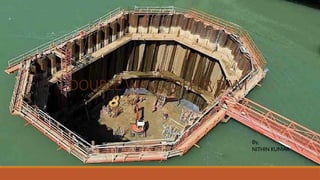
The design andconstruction of a double wall coffer dam is a specialized process
used in civil engineering projects , particularly when working on projects such as
bridge foundations, tunnels, or piers in bodies of water. A double wall coffer dam is
often employed to create a dry working area in water by enclosing an area with two
concentric walls of barriers, allowing for the dewatering of the area between the
walls.
3.
KEY ELEMENTS INTHE DESIGN OF A DOUBLE WALL COFFER DAM
Outer wall (Primary wall)
1. The outer wall is typically the first barrier construction, designed to withstand the
hydrostatic pressure of the surrounding water.
2. it is often made of sheet piles or other impermeable materials such as steel or
reinforced concrete
3. The outer wall should be sufficiently robust to resist forces such as water pressure,
wave action, and potential impacts from debris or vessels.
4.
Inner Wall(Secondary Wall)
1. The inner wall is built inside the outer wall and serves as a secondary containment barrier
2. It provides added security by limiting water leakage and ensuring stability in the event of
damage to the outer wall.
3. This wall may be constructed with similar materials to the outer wall, but can also include
methods such as slurry walls or reinforced concrete if the outer wall is sheet piling
Foundation and bottom Seal
1. The cofferdam must have an adequate foundation that anchors the outer wall and provides
stability against water pressure and soil movement.
2. A bottom seal is essential to prevent water from seeping underneath the cofferdam.
This is typically done by driving sheet piles into the riverbed, applying bentonite slurry or using
impermeable membranes.
Water removal systems.
1. once the cofferdam is in place, continuous pumping or dewatering systems are needed to
maintain a dry environment within the cofferdam. Sump pumps or well
points are commonly used to lower the water level inside.
2. Monitoring systems to detect leakage are also important.
5.
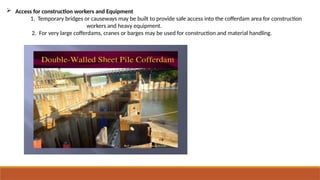
Access forconstruction workers and Equipment
1. Temporary bridges or causeways may be built to provide safe access into the cofferdam area for construction
workers and heavy equipment.
2. For very large cofferdams, cranes or barges may be used for construction and material handling.
6.
CONSTRUCTION PROCESS OFA DOUBLE WALL COFFER DAM
Site preparation and surveying
1. The first step is to conduct a detailed survey of the site to understand the water
depth, soil conditions, and expected water pressures.
2. Temporary access roads or barges are often needed to bring equipment and
materials to the construction site.
Outer wall installation
1. Sheet Piling Method- Sheet piles ( steel, concrete, or composite ) are driven into the ground
using vibratory or impact driving methods. These piles from the outer barrier.
2. The outer wall must be installed to a depth that ensures adequate stability and resistance against
water forces. The outer edge of the cofferdam may also be anchored to the bedrock or deep into the soil to
prevent movement.
7.
Formation ofthe inner wall
1. Once the outer wall is completed, the inner wall is constructed. The method of construction depends on the
specifics site conditions and design. It involves additional sheet piles or a concrete barrier, or in some cases, a slurry wall
can be used.
2. The inner wall is typically placed to a similar depth or slightly shallower than the outer wall to provide
redundancy.
Dewatering and waterproofing
1. After the walls are erected, dewatering equipment is set up inside the coffer dam to lower the water level and
maintain a dry working environment.
2. A bottom seal or membrane may be added to ensure the water does not seep beneath the cofferdam. This could
include installing a bentonite slurry or impermeable membrane.
Additional structural Elements
1. Anchoring- Additional anchor piles or tiebacks are installed to stabilize both the outer and inner walls
2. Dewatering wells and pumps- sump pumps or wellpoint systems are used to manage the water inside the
cofferdam during construction activities.
Access construction
1. Temporary platforms, bridges, or ramps may be constructed to allow workers and machinery to safely enter the
dry area within the cofferdam.
2. This also includes ensuring that utilities such as lighting and power are available to support construction
operations.
8.
Monitoring andMaintenance
1. During the construction phase, continuous monitoring is critical. This includes checking for water seepage or
wall movement, as well as ensuring that dewatering systems are functioning properly.
2. Maintenance of the cofferdam may involves repairing leaks or reinforcing sections that show signs of movement
or wear.
DESIGN CONSIDERATIONS
1. Hydrostatic pressure:- The design must account for the water pressure acting on the cofferdam, especially the
outer wall, as it must be designed to withstand both static and dynamic loads ( e.g. waves or boat traffic )
2. Soil and bedrock conditions:- The soil and bedrock conditions impact the design, particularly in terms of
foundation depth and the installation of anchors. For ex. Soft soils might require additional stabilization
techniques.
3. Safety:- Structural safety is paramount. The cofferdam design should be robust enough to prevent collapse or
failure, ensuring that workers are safe from sudden water intrusion.
4. Environment Impact:- The cofferdam should be designed to minimize environmental disruption, particularly to
aquatic habitats, during construction.
9.
ADVANTAGES OF DOUBLE-WALL COFFERDAM
Enhanced Stability:- The two-layer structure provides increased resistance to external water
pressure, reducing the risk of failure.
Redundancy :- in the event of a breach in the outer wall, the inner wall provides a backup
Flexibility:- Double wall cofferdam can be customized for a variety of site conditions, form
shallow waters to deep, turbulent environments.
Lower water leakage:- The two walls reduce the potential for water seepage, ensuring a more
controlled and dry construction environment.
10.
DISADVANTAGE OF COFFERDAM
Cost- Double wall cofferdam tend to be more expensive to design and construct than single
wall alternatives due to the complexity of construction and the materials involved.
Construction Time- The additional wall and structural elements increase the overall time
required for construction
Materials Requirements – The amount of materials required for both walls and dewatering
systems can be substantial, making it less efficient in some cases.
11.
CONCLUSION
The construction ofa double- wall cofferdam is an effective method for providing a stable and
dry work environment in water bodies, particularly when the external conditions are
challenging.
It involves careful design, including the choice of materials for both walls, as well as careful
planning of dewatering systems, access, and structural monitoring to ensure safety and
functionality.