DESIGN CONSIDERATIONS &
COMPONENTS OF COFFERDAM
Presented by
1304081- Swagata Dasgupta
1304085 - Samiha Rabbani
1304090 - Obaidul Islam
1304104 - Shams Razzak Rothe
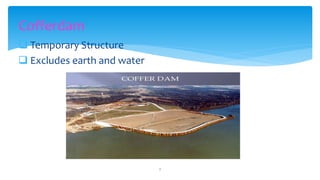
Cofferdam
 Temporary Structure
 Excludes earth and water
2
1. Overall Stability
Risk occurs in –
 Sloping ground
 Riverfront cofferdam
 Where the differential height is greater
 Where cohesive soils extend to considerable depths on sloping sites
Material Stresses
2. Bottom Failure by Piping and Basal Heave
Checking necessary for-
 Risk of hydraulic failure by piping: for narrow cofferdams
 Risk of basal failure: in cofferdams in soft clay
Material Stresses
3. Aggressive Site Conditions
a) Effect of Wave Forces on the Face of the Structure
Waves in deep water
Where waves are reflected
Where waves break on the structure
Waves caused by ship movements
Material Stresses
b) Risk of Over-topping of the Cofferdam Sheeting
To prevent-
The cofferdam should be tied
Adequate sluices with safe locations for operating locations
Material Stresses
c) Scour Protection
Providing cutwaters: upstream and downstream ends of a cofferdam
maybe shaped to reduce scour
Rock or concrete beds: to avoid erosion of the river or sea bed
Grout mattresses weighted by rockfill: for river cofferdams
Material Stresses
d) Protection from Vessel Impact
Fendering or strongpoints built into the cofferdam sheeting
Material Stresses
Circular Cofferdams
General Layout of the Cofferdam
Circular Cofferdams
General Layout of the Cofferdam
What can be accommodated in circular
cofferdams cost-effectively?
Square shaped plan structures
Circular plan shape storage wells
Rectilinear Cofferdams
General Layout of the Cofferdam
 The most economical arrangement uses
Maximum straight runs of piling
Minimum of return angles
Load Transfer
Soil
Sheeting
Waling
Struts
12
Principle Reasons for Failure
Poor
workmanship
Inadequate
strut section
Inadequate
embedment
Allowance of
surcharge
13
Economical use of anchors
 Depends on the strength of the subsoil
 Dense sands and gravels would be preferred
Opportunity to use anchors
 Ownership of land
 Permission to found anchors
Ground Anchors
Acting earth pressures on anchor installation
 Soil strengths
 Wall and soil stiffness
 Anchor spacing
 Anchor yield
 Prestress locked into the anchors
Ground Anchors
Five anchor types
 Type A
 Type B
 Type C
 Type D
 Type E
Ground Anchors
Four items for design of anchors
 Overall stability
 Depth of embedment
 Fixed anchor dimensions
 Group effects
Ground Anchors
Components of Braced Cofferdam
 Sheet pile
 Bracing
1. Waling
2. Passive Anchorage
3. Struts
Figure 4
18
Sheet Piling
Used for outer walls of marine or land cofferdam
Selection of section:
• Criteria- i) Flexural strength
ii) Resistance to driving stress
• Sufficiency of pile sections
Two types of pile driver:
1. Drives piles in panels of six to eight piles
2. Drives one pile at a time
19
Bracing
Waling
Necessity
Load Transfer:
Continuity
• Diaphragm Walls
• Secant Piles
Sheeting Waling Struts/ Anchors
20
Waling (cont.)
Connections
Special Considerations
• For inclined struts
• For anchors
• For diagonal struts
Irregular Alignment Problem
Load Factor: 1.4
Waling
Figure 5
21
Size of Walling
22
Size of Walling (cont.)
Varies with diameter of cofferdams
‘d’ should not be less than ‘D/35’
Waling load = 1.5EI / 10^5 R^3
Permissible compressive stress < 5.2 N/mm^2
Check tension on walling beam
23
Passive Anchors
 Design Principal
Net available passive pressure= passive pressure-active pressure
 Special Considerations
i) Surcharge ii) Friction
 Materials
i) Mild steel - 111N/mm2
ii) High yield steel -140 N/mm2
Passive Anchors (cont.)
Factor of Safety: 1.5-2
Protection:
 To avoid effect of fill settlement
 To avoid corrosion
Struts
 A strut is a component designed to resist
longitudinal compression.
Importance
 The most likely collapse
mechanism of a braced
cofferdam is the buckling of
it’s strutting.
Struts cont.
Collapse of waling or sheeting is unlikely
Reasons of Failure:
 Passive failure below formation level
 Extreme loading
 Poor workmanship
Positioning the strut
Struts should be supported by
welding steel location angles to
end plate prior to bolting.
Struts are square to the wallings
in plan to avoid eccentric loading.
As precaution check 10% of strut
width or depth in each direction.
Spacing
 The vertical spacing of the struts depend on both the strut capacity and the
flexural strength of the walling.
Spacing (cont.)
The minimum frame spacing must be sufficient to allow mechanical
excavation plant to pass under the frame prior to placing the next lowest
frame.
Final stages of construction
The placing of the lowest frame in a multi-frame cofferdam is the period
of greatest risk to the bracing.
The next highest frame will be highly loaded and the factor of safety
against passive failure will be at it’s lowest.
The bending stress and deformation of the walling will be at their highest
values.
All bracing components should be prefabricated to avoid cofferdam
being unpropped at the lowest level for lengthy period.
Walling details
 lifting and bracing steel
 joining sections of cages
 lateral spacing between reinforcement cages of adjacent panels
 details of starter steel for floor slabs
 detailing for ground anchors
 inclusion of reinforcement for waling
 min spacing and cover
 water bar in vertical panel joints
Sheet Pile Walls Across Dock Entrance
Several means-
Cellular cofferdam for new construction
Raking struts to the dock floor to exclude water from
the existing dock
Driving sheet piles to a circular arc in plan for the
existing entrance
Cost of temporary cofferdams
 Design curves
• Section modulus of pilling
• No of bracing
• Bending moments included in cantilever
• Maximum penetration depth
35
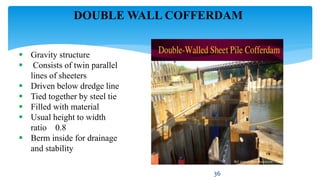
DOUBLE WALL COFFERDAM
 Gravity structure
 Consists of twin parallel
lines of sheeters
 Driven below dredge line
 Tied together by steel tie
 Filled with material
 Usual height to width
ratio 0.8
 Berm inside for drainage
and stability
36
Factors Affecting Stability
Strength of filler material
Strength of sheeters and ties
Soil at foundation level
37
Modes of Failure Considered in Design of Double
Wall Cofferdam
Tie rod design and water pressure:
 Sheet piles should be designed using at rest pressure of
filling
 Hydraulic filling is used to place sand back fills between the
sheeters
 Walls should be designed for most severe assumption of
water pressure-water level within the filling may rise at top
level of sheeters.
38
Sliding:
Resistance to sliding provided by
 Passive resistance of soil
 Shear strength of sheeters
 Frictional resistance of filler
material
39
Overall stability
a stability analysis using force polygon
establishing the efficiency of fill material against failure by
horizontal movement at the top
Ensuring a factor of safety of 1.5
40
Alternative method:
A minimum factor of safety( ratio of overturning and
resisting moment) 1.5
Otherwise trial required with
 increased width
 improved filling material
 deeper driving of sheeters
41
Measures to protect scouring on outside
face
Placing rock or precast concrete blocks against outer
face
Laying grouter mattresses on the river bed
Lateral deformation at the head of cofferdam is
eliminated by using strongpoints
42
THE END

presentation-of-cofferdam-design.pptx

  • 1.
    DESIGN CONSIDERATIONS & COMPONENTSOF COFFERDAM Presented by 1304081- Swagata Dasgupta 1304085 - Samiha Rabbani 1304090 - Obaidul Islam 1304104 - Shams Razzak Rothe
  • 2.
    Cofferdam  Temporary Structure Excludes earth and water 2
  • 3.
    1. Overall Stability Riskoccurs in –  Sloping ground  Riverfront cofferdam  Where the differential height is greater  Where cohesive soils extend to considerable depths on sloping sites Material Stresses
  • 4.
    2. Bottom Failureby Piping and Basal Heave Checking necessary for-  Risk of hydraulic failure by piping: for narrow cofferdams  Risk of basal failure: in cofferdams in soft clay Material Stresses
  • 5.
    3. Aggressive SiteConditions a) Effect of Wave Forces on the Face of the Structure Waves in deep water Where waves are reflected Where waves break on the structure Waves caused by ship movements Material Stresses
  • 6.
    b) Risk ofOver-topping of the Cofferdam Sheeting To prevent- The cofferdam should be tied Adequate sluices with safe locations for operating locations Material Stresses
  • 7.
    c) Scour Protection Providingcutwaters: upstream and downstream ends of a cofferdam maybe shaped to reduce scour Rock or concrete beds: to avoid erosion of the river or sea bed Grout mattresses weighted by rockfill: for river cofferdams Material Stresses
  • 8.
    d) Protection fromVessel Impact Fendering or strongpoints built into the cofferdam sheeting Material Stresses
  • 9.
  • 10.
    Circular Cofferdams General Layoutof the Cofferdam What can be accommodated in circular cofferdams cost-effectively? Square shaped plan structures Circular plan shape storage wells
  • 11.
    Rectilinear Cofferdams General Layoutof the Cofferdam  The most economical arrangement uses Maximum straight runs of piling Minimum of return angles
  • 12.
  • 13.
    Principle Reasons forFailure Poor workmanship Inadequate strut section Inadequate embedment Allowance of surcharge 13
  • 14.
    Economical use ofanchors  Depends on the strength of the subsoil  Dense sands and gravels would be preferred Opportunity to use anchors  Ownership of land  Permission to found anchors Ground Anchors
  • 15.
    Acting earth pressureson anchor installation  Soil strengths  Wall and soil stiffness  Anchor spacing  Anchor yield  Prestress locked into the anchors Ground Anchors
  • 16.
    Five anchor types Type A  Type B  Type C  Type D  Type E Ground Anchors
  • 17.
    Four items fordesign of anchors  Overall stability  Depth of embedment  Fixed anchor dimensions  Group effects Ground Anchors
  • 18.
    Components of BracedCofferdam  Sheet pile  Bracing 1. Waling 2. Passive Anchorage 3. Struts Figure 4 18
  • 19.
    Sheet Piling Used forouter walls of marine or land cofferdam Selection of section: • Criteria- i) Flexural strength ii) Resistance to driving stress • Sufficiency of pile sections Two types of pile driver: 1. Drives piles in panels of six to eight piles 2. Drives one pile at a time 19
  • 20.
    Bracing Waling Necessity Load Transfer: Continuity • DiaphragmWalls • Secant Piles Sheeting Waling Struts/ Anchors 20
  • 21.
    Waling (cont.) Connections Special Considerations •For inclined struts • For anchors • For diagonal struts Irregular Alignment Problem Load Factor: 1.4 Waling Figure 5 21
  • 22.
  • 23.
    Size of Walling(cont.) Varies with diameter of cofferdams ‘d’ should not be less than ‘D/35’ Waling load = 1.5EI / 10^5 R^3 Permissible compressive stress < 5.2 N/mm^2 Check tension on walling beam 23
  • 24.
    Passive Anchors  DesignPrincipal Net available passive pressure= passive pressure-active pressure  Special Considerations i) Surcharge ii) Friction  Materials i) Mild steel - 111N/mm2 ii) High yield steel -140 N/mm2
  • 25.
    Passive Anchors (cont.) Factorof Safety: 1.5-2 Protection:  To avoid effect of fill settlement  To avoid corrosion
  • 26.
    Struts  A strutis a component designed to resist longitudinal compression. Importance  The most likely collapse mechanism of a braced cofferdam is the buckling of it’s strutting.
  • 27.
    Struts cont. Collapse ofwaling or sheeting is unlikely Reasons of Failure:  Passive failure below formation level  Extreme loading  Poor workmanship
  • 28.
    Positioning the strut Strutsshould be supported by welding steel location angles to end plate prior to bolting. Struts are square to the wallings in plan to avoid eccentric loading. As precaution check 10% of strut width or depth in each direction.
  • 29.
    Spacing  The verticalspacing of the struts depend on both the strut capacity and the flexural strength of the walling.
  • 30.
    Spacing (cont.) The minimumframe spacing must be sufficient to allow mechanical excavation plant to pass under the frame prior to placing the next lowest frame.
  • 31.
    Final stages ofconstruction The placing of the lowest frame in a multi-frame cofferdam is the period of greatest risk to the bracing. The next highest frame will be highly loaded and the factor of safety against passive failure will be at it’s lowest. The bending stress and deformation of the walling will be at their highest values. All bracing components should be prefabricated to avoid cofferdam being unpropped at the lowest level for lengthy period.
  • 32.
    Walling details  liftingand bracing steel  joining sections of cages  lateral spacing between reinforcement cages of adjacent panels  details of starter steel for floor slabs  detailing for ground anchors  inclusion of reinforcement for waling  min spacing and cover  water bar in vertical panel joints
  • 33.
    Sheet Pile WallsAcross Dock Entrance
  • 34.
    Sheet Pile WallsAcross Dock Entrance Several means- Cellular cofferdam for new construction Raking struts to the dock floor to exclude water from the existing dock Driving sheet piles to a circular arc in plan for the existing entrance
  • 35.
    Cost of temporarycofferdams  Design curves • Section modulus of pilling • No of bracing • Bending moments included in cantilever • Maximum penetration depth 35
  • 36.
    DOUBLE WALL COFFERDAM Gravity structure  Consists of twin parallel lines of sheeters  Driven below dredge line  Tied together by steel tie  Filled with material  Usual height to width ratio 0.8  Berm inside for drainage and stability 36
  • 37.
    Factors Affecting Stability Strengthof filler material Strength of sheeters and ties Soil at foundation level 37
  • 38.
    Modes of FailureConsidered in Design of Double Wall Cofferdam Tie rod design and water pressure:  Sheet piles should be designed using at rest pressure of filling  Hydraulic filling is used to place sand back fills between the sheeters  Walls should be designed for most severe assumption of water pressure-water level within the filling may rise at top level of sheeters. 38
  • 39.
    Sliding: Resistance to slidingprovided by  Passive resistance of soil  Shear strength of sheeters  Frictional resistance of filler material 39
  • 40.
    Overall stability a stabilityanalysis using force polygon establishing the efficiency of fill material against failure by horizontal movement at the top Ensuring a factor of safety of 1.5 40
  • 41.
    Alternative method: A minimumfactor of safety( ratio of overturning and resisting moment) 1.5 Otherwise trial required with  increased width  improved filling material  deeper driving of sheeters 41
  • 42.
    Measures to protectscouring on outside face Placing rock or precast concrete blocks against outer face Laying grouter mattresses on the river bed Lateral deformation at the head of cofferdam is eliminated by using strongpoints 42
  • 43.