MAT AND PILE
FOUNDATION
NOROZ FIAZ MALGHANI
Mat/Raft Foundation
A mat foundation is a thick reinforced concrete slab supporting arrangement of
column's or walls in a row and transmitting the load into the soil. It is use to
support storage tanks, industrial equipment's , chimney's and various structure.
WHY IT IS USED
 The spread footings cover over 50% of the foundation area because of large
column load.
 The soil is soft with a low bearing capacity.
 When the expenses of deep foundation is higher than raft foundation.
 Walls of the structure are so close that individual footings would overlap
TYPES OF MAT FOUNDATION
 Flat plate mat
 Plate thickened under column's
 Rigid frame mat
 Piled mat
 Two way beam and slab
 Plate with pedestal
PRESSURE DISTRIBUTION IN MAT
FOUNDATION
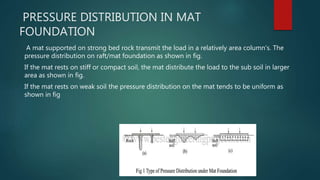
A mat supported on strong bed rock transmit the load in a relatively area column's. The
pressure distribution on raft/mat foundation as shown in fig.
If the mat rests on stiff or compact soil, the mat distribute the load to the sub soil in larger
area as shown in fig.
If the mat rests on weak soil the pressure distribution on the mat tends to be uniform as
shown in fig
PROCEDURE
1. SOIL TEST
2. SHORE PILE CONSTRUCTION
3. EXCAVATION
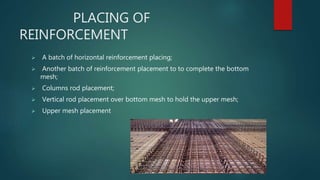
4. REINFORCEMENT
5. CC LAYER CONSTRUCTION
6. LEVELING & DRESSING
7. COLOUMN POSITIONING
8. FORM WORK
9. CONCRETE WORK
10. CURING
SOIL TEST
 Bearing capacity of soil
 Classification of soil
 Moisture content
 Ground water level
 Appropriation and depth of mat
SHORE PILE CONSTRUCTION
Shore piles support the surrounding loads and prevent the surrounding soil from breaking
in at the time of construction
PLACING OF
REINFORCEMENT
 A batch of horizontal reinforcement placing;
 Another batch of reinforcement placement to to complete the bottom
mesh;
 Columns rod placement;
 Vertical rod placement over bottom mesh to hold the upper mesh;
 Upper mesh placement
FORM WORK
 Form work is a mold or open box, like container into which fresh concrete is poured
and compacted.
 When the concrete is set, the form work is removed and a solid mass is produced in
the shape of the inner face of the form work.
 The top of the form work is normally left open.
 False work is the necessary support system that hold the formwork in the correct
position.
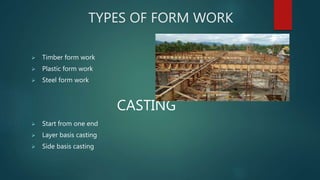
TYPES OF FORM WORK
 Timber form work
 Plastic form work
 Steel form work
CASTING
 Start from one end
 Layer basis casting
 Side basis casting
LEVELING
After casting the whole mat area leveling is essential to be ensured
That the thickness of the mat slab is same all over the area.
TYPES OF CURING
 Shading concrete work
 Steam curing
 Ponding method
 Sprinkling of water
 Covering concrete surface with gunny bags
ADVANTAGES OF MAT/RAFT
FOUNDATION
 Raft foundation is economic due to combination of foundation& floor slab
 Require little excavation
 Can cope with mixed and poor ground condition
 It reduces different settlement.
DISADVANTAES OF MAT FOUNDATION
 It require specific treatment for point loads.
 Edge erosion occur if not treated properly
PILE FOUNDATION
 Pile foundation is a special kind of deep foundation, where the depth of
the foundation is much greater than the width of the foundation
 Today, pile foundation is much more common than any other type of
deep foundation
USES
 It is used where the soil is compressible,
 It is used where the soil is water logged
 It is used when stratum of required bearing capacity is at greater depth
MAJOR USES OF PILES :
 To carry vertical compression loads,
 To resist uplift loads
 To resist horizontal or inclined loads
CLASSIFICATION OF PILES
1. BASED ON THE FUNCTION
 End bearing pile
 Friction pile
 compaction pile
 Sheet pile
 Batter pile
 Tension pile
 fender pile and dolphins
2. BASED ON THE MATERIAL& COMPOSITION
 Concrete pile
 Timber pile
 Steel pile
 Composite pile: concrete& timber concrete& steel
3. BASED ON THE METHOD OF INSTALLATION;
 Driven pile
 cast-in situ pile
 Driven and cast-in-situ pile
SELECTION OF PILES
FACTOR GOVERNING THE SELECTION OF
PILES
They are:
 Length of the pile in relation to the load and type of soil,
 Characters of the structure,
 Availability of the materials,
 types of loading,
 Factor causing deterioration,
 Ease of maintenance,
 Estimated cost of types of pile, taking into account the initial cost, life expectancy and
cost of maintenance
 Availability of funds.
Prepared By
NOROZ FIAZ MALGHANI
CIVIL ENGINEER

Mat or raft foundation

  • 1.
  • 2.
    Mat/Raft Foundation A matfoundation is a thick reinforced concrete slab supporting arrangement of column's or walls in a row and transmitting the load into the soil. It is use to support storage tanks, industrial equipment's , chimney's and various structure. WHY IT IS USED  The spread footings cover over 50% of the foundation area because of large column load.  The soil is soft with a low bearing capacity.  When the expenses of deep foundation is higher than raft foundation.  Walls of the structure are so close that individual footings would overlap
  • 3.
    TYPES OF MATFOUNDATION  Flat plate mat  Plate thickened under column's  Rigid frame mat  Piled mat  Two way beam and slab  Plate with pedestal
  • 4.
    PRESSURE DISTRIBUTION INMAT FOUNDATION A mat supported on strong bed rock transmit the load in a relatively area column's. The pressure distribution on raft/mat foundation as shown in fig. If the mat rests on stiff or compact soil, the mat distribute the load to the sub soil in larger area as shown in fig. If the mat rests on weak soil the pressure distribution on the mat tends to be uniform as shown in fig
  • 5.
    PROCEDURE 1. SOIL TEST 2.SHORE PILE CONSTRUCTION 3. EXCAVATION 4. REINFORCEMENT 5. CC LAYER CONSTRUCTION 6. LEVELING & DRESSING 7. COLOUMN POSITIONING 8. FORM WORK 9. CONCRETE WORK 10. CURING
  • 6.
    SOIL TEST  Bearingcapacity of soil  Classification of soil  Moisture content  Ground water level  Appropriation and depth of mat SHORE PILE CONSTRUCTION Shore piles support the surrounding loads and prevent the surrounding soil from breaking in at the time of construction
  • 7.
    PLACING OF REINFORCEMENT  Abatch of horizontal reinforcement placing;  Another batch of reinforcement placement to to complete the bottom mesh;  Columns rod placement;  Vertical rod placement over bottom mesh to hold the upper mesh;  Upper mesh placement
  • 8.
    FORM WORK  Formwork is a mold or open box, like container into which fresh concrete is poured and compacted.  When the concrete is set, the form work is removed and a solid mass is produced in the shape of the inner face of the form work.  The top of the form work is normally left open.  False work is the necessary support system that hold the formwork in the correct position.
  • 9.
    TYPES OF FORMWORK  Timber form work  Plastic form work  Steel form work CASTING  Start from one end  Layer basis casting  Side basis casting
  • 10.
    LEVELING After casting thewhole mat area leveling is essential to be ensured That the thickness of the mat slab is same all over the area. TYPES OF CURING  Shading concrete work  Steam curing  Ponding method  Sprinkling of water  Covering concrete surface with gunny bags
  • 11.
    ADVANTAGES OF MAT/RAFT FOUNDATION Raft foundation is economic due to combination of foundation& floor slab  Require little excavation  Can cope with mixed and poor ground condition  It reduces different settlement. DISADVANTAES OF MAT FOUNDATION  It require specific treatment for point loads.  Edge erosion occur if not treated properly
  • 12.
    PILE FOUNDATION  Pilefoundation is a special kind of deep foundation, where the depth of the foundation is much greater than the width of the foundation  Today, pile foundation is much more common than any other type of deep foundation USES  It is used where the soil is compressible,  It is used where the soil is water logged  It is used when stratum of required bearing capacity is at greater depth
  • 13.
    MAJOR USES OFPILES :  To carry vertical compression loads,  To resist uplift loads  To resist horizontal or inclined loads CLASSIFICATION OF PILES 1. BASED ON THE FUNCTION  End bearing pile  Friction pile  compaction pile  Sheet pile  Batter pile  Tension pile  fender pile and dolphins
  • 14.
    2. BASED ONTHE MATERIAL& COMPOSITION  Concrete pile  Timber pile  Steel pile  Composite pile: concrete& timber concrete& steel 3. BASED ON THE METHOD OF INSTALLATION;  Driven pile  cast-in situ pile  Driven and cast-in-situ pile
  • 15.
    SELECTION OF PILES FACTORGOVERNING THE SELECTION OF PILES They are:  Length of the pile in relation to the load and type of soil,  Characters of the structure,  Availability of the materials,  types of loading,  Factor causing deterioration,  Ease of maintenance,  Estimated cost of types of pile, taking into account the initial cost, life expectancy and cost of maintenance  Availability of funds.
  • 16.
    Prepared By NOROZ FIAZMALGHANI CIVIL ENGINEER