COENUROSIS
(GID, STURDY)
INTRODUCTION
• Disease associated with Coenurus cerebralis, the intermediate stage of
tapeworm T.multiceps, which inhabits the intestine of dogs and wild canidae
• Coenurus cerebralis can mature in brain and spinal cord of sheep, goat, cattle
horse and other wild ruminants, occasionally humans
• Clinical coenurosis is primarily a disease of sheep, occasionally goat and
cattle
ETIOLOGY
• Cestode T.multiceps belong to the genus taenia
• Coeurosis caused by the invasion of brain and spinal cord by intermediate
stages of Taenia multiceps.
• Morphologically –adult worms –whitish, dorso ventrally flattened and
segmented- 100cm
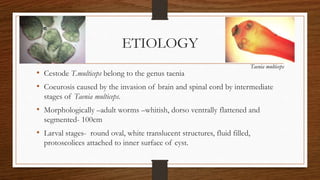
• Larval stages- round oval, white translucent structures, fluid filled,
protoscolices attached to inner surface of cyst.
Taenia multiceps
EPIDEMIOLOGY
• World wide distribution
• 72% of infections in sheep occurred when the animals were between 6-24
months old (Achenef et al., 1999)
• Young lambs/kids aged 6-8weeks are highly susceptible.
• It can also be acquired prenatally in new born.
MODE OF TRANSMISSION
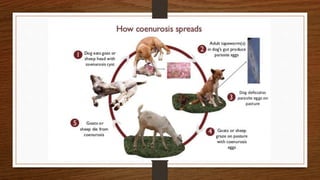
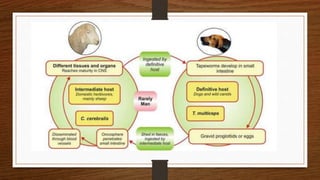
• Transmission cycle of infection by T. multiceps takes place between dogs
and domestic herbivores
• Taenia eggs expelled in faeces of infected dogs/canids  source of infection
• Maintenance of the parasitosis – when dogs get to access slaughtered
animals that harbour infected larval stages
PATHOGENESIS
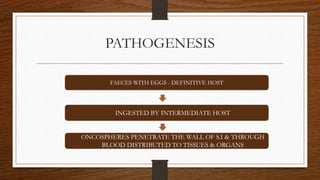
FAECES WITH EGGS - DEFINITIVE HOST
INGESTED BY INTERMEDIATE HOST
ONCOSPHERES PENETRATE THE WALL OF S.I & THROUGH
BLOOD DISTRIBUTED TO TISSUES & ORGANS
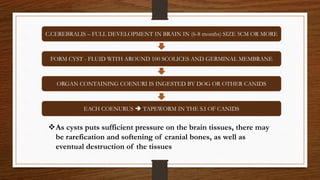
C.CEREBRALIS – FULL DEVELOPMENT IN BRAIN IN (6-8 months) SIZE 5CM OR MORE
FORM CYST - FLUID WITH AROUND 100 SCOLICES AND GERMINAL MEMBRANE
ORGAN CONTAINING COENURI IS INGESTED BY DOG OR OTHER CANIDS
EACH COENURUS  TAPEWORM IN THE S.I OF CANIDS
As cysts puts sufficient pressure on the brain tissues, there may
be rarefication and softening of cranial bones, as well as
eventual destruction of the tissues
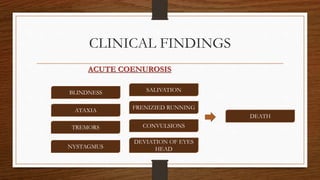
CLINICAL FINDINGS
BLINDNESS
ATAXIA
TREMORS
NYSTAGMUS
SALIVATION
FRENIZIED RUNNING
CONVULSIONS
DEVIATION OF EYES
HEAD
DEATH
ACUTE COENUROSIS
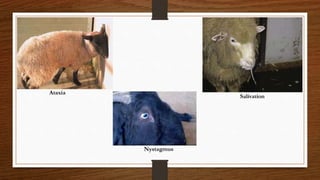
Ataxia
Nystagmus
Salivation
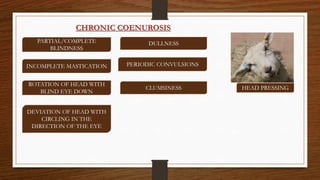
PARTIAL/COMPLETE
BLINDNESS
DULLNESS
CLUMSINESS HEAD PRESSING
INCOMPLETE MASTICATION PERIODIC CONVULSIONS
ROTATION OF HEAD WITH
BLIND EYE DOWN
DEVIATION OF HEAD WITH
CIRCLING IN THE
DIRECTION OF THE EYE
CHRONIC COENUROSIS
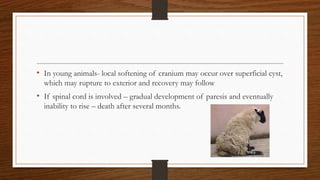
• In young animals- local softening of cranium may occur over superficial cyst,
which may rupture to exterior and recovery may follow
• If spinal cord is involved – gradual development of paresis and eventually
inability to rise – death after several months.
DIAGNOSIS
• It can be done in intermediate hosts by recovery and examination of parasite
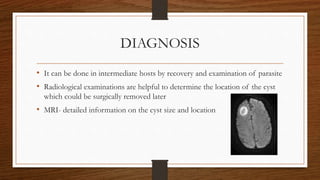
• Radiological examinations are helpful to determine the location of the cyst
which could be surgically removed later
• MRI- detailed information on the cyst size and location
DIFFERENTIAL DIAGNOSIS
• Other space occupying lesions of cranial cavity, spinal cord including
abscess
tumour
hydatidosis
NECROPSY FINDINGS
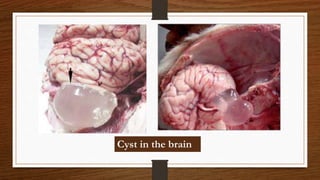
• Thin walled cyst – anywhere in the brain, most commonly – external surface
of cerebral hemisphere
• Spinal cord – lesions often present in lumbar region, but seen in cervical
region too
• Due to the pressure – atrophy of nervous tissue and softening of overlying
bone
Cyst in the brain
TREATMENT & CONTROL
• Surgical removal of cyst with complete recovery is possible in majority of
the cases.
• Best results are observed – albendazole (25mg/kg) orally Or in combination
with fenbendazole (500mg), praziquantel (500mg)
• Life cycle can be broken by control of mature tapeworm infestation in dogs
• Carcass with larval stages should be incinerated.

Coenurosis in ruminants

  • 1.
  • 2.
    INTRODUCTION • Disease associatedwith Coenurus cerebralis, the intermediate stage of tapeworm T.multiceps, which inhabits the intestine of dogs and wild canidae • Coenurus cerebralis can mature in brain and spinal cord of sheep, goat, cattle horse and other wild ruminants, occasionally humans • Clinical coenurosis is primarily a disease of sheep, occasionally goat and cattle
  • 3.
    ETIOLOGY • Cestode T.multicepsbelong to the genus taenia • Coeurosis caused by the invasion of brain and spinal cord by intermediate stages of Taenia multiceps. • Morphologically –adult worms –whitish, dorso ventrally flattened and segmented- 100cm • Larval stages- round oval, white translucent structures, fluid filled, protoscolices attached to inner surface of cyst. Taenia multiceps
  • 4.
    EPIDEMIOLOGY • World widedistribution • 72% of infections in sheep occurred when the animals were between 6-24 months old (Achenef et al., 1999) • Young lambs/kids aged 6-8weeks are highly susceptible. • It can also be acquired prenatally in new born.
  • 5.
    MODE OF TRANSMISSION •Transmission cycle of infection by T. multiceps takes place between dogs and domestic herbivores • Taenia eggs expelled in faeces of infected dogs/canids  source of infection • Maintenance of the parasitosis – when dogs get to access slaughtered animals that harbour infected larval stages
  • 7.
    PATHOGENESIS FAECES WITH EGGS- DEFINITIVE HOST INGESTED BY INTERMEDIATE HOST ONCOSPHERES PENETRATE THE WALL OF S.I & THROUGH BLOOD DISTRIBUTED TO TISSUES & ORGANS
  • 8.
    C.CEREBRALIS – FULLDEVELOPMENT IN BRAIN IN (6-8 months) SIZE 5CM OR MORE FORM CYST - FLUID WITH AROUND 100 SCOLICES AND GERMINAL MEMBRANE ORGAN CONTAINING COENURI IS INGESTED BY DOG OR OTHER CANIDS EACH COENURUS  TAPEWORM IN THE S.I OF CANIDS As cysts puts sufficient pressure on the brain tissues, there may be rarefication and softening of cranial bones, as well as eventual destruction of the tissues
  • 10.
  • 11.
  • 12.
    PARTIAL/COMPLETE BLINDNESS DULLNESS CLUMSINESS HEAD PRESSING INCOMPLETEMASTICATION PERIODIC CONVULSIONS ROTATION OF HEAD WITH BLIND EYE DOWN DEVIATION OF HEAD WITH CIRCLING IN THE DIRECTION OF THE EYE CHRONIC COENUROSIS
  • 13.
    • In younganimals- local softening of cranium may occur over superficial cyst, which may rupture to exterior and recovery may follow • If spinal cord is involved – gradual development of paresis and eventually inability to rise – death after several months.
  • 14.
    DIAGNOSIS • It canbe done in intermediate hosts by recovery and examination of parasite • Radiological examinations are helpful to determine the location of the cyst which could be surgically removed later • MRI- detailed information on the cyst size and location
  • 15.
    DIFFERENTIAL DIAGNOSIS • Otherspace occupying lesions of cranial cavity, spinal cord including abscess tumour hydatidosis
  • 16.
    NECROPSY FINDINGS • Thinwalled cyst – anywhere in the brain, most commonly – external surface of cerebral hemisphere • Spinal cord – lesions often present in lumbar region, but seen in cervical region too • Due to the pressure – atrophy of nervous tissue and softening of overlying bone
  • 17.
  • 18.
    TREATMENT & CONTROL •Surgical removal of cyst with complete recovery is possible in majority of the cases. • Best results are observed – albendazole (25mg/kg) orally Or in combination with fenbendazole (500mg), praziquantel (500mg) • Life cycle can be broken by control of mature tapeworm infestation in dogs • Carcass with larval stages should be incinerated.