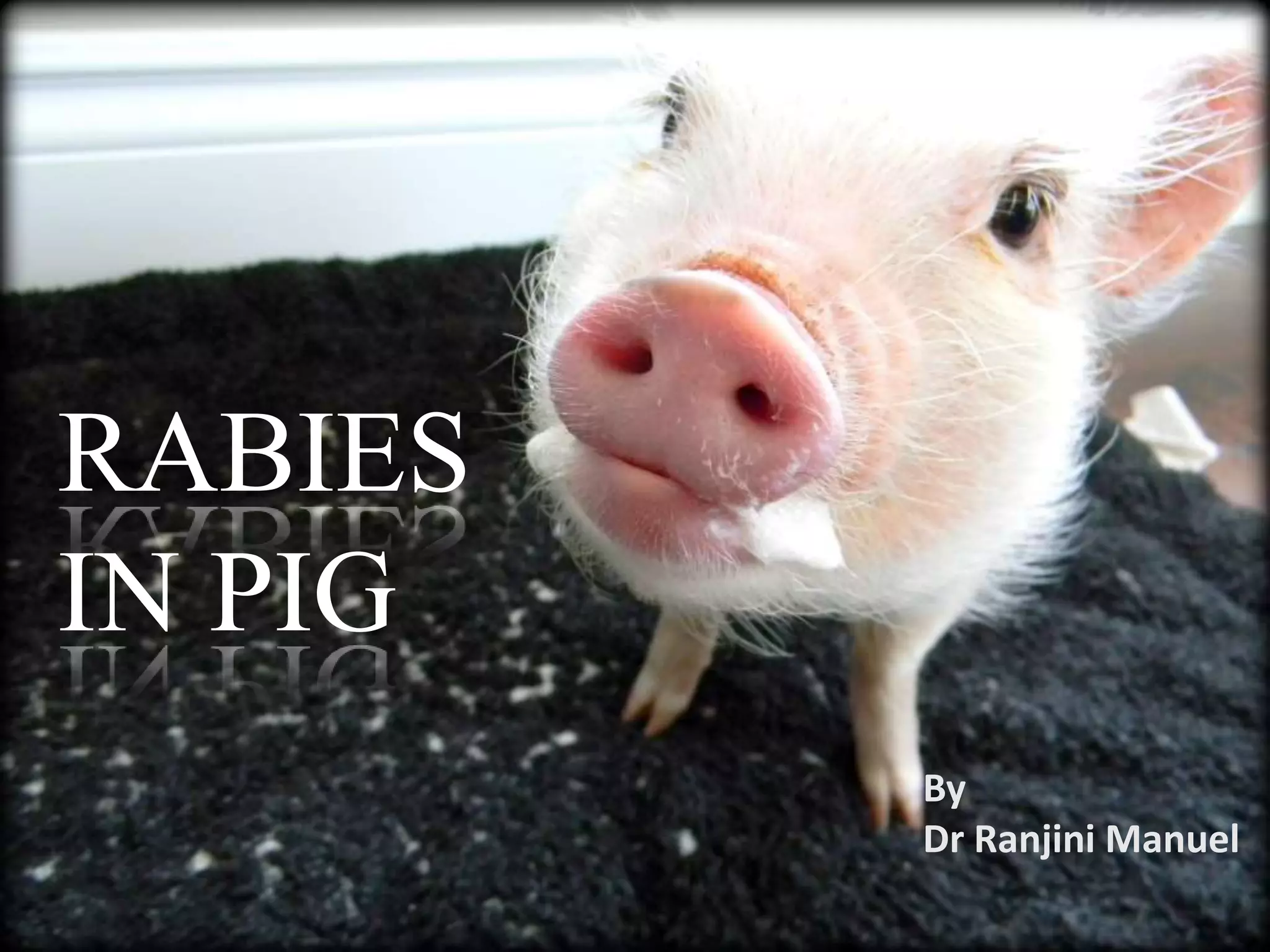
RABIES
IN PIG
By
Dr Ranjini Manuel
INTRODUCTION
All mammalian species are believed to be susceptible to
rabies virus, although some appear to require higher
infectious doses to develop clinical disease
Rare Reportable
Acute Lethal
Zoonotic
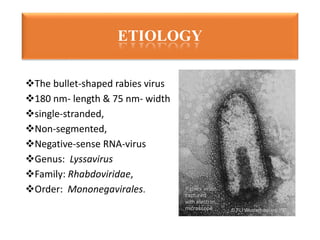
The bullet-shaped rabies virus
180 nm- length & 75 nm- width
single-stranded,
Non-segmented,
Negative-sense RNA-virus
Genus: Lyssavirus
Family: Rhabdoviridae,
Order: Mononegavirales.
ETIOLOGY
Twelve distinct lyssa virus species
can be distinguished within the
genus,
RABV is the most important one for
public and animal health
Lagos haven’t caused diseases or
death in humans
SPECIES
classical rabies virus (RABV),
Lagos bat virus (LBV),
Mokola virus (MOKV),
Duvenhage virus (DUVV),
European bat lyssaviruses type-1
(EBLV-1), (EBLV-2)
Australian bat lyssavirus (ABLV),
Aravan virus (ARAV),
Khujand virus (KHUV),
Irkut virus (IRKV),
West Caucasian bat virus (WCBV),
Shimoni bat virus (SHIBV).
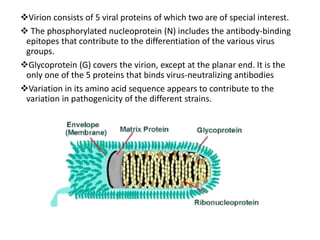
Virion consists of 5 viral proteins of which two are of special interest.
 The phosphorylated nucleoprotein (N) includes the antibody-binding
epitopes that contribute to the differentiation of the various virus
groups.
Glycoprotein (G) covers the virion, except at the planar end. It is the
only one of the 5 proteins that binds virus-neutralizing antibodies
Variation in its amino acid sequence appears to contribute to the
variation in pathogenicity of the different strains.
 Classic zoonotic infection, Recognized for over 4,000 years.
 Spread from animals (dogs, cats, foxes, bats, etc.) to human
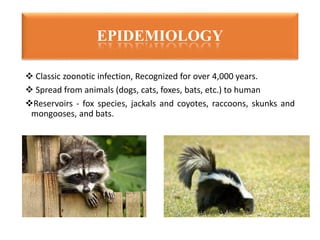
Reservoirs - fox species, jackals and coyotes, raccoons, skunks and
mongooses, and bats.
EPIDEMIOLOGY
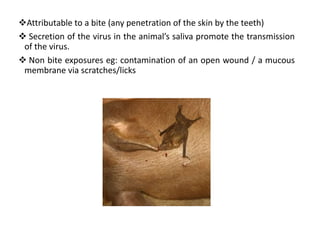
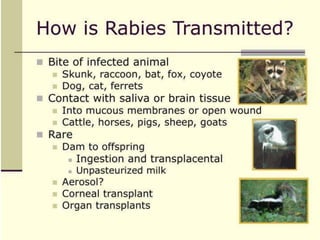
Attributable to a bite (any penetration of the skin by the teeth)
 Secretion of the virus in the animal’s saliva promote the transmission
of the virus.
 Non bite exposures eg: contamination of an open wound / a mucous
membrane via scratches/licks
Rabies virus propagates in two epidemiologic cycles.
 urban cycle, the street virus circulates in feral and domestic dogs
and still puts humans at great risk of exposure -developing countries.
In developed world -shift from urban-sylvatic cycle, in which
distinctive rabies virus variants circulate in specific wildlife reservoirs
within discrete geographic clusters.
EPIDEMIOLOGY
 Outbreak of swine rabies transmitted by a dog in China the main
clinical signs were aggressiveness and other neurological signs
 In USA, in 10 cases of rabies transmitted by wild animals, mainly
raccoons, mongoose and skunks, clinical signs were fever, aggression,
restlessness, anorexia, head rubbing, progressive paralysis,
depression, and vocalization.
 In Brazil there are several reports of identification of rabies virus in
swine but there are no reports on the epidemiology.
DISTRIBUTION
The incidence of rabies in swine in North America is low.
Two of 2601 rabies cases reported from 1998 through 2003 in Canada
(Canadian Food Inspection Agency 2004)
The geographic distribution of rabies is almost global,
 with the exception of island nations in the South Pacific (New Zealand
and others), where rabies has never been recorded.
 In Japan, the United Kingdom, Norway, and a few other countries,
rabies has been eradicated
The World Health Organization classifies a country as rabies-free if no
indigenous cases of rabies have been confirmed in any animal species
and humans during the previous 2 years
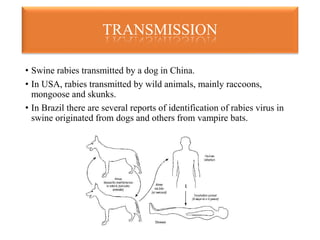
• Swine rabies transmitted by a dog in China.
• In USA, rabies transmitted by wild animals, mainly raccoons,
mongoose and skunks.
• In Brazil there are several reports of identification of rabies virus in
swine originated from dogs and others from vampire bats.
TRANSMISSION
 The incubation period -few days to several months.
The duration -depends on the virus strain, the site of the bite and
the amount of virus transmitted, and the age and immune status of
the bitten animal.
Rabies spread by infected saliva entering an open cut or wound, or
contacting a mucous membrane, such as those in the mouth, nasal
cavity or eyes.
Following an eclipse phase, in which virus replication occurs,
possibly in myocytes at the bite site, the virus migrates through the
axoplasm of the peripheral or cranial nerves to reach the CNS.
PATHOGENESIS
Once it’s in the brain it multiplies quickly, and that’s when clinical
signs appear
virus moves centrifugally into non-nervous tissues, including the
salivary glands and eyes. Virus may be shed in saliva of infected
animals prior to, at, or after onset of clinical disease (Rupprecht et al.
2002).
Once symptoms appear, rabies is always fatal.
The lag time between inoculation and neural invasion may be the
grace time during which post-exposure prophylactic treatment is
most likely to be effective (Acha and Szyfres 2003).
PATHOGENESIS
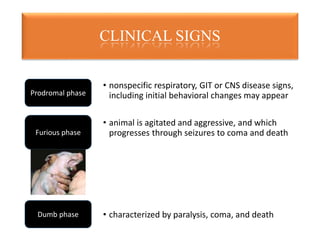
• nonspecific respiratory, GIT or CNS disease signs,
including initial behavioral changes may appear
• animal is agitated and aggressive, and which
progresses through seizures to coma and death
• characterized by paralysis, coma, and death
Prodromal phase
Furious phase
Dumb phase
CLINICAL SIGNS
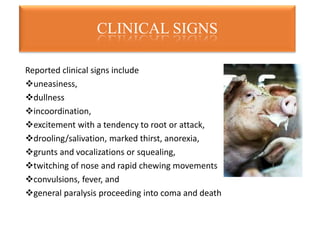
Reported clinical signs include
uneasiness,
dullness
incoordination,
excitement with a tendency to root or attack,
drooling/salivation, marked thirst, anorexia,
grunts and vocalizations or squealing,
twitching of nose and rapid chewing movements
convulsions, fever, and
general paralysis proceeding into coma and death
CLINICAL SIGNS
Post Mortem Diagnosis
(FAT) for rabies – gold standard test
Antigen may be detected in all parts of the CNS of infected animals,
in corneal impressions, and in skin biopsies
Test is the most sensitive -impression smears from the medulla
oblongata, cerebellum, and hippocampus (Ammon’s horn), in which
the greatest antigen quantities can be expected
False-negative FAT have been reported in swine in such cases rabies
can confirmed by mouse inoculation tests
DIAGNOSIS
Direct immunofluorescence testing
 ELISA
 PCR
Negri bodies, which are eosinophilic inclusions in the cytoplasm of
nerve cells and dendrites of infected animals, are frequently absent in
rabid swine
• In case of exposure, unvaccinated livestock should be slaughtered
immediately:
• “If the animal is slaughtered within 7 days of being bitten, its tissues
may be eaten without risk of infection, provided that liberal portions
of exposed area are discarded” (National Association of State Public
Health Veterinarians 2004).
PREVENTION & CONTROL
• Temperature: Does not survive for more than 24 hours in dead
animals when temperatures reach 21°C (70°F), but is highly resistant
for extended periods at low or freezing temperatures
• pH: Sensitive to very low pH (below 3) or very high pH (greater than
11)
• Chemicals/ Disinfectants: Inactivated by sodium hypochlorite, 45–
75% ethanol, iodine preparations, quaternary ammonium
compounds, formaldehyde, phenol, ether, trypsin, β-propiolactone,
and some other detergents
• Survival: Does not survive well outside its host (in dried blood and
secretions) as it is susceptible to sunlight and desiccation. It is also
susceptible to ultraviolet radiation
RESISTANCE TO PHYSICAL &
CHEMICALACTION
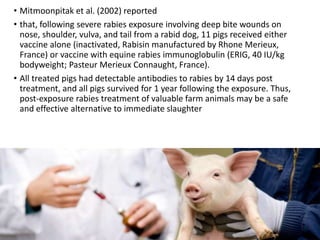
• Mitmoonpitak et al. (2002) reported
• that, following severe rabies exposure involving deep bite wounds on
nose, shoulder, vulva, and tail from a rabid dog, 11 pigs received either
vaccine alone (inactivated, Rabisin manufactured by Rhone Merieux,
France) or vaccine with equine rabies immunoglobulin (ERIG, 40 IU/kg
bodyweight; Pasteur Merieux Connaught, France).
• All treated pigs had detectable antibodies to rabies by 14 days post
treatment, and all pigs survived for 1 year following the exposure. Thus,
post-exposure rabies treatment of valuable farm animals may be a safe
and effective alternative to immediate slaughter
• Rabies vaccines are defined as a standardized formulation containing
defined amounts of immunogens. These immunogens are either
inactivated (killed), live-attenuated or biotechnology-derived.
• Live-attenuated vaccines have been widely used for injection in
domestic animals. However, several of these products have been
documented to cause rabies in vaccinated animals
• The rabies virus glycoprotein biotechnology-derived vector vaccines
are not live rabies virus vaccines. They are prepared by inserting non-
infectious rabies virus nucleic acid coding for rabies virus glycoprotein
into a vector.
PROPHYLAXIS
• Management control and prevention
• Since it is a zoonotic infection - the affected pig – isolation .
• Beware that other pigs may be incubating the disease. Inspect them all
frequently and if any behave suspiciously separate them
• Slaughtering of affected pigs
• In regions where rabies is common, farm staff and the farm dogs should
be vaccinated.
THANK YOU

Rabies in pigs

  • 1.
  • 2.
    INTRODUCTION All mammalian speciesare believed to be susceptible to rabies virus, although some appear to require higher infectious doses to develop clinical disease Rare Reportable Acute Lethal Zoonotic
  • 3.
    The bullet-shaped rabiesvirus 180 nm- length & 75 nm- width single-stranded, Non-segmented, Negative-sense RNA-virus Genus: Lyssavirus Family: Rhabdoviridae, Order: Mononegavirales. ETIOLOGY
  • 4.
    Twelve distinct lyssavirus species can be distinguished within the genus, RABV is the most important one for public and animal health Lagos haven’t caused diseases or death in humans SPECIES classical rabies virus (RABV), Lagos bat virus (LBV), Mokola virus (MOKV), Duvenhage virus (DUVV), European bat lyssaviruses type-1 (EBLV-1), (EBLV-2) Australian bat lyssavirus (ABLV), Aravan virus (ARAV), Khujand virus (KHUV), Irkut virus (IRKV), West Caucasian bat virus (WCBV), Shimoni bat virus (SHIBV).
  • 5.
    Virion consists of5 viral proteins of which two are of special interest.  The phosphorylated nucleoprotein (N) includes the antibody-binding epitopes that contribute to the differentiation of the various virus groups. Glycoprotein (G) covers the virion, except at the planar end. It is the only one of the 5 proteins that binds virus-neutralizing antibodies Variation in its amino acid sequence appears to contribute to the variation in pathogenicity of the different strains.
  • 6.
     Classic zoonoticinfection, Recognized for over 4,000 years.  Spread from animals (dogs, cats, foxes, bats, etc.) to human Reservoirs - fox species, jackals and coyotes, raccoons, skunks and mongooses, and bats. EPIDEMIOLOGY
  • 7.
    Attributable to abite (any penetration of the skin by the teeth)  Secretion of the virus in the animal’s saliva promote the transmission of the virus.  Non bite exposures eg: contamination of an open wound / a mucous membrane via scratches/licks
  • 8.
    Rabies virus propagatesin two epidemiologic cycles.  urban cycle, the street virus circulates in feral and domestic dogs and still puts humans at great risk of exposure -developing countries. In developed world -shift from urban-sylvatic cycle, in which distinctive rabies virus variants circulate in specific wildlife reservoirs within discrete geographic clusters. EPIDEMIOLOGY
  • 9.
     Outbreak ofswine rabies transmitted by a dog in China the main clinical signs were aggressiveness and other neurological signs  In USA, in 10 cases of rabies transmitted by wild animals, mainly raccoons, mongoose and skunks, clinical signs were fever, aggression, restlessness, anorexia, head rubbing, progressive paralysis, depression, and vocalization.  In Brazil there are several reports of identification of rabies virus in swine but there are no reports on the epidemiology. DISTRIBUTION
  • 10.
    The incidence ofrabies in swine in North America is low. Two of 2601 rabies cases reported from 1998 through 2003 in Canada (Canadian Food Inspection Agency 2004) The geographic distribution of rabies is almost global,  with the exception of island nations in the South Pacific (New Zealand and others), where rabies has never been recorded.  In Japan, the United Kingdom, Norway, and a few other countries, rabies has been eradicated The World Health Organization classifies a country as rabies-free if no indigenous cases of rabies have been confirmed in any animal species and humans during the previous 2 years
  • 12.
    • Swine rabiestransmitted by a dog in China. • In USA, rabies transmitted by wild animals, mainly raccoons, mongoose and skunks. • In Brazil there are several reports of identification of rabies virus in swine originated from dogs and others from vampire bats. TRANSMISSION
  • 13.
     The incubationperiod -few days to several months. The duration -depends on the virus strain, the site of the bite and the amount of virus transmitted, and the age and immune status of the bitten animal. Rabies spread by infected saliva entering an open cut or wound, or contacting a mucous membrane, such as those in the mouth, nasal cavity or eyes. Following an eclipse phase, in which virus replication occurs, possibly in myocytes at the bite site, the virus migrates through the axoplasm of the peripheral or cranial nerves to reach the CNS. PATHOGENESIS
  • 14.
    Once it’s inthe brain it multiplies quickly, and that’s when clinical signs appear virus moves centrifugally into non-nervous tissues, including the salivary glands and eyes. Virus may be shed in saliva of infected animals prior to, at, or after onset of clinical disease (Rupprecht et al. 2002). Once symptoms appear, rabies is always fatal. The lag time between inoculation and neural invasion may be the grace time during which post-exposure prophylactic treatment is most likely to be effective (Acha and Szyfres 2003). PATHOGENESIS
  • 15.
    • nonspecific respiratory,GIT or CNS disease signs, including initial behavioral changes may appear • animal is agitated and aggressive, and which progresses through seizures to coma and death • characterized by paralysis, coma, and death Prodromal phase Furious phase Dumb phase CLINICAL SIGNS
  • 16.
    Reported clinical signsinclude uneasiness, dullness incoordination, excitement with a tendency to root or attack, drooling/salivation, marked thirst, anorexia, grunts and vocalizations or squealing, twitching of nose and rapid chewing movements convulsions, fever, and general paralysis proceeding into coma and death CLINICAL SIGNS
  • 17.
    Post Mortem Diagnosis (FAT)for rabies – gold standard test Antigen may be detected in all parts of the CNS of infected animals, in corneal impressions, and in skin biopsies Test is the most sensitive -impression smears from the medulla oblongata, cerebellum, and hippocampus (Ammon’s horn), in which the greatest antigen quantities can be expected False-negative FAT have been reported in swine in such cases rabies can confirmed by mouse inoculation tests DIAGNOSIS
  • 18.
    Direct immunofluorescence testing ELISA  PCR Negri bodies, which are eosinophilic inclusions in the cytoplasm of nerve cells and dendrites of infected animals, are frequently absent in rabid swine
  • 19.
    • In caseof exposure, unvaccinated livestock should be slaughtered immediately: • “If the animal is slaughtered within 7 days of being bitten, its tissues may be eaten without risk of infection, provided that liberal portions of exposed area are discarded” (National Association of State Public Health Veterinarians 2004). PREVENTION & CONTROL
  • 20.
    • Temperature: Doesnot survive for more than 24 hours in dead animals when temperatures reach 21°C (70°F), but is highly resistant for extended periods at low or freezing temperatures • pH: Sensitive to very low pH (below 3) or very high pH (greater than 11) • Chemicals/ Disinfectants: Inactivated by sodium hypochlorite, 45– 75% ethanol, iodine preparations, quaternary ammonium compounds, formaldehyde, phenol, ether, trypsin, β-propiolactone, and some other detergents • Survival: Does not survive well outside its host (in dried blood and secretions) as it is susceptible to sunlight and desiccation. It is also susceptible to ultraviolet radiation RESISTANCE TO PHYSICAL & CHEMICALACTION
  • 21.
    • Mitmoonpitak etal. (2002) reported • that, following severe rabies exposure involving deep bite wounds on nose, shoulder, vulva, and tail from a rabid dog, 11 pigs received either vaccine alone (inactivated, Rabisin manufactured by Rhone Merieux, France) or vaccine with equine rabies immunoglobulin (ERIG, 40 IU/kg bodyweight; Pasteur Merieux Connaught, France). • All treated pigs had detectable antibodies to rabies by 14 days post treatment, and all pigs survived for 1 year following the exposure. Thus, post-exposure rabies treatment of valuable farm animals may be a safe and effective alternative to immediate slaughter
  • 22.
    • Rabies vaccinesare defined as a standardized formulation containing defined amounts of immunogens. These immunogens are either inactivated (killed), live-attenuated or biotechnology-derived. • Live-attenuated vaccines have been widely used for injection in domestic animals. However, several of these products have been documented to cause rabies in vaccinated animals • The rabies virus glycoprotein biotechnology-derived vector vaccines are not live rabies virus vaccines. They are prepared by inserting non- infectious rabies virus nucleic acid coding for rabies virus glycoprotein into a vector. PROPHYLAXIS
  • 23.
    • Management controland prevention • Since it is a zoonotic infection - the affected pig – isolation . • Beware that other pigs may be incubating the disease. Inspect them all frequently and if any behave suspiciously separate them • Slaughtering of affected pigs • In regions where rabies is common, farm staff and the farm dogs should be vaccinated.
  • 24.