

By,
Dr Ranjini Manuel
ETIOLOGY
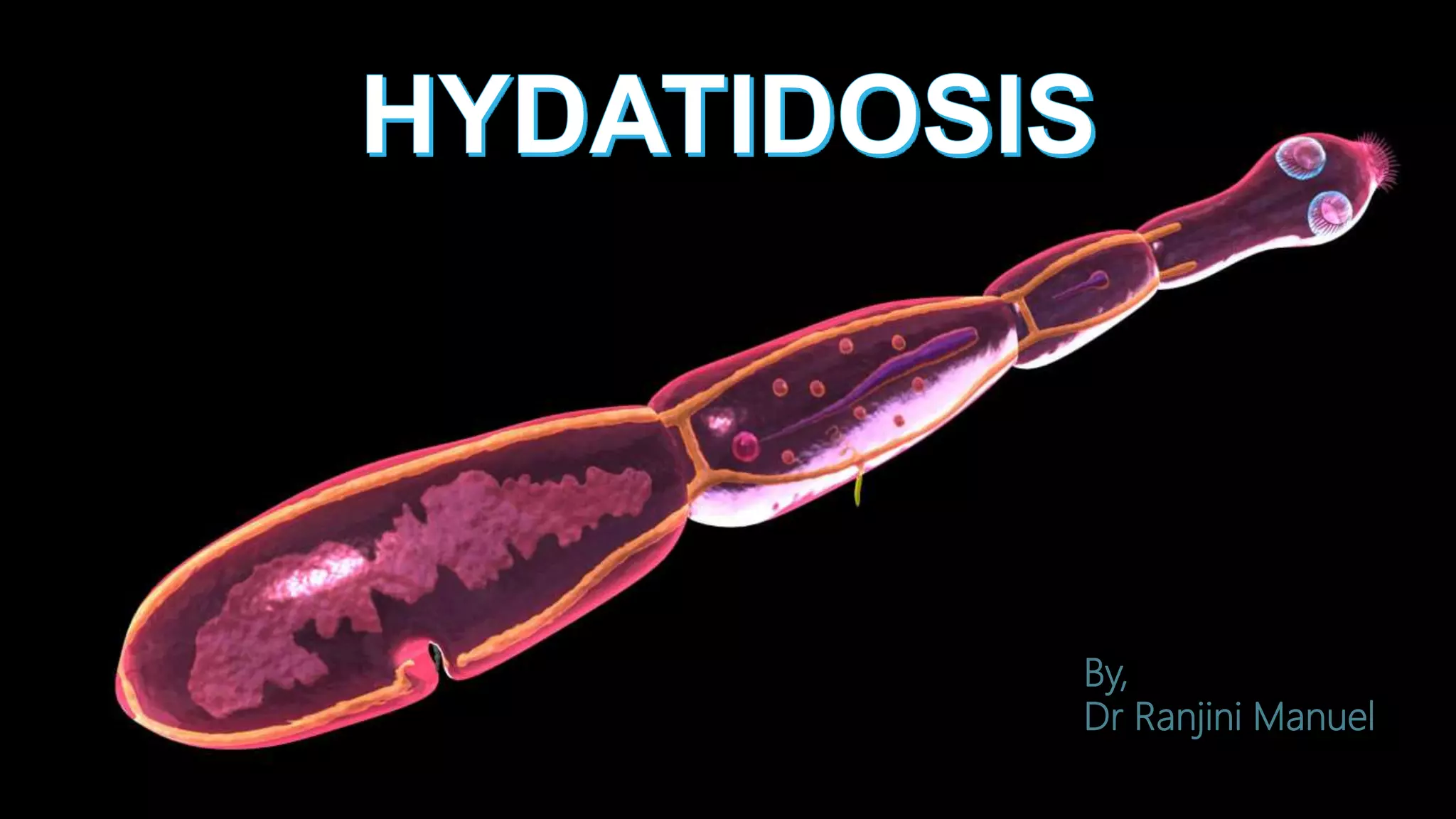
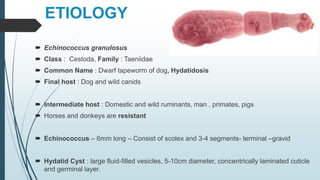
 Echinococcus granulosus
 Class : Cestoda, Family : Taeniidae
 Common Name : Dwarf tapeworm of dog, Hydatidosis
 Final host : Dog and wild canids
 Intermediate host : Domestic and wild ruminants, man , primates, pigs
 Horses and donkeys are resistant
 Echinococcus – 6mm long – Consist of scolex and 3-4 segments- terminal –gravid
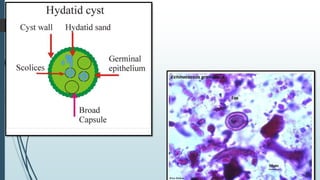
 Hydatid Cyst : large fluid-filled vesicles, 5-10cm diameter, concentrically laminated cuticle
and germinal layer.
EPIDEMIOLOGY
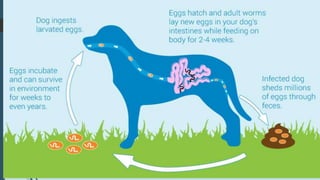
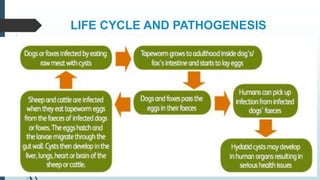
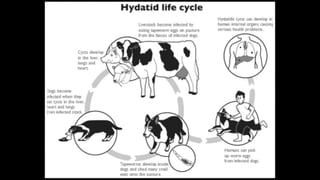
LIFE CYCLE AND PATHOGENESIS
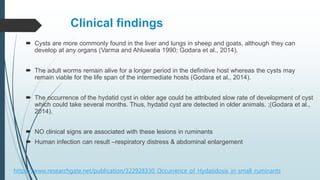
Clinical findings
 Cysts are more commonly found in the liver and lungs in sheep and goats, although they can
develop at any organs (Varma and Ahluwalia 1990; Godara et al., 2014).
 The adult worms remain alive for a longer period in the definitive host whereas the cysts may
remain viable for the life span of the intermediate hosts (Godara et al., 2014).
 The occurrence of the hydatid cyst in older age could be attributed slow rate of development of cyst
which could take several months. Thus, hydatid cyst are detected in older animals. ;(Godara et al.,
2014).
 NO clinical signs are associated with these lesions in ruminants
 Human infection can result –respiratory distress & abdominal enlargement
https://www.researchgate.net/publication/322928330_Occurrence_of_Hydatidosis_in_small_ruminants
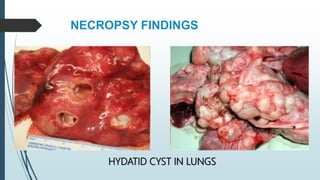
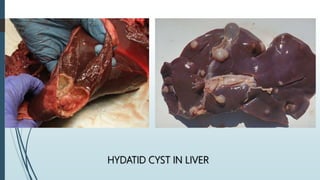
NECROPSY FINDINGS
HYDATID CYST IN LUNGS
HYDATID CYST IN LIVER
DIAGNOSIS
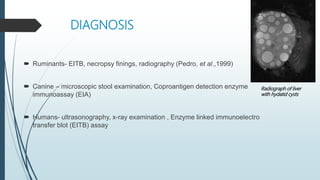
 Ruminants- EITB, necropsy finings, radiography (Pedro, et al.,1999)
 Canine – microscopic stool examination, Coproantigen detection enzyme
immunoassay (EIA)
 Humans- ultrasonography, x-ray examination , Enzyme linked immunoelectro
transfer blot (EITB) assay
Radiograph of liver
with hydatid cysts
remarks
 Evn if we ingest the vesicular fluid we wont infected – infective stage is the egg
with embryo . Highly protein rich fluid . Evn if scolices are ingested
 Sterile and non sterile fluid
 Cassoni test ?
CONTROL
• Regular treatment of dogs to eliminate adult
tapeworms
• Denying dogs access to abattoirs
• Proper disposal of infected carcass
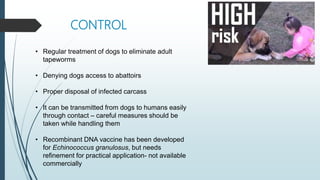
• It can be transmitted from dogs to humans easily
through contact – careful measures should be
taken while handling them
• Recombinant DNA vaccine has been developed
for Echinococcus granulosus, but needs
refinement for practical application- not available
commercially
Hydatidosis- Echinococcus granulosus

Hydatidosis- Echinococcus granulosus

  • 1.
  • 2.
    ETIOLOGY  Echinococcus granulosus Class : Cestoda, Family : Taeniidae  Common Name : Dwarf tapeworm of dog, Hydatidosis  Final host : Dog and wild canids  Intermediate host : Domestic and wild ruminants, man , primates, pigs  Horses and donkeys are resistant  Echinococcus – 6mm long – Consist of scolex and 3-4 segments- terminal –gravid  Hydatid Cyst : large fluid-filled vesicles, 5-10cm diameter, concentrically laminated cuticle and germinal layer.
  • 4.
  • 6.
    LIFE CYCLE ANDPATHOGENESIS
  • 8.
    Clinical findings  Cystsare more commonly found in the liver and lungs in sheep and goats, although they can develop at any organs (Varma and Ahluwalia 1990; Godara et al., 2014).  The adult worms remain alive for a longer period in the definitive host whereas the cysts may remain viable for the life span of the intermediate hosts (Godara et al., 2014).  The occurrence of the hydatid cyst in older age could be attributed slow rate of development of cyst which could take several months. Thus, hydatid cyst are detected in older animals. ;(Godara et al., 2014).  NO clinical signs are associated with these lesions in ruminants  Human infection can result –respiratory distress & abdominal enlargement https://www.researchgate.net/publication/322928330_Occurrence_of_Hydatidosis_in_small_ruminants
  • 9.
  • 10.
  • 11.
    DIAGNOSIS  Ruminants- EITB,necropsy finings, radiography (Pedro, et al.,1999)  Canine – microscopic stool examination, Coproantigen detection enzyme immunoassay (EIA)  Humans- ultrasonography, x-ray examination , Enzyme linked immunoelectro transfer blot (EITB) assay Radiograph of liver with hydatid cysts
  • 12.
    remarks  Evn ifwe ingest the vesicular fluid we wont infected – infective stage is the egg with embryo . Highly protein rich fluid . Evn if scolices are ingested  Sterile and non sterile fluid  Cassoni test ?
  • 13.
    CONTROL • Regular treatmentof dogs to eliminate adult tapeworms • Denying dogs access to abattoirs • Proper disposal of infected carcass • It can be transmitted from dogs to humans easily through contact – careful measures should be taken while handling them • Recombinant DNA vaccine has been developed for Echinococcus granulosus, but needs refinement for practical application- not available commercially