VETERINARY HELMINTHOLOGY
TAPEWORM/ CESTODES General Characteristics: 1. ribbon-like and dorsoventrally flattened 2. most of the show indirect types of life cycle. The exceptional type of life cycle is found in  Hymenolepis spp  where direct and indirect types are found.   3. they are hermaphrodite 4. cysts or bladderworms are intermediate or larval stage of the parasite 5. the final host gets infection by ingestion of intermediate host or flesh of intermediate host containing the bladder worms 6. the body can be divided into three broad parts
Head/ Scolex -very minute as compared to other parts -shape varies which may be roughly triangular,ball shaped or round -there is presence of sucker (armed or unarmed ) which is not used for taking food but used as apertures for attachment -anteriorly there is structure called rostellum Neck -immediately behind the head and without any segment -segmentation starts here Body  -area is completely segmented
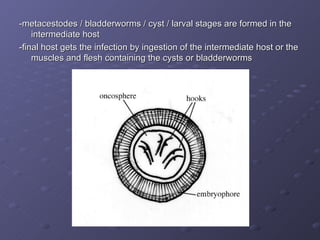
Three types of segments are present: IMMATURE- the reproductive system and eggs are absent MATURE- completely developed reproductive system  GRAVID- reproductive system is replaced by the eggs  - either detached from the parasite or its disintegrated and the eggs are expelled out Eggs: -have basic structure comprising oncosphere or hexacanth embryo, a striated shell or embryophore and a delicate membrane -the following are the events which occur during biological development: a.  Eggs are expelled out from the gravid segment b. the eggs are ingested by the intermediate hosts and hatching occurs in the intermediate host or hatch in the environment  ( Cotyloda)
-metacestodes / bladderworms / cyst / larval stages are formed in the intermediate host -final host gets the infection by ingestion of the intermediate host or the muscles and flesh containing the cysts or bladderworms
Poultry Tapeworm Genus Raillietina - small to medium-sized tapeworm that inhabit the small intestine  -cosmopolitan in distribution Species: R. cesticillus  R. demerariensis R. echidnobothrida R. tetragona R. asiatica R. celebensis
R. cesticillus Morphology: 1. smaller (4-15 cm) than R. tetragona, R. echidnobothrida 2. broad rostellum which is armed with 400-500 hooks 3. circular sucker is unarmed 4. egg capsule contains single egg R. echidnobothrida Morphology 1. size is 8.5-22 cm 2. suckers are circular and surrounded by several rows of hooks 3. rostellum is very small 4. egg capsule contains multiple eggs
R. tetragona 1. 25 cm long and largest tapeworm in poultry 2. rostellum is small and possesses one or two rows of hooks  3. egg capsule contains multiple eggs 4. sucker is oval and surrounded by several rows of hooks LIFE CYLCE: egg oncosphere cysticercoid ( infective stage ) adult Ants and Musca domestica acts as IH of R. tetragona and R. echidnobothrida. The beetle acts as IH for R. cesticillus
Pathogenesis: 1. nodule formation in the intestine by R. echidnobothrida 2. enteritis by R. tetragona and R. cesticillus Genus Davainea D. proglottina D. meleagridis Morphology 1. very small only several mm that’s why it is advised to take mucosal scraping for its detection 2. has prominent rostellum armed with hammer-shaped hooks 3. presence of single set of reproductive organ which alternates regularly 4. has 4-9 segments 5. egg capsule contains single egg
Life cycle: Egg Oncosphere Cysticercoid in IH ( infective stage on ants or slugs ) Adult The gravid segments crawl out of the host. The gravid segments are actively motile and crawl onto the grass blade due to its phototactic nature. The eggs are released during the act of crawling. The eggs hatch after ingested by IH and cysticercoid is formed within a month. The final host gets the infection when the infected snails are ingested by the birds.
Family Dipyliidae: Dipylidium caninum- double pored tapeworm of dogs Morphology: 1. head or scolex is pyriform in shaped having hooks characteristically rose-thorn shaped 2. presence of two sets of reproductive system like Moniezia spp 3. mature segments are cucumber seed shape LIFE CYCLE: egg onchosphere cystercercoid in IH ( flea C. canis, C. felis, T. canis, Pulex spp ) adult
Gravid segments get detached from the adult tapeworm and crawl. During crawling the eggs are released from the gravid segment. The IH ingest the eggs and hatched in the gut and oncospheres are released and these migrate in the body cavity. A cysticercoid with tail appendage is formed within few weeks. Final host gets the infection by ingestion of the infected IH. Pathogenesis: 1. sloughing, denudation of mucosa 2. constant irritation of the anal sac resulting to anal pruritus 3. intoxication due to absorption of the metabolites released by the parasites which affects the nervous system Diagnosis: 1. examination of fecal sample 2. dragging anus over the ground or any hard objects
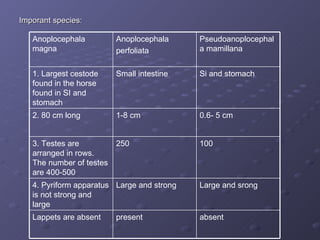
Family Anoplocephalidae:  common cestodes of equine Morphology: 1. rostellum and hooks are present  2. segments are noticeably broad\ 3. presence of egg capsule or paruterine organ 4. eggs have 3 coverings; the outermost formed by the vitelline gland,  middle albuminous and inner chitinous 5. eggs of many members bear a pear shaped structure called pyriform apparatus Genera: Anoplocephala  Moniezia Paranocephala  Cittotaenia Pseudanocephala
Imporant species: absent present Lappets are absent Large and srong Large and strong 4. Pyriform apparatus is not strong and large  100 250  3. Testes are arranged in rows. The number of testes are 400-500 0.6- 5 cm 1-8 cm  2. 80 cm long Si and stomach Small intestine 1. Largest cestode found in the horse found in SI and stomach Pseudoanoplocephala mamillana Anoplocephala perfoliata Anoplocephala magna
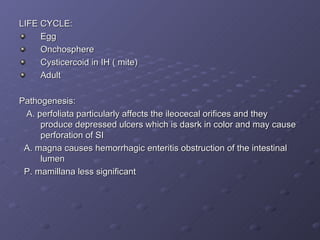
LIFE CYCLE: Egg Onchosphere Cysticercoid in IH ( mite) Adult Pathogenesis: A. perfoliata particularly affects the ileocecal orifices and they produce depressed ulcers which is dasrk in color and may cause perforation of SI A. magna causes hemorrhagic enteritis obstruction of the intestinal lumen P. mamillana less significant
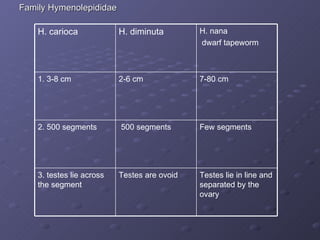
Family Hymenolepididae Testes lie in line and separated by the ovary Testes are ovoid 3. testes lie across the segment Few segments 500 segments 2. 500 segments 7-80 cm 2-6 cm 1. 3-8 cm H. nana dwarf tapeworm H. diminuta H. carioca
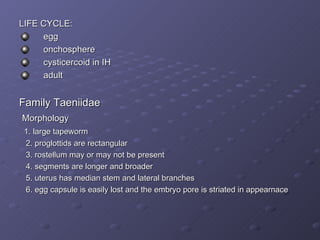
LIFE CYCLE: egg onchosphere cysticercoid in IH adult Family Taeniidae Morphology 1. large tapeworm 2. proglottids are rectangular 3. rostellum may or may not be present 4. segments are longer and broader 5. uterus has median stem and lateral branches 6. egg capsule is easily lost and the embryo pore is striated in appearnace
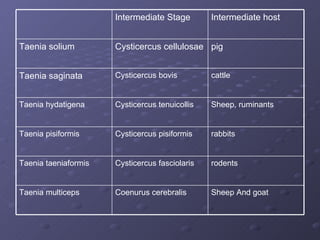
Sheep And goat Coenurus cerebralis Taenia multiceps rodents Cysticercus fasciolaris Taenia taeniaformis rabbits Cysticercus pisiformis Taenia pisiformis Sheep, ruminants Cysticercus tenuicollis Taenia hydatigena cattle Cysticercus bovis Taenia saginata pig Cysticercus cellulosae Taenia solium Intermediate host Intermediate Stage
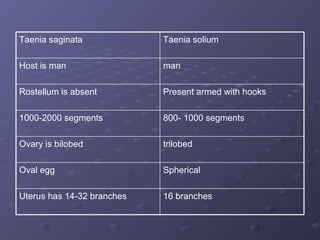
16 branches Uterus has 14-32 branches Spherical  Oval egg trilobed Ovary is bilobed 800- 1000 segments 1000-2000 segments Present armed with hooks Rostellum is absent  man Host is man Taenia solium Taenia saginata
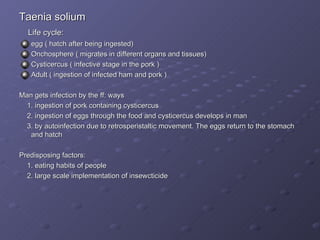
Taenia solium Life cycle: egg ( hatch after being ingested) Onchosphere ( migrates in different organs and tissues) Cysticercus ( infective stage in the pork ) Adult ( ingestion of infected ham and pork ) Man gets infection by the ff: ways 1. ingestion of pork containing cysticercus 2. ingestion of eggs through the food and cysticercus develops in man 3. by autoinfection due to retrosperistaltic movement. The eggs return to the stomach and hatch Predisposing factors: 1. eating habits of people 2. large scale implementation of insewcticide
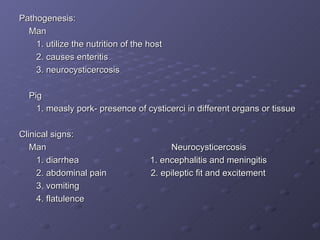
Pathogenesis: Man 1. utilize the nutrition of the host  2. causes enteritis 3. neurocysticercosis Pig 1. measly pork- presence of cysticerci in different organs or tissue Clinical signs: Man  Neurocysticercosis 1. diarrhea  1. encephalitis and meningitis 2. abdominal pain  2. epileptic fit and excitement 3. vomiting 4. flatulence
Taenia multiceps Life cycle: egg Onchosphere Coenurus ( infective stage in the brain of sheep and goat ) Adult Pathogenesis: Migratory onchospheres care dangerous in the sheep. This causes meningitis and encephalitis  Gradually the cyst creates pressure in the brain as per the advancement of development of cyst. The brain muscles get atrophied The skull gets atrophied and ultimately maybe soft and easily felt when touching Aside from brain several nerves are also affected ( ocular, auditory )
Clinical signs: 1. the animal looses the condition and fails to respond to the environment 2. circling movement ( gid ) is an important sign 3. sometimes the animals move in straight and keep its head on the hard surface Genus Echinicoccus E. granulosus  E.  vogeli E. multilocularis E. oligarthus Morphology: 1. very small only few segments are present 2. terminal segment is the gravid segment 3. scolex has the rostellum which is armed with hooks 4. ovary is kidney shaped
Life cycle: egg onchosphere  hydatid cyst in IH adult Pathogenesis: 1. enteritis 2. pressure atrophy in the vital organs due to pressure of large- sized cyst 3. functional disturbance Diagnosis: 1. examination of feces 2. detection of cysticercus in the tongue and other palpable areas 3. Casonis Test- hydatid fluid is inoculated in the suspected individual and there would be hypersensitive reaction within 15 mins or less in positive cases
Family Mesocestoididae: Genus Mesocestoides  M. lineatus  M. jonesi M. variabilis M. tenuis Morphology: 1. head or scolex is devoid of rostellum and hooks 2. presence of single set of reproductive system 3. genital pore is dorsally situated 4. bilobed ovary and vitelline glands 5. testes are situated on either side of the excretory canal DH- dog, fox, cat IH- 1 st  – mites 2 nd  - birds
Developmental stages: egg onchosphere cysticercoid in IH tetrathyridium in birds, lizards, snakes adult *M. corti can asexually multiply in the IH and DH Pathogenesis: 1. enteritis 2. nervous disorder 3. anal priritus
Genus Diphyllobothrium Species: D. latum D. mansonoides Morphology: 1. long and maybe reaching up to several meters 2. thousands of segments are presents 3. head is spatula shaped with a deep groove in the middle called bothria 4. no rostellum 5. genital organs are situated mid-ventrally  6. eggs are oval and operculated and have fair resemblance to trematodes 7. ovary is bilobed and uterus is rosette-shaped
Life cycle: Egg Ciliated coracidium Procercoid (cyclops) Plerocercoid (fish) Adult Pathogenesis 1. enteritis  2. anemia ( B12 def. or Pernicious anemia ) 3. anal pruritus 4. epileptic fit

Veterinary Helminthology

  • 1.
  • 2.
    TAPEWORM/ CESTODES GeneralCharacteristics: 1. ribbon-like and dorsoventrally flattened 2. most of the show indirect types of life cycle. The exceptional type of life cycle is found in Hymenolepis spp where direct and indirect types are found. 3. they are hermaphrodite 4. cysts or bladderworms are intermediate or larval stage of the parasite 5. the final host gets infection by ingestion of intermediate host or flesh of intermediate host containing the bladder worms 6. the body can be divided into three broad parts
  • 3.
    Head/ Scolex -veryminute as compared to other parts -shape varies which may be roughly triangular,ball shaped or round -there is presence of sucker (armed or unarmed ) which is not used for taking food but used as apertures for attachment -anteriorly there is structure called rostellum Neck -immediately behind the head and without any segment -segmentation starts here Body -area is completely segmented
  • 4.
    Three types ofsegments are present: IMMATURE- the reproductive system and eggs are absent MATURE- completely developed reproductive system GRAVID- reproductive system is replaced by the eggs - either detached from the parasite or its disintegrated and the eggs are expelled out Eggs: -have basic structure comprising oncosphere or hexacanth embryo, a striated shell or embryophore and a delicate membrane -the following are the events which occur during biological development: a. Eggs are expelled out from the gravid segment b. the eggs are ingested by the intermediate hosts and hatching occurs in the intermediate host or hatch in the environment ( Cotyloda)
  • 5.
    -metacestodes / bladderworms/ cyst / larval stages are formed in the intermediate host -final host gets the infection by ingestion of the intermediate host or the muscles and flesh containing the cysts or bladderworms
  • 6.
    Poultry Tapeworm GenusRaillietina - small to medium-sized tapeworm that inhabit the small intestine -cosmopolitan in distribution Species: R. cesticillus R. demerariensis R. echidnobothrida R. tetragona R. asiatica R. celebensis
  • 7.
    R. cesticillus Morphology:1. smaller (4-15 cm) than R. tetragona, R. echidnobothrida 2. broad rostellum which is armed with 400-500 hooks 3. circular sucker is unarmed 4. egg capsule contains single egg R. echidnobothrida Morphology 1. size is 8.5-22 cm 2. suckers are circular and surrounded by several rows of hooks 3. rostellum is very small 4. egg capsule contains multiple eggs
  • 8.
    R. tetragona 1.25 cm long and largest tapeworm in poultry 2. rostellum is small and possesses one or two rows of hooks 3. egg capsule contains multiple eggs 4. sucker is oval and surrounded by several rows of hooks LIFE CYLCE: egg oncosphere cysticercoid ( infective stage ) adult Ants and Musca domestica acts as IH of R. tetragona and R. echidnobothrida. The beetle acts as IH for R. cesticillus
  • 9.
    Pathogenesis: 1. noduleformation in the intestine by R. echidnobothrida 2. enteritis by R. tetragona and R. cesticillus Genus Davainea D. proglottina D. meleagridis Morphology 1. very small only several mm that’s why it is advised to take mucosal scraping for its detection 2. has prominent rostellum armed with hammer-shaped hooks 3. presence of single set of reproductive organ which alternates regularly 4. has 4-9 segments 5. egg capsule contains single egg
  • 10.
    Life cycle: EggOncosphere Cysticercoid in IH ( infective stage on ants or slugs ) Adult The gravid segments crawl out of the host. The gravid segments are actively motile and crawl onto the grass blade due to its phototactic nature. The eggs are released during the act of crawling. The eggs hatch after ingested by IH and cysticercoid is formed within a month. The final host gets the infection when the infected snails are ingested by the birds.
  • 11.
    Family Dipyliidae: Dipylidiumcaninum- double pored tapeworm of dogs Morphology: 1. head or scolex is pyriform in shaped having hooks characteristically rose-thorn shaped 2. presence of two sets of reproductive system like Moniezia spp 3. mature segments are cucumber seed shape LIFE CYCLE: egg onchosphere cystercercoid in IH ( flea C. canis, C. felis, T. canis, Pulex spp ) adult
  • 12.
    Gravid segments getdetached from the adult tapeworm and crawl. During crawling the eggs are released from the gravid segment. The IH ingest the eggs and hatched in the gut and oncospheres are released and these migrate in the body cavity. A cysticercoid with tail appendage is formed within few weeks. Final host gets the infection by ingestion of the infected IH. Pathogenesis: 1. sloughing, denudation of mucosa 2. constant irritation of the anal sac resulting to anal pruritus 3. intoxication due to absorption of the metabolites released by the parasites which affects the nervous system Diagnosis: 1. examination of fecal sample 2. dragging anus over the ground or any hard objects
  • 13.
    Family Anoplocephalidae: common cestodes of equine Morphology: 1. rostellum and hooks are present 2. segments are noticeably broad\ 3. presence of egg capsule or paruterine organ 4. eggs have 3 coverings; the outermost formed by the vitelline gland, middle albuminous and inner chitinous 5. eggs of many members bear a pear shaped structure called pyriform apparatus Genera: Anoplocephala Moniezia Paranocephala Cittotaenia Pseudanocephala
  • 14.
    Imporant species: absentpresent Lappets are absent Large and srong Large and strong 4. Pyriform apparatus is not strong and large 100 250 3. Testes are arranged in rows. The number of testes are 400-500 0.6- 5 cm 1-8 cm 2. 80 cm long Si and stomach Small intestine 1. Largest cestode found in the horse found in SI and stomach Pseudoanoplocephala mamillana Anoplocephala perfoliata Anoplocephala magna
  • 15.
    LIFE CYCLE: EggOnchosphere Cysticercoid in IH ( mite) Adult Pathogenesis: A. perfoliata particularly affects the ileocecal orifices and they produce depressed ulcers which is dasrk in color and may cause perforation of SI A. magna causes hemorrhagic enteritis obstruction of the intestinal lumen P. mamillana less significant
  • 16.
    Family Hymenolepididae Testeslie in line and separated by the ovary Testes are ovoid 3. testes lie across the segment Few segments 500 segments 2. 500 segments 7-80 cm 2-6 cm 1. 3-8 cm H. nana dwarf tapeworm H. diminuta H. carioca
  • 17.
    LIFE CYCLE: eggonchosphere cysticercoid in IH adult Family Taeniidae Morphology 1. large tapeworm 2. proglottids are rectangular 3. rostellum may or may not be present 4. segments are longer and broader 5. uterus has median stem and lateral branches 6. egg capsule is easily lost and the embryo pore is striated in appearnace
  • 18.
    Sheep And goatCoenurus cerebralis Taenia multiceps rodents Cysticercus fasciolaris Taenia taeniaformis rabbits Cysticercus pisiformis Taenia pisiformis Sheep, ruminants Cysticercus tenuicollis Taenia hydatigena cattle Cysticercus bovis Taenia saginata pig Cysticercus cellulosae Taenia solium Intermediate host Intermediate Stage
  • 19.
    16 branches Uterushas 14-32 branches Spherical Oval egg trilobed Ovary is bilobed 800- 1000 segments 1000-2000 segments Present armed with hooks Rostellum is absent man Host is man Taenia solium Taenia saginata
  • 20.
    Taenia solium Lifecycle: egg ( hatch after being ingested) Onchosphere ( migrates in different organs and tissues) Cysticercus ( infective stage in the pork ) Adult ( ingestion of infected ham and pork ) Man gets infection by the ff: ways 1. ingestion of pork containing cysticercus 2. ingestion of eggs through the food and cysticercus develops in man 3. by autoinfection due to retrosperistaltic movement. The eggs return to the stomach and hatch Predisposing factors: 1. eating habits of people 2. large scale implementation of insewcticide
  • 21.
    Pathogenesis: Man 1.utilize the nutrition of the host 2. causes enteritis 3. neurocysticercosis Pig 1. measly pork- presence of cysticerci in different organs or tissue Clinical signs: Man Neurocysticercosis 1. diarrhea 1. encephalitis and meningitis 2. abdominal pain 2. epileptic fit and excitement 3. vomiting 4. flatulence
  • 22.
    Taenia multiceps Lifecycle: egg Onchosphere Coenurus ( infective stage in the brain of sheep and goat ) Adult Pathogenesis: Migratory onchospheres care dangerous in the sheep. This causes meningitis and encephalitis Gradually the cyst creates pressure in the brain as per the advancement of development of cyst. The brain muscles get atrophied The skull gets atrophied and ultimately maybe soft and easily felt when touching Aside from brain several nerves are also affected ( ocular, auditory )
  • 23.
    Clinical signs: 1.the animal looses the condition and fails to respond to the environment 2. circling movement ( gid ) is an important sign 3. sometimes the animals move in straight and keep its head on the hard surface Genus Echinicoccus E. granulosus E. vogeli E. multilocularis E. oligarthus Morphology: 1. very small only few segments are present 2. terminal segment is the gravid segment 3. scolex has the rostellum which is armed with hooks 4. ovary is kidney shaped
  • 24.
    Life cycle: eggonchosphere hydatid cyst in IH adult Pathogenesis: 1. enteritis 2. pressure atrophy in the vital organs due to pressure of large- sized cyst 3. functional disturbance Diagnosis: 1. examination of feces 2. detection of cysticercus in the tongue and other palpable areas 3. Casonis Test- hydatid fluid is inoculated in the suspected individual and there would be hypersensitive reaction within 15 mins or less in positive cases
  • 25.
    Family Mesocestoididae: GenusMesocestoides M. lineatus M. jonesi M. variabilis M. tenuis Morphology: 1. head or scolex is devoid of rostellum and hooks 2. presence of single set of reproductive system 3. genital pore is dorsally situated 4. bilobed ovary and vitelline glands 5. testes are situated on either side of the excretory canal DH- dog, fox, cat IH- 1 st – mites 2 nd - birds
  • 26.
    Developmental stages: eggonchosphere cysticercoid in IH tetrathyridium in birds, lizards, snakes adult *M. corti can asexually multiply in the IH and DH Pathogenesis: 1. enteritis 2. nervous disorder 3. anal priritus
  • 27.
    Genus Diphyllobothrium Species:D. latum D. mansonoides Morphology: 1. long and maybe reaching up to several meters 2. thousands of segments are presents 3. head is spatula shaped with a deep groove in the middle called bothria 4. no rostellum 5. genital organs are situated mid-ventrally 6. eggs are oval and operculated and have fair resemblance to trematodes 7. ovary is bilobed and uterus is rosette-shaped
  • 28.
    Life cycle: EggCiliated coracidium Procercoid (cyclops) Plerocercoid (fish) Adult Pathogenesis 1. enteritis 2. anemia ( B12 def. or Pernicious anemia ) 3. anal pruritus 4. epileptic fit