CODE DIVISION DUPLEXINGCODE DIVISION DUPLEXING
Under the esteemed guidance of
Smt.V.LAVANYA,M.Tech
Assistant Professor
Presented by
M.BHARATHI DEVI
(09331A0469)
Topics to be coveredTopics to be covered
INTRODUCTION
CDMA
FDD
TDD
CDD
SMART CODES
LAS _CDMA
1.Access codes in traditional CDMA and
LAS-CDMA
Topics to be CoveredTopics to be Covered
Generation of LAS-Codes
Perspectives of LAS-CDMA for the 4G
wireless systems
CDD-A New Milestone
CONCLUSION
References
IntroductionIntroduction
Reducing interference in a cellular system
is the most effective approach to
increasing radio capacity and transmission
data rate in the wireless environment.
Therefore, reducing interference is a
difficult and important challenge in
wireless communications.
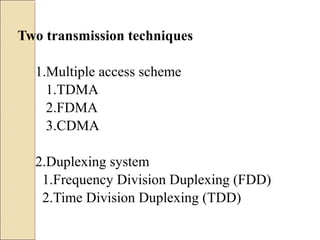
Two transmission techniques
1.Multiple access scheme
1.TDMA
2.FDMA
3.CDMA
2.Duplexing system
1.Frequency Division Duplexing (FDD)
2.Time Division Duplexing (TDD)
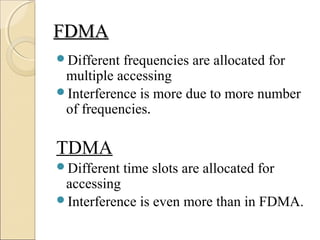
FDMAFDMA
Different frequencies are allocated for
multiple accessing
Interference is more due to more number
of frequencies.
TDMA
Different time slots are allocated for
accessing
Interference is even more than in FDMA.
CDMACDMA
CDMA is the best multiple access scheme
when compared to all others for combating
interference.
Codes in CDMA can be more than one
type of code.
A set of smart codes can make a high-
capacity CDMA system very effective
without adding other technologies.
Traditional CDMA systems are all self-
interference system.
FDDFDD
Uses different frequencies to handle
incoming and outgoing signals.
Currently, all cellular systems use
frequency-division duplexing in an
attempt to eliminate interference from
adjacent cells.
TDDTDD
Uses a single frequency but different time
slots to handle incoming and outgoing
signals.
 TDD can only be used for small confined
area systems.
TDD is not used for mobile systems.
CDDCDD
Code-division duplexing is an innovative
solution that can eliminate all kinds of
interference.
Eliminating all types of interference
makes CDD the most spectrum efficient
duplexing system.
The smart code plus TDD is called CDD.
What type of codes are to be used inWhat type of codes are to be used in
CDD?CDD?
Walsh codes are used in CDMA,which are not
to smart.
Walsh codes are orthogonal in nature i.e., they
arrive at different times.
Thus, smart codes are efficient to be used.
What are smart codes?What are smart codes?
The codes which satisfy the following
properties are called smart codes:
Auto-correlation
Rxx (τ) = 0 for τ = 0
δ for τ ≠ 0, within window τ0
 Cross-correlation
Rxy (τ) = δ for all τ, within window τ0
Where τ0 is a correlation window, δ can be
zero or low correlation value.
How do smart codes reduceHow do smart codes reduce
interference?interference?
Smart code sequences have two properties:
1.Auto-correlation equals zero, which causes no
multipath interference.
2.Cross-correlation equals zero, which causes no
multi-user interference.
LAS CDMALAS CDMA
The LAS- CDMA utilizes the LAS codes
which are a set of smart codes.
The spreading sequences exhibit zero
correlation values, when the relative delay-
induced code offset is in the so-called Zero
Correlation Zone (ZCZ) or Interference Free
Window (IFW) of the spreading code.

This family is constituted by the combination of the
so-called Large Area (LA) codes and Loosely
Synchronous (LS) codes.
The disadvantage of LAS codes is that the number of
codes having an IFW is limited.
When the LAS CDMA system operates in an
asynchronous manner, it encounters a more serious
MAI and Multipath Interference (MPI) than
traditional CDMA.
-20 -10 0 10 20
τ
τ
G-1/2
G – Processing Gain
0
G-1/2
Auto-Correlation
Cross-Correlation
Relative delay
Multiple Access Codes Correlations of Traditional CDMA
• Auto-correlation:
• Cross-correlations: (Relative delay)
τ
0
τ
IFW
IFW: Interference
Free Window
a
b
τ
0
0
0
0
0
0
τ
Multiple Access Codes Correlations of LAS-CDMA
LAS CDMA continued…LAS CDMA continued…
LAS-CDMA introduces a novel multiple
access scheme, based on two families of
CDMA codes, LA codes and LS codes.
LA codes are a family of pulse train with
carefully designed pulse intervals.
LA codes are mainly used to reduce the ACI
(Adjacent Cell Interference).
LAS CDMALAS CDMA
The pulses of LA code are formed by
passing through a LS code to its matched
filter at the required pulse positions.
LS codes are used for spreading.
 The family of LS codes has interesting
correlation properties.
Generation of LAS-CodesGeneration of LAS-Codes
LA Codes
LA codes belong to a family of ternary
codes having elements of ±1 or 0.
Their maximum correlation magnitude is
unity and they also exhibit an IFW.
DRAWBACK OF LA CODESDRAWBACK OF LA CODES
 A specific drawback of this family of
sequences is their relatively low duty ratio,
quantifying the density of the non-zero pulses,
since this limits the number of codes available
and hence the number of users supported.
Loosely Synchronized (LS) CodesLoosely Synchronized (LS) Codes
Loosely Synchronized (LS) codes exploit the
properties of the so-called orthogonal
complementary sets.
Seeding LS Codes in LA Codes toSeeding LS Codes in LA Codes to
Generate LAS codesGenerate LAS codes
The main problems associated with applying
LA codes in practical CDMA systems are
related to their low duty ratio and to the
resultant small number of available codes.
A specific family of LAS codes mitigates this
problem by combining the LA codes and the
LS codes.
Perspectives of LAS-CDMA for thePerspectives of LAS-CDMA for the
4G wireless systems4G wireless systems
Due to the existence of IFW, LAS-CDMA
may have a much smaller interference level
than traditional CDMA.
 Consequently, LAS-CDMA system may have
a much higher capacity as well as a higher
spectral efficiency than a traditional CDMA.
According to the basic multi-user
information theory, the optimum way to
share (not to distribute) a channel capacity is
the “Waveform Division” Multiple Access
or CDMA technology.
However, since traditional CDMA is a self-
interference limited, that would drastically
limit its capacity, in studying 4G systems,
many people focus their attention on
OFDM/OFDMA technology, space-time
coding for MIMO channels etc…
CDD-A New MilestoneCDD-A New Milestone
1.CDD Technology Is A New Milestone From
FDD Systems To CDD Systems.
Cellular technology before 1989 utilized
frequency reuse in FDMA and TDMA
networks.
After 1989, CDMA was a breakthrough
technology for maintaining the same
frequency being used in all the cells.
The LAS smart codes are the next
breakthrough technology.
 Applying LAS technology to a TDD system
becomes a CDD system.
Without the sending and receiving occurring
at the same time we can use the same smart
code for both sending and receiving; thus,
LAS + TDD = CDD. CDD is no more like
TDD and is a better system for cellular.
2.Reduce Interference-Limited Environment
To Noise-Limited Environment
Before 1989, cellular systems were using
multiple cells with multiple frequencies
assigned in each cell.
These systems generate an interference-
limited environment.
After 1989, multiple cells used the same
frequency. Although the capacity increased
using CDMA, the system is still in an
interference-limited environment.
CONCLUSIONCONCLUSION
CDMA is the best multiple access scheme
when compared to all others for combating
interference.
A set of smart codes can make a high-
capacity CDMA system very effective
without adding other technologies.
 A CDD system is simpler in design and
lower cost.
REFERENCESREFERENCES
www.techalone.com
www.seminars101.com
THANK YOU

Code division Duplexing

  • 1.
    CODE DIVISION DUPLEXINGCODEDIVISION DUPLEXING Under the esteemed guidance of Smt.V.LAVANYA,M.Tech Assistant Professor Presented by M.BHARATHI DEVI (09331A0469)
  • 2.
    Topics to becoveredTopics to be covered INTRODUCTION CDMA FDD TDD CDD SMART CODES LAS _CDMA 1.Access codes in traditional CDMA and LAS-CDMA
  • 3.
    Topics to beCoveredTopics to be Covered Generation of LAS-Codes Perspectives of LAS-CDMA for the 4G wireless systems CDD-A New Milestone CONCLUSION References
  • 4.
    IntroductionIntroduction Reducing interference ina cellular system is the most effective approach to increasing radio capacity and transmission data rate in the wireless environment. Therefore, reducing interference is a difficult and important challenge in wireless communications.
  • 5.
    Two transmission techniques 1.Multipleaccess scheme 1.TDMA 2.FDMA 3.CDMA 2.Duplexing system 1.Frequency Division Duplexing (FDD) 2.Time Division Duplexing (TDD)
  • 7.
    FDMAFDMA Different frequencies areallocated for multiple accessing Interference is more due to more number of frequencies. TDMA Different time slots are allocated for accessing Interference is even more than in FDMA.
  • 8.
    CDMACDMA CDMA is thebest multiple access scheme when compared to all others for combating interference. Codes in CDMA can be more than one type of code. A set of smart codes can make a high- capacity CDMA system very effective without adding other technologies. Traditional CDMA systems are all self- interference system.
  • 9.
    FDDFDD Uses different frequenciesto handle incoming and outgoing signals. Currently, all cellular systems use frequency-division duplexing in an attempt to eliminate interference from adjacent cells.
  • 11.
    TDDTDD Uses a singlefrequency but different time slots to handle incoming and outgoing signals.  TDD can only be used for small confined area systems. TDD is not used for mobile systems.
  • 13.
    CDDCDD Code-division duplexing isan innovative solution that can eliminate all kinds of interference. Eliminating all types of interference makes CDD the most spectrum efficient duplexing system. The smart code plus TDD is called CDD.
  • 15.
    What type ofcodes are to be used inWhat type of codes are to be used in CDD?CDD? Walsh codes are used in CDMA,which are not to smart. Walsh codes are orthogonal in nature i.e., they arrive at different times. Thus, smart codes are efficient to be used.
  • 16.
    What are smartcodes?What are smart codes? The codes which satisfy the following properties are called smart codes: Auto-correlation Rxx (τ) = 0 for τ = 0 δ for τ ≠ 0, within window τ0  Cross-correlation Rxy (τ) = δ for all τ, within window τ0 Where τ0 is a correlation window, δ can be zero or low correlation value.
  • 19.
    How do smartcodes reduceHow do smart codes reduce interference?interference? Smart code sequences have two properties: 1.Auto-correlation equals zero, which causes no multipath interference. 2.Cross-correlation equals zero, which causes no multi-user interference.
  • 21.
    LAS CDMALAS CDMA TheLAS- CDMA utilizes the LAS codes which are a set of smart codes. The spreading sequences exhibit zero correlation values, when the relative delay- induced code offset is in the so-called Zero Correlation Zone (ZCZ) or Interference Free Window (IFW) of the spreading code. 
  • 22.
    This family isconstituted by the combination of the so-called Large Area (LA) codes and Loosely Synchronous (LS) codes. The disadvantage of LAS codes is that the number of codes having an IFW is limited. When the LAS CDMA system operates in an asynchronous manner, it encounters a more serious MAI and Multipath Interference (MPI) than traditional CDMA.
  • 23.
    -20 -10 010 20 τ τ G-1/2 G – Processing Gain 0 G-1/2 Auto-Correlation Cross-Correlation Relative delay Multiple Access Codes Correlations of Traditional CDMA
  • 24.
    • Auto-correlation: • Cross-correlations:(Relative delay) τ 0 τ IFW IFW: Interference Free Window a b τ 0 0 0 0 0 0 τ Multiple Access Codes Correlations of LAS-CDMA
  • 25.
    LAS CDMA continued…LASCDMA continued… LAS-CDMA introduces a novel multiple access scheme, based on two families of CDMA codes, LA codes and LS codes. LA codes are a family of pulse train with carefully designed pulse intervals. LA codes are mainly used to reduce the ACI (Adjacent Cell Interference).
  • 26.
    LAS CDMALAS CDMA Thepulses of LA code are formed by passing through a LS code to its matched filter at the required pulse positions. LS codes are used for spreading.  The family of LS codes has interesting correlation properties.
  • 27.
    Generation of LAS-CodesGenerationof LAS-Codes LA Codes LA codes belong to a family of ternary codes having elements of ±1 or 0. Their maximum correlation magnitude is unity and they also exhibit an IFW.
  • 28.
    DRAWBACK OF LACODESDRAWBACK OF LA CODES  A specific drawback of this family of sequences is their relatively low duty ratio, quantifying the density of the non-zero pulses, since this limits the number of codes available and hence the number of users supported.
  • 29.
    Loosely Synchronized (LS)CodesLoosely Synchronized (LS) Codes Loosely Synchronized (LS) codes exploit the properties of the so-called orthogonal complementary sets.
  • 30.
    Seeding LS Codesin LA Codes toSeeding LS Codes in LA Codes to Generate LAS codesGenerate LAS codes The main problems associated with applying LA codes in practical CDMA systems are related to their low duty ratio and to the resultant small number of available codes. A specific family of LAS codes mitigates this problem by combining the LA codes and the LS codes.
  • 31.
    Perspectives of LAS-CDMAfor thePerspectives of LAS-CDMA for the 4G wireless systems4G wireless systems Due to the existence of IFW, LAS-CDMA may have a much smaller interference level than traditional CDMA.  Consequently, LAS-CDMA system may have a much higher capacity as well as a higher spectral efficiency than a traditional CDMA.
  • 32.
    According to thebasic multi-user information theory, the optimum way to share (not to distribute) a channel capacity is the “Waveform Division” Multiple Access or CDMA technology. However, since traditional CDMA is a self- interference limited, that would drastically limit its capacity, in studying 4G systems, many people focus their attention on OFDM/OFDMA technology, space-time coding for MIMO channels etc…
  • 33.
    CDD-A New MilestoneCDD-ANew Milestone 1.CDD Technology Is A New Milestone From FDD Systems To CDD Systems. Cellular technology before 1989 utilized frequency reuse in FDMA and TDMA networks. After 1989, CDMA was a breakthrough technology for maintaining the same frequency being used in all the cells.
  • 34.
    The LAS smartcodes are the next breakthrough technology.  Applying LAS technology to a TDD system becomes a CDD system. Without the sending and receiving occurring at the same time we can use the same smart code for both sending and receiving; thus, LAS + TDD = CDD. CDD is no more like TDD and is a better system for cellular.
  • 35.
    2.Reduce Interference-Limited Environment ToNoise-Limited Environment Before 1989, cellular systems were using multiple cells with multiple frequencies assigned in each cell. These systems generate an interference- limited environment. After 1989, multiple cells used the same frequency. Although the capacity increased using CDMA, the system is still in an interference-limited environment.
  • 36.
    CONCLUSIONCONCLUSION CDMA is thebest multiple access scheme when compared to all others for combating interference. A set of smart codes can make a high- capacity CDMA system very effective without adding other technologies.  A CDD system is simpler in design and lower cost.
  • 37.
  • 38.