SEMINAR REPORT ON
WIDEBAND CODE-DIVISION
MULTIPLEACCESS(WCDMA)
DEPARTMENT OF ELECTRONICS AND
COMMUNICATION
SUBMITTED TO: SUBMITTED BY:
MRS. MEENAKSHI AWSATHI SABAL KUMAR
SR.ASSTT. PROFESSOR EC-B(3RD YEAR)
CONTENT
INTRODUCTION :WCDMA
BASICS OF WCDMA
SPECIFICATIONS
GENRATION OF WCDMA
SPREADING PRINCIPLE
CODES
POWER CONTROL
WCDMA HANDOVERS
ADVANTAGES OF WCDMA
CURRENT WCDMA MARKET
WCDMA
 WCDMA: A high speed 3G mobile wireless technology with capacity
to offer higher data rate than CDMA.
 WCDMA has the capacity to easily handle bandwidth-intensive
applications such as video, data, and image transmission necessary
for mobile internet services.
 WCDMA was adopted as a standard by the International Mobile
Telecommunications-2000 (IMT 2000) with the intention to create a
global standard for real time multimedia services and international
roaming.
 WCDMA is direct spread technology, which means that it will spread
its transmissions over a wide, 5MHz carrier.
 WCDMA is the leading 3G wireless standard in the world today.
BASICSOFTHEWCDMA
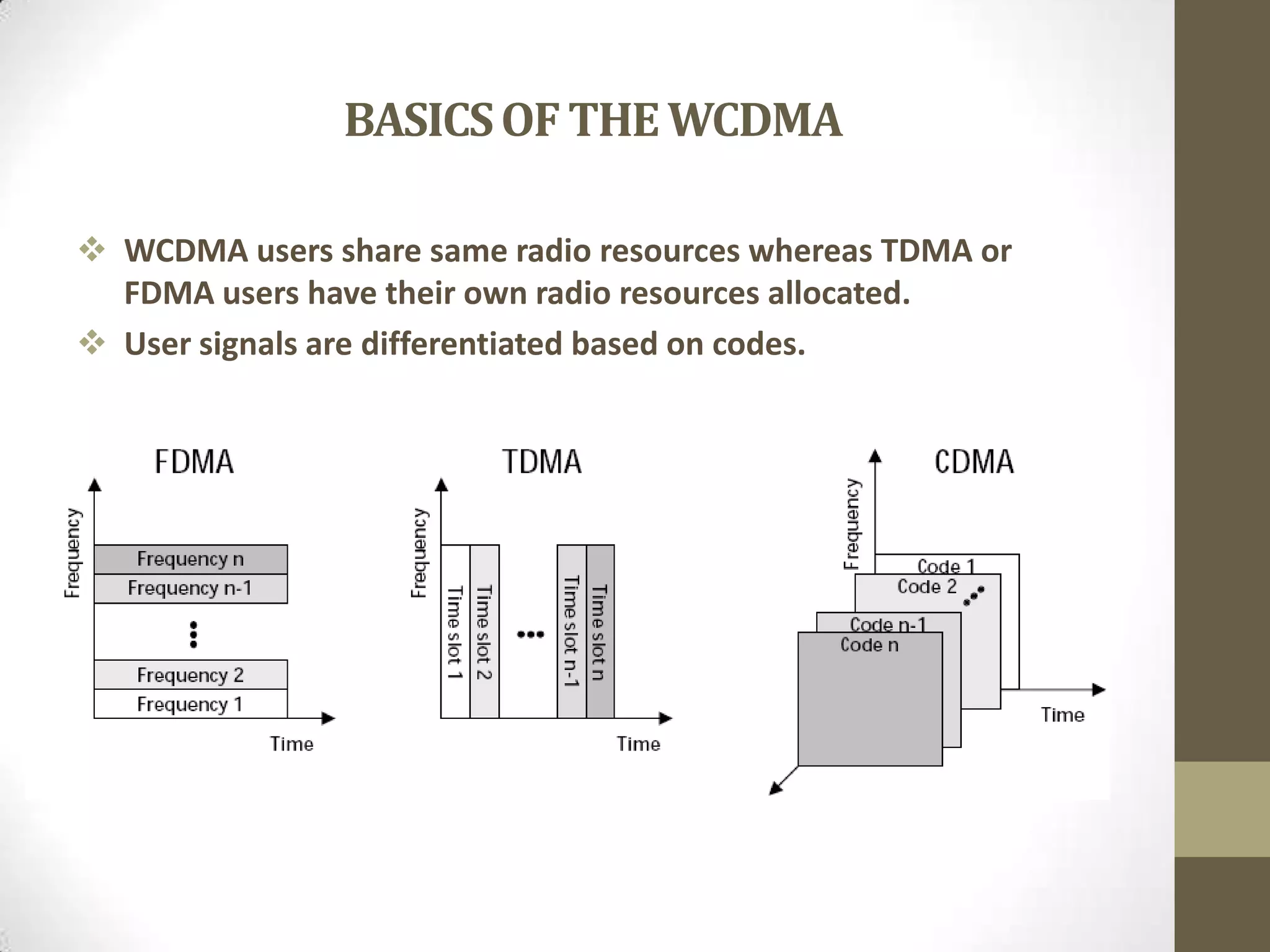
 WCDMA users share same radio resources whereas TDMA or
FDMA users have their own radio resources allocated.
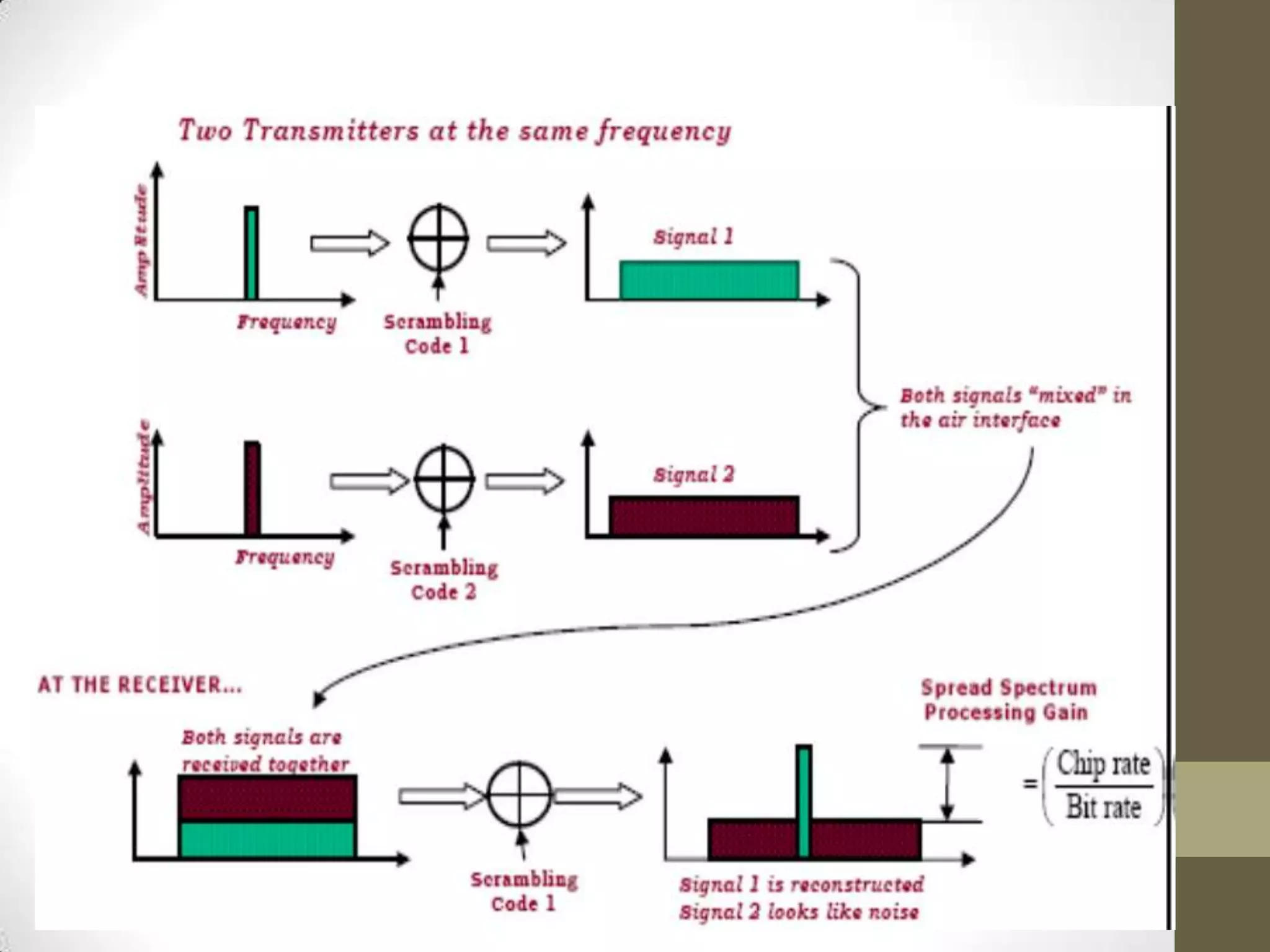
 User signals are differentiated based on codes.
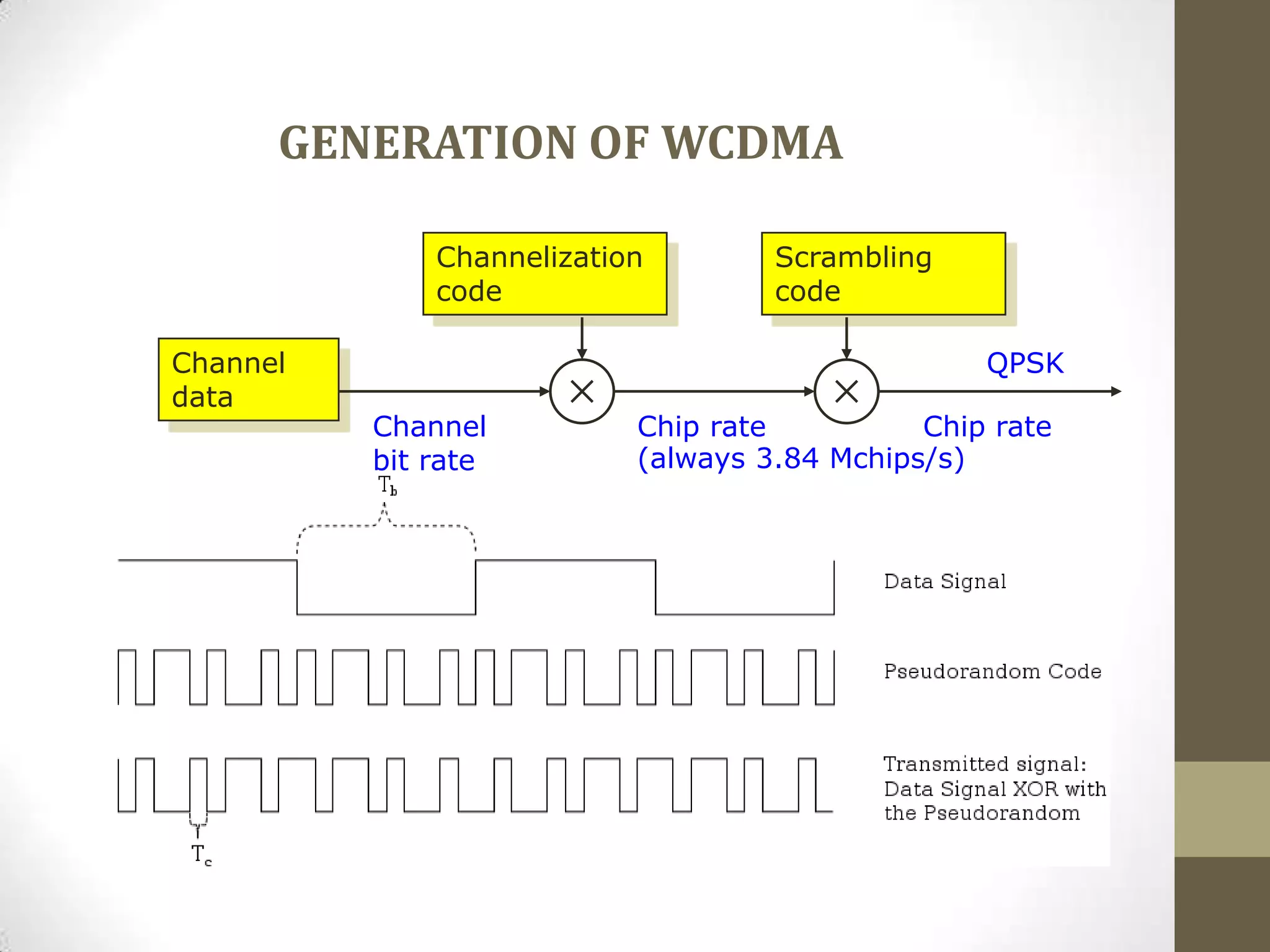
GENERATION OF WCDMA
Channel
data
Channelization
code
Scrambling
code
Channel
bit rate
Chip rate Chip rate
(always 3.84 Mchips/s)
QPSK
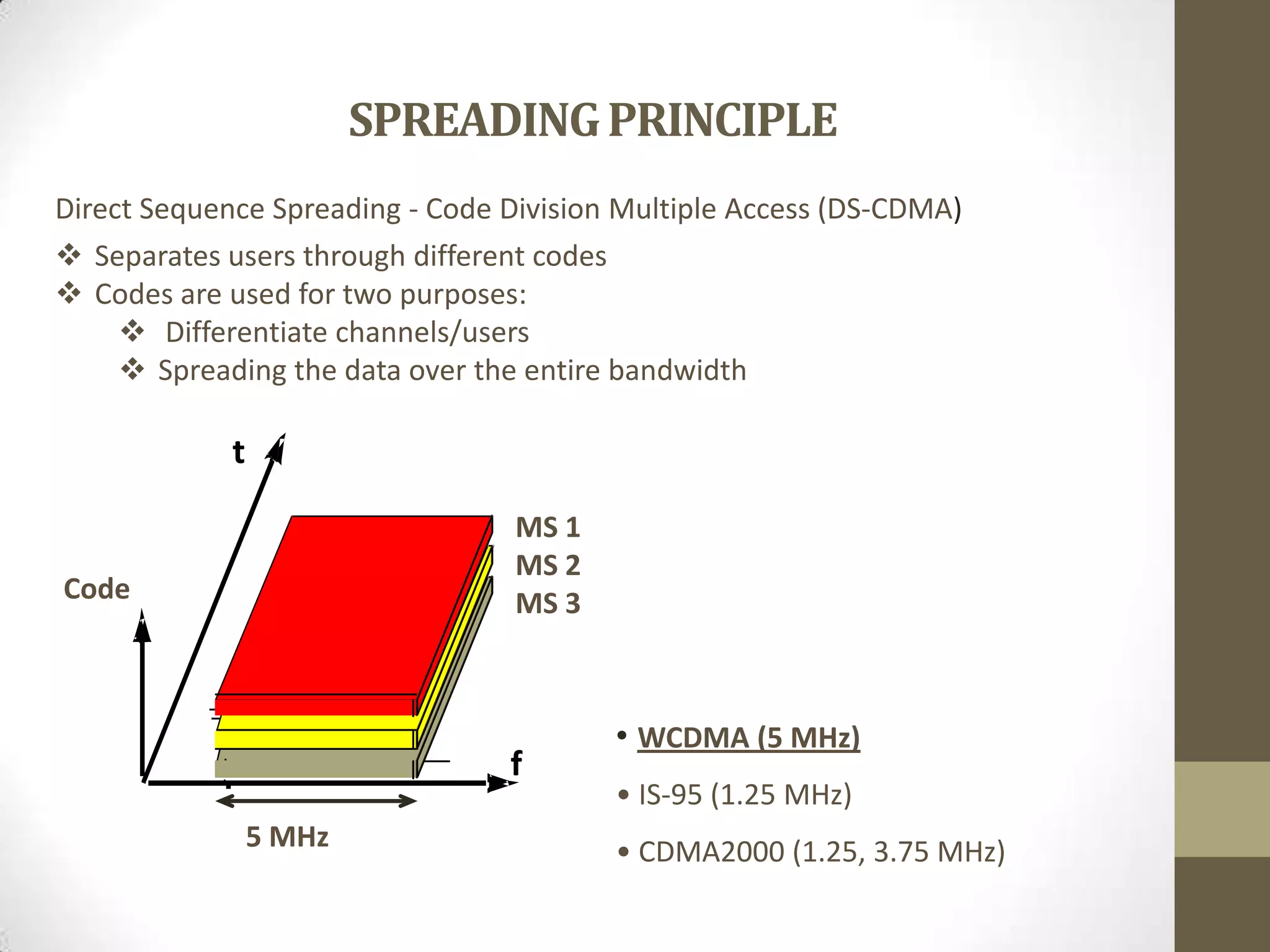
 Separates users through different codes
 Codes are used for two purposes:
 Differentiate channels/users
 Spreading the data over the entire bandwidth
f
Code
t
MS 1
MS 2
MS 3
5 MHz
• WCDMA (5 MHz)
• IS-95 (1.25 MHz)
• CDMA2000 (1.25, 3.75 MHz)
SPREADINGPRINCIPLE
Direct Sequence Spreading - Code Division Multiple Access (DS-CDMA)
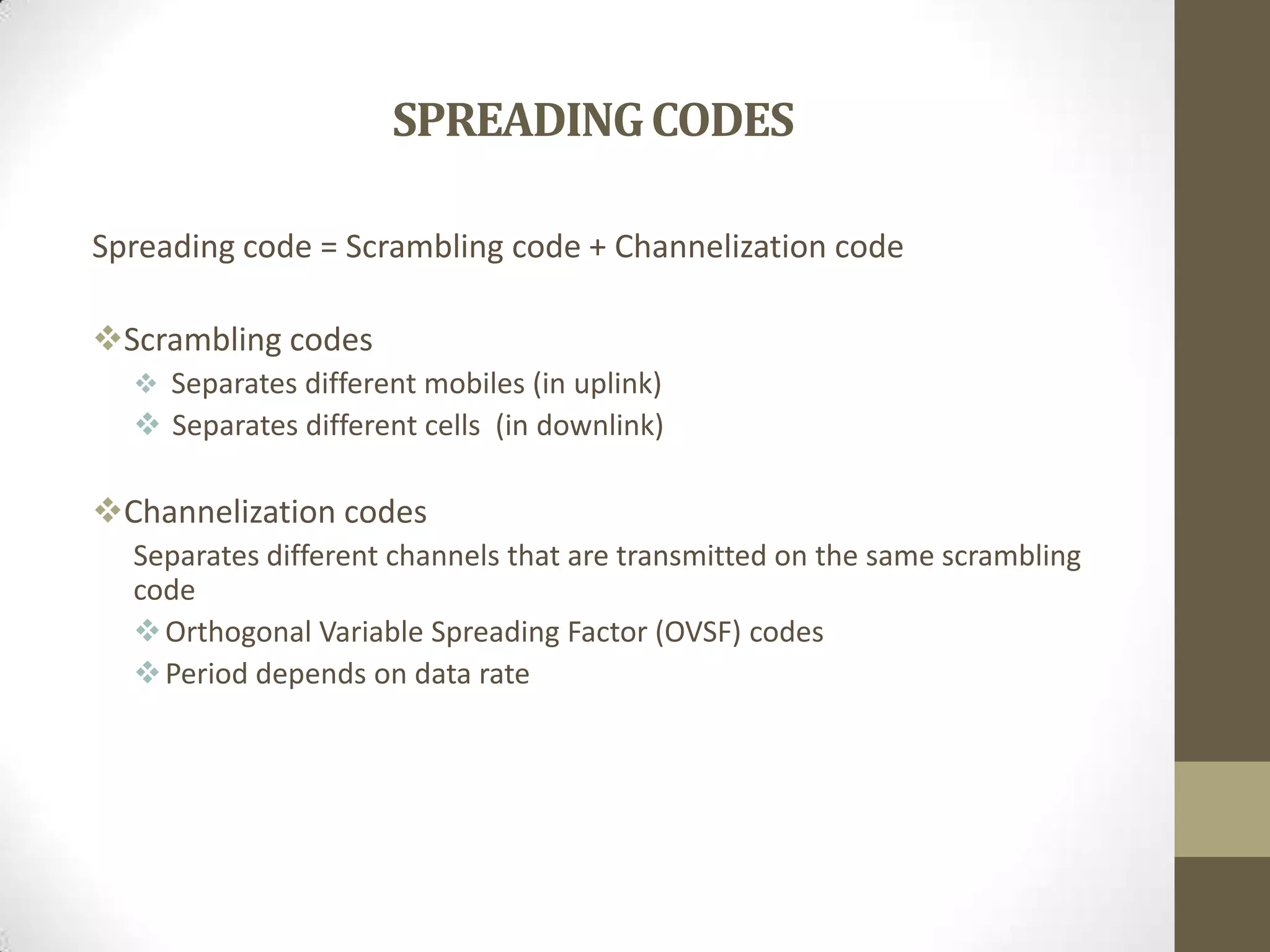
SPREADINGCODES
Spreading code = Scrambling code + Channelization code
Scrambling codes
 Separates different mobiles (in uplink)
 Separates different cells (in downlink)
Channelization codes
Separates different channels that are transmitted on the same scrambling
code
Orthogonal Variable Spreading Factor (OVSF) codes
Period depends on data rate
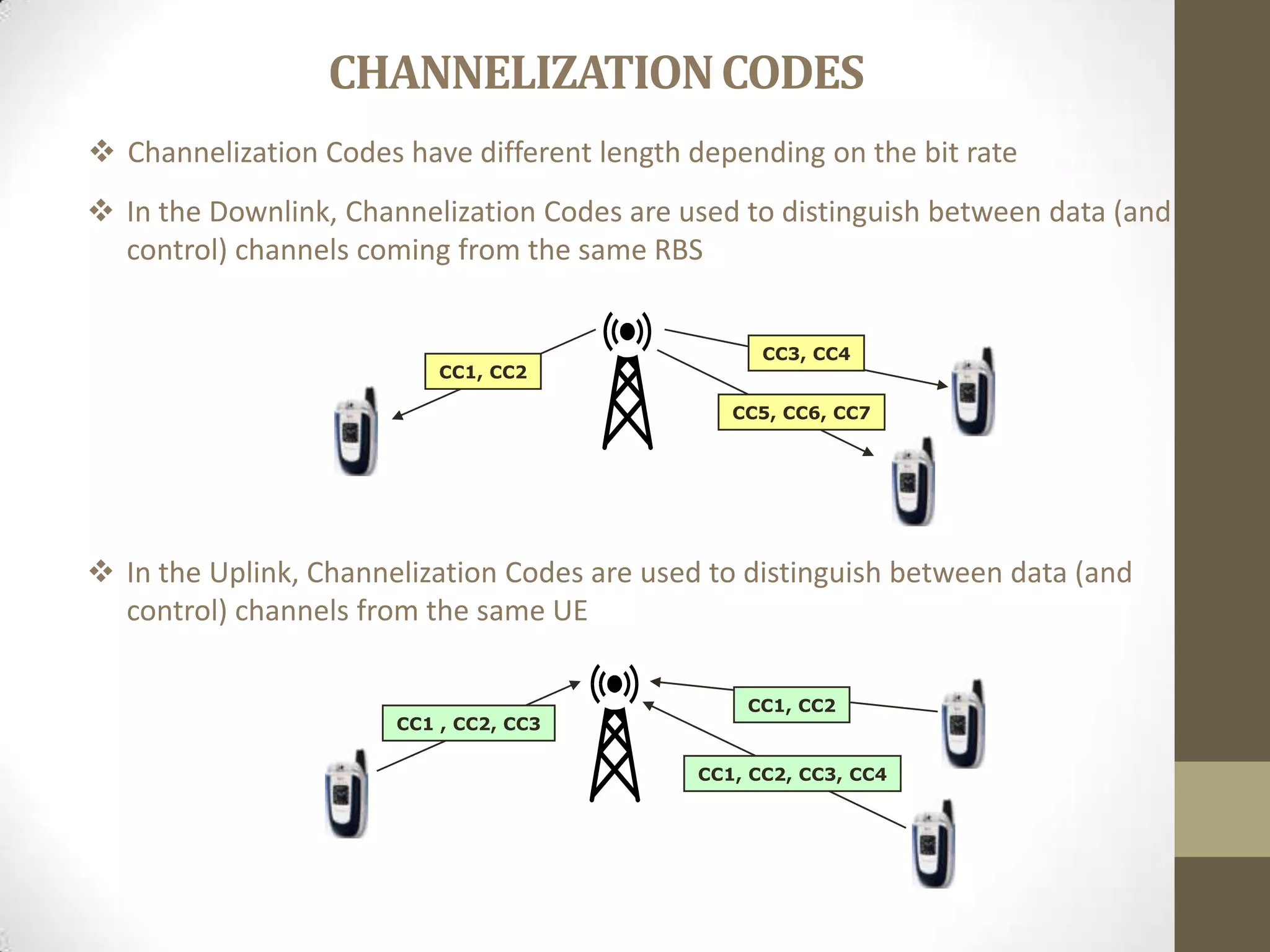
CHANNELIZATIONCODES
CC1, CC2
CC3, CC4
CC5, CC6, CC7
CC1 , CC2, CC3
CC1, CC2
CC1, CC2, CC3, CC4
 In the Uplink, Channelization Codes are used to distinguish between data (and
control) channels from the same UE
 In the Downlink, Channelization Codes are used to distinguish between data (and
control) channels coming from the same RBS
 Channelization Codes have different length depending on the bit rate
 After the Channelization Codes, the data stream is multiplied by a special code to
distinguish between different transmitters.
 Scrambling codes are not orthogonal so they do not need to be synchronized
 The separation of scrambling codes is proportional to the code length – longer
codes, better separation (but not 100%)
 Scrambling codes are 38400 chips long
SCRAMBLING CODES
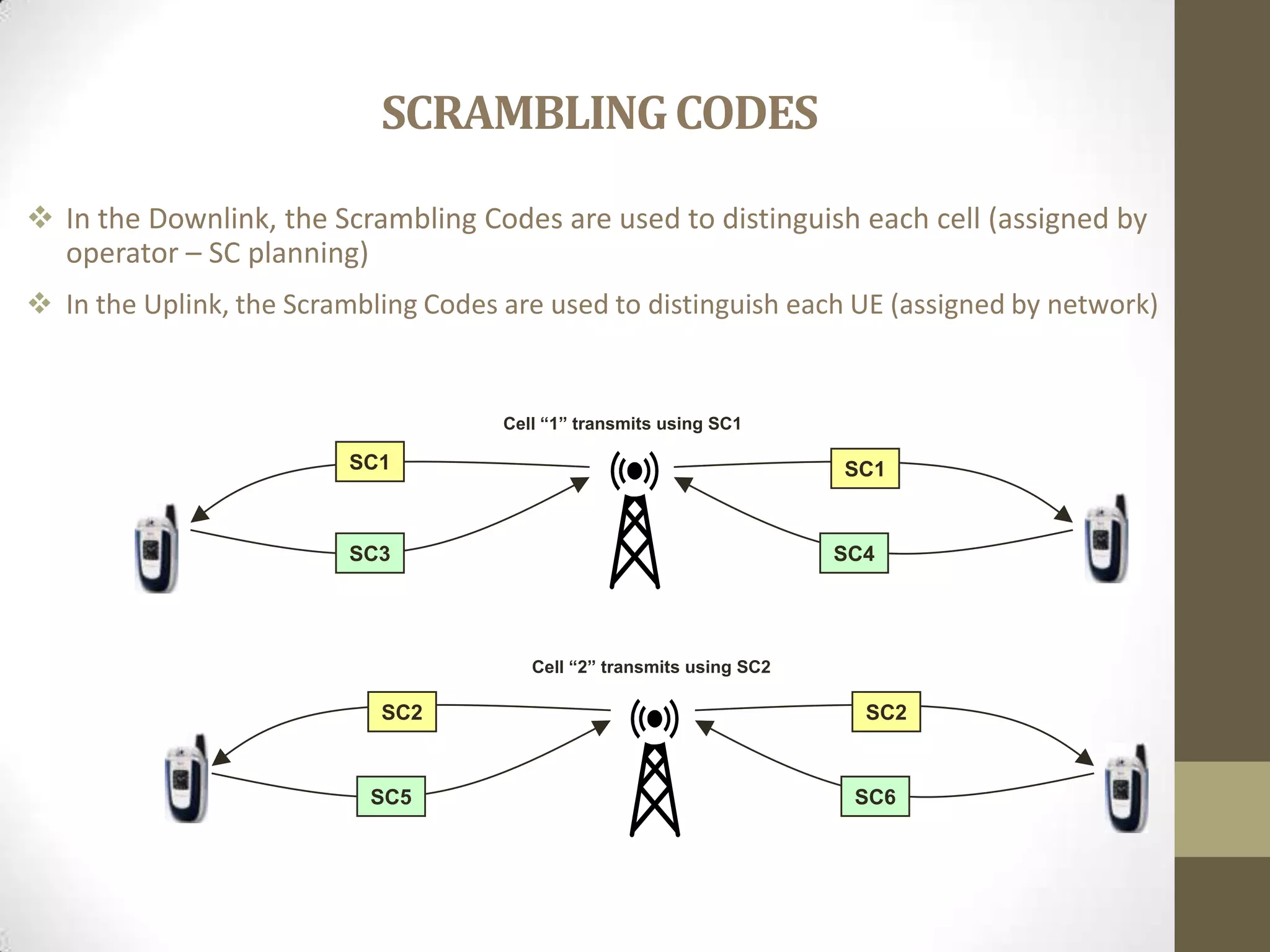
SCRAMBLINGCODES
 In the Downlink, the Scrambling Codes are used to distinguish each cell (assigned by
operator – SC planning)
 In the Uplink, the Scrambling Codes are used to distinguish each UE (assigned by network)
SC3 SC4
SC5 SC6
SC1 SC1
Cell “1” transmits using SC1
SC2 SC2
Cell “2” transmits using SC2
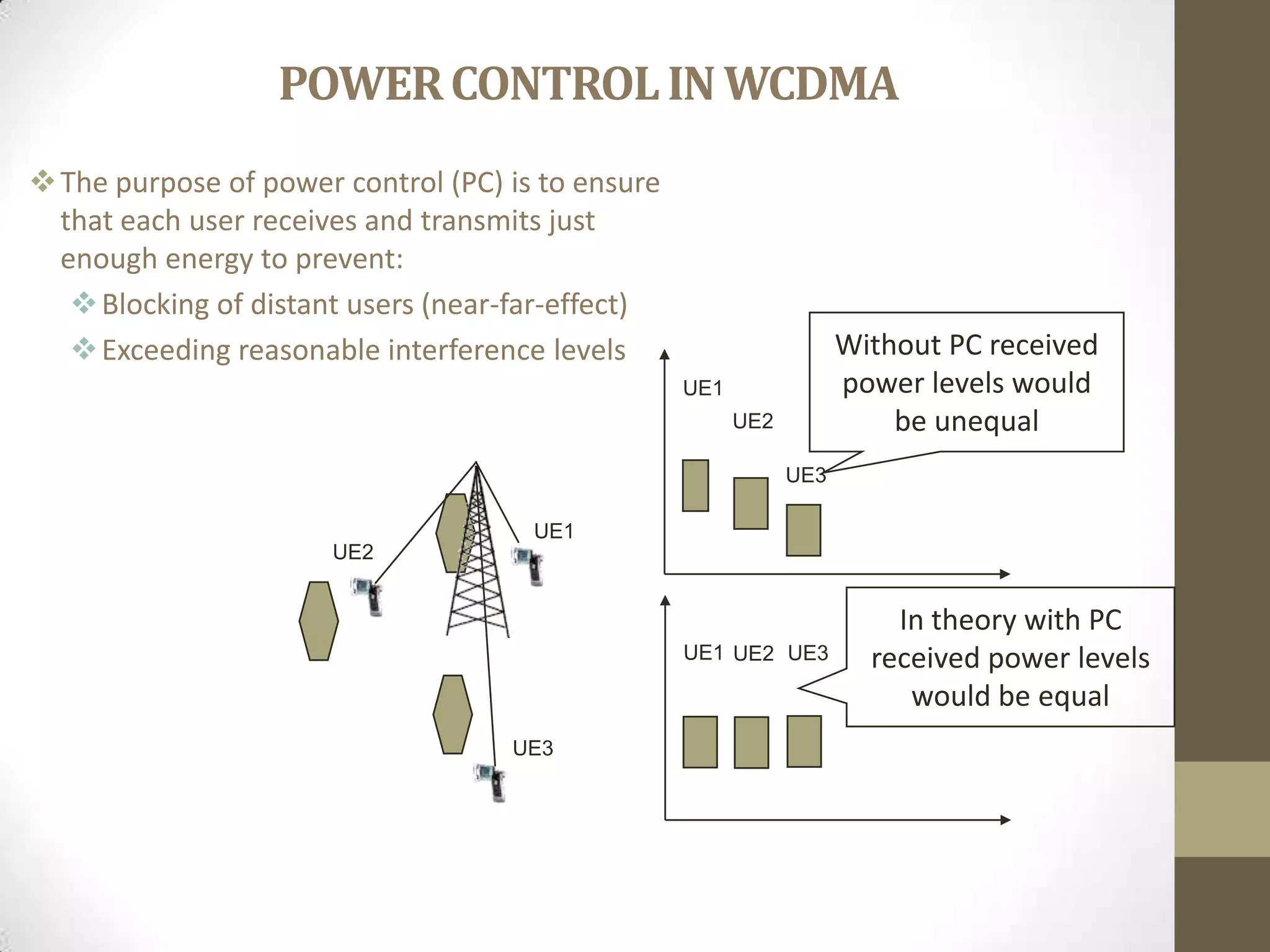
POWERCONTROLINWCDMA
The purpose of power control (PC) is to ensure
that each user receives and transmits just
enough energy to prevent:
Blocking of distant users (near-far-effect)
Exceeding reasonable interference levels
UE1
UE2
UE3
UE1
UE2
UE3
UE1 UE2 UE3
Without PC received
power levels would
be unequal
In theory with PC
received power levels
would be equal
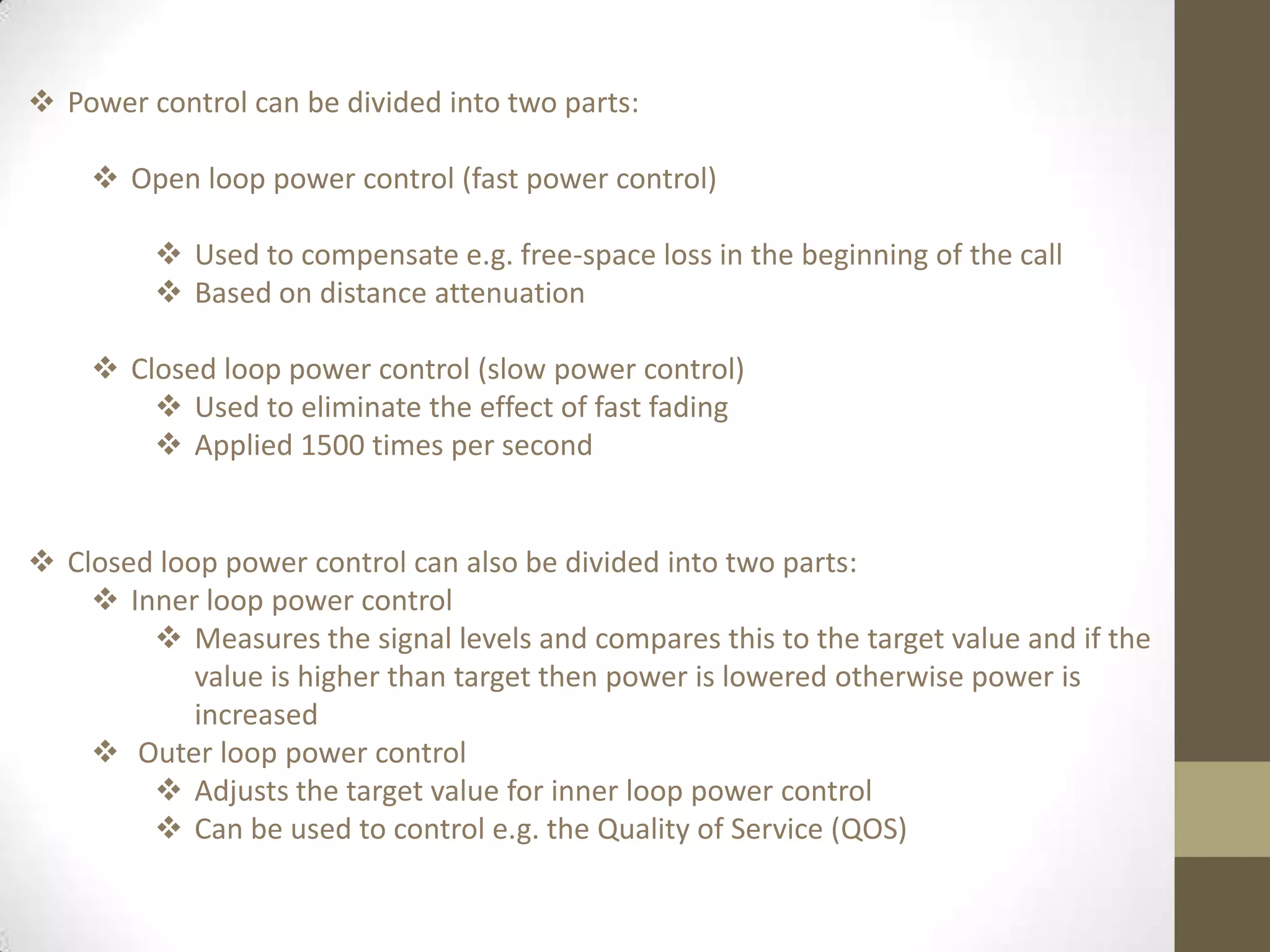
 Power control can be divided into two parts:
 Open loop power control (fast power control)
 Used to compensate e.g. free-space loss in the beginning of the call
 Based on distance attenuation
 Closed loop power control (slow power control)
 Used to eliminate the effect of fast fading
 Applied 1500 times per second
 Closed loop power control can also be divided into two parts:
 Inner loop power control
 Measures the signal levels and compares this to the target value and if the
value is higher than target then power is lowered otherwise power is
increased
 Outer loop power control
 Adjusts the target value for inner loop power control
 Can be used to control e.g. the Quality of Service (QOS)
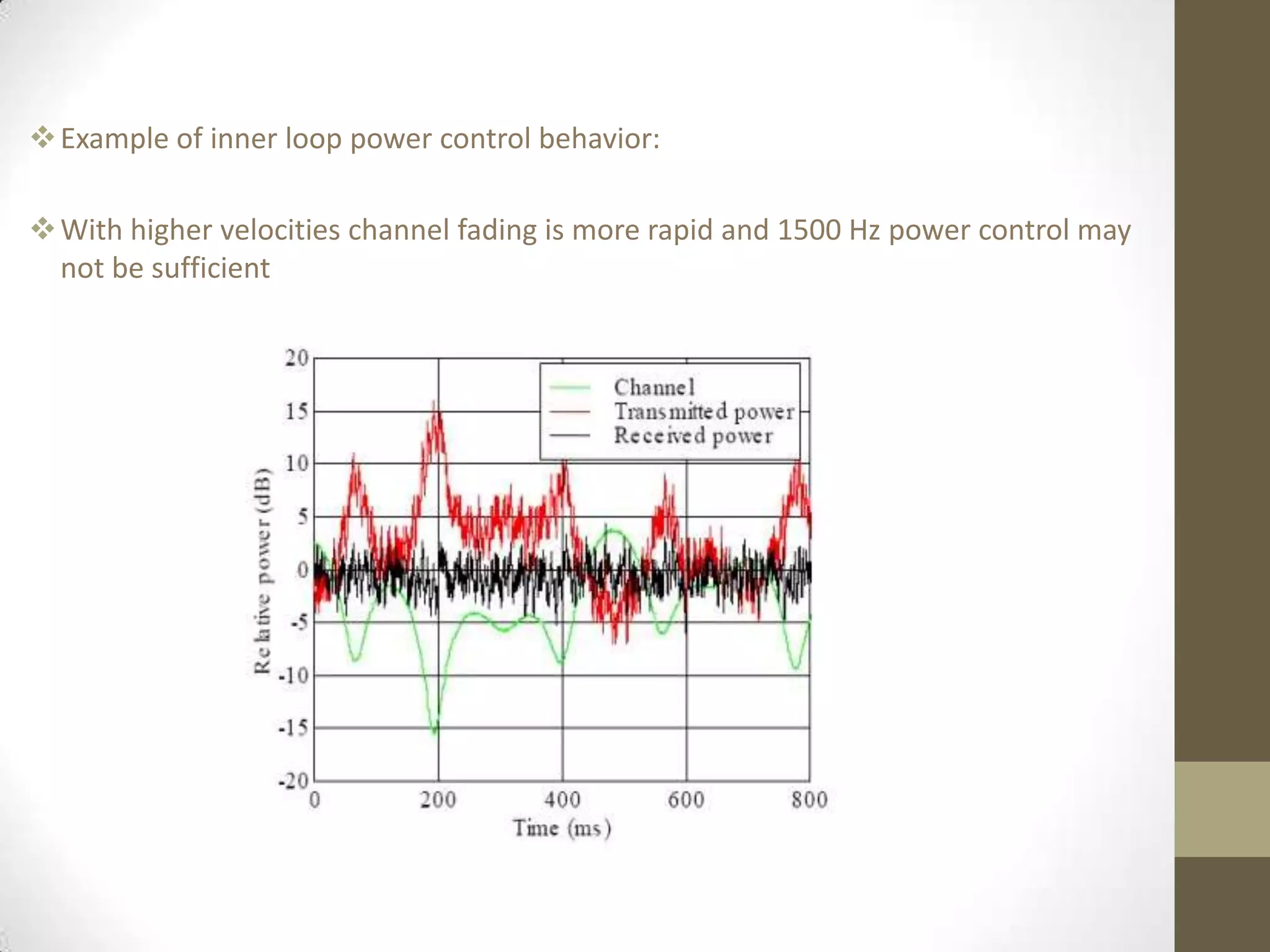
Example of inner loop power control behavior:
With higher velocities channel fading is more rapid and 1500 Hz power control may
not be sufficient
WCDMAHandovers
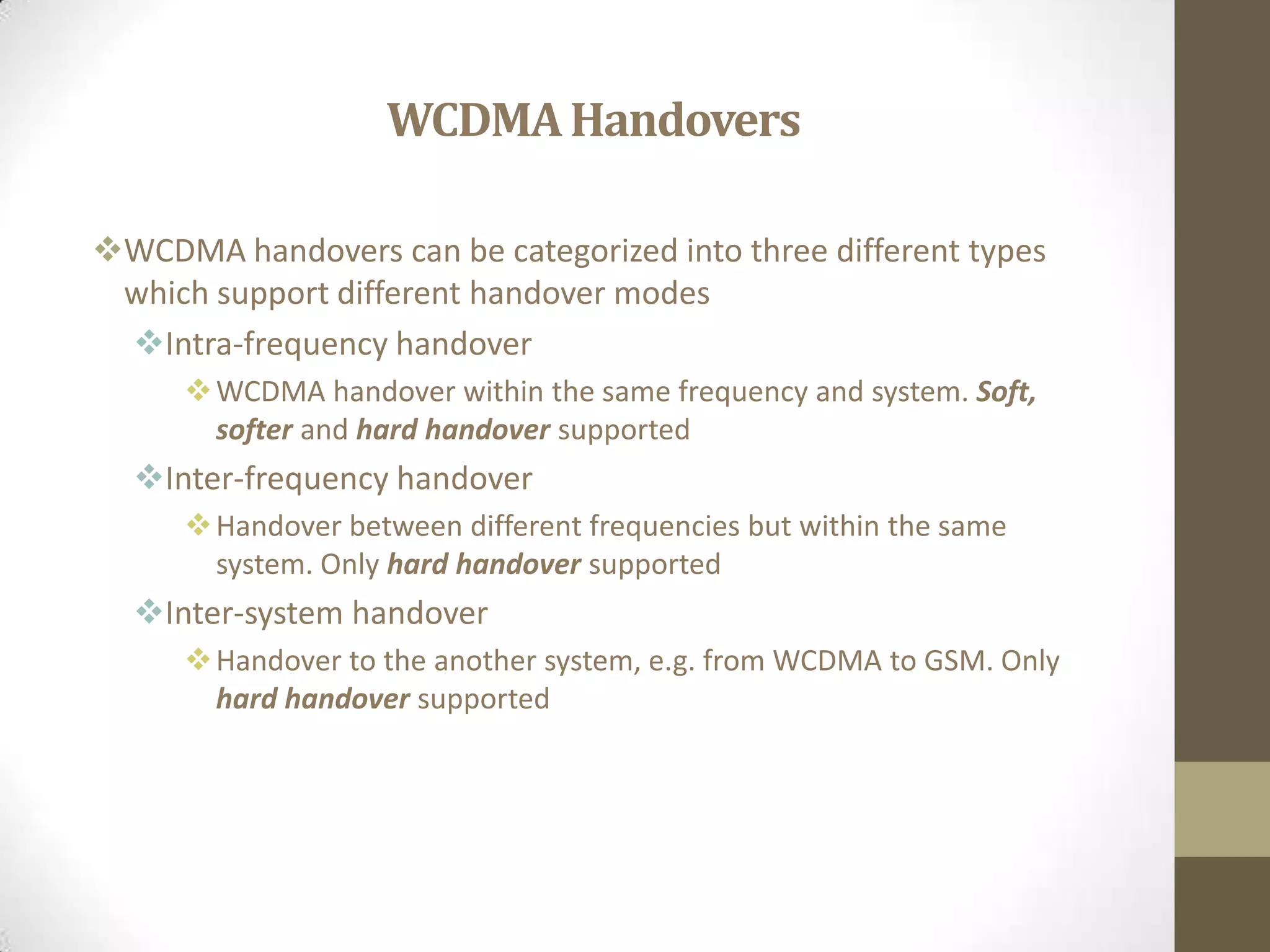
WCDMA handovers can be categorized into three different types
which support different handover modes
Intra-frequency handover
WCDMA handover within the same frequency and system. Soft,
softer and hard handover supported
Inter-frequency handover
Handover between different frequencies but within the same
system. Only hard handover supported
Inter-system handover
Handover to the another system, e.g. from WCDMA to GSM. Only
hard handover supported
WCDMAHandovers
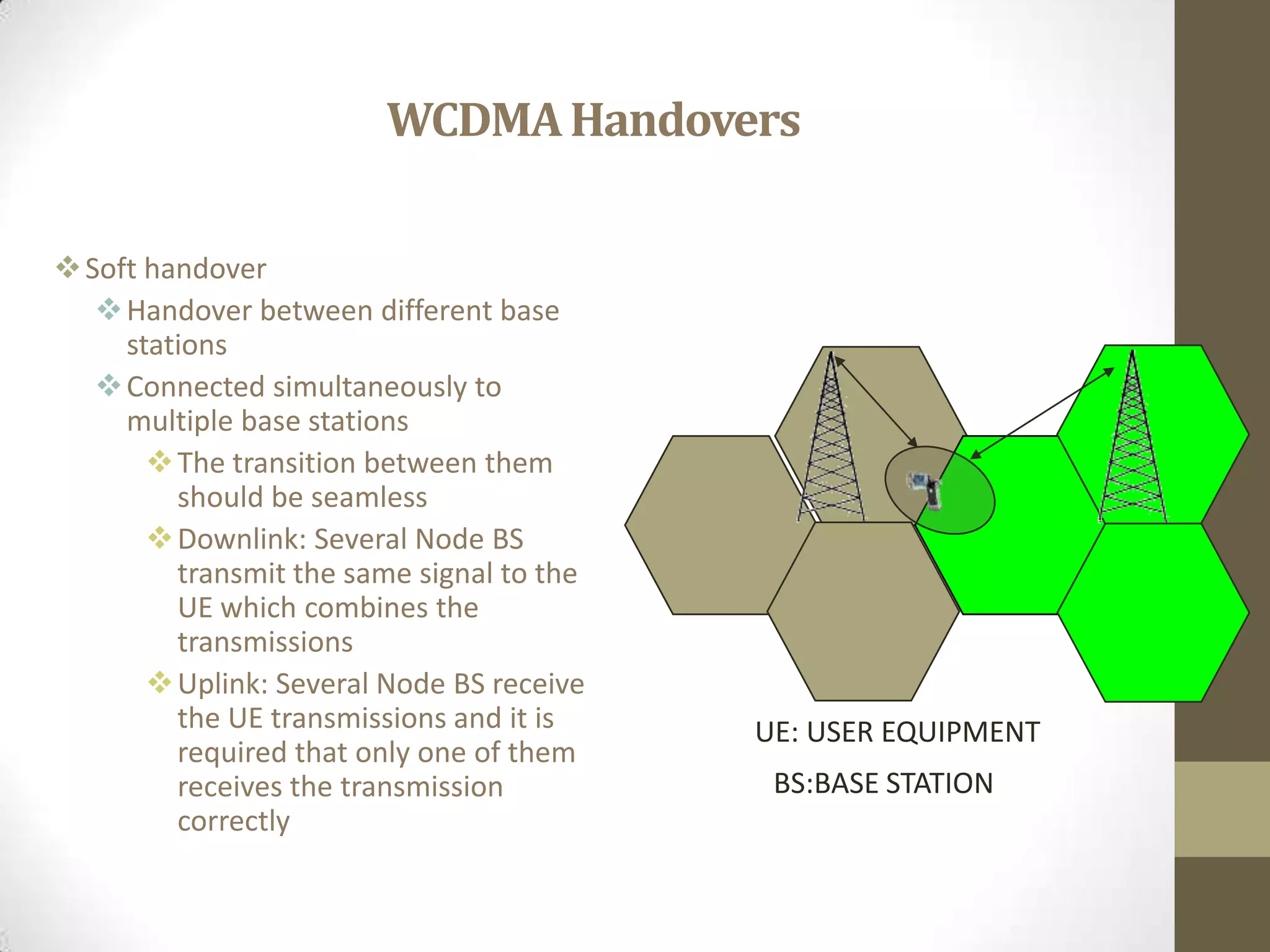
Soft handover
Handover between different base
stations
Connected simultaneously to
multiple base stations
The transition between them
should be seamless
Downlink: Several Node BS
transmit the same signal to the
UE which combines the
transmissions
Uplink: Several Node BS receive
the UE transmissions and it is
required that only one of them
receives the transmission
correctly
UE: USER EQUIPMENT
BS:BASE STATION
WCDMAHandovers
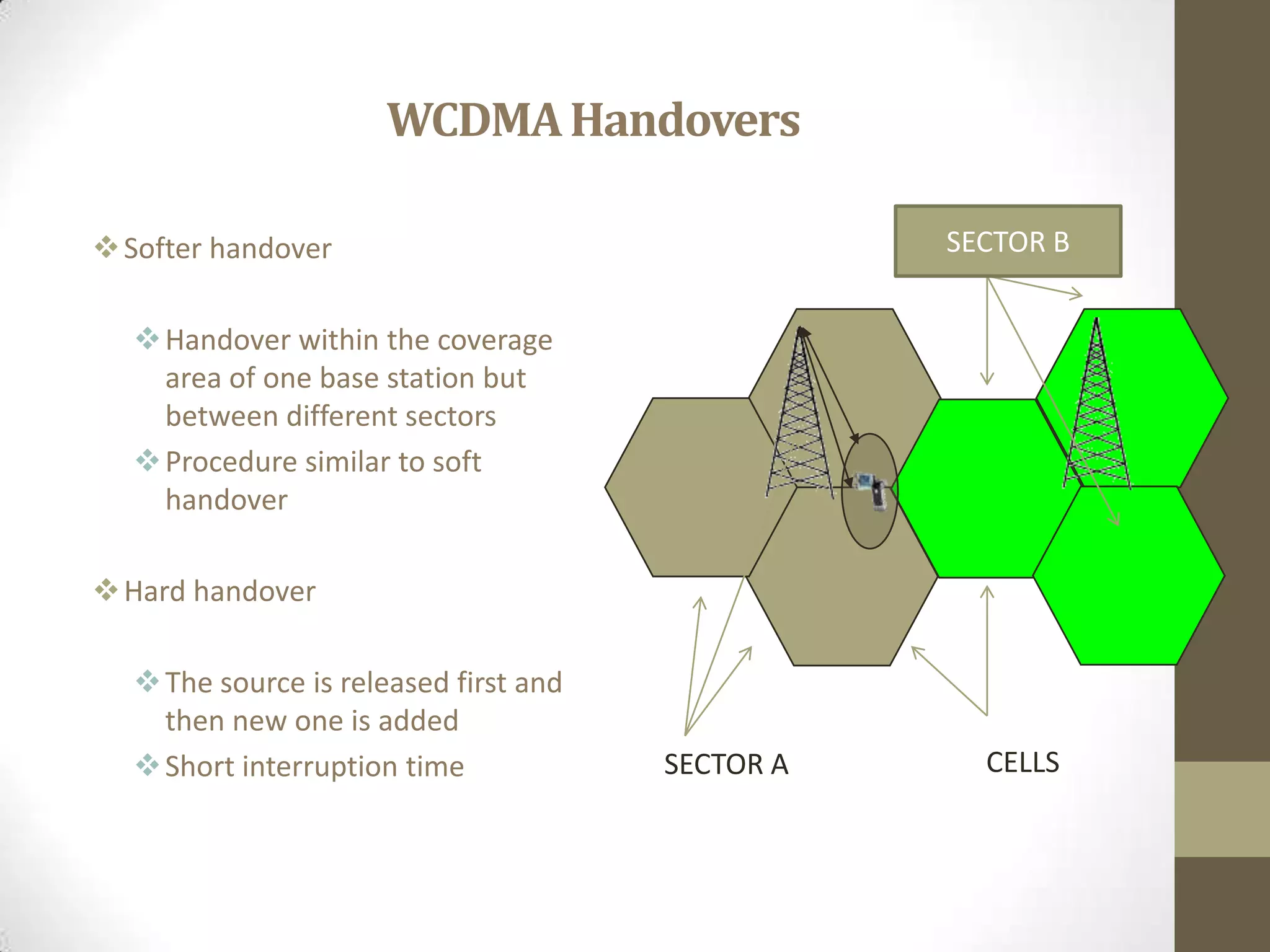
Softer handover
Handover within the coverage
area of one base station but
between different sectors
Procedure similar to soft
handover
Hard handover
The source is released first and
then new one is added
Short interruption time
UE1
BS 2
SECTOR B
SECTOR A CELLS
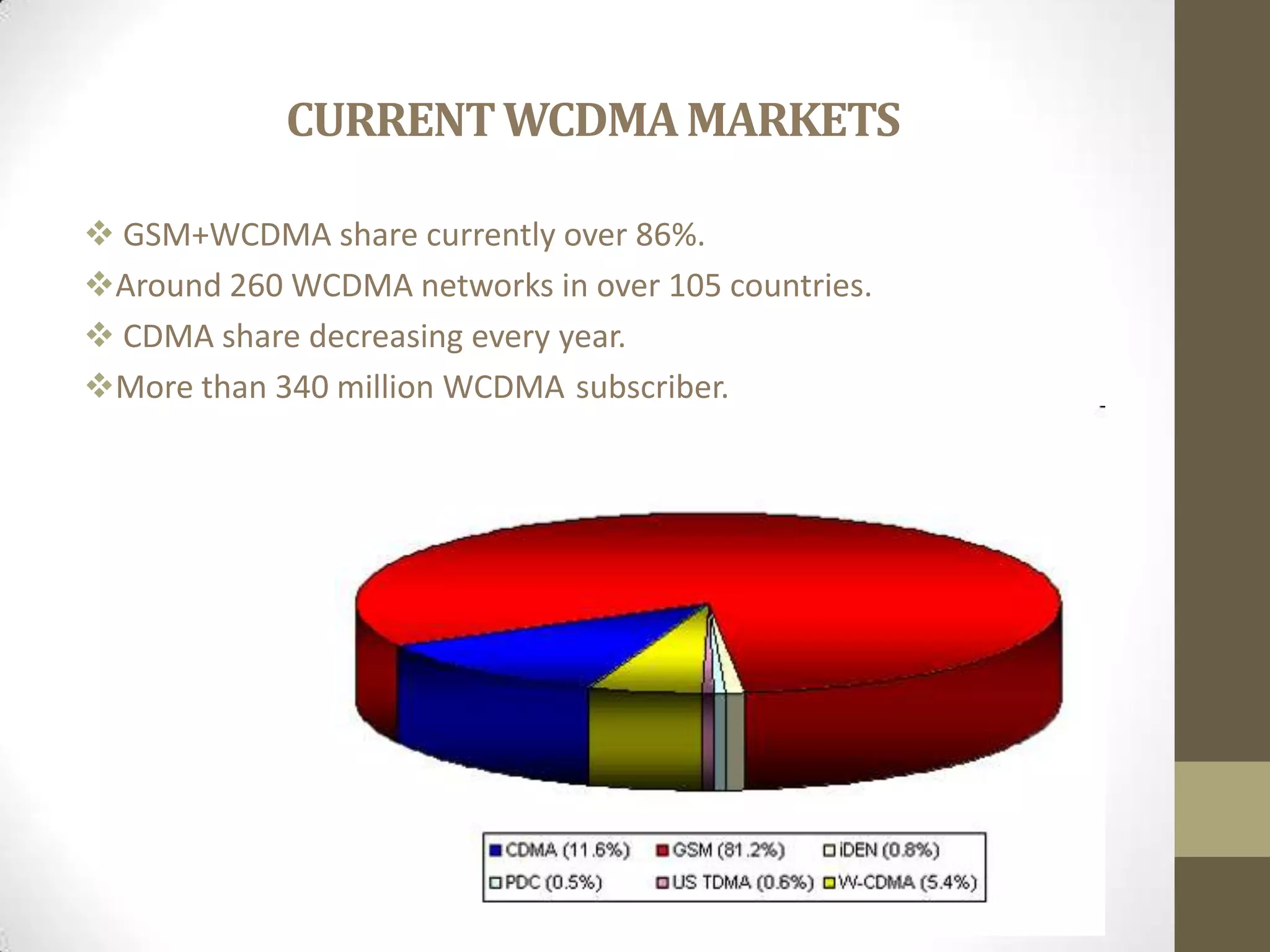
CURRENTWCDMAMARKETS
 GSM+WCDMA share currently over 86%.
Around 260 WCDMA networks in over 105 countries.
 CDMA share decreasing every year.
More than 340 million WCDMA subscriber.
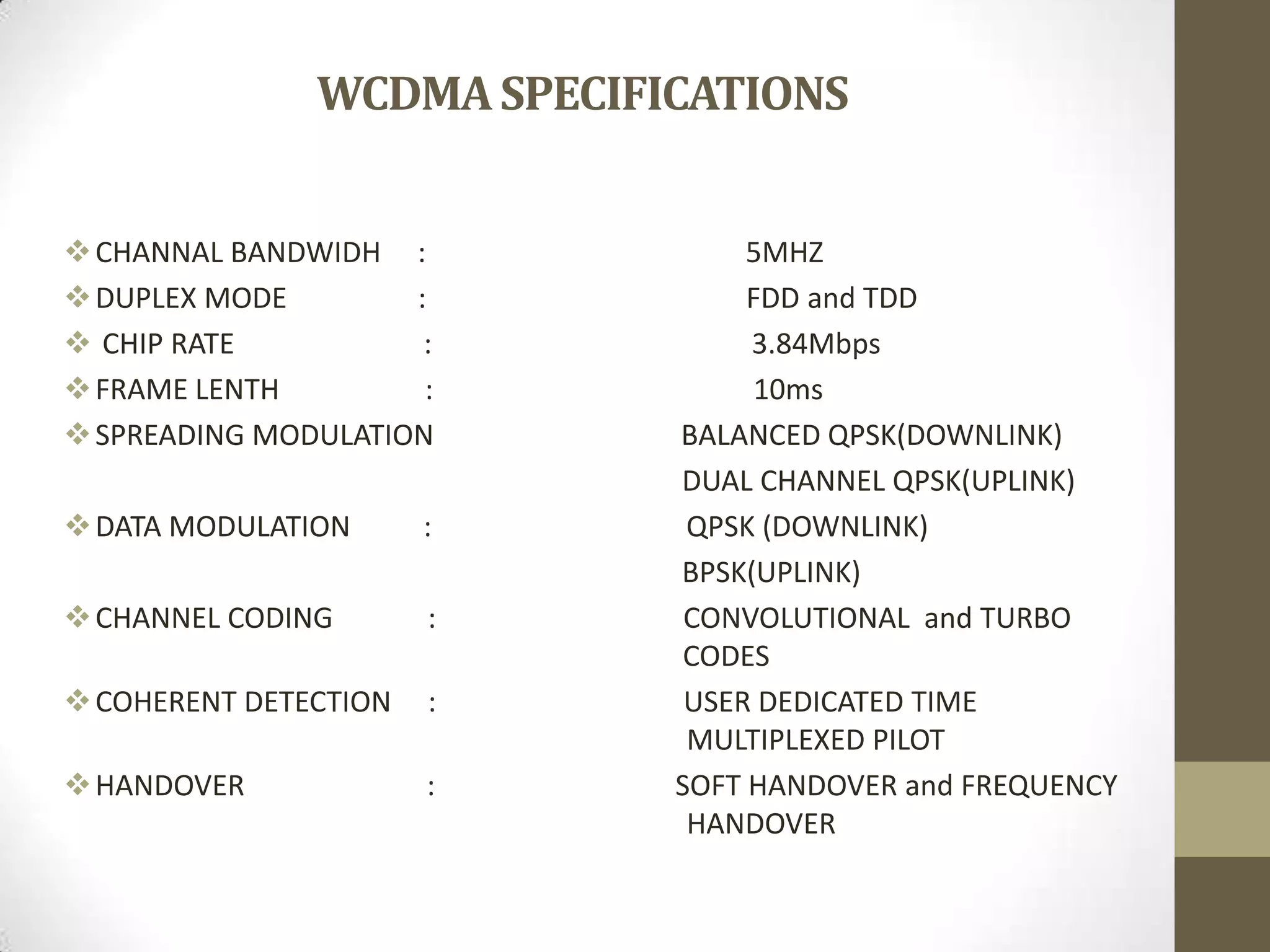
WCDMASPECIFICATIONS
CHANNAL BANDWIDH : 5MHZ
DUPLEX MODE : FDD and TDD
 CHIP RATE : 3.84Mbps
FRAME LENTH : 10ms
SPREADING MODULATION BALANCED QPSK(DOWNLINK)
DUAL CHANNEL QPSK(UPLINK)
DATA MODULATION : QPSK (DOWNLINK)
BPSK(UPLINK)
CHANNEL CODING : CONVOLUTIONAL and TURBO
CODES
COHERENT DETECTION : USER DEDICATED TIME
MULTIPLEXED PILOT
HANDOVER : SOFT HANDOVER and FREQUENCY
HANDOVER
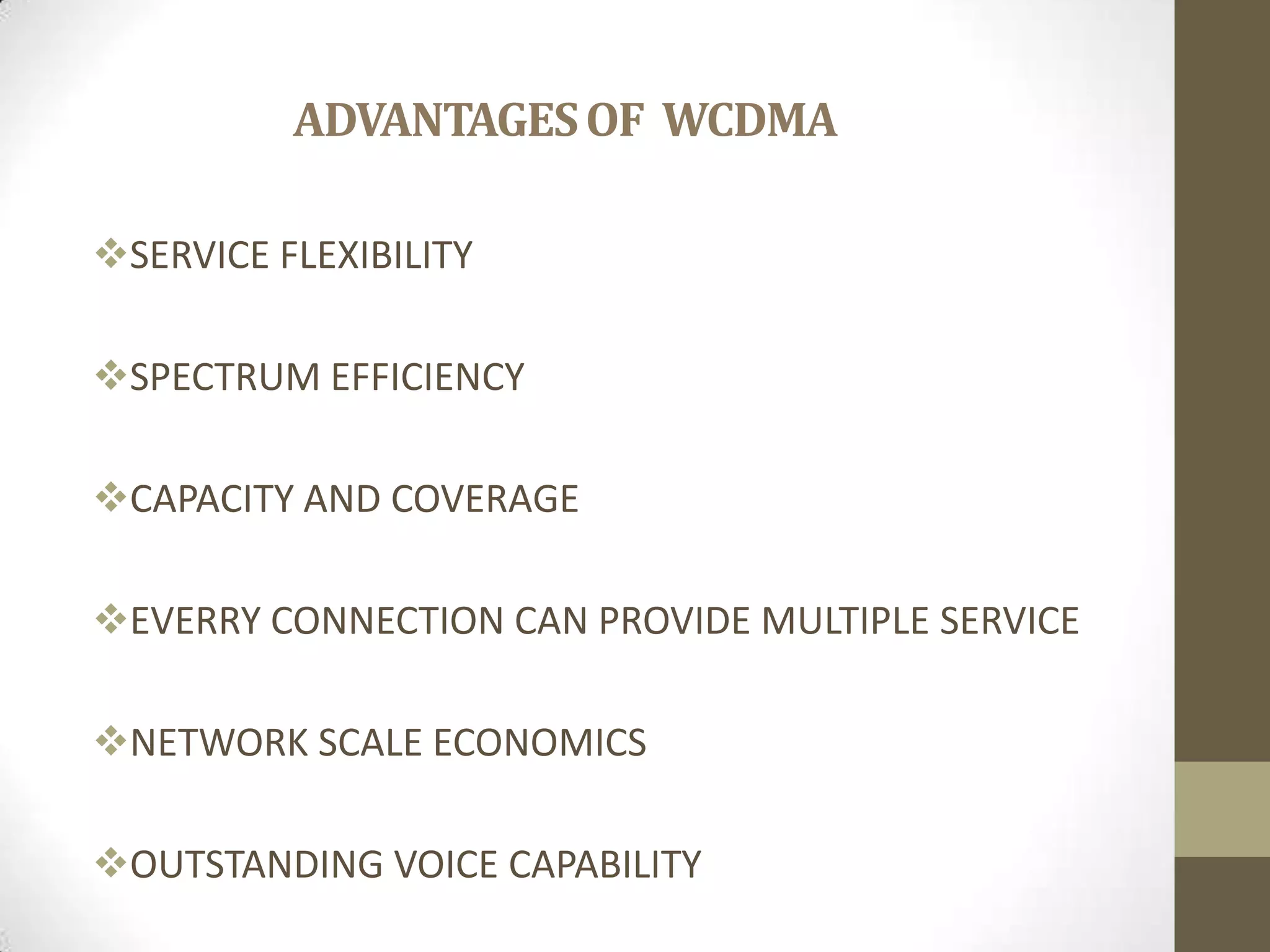
ADVANTAGESOF WCDMA
SERVICE FLEXIBILITY
SPECTRUM EFFICIENCY
CAPACITY AND COVERAGE
EVERRY CONNECTION CAN PROVIDE MULTIPLE SERVICE
NETWORK SCALE ECONOMICS
OUTSTANDING VOICE CAPABILITY
Finalpresentation 130222143702-phpapp02

Finalpresentation 130222143702-phpapp02

  • 1.
    SEMINAR REPORT ON WIDEBANDCODE-DIVISION MULTIPLEACCESS(WCDMA) DEPARTMENT OF ELECTRONICS AND COMMUNICATION SUBMITTED TO: SUBMITTED BY: MRS. MEENAKSHI AWSATHI SABAL KUMAR SR.ASSTT. PROFESSOR EC-B(3RD YEAR)
  • 2.
    CONTENT INTRODUCTION :WCDMA BASICS OFWCDMA SPECIFICATIONS GENRATION OF WCDMA SPREADING PRINCIPLE CODES POWER CONTROL WCDMA HANDOVERS ADVANTAGES OF WCDMA CURRENT WCDMA MARKET
  • 3.
    WCDMA  WCDMA: Ahigh speed 3G mobile wireless technology with capacity to offer higher data rate than CDMA.  WCDMA has the capacity to easily handle bandwidth-intensive applications such as video, data, and image transmission necessary for mobile internet services.  WCDMA was adopted as a standard by the International Mobile Telecommunications-2000 (IMT 2000) with the intention to create a global standard for real time multimedia services and international roaming.  WCDMA is direct spread technology, which means that it will spread its transmissions over a wide, 5MHz carrier.  WCDMA is the leading 3G wireless standard in the world today.
  • 4.
    BASICSOFTHEWCDMA  WCDMA usersshare same radio resources whereas TDMA or FDMA users have their own radio resources allocated.  User signals are differentiated based on codes.
  • 5.
  • 6.
     Separates usersthrough different codes  Codes are used for two purposes:  Differentiate channels/users  Spreading the data over the entire bandwidth f Code t MS 1 MS 2 MS 3 5 MHz • WCDMA (5 MHz) • IS-95 (1.25 MHz) • CDMA2000 (1.25, 3.75 MHz) SPREADINGPRINCIPLE Direct Sequence Spreading - Code Division Multiple Access (DS-CDMA)
  • 8.
    SPREADINGCODES Spreading code =Scrambling code + Channelization code Scrambling codes  Separates different mobiles (in uplink)  Separates different cells (in downlink) Channelization codes Separates different channels that are transmitted on the same scrambling code Orthogonal Variable Spreading Factor (OVSF) codes Period depends on data rate
  • 9.
    CHANNELIZATIONCODES CC1, CC2 CC3, CC4 CC5,CC6, CC7 CC1 , CC2, CC3 CC1, CC2 CC1, CC2, CC3, CC4  In the Uplink, Channelization Codes are used to distinguish between data (and control) channels from the same UE  In the Downlink, Channelization Codes are used to distinguish between data (and control) channels coming from the same RBS  Channelization Codes have different length depending on the bit rate
  • 10.
     After theChannelization Codes, the data stream is multiplied by a special code to distinguish between different transmitters.  Scrambling codes are not orthogonal so they do not need to be synchronized  The separation of scrambling codes is proportional to the code length – longer codes, better separation (but not 100%)  Scrambling codes are 38400 chips long SCRAMBLING CODES
  • 11.
    SCRAMBLINGCODES  In theDownlink, the Scrambling Codes are used to distinguish each cell (assigned by operator – SC planning)  In the Uplink, the Scrambling Codes are used to distinguish each UE (assigned by network) SC3 SC4 SC5 SC6 SC1 SC1 Cell “1” transmits using SC1 SC2 SC2 Cell “2” transmits using SC2
  • 12.
    POWERCONTROLINWCDMA The purpose ofpower control (PC) is to ensure that each user receives and transmits just enough energy to prevent: Blocking of distant users (near-far-effect) Exceeding reasonable interference levels UE1 UE2 UE3 UE1 UE2 UE3 UE1 UE2 UE3 Without PC received power levels would be unequal In theory with PC received power levels would be equal
  • 13.
     Power controlcan be divided into two parts:  Open loop power control (fast power control)  Used to compensate e.g. free-space loss in the beginning of the call  Based on distance attenuation  Closed loop power control (slow power control)  Used to eliminate the effect of fast fading  Applied 1500 times per second  Closed loop power control can also be divided into two parts:  Inner loop power control  Measures the signal levels and compares this to the target value and if the value is higher than target then power is lowered otherwise power is increased  Outer loop power control  Adjusts the target value for inner loop power control  Can be used to control e.g. the Quality of Service (QOS)
  • 14.
    Example of innerloop power control behavior: With higher velocities channel fading is more rapid and 1500 Hz power control may not be sufficient
  • 15.
    WCDMAHandovers WCDMA handovers canbe categorized into three different types which support different handover modes Intra-frequency handover WCDMA handover within the same frequency and system. Soft, softer and hard handover supported Inter-frequency handover Handover between different frequencies but within the same system. Only hard handover supported Inter-system handover Handover to the another system, e.g. from WCDMA to GSM. Only hard handover supported
  • 16.
    WCDMAHandovers Soft handover Handover betweendifferent base stations Connected simultaneously to multiple base stations The transition between them should be seamless Downlink: Several Node BS transmit the same signal to the UE which combines the transmissions Uplink: Several Node BS receive the UE transmissions and it is required that only one of them receives the transmission correctly UE: USER EQUIPMENT BS:BASE STATION
  • 17.
    WCDMAHandovers Softer handover Handover withinthe coverage area of one base station but between different sectors Procedure similar to soft handover Hard handover The source is released first and then new one is added Short interruption time UE1 BS 2 SECTOR B SECTOR A CELLS
  • 18.
    CURRENTWCDMAMARKETS  GSM+WCDMA sharecurrently over 86%. Around 260 WCDMA networks in over 105 countries.  CDMA share decreasing every year. More than 340 million WCDMA subscriber.
  • 19.
    WCDMASPECIFICATIONS CHANNAL BANDWIDH :5MHZ DUPLEX MODE : FDD and TDD  CHIP RATE : 3.84Mbps FRAME LENTH : 10ms SPREADING MODULATION BALANCED QPSK(DOWNLINK) DUAL CHANNEL QPSK(UPLINK) DATA MODULATION : QPSK (DOWNLINK) BPSK(UPLINK) CHANNEL CODING : CONVOLUTIONAL and TURBO CODES COHERENT DETECTION : USER DEDICATED TIME MULTIPLEXED PILOT HANDOVER : SOFT HANDOVER and FREQUENCY HANDOVER
  • 20.
    ADVANTAGESOF WCDMA SERVICE FLEXIBILITY SPECTRUMEFFICIENCY CAPACITY AND COVERAGE EVERRY CONNECTION CAN PROVIDE MULTIPLE SERVICE NETWORK SCALE ECONOMICS OUTSTANDING VOICE CAPABILITY