Development of Ear
Dr safika zaman, Dept of ENT & Head Neck surgery
VIMS, RKMSP
embryogenesis
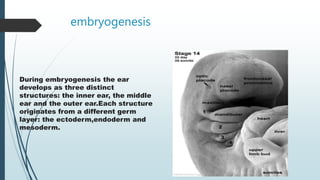
During embryogenesis the ear
develops as three distinct
structures: the inner ear, the middle
ear and the outer ear.Each structure
originates from a different germ
layer: the ectoderm,endoderm and
mesoderm.
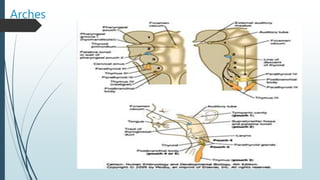
Arches
External Ear
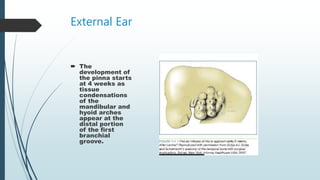
 The
development of
the pinna starts
at 4 weeks as
tissue
condensations
of the
mandibular and
hyoid arches
appear at the
distal portion
of the first
branchial
groove.
External ear
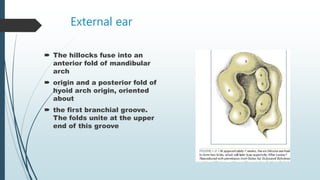
 The hillocks fuse into an
anterior fold of mandibular
arch
 origin and a posterior fold of
hyoid arch origin, oriented
about
 the first branchial groove.
The folds unite at the upper
end of this groove
External ear
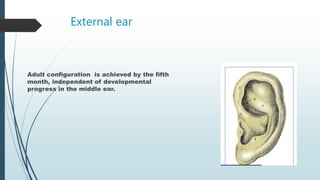
Adult configuration is achieved by the fifth
month, independent of developmental
progress in the middle ear.
External auditory canal
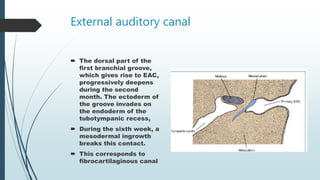
 The dorsal part of the
first branchial groove,
which gives rise to EAC,
progressively deepens
during the second
month. The ectoderm of
the groove invades on
the endoderm of the
tubotympanic recess,
 During the sixth week, a
mesodermal ingrowth
breaks this contact.
 This corresponds to
fibrocartilaginous canal
TYMPANOMASTOID COMPARTMENT
AND EUSTACHIAN TUBE
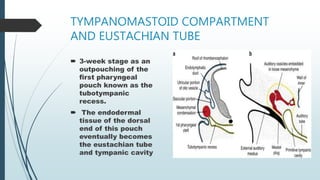
 3-week stage as an
outpouching of the
first pharyngeal
pouch known as the
tubotympanic
recess.
 The endodermal
tissue of the dorsal
end of this pouch
eventually becomes
the eustachian tube
and tympanic cavity
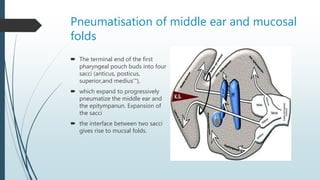
Pneumatisation of middle ear and mucosal
folds
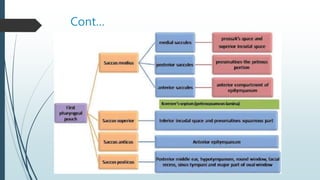
 The terminal end of the first
pharyngeal pouch buds into four
sacci (anticus, posticus,
superior,and medius'"),
 which expand to progressively
pneumatize the middle ear and
the epitympanun. Expansion of
the sacci
 the interface between two sacci
gives rise to mucsal folds.
Cont…
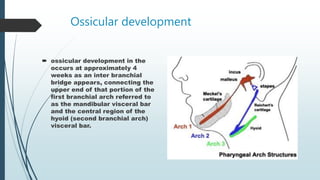
Ossicular development
 ossicular development in the
occurs at approximately 4
weeks as an inter branchial
bridge appears, connecting the
upper end of that portion of the
first branchial arch referred to
as the mandibular visceral bar
and the central region of the
hyoid (second branchial arch)
visceral bar.
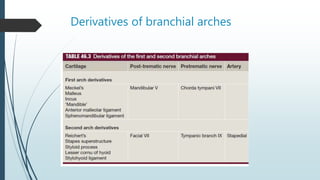
Derivatives of branchial arches
Development of otic labyrinth
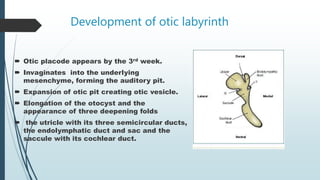
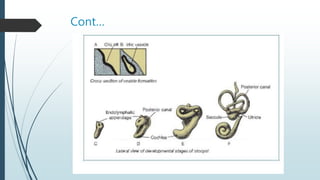
 Otic placode appears by the 3rd week.
 Invaginates into the underlying
mesenchyme, forming the auditory pit.
 Expansion of otic pit creating otic vesicle.
 Elongation of the otocyst and the
appearance of three deepening folds
 the utricle with its three semicircular ducts,
the endolymphatic duct and sac and the
saccule with its cochlear duct.
Cont…
Development of Perilymphatic labyrinth
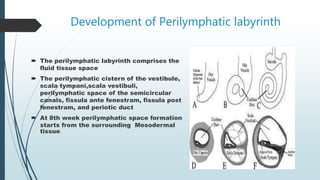
 The perilymphatic labyrinth comprises the
fluid tissue space
 The perilymphatic cistern of the vestibule,
scala tympani,scala vestibuli,
perilymphatic space of the semicircular
canals, fissula ante fenestram, fissula post
fenestram, and periotic duct
 At 8th week perilymphatic space formation
starts from the surrounding Mesodermal
tissue.
Development of otic capsule
 Starts at 4th week
 Becomes petrous part of temporal bone.
 Develops from mesenchyme that is differentiates into
embryonic cartilage.
 A total of 14 center eventually appear and fuse to complete
the ossification of the otic capsule.
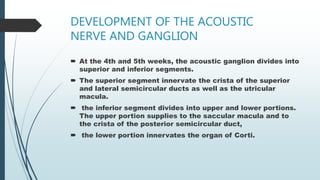
DEVELOPMENT OF THE ACOUSTIC
NERVE AND GANGLION
 At the 4th and 5th weeks, the acoustic ganglion divides into
superior and inferior segments.
 The superior segment innervate the crista of the superior
and lateral semicircular ducts as well as the utricular
macula.
 the inferior segment divides into upper and lower portions.
The upper portion supplies to the saccular macula and to
the crista of the posterior semicircular duct,
 the lower portion innervates the organ of Corti.
DEVELOPMENT OF THE FACIAL
NERVE AND GENICULATE GANGLION
 At about 4 weeks, the facial nerve and its geniculate
ganglion begin to develop from primordial tissue, arising
from the rhomben cephalon.
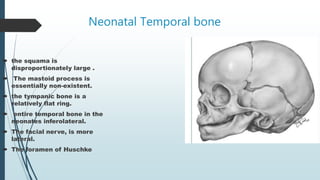
 the squama is
disproportionately large .
 The mastoid process is
essentially non-existent.
 the tympanic bone is a
relatively flat ring.
 entire temporal bone in the
neonates inferolateral.
 The facial nerve, is more
lateral.
 The foramen of Huschke
Neonatal Temporal bone
Thank you

Development of ear ppt

  • 1.
    Development of Ear Drsafika zaman, Dept of ENT & Head Neck surgery VIMS, RKMSP
  • 2.
    embryogenesis During embryogenesis theear develops as three distinct structures: the inner ear, the middle ear and the outer ear.Each structure originates from a different germ layer: the ectoderm,endoderm and mesoderm.
  • 3.
  • 4.
    External Ear  The developmentof the pinna starts at 4 weeks as tissue condensations of the mandibular and hyoid arches appear at the distal portion of the first branchial groove.
  • 5.
    External ear  Thehillocks fuse into an anterior fold of mandibular arch  origin and a posterior fold of hyoid arch origin, oriented about  the first branchial groove. The folds unite at the upper end of this groove
  • 6.
    External ear Adult configurationis achieved by the fifth month, independent of developmental progress in the middle ear.
  • 7.
    External auditory canal The dorsal part of the first branchial groove, which gives rise to EAC, progressively deepens during the second month. The ectoderm of the groove invades on the endoderm of the tubotympanic recess,  During the sixth week, a mesodermal ingrowth breaks this contact.  This corresponds to fibrocartilaginous canal
  • 8.
    TYMPANOMASTOID COMPARTMENT AND EUSTACHIANTUBE  3-week stage as an outpouching of the first pharyngeal pouch known as the tubotympanic recess.  The endodermal tissue of the dorsal end of this pouch eventually becomes the eustachian tube and tympanic cavity
  • 9.
    Pneumatisation of middleear and mucosal folds  The terminal end of the first pharyngeal pouch buds into four sacci (anticus, posticus, superior,and medius'"),  which expand to progressively pneumatize the middle ear and the epitympanun. Expansion of the sacci  the interface between two sacci gives rise to mucsal folds.
  • 10.
  • 11.
    Ossicular development  ossiculardevelopment in the occurs at approximately 4 weeks as an inter branchial bridge appears, connecting the upper end of that portion of the first branchial arch referred to as the mandibular visceral bar and the central region of the hyoid (second branchial arch) visceral bar.
  • 12.
  • 13.
    Development of oticlabyrinth  Otic placode appears by the 3rd week.  Invaginates into the underlying mesenchyme, forming the auditory pit.  Expansion of otic pit creating otic vesicle.  Elongation of the otocyst and the appearance of three deepening folds  the utricle with its three semicircular ducts, the endolymphatic duct and sac and the saccule with its cochlear duct.
  • 14.
  • 15.
    Development of Perilymphaticlabyrinth  The perilymphatic labyrinth comprises the fluid tissue space  The perilymphatic cistern of the vestibule, scala tympani,scala vestibuli, perilymphatic space of the semicircular canals, fissula ante fenestram, fissula post fenestram, and periotic duct  At 8th week perilymphatic space formation starts from the surrounding Mesodermal tissue.
  • 16.
    Development of oticcapsule  Starts at 4th week  Becomes petrous part of temporal bone.  Develops from mesenchyme that is differentiates into embryonic cartilage.  A total of 14 center eventually appear and fuse to complete the ossification of the otic capsule.
  • 17.
    DEVELOPMENT OF THEACOUSTIC NERVE AND GANGLION  At the 4th and 5th weeks, the acoustic ganglion divides into superior and inferior segments.  The superior segment innervate the crista of the superior and lateral semicircular ducts as well as the utricular macula.  the inferior segment divides into upper and lower portions. The upper portion supplies to the saccular macula and to the crista of the posterior semicircular duct,  the lower portion innervates the organ of Corti.
  • 18.
    DEVELOPMENT OF THEFACIAL NERVE AND GENICULATE GANGLION  At about 4 weeks, the facial nerve and its geniculate ganglion begin to develop from primordial tissue, arising from the rhomben cephalon.
  • 19.
     the squamais disproportionately large .  The mastoid process is essentially non-existent.  the tympanic bone is a relatively flat ring.  entire temporal bone in the neonates inferolateral.  The facial nerve, is more lateral.  The foramen of Huschke Neonatal Temporal bone
  • 20.