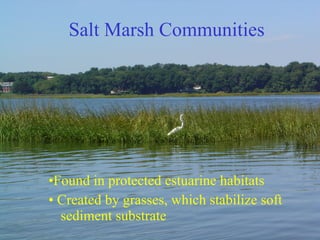
Salt Marsh Communities • Found in protected estuarine habitats •  Created by grasses, which stabilize soft sediment substrate
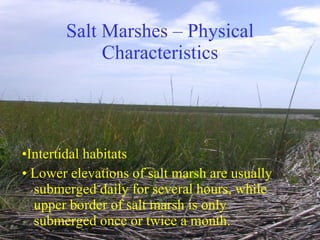
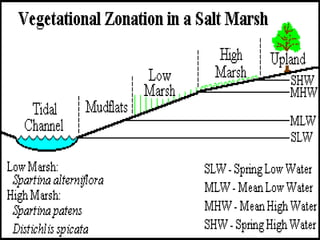
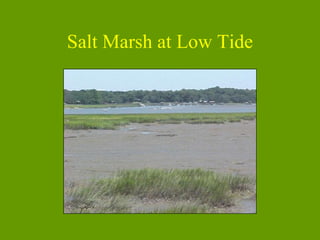
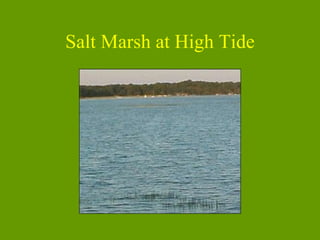
Salt Marshes – Physical Characteristics • Intertidal habitats •  Lower elevations of salt marsh are usually submerged daily for several hours, while upper border of salt marsh is only submerged once or twice a month.
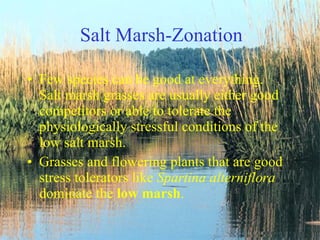
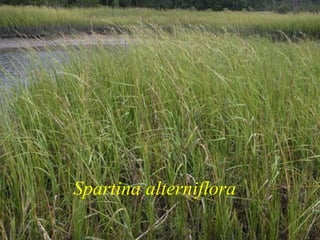
Salt Marsh-Zonation Few species can be good at everything.  Salt marsh grasses are usually either good competitors or able to tolerate the physiologically stressful conditions of the low salt marsh.  Grasses and flowering plants that are good stress tolerators like  Spartina alterniflora  dominate the  low marsh .
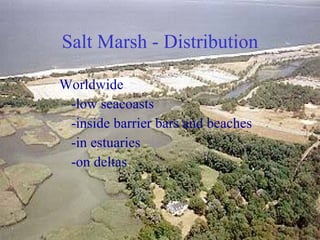
Salt Marsh - Distribution Worldwide -low seacoasts -inside barrier bars and beaches -in estuaries -on deltas
 
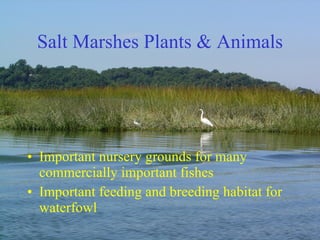
Salt Marshes Plants & Animals Important nursery grounds for many commercially important fishes Important feeding and breeding habitat for waterfowl
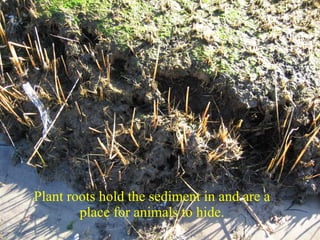
Plant roots hold the sediment in and are a place for animals to hide.
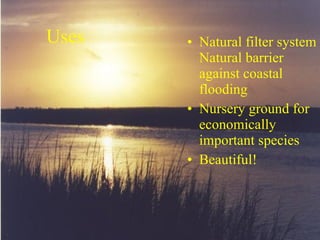
Uses Natural filter system Natural barrier against coastal flooding Nursery ground for economically important species Beautiful!
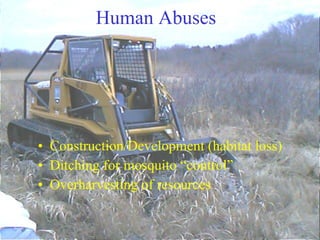
Human Abuses Construction/Development (habitat loss) Ditching for mosquito “control” Overharvesting of resources
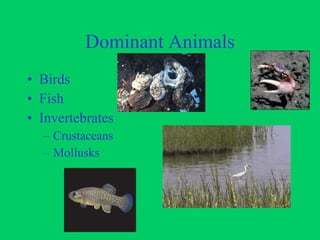
Dominant Animals Birds Fish Invertebrates Crustaceans Mollusks
 
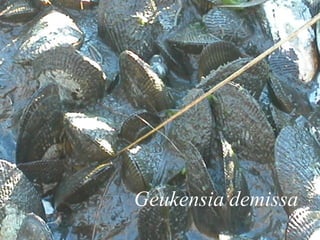
Geukensia demissa
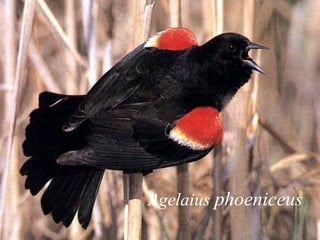
Agelaius  phoeniceus
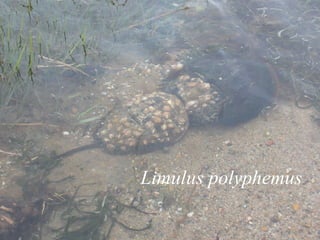
Limulus polyphemus
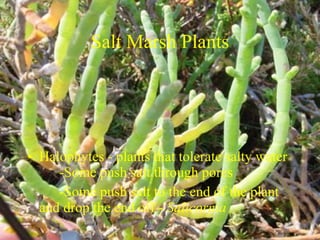
Salt Marsh Plants Halophytes - plants that tolerate salty water  -Some push salt through pores -Some push salt to the end of the plant  and drop the end off -  Salicornia
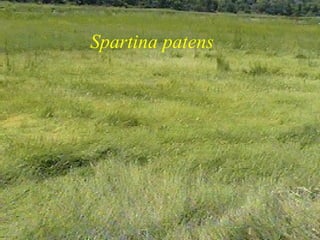
Spartina patens
Spartina alterniflora
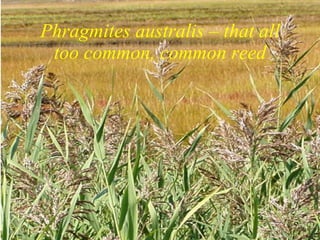
Phragmites australis – that all too common, common reed
Salt Marsh at Low Tide
Salt Marsh at High Tide
To Learn More About Salt Marshes Local salt marshes:  www.chipr.sunysb.edu/eserc/longis/flaxpond.html Regional salt marshes: http:// www.edc.uri.edu/restoration/html/gallery/plants/reed.htm http:// serc.carleton.edu/introgeo/roleplaying/examples/tide.html http://www.nationalgeographic.com/xpeditions/lessons/08/g35/oceans35.html http:// www.dnr.sc.gov/marine/pub/seascience/dynamic.html
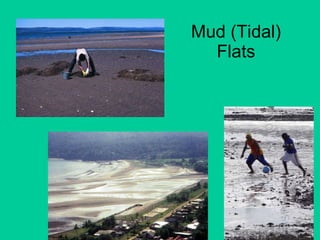
Mud (Tidal) Flats
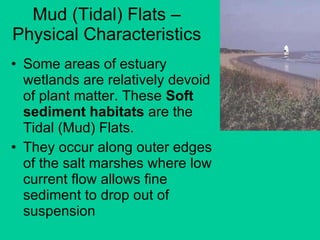
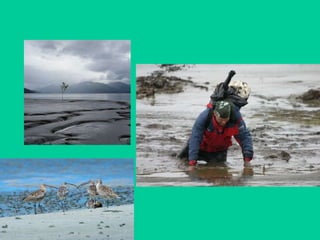
Mud (Tidal) Flats – Physical Characteristics Some areas of estuary wetlands are relatively devoid of plant matter. These  Soft sediment habitats  are the Tidal (Mud) Flats. They occur along outer edges of the salt marshes where low current flow allows fine sediment to drop out of suspension
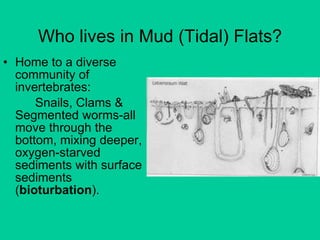
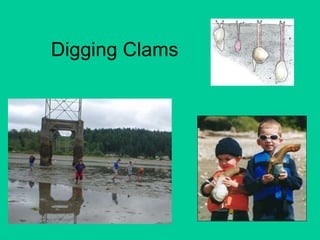
Who lives in Mud (Tidal) Flats? Home to a diverse community of invertebrates: Snails, Clams & Segmented worms-all move through the bottom, mixing deeper, oxygen-starved sediments with surface sediments ( bioturbation ).
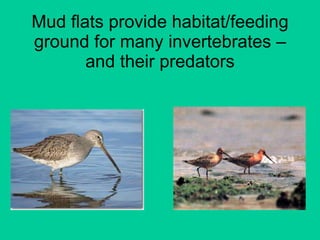
Mud flats provide habitat/feeding ground for many invertebrates – and their predators
Digging Clams
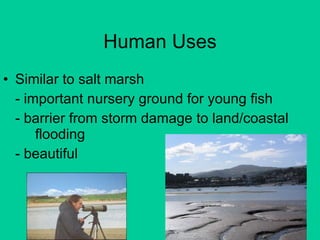
Human Uses Similar to salt marsh - important nursery ground for young fish - barrier from storm damage to land/coastal  flooding - beautiful
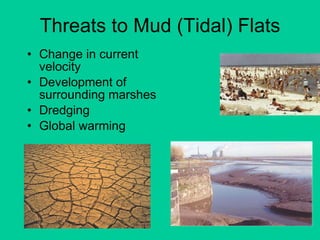
Threats to Mud (Tidal) Flats Change in current velocity Development of surrounding marshes Dredging Global warming
 
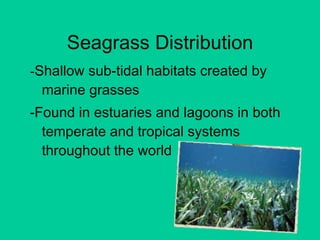
Seagrass Distribution - Shallow sub-tidal habitats created by marine grasses -Found in estuaries and lagoons in both temperate and tropical systems throughout the world
Values of Seagrasses - Mo dify environment by reducing current velocity, which can in turn affect sedimentation rates & soil grain size -Help slow down storms moving inland -Increase habitat complexity, reducing predation intensity -FOOD, SHELTER, NURSERY !!
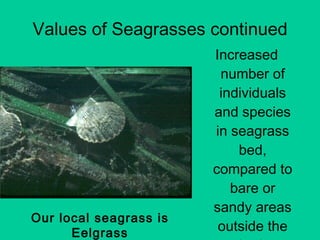
Values of Seagrasses continued Increased number of individuals and species in seagrass bed, compared to bare or sandy areas outside the bed. Our local seagrass is Eelgrass
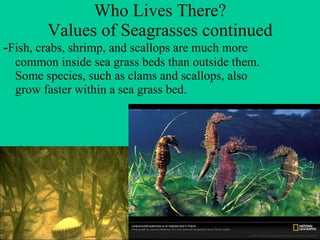
Who Lives There? Values of Seagrasses continued - Fish, crabs, shrimp, and scallops are much more common inside sea grass beds than outside them.  Some species, such as clams and scallops, also grow faster within a sea grass bed.
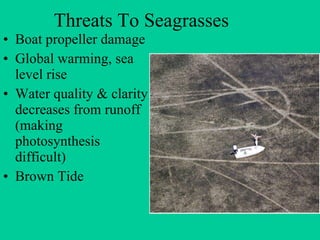
Threats To Seagrasses Boat propeller damage Global warming, sea level rise Water quality & clarity decreases from runoff (making photosynthesis difficult) Brown Tide
To learn more about Seagrasses: http://www.sms.si.edu/IRLspec/Seagrass_Habitat.htm http://www.ncl.ac.uk/tcmweb/tcm/sglinks.htm
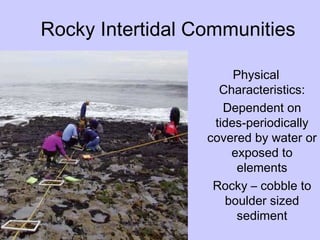
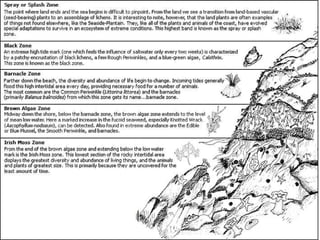
Rocky Intertidal Communities Physical Characteristics: Dependent on tides-periodically covered by water or exposed to elements Rocky – cobble to boulder sized sediment
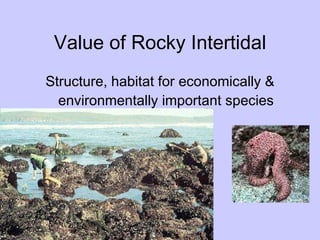
Value of Rocky Intertidal Structure, habitat for economically & environmentally important species
 
 
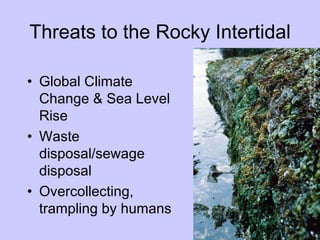
Threats to the Rocky Intertidal Global Climate Change & Sea Level Rise Waste disposal/sewage disposal Overcollecting, trampling by humans
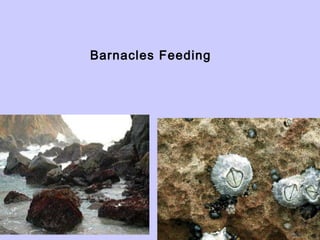
http://www.youtube.com/watch?v=25F7xMVNt-w   Barnacles Feeding
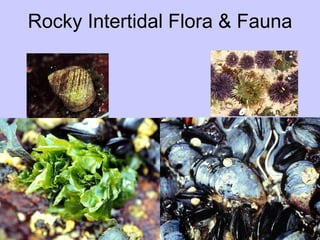
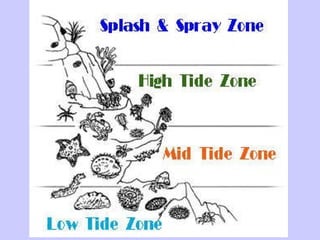
Rocky Intertidal Flora & Fauna

Helpful Links to Communities Salt Marsh & Rocky Shores: http://www.uri.edu/cels/bio/rishores/home.htm Barnacles!  http://www.youtube.com/watch?v=M2ow4sB-RQs&feature=related

Coastal Communities

  • 1.
    Salt Marsh Communities• Found in protected estuarine habitats • Created by grasses, which stabilize soft sediment substrate
  • 2.
    Salt Marshes –Physical Characteristics • Intertidal habitats • Lower elevations of salt marsh are usually submerged daily for several hours, while upper border of salt marsh is only submerged once or twice a month.
  • 3.
    Salt Marsh-Zonation Fewspecies can be good at everything. Salt marsh grasses are usually either good competitors or able to tolerate the physiologically stressful conditions of the low salt marsh. Grasses and flowering plants that are good stress tolerators like Spartina alterniflora dominate the low marsh .
  • 4.
    Salt Marsh -Distribution Worldwide -low seacoasts -inside barrier bars and beaches -in estuaries -on deltas
  • 5.
  • 6.
    Salt Marshes Plants& Animals Important nursery grounds for many commercially important fishes Important feeding and breeding habitat for waterfowl
  • 7.
    Plant roots holdthe sediment in and are a place for animals to hide.
  • 8.
    Uses Natural filtersystem Natural barrier against coastal flooding Nursery ground for economically important species Beautiful!
  • 9.
    Human Abuses Construction/Development(habitat loss) Ditching for mosquito “control” Overharvesting of resources
  • 10.
    Dominant Animals BirdsFish Invertebrates Crustaceans Mollusks
  • 11.
  • 12.
  • 13.
  • 14.
  • 15.
    Salt Marsh PlantsHalophytes - plants that tolerate salty water -Some push salt through pores -Some push salt to the end of the plant and drop the end off - Salicornia
  • 16.
  • 17.
  • 18.
    Phragmites australis –that all too common, common reed
  • 19.
    Salt Marsh atLow Tide
  • 20.
    Salt Marsh atHigh Tide
  • 21.
    To Learn MoreAbout Salt Marshes Local salt marshes: www.chipr.sunysb.edu/eserc/longis/flaxpond.html Regional salt marshes: http:// www.edc.uri.edu/restoration/html/gallery/plants/reed.htm http:// serc.carleton.edu/introgeo/roleplaying/examples/tide.html http://www.nationalgeographic.com/xpeditions/lessons/08/g35/oceans35.html http:// www.dnr.sc.gov/marine/pub/seascience/dynamic.html
  • 22.
  • 23.
    Mud (Tidal) Flats– Physical Characteristics Some areas of estuary wetlands are relatively devoid of plant matter. These Soft sediment habitats are the Tidal (Mud) Flats. They occur along outer edges of the salt marshes where low current flow allows fine sediment to drop out of suspension
  • 24.
    Who lives inMud (Tidal) Flats? Home to a diverse community of invertebrates: Snails, Clams & Segmented worms-all move through the bottom, mixing deeper, oxygen-starved sediments with surface sediments ( bioturbation ).
  • 25.
    Mud flats providehabitat/feeding ground for many invertebrates – and their predators
  • 26.
  • 27.
    Human Uses Similarto salt marsh - important nursery ground for young fish - barrier from storm damage to land/coastal flooding - beautiful
  • 28.
    Threats to Mud(Tidal) Flats Change in current velocity Development of surrounding marshes Dredging Global warming
  • 29.
  • 30.
    Seagrass Distribution -Shallow sub-tidal habitats created by marine grasses -Found in estuaries and lagoons in both temperate and tropical systems throughout the world
  • 31.
    Values of Seagrasses- Mo dify environment by reducing current velocity, which can in turn affect sedimentation rates & soil grain size -Help slow down storms moving inland -Increase habitat complexity, reducing predation intensity -FOOD, SHELTER, NURSERY !!
  • 32.
    Values of Seagrassescontinued Increased number of individuals and species in seagrass bed, compared to bare or sandy areas outside the bed. Our local seagrass is Eelgrass
  • 33.
    Who Lives There?Values of Seagrasses continued - Fish, crabs, shrimp, and scallops are much more common inside sea grass beds than outside them. Some species, such as clams and scallops, also grow faster within a sea grass bed.
  • 34.
    Threats To SeagrassesBoat propeller damage Global warming, sea level rise Water quality & clarity decreases from runoff (making photosynthesis difficult) Brown Tide
  • 35.
    To learn moreabout Seagrasses: http://www.sms.si.edu/IRLspec/Seagrass_Habitat.htm http://www.ncl.ac.uk/tcmweb/tcm/sglinks.htm
  • 36.
    Rocky Intertidal CommunitiesPhysical Characteristics: Dependent on tides-periodically covered by water or exposed to elements Rocky – cobble to boulder sized sediment
  • 37.
    Value of RockyIntertidal Structure, habitat for economically & environmentally important species
  • 38.
  • 39.
  • 40.
    Threats to theRocky Intertidal Global Climate Change & Sea Level Rise Waste disposal/sewage disposal Overcollecting, trampling by humans
  • 41.
  • 42.
  • 43.
    Helpful Links toCommunities Salt Marsh & Rocky Shores: http://www.uri.edu/cels/bio/rishores/home.htm Barnacles! http://www.youtube.com/watch?v=M2ow4sB-RQs&feature=related

Editor's Notes

  • #10 Filling in salt marshes for great waterfront housing
  • #13 Ribbed mussels
  • #14 Red-winged blackbird
  • #15 Horseshoe crab
  • #16 Pickleweed - Halophytes
  • #17 Salt Marsh Hay
  • #18 cordgrass