• TYPES OF ESTUARINE COMMUNITIES
Open Water
Mudflats
Salt Marshes
Mangrove Forests
Other Estuarine Communities
• TYPES OF ESTUARINE COMMUNITIES
Open Water
Lots of suspended sediment → murky water → poor
light penetration → limited primary production by
phytoplankton
Small estuaries – planktons are flushed in and out
Large estuaries – have own estuarine species
Good nurseries for fish and invertebrates
Abundant food
Fewer predators
• TYPES OF ESTUARINE COMMUNITIES
Open Water
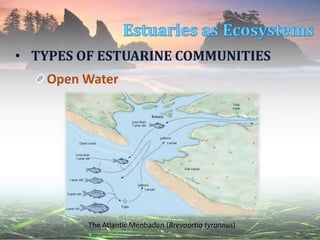
The Atlantic Menhaden (Brevoortia tyrannus)
• TYPES OF ESTUARINE COMMUNITIES
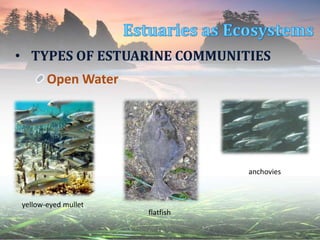
Open Water
yellow-eyed mullet
flatfish
anchovies
• TYPES OF ESTUARINE COMMUNITIES
Open Water
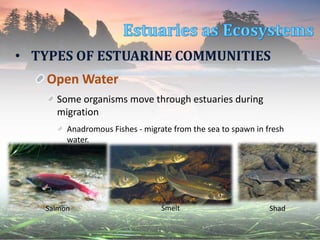
Some organisms move through estuaries during
migration
Anadromous Fishes - migrate from the sea to spawn in fresh
water.
Salmon Smelt Shad
• TYPES OF ESTUARINE COMMUNITIES
Open Water
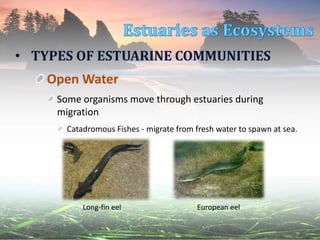
Some organisms move through estuaries during
migration
Catadromous Fishes - migrate from fresh water to spawn at sea.
European eelLong-fin eel
• TYPES OF ESTUARINE COMMUNITIES
Open Water
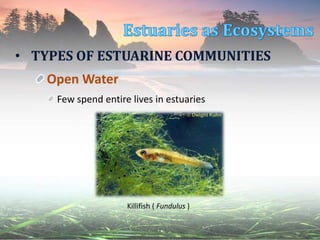
Few spend entire lives in estuaries
Killifish ( Fundulus )
• TYPES OF ESTUARINE COMMUNITIES
Mudflats
Bottoms of estuaries that are exposed at low tides
Extensive in large tidal range
Sand - accumulate near river mouth & tidal creeks
Fine, silty – in calmer central part of mudflat
Low tides expose organisms to dessication, temperature
change, & predation
Regular variations in salinity
• TYPES OF ESTUARINE COMMUNITIES
Mudflats
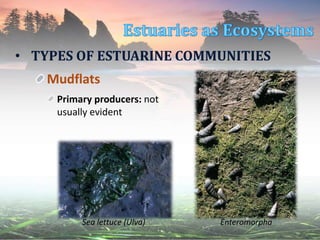
Primary producers: not
usually evident
EnteromorphaSea lettuce (Ulva)
• TYPES OF ESTUARINE COMMUNITIES
Mudflats
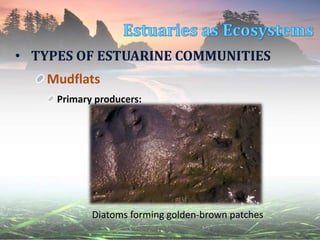
Primary producers:
Diatoms forming golden-brown patches
• TYPES OF ESTUARINE COMMUNITIES
Mudflats
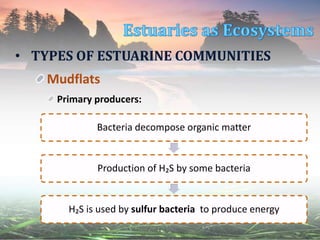
Primary producers:
Bacteria decompose organic matter
Production of H₂S by some bacteria
H₂S is used by sulfur bacteria to produce energy
• TYPES OF ESTUARINE COMMUNITIES
Mudflats
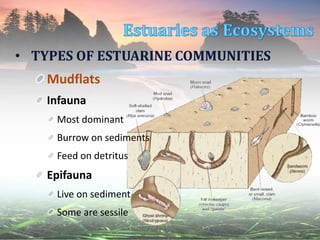
Infauna
Most dominant
Burrow on sediments
Feed on detritus
Epifauna
Live on sediment
Some are sessile
• TYPES OF ESTUARINE COMMUNITIES
Mudflats
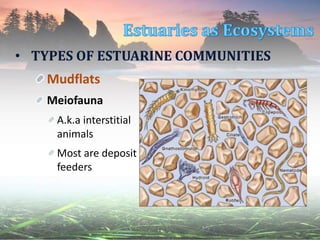
Meiofauna
A.k.a interstitial
animals
Most are deposit
feeders
• TYPES OF ESTUARINE COMMUNITIES
Mudflats
Deposit feeders – eat organic materials in
sediments
Suspension feeders – feed on suspended
materials in water
• TYPES OF ESTUARINE COMMUNITIES
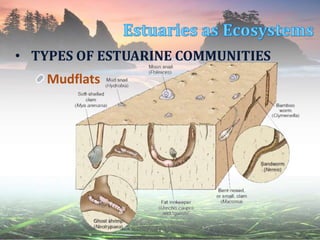
Mudflats
• TYPES OF ESTUARINE COMMUNITIES
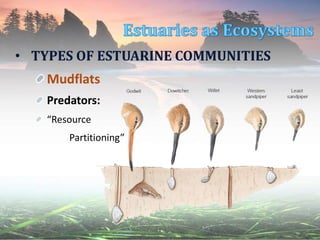
Mudflats
Predators:
“Resource
Partitioning”
• TYPES OF ESTUARINE COMMUNITIES
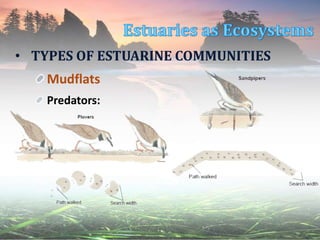
Mudflats
Predators:
• TYPES OF ESTUARINE COMMUNITIES
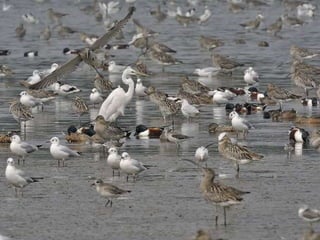
Mudflats
Predators:
• TYPES OF ESTUARINE COMMUNITIES
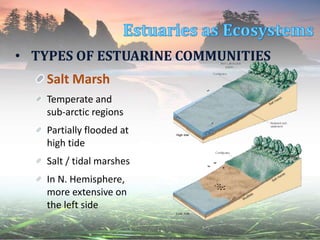
Salt Marsh
Temperate and
sub-arctic regions
Partially flooded at
high tide
Salt / tidal marshes
In N. Hemisphere,
more extensive on
the left side
• TYPES OF ESTUARINE COMMUNITIES
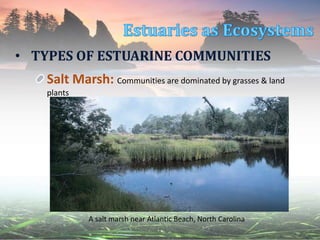
Salt Marsh: Communities are dominated by grasses & land
plants
A salt marsh near Atlantic Beach, North Carolina
• TYPES OF ESTUARINE COMMUNITIES
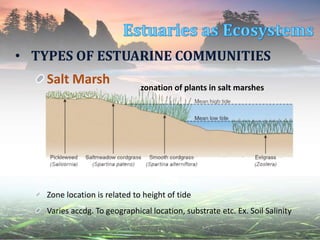
Salt Marsh zonation of plants in salt marshes
Zone location is related to height of tide
Varies accdg. To geographical location, substrate etc. Ex. Soil Salinity
• TYPES OF ESTUARINE COMMUNITIES
Salt Marsh
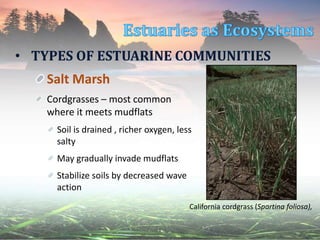
Cordgrasses – most common
where it meets mudflats
Soil is drained , richer oxygen, less
salty
May gradually invade mudflats
Stabilize soils by decreased wave
action
California cordgrass (Spartina foliosa),
• TYPES OF ESTUARINE COMMUNITIES
Salt Marsh
Home to decay bacteria, diatoms, green algae, &
cyanobacteria.
Bacteria decompose – major source of detritus
Some bacteria are nitrogen fixers –enrich sediment
Animals:
burrowing animals in mudflats
Nematodes, small crustaceans, larvae of land insects
• TYPES OF ESTUARINE COMMUNITIES
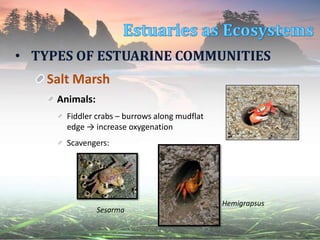
Salt Marsh
Animals:
Fiddler crabs – burrows along mudflat
edge → increase oxygenation
Scavengers:
Sesarma
Hemigrapsus
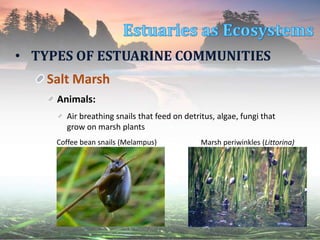
• TYPES OF ESTUARINE COMMUNITIES
Salt Marsh
Animals:
Air breathing snails that feed on detritus, algae, fungi that
grow on marsh plants
Coffee bean snails (Melampus) Marsh periwinkles (Littorina)
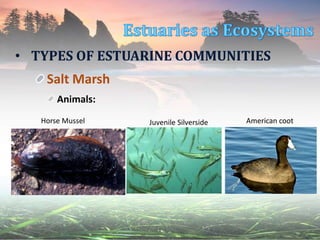
• TYPES OF ESTUARINE COMMUNITIES
Salt Marsh
Animals:
Horse Mussel Juvenile Silverside American coot
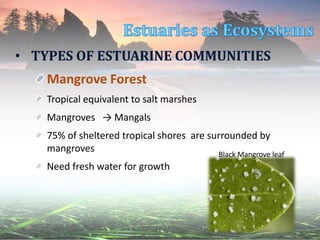
• TYPES OF ESTUARINE COMMUNITIES
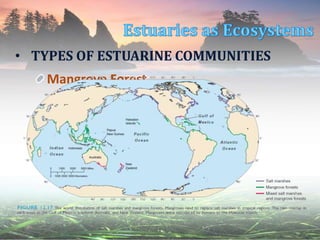
Mangrove Forest
Tropical equivalent to salt marshes
Mangroves → Mangals
75% of sheltered tropical shores are surrounded by
mangroves
Need fresh water for growth
Black Mangrove leaf
Mangrove Forest
• TYPES OF ESTUARINE COMMUNITIES
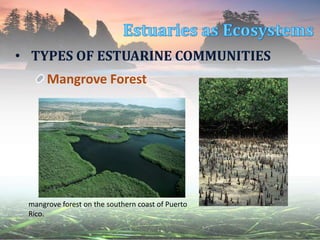
Mangrove Forest
mangrove forest on the southern coast of Puerto
Rico.
Mangrove Forest
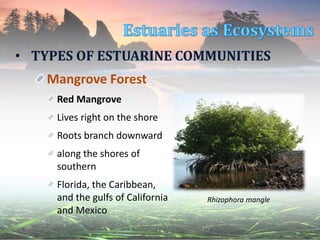
Red Mangrove
Lives right on the shore
Roots branch downward
along the shores of
southern
Florida, the Caribbean,
and the gulfs of California
and Mexico
• TYPES OF ESTUARINE COMMUNITIES
Rhizophora mangle
Mangrove Forest
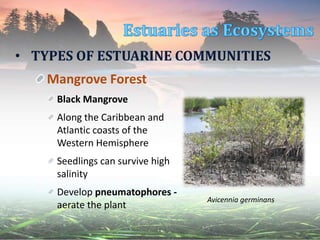
Black Mangrove
Along the Caribbean and
Atlantic coasts of the
Western Hemisphere
Seedlings can survive high
salinity
Develop pneumatophores -
aerate the plant
• TYPES OF ESTUARINE COMMUNITIES
Avicennia germinans
Mangrove Forest
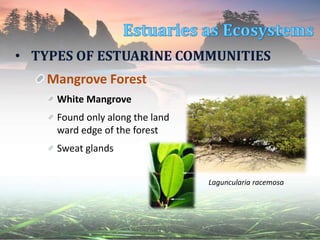
White Mangrove
Found only along the land
ward edge of the forest
Sweat glands
• TYPES OF ESTUARINE COMMUNITIES
Laguncularia racemosa
Mangrove Forest
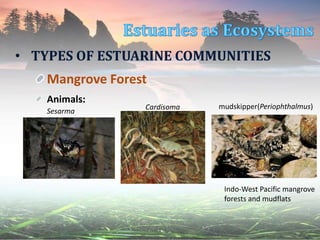
Animals:
• TYPES OF ESTUARINE COMMUNITIES
Sesarma
Cardisoma mudskipper(Periophthalmus)
Indo-West Pacific mangrove
forests and mudflats
• TYPES OF ESTUARINE COMMUNITIES
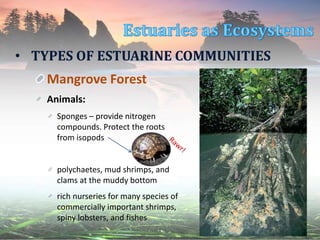
Mangrove Forest
Animals:
Sponges – provide nitrogen
compounds. Protect the roots
from isopods
polychaetes, mud shrimps, and
clams at the muddy bottom
rich nurseries for many species of
commercially important shrimps,
spiny lobsters, and fishes
• TYPES OF ESTUARINE COMMUNITIES
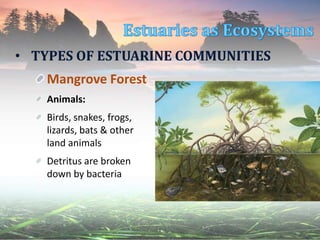
Mangrove Forest
Animals:
Birds, snakes, frogs,
lizards, bats & other
land animals
Detritus are broken
down by bacteria
• TYPES OF ESTUARINE COMMUNITIES
Other Estuarine Communities
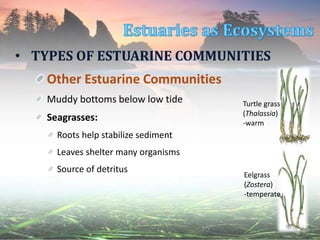
Muddy bottoms below low tide
Seagrasses:
Roots help stabilize sediment
Leaves shelter many organisms
Source of detritus
Eelgrass
(Zostera)
-temperate
Turtle grass
(Thalassia)
-warm
• TYPES OF ESTUARINE COMMUNITIES
Other Estuarine Communities
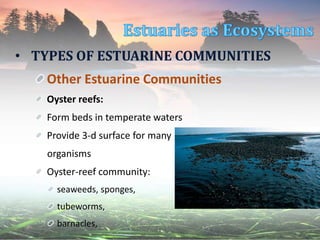
Oyster reefs:
Form beds in temperate waters
Provide 3-d surface for many
organisms
Oyster-reef community:
seaweeds, sponges,
tubeworms,
barnacles,
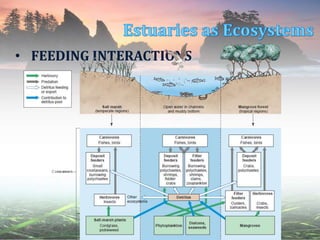
• FEEDING INTERACTIONS
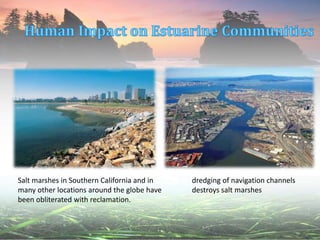
Salt marshes in Southern California and in
many other locations around the globe have
been obliterated with reclamation.
dredging of navigation channels
destroys salt marshes
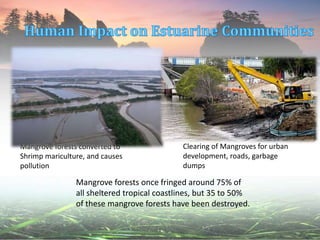
Mangrove forests converted to
Shrimp mariculture, and causes
pollution
Clearing of Mangroves for urban
development, roads, garbage
dumps
Mangrove forests once fringed around 75% of
all sheltered tropical coastlines, but 35 to 50%
of these mangrove forests have been destroyed.

Estuaries: Communities

  • 2.
    • TYPES OFESTUARINE COMMUNITIES Open Water Mudflats Salt Marshes Mangrove Forests Other Estuarine Communities
  • 3.
    • TYPES OFESTUARINE COMMUNITIES Open Water Lots of suspended sediment → murky water → poor light penetration → limited primary production by phytoplankton Small estuaries – planktons are flushed in and out Large estuaries – have own estuarine species Good nurseries for fish and invertebrates Abundant food Fewer predators
  • 4.
    • TYPES OFESTUARINE COMMUNITIES Open Water The Atlantic Menhaden (Brevoortia tyrannus)
  • 5.
    • TYPES OFESTUARINE COMMUNITIES Open Water yellow-eyed mullet flatfish anchovies
  • 6.
    • TYPES OFESTUARINE COMMUNITIES Open Water Some organisms move through estuaries during migration Anadromous Fishes - migrate from the sea to spawn in fresh water. Salmon Smelt Shad
  • 7.
    • TYPES OFESTUARINE COMMUNITIES Open Water Some organisms move through estuaries during migration Catadromous Fishes - migrate from fresh water to spawn at sea. European eelLong-fin eel
  • 8.
    • TYPES OFESTUARINE COMMUNITIES Open Water Few spend entire lives in estuaries Killifish ( Fundulus )
  • 9.
    • TYPES OFESTUARINE COMMUNITIES Mudflats Bottoms of estuaries that are exposed at low tides Extensive in large tidal range Sand - accumulate near river mouth & tidal creeks Fine, silty – in calmer central part of mudflat Low tides expose organisms to dessication, temperature change, & predation Regular variations in salinity
  • 10.
    • TYPES OFESTUARINE COMMUNITIES Mudflats Primary producers: not usually evident EnteromorphaSea lettuce (Ulva)
  • 11.
    • TYPES OFESTUARINE COMMUNITIES Mudflats Primary producers: Diatoms forming golden-brown patches
  • 12.
    • TYPES OFESTUARINE COMMUNITIES Mudflats Primary producers: Bacteria decompose organic matter Production of H₂S by some bacteria H₂S is used by sulfur bacteria to produce energy
  • 13.
    • TYPES OFESTUARINE COMMUNITIES Mudflats Infauna Most dominant Burrow on sediments Feed on detritus Epifauna Live on sediment Some are sessile
  • 14.
    • TYPES OFESTUARINE COMMUNITIES Mudflats Meiofauna A.k.a interstitial animals Most are deposit feeders
  • 15.
    • TYPES OFESTUARINE COMMUNITIES Mudflats Deposit feeders – eat organic materials in sediments Suspension feeders – feed on suspended materials in water
  • 16.
    • TYPES OFESTUARINE COMMUNITIES Mudflats
  • 17.
    • TYPES OFESTUARINE COMMUNITIES Mudflats Predators: “Resource Partitioning”
  • 18.
    • TYPES OFESTUARINE COMMUNITIES Mudflats Predators:
  • 19.
    • TYPES OFESTUARINE COMMUNITIES Mudflats Predators:
  • 20.
    • TYPES OFESTUARINE COMMUNITIES Salt Marsh Temperate and sub-arctic regions Partially flooded at high tide Salt / tidal marshes In N. Hemisphere, more extensive on the left side
  • 21.
    • TYPES OFESTUARINE COMMUNITIES Salt Marsh: Communities are dominated by grasses & land plants A salt marsh near Atlantic Beach, North Carolina
  • 22.
    • TYPES OFESTUARINE COMMUNITIES Salt Marsh zonation of plants in salt marshes Zone location is related to height of tide Varies accdg. To geographical location, substrate etc. Ex. Soil Salinity
  • 23.
    • TYPES OFESTUARINE COMMUNITIES Salt Marsh Cordgrasses – most common where it meets mudflats Soil is drained , richer oxygen, less salty May gradually invade mudflats Stabilize soils by decreased wave action California cordgrass (Spartina foliosa),
  • 24.
    • TYPES OFESTUARINE COMMUNITIES Salt Marsh Home to decay bacteria, diatoms, green algae, & cyanobacteria. Bacteria decompose – major source of detritus Some bacteria are nitrogen fixers –enrich sediment Animals: burrowing animals in mudflats Nematodes, small crustaceans, larvae of land insects
  • 25.
    • TYPES OFESTUARINE COMMUNITIES Salt Marsh Animals: Fiddler crabs – burrows along mudflat edge → increase oxygenation Scavengers: Sesarma Hemigrapsus
  • 26.
    • TYPES OFESTUARINE COMMUNITIES Salt Marsh Animals: Air breathing snails that feed on detritus, algae, fungi that grow on marsh plants Coffee bean snails (Melampus) Marsh periwinkles (Littorina)
  • 27.
    • TYPES OFESTUARINE COMMUNITIES Salt Marsh Animals: Horse Mussel Juvenile Silverside American coot
  • 28.
    • TYPES OFESTUARINE COMMUNITIES Mangrove Forest Tropical equivalent to salt marshes Mangroves → Mangals 75% of sheltered tropical shores are surrounded by mangroves Need fresh water for growth Black Mangrove leaf
  • 29.
    Mangrove Forest • TYPESOF ESTUARINE COMMUNITIES
  • 30.
    • TYPES OFESTUARINE COMMUNITIES Mangrove Forest mangrove forest on the southern coast of Puerto Rico.
  • 31.
    Mangrove Forest Red Mangrove Livesright on the shore Roots branch downward along the shores of southern Florida, the Caribbean, and the gulfs of California and Mexico • TYPES OF ESTUARINE COMMUNITIES Rhizophora mangle
  • 32.
    Mangrove Forest Black Mangrove Alongthe Caribbean and Atlantic coasts of the Western Hemisphere Seedlings can survive high salinity Develop pneumatophores - aerate the plant • TYPES OF ESTUARINE COMMUNITIES Avicennia germinans
  • 33.
    Mangrove Forest White Mangrove Foundonly along the land ward edge of the forest Sweat glands • TYPES OF ESTUARINE COMMUNITIES Laguncularia racemosa
  • 34.
    Mangrove Forest Animals: • TYPESOF ESTUARINE COMMUNITIES Sesarma Cardisoma mudskipper(Periophthalmus) Indo-West Pacific mangrove forests and mudflats
  • 35.
    • TYPES OFESTUARINE COMMUNITIES Mangrove Forest Animals: Sponges – provide nitrogen compounds. Protect the roots from isopods polychaetes, mud shrimps, and clams at the muddy bottom rich nurseries for many species of commercially important shrimps, spiny lobsters, and fishes
  • 36.
    • TYPES OFESTUARINE COMMUNITIES Mangrove Forest Animals: Birds, snakes, frogs, lizards, bats & other land animals Detritus are broken down by bacteria
  • 37.
    • TYPES OFESTUARINE COMMUNITIES Other Estuarine Communities Muddy bottoms below low tide Seagrasses: Roots help stabilize sediment Leaves shelter many organisms Source of detritus Eelgrass (Zostera) -temperate Turtle grass (Thalassia) -warm
  • 38.
    • TYPES OFESTUARINE COMMUNITIES Other Estuarine Communities Oyster reefs: Form beds in temperate waters Provide 3-d surface for many organisms Oyster-reef community: seaweeds, sponges, tubeworms, barnacles,
  • 39.
  • 40.
    Salt marshes inSouthern California and in many other locations around the globe have been obliterated with reclamation. dredging of navigation channels destroys salt marshes
  • 41.
    Mangrove forests convertedto Shrimp mariculture, and causes pollution Clearing of Mangroves for urban development, roads, garbage dumps Mangrove forests once fringed around 75% of all sheltered tropical coastlines, but 35 to 50% of these mangrove forests have been destroyed.