A North Carolina Treasure
Kella Randolph M.Ed.
Core Sound Estuary
• Location
o Importance
• Plant life
oAnimal life
• Rivers, streams and other waterways that feed into the sound
oThreats to the Core Sound Estuary
Core Sound Estuary
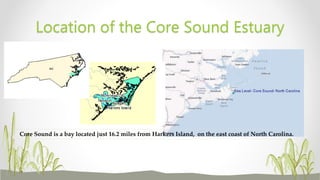
Location of the Core Sound Estuary
Core Sound is a bay located just 16.2 miles from Harkers Island, on the east coast of North Carolina.
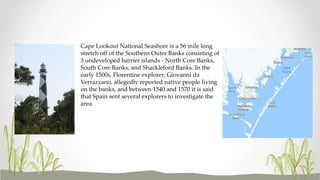
Cape Lookout National Seashore is a 56 mile long
stretch off of the Southern Outer Banks consisting of
3 undeveloped barrier islands - North Core Banks,
South Core Banks, and Shackleford Banks. In the
early 1500s, Florentine explorer, Giovanni da
Verrazzano, allegedly reported native people living
on the banks, and between 1540 and 1570 it is said
that Spain sent several explorers to investigate the
area.
Estuaries are some of the most
productive ecosystems in the world.
Many animal species rely on estuaries
for food and as places to nest and
breed. Human communities also rely
on estuaries for food, recreation, and
jobs. (NOAA)
Estuaries are bodies of water as well
as their surrounding coastal habitats
typically found where rivers meet the
sea. Estuaries harbor unique plant and
animal communities because their
waters are brackish—a mixture of
fresh water draining from the land
and salty seawater. (NOAA)
Importance of the Core Sound Estuary
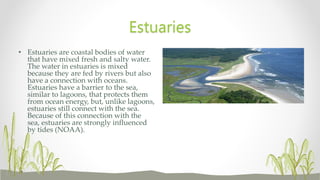
• Estuaries are coastal bodies of water
that have mixed fresh and salty water.
The water in estuaries is mixed
because they are fed by rivers but also
have a connection with oceans.
Estuaries have a barrier to the sea,
similar to lagoons, that protects them
from ocean energy, but, unlike lagoons,
estuaries still connect with the sea.
Because of this connection with the
sea, estuaries are strongly influenced
by tides (NOAA).
Estuaries
Estuaries’ unique environment makes them a good
place for humans and animals. Humans benefit from the
beauty of estuaries and the food and resources they
provide. Estuaries are often tourism attractions or
harbors and ports. The mix of fresh and saltwater makes
a great feeding ground and habitat for many types of
wildlife (EPA).
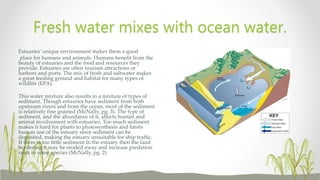
This water mixture also results in a mixture of types of
sediment. Though estuaries have sediment from both
upstream rivers and from the ocean, most of the sediment
is relatively fine grained (McNally, pg. 3). The type of
sediment, and the abundance of it, affects human and
animal involvement with estuaries. Too much sediment
makes it hard for plants to photosynthesis and limits
human use of the estuary since sediment can be
deposited, making the estuary unsuitable for ship traffic.
If there is too little sediment in the estuary then the land
bordering it may be eroded away and increase predation
rates in some species (McNally, pg. 2)
Fresh water mixes with ocean water.
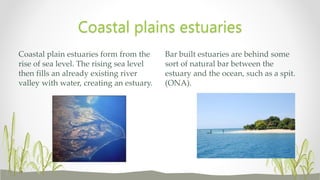
Bar built estuaries are behind some
sort of natural bar between the
estuary and the ocean, such as a spit.
(ONA).
Coastal plain estuaries form from the
rise of sea level. The rising sea level
then fills an already existing river
valley with water, creating an estuary.
Coastal plains estuaries
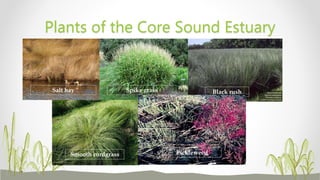
Plants of the Core Sound Estuary
Salt hay Spike grass Black rush
Smooth cordgrass Pickleweed
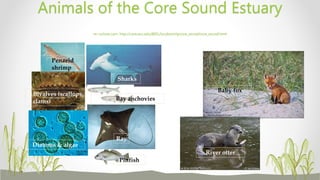
Animals of the Core Sound Estuary
nc-culture.com, http://core.ecu.edu/BIOL/luczkovichj/core_sound/core_sound.html
Baby fox
Diatoms & algae
Ray
Sharks
Bay anchovies
Pinfish
Bivalves (scallops,
clams)
Penaeid
shrimp
River otter
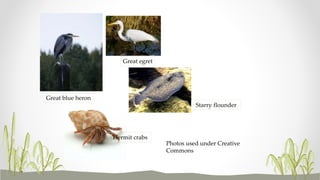
Photos used under Creative
Commons
Starry flounder
Hermit crabs
Great blue heron
Great egret
Core Sound produces the most valuable seafood catch in the basin, followed by
Bogue Sound and the Newport River.
White Oak River is a remote, scenic, 48-mile river that spills into Bogue Sound
past the picturesque town of Swansboro. Still farther east is the basin’s Newport
River, which begins near Havelock and flows into the eastern end of Bogue
Sound. The shortest and eastern -most river in the basin is the North River,
which empties into Back Sound near Harker's Island.
http://www.eenorthcarolina.org/Documents/RiverBasin_pdfs/final_web_whiteoak.pdf
Rivers, streams and waterways of the
Core Sound Estuary
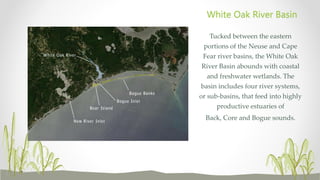
Tucked between the eastern
portions of the Neuse and Cape
Fear river basins, the White Oak
River Basin abounds with coastal
and freshwater wetlands. The
basin includes four river systems,
or sub-basins, that feed into highly
productive estuaries of
Back, Core and Bogue sounds.
White Oak River Basin
• http://www.ncwildlife.org/Portals/0/Conserving/documents/NCRiverBasins/WhiteOakRiverBasin/WOR
B-FULL.pdf
• http://pubs.usgs.gov/circ/circ1173/circ1173b/chapter08.htm
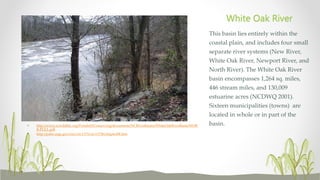
This basin lies entirely within the
coastal plain, and includes four small
separate river systems (New River,
White Oak River, Newport River, and
North River). The White Oak River
basin encompasses 1,264 sq. miles,
446 stream miles, and 130,009
estuarine acres (NCDWQ 2001).
Sixteen municipalities (towns) are
located in whole or in part of the
basin.
White Oak River
Salt marshes are salty because they
are flooded by seawater every day.
They are marshy because their ground
is composed of peat. Peat is made of
decomposing plant matter that is
often several feet thick. Peat is
waterlogged, root-filled, and very
spongy.
http://oceanservice.noaa.gov/education/tutorial_estuaries/media/supp_est06
a_salt.html
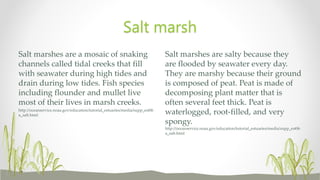
Salt marshes are a mosaic of snaking
channels called tidal creeks that fill
with seawater during high tides and
drain during low tides. Fish species
including flounder and mullet live
most of their lives in marsh creeks.
http://oceanservice.noaa.gov/education/tutorial_estuaries/media/supp_est06
a_salt.html
Salt marsh
Core Sound Salt Marsh
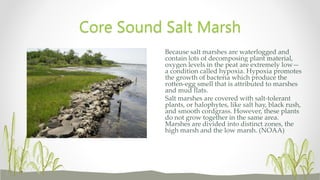
Because salt marshes are waterlogged and
contain lots of decomposing plant material,
oxygen levels in the peat are extremely low—
a condition called hypoxia. Hypoxia promotes
the growth of bacteria which produce the
rotten-egg smell that is attributed to marshes
and mud flats.
Salt marshes are covered with salt-tolerant
plants, or halophytes, like salt hay, black rush,
and smooth cordgrass. However, these plants
do not grow together in the same area.
Marshes are divided into distinct zones, the
high marsh and the low marsh. (NOAA)
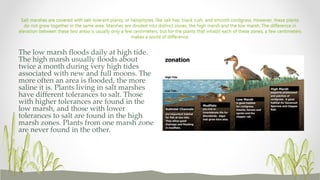
The low marsh floods daily at high tide.
The high marsh usually floods about
twice a month during very high tides
associated with new and full moons. The
more often an area is flooded, the more
saline it is. Plants living in salt marshes
have different tolerances to salt. Those
with higher tolerances are found in the
low marsh, and those with lower
tolerances to salt are found in the high
marsh zones. Plants from one marsh zone
are never found in the other.
Salt marshes are covered with salt-tolerant plants, or halophytes, like salt hay, black rush, and smooth cordgrass. However, these plants
do not grow together in the same area. Marshes are divided into distinct zones, the high marsh and the low marsh. The difference in
elevation between these two areas is usually only a few centimeters, but for the plants that inhabit each of these zones, a few centimeters
makes a world of difference.
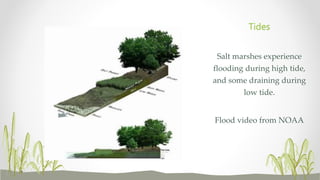
Salt marshes experience
flooding during high tide,
and some draining during
low tide.
Flood video from NOAA
Tides
One type of natural disturbance is the
continual pounding of ocean waves. In many
estuaries, barrier beaches protect inland
habitats from wave erosion. If these beaches
are destroyed, salt marshes and inland
habitats adjacent to the estuary may become
permanently damaged. Waves can also
dislodge plants and animals, or bury them
with sediments, while objects carried by the
water can crush them. Large storms are
especially destructive to estuaries,
particularly in areas like Florida and the
Carolinas, where barrier beaches are
common. (NOAA)
Estuaries are fragile ecosystems that are
very susceptible to disturbances. Natural
disturbances are caused by the forces of
nature, while anthropogenic disturbances
are caused by people. Natural
disturbances include winds, tidal
currents, waves, and ice. Anthropogenic
disturbances include pollution, coastal
development, and the introduction of
non-native species to an area. (NOAA)
Threats to the Core Sound Estuary
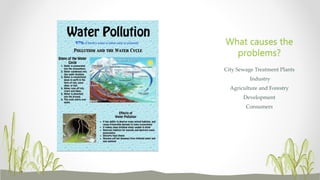
City Sewage Treatment Plants
Industry
Agriculture and Forestry
Development
Consumers
What causes the
problems?
• Install a water efficient toilet. In the meantime, put
a brick or 1/2 gal container in the standard toilet
tank to reduce water use per flush.
• Run the dishwasher or clothes washer only when
you have a full load. This conserves electricity and
water.
• Use the minimum amount of detergent and/or
bleach when you are washing clothes or dishes.
Use only phosphate free soaps and detergents.
• Minimize the use of pesticides, herbicides,
fertilizers. DO NOT dispose of these chemicals,
motor oil, or other automotive fluids into the
sanitary sewer or storm sewer systems. Both of
them end at the river.
• If your home has a sump pump or cellar drain,
make certain it does not drain into the sanitary
sewer system.
http://www.simsbury-ct.gov/water-pollution-control/pages/ten-things-you-can-
do-to-reduce-water-pollution
Ten Things You Can Do To Reduce Water Pollution
• DO NOT pour fat from cooking or any other type
of fat, oil, or grease down the sink. Keep a “fat jar”
under the sink to collect the fat and discard in the
solid waste when full.
• DO NOT dispose of household chemicals or
cleaning agents down the sink or toilet.
• DO NOT flush pills, liquid or powder medications
or drugs down the toilet. For recommendations on
proper disposal for all types of medical wastes,
visit the CT DEP publication here.
• Avoid using the toilet as a wastebasket. Most
tissues, wrappers, dust cloths, and other paper
goods should be properly discarded in a
wastebasket. The fiber reinforced cleaning
products that have become popular should never
be discarded in the toilet.
• Avoid using a garbage disposal. Keep solid wastes
solid. Make a compost pile from vegetable scraps.
EPA. Retrieved from http://water.epa.gov/type/oceb/nep/about.cfm.
McNally, W. H., Mehta, A. J. Retrieved from http://www.eolss.net/Sample-Chapters/C09/E2-
06-01-04.pdf.
NOAA. Retrieved from
http://oceanservice.noaa.gov/education/tutorial_estuaries/welcome.html.
ONA Retrieved from http://www.onr.navy.mil/focus/ocean/habitats/estuaries1.htm.
http://oceanservice.noaa.gov/education/tutorial_estuaries/media/supp_est06a_salt.html
http://www.eenorthcarolina.org/Documents/RiverBasin_pdfs/final_web_whiteoak.pdf
Photos courtesy of Creative Commons and NOAA
Resources

Core sound estuary1

  • 1.
    A North CarolinaTreasure Kella Randolph M.Ed. Core Sound Estuary
  • 2.
    • Location o Importance •Plant life oAnimal life • Rivers, streams and other waterways that feed into the sound oThreats to the Core Sound Estuary Core Sound Estuary
  • 3.
    Location of theCore Sound Estuary Core Sound is a bay located just 16.2 miles from Harkers Island, on the east coast of North Carolina.
  • 4.
    Cape Lookout NationalSeashore is a 56 mile long stretch off of the Southern Outer Banks consisting of 3 undeveloped barrier islands - North Core Banks, South Core Banks, and Shackleford Banks. In the early 1500s, Florentine explorer, Giovanni da Verrazzano, allegedly reported native people living on the banks, and between 1540 and 1570 it is said that Spain sent several explorers to investigate the area.
  • 5.
    Estuaries are someof the most productive ecosystems in the world. Many animal species rely on estuaries for food and as places to nest and breed. Human communities also rely on estuaries for food, recreation, and jobs. (NOAA) Estuaries are bodies of water as well as their surrounding coastal habitats typically found where rivers meet the sea. Estuaries harbor unique plant and animal communities because their waters are brackish—a mixture of fresh water draining from the land and salty seawater. (NOAA) Importance of the Core Sound Estuary
  • 6.
    • Estuaries arecoastal bodies of water that have mixed fresh and salty water. The water in estuaries is mixed because they are fed by rivers but also have a connection with oceans. Estuaries have a barrier to the sea, similar to lagoons, that protects them from ocean energy, but, unlike lagoons, estuaries still connect with the sea. Because of this connection with the sea, estuaries are strongly influenced by tides (NOAA). Estuaries
  • 7.
    Estuaries’ unique environmentmakes them a good place for humans and animals. Humans benefit from the beauty of estuaries and the food and resources they provide. Estuaries are often tourism attractions or harbors and ports. The mix of fresh and saltwater makes a great feeding ground and habitat for many types of wildlife (EPA). This water mixture also results in a mixture of types of sediment. Though estuaries have sediment from both upstream rivers and from the ocean, most of the sediment is relatively fine grained (McNally, pg. 3). The type of sediment, and the abundance of it, affects human and animal involvement with estuaries. Too much sediment makes it hard for plants to photosynthesis and limits human use of the estuary since sediment can be deposited, making the estuary unsuitable for ship traffic. If there is too little sediment in the estuary then the land bordering it may be eroded away and increase predation rates in some species (McNally, pg. 2) Fresh water mixes with ocean water.
  • 8.
    Bar built estuariesare behind some sort of natural bar between the estuary and the ocean, such as a spit. (ONA). Coastal plain estuaries form from the rise of sea level. The rising sea level then fills an already existing river valley with water, creating an estuary. Coastal plains estuaries
  • 9.
    Plants of theCore Sound Estuary Salt hay Spike grass Black rush Smooth cordgrass Pickleweed
  • 10.
    Animals of theCore Sound Estuary nc-culture.com, http://core.ecu.edu/BIOL/luczkovichj/core_sound/core_sound.html Baby fox Diatoms & algae Ray Sharks Bay anchovies Pinfish Bivalves (scallops, clams) Penaeid shrimp River otter
  • 11.
    Photos used underCreative Commons Starry flounder Hermit crabs Great blue heron Great egret
  • 12.
    Core Sound producesthe most valuable seafood catch in the basin, followed by Bogue Sound and the Newport River. White Oak River is a remote, scenic, 48-mile river that spills into Bogue Sound past the picturesque town of Swansboro. Still farther east is the basin’s Newport River, which begins near Havelock and flows into the eastern end of Bogue Sound. The shortest and eastern -most river in the basin is the North River, which empties into Back Sound near Harker's Island. http://www.eenorthcarolina.org/Documents/RiverBasin_pdfs/final_web_whiteoak.pdf Rivers, streams and waterways of the Core Sound Estuary
  • 13.
    Tucked between theeastern portions of the Neuse and Cape Fear river basins, the White Oak River Basin abounds with coastal and freshwater wetlands. The basin includes four river systems, or sub-basins, that feed into highly productive estuaries of Back, Core and Bogue sounds. White Oak River Basin
  • 14.
    • http://www.ncwildlife.org/Portals/0/Conserving/documents/NCRiverBasins/WhiteOakRiverBasin/WOR B-FULL.pdf • http://pubs.usgs.gov/circ/circ1173/circ1173b/chapter08.htm Thisbasin lies entirely within the coastal plain, and includes four small separate river systems (New River, White Oak River, Newport River, and North River). The White Oak River basin encompasses 1,264 sq. miles, 446 stream miles, and 130,009 estuarine acres (NCDWQ 2001). Sixteen municipalities (towns) are located in whole or in part of the basin. White Oak River
  • 15.
    Salt marshes aresalty because they are flooded by seawater every day. They are marshy because their ground is composed of peat. Peat is made of decomposing plant matter that is often several feet thick. Peat is waterlogged, root-filled, and very spongy. http://oceanservice.noaa.gov/education/tutorial_estuaries/media/supp_est06 a_salt.html Salt marshes are a mosaic of snaking channels called tidal creeks that fill with seawater during high tides and drain during low tides. Fish species including flounder and mullet live most of their lives in marsh creeks. http://oceanservice.noaa.gov/education/tutorial_estuaries/media/supp_est06 a_salt.html Salt marsh
  • 16.
    Core Sound SaltMarsh Because salt marshes are waterlogged and contain lots of decomposing plant material, oxygen levels in the peat are extremely low— a condition called hypoxia. Hypoxia promotes the growth of bacteria which produce the rotten-egg smell that is attributed to marshes and mud flats. Salt marshes are covered with salt-tolerant plants, or halophytes, like salt hay, black rush, and smooth cordgrass. However, these plants do not grow together in the same area. Marshes are divided into distinct zones, the high marsh and the low marsh. (NOAA)
  • 17.
    The low marshfloods daily at high tide. The high marsh usually floods about twice a month during very high tides associated with new and full moons. The more often an area is flooded, the more saline it is. Plants living in salt marshes have different tolerances to salt. Those with higher tolerances are found in the low marsh, and those with lower tolerances to salt are found in the high marsh zones. Plants from one marsh zone are never found in the other. Salt marshes are covered with salt-tolerant plants, or halophytes, like salt hay, black rush, and smooth cordgrass. However, these plants do not grow together in the same area. Marshes are divided into distinct zones, the high marsh and the low marsh. The difference in elevation between these two areas is usually only a few centimeters, but for the plants that inhabit each of these zones, a few centimeters makes a world of difference.
  • 18.
    Salt marshes experience floodingduring high tide, and some draining during low tide. Flood video from NOAA Tides
  • 19.
    One type ofnatural disturbance is the continual pounding of ocean waves. In many estuaries, barrier beaches protect inland habitats from wave erosion. If these beaches are destroyed, salt marshes and inland habitats adjacent to the estuary may become permanently damaged. Waves can also dislodge plants and animals, or bury them with sediments, while objects carried by the water can crush them. Large storms are especially destructive to estuaries, particularly in areas like Florida and the Carolinas, where barrier beaches are common. (NOAA) Estuaries are fragile ecosystems that are very susceptible to disturbances. Natural disturbances are caused by the forces of nature, while anthropogenic disturbances are caused by people. Natural disturbances include winds, tidal currents, waves, and ice. Anthropogenic disturbances include pollution, coastal development, and the introduction of non-native species to an area. (NOAA) Threats to the Core Sound Estuary
  • 20.
    City Sewage TreatmentPlants Industry Agriculture and Forestry Development Consumers What causes the problems?
  • 21.
    • Install awater efficient toilet. In the meantime, put a brick or 1/2 gal container in the standard toilet tank to reduce water use per flush. • Run the dishwasher or clothes washer only when you have a full load. This conserves electricity and water. • Use the minimum amount of detergent and/or bleach when you are washing clothes or dishes. Use only phosphate free soaps and detergents. • Minimize the use of pesticides, herbicides, fertilizers. DO NOT dispose of these chemicals, motor oil, or other automotive fluids into the sanitary sewer or storm sewer systems. Both of them end at the river. • If your home has a sump pump or cellar drain, make certain it does not drain into the sanitary sewer system. http://www.simsbury-ct.gov/water-pollution-control/pages/ten-things-you-can- do-to-reduce-water-pollution Ten Things You Can Do To Reduce Water Pollution • DO NOT pour fat from cooking or any other type of fat, oil, or grease down the sink. Keep a “fat jar” under the sink to collect the fat and discard in the solid waste when full. • DO NOT dispose of household chemicals or cleaning agents down the sink or toilet. • DO NOT flush pills, liquid or powder medications or drugs down the toilet. For recommendations on proper disposal for all types of medical wastes, visit the CT DEP publication here. • Avoid using the toilet as a wastebasket. Most tissues, wrappers, dust cloths, and other paper goods should be properly discarded in a wastebasket. The fiber reinforced cleaning products that have become popular should never be discarded in the toilet. • Avoid using a garbage disposal. Keep solid wastes solid. Make a compost pile from vegetable scraps.
  • 22.
    EPA. Retrieved fromhttp://water.epa.gov/type/oceb/nep/about.cfm. McNally, W. H., Mehta, A. J. Retrieved from http://www.eolss.net/Sample-Chapters/C09/E2- 06-01-04.pdf. NOAA. Retrieved from http://oceanservice.noaa.gov/education/tutorial_estuaries/welcome.html. ONA Retrieved from http://www.onr.navy.mil/focus/ocean/habitats/estuaries1.htm. http://oceanservice.noaa.gov/education/tutorial_estuaries/media/supp_est06a_salt.html http://www.eenorthcarolina.org/Documents/RiverBasin_pdfs/final_web_whiteoak.pdf Photos courtesy of Creative Commons and NOAA Resources