Mangrove Forests
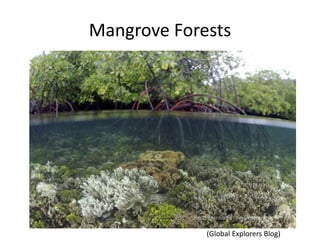
(Global Explorers Blog)
Distribution
(“Environment—Tropical Shelf Seas and Shores”)
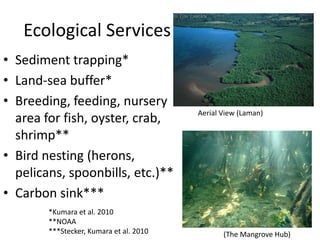
Ecological Services
• Sediment trapping*
• Land-sea buffer*
• Breeding, feeding, nursery
area for fish, oyster, crab,
shrimp**
• Bird nesting (herons,
pelicans, spoonbills, etc.)**
• Carbon sink***
Aerial View (Laman)
(The Mangrove Hub)
*Kumara et al. 2010
**NOAA
***Stecker, Kumara et al. 2010
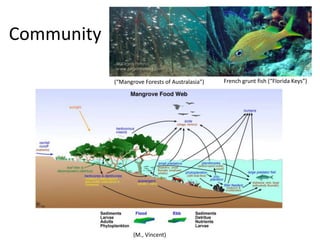
Community
(“Mangrove Forests of Australasia”) French grunt fish (“Florida Keys”)
(M., Vincent)
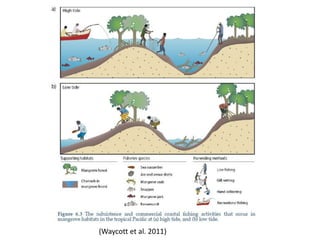
(Waycott et al. 2011)
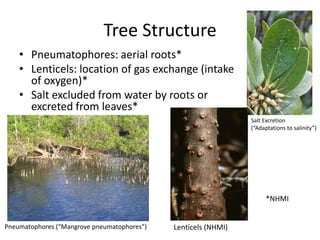
Tree Structure
• Pneumatophores: aerial roots*
• Lenticels: location of gas exchange (intake
of oxygen)*
• Salt excluded from water by roots or
excreted from leaves*
Salt Excretion
(“Adaptations to salinity”)
Lenticels (NHMI)Pneumatophores (“Mangrove pneumatophores”)
*NHMI
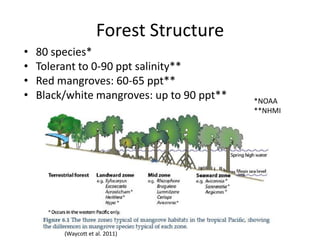
Forest Structure
• 80 species*
• Tolerant to 0-90 ppt salinity**
• Red mangroves: 60-65 ppt**
• Black/white mangroves: up to 90 ppt**
(Waycott et al. 2011)
*NOAA
**NHMI
Threats: From the Land
• 35% loss in
mangroves*
• Mangrove clearing has
caused 10% of
deforestation-based
CO₂ emissions**
• Only make up 0.7% of
forests***
• Land used for
agriculture (rice),
aquaculture (shrimp
ponds),
industrial/residential
building***
(ELAW)
(Smithsonian)
*Mumby et al. 2004
**Phys.org
***Stecker
Threats: From the Sea
• Sea level rising by 3 mm/year*
• 70-140 cm increase in level by 2100**
• Due to loss of land ice and thermal expansion
of oceans
(Church et al. 2008)
*Church et al. 2008
**Waycott et al. 2011
Adaptability
• Historically began landward migration with
sea level rise rate higher than 0.7 mm/year*
• May also accrete sediment (2.8 mm/year)
• Adaptability depends on:*
– Sediment availability for elevation building
– Landward human infrastructure
– Landward surface gradient
– Landward natural competition
*Waycott et al. 2011
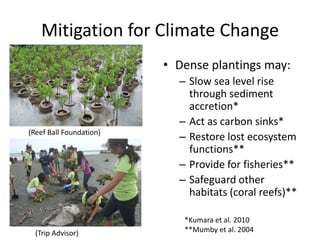
Mitigation for Climate Change
• Dense plantings may:
– Slow sea level rise
through sediment
accretion*
– Act as carbon sinks*
– Restore lost ecosystem
functions**
– Provide for fisheries**
– Safeguard other
habitats (coral reefs)**
(Reef Ball Foundation)
(Trip Advisor)
*Kumara et al. 2010
**Mumby et al. 2004
Bibliography
“Adaptations to salinity.” <http://users.tpg.com.au/users/rwest000/mangrove/salinity.html>
Bering, A. J. “Plant the Mangrove Propagules.” Trip Advisor. <http://tripwow.tripadvisor.com/slideshow-photo/plant-
the-mangrove-propagules-roxas-city-philippines.html?sid=66320734&fid=upload_13268627070-tpfil02aw-25340>
Church, J. A., White, N. J., Aarup, T., Wilson, W. S., Woodworth, P. L., Domingues, C. M., Hunter, J. R., and Lambeck, K.
(2008). Understanding global sea levels: past, present and future. Sustainable Science 3, 9-22.
“Coastal Development or Devastation.” Environmental Law Alliance Worldwide (2012).
<http://www.elaw.org/node/1237>
“Declining mangroves shield against global warming.” Phys.org. <http://phys.org/news/2011-04-declining-mangroves-
shield-global.html>
“Environment—Tropical Shelf Seas and Shores—System Description.”
<https://publicwiki.deltares.nl/display/BWN/Environment+-+Tropical+Shelf+Seas+and+Shores+-+System+description>
“Florida Keys.” <http://www.aug.edu/~sbajmb/pictures/Best-of-FloridaKeys-2006-Web/FloridaKeys2006.htm>
“Former Mangrove Forest.” Smithsonian. <http://ocean.si.edu/ocean-photos/former-mangrove-forest>
Grol, M. G. G., Nagelkerken, I., Bosch, N., and Meesters, E. (2011). Preference of early juveniles of a coral reef fish for
distinct lagoonal microhabitats is not related to common measures of structural complexity. Mar. Ecol. Prog. Series
432, 221-233.
“Indonesia: The Mangroves.” Global Explorers Blog (2012). <http://explorers.neaq.org/2012/02/indonesia-
mangroves.html>
Kumara, M. P., Jayatissa, L. P., Krauss, K. W., Phillips, D. H., and Huxham, M. (2010). High mangrove density enhances
surface accretion, surface elevation change, and tree survival in coastal areas susceptible to sea-level rise. Oecologia
164, 545-553.
Bibliography (cont.)
Laman, Tim. <http://timlaman.photoshelter.com/image/I00004rARLozl4c8>
M., Vincent. “The Amazing Mangroves.”
<http://w3.shorecrest.org/~Lisa_Peck/MarineBio/syllabus/ch11_ecosystems/ecosystem_wp/2008/vince/prod.h
tml>
“Mangrove Facts and Myths.” The Mangrove Hub. <http://whataremangroves.com/mangrove-facts-and-
myths/>
“Mangrove Forests.” NOAA Ocean Service Education.
<http://oceanservice.noaa.gov/education/kits/estuaries/media/supp_estuar06b_mangrove.html>
“Mangrove Forests of Australasia.”
<http://www.jurgenfreund.com/stories/mangroves/content/1006407_large.html>
”Mangrove pneumatophores.” <http://commons.wikimedia.org/wiki/File:Mangrove_pneumatophores.JPG>
“Morphological and Physiological Adaptations.” Newfound Harbor Marine Institute.
<http://www.nhmi.org/mangroves/phy.htm>
Mumby, P. J., Edwards, A. J., Arias-Gonzalez, J. E., Lindeman, K. C., Blackwell, P. G., Gall, A., Gorczynska, M. I.,
Harborne, A. R., Pescod, C. L., Renken, H., Wabnitz, C. C. C., and Llewellyn, G (2004). Mangroves enhance the
biomass of coral reef fish communities in the Caribbean. Nature 427, 533-536.
“Plant Mangroves.” Reef Ball Foundation. <http://www.reefball.org/>
Staats, Eric. “Push is on to restore dying mangrove forest near Marco Island.”
<http://www.naplesnews.com/news/2011/jan/20/dying-mangrove-forest-marco-island-goodland-sr92/>
Stecker, Tiffany. “Restoring Mangroves May Prove Cheap Way to Cool Climate.” Scientific American.
<http://www.scientificamerican.com/article.cfm?id=restoring-mangroves-may-prove-cheap-way-to-cool-
climate>
Waycott, M., McKenzie, L. J., Mellors, J. E., Ellison, J. C., Sheaves, M. T., Collier, C., Schwarz, A., Webb, A.,
Johnson, J. E., and Payri, C., E. (2011). Vulnerability of mangroves, seagrasses, and intertidal flats in the tropical
Pacific to climate change. In Vulnerability of Tropical Pacific Fisheries and Aquaculture to Climate Change (297-
368).

Mangroves and Climate Change

  • 1.
  • 2.
  • 3.
    Ecological Services • Sedimenttrapping* • Land-sea buffer* • Breeding, feeding, nursery area for fish, oyster, crab, shrimp** • Bird nesting (herons, pelicans, spoonbills, etc.)** • Carbon sink*** Aerial View (Laman) (The Mangrove Hub) *Kumara et al. 2010 **NOAA ***Stecker, Kumara et al. 2010
  • 4.
    Community (“Mangrove Forests ofAustralasia”) French grunt fish (“Florida Keys”) (M., Vincent)
  • 5.
  • 6.
    Tree Structure • Pneumatophores:aerial roots* • Lenticels: location of gas exchange (intake of oxygen)* • Salt excluded from water by roots or excreted from leaves* Salt Excretion (“Adaptations to salinity”) Lenticels (NHMI)Pneumatophores (“Mangrove pneumatophores”) *NHMI
  • 7.
    Forest Structure • 80species* • Tolerant to 0-90 ppt salinity** • Red mangroves: 60-65 ppt** • Black/white mangroves: up to 90 ppt** (Waycott et al. 2011) *NOAA **NHMI
  • 8.
    Threats: From theLand • 35% loss in mangroves* • Mangrove clearing has caused 10% of deforestation-based CO₂ emissions** • Only make up 0.7% of forests*** • Land used for agriculture (rice), aquaculture (shrimp ponds), industrial/residential building*** (ELAW) (Smithsonian) *Mumby et al. 2004 **Phys.org ***Stecker
  • 9.
    Threats: From theSea • Sea level rising by 3 mm/year* • 70-140 cm increase in level by 2100** • Due to loss of land ice and thermal expansion of oceans (Church et al. 2008) *Church et al. 2008 **Waycott et al. 2011
  • 10.
    Adaptability • Historically beganlandward migration with sea level rise rate higher than 0.7 mm/year* • May also accrete sediment (2.8 mm/year) • Adaptability depends on:* – Sediment availability for elevation building – Landward human infrastructure – Landward surface gradient – Landward natural competition *Waycott et al. 2011
  • 11.
    Mitigation for ClimateChange • Dense plantings may: – Slow sea level rise through sediment accretion* – Act as carbon sinks* – Restore lost ecosystem functions** – Provide for fisheries** – Safeguard other habitats (coral reefs)** (Reef Ball Foundation) (Trip Advisor) *Kumara et al. 2010 **Mumby et al. 2004
  • 12.
    Bibliography “Adaptations to salinity.”<http://users.tpg.com.au/users/rwest000/mangrove/salinity.html> Bering, A. J. “Plant the Mangrove Propagules.” Trip Advisor. <http://tripwow.tripadvisor.com/slideshow-photo/plant- the-mangrove-propagules-roxas-city-philippines.html?sid=66320734&fid=upload_13268627070-tpfil02aw-25340> Church, J. A., White, N. J., Aarup, T., Wilson, W. S., Woodworth, P. L., Domingues, C. M., Hunter, J. R., and Lambeck, K. (2008). Understanding global sea levels: past, present and future. Sustainable Science 3, 9-22. “Coastal Development or Devastation.” Environmental Law Alliance Worldwide (2012). <http://www.elaw.org/node/1237> “Declining mangroves shield against global warming.” Phys.org. <http://phys.org/news/2011-04-declining-mangroves- shield-global.html> “Environment—Tropical Shelf Seas and Shores—System Description.” <https://publicwiki.deltares.nl/display/BWN/Environment+-+Tropical+Shelf+Seas+and+Shores+-+System+description> “Florida Keys.” <http://www.aug.edu/~sbajmb/pictures/Best-of-FloridaKeys-2006-Web/FloridaKeys2006.htm> “Former Mangrove Forest.” Smithsonian. <http://ocean.si.edu/ocean-photos/former-mangrove-forest> Grol, M. G. G., Nagelkerken, I., Bosch, N., and Meesters, E. (2011). Preference of early juveniles of a coral reef fish for distinct lagoonal microhabitats is not related to common measures of structural complexity. Mar. Ecol. Prog. Series 432, 221-233. “Indonesia: The Mangroves.” Global Explorers Blog (2012). <http://explorers.neaq.org/2012/02/indonesia- mangroves.html> Kumara, M. P., Jayatissa, L. P., Krauss, K. W., Phillips, D. H., and Huxham, M. (2010). High mangrove density enhances surface accretion, surface elevation change, and tree survival in coastal areas susceptible to sea-level rise. Oecologia 164, 545-553.
  • 13.
    Bibliography (cont.) Laman, Tim.<http://timlaman.photoshelter.com/image/I00004rARLozl4c8> M., Vincent. “The Amazing Mangroves.” <http://w3.shorecrest.org/~Lisa_Peck/MarineBio/syllabus/ch11_ecosystems/ecosystem_wp/2008/vince/prod.h tml> “Mangrove Facts and Myths.” The Mangrove Hub. <http://whataremangroves.com/mangrove-facts-and- myths/> “Mangrove Forests.” NOAA Ocean Service Education. <http://oceanservice.noaa.gov/education/kits/estuaries/media/supp_estuar06b_mangrove.html> “Mangrove Forests of Australasia.” <http://www.jurgenfreund.com/stories/mangroves/content/1006407_large.html> ”Mangrove pneumatophores.” <http://commons.wikimedia.org/wiki/File:Mangrove_pneumatophores.JPG> “Morphological and Physiological Adaptations.” Newfound Harbor Marine Institute. <http://www.nhmi.org/mangroves/phy.htm> Mumby, P. J., Edwards, A. J., Arias-Gonzalez, J. E., Lindeman, K. C., Blackwell, P. G., Gall, A., Gorczynska, M. I., Harborne, A. R., Pescod, C. L., Renken, H., Wabnitz, C. C. C., and Llewellyn, G (2004). Mangroves enhance the biomass of coral reef fish communities in the Caribbean. Nature 427, 533-536. “Plant Mangroves.” Reef Ball Foundation. <http://www.reefball.org/> Staats, Eric. “Push is on to restore dying mangrove forest near Marco Island.” <http://www.naplesnews.com/news/2011/jan/20/dying-mangrove-forest-marco-island-goodland-sr92/> Stecker, Tiffany. “Restoring Mangroves May Prove Cheap Way to Cool Climate.” Scientific American. <http://www.scientificamerican.com/article.cfm?id=restoring-mangroves-may-prove-cheap-way-to-cool- climate> Waycott, M., McKenzie, L. J., Mellors, J. E., Ellison, J. C., Sheaves, M. T., Collier, C., Schwarz, A., Webb, A., Johnson, J. E., and Payri, C., E. (2011). Vulnerability of mangroves, seagrasses, and intertidal flats in the tropical Pacific to climate change. In Vulnerability of Tropical Pacific Fisheries and Aquaculture to Climate Change (297- 368).