Prof.Dr.P.Vijayaraghavan’s Unit Dr.C.R.Rajkumar
GLOMERULAR DISEASES DEFINITION; Abnormalites of glomerular funtion can be caused by damage to the major components of the glomerulus: Epithelium (podocytes), Basement membrane, capillary endothelium, mesangium. Damage manifested  by an inflammatory process. Specific histologic pattern of glomeruli injury can be  seen on renal biobsy through light microscopy,  Electron microscopy.
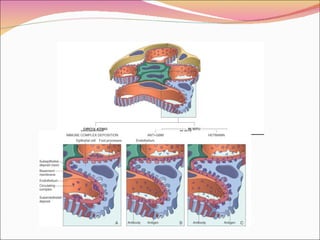
Pathogenesis of glomerular injury  Antibody mediated injury In situ immune complex deposition Fixed intrinsic tissue antigens  NC1 domain of collagen type4 antigen [anti GBM-nephritis] Heymann antigen [membranous nephropathy] Mesangial antigens  Circulating immune complex deposition Endogenous antigen[DNA,Nuclear  proteins,immunoglobulins,igA] Exogenous antigen [infectiousagents,drugs] Cytotoxic antibodies Cell mediated immune injury Activation of alternative  complement pathway
 
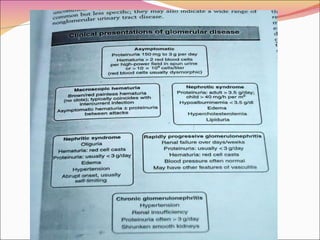
C linical manifestation of glomerular injury Asymptomatic Macroscopic hematuria Nephrotic Syndrome Nephritic syndrome Rapidly Progressive glomerular nephritis Chronic Nephritic Syndrome
 
GLOMERULAR DISEASE WITH NEPHRITIC SYNDROME Post streptococcal glomerular nephritis Other post infectious diseases Endocarditis Abscess Shunt Ig A nephropathy Systemic lupus
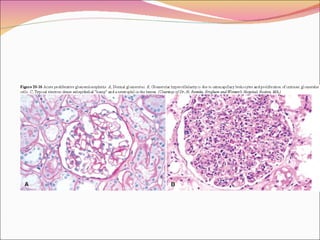
Glomerular diseases with acute nephritis Acute Proliferative Glomerulonephritis Acute post-streptococcal (post-infectious) GN.  children age 3-14 .  Immune complexes and planted bacterial antigens with  activation of alternative complement pathway oliguria, hematuria or tea-colored urine, edema,  hypertension, and eventually renal failure 1-4 weeks post-infections.  protenuria,RBC cast Positive, streptococcal serology and  decreased C3  complement  Subepithelial  deposits of IgG and C3 complement in coarsely granular  ("lumpy-bumpy" or "hump-like ") pattern along capillary loops.  good prognosis , rarely renal failure U
 
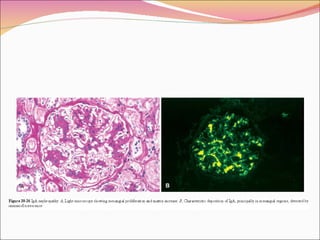
G lomerular diseases with primary haematuria IgA Nephropathy (Berger’s Disease ] Most common primary glomerular disease.  Mostly adolescents and young adults  gross hematuria  occurring coincidentally with or immediately following (24-48 hours), a viral upper respiratory infection, flu-like illness, gastrointestinal syndrome episodes of gross hematuria , microscopic hematuria .  Focal and segmental glomerular mesangial proliferation, with IgA deposits. Increased serum IgA . Normal C3  complement.  Prognosis – Generally benign  20% progress to renal insufficiency in 10 years. recurs after renal transplantation.
 
Glomerular disease presenting as nephrotic syndrome Minimal change disease FSGN Membranous nephropathy MPGN type 1 MPGN type 2 Cryoglobulinemic MPGN Amyloid  diabetic nephropathy
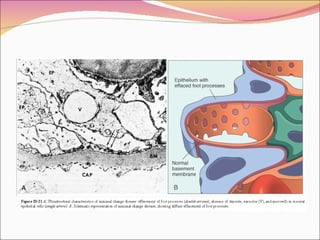
Minimal Change Disease  (Lipoid nephrosis, foot process disease) 80%- childhood nephrotic syndrome  20% -  adult nephritic syndrome.  Idiopathic . Pathogenesis is loss of net negative charge on capillary basement membrane.  Nephrotic syndrome, may be severe. History of recent URI in 30%. Association with Hodgkin’s lymphoma in some patients.  Heavy proteinuria with minimal or only modest urinary sediment (cells and casts).  Normal light microscopy.  Foot process fusion  on electron microscopy.  Course & Prognosis  – Most children show complete remission with steroid treatment. Adults are more resistant to steroid therapy and have a higher incidence of complications.  Glomerular Diseases with Nephrotic Syndrome
 
F ocal segmental glomerulo sclerosis 80% < 35 years 10-15% of cases of nephrotic syndrome in childhood.  Idiopathic  Chronic ureteral reflux or heroin abuse in some patients. Nephrotic syndrome with many patients showing hematuria, hypertension, and/or renal insufficiency.  Focal and segmental sclerosis initially, progressing to global sclerosis of the glomerulus.  Course & Prognosis   - Slowly progressive  , 25% -of patients developing renal insufficiency in 5 years,  50%-80% within 10 years. Usually steroid resistant.  Recurrence after renal transplantation is very common.
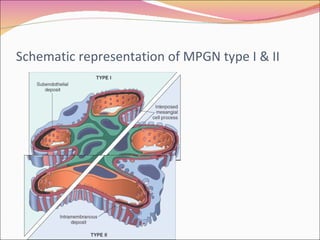
M embrano proliferative glomerulo nephritis (MPGN) M esangiocapillary glomerulonephritis OR  lobar glomerulonephritis 5-30 years Immune complex disease  Associated conditions: Chronic infections (especially hepatitis C), cancer, heroin abuse, SLE, etc  Usually nephrotic syndrome, less often acute nephritic syndrome. Recent history of URI in many patients. Hypertension and/or renal insufficiency may occur. Decreased serum complement  levels. Hepatitis C serology should be obtained Glomerular hypercellularity with capillary basement membrane thickening and splitting [TRAM-TRACKING ].  Subendothelial deposits of C3  complement and sometimes IgG .  Prognosis  Progressive deterioration of renal function; Many patients develop end-stage renal insufficiency within 10 years.
Schematic representation of MPGN type I & II
MPGN 2 Dense deposit disease causes  ;  Idiopathic C3 nephritic factor associated Partial lipodystrophy Low serum c3 and thickening of the GBM containing ribbons of dense deposits and C3   -intra membranous deposit
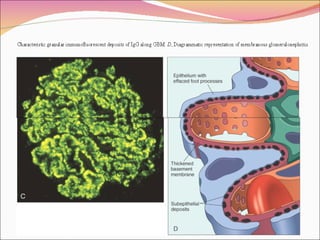
Membranous Glomerulonephritis  (MGN 4th-6th decade 50% -  most common cause of nephrotic syndrome in adults.  idiopathic.  Associated conditions: Carcinoma, chronic infections, heavy metal exposure, drugs. Nonselective proteinuria ± hematuria Nephrotic syndrome in most patients + microscopic hematuria. Systemic disease may be present, especially  colon and lung carcinoma .  Renal vein thrombosis  is a common complication (50%).  Thickened basement membranes with  subepithelia l deposits of IgG and C3 complement. Four pathologic stages.  Good prognosis in children,  20-30% of adults progress to ESRD in a few years in spite of steroids
 
Glomerular disease presenting as RPGN  Goodpasture’s syndrome Vasculitis Wegner’s granulomatosis Microscopic polyangitis  Pauci immune crecentric glomerulonephritis Immune complex disease SLE Post steptococcal glomerulo nephritis IgA nephropathy/henoch –schonlein purpura endocarditis
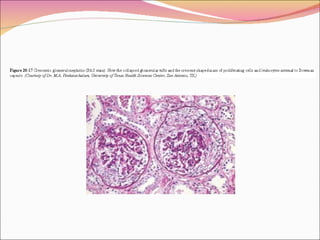
Anti-Glomerular Basement Membrane Disease  (Goodpasture’s Syndrome) 2nd-4th decades, usually males.  The GBM and alveolar basement membrane becomes antigenic. Deposited antibodies activate complement system and damage membranes. Hemoptysis  with coincident or subsequent acute renal failure.  Anti-GBM antibodies in 90% cases.  Crescents in >50% of glomeruli . Diffuse, linear IgG outlining capillary loops.  90% progress  to end-stage renal insufficiency in 1-2 years. Prognosis may depend on pulmonary complications.  Frequently recurs after renal transplantation.
 
Renal Manifestations of Systemic Disease Renal Manifestations of SLE (Lupus Nephritis) common, multisystem disease. 10:1, F:M an autoimmune disorder in which denatured DNA functions as the antigen nephritis or nephrotic syndrome. proteinuria, Hematuria in severe cases with red and white blood cells, hyaline, granular, and broad casts  (&quot;telescoped&quot; urinary sediment).  Decreased serum complement levels, false positive test for syphilis, antinuclear antibodies,  Prognosis  – Renal failure in about 40% of patients. Related to histologic sub-class . Crescent formation more ominous.
) diabetic glomerulosclerosis (Kimmelstiel-Wilson Syndrome) Most common  glomerular disease. multifactorial.  >20%-40% - type I  diabetes mellitus in approximately 20 years 20%-30% - type II DM proteinuria full-blown  nephrotic syndrome Microscopic hematuria and hypertension  Hypertension and retinopathy  Microalbuminuria is an early sign of diabetic nephropathy,  usually about  10 years  after onset of disease ..   initially diffuse diabetic glomerulosclerosis later becomes  nodular diabetic glomerulosclerosis, Kimmelstiel-Wilson kidney )  Prognosis  – Gradual progression to ESRD . Commonly recurs  after renal transplantation.
Renal Amyloid Primary [AL ]amyloidosis –  associated with multiple myeloma.  Secondary[AA] amyloidosis – chronic infectious diseases (i.e., TB, osteomyelitis, leprosy) and chronic inflammatory diseases (i.e., rheumatoid arthritis, ankylosing spondylitis).  Proteinuria, nephrotic syndrome, Hypertension is usual Amyloid deposited first in mesangium, small vessels, and later in glomerular capillary wall.  &quot; Apple&quot; green birefringence  of vessels and glomeruli when stained with Congo Red and polarized.  Prognosis   – Usually progresses to renal failure .  secondary amyloidosis (e.g. cure of TB), improvement may  occur. Renal failure is common cause of death in primary amyloidosis.
TUBULOINTERSTITIAL DISEASES Primary tubulointerstitial disease of the kidney characterized by histologic and functional abnormalities that involve the tubules and interstitium to a greater degree than glomeruli and renal vasculature  Acute tubular necrosis Acute interstitial nephritis Chronic interstitial nephritis
ACUTE INTERSTITIAL NEPHRITIS DRUGS Antibiotics[betalactams,sulphonamides,vancomycin, erythromycin,minocycline] NSAID and cyclooxygenase 2inhibitor Diuretics [thiazides,frusemide,triamterine] Anti convulsions [phenytoin,phenobarbitol,CBZ,volproic acid] Misscelleneous [captopril,H2blockers,proton pump inhibitor] INFECTION Bacteria Viruses miscellaneous IDIOPATHIC Tubulointerstitial nephritis –uveitis syndrome Acute –tubule basement membrane disease sarcoidosis
CHRONIC INTERSTITIAL NEPHRITIS CAUSES KIDNEYS MACROSCOPICALLY NORMAL Drugs [lithim,cyclosporine,tacrolimus,indinavir,cisplatin] Metabolic [hyperuricemia,hypokalemia,hypercalcemia,hyperoxaluria,cystinosis] Heavy metals  [lead,cadmium,arsenic,mercury,gold,uranium] Radiation Balkan  nephropathy Immunemediated [SLE,sjogrens syndrome,sarcoidosis,wegner’s granulomatosis,other vasculitis] Vascular diseases  [athero sclelotic kidney disease] Hematologic disturabances [multiple myeloma,light chain deposition disease, lymphoma, SCD,PNH] Progressive glomerular disease  of  all etiologies[glomerulonephritis, diabetes, hypertension] idiopathic
KIDNEYS MACROSCOPICALLY ABNORMAL Analgesic nephropathy Chronic obstruction Hereditary  [nephronophtisis  , medullary cystic disease , familial juvenile hyperuricemic nephropathy , ADPKD , ARPKD] Infection  Chronic pylonephritis,  malacoplakia,xanthogranulomatous pylonephritis]
FUNCTIONAL CONSEQUENCES OF TUBULO INTERSTITIAL DISEASE DEFECT CAUSES REDUCED  GFR OBLITERATION OF   microvasculature and obstruction of tubules FANCONI SYNDROME DAMAGE OF PROXIMAL TUBULAR REABSORBTION OF GLUCOSE , AMINOACIDS, PHASPHATE ,AND BICORBANATE HYPERCHOREMIC  ACIDOSIS 1.REDUCED AMMONIA PRODUCTION 2.INABILITY TO ACIDIFY THE COLLECTING DUCT [DISTAL RTA] 3.PROXIMAL BICORBANATE WASTING TUBULAR OR SMALL MOLECULAR WEIGHT  PROTENURIA FAILURE OF PROXIMAL TUBULE PROTEIN  REABSORBTION POLYURIA ,ISOTHENUIA DAMAGE TO MEDULLARY TUBULES AND VASCULATURE HYPERKALEMIA POTTASIUM SECRETARY DEFECTS INCLUDING  ALDOSTERONE RESISTANCE
Analgesic nephropathy Heavy users of  analgesics mixtures containing phenacetin combination with aspirin acetoaminophen,or coffeine,. Clinical features;  renal insufficiency,non nephrotic proteinuria,or sterile pyuria Hypertension, anemia and impaired urinary concentration –renal insufficiency  Flank pain and hematuria-pappillary necrosis Diagnosis  ;1]history 2 ] CT - signs decreased renal size pappillary calcifications More  prone for transitional cell carcinoma
Thank You.

CME: Glomerular & Tubular Disorders

  • 1.
  • 2.
    GLOMERULAR DISEASES DEFINITION;Abnormalites of glomerular funtion can be caused by damage to the major components of the glomerulus: Epithelium (podocytes), Basement membrane, capillary endothelium, mesangium. Damage manifested by an inflammatory process. Specific histologic pattern of glomeruli injury can be seen on renal biobsy through light microscopy, Electron microscopy.
  • 3.
    Pathogenesis of glomerularinjury Antibody mediated injury In situ immune complex deposition Fixed intrinsic tissue antigens NC1 domain of collagen type4 antigen [anti GBM-nephritis] Heymann antigen [membranous nephropathy] Mesangial antigens Circulating immune complex deposition Endogenous antigen[DNA,Nuclear proteins,immunoglobulins,igA] Exogenous antigen [infectiousagents,drugs] Cytotoxic antibodies Cell mediated immune injury Activation of alternative complement pathway
  • 4.
  • 5.
    C linical manifestationof glomerular injury Asymptomatic Macroscopic hematuria Nephrotic Syndrome Nephritic syndrome Rapidly Progressive glomerular nephritis Chronic Nephritic Syndrome
  • 6.
  • 7.
    GLOMERULAR DISEASE WITHNEPHRITIC SYNDROME Post streptococcal glomerular nephritis Other post infectious diseases Endocarditis Abscess Shunt Ig A nephropathy Systemic lupus
  • 8.
    Glomerular diseases withacute nephritis Acute Proliferative Glomerulonephritis Acute post-streptococcal (post-infectious) GN. children age 3-14 . Immune complexes and planted bacterial antigens with activation of alternative complement pathway oliguria, hematuria or tea-colored urine, edema, hypertension, and eventually renal failure 1-4 weeks post-infections. protenuria,RBC cast Positive, streptococcal serology and decreased C3 complement Subepithelial deposits of IgG and C3 complement in coarsely granular (&quot;lumpy-bumpy&quot; or &quot;hump-like &quot;) pattern along capillary loops. good prognosis , rarely renal failure U
  • 9.
  • 10.
    G lomerular diseaseswith primary haematuria IgA Nephropathy (Berger’s Disease ] Most common primary glomerular disease. Mostly adolescents and young adults gross hematuria occurring coincidentally with or immediately following (24-48 hours), a viral upper respiratory infection, flu-like illness, gastrointestinal syndrome episodes of gross hematuria , microscopic hematuria . Focal and segmental glomerular mesangial proliferation, with IgA deposits. Increased serum IgA . Normal C3 complement. Prognosis – Generally benign 20% progress to renal insufficiency in 10 years. recurs after renal transplantation.
  • 11.
  • 12.
    Glomerular disease presentingas nephrotic syndrome Minimal change disease FSGN Membranous nephropathy MPGN type 1 MPGN type 2 Cryoglobulinemic MPGN Amyloid diabetic nephropathy
  • 13.
    Minimal Change Disease (Lipoid nephrosis, foot process disease) 80%- childhood nephrotic syndrome 20% - adult nephritic syndrome. Idiopathic . Pathogenesis is loss of net negative charge on capillary basement membrane. Nephrotic syndrome, may be severe. History of recent URI in 30%. Association with Hodgkin’s lymphoma in some patients. Heavy proteinuria with minimal or only modest urinary sediment (cells and casts). Normal light microscopy. Foot process fusion on electron microscopy. Course & Prognosis – Most children show complete remission with steroid treatment. Adults are more resistant to steroid therapy and have a higher incidence of complications. Glomerular Diseases with Nephrotic Syndrome
  • 14.
  • 15.
    F ocal segmentalglomerulo sclerosis 80% < 35 years 10-15% of cases of nephrotic syndrome in childhood. Idiopathic Chronic ureteral reflux or heroin abuse in some patients. Nephrotic syndrome with many patients showing hematuria, hypertension, and/or renal insufficiency. Focal and segmental sclerosis initially, progressing to global sclerosis of the glomerulus. Course & Prognosis - Slowly progressive , 25% -of patients developing renal insufficiency in 5 years, 50%-80% within 10 years. Usually steroid resistant. Recurrence after renal transplantation is very common.
  • 16.
    M embrano proliferativeglomerulo nephritis (MPGN) M esangiocapillary glomerulonephritis OR lobar glomerulonephritis 5-30 years Immune complex disease Associated conditions: Chronic infections (especially hepatitis C), cancer, heroin abuse, SLE, etc Usually nephrotic syndrome, less often acute nephritic syndrome. Recent history of URI in many patients. Hypertension and/or renal insufficiency may occur. Decreased serum complement levels. Hepatitis C serology should be obtained Glomerular hypercellularity with capillary basement membrane thickening and splitting [TRAM-TRACKING ]. Subendothelial deposits of C3 complement and sometimes IgG . Prognosis Progressive deterioration of renal function; Many patients develop end-stage renal insufficiency within 10 years.
  • 17.
  • 18.
    MPGN 2 Densedeposit disease causes ; Idiopathic C3 nephritic factor associated Partial lipodystrophy Low serum c3 and thickening of the GBM containing ribbons of dense deposits and C3 -intra membranous deposit
  • 19.
    Membranous Glomerulonephritis (MGN 4th-6th decade 50% - most common cause of nephrotic syndrome in adults. idiopathic. Associated conditions: Carcinoma, chronic infections, heavy metal exposure, drugs. Nonselective proteinuria ± hematuria Nephrotic syndrome in most patients + microscopic hematuria. Systemic disease may be present, especially colon and lung carcinoma . Renal vein thrombosis is a common complication (50%). Thickened basement membranes with subepithelia l deposits of IgG and C3 complement. Four pathologic stages. Good prognosis in children, 20-30% of adults progress to ESRD in a few years in spite of steroids
  • 20.
  • 21.
    Glomerular disease presentingas RPGN Goodpasture’s syndrome Vasculitis Wegner’s granulomatosis Microscopic polyangitis Pauci immune crecentric glomerulonephritis Immune complex disease SLE Post steptococcal glomerulo nephritis IgA nephropathy/henoch –schonlein purpura endocarditis
  • 22.
    Anti-Glomerular Basement MembraneDisease (Goodpasture’s Syndrome) 2nd-4th decades, usually males. The GBM and alveolar basement membrane becomes antigenic. Deposited antibodies activate complement system and damage membranes. Hemoptysis with coincident or subsequent acute renal failure. Anti-GBM antibodies in 90% cases. Crescents in >50% of glomeruli . Diffuse, linear IgG outlining capillary loops. 90% progress to end-stage renal insufficiency in 1-2 years. Prognosis may depend on pulmonary complications. Frequently recurs after renal transplantation.
  • 23.
  • 24.
    Renal Manifestations ofSystemic Disease Renal Manifestations of SLE (Lupus Nephritis) common, multisystem disease. 10:1, F:M an autoimmune disorder in which denatured DNA functions as the antigen nephritis or nephrotic syndrome. proteinuria, Hematuria in severe cases with red and white blood cells, hyaline, granular, and broad casts (&quot;telescoped&quot; urinary sediment). Decreased serum complement levels, false positive test for syphilis, antinuclear antibodies, Prognosis – Renal failure in about 40% of patients. Related to histologic sub-class . Crescent formation more ominous.
  • 25.
    ) diabetic glomerulosclerosis(Kimmelstiel-Wilson Syndrome) Most common glomerular disease. multifactorial. >20%-40% - type I diabetes mellitus in approximately 20 years 20%-30% - type II DM proteinuria full-blown nephrotic syndrome Microscopic hematuria and hypertension Hypertension and retinopathy Microalbuminuria is an early sign of diabetic nephropathy, usually about 10 years after onset of disease .. initially diffuse diabetic glomerulosclerosis later becomes nodular diabetic glomerulosclerosis, Kimmelstiel-Wilson kidney ) Prognosis – Gradual progression to ESRD . Commonly recurs after renal transplantation.
  • 26.
    Renal Amyloid Primary[AL ]amyloidosis – associated with multiple myeloma. Secondary[AA] amyloidosis – chronic infectious diseases (i.e., TB, osteomyelitis, leprosy) and chronic inflammatory diseases (i.e., rheumatoid arthritis, ankylosing spondylitis). Proteinuria, nephrotic syndrome, Hypertension is usual Amyloid deposited first in mesangium, small vessels, and later in glomerular capillary wall. &quot; Apple&quot; green birefringence of vessels and glomeruli when stained with Congo Red and polarized. Prognosis – Usually progresses to renal failure . secondary amyloidosis (e.g. cure of TB), improvement may occur. Renal failure is common cause of death in primary amyloidosis.
  • 27.
    TUBULOINTERSTITIAL DISEASES Primarytubulointerstitial disease of the kidney characterized by histologic and functional abnormalities that involve the tubules and interstitium to a greater degree than glomeruli and renal vasculature Acute tubular necrosis Acute interstitial nephritis Chronic interstitial nephritis
  • 28.
    ACUTE INTERSTITIAL NEPHRITISDRUGS Antibiotics[betalactams,sulphonamides,vancomycin, erythromycin,minocycline] NSAID and cyclooxygenase 2inhibitor Diuretics [thiazides,frusemide,triamterine] Anti convulsions [phenytoin,phenobarbitol,CBZ,volproic acid] Misscelleneous [captopril,H2blockers,proton pump inhibitor] INFECTION Bacteria Viruses miscellaneous IDIOPATHIC Tubulointerstitial nephritis –uveitis syndrome Acute –tubule basement membrane disease sarcoidosis
  • 29.
    CHRONIC INTERSTITIAL NEPHRITISCAUSES KIDNEYS MACROSCOPICALLY NORMAL Drugs [lithim,cyclosporine,tacrolimus,indinavir,cisplatin] Metabolic [hyperuricemia,hypokalemia,hypercalcemia,hyperoxaluria,cystinosis] Heavy metals [lead,cadmium,arsenic,mercury,gold,uranium] Radiation Balkan nephropathy Immunemediated [SLE,sjogrens syndrome,sarcoidosis,wegner’s granulomatosis,other vasculitis] Vascular diseases [athero sclelotic kidney disease] Hematologic disturabances [multiple myeloma,light chain deposition disease, lymphoma, SCD,PNH] Progressive glomerular disease of all etiologies[glomerulonephritis, diabetes, hypertension] idiopathic
  • 30.
    KIDNEYS MACROSCOPICALLY ABNORMALAnalgesic nephropathy Chronic obstruction Hereditary [nephronophtisis , medullary cystic disease , familial juvenile hyperuricemic nephropathy , ADPKD , ARPKD] Infection Chronic pylonephritis, malacoplakia,xanthogranulomatous pylonephritis]
  • 31.
    FUNCTIONAL CONSEQUENCES OFTUBULO INTERSTITIAL DISEASE DEFECT CAUSES REDUCED GFR OBLITERATION OF microvasculature and obstruction of tubules FANCONI SYNDROME DAMAGE OF PROXIMAL TUBULAR REABSORBTION OF GLUCOSE , AMINOACIDS, PHASPHATE ,AND BICORBANATE HYPERCHOREMIC ACIDOSIS 1.REDUCED AMMONIA PRODUCTION 2.INABILITY TO ACIDIFY THE COLLECTING DUCT [DISTAL RTA] 3.PROXIMAL BICORBANATE WASTING TUBULAR OR SMALL MOLECULAR WEIGHT PROTENURIA FAILURE OF PROXIMAL TUBULE PROTEIN REABSORBTION POLYURIA ,ISOTHENUIA DAMAGE TO MEDULLARY TUBULES AND VASCULATURE HYPERKALEMIA POTTASIUM SECRETARY DEFECTS INCLUDING ALDOSTERONE RESISTANCE
  • 32.
    Analgesic nephropathy Heavyusers of analgesics mixtures containing phenacetin combination with aspirin acetoaminophen,or coffeine,. Clinical features; renal insufficiency,non nephrotic proteinuria,or sterile pyuria Hypertension, anemia and impaired urinary concentration –renal insufficiency Flank pain and hematuria-pappillary necrosis Diagnosis ;1]history 2 ] CT - signs decreased renal size pappillary calcifications More prone for transitional cell carcinoma
  • 33.