Glomerular diseases
Rajeev Sachdeva MD, MS – PGY1
Objectives
• NephrOtic vs. NephrItic Syndrome
• Workup (Labs, Physical Exam findings)
• Nephrotic in detail
• Nephritic in detail
• Management
Workup
• Basic laboratory testing (including plasma or serum creatinine, albumin,
electrolytes, calcium, phosphorus, and complete blood count)
• urinalysis of sediment (critical in establishing the presence of most of the nephritic
syndromes; red blood cell [RBC] casts or dysmorphic RBCs are hallmarks)
• estimation of protein excretion (spot protein/creatinine ratio or 24-hour urine
collection)
• serologic testing for disorders that cause glomerular disease (e.g., lupus and
hepatitis serologies, antistreptolysin O [ASO], cryogobulins, antinuclear antibody,
ANCA, anti-GBM, and protein electrophoresis)
• measurement of serum complement levels
• kidney biopsy (generally required to document the underlying pathology and to
identify the type of glomerular disease)
– Positive ANCA or anti-GBM tests in the context of nephritic syndrome may be sufficient to
make the diagnosis without the need for a biopsy, depending on the clinical status and kidney
function.
– If membranous nephropathy is seen on biopsy, then molecular and antibody studies should be
considered.
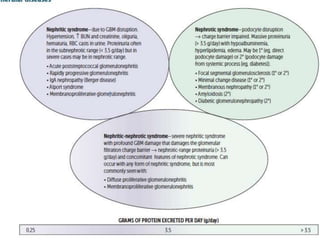
Nephrotic Syndrome
• Nephrotic syndrome NephrOtic syndrome—massive prOteinuria (>
3.5 g/day) with hypoalbuminemia, resulting edema, hyperlipidemia.
Frothy urine with fatty casts.
• Disruption of glomerular filtration charge barrier may be primary
(eg, direct sclerosis of podocytes) or secondary (systemic process
[eg, diabetes] secondarily damages podocytes).
• Severe nephritic syndrome may present with nephrotic syndrome
features (nephritic-nephrotic syndrome) if damage to GBM is severe
enough to damage charge barrier.
• Associated with hypercoagulable state due to antithrombin (AT) III
loss in urine and •
risk of infection (loss of immunoglobulins in urine
and soft tissue compromise by edema).
Minimal Change Disease (lipoid
Nephrosis)
• Most common cause of nephrotic syndrome in
children.
• Often primary (idiopathic) and may be triggered by
recent infection, immunization, immune stimulus.
• Rarely, may be secondary to lymphoma (eg, cytokine-
mediated damage).
• primary disease has excellent response to
corticosteroids.
• LM—Normal glomeruli (lipid may be seen in PCT cells)
• IF—⊝
• EM—effacement of podocyte foot processes
Focal Segmental Glomerulosclerosis
FSGS
• Most common cause of nephrotic syndrome in African-
Americans and Hispanics.
• Can be 1Åã (idiopathic) or 2Åã to other conditions (eg, HIV
infection, sickle cell disease, heroin abuse,
• massive obesity, interferon treatment, or congenital
malformations).
• 1Åã disease has inconsistent response to steroids. May
progress to CKD.
• LM—segmental sclerosis and hyalinosis B
• IF—often ⊝ but may be ⊕ for nonspecific focal deposits
of IgM, C3, C1
• EM—effacement of foot processes similar to minimal
change disease
Membranous
• Membranous
• Can be 1Åã (eg, antibodies to phospholipase A2
receptor) or 2Åã to drugs (eg, NSAIDs, penicillamine,
• gold), infections (eg, HBV, HCV, syphilis), SLE, or solid
tumors.
• 1Åã disease has poor response to steroids. May
progress to CKD.
• LM—diffuse capillary and GBM thickening C
• IF—granular due to IC deposition
• EM—“Spike and dome” appearance of subepithelial
deposits
Amyloidosis
• Kidney is the most commonly involved organ
(systemic amyloidosis). Associated with
chronic conditions that predispose to amyloid
deposition (eg, AL amyloid, AA amyloid).
• LM—Congo red stain shows apple-green
birefringence under polarized light due to
amyloid deposition in the mesangium
Diabetic Glomerulonephropathy
• Most common cause of ESRD in the United States.
• Hyperglycemia Žnonenzymatic glycation of tissue
proteins Žmesangial expansion; GBM thickening and •
permeability. Hyperfiltration (glomerular HTN and •
GFR) Žglomerular hypertrophy and glomerular scarring
(glomerulosclerosis) leading to further progression of
nephropathy.
• LM—Mesangial expansion, GBM thickening,
eosinophilic nodular glomerulosclerosis
• (Kimmelstiel-Wilson lesions )
Nephritic Syndrome
• NephrItic syndrome = Inflammatory process.
When glomeruli are involved, leads to
hematuria and RBC casts in urine. Associated
with azotemia, oliguria, hypertension (due to
salt retention), proteinuria,
hypercellular/inflamed glomeruli on biopsy.
Acute poststreptococcal
glomerulonephritis
• Most frequently seen in children. ~ 2–4 weeks after group
A streptococcal infection of pharynx or skin. Resolves
spontaneously in most children; may progress to renal
insufficiency in adults. Type III hypersensitivity reaction.
Presents with peripheral and periorbital edema, cola-
colored urine, HTN. ⊕ strep titers/serologies, •
decrease
complement levels (C3) due to consumption.
• LM—glomeruli enlarged and hypercellular A
• IF—(“starry sky”) granular appearance (“lumpy-bumpy”) B
due to IgG, IgM, and C3
• deposition along GBM and mesangium
• EM—subepithelial immune complex (IC) humps
Rapid Progressive Glomerulonephritis
(Crescent)
• Poor prognosis, rapidly deteriorating renal function (days to weeks).
• LM—crescent moon shape C . Crescents consist of fibrin and
plasma proteins (eg, C3b) with glomerular parietal cells, monocytes,
macrophages
• Several disease processes may result in this pattern which may be
delineated via IF pattern.
• Linear IF due to antibodies to GBM and alveolar basement
membrane: Goodpasture syndrome—hematuria/hemoptysis; type
II hypersensitivity reaction; Treatment: plasmapheresis
• Negative IF/Pauci-immune (no Ig/C3 deposition): Granulomatosis
with polyangiitis (Wegener)—PR3-ANCA/c-ANCA or Microscopic
polyangiitis—MPO-ANCA/p-ANCA
• Granular IF—PSGN or DPGN
Diffuse Proliferative Glomerulonephritis
(DPGN)
• Often due to SLE (think “wire lupus”). DPGN
and MPGN often present as nephrotic
syndrome and nephritic syndrome
concurrently.
• LM—“wire looping” of capillaries
• IF—granular; EM—subendothelial and
sometimes intramembranous IgG-based ICs
often with C3 deposition.
IgA Nephropathy - Berger
• Common in Asians.
• Episodic hematuria that occurs concurrently
with respiratory or GI tract infections (IgA is
secreted by mucosal linings). Renal pathology
of IgA vasculitis (HSP).
• LM—mesangial proliferation
• IF—IgA-based IC deposits in mesangium;
EM—mesangial IC deposition
Alport Syndrome
• Mutation in type IV collagen Ž
thinning and
splitting of glomerular basement membrane.
• Most commonly X-linked dominant. Eye
problems (eg, retinopathy, lens dislocation),
glomerulonephritis, sensorineural deafness;
“can’t see, can’t pee, can’t hear a bee.”
• EM—“Basket-weave”
Membrano-proliferative
Glomerulonephritis
• MPGN is a nephritic syndrome that often co-presents
with nephrotic syndrome.
• Type I may be secondary to hepatitis B or C infection.
May also be idiopathic.
– Subendothelial IC deposits with granular IF
• Type II is associated with C3 nephritic factor (IgG
antibody that stabilizes C3 convertase persistent
complement activation decrease C3 levels).
– Intramembranous deposits, also called dense deposit
disease
• In both types, mesangial ingrowth Ž
GBM splitting Ž
“tram-track” appearance on H&E D and PAS E stains.
Management
• Treatment with ACE inhibitors or angiotensin receptor blockers (ARBs) can lower
intraglomerular pressure and reduce proteinuria. However, patients may
experience adverse events such as hypotension or hyperkalemia. Loop diuretics
may be started to reduce symptoms of edema.
• Hyperlipidemia can be treated with a statin; A change in diet is unlikely to bring
the hyperlipidemia under control. There may be resolution of hyperlipidemia once
the nephrotic syndrome responds to therapy.
• Among patients with membranous nephropathy and other types of nephrotic
syndrome, the risk of arterial and venous thromboembolism is higher than normal,
but anticoagulation may not prevent half or more of the possible episodes.
Therefore, prophylactic anticoagulants may be considered on a case-by-case basis.
• The risks of infection also need to be considered, and the KDIGO guidelines
recommend that vaccinations such as the influenza and pneumococcal vaccination
be current. Live vaccines are contraindicated if patients receive
immunosuppressive agents and should not be administered until the prednisone
dose is <20mg/day or the immunosuppressive therapy has been stopped for 3
months.
Management cont…
• The main issues related to management of nephrotic
syndrome (i.e., treatment of proteinuria, hypertension
and hypercoagulability) are also important for various
glomerulonephritides. Treatment with glucocorticoids,
other immunosuppressive therapies and cytotoxic
agents such as cyclophosphamide, rituximab and
mycophenolate mofetil can be employed, depending
on the biopsy findings and pathogenesis. Management
is also influenced by any underlying disorders such as
the presence of an autoimmune condition.

Glomerulonephropathy PGY 1.pptx

  • 1.
  • 2.
    Objectives • NephrOtic vs.NephrItic Syndrome • Workup (Labs, Physical Exam findings) • Nephrotic in detail • Nephritic in detail • Management
  • 4.
    Workup • Basic laboratorytesting (including plasma or serum creatinine, albumin, electrolytes, calcium, phosphorus, and complete blood count) • urinalysis of sediment (critical in establishing the presence of most of the nephritic syndromes; red blood cell [RBC] casts or dysmorphic RBCs are hallmarks) • estimation of protein excretion (spot protein/creatinine ratio or 24-hour urine collection) • serologic testing for disorders that cause glomerular disease (e.g., lupus and hepatitis serologies, antistreptolysin O [ASO], cryogobulins, antinuclear antibody, ANCA, anti-GBM, and protein electrophoresis) • measurement of serum complement levels • kidney biopsy (generally required to document the underlying pathology and to identify the type of glomerular disease) – Positive ANCA or anti-GBM tests in the context of nephritic syndrome may be sufficient to make the diagnosis without the need for a biopsy, depending on the clinical status and kidney function. – If membranous nephropathy is seen on biopsy, then molecular and antibody studies should be considered.
  • 5.
    Nephrotic Syndrome • Nephroticsyndrome NephrOtic syndrome—massive prOteinuria (> 3.5 g/day) with hypoalbuminemia, resulting edema, hyperlipidemia. Frothy urine with fatty casts. • Disruption of glomerular filtration charge barrier may be primary (eg, direct sclerosis of podocytes) or secondary (systemic process [eg, diabetes] secondarily damages podocytes). • Severe nephritic syndrome may present with nephrotic syndrome features (nephritic-nephrotic syndrome) if damage to GBM is severe enough to damage charge barrier. • Associated with hypercoagulable state due to antithrombin (AT) III loss in urine and • risk of infection (loss of immunoglobulins in urine and soft tissue compromise by edema).
  • 6.
    Minimal Change Disease(lipoid Nephrosis) • Most common cause of nephrotic syndrome in children. • Often primary (idiopathic) and may be triggered by recent infection, immunization, immune stimulus. • Rarely, may be secondary to lymphoma (eg, cytokine- mediated damage). • primary disease has excellent response to corticosteroids. • LM—Normal glomeruli (lipid may be seen in PCT cells) • IF—⊝ • EM—effacement of podocyte foot processes
  • 7.
    Focal Segmental Glomerulosclerosis FSGS •Most common cause of nephrotic syndrome in African- Americans and Hispanics. • Can be 1Åã (idiopathic) or 2Åã to other conditions (eg, HIV infection, sickle cell disease, heroin abuse, • massive obesity, interferon treatment, or congenital malformations). • 1Åã disease has inconsistent response to steroids. May progress to CKD. • LM—segmental sclerosis and hyalinosis B • IF—often ⊝ but may be ⊕ for nonspecific focal deposits of IgM, C3, C1 • EM—effacement of foot processes similar to minimal change disease
  • 8.
    Membranous • Membranous • Canbe 1Åã (eg, antibodies to phospholipase A2 receptor) or 2Åã to drugs (eg, NSAIDs, penicillamine, • gold), infections (eg, HBV, HCV, syphilis), SLE, or solid tumors. • 1Åã disease has poor response to steroids. May progress to CKD. • LM—diffuse capillary and GBM thickening C • IF—granular due to IC deposition • EM—“Spike and dome” appearance of subepithelial deposits
  • 9.
    Amyloidosis • Kidney isthe most commonly involved organ (systemic amyloidosis). Associated with chronic conditions that predispose to amyloid deposition (eg, AL amyloid, AA amyloid). • LM—Congo red stain shows apple-green birefringence under polarized light due to amyloid deposition in the mesangium
  • 10.
    Diabetic Glomerulonephropathy • Mostcommon cause of ESRD in the United States. • Hyperglycemia Žnonenzymatic glycation of tissue proteins Žmesangial expansion; GBM thickening and • permeability. Hyperfiltration (glomerular HTN and • GFR) Žglomerular hypertrophy and glomerular scarring (glomerulosclerosis) leading to further progression of nephropathy. • LM—Mesangial expansion, GBM thickening, eosinophilic nodular glomerulosclerosis • (Kimmelstiel-Wilson lesions )
  • 11.
    Nephritic Syndrome • NephrIticsyndrome = Inflammatory process. When glomeruli are involved, leads to hematuria and RBC casts in urine. Associated with azotemia, oliguria, hypertension (due to salt retention), proteinuria, hypercellular/inflamed glomeruli on biopsy.
  • 12.
    Acute poststreptococcal glomerulonephritis • Mostfrequently seen in children. ~ 2–4 weeks after group A streptococcal infection of pharynx or skin. Resolves spontaneously in most children; may progress to renal insufficiency in adults. Type III hypersensitivity reaction. Presents with peripheral and periorbital edema, cola- colored urine, HTN. ⊕ strep titers/serologies, • decrease complement levels (C3) due to consumption. • LM—glomeruli enlarged and hypercellular A • IF—(“starry sky”) granular appearance (“lumpy-bumpy”) B due to IgG, IgM, and C3 • deposition along GBM and mesangium • EM—subepithelial immune complex (IC) humps
  • 13.
    Rapid Progressive Glomerulonephritis (Crescent) •Poor prognosis, rapidly deteriorating renal function (days to weeks). • LM—crescent moon shape C . Crescents consist of fibrin and plasma proteins (eg, C3b) with glomerular parietal cells, monocytes, macrophages • Several disease processes may result in this pattern which may be delineated via IF pattern. • Linear IF due to antibodies to GBM and alveolar basement membrane: Goodpasture syndrome—hematuria/hemoptysis; type II hypersensitivity reaction; Treatment: plasmapheresis • Negative IF/Pauci-immune (no Ig/C3 deposition): Granulomatosis with polyangiitis (Wegener)—PR3-ANCA/c-ANCA or Microscopic polyangiitis—MPO-ANCA/p-ANCA • Granular IF—PSGN or DPGN
  • 14.
    Diffuse Proliferative Glomerulonephritis (DPGN) •Often due to SLE (think “wire lupus”). DPGN and MPGN often present as nephrotic syndrome and nephritic syndrome concurrently. • LM—“wire looping” of capillaries • IF—granular; EM—subendothelial and sometimes intramembranous IgG-based ICs often with C3 deposition.
  • 15.
    IgA Nephropathy -Berger • Common in Asians. • Episodic hematuria that occurs concurrently with respiratory or GI tract infections (IgA is secreted by mucosal linings). Renal pathology of IgA vasculitis (HSP). • LM—mesangial proliferation • IF—IgA-based IC deposits in mesangium; EM—mesangial IC deposition
  • 16.
    Alport Syndrome • Mutationin type IV collagen Ž thinning and splitting of glomerular basement membrane. • Most commonly X-linked dominant. Eye problems (eg, retinopathy, lens dislocation), glomerulonephritis, sensorineural deafness; “can’t see, can’t pee, can’t hear a bee.” • EM—“Basket-weave”
  • 17.
    Membrano-proliferative Glomerulonephritis • MPGN isa nephritic syndrome that often co-presents with nephrotic syndrome. • Type I may be secondary to hepatitis B or C infection. May also be idiopathic. – Subendothelial IC deposits with granular IF • Type II is associated with C3 nephritic factor (IgG antibody that stabilizes C3 convertase persistent complement activation decrease C3 levels). – Intramembranous deposits, also called dense deposit disease • In both types, mesangial ingrowth Ž GBM splitting Ž “tram-track” appearance on H&E D and PAS E stains.
  • 18.
    Management • Treatment withACE inhibitors or angiotensin receptor blockers (ARBs) can lower intraglomerular pressure and reduce proteinuria. However, patients may experience adverse events such as hypotension or hyperkalemia. Loop diuretics may be started to reduce symptoms of edema. • Hyperlipidemia can be treated with a statin; A change in diet is unlikely to bring the hyperlipidemia under control. There may be resolution of hyperlipidemia once the nephrotic syndrome responds to therapy. • Among patients with membranous nephropathy and other types of nephrotic syndrome, the risk of arterial and venous thromboembolism is higher than normal, but anticoagulation may not prevent half or more of the possible episodes. Therefore, prophylactic anticoagulants may be considered on a case-by-case basis. • The risks of infection also need to be considered, and the KDIGO guidelines recommend that vaccinations such as the influenza and pneumococcal vaccination be current. Live vaccines are contraindicated if patients receive immunosuppressive agents and should not be administered until the prednisone dose is <20mg/day or the immunosuppressive therapy has been stopped for 3 months.
  • 19.
    Management cont… • Themain issues related to management of nephrotic syndrome (i.e., treatment of proteinuria, hypertension and hypercoagulability) are also important for various glomerulonephritides. Treatment with glucocorticoids, other immunosuppressive therapies and cytotoxic agents such as cyclophosphamide, rituximab and mycophenolate mofetil can be employed, depending on the biopsy findings and pathogenesis. Management is also influenced by any underlying disorders such as the presence of an autoimmune condition.

Editor's Notes

  • #9 primary (now associated with certain antiibodies, most commonly to the M-type phospholipase A2 receptor [PLA2R] and thrombospondin type 1- domain-containing 7A [THSD7A]) and secondary (e.g., associated with hepatitis B and C, nonsteroidal anti-inflammatory drugs [NSAIDS], lupus, malignancy)