Cluster
analysis
Presented By:-
Shubham Goyal
•What is clusteranalysis?What is clusteranalysis?
•Types of data in clusteranalysisTypes of data in clusteranalysis
•Majorclustering methodsMajorclustering methods
•SummarySummary
ClusteranalysisClusteranalysis
Cluster:Cluster: a collection of data
objects
osimilar to one another within the
same cluster
odissimilar to the objects in the
other clusters
Aimof clustering:Aimof clustering: to group a set
of data objects into clusters
What is clusteranalysis?What is clusteranalysis?
APPLICATIONS OFCLUSTERINGAPPLICATIONS OFCLUSTERING
Marketing:Marketing: discovering of distinct customer
groups in a purchase database
Land use:Land use: identifying of areas of similar land use
in an earth observation database
Insurance:Insurance: identifying groups of motor insurance
policy holders with a high average claim cost
City-planning:City-planning: identifying groups of houses
according to their house type, value, and
geographical location
TYPEOFDATA IN CLUSTERTYPEOFDATA IN CLUSTER
ANALYSISANALYSIS
•Interval-scaled variablesInterval-scaled variables
•Binary variablesBinary variables
•OrdinalOrdinal
•RRatio variablesatio variables
•Complex data typesComplex data types
MAJORCLUSTERINGMAJORCLUSTERING
METHODSMETHODS
•Partitioning methods-
•K-means methodsK-means methods
•Hierarchical methodsHierarchical methods
K-MEANS CLUSTERINGK-MEANS CLUSTERING
METHODMETHOD
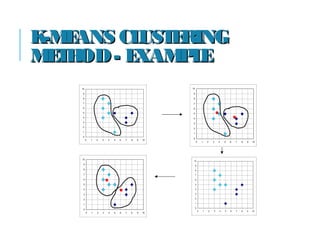
Input to the algorithmInput to the algorithm: the number of clusters k,
and a database of n objects
Algorithmconsists of fourstepsAlgorithmconsists of foursteps:
1. partition object into k nonempty subsets/clusters
2. compute a seed points as the centroidcentroid (the
mean of the objects in the cluster) for each
cluster in the current partition
3. assign each object to the cluster with the nearest
centroid
4. go back to Step 2, stop when there are no more
new assignments
K-MEANS CLUSTERINGK-MEANS CLUSTERING
METHOD- EXAMPLEMETHOD- EXAMPLE
0
1
2
3
4
5
6
7
8
9
10
0 1 2 3 4 5 6 7 8 9 10
0
1
2
3
4
5
6
7
8
9
10
0 1 2 3 4 5 6 7 8 9 10
0
1
2
3
4
5
6
7
8
9
10
0 1 2 3 4 5 6 7 8 9 10
0
1
2
3
4
5
6
7
8
9
10
0 1 2 3 4 5 6 7 8 9 10
Complexities of K-means
 
Time Complexity
 Let tdist be the time to calculate the distance between two
objects
 Each iteration time complexity:
O(Kn tdist)
K = number of clusters (centroids)
n = number of objects
 Bound number of iterations I giving
O(I Kn tdist)
 
Space Complexity
For m-dimensional vectors
Strength of the k-Means
Clustering
•   Relatively efficient: O (t k n), where n is number of
objects,
k is number of clusters, and t is number of iterations.
Normally k, t << n.
• K-Means may produce tighter clusters than
hierarchical
clustering.
 
Weakness of the k-means
Clustering
• Applicable only when mean is defined (works only for
numerical observations), then what about categorical
data?
• Need to specify k, the number of clusters, in advance.
• Unable to handle noisy data and outliers
•Clusteranalysis groups objectsClusteranalysis groups objects
based on theirsimilaritybased on theirsimilarity
•Clusteranalysis has wideClusteranalysis has wide
applicationsapplications
•Measure of similarity can beMeasure of similarity can be
computed forvarious type ofcomputed forvarious type of
datadata
•Selection of similarity measureSelection of similarity measure
is dependent on the data usedis dependent on the data used
and the type of similarity weand the type of similarity we
are searching forare searching for
SummarySummary
REFERENCES - CLUSTERINGREFERENCES - CLUSTERING
•R. Agrawal, J. Gehrke, D. Gunopulos, and P. Raghavan. Automatic subspace clustering of
high dimensional data for data mining applications. SIGMOD'98
• Ms.Avita Katal , Assistant professor ,Dept. of CS/IT , Graphic Era Hill University.
Cluster analysis

Cluster analysis

  • 1.
  • 2.
    •What is clusteranalysis?Whatis clusteranalysis? •Types of data in clusteranalysisTypes of data in clusteranalysis •Majorclustering methodsMajorclustering methods •SummarySummary ClusteranalysisClusteranalysis
  • 3.
    Cluster:Cluster: a collectionof data objects osimilar to one another within the same cluster odissimilar to the objects in the other clusters Aimof clustering:Aimof clustering: to group a set of data objects into clusters What is clusteranalysis?What is clusteranalysis?
  • 4.
    APPLICATIONS OFCLUSTERINGAPPLICATIONS OFCLUSTERING Marketing:Marketing:discovering of distinct customer groups in a purchase database Land use:Land use: identifying of areas of similar land use in an earth observation database Insurance:Insurance: identifying groups of motor insurance policy holders with a high average claim cost City-planning:City-planning: identifying groups of houses according to their house type, value, and geographical location
  • 5.
    TYPEOFDATA IN CLUSTERTYPEOFDATAIN CLUSTER ANALYSISANALYSIS •Interval-scaled variablesInterval-scaled variables •Binary variablesBinary variables •OrdinalOrdinal •RRatio variablesatio variables •Complex data typesComplex data types
  • 6.
  • 7.
    K-MEANS CLUSTERINGK-MEANS CLUSTERING METHODMETHOD Inputto the algorithmInput to the algorithm: the number of clusters k, and a database of n objects Algorithmconsists of fourstepsAlgorithmconsists of foursteps: 1. partition object into k nonempty subsets/clusters 2. compute a seed points as the centroidcentroid (the mean of the objects in the cluster) for each cluster in the current partition 3. assign each object to the cluster with the nearest centroid 4. go back to Step 2, stop when there are no more new assignments
  • 8.
    K-MEANS CLUSTERINGK-MEANS CLUSTERING METHOD-EXAMPLEMETHOD- EXAMPLE 0 1 2 3 4 5 6 7 8 9 10 0 1 2 3 4 5 6 7 8 9 10 0 1 2 3 4 5 6 7 8 9 10 0 1 2 3 4 5 6 7 8 9 10 0 1 2 3 4 5 6 7 8 9 10 0 1 2 3 4 5 6 7 8 9 10 0 1 2 3 4 5 6 7 8 9 10 0 1 2 3 4 5 6 7 8 9 10
  • 9.
    Complexities of K-means   TimeComplexity  Let tdist be the time to calculate the distance between two objects  Each iteration time complexity: O(Kn tdist) K = number of clusters (centroids) n = number of objects  Bound number of iterations I giving O(I Kn tdist)   Space Complexity For m-dimensional vectors
  • 10.
    Strength of thek-Means Clustering •   Relatively efficient: O (t k n), where n is number of objects, k is number of clusters, and t is number of iterations. Normally k, t << n. • K-Means may produce tighter clusters than hierarchical clustering.  
  • 11.
    Weakness of thek-means Clustering • Applicable only when mean is defined (works only for numerical observations), then what about categorical data? • Need to specify k, the number of clusters, in advance. • Unable to handle noisy data and outliers
  • 12.
    •Clusteranalysis groups objectsClusteranalysisgroups objects based on theirsimilaritybased on theirsimilarity •Clusteranalysis has wideClusteranalysis has wide applicationsapplications •Measure of similarity can beMeasure of similarity can be computed forvarious type ofcomputed forvarious type of datadata •Selection of similarity measureSelection of similarity measure is dependent on the data usedis dependent on the data used and the type of similarity weand the type of similarity we are searching forare searching for SummarySummary
  • 13.
    REFERENCES - CLUSTERINGREFERENCES- CLUSTERING •R. Agrawal, J. Gehrke, D. Gunopulos, and P. Raghavan. Automatic subspace clustering of high dimensional data for data mining applications. SIGMOD'98 • Ms.Avita Katal , Assistant professor ,Dept. of CS/IT , Graphic Era Hill University.