.
:
(Clustering Analysis)
1
What is Clustering in Data Mining?
• Cluster : (collection)
– (Similarity)
– (Dissimilarity or
Distance)
• Cluster Analysis
–
• Clustering
– (Classification)
(unsupervised classification)
2
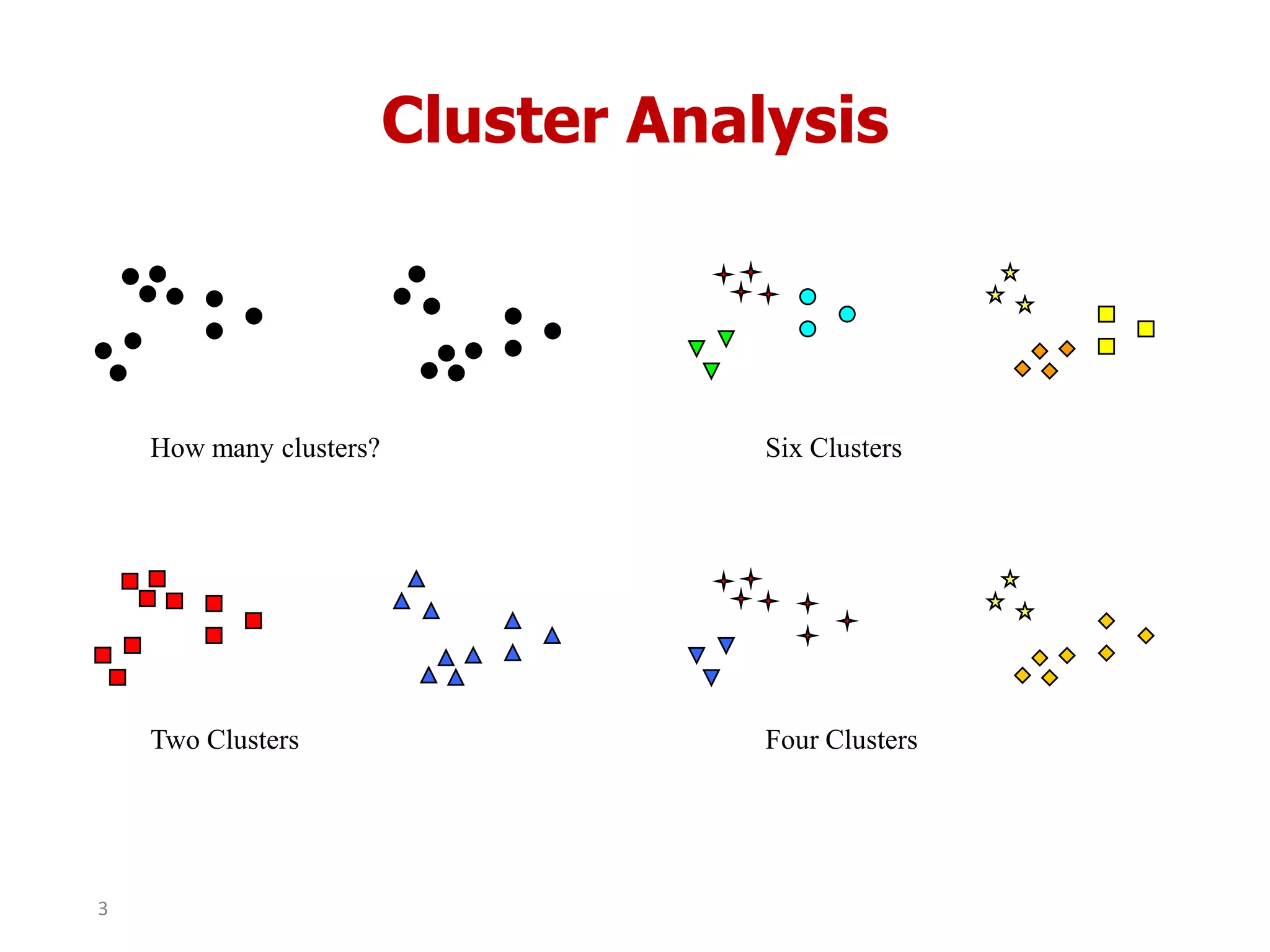
Cluster Analysis
How many clusters?
Four ClustersTwo Clusters
Six Clusters
3
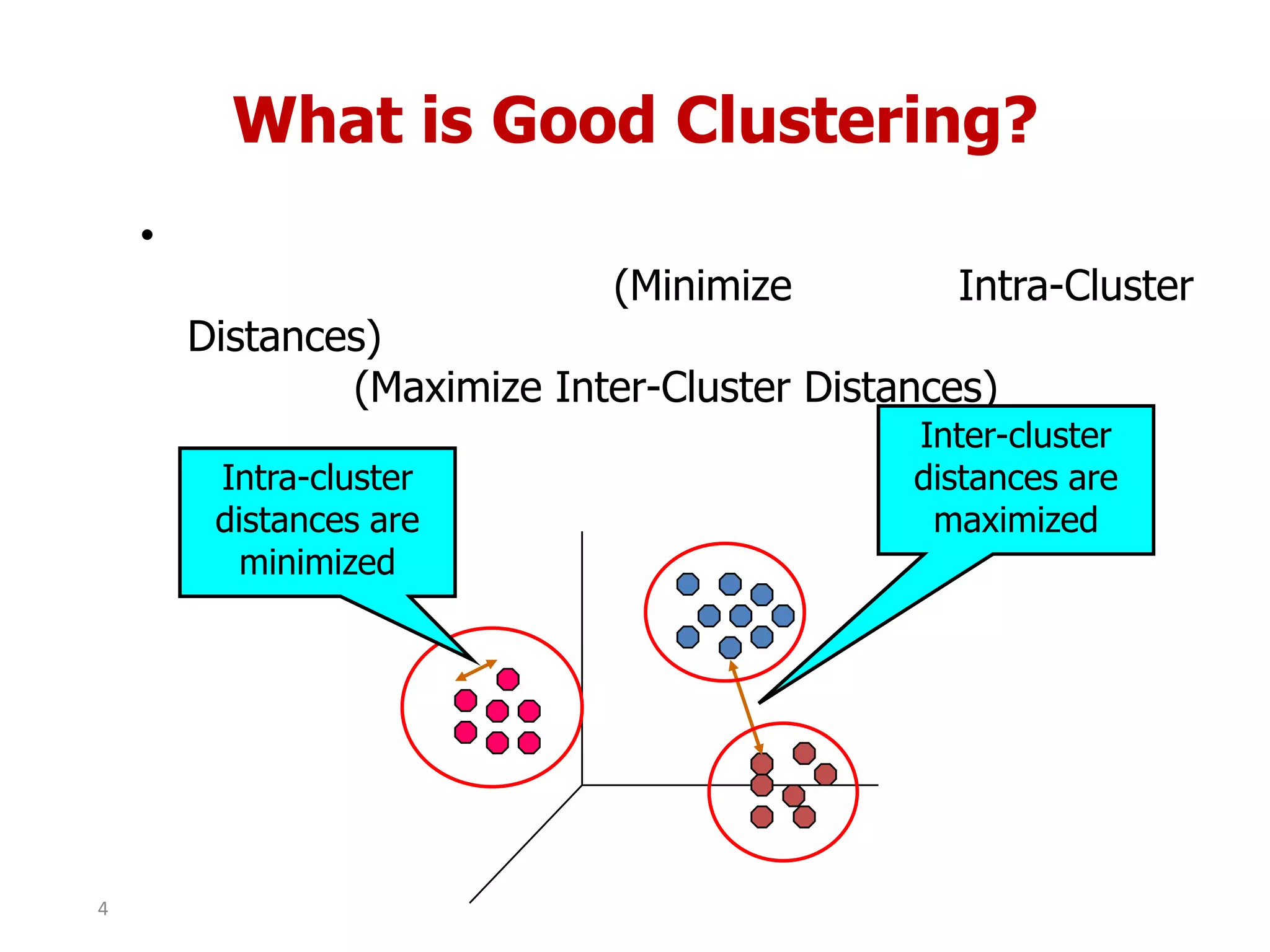
What is Good Clustering?
•
(Minimize Intra-Cluster
Distances)
(Maximize Inter-Cluster Distances)
Inter-cluster
distances are
maximized
Intra-cluster
distances are
minimized
4
Types of Clustering
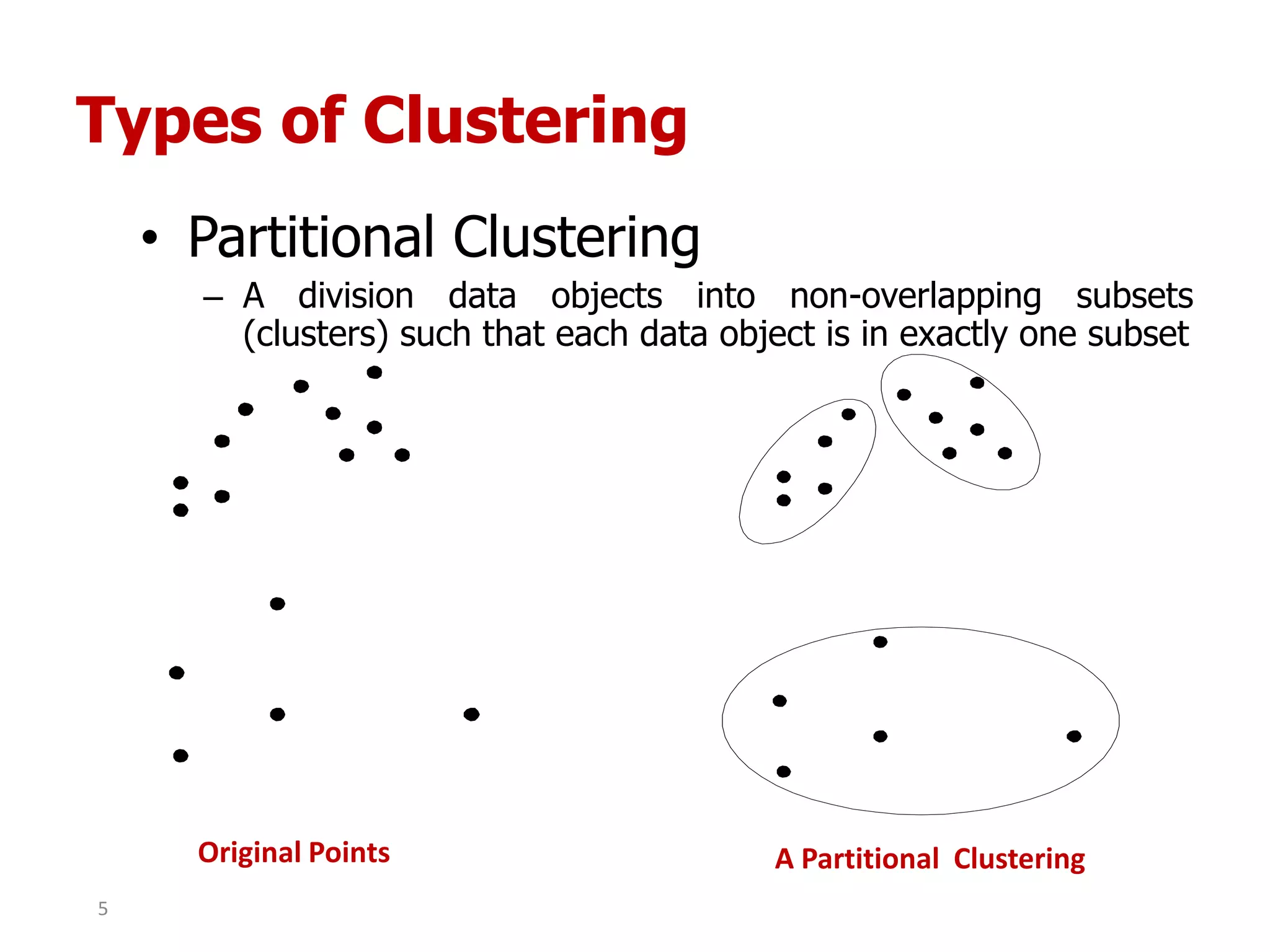
• Partitional Clustering
– A division data objects into non-overlapping subsets
(clusters) such that each data object is in exactly one subset
Original Points A Partitional Clustering
5
Types of Clustering
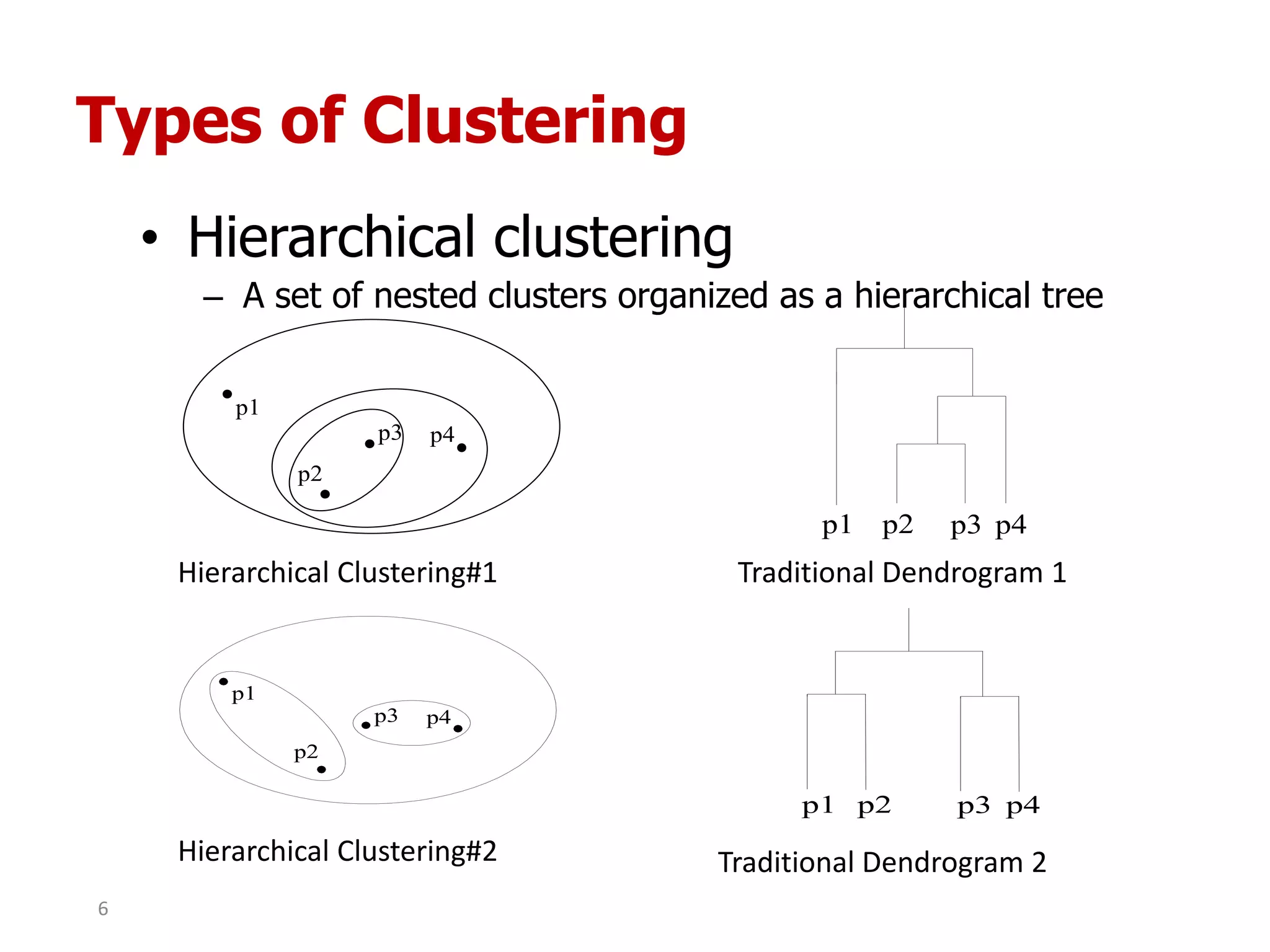
• Hierarchical clustering
– A set of nested clusters organized as a hierarchical tree
p4
p1
p3
p2
p4
p1
p3
p2
p4p1 p2 p3
p4p1 p2 p3
Hierarchical Clustering#1
Hierarchical Clustering#2 Traditional Dendrogram 2
Traditional Dendrogram 1
6
Types of Clustering
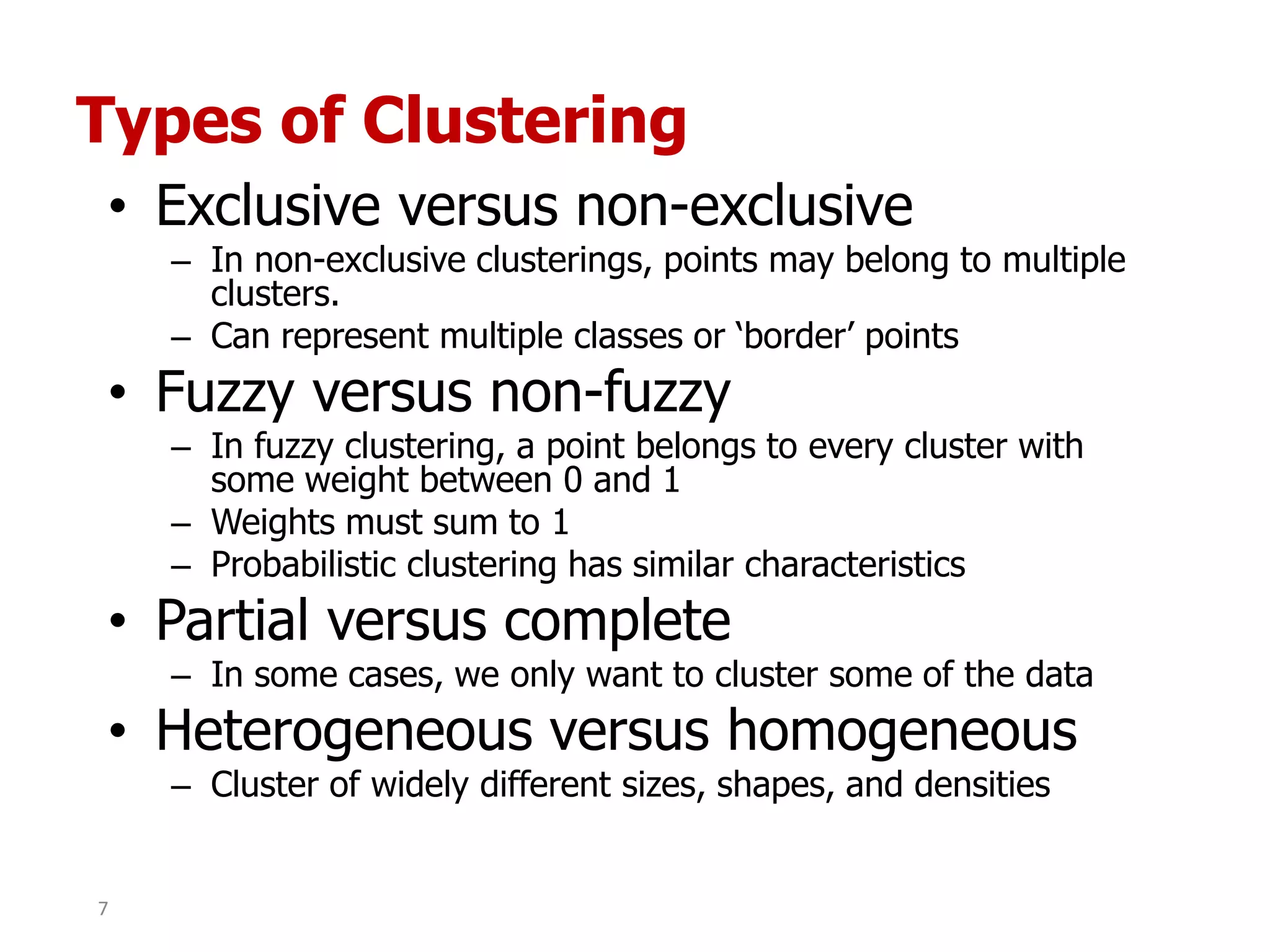
• Exclusive versus non-exclusive
– In non-exclusive clusterings, points may belong to multiple
clusters.
– Can represent multiple classes or „border‟ points
• Fuzzy versus non-fuzzy
– In fuzzy clustering, a point belongs to every cluster with
some weight between 0 and 1
– Weights must sum to 1
– Probabilistic clustering has similar characteristics
• Partial versus complete
– In some cases, we only want to cluster some of the data
• Heterogeneous versus homogeneous
– Cluster of widely different sizes, shapes, and densities
7
Characteristics of Cluster
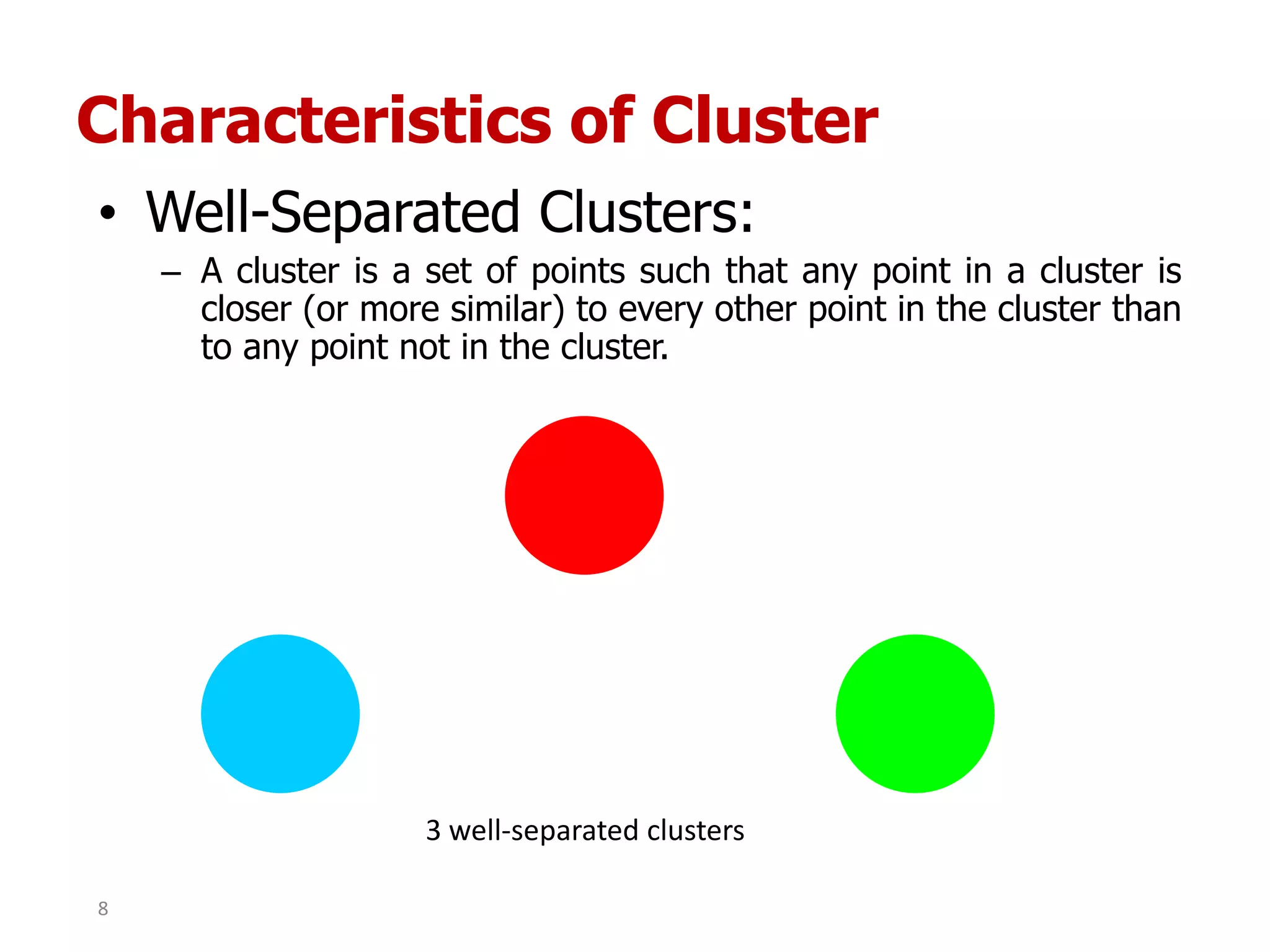
• Well-Separated Clusters:
– A cluster is a set of points such that any point in a cluster is
closer (or more similar) to every other point in the cluster than
to any point not in the cluster.
3 well-separated clusters
8
Characteristics of Cluster
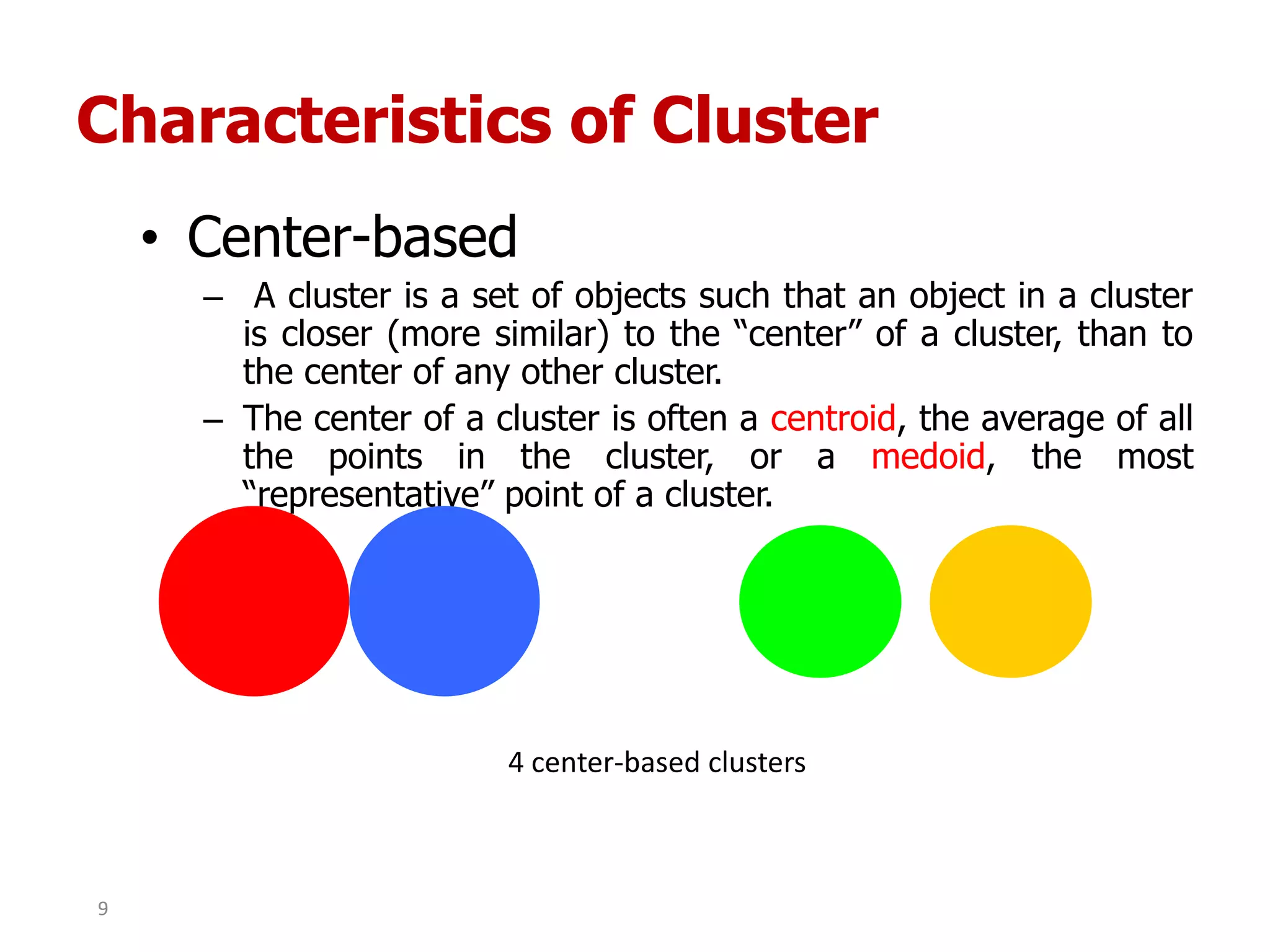
• Center-based
– A cluster is a set of objects such that an object in a cluster
is closer (more similar) to the “center” of a cluster, than to
the center of any other cluster.
– The center of a cluster is often a centroid, the average of all
the points in the cluster, or a medoid, the most
“representative” point of a cluster.
4 center-based clusters
9
Characteristics of Cluster
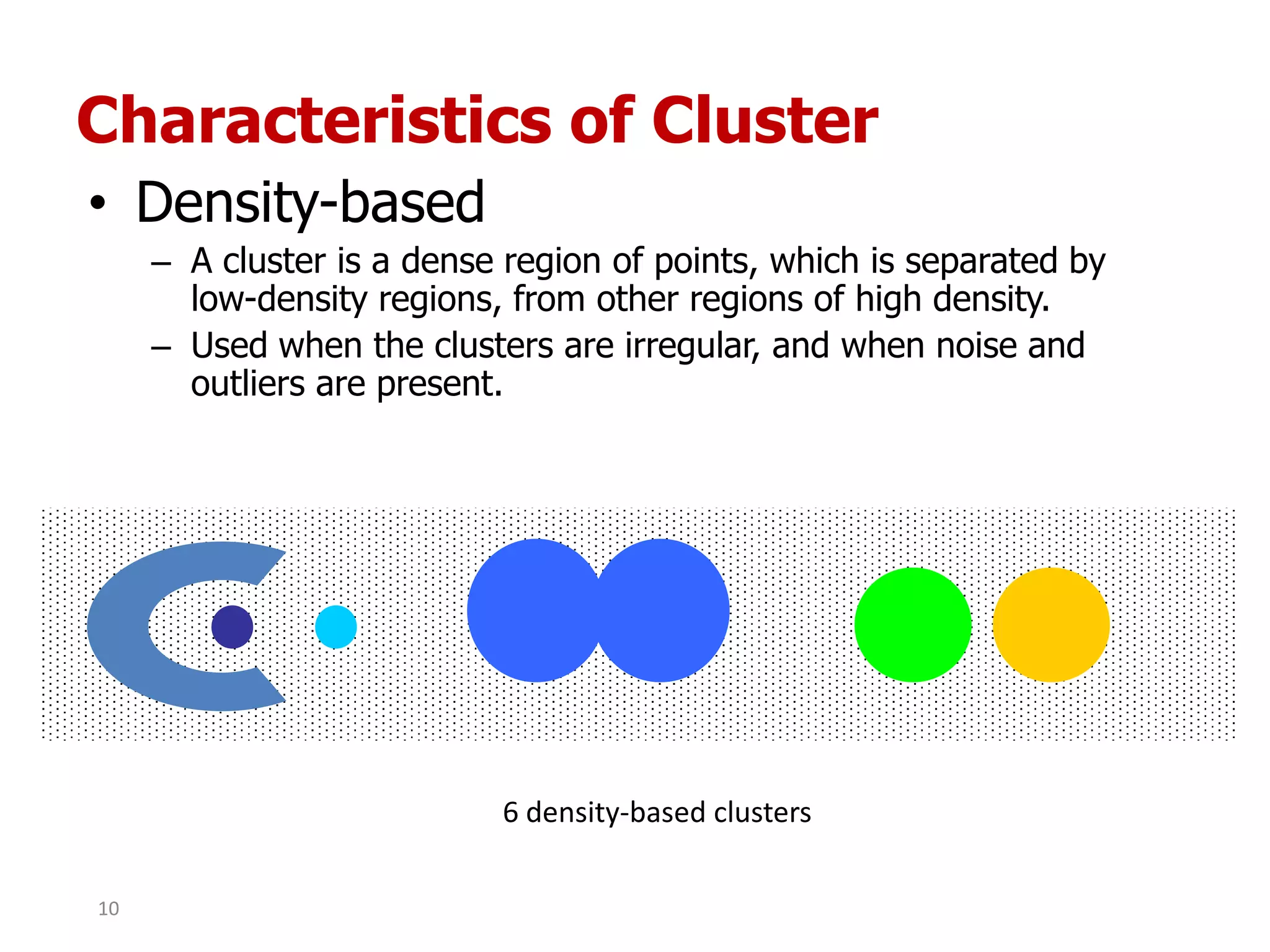
• Density-based
– A cluster is a dense region of points, which is separated by
low-density regions, from other regions of high density.
– Used when the clusters are irregular, and when noise and
outliers are present.
6 density-based clusters
10
Characteristics of Cluster
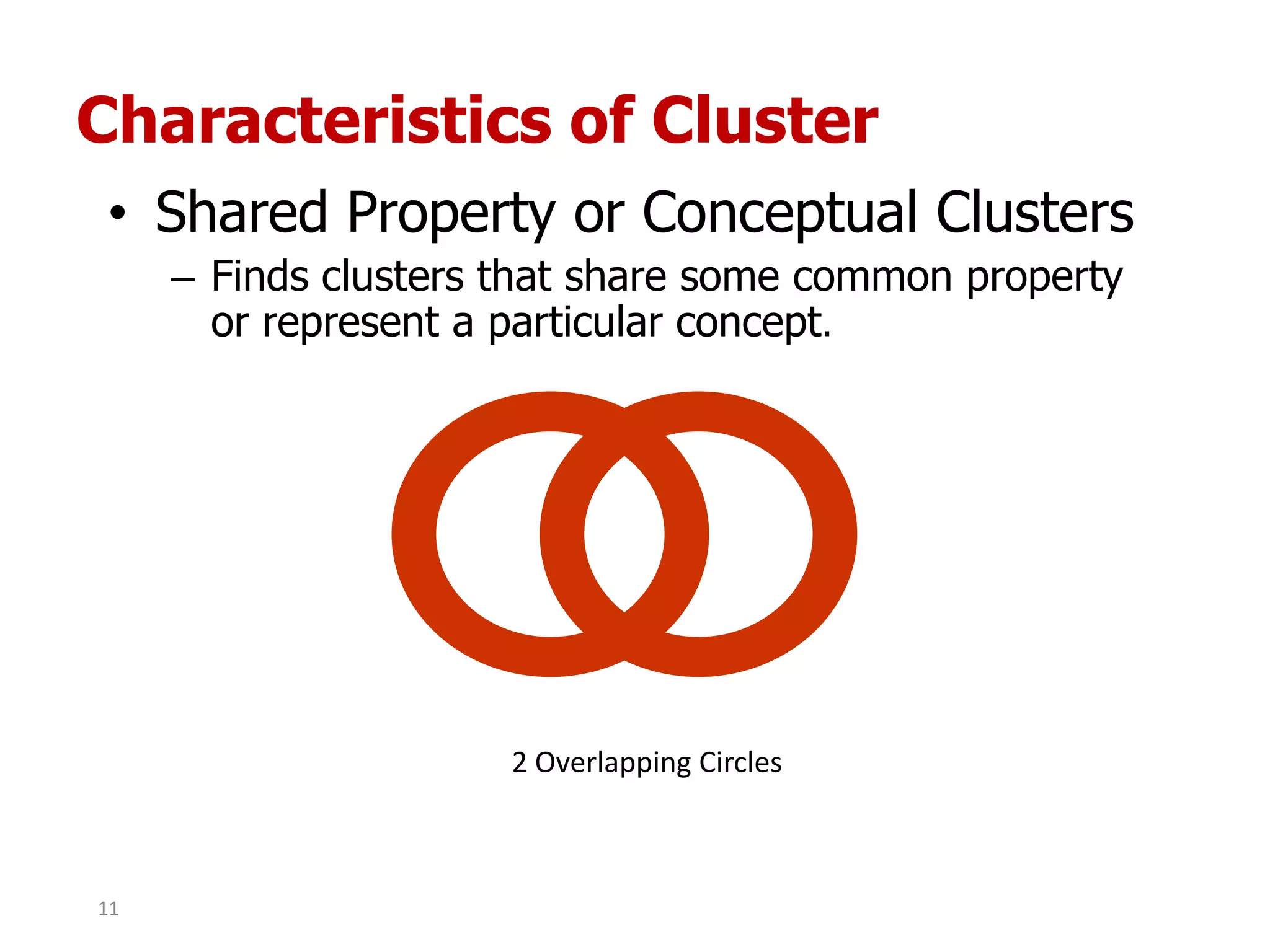
• Shared Property or Conceptual Clusters
– Finds clusters that share some common property
or represent a particular concept.
2 Overlapping Circles
11
Clustering Algorithms
• K-means clustering
• Hierarchical clustering
12
K-means Clustering
• (Partition) n
D k (
k)
• k-Means k
13
K-means Clustering Algorithm
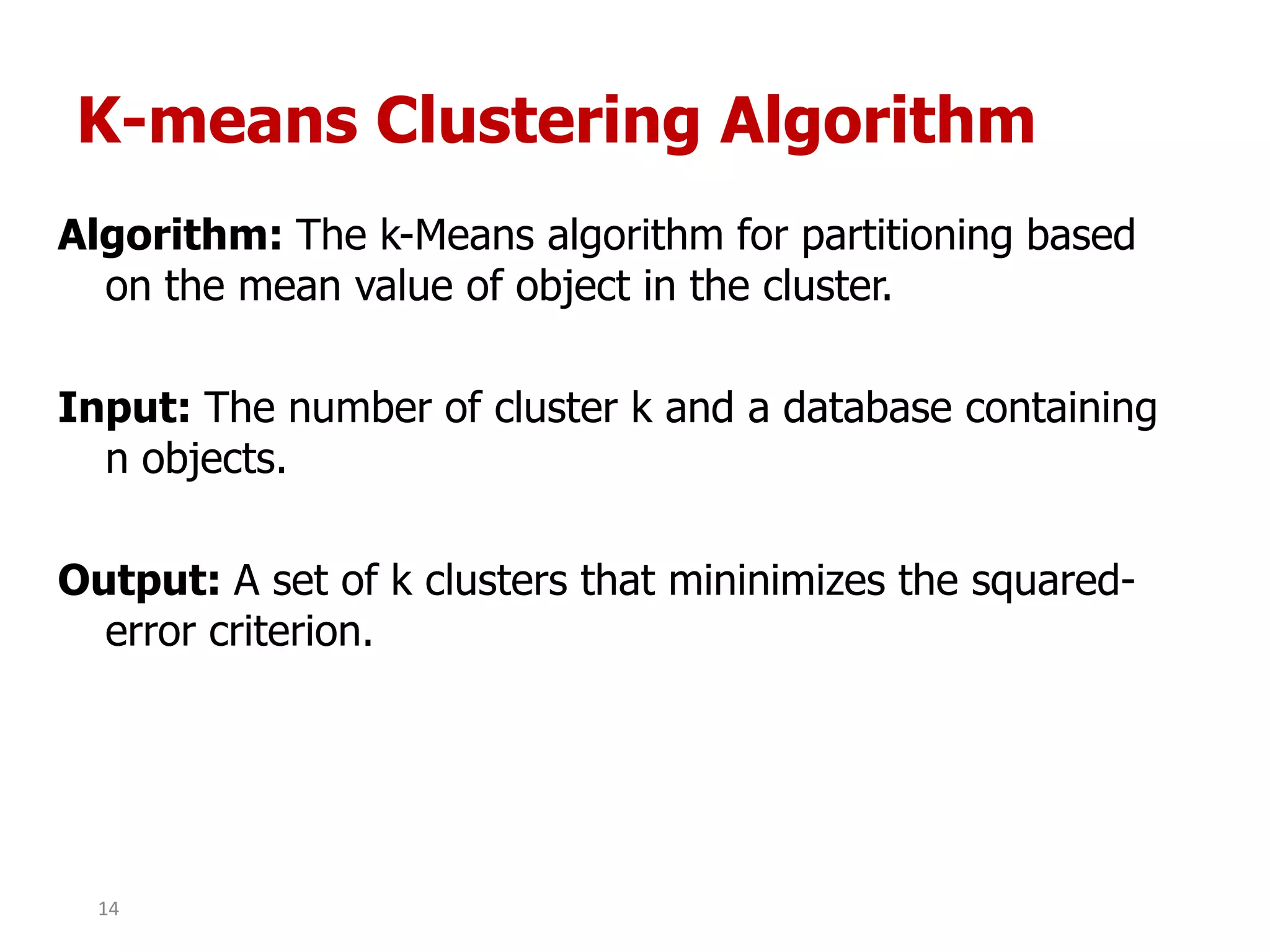
Algorithm: The k-Means algorithm for partitioning based
on the mean value of object in the cluster.
Input: The number of cluster k and a database containing
n objects.
Output: A set of k clusters that mininimizes the squared-
error criterion.
14
K-means Clustering Algorithm
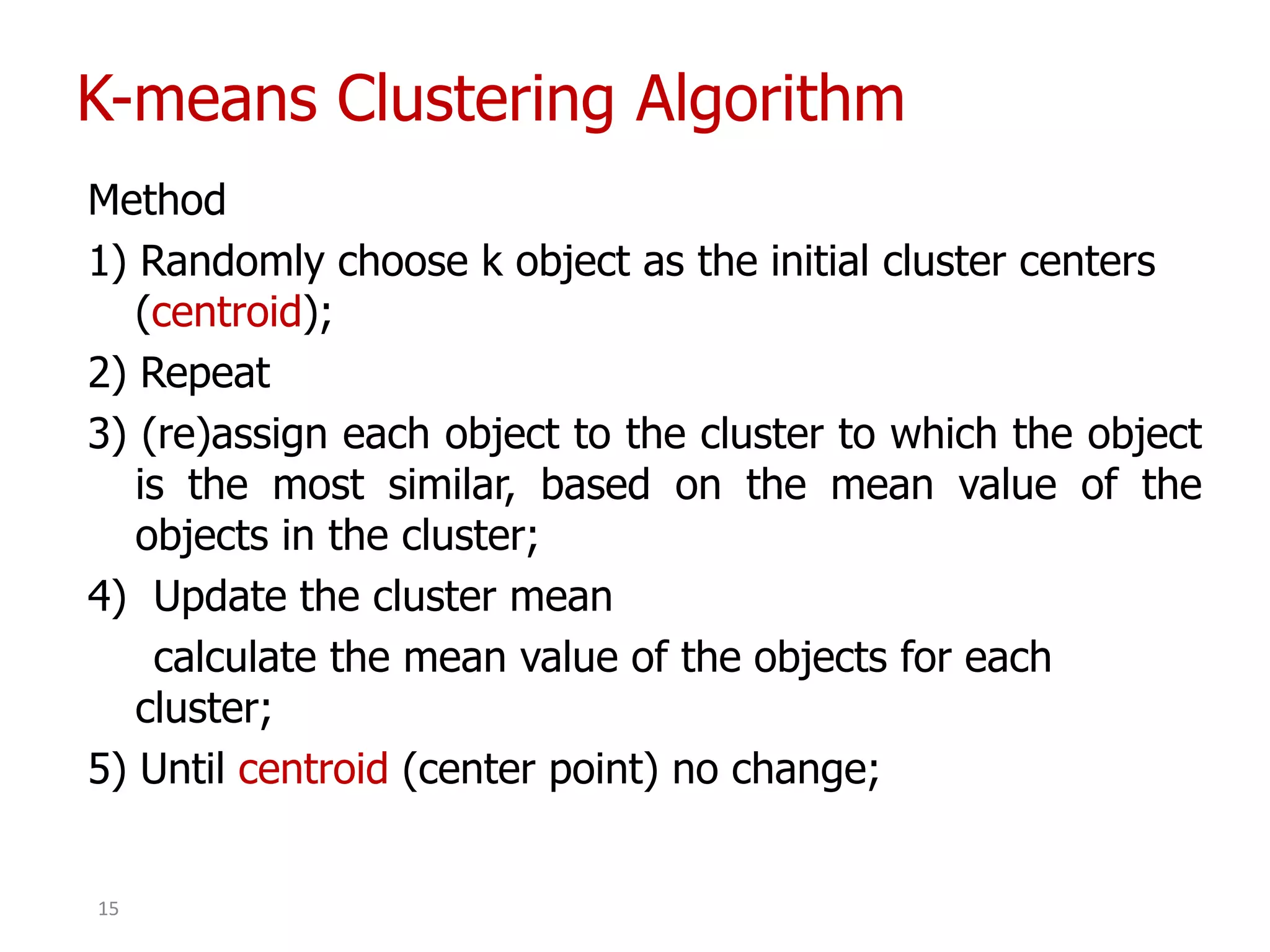
Method
1) Randomly choose k object as the initial cluster centers
(centroid);
2) Repeat
3) (re)assign each object to the cluster to which the object
is the most similar, based on the mean value of the
objects in the cluster;
4) Update the cluster mean
calculate the mean value of the objects for each
cluster;
5) Until centroid (center point) no change;
15
Example: K-Mean Clustering
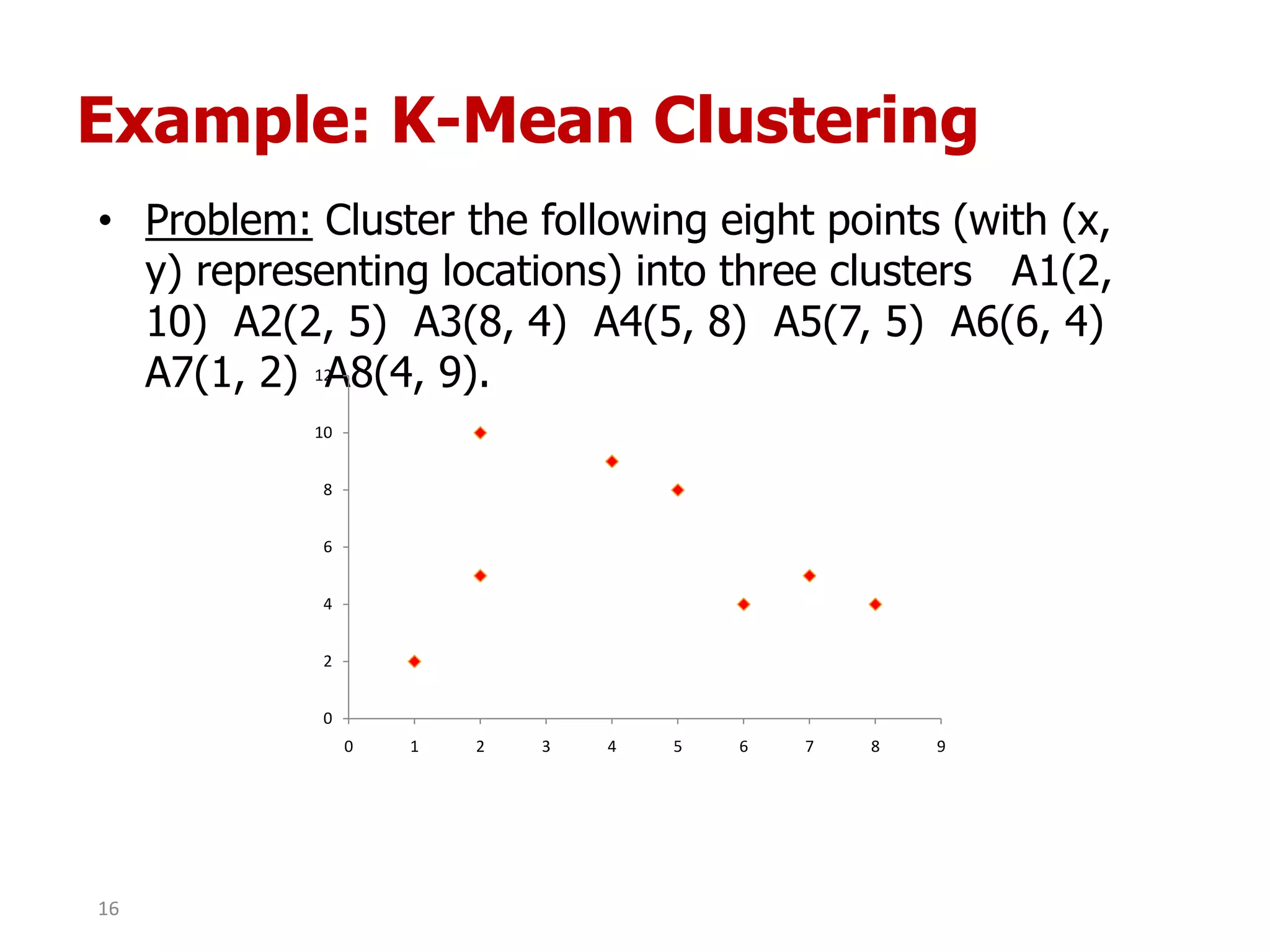
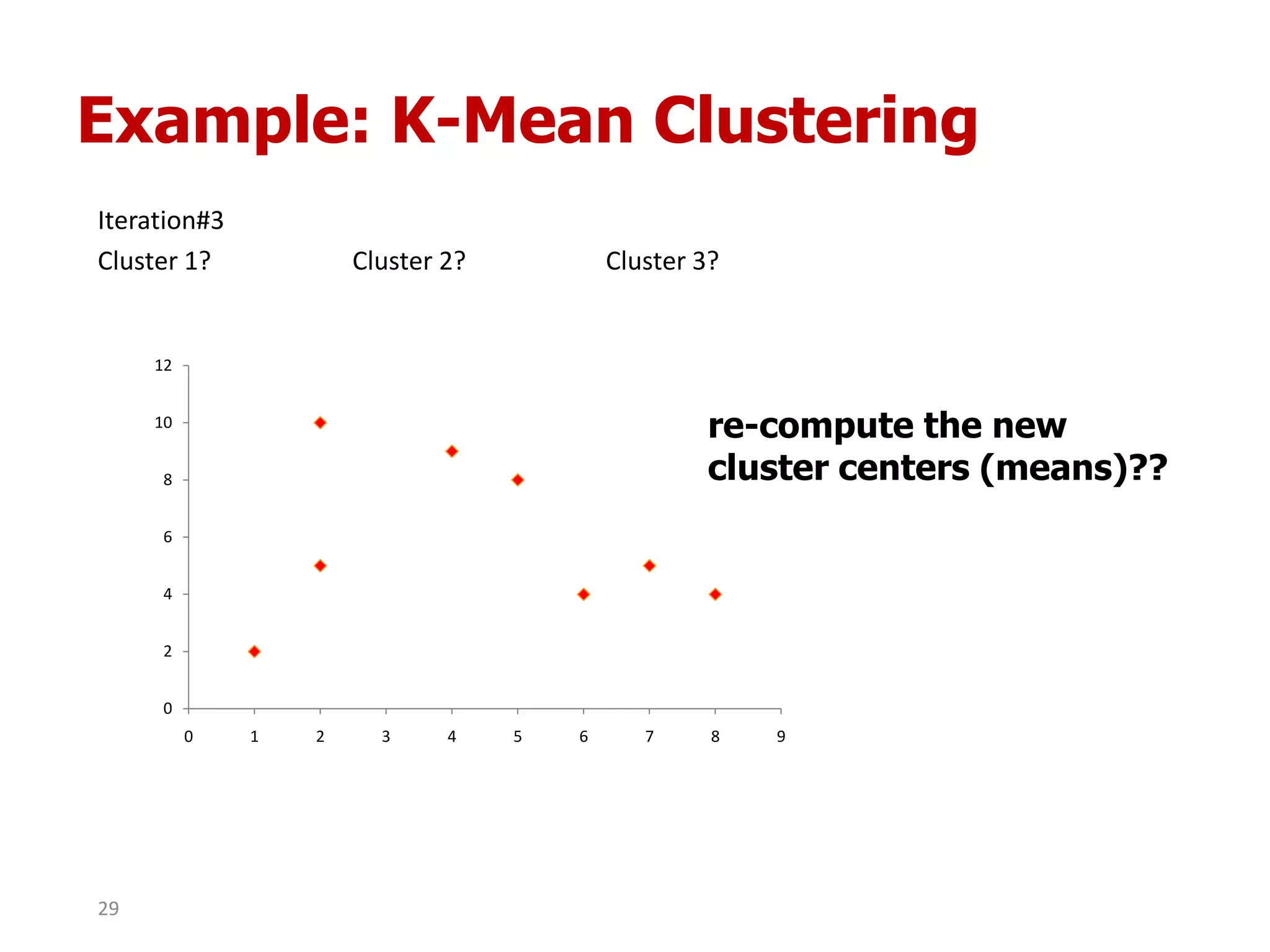
• Problem: Cluster the following eight points (with (x,
y) representing locations) into three clusters A1(2,
10) A2(2, 5) A3(8, 4) A4(5, 8) A5(7, 5) A6(6, 4)
A7(1, 2) A8(4, 9).
0
2
4
6
8
10
12
0 1 2 3 4 5 6 7 8 9
16
Example: K-Mean Clustering
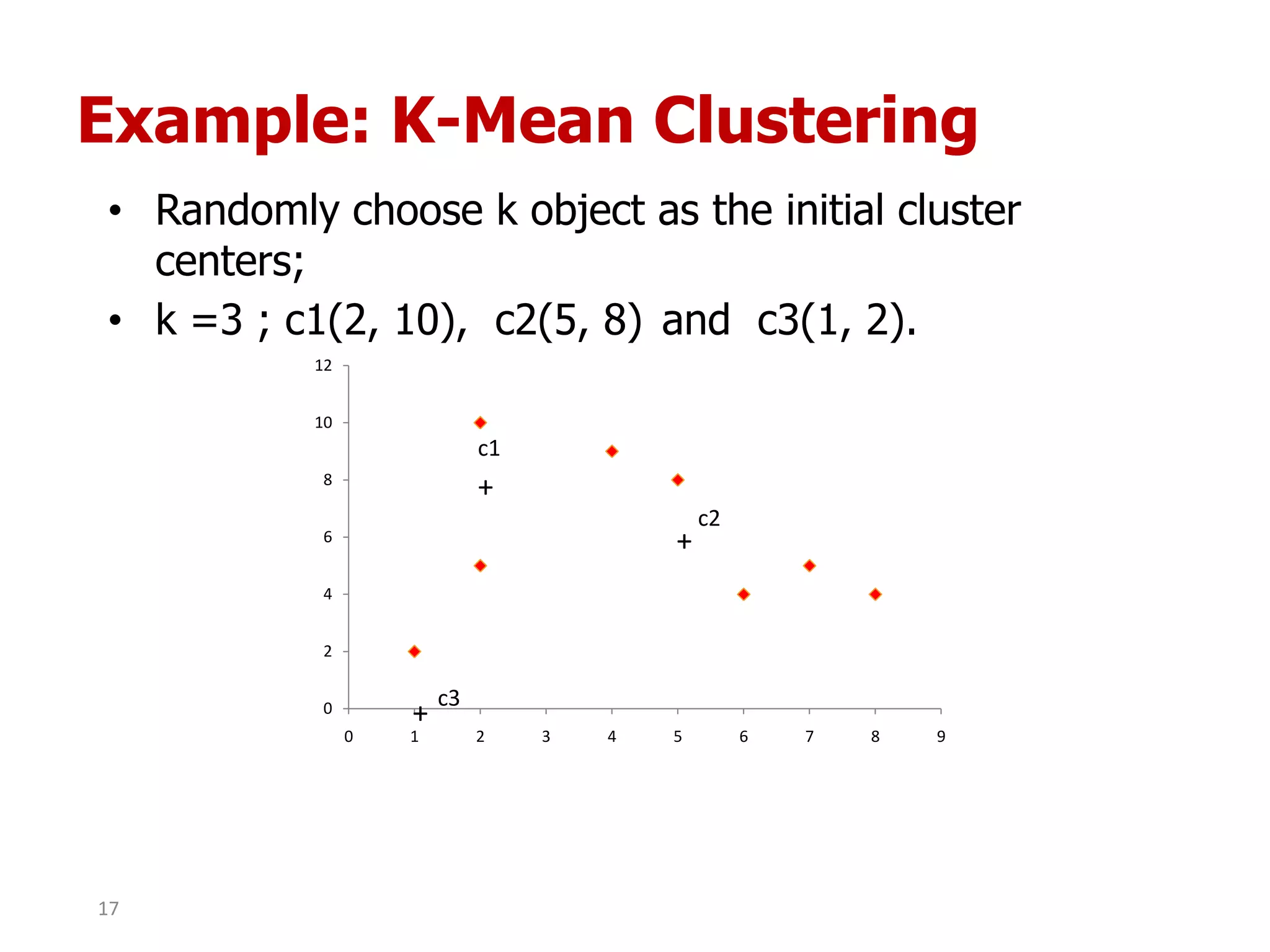
• Randomly choose k object as the initial cluster
centers;
• k =3 ; c1(2, 10), c2(5, 8) and c3(1, 2).
0
2
4
6
8
10
12
0 1 2 3 4 5 6 7 8 9
+
+
+
c1
c2
c3
17
Example: K-Mean Clustering
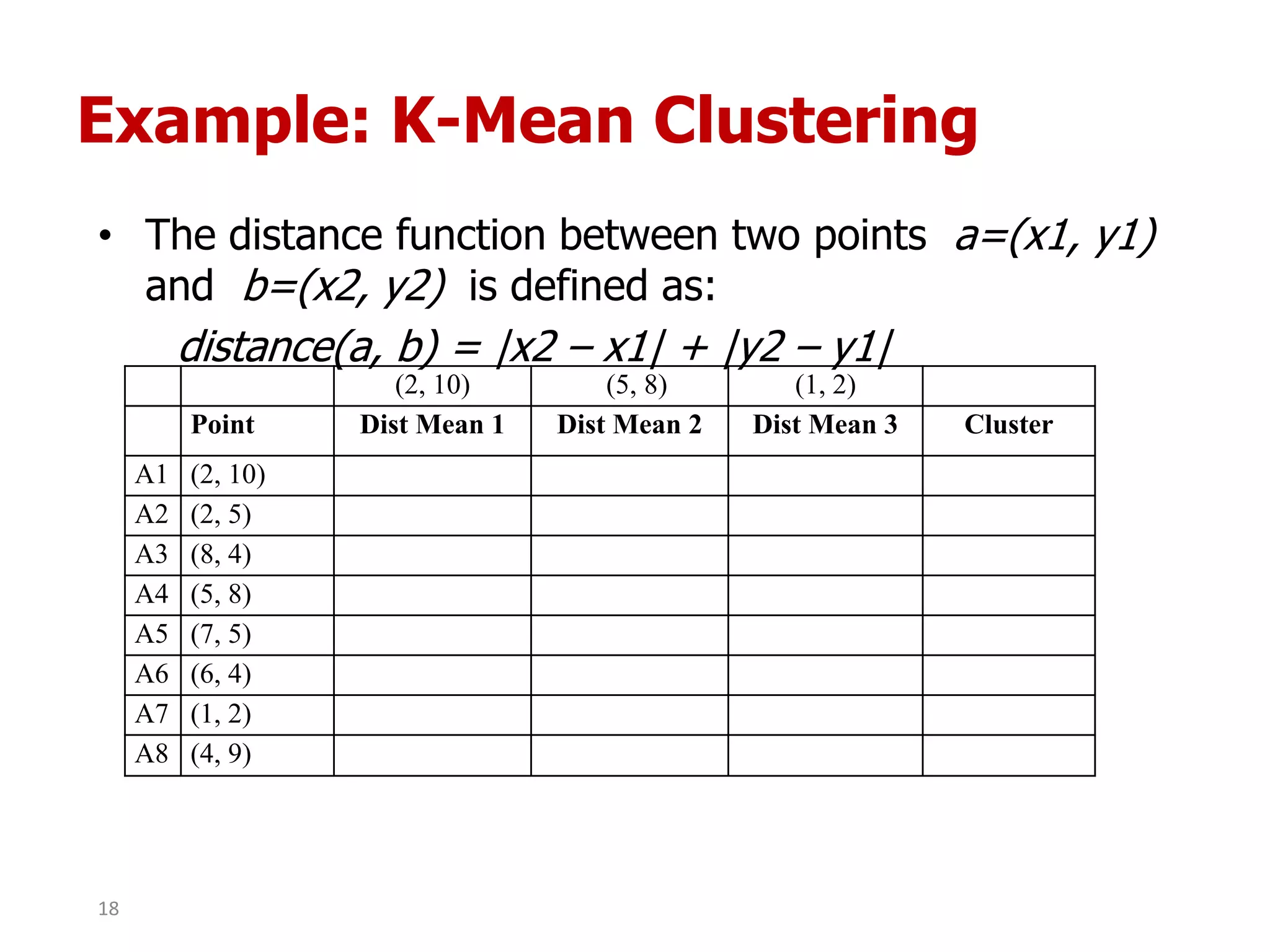
• The distance function between two points a=(x1, y1)
and b=(x2, y2) is defined as:
distance(a, b) = |x2 – x1| + |y2 – y1|
(2, 10) (5, 8) (1, 2)
Point Dist Mean 1 Dist Mean 2 Dist Mean 3 Cluster
A1 (2, 10)
A2 (2, 5)
A3 (8, 4)
A4 (5, 8)
A5 (7, 5)
A6 (6, 4)
A7 (1, 2)
A8 (4, 9)
18
Example: K-Mean Clustering
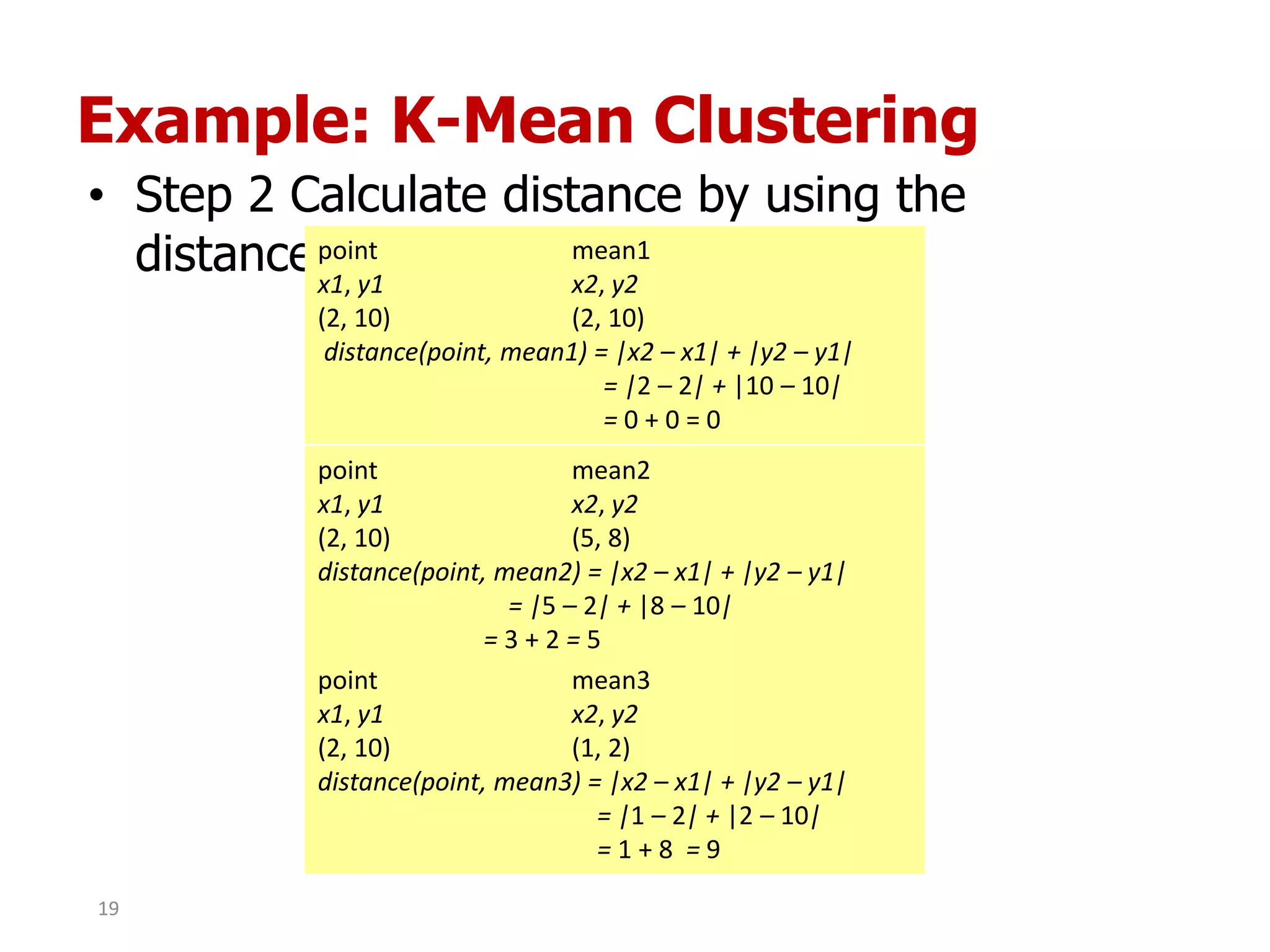
• Step 2 Calculate distance by using the
distance functionpoint mean1
x1, y1 x2, y2
(2, 10) (2, 10)
distance(point, mean1) = |x2 – x1| + |y2 – y1|
= |2 – 2| + |10 – 10|
= 0 + 0 = 0
point mean2
x1, y1 x2, y2
(2, 10) (5, 8)
distance(point, mean2) = |x2 – x1| + |y2 – y1|
= |5 – 2| + |8 – 10|
= 3 + 2 = 5
point mean3
x1, y1 x2, y2
(2, 10) (1, 2)
distance(point, mean3) = |x2 – x1| + |y2 – y1|
= |1 – 2| + |2 – 10|
= 1 + 8 = 9
19
Example: K-Mean Clustering
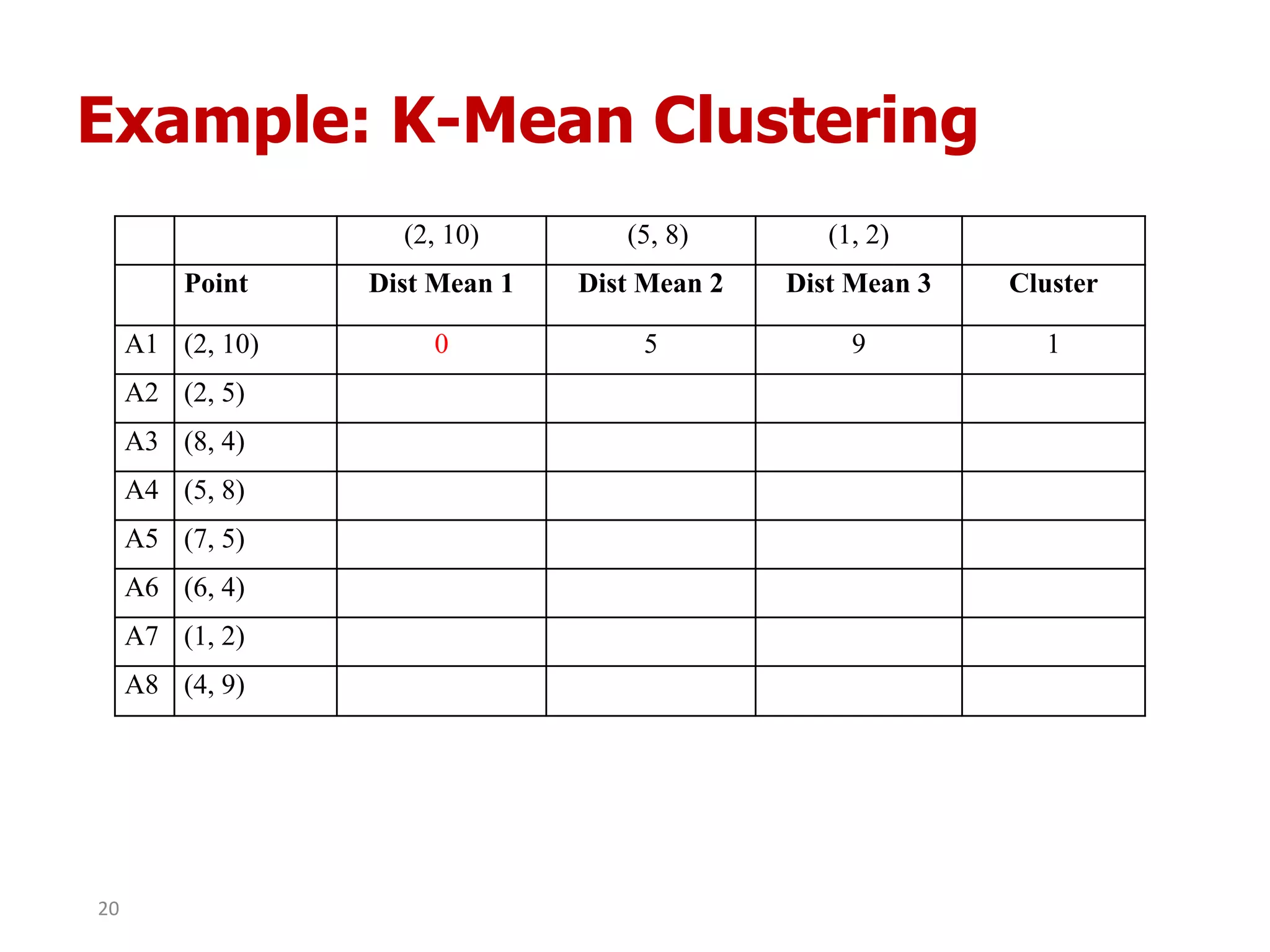
(2, 10) (5, 8) (1, 2)
Point Dist Mean 1 Dist Mean 2 Dist Mean 3 Cluster
A1 (2, 10) 0 5 9 1
A2 (2, 5)
A3 (8, 4)
A4 (5, 8)
A5 (7, 5)
A6 (6, 4)
A7 (1, 2)
A8 (4, 9)
20
Example: K-Mean Clustering
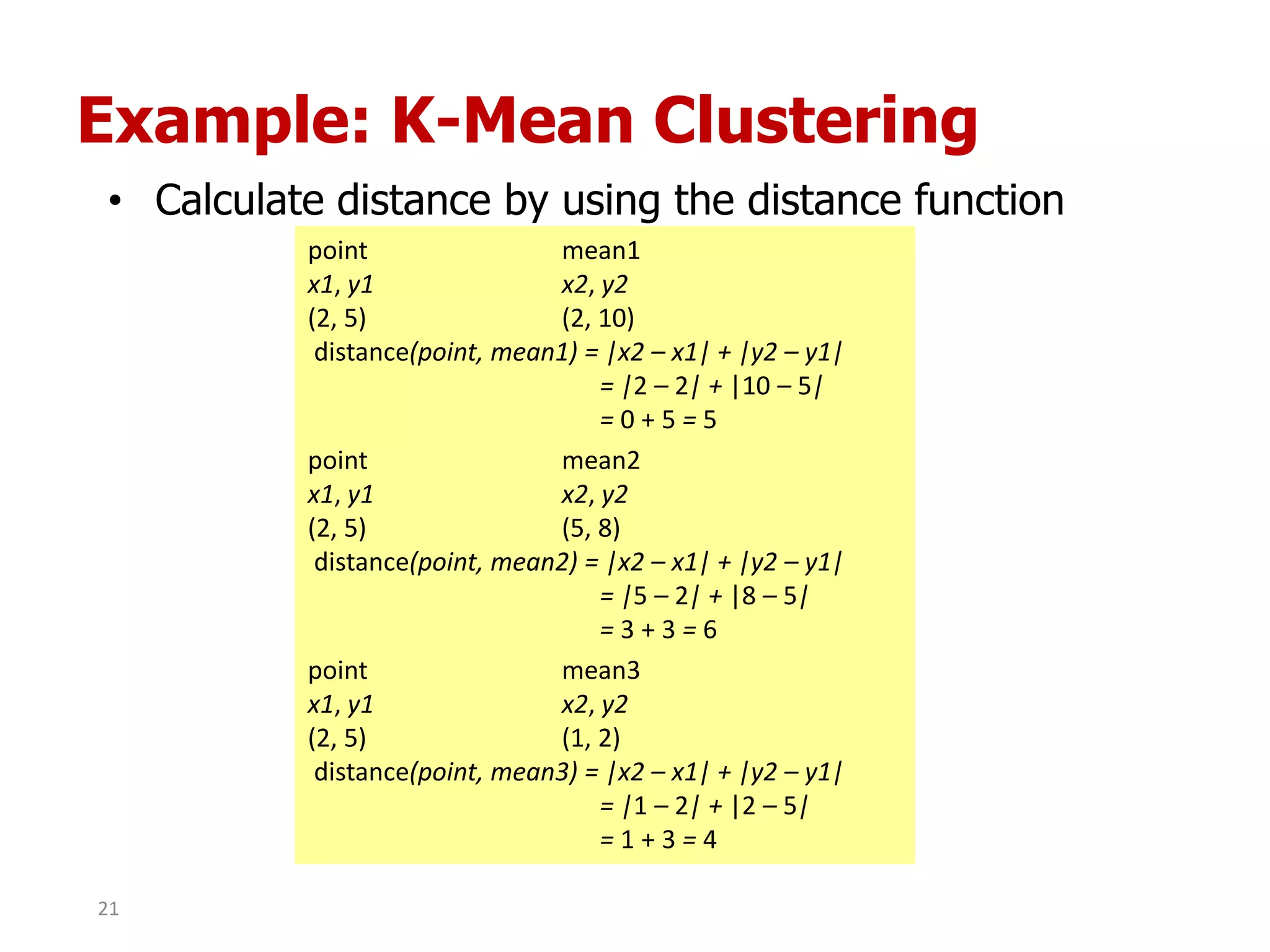
• Calculate distance by using the distance function
point mean1
x1, y1 x2, y2
(2, 5) (2, 10)
distance(point, mean1) = |x2 – x1| + |y2 – y1|
= |2 – 2| + |10 – 5|
= 0 + 5 = 5
point mean2
x1, y1 x2, y2
(2, 5) (5, 8)
distance(point, mean2) = |x2 – x1| + |y2 – y1|
= |5 – 2| + |8 – 5|
= 3 + 3 = 6
point mean3
x1, y1 x2, y2
(2, 5) (1, 2)
distance(point, mean3) = |x2 – x1| + |y2 – y1|
= |1 – 2| + |2 – 5|
= 1 + 3 = 4
21
Example: K-Mean Clustering
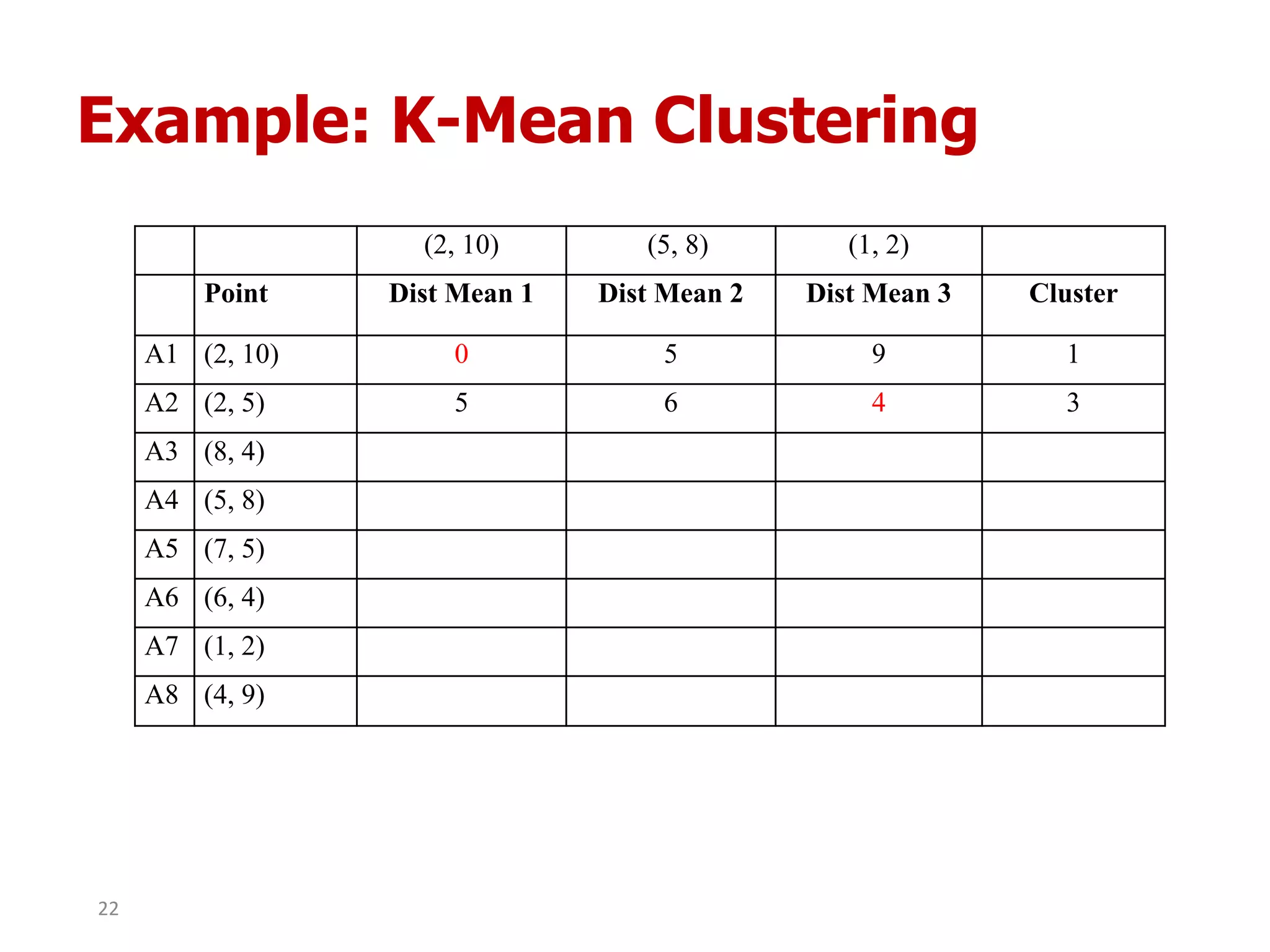
(2, 10) (5, 8) (1, 2)
Point Dist Mean 1 Dist Mean 2 Dist Mean 3 Cluster
A1 (2, 10) 0 5 9 1
A2 (2, 5) 5 6 4 3
A3 (8, 4)
A4 (5, 8)
A5 (7, 5)
A6 (6, 4)
A7 (1, 2)
A8 (4, 9)
22
Example: K-Mean Clustering
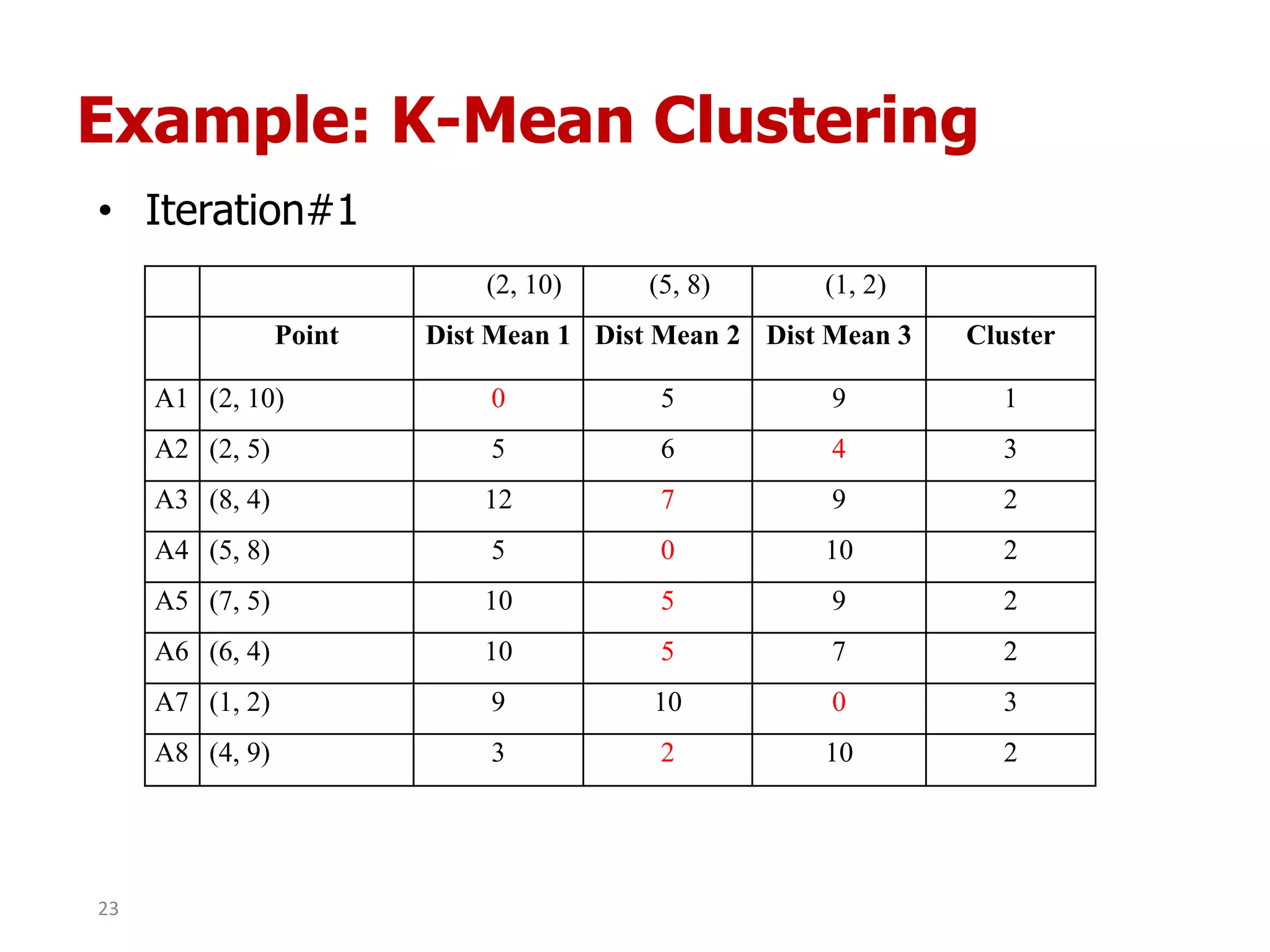
• Iteration#1
(2, 10) (5, 8) (1, 2)
Point Dist Mean 1 Dist Mean 2 Dist Mean 3 Cluster
A1 (2, 10) 0 5 9 1
A2 (2, 5) 5 6 4 3
A3 (8, 4) 12 7 9 2
A4 (5, 8) 5 0 10 2
A5 (7, 5) 10 5 9 2
A6 (6, 4) 10 5 7 2
A7 (1, 2) 9 10 0 3
A8 (4, 9) 3 2 10 2
23
Example: K-Mean Clustering
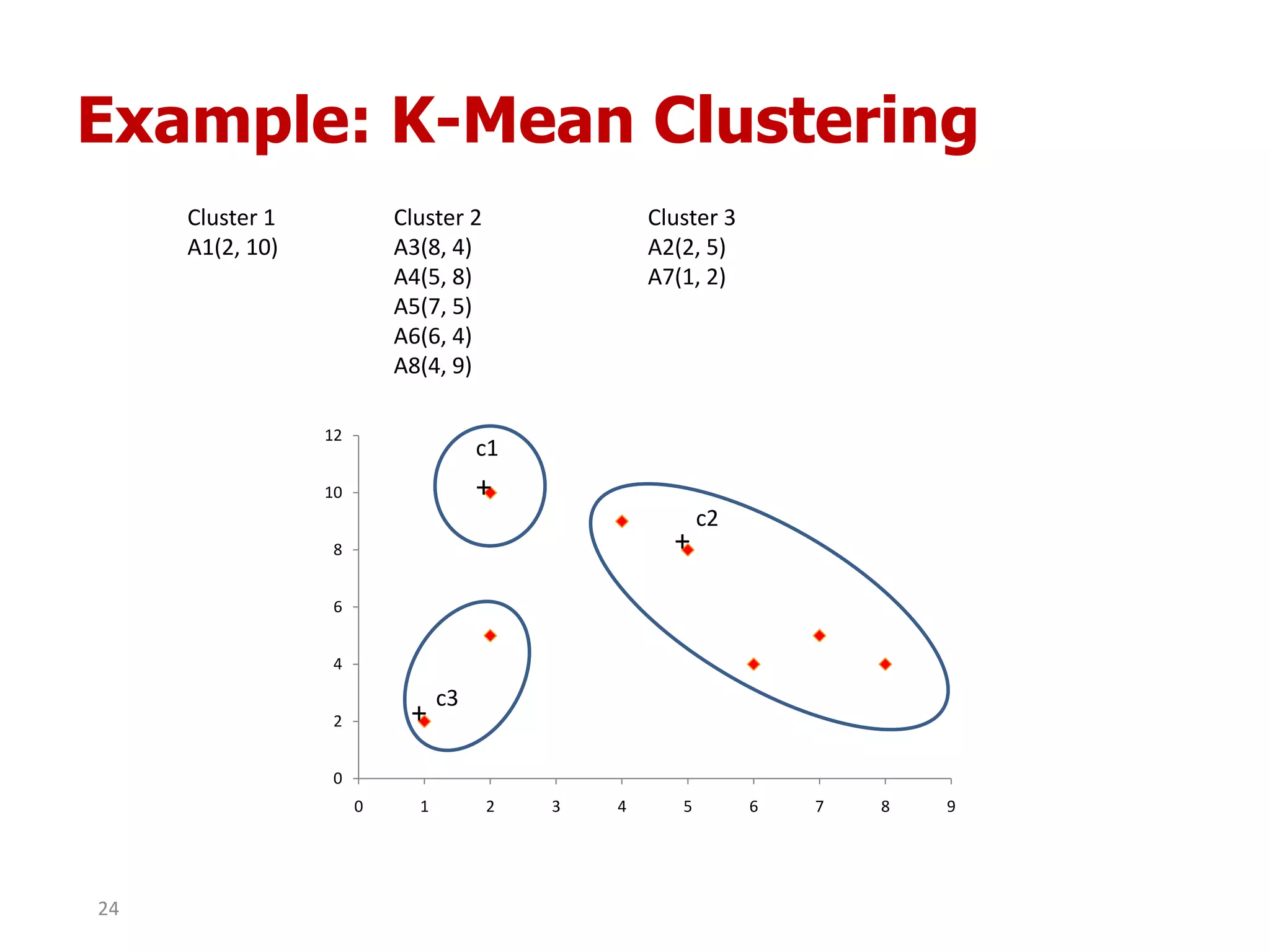
Cluster 1 Cluster 2 Cluster 3
A1(2, 10) A3(8, 4) A2(2, 5)
A4(5, 8) A7(1, 2)
A5(7, 5)
A6(6, 4)
A8(4, 9)
0
2
4
6
8
10
12
0 1 2 3 4 5 6 7 8 9
+
+
c1
c2
c3
+
24
Example: K-Mean Clustering
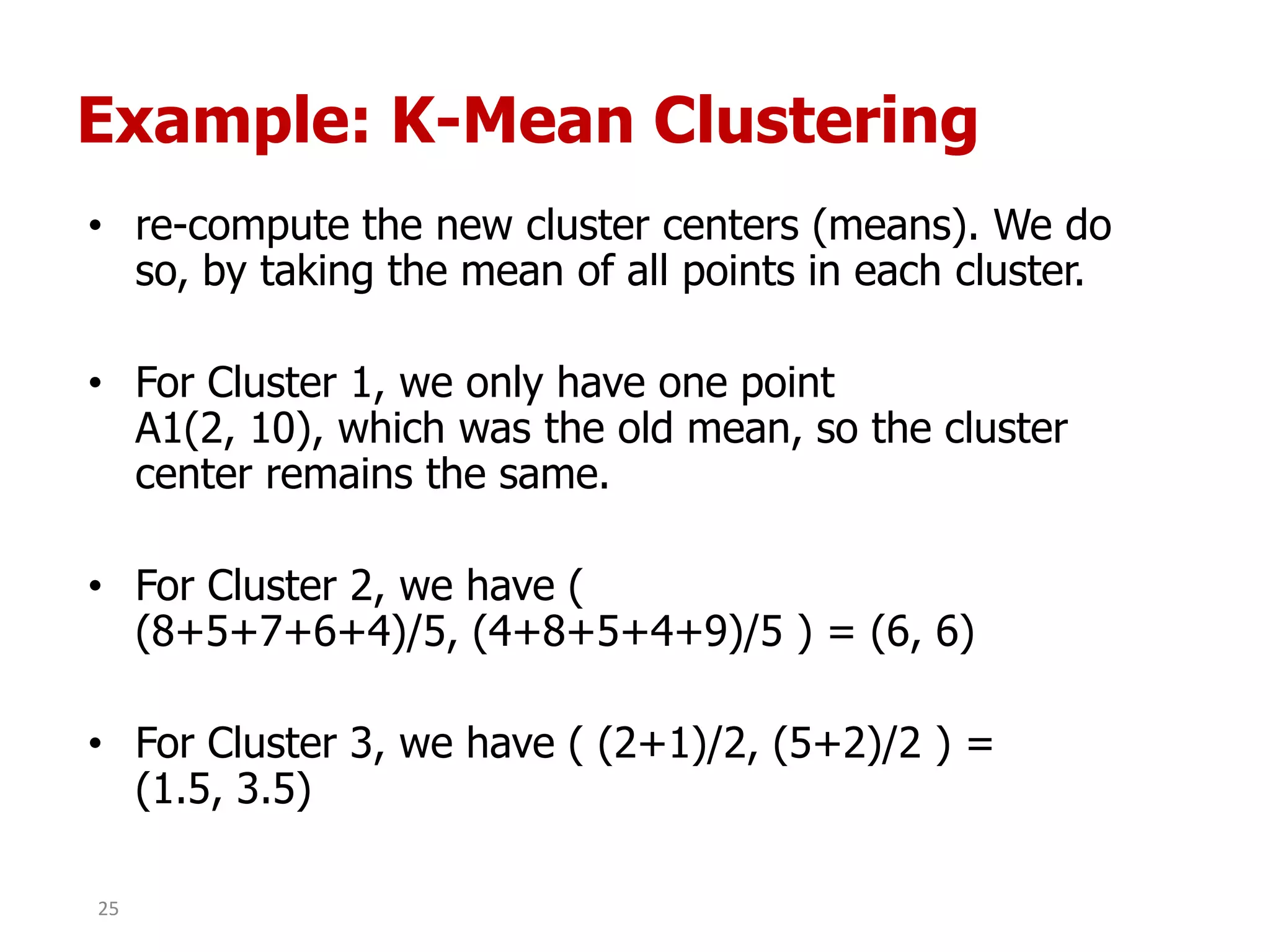
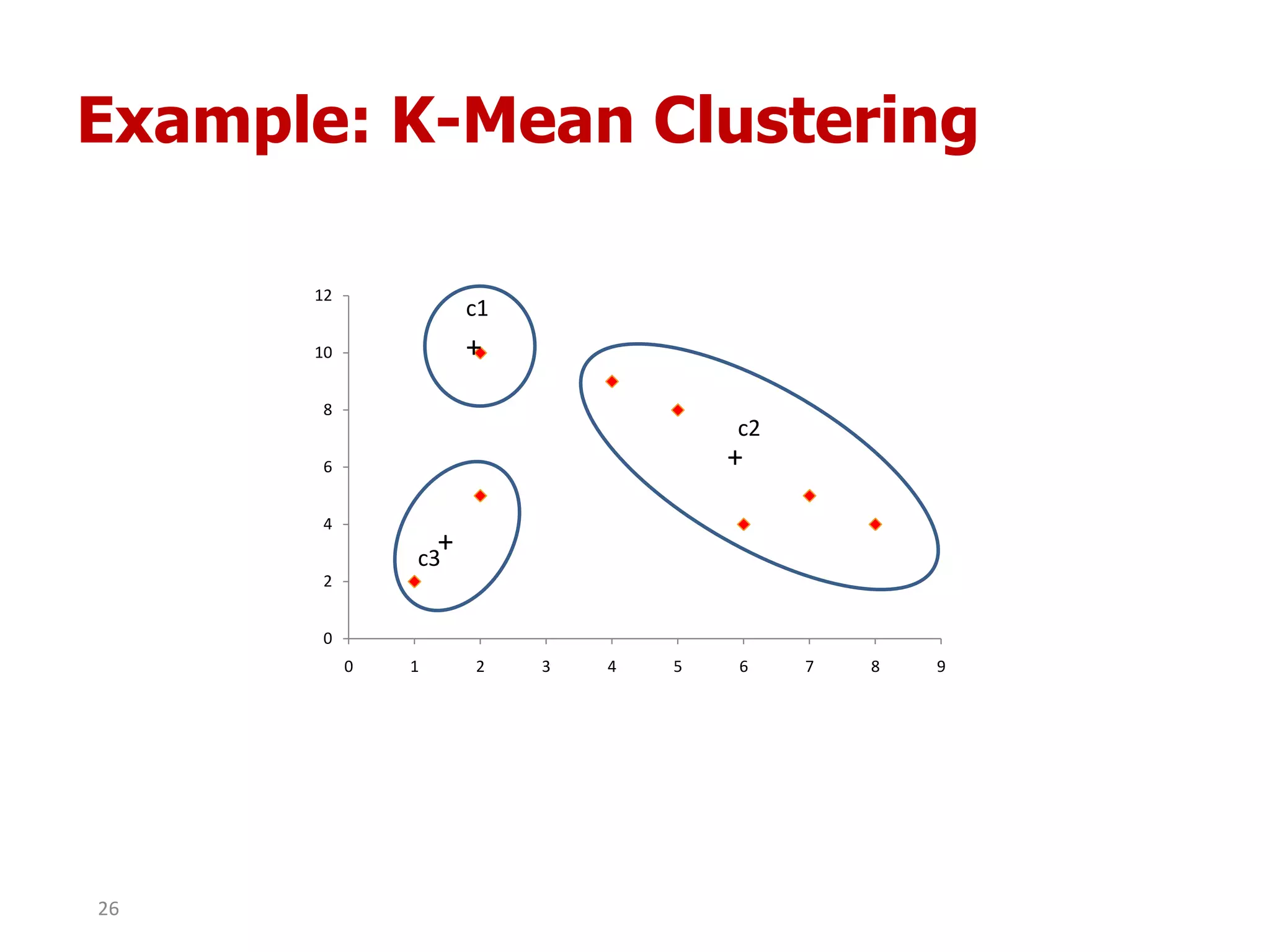
• re-compute the new cluster centers (means). We do
so, by taking the mean of all points in each cluster.
• For Cluster 1, we only have one point
A1(2, 10), which was the old mean, so the cluster
center remains the same.
• For Cluster 2, we have (
(8+5+7+6+4)/5, (4+8+5+4+9)/5 ) = (6, 6)
• For Cluster 3, we have ( (2+1)/2, (5+2)/2 ) =
(1.5, 3.5)
25
Example: K-Mean Clustering
0
2
4
6
8
10
12
0 1 2 3 4 5 6 7 8 9
+
+
c1
c2
c3
+
26
Example: K-Mean Clustering
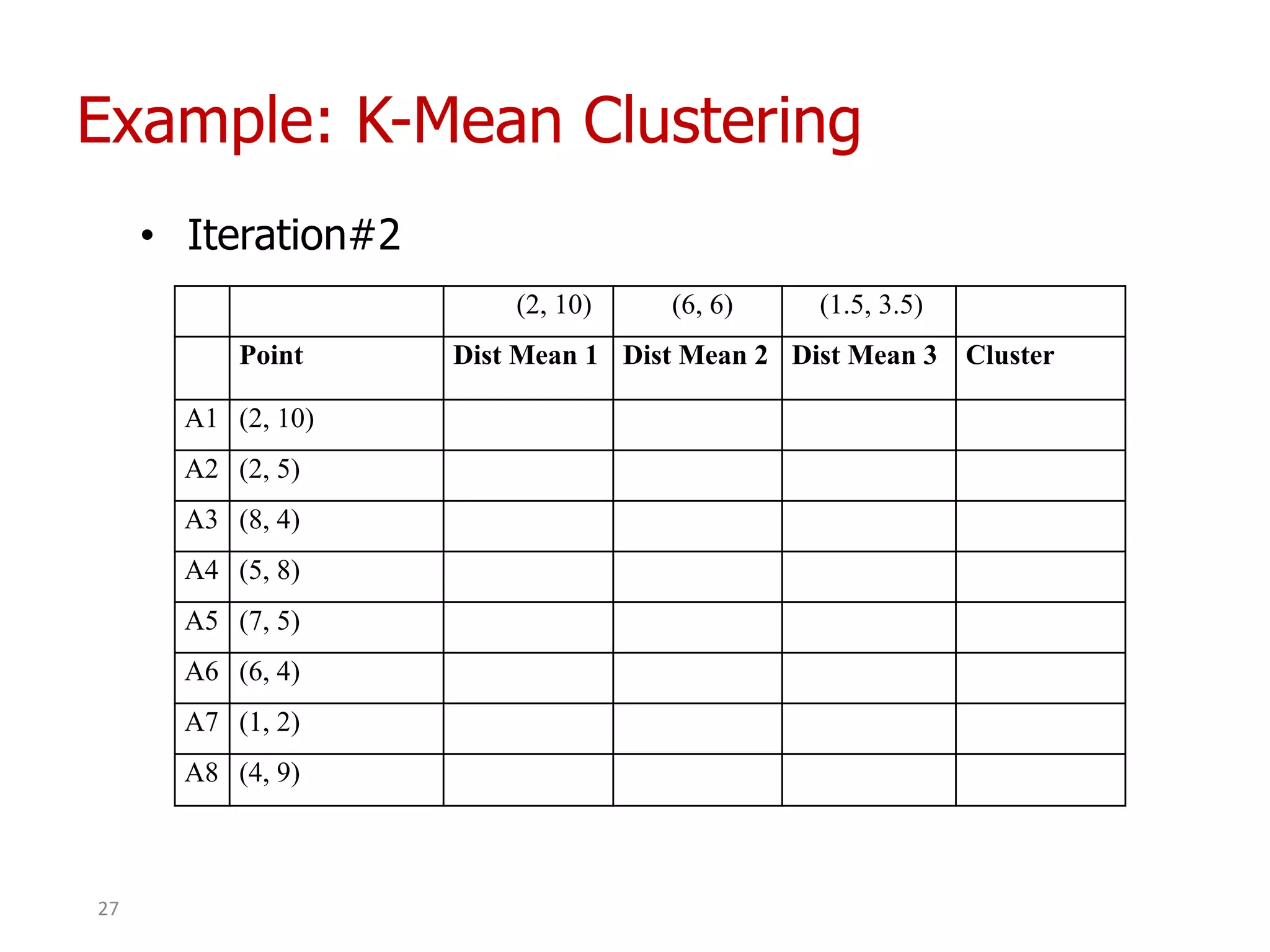
• Iteration#2
(2, 10) (6, 6) (1.5, 3.5)
Point Dist Mean 1 Dist Mean 2 Dist Mean 3 Cluster
A1 (2, 10)
A2 (2, 5)
A3 (8, 4)
A4 (5, 8)
A5 (7, 5)
A6 (6, 4)
A7 (1, 2)
A8 (4, 9)
27
Example: K-Mean Clustering
(Iteration#2)
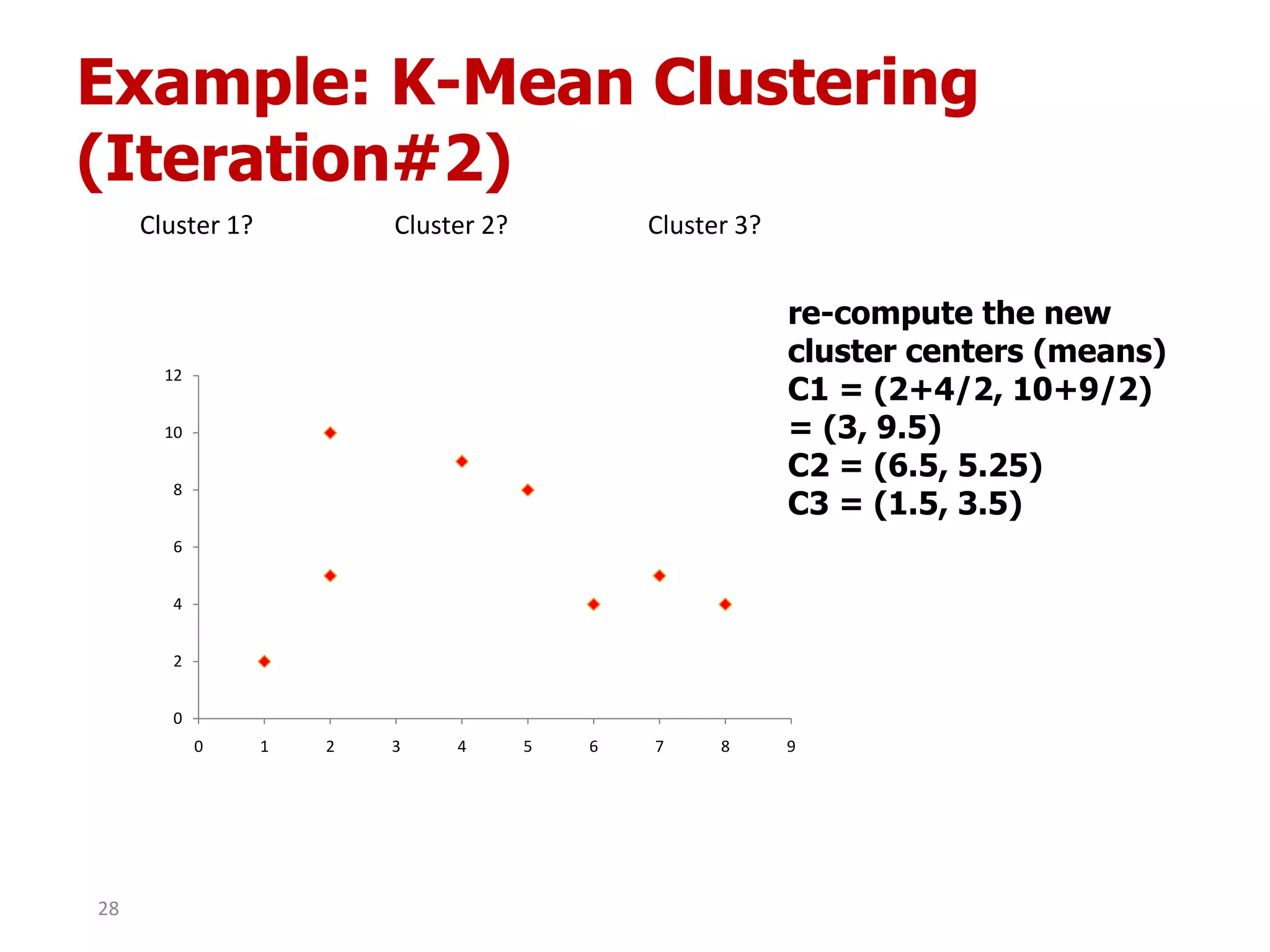
Cluster 1? Cluster 2? Cluster 3?
0
2
4
6
8
10
12
0 1 2 3 4 5 6 7 8 9
re-compute the new
cluster centers (means)
C1 = (2+4/2, 10+9/2)
= (3, 9.5)
C2 = (6.5, 5.25)
C3 = (1.5, 3.5)
28
Example: K-Mean Clustering
Iteration#3
Cluster 1? Cluster 2? Cluster 3?
0
2
4
6
8
10
12
0 1 2 3 4 5 6 7 8 9
re-compute the new
cluster centers (means)??
29
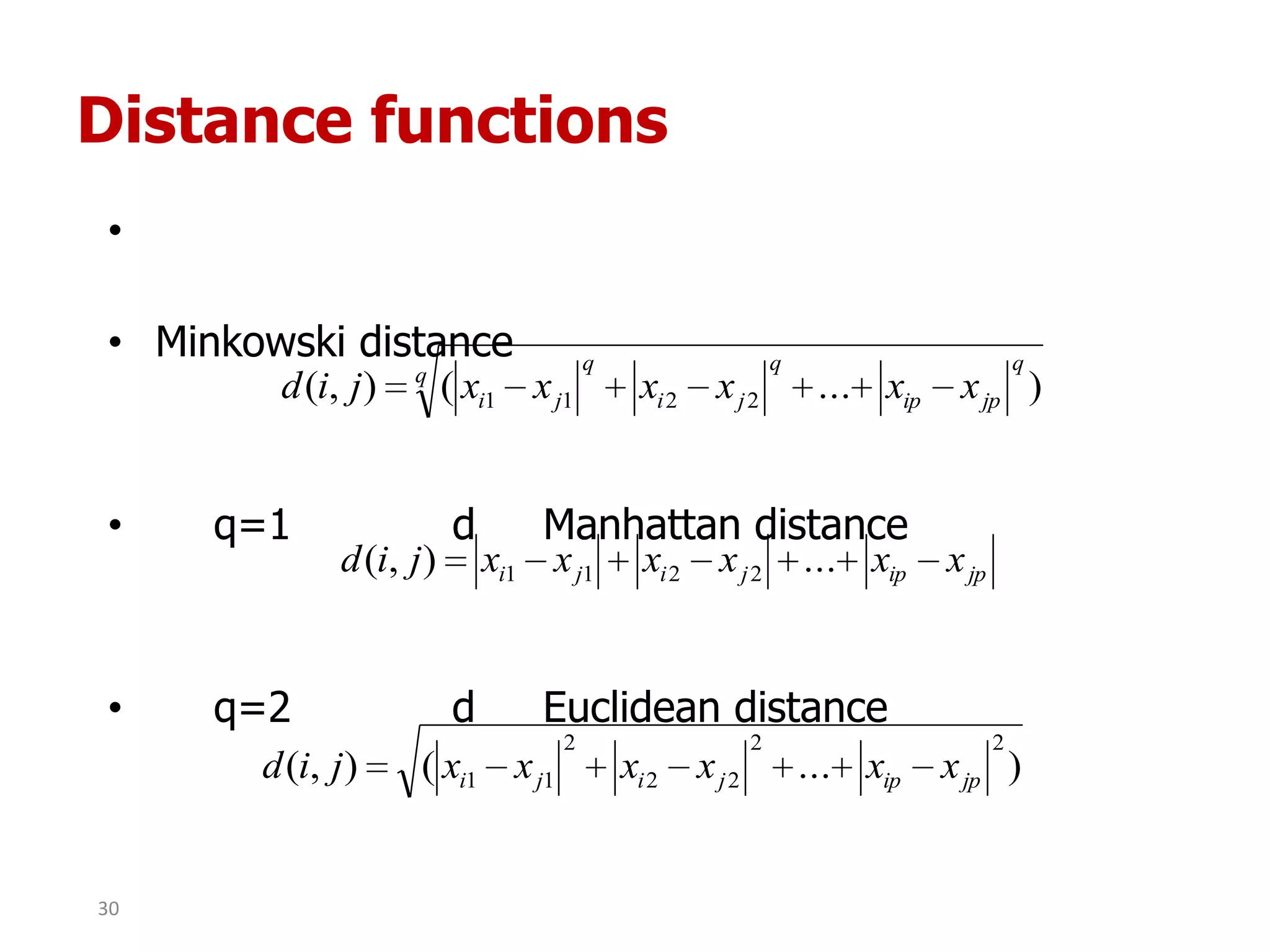
Distance functions
•
• Minkowski distance
• q=1 d Manhattan distance
• q=2 d Euclidean distance
q
q
jpip
q
ji
q
ji xxxxxxjid )...(),( 2211
jpipjiji xxxxxxjid ...),( 2211
)...(),(
22
22
2
11 jpipjiji xxxxxxjid
30
Evaluating K-means Clusters
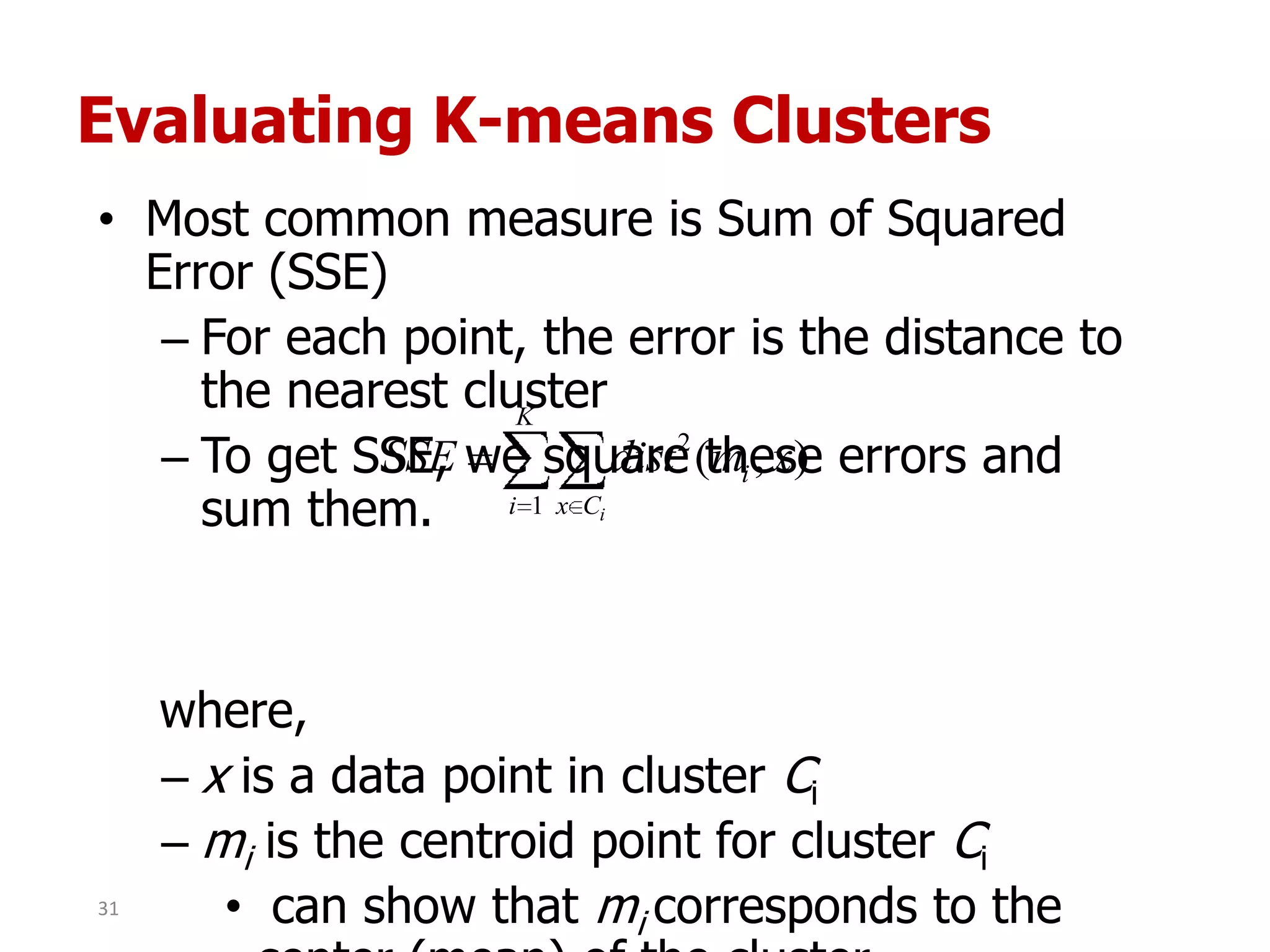
• Most common measure is Sum of Squared
Error (SSE)
– For each point, the error is the distance to
the nearest cluster
– To get SSE, we square these errors and
sum them.
where,
– x is a data point in cluster Ci
– mi is the centroid point for cluster Ci
• can show that mi corresponds to the
K
i Cx
i
i
xmdistSSE
1
2
),(
31
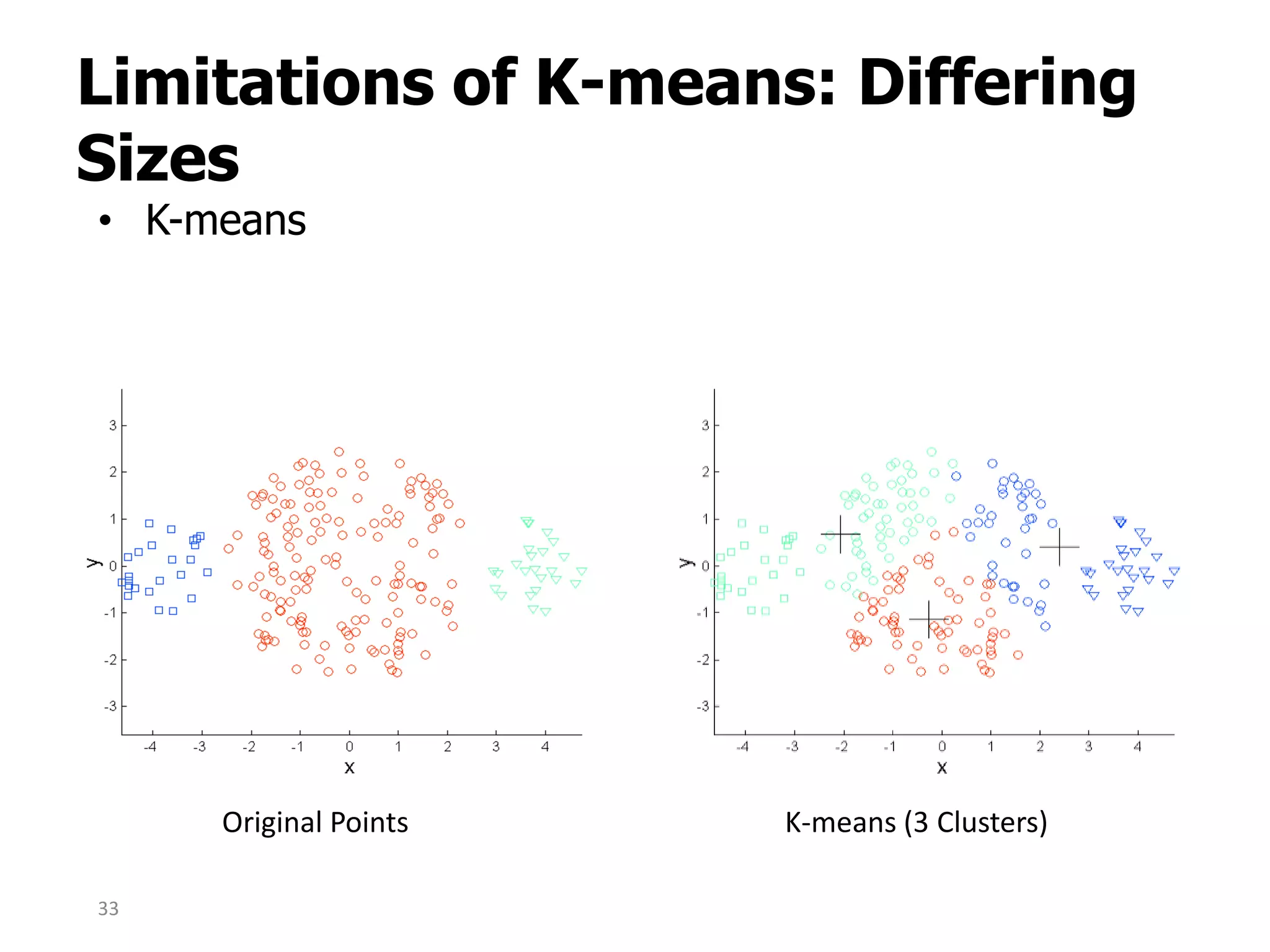
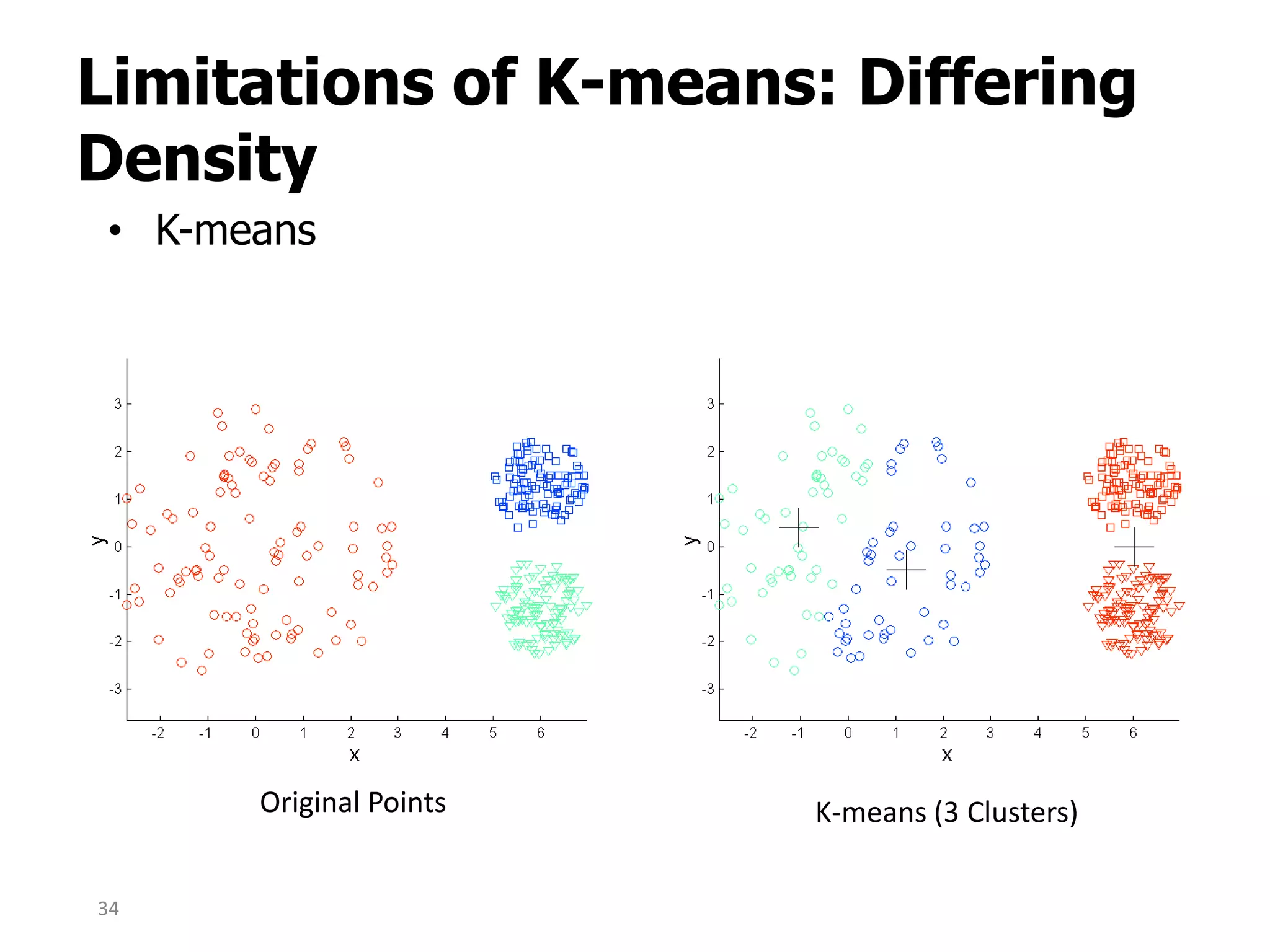
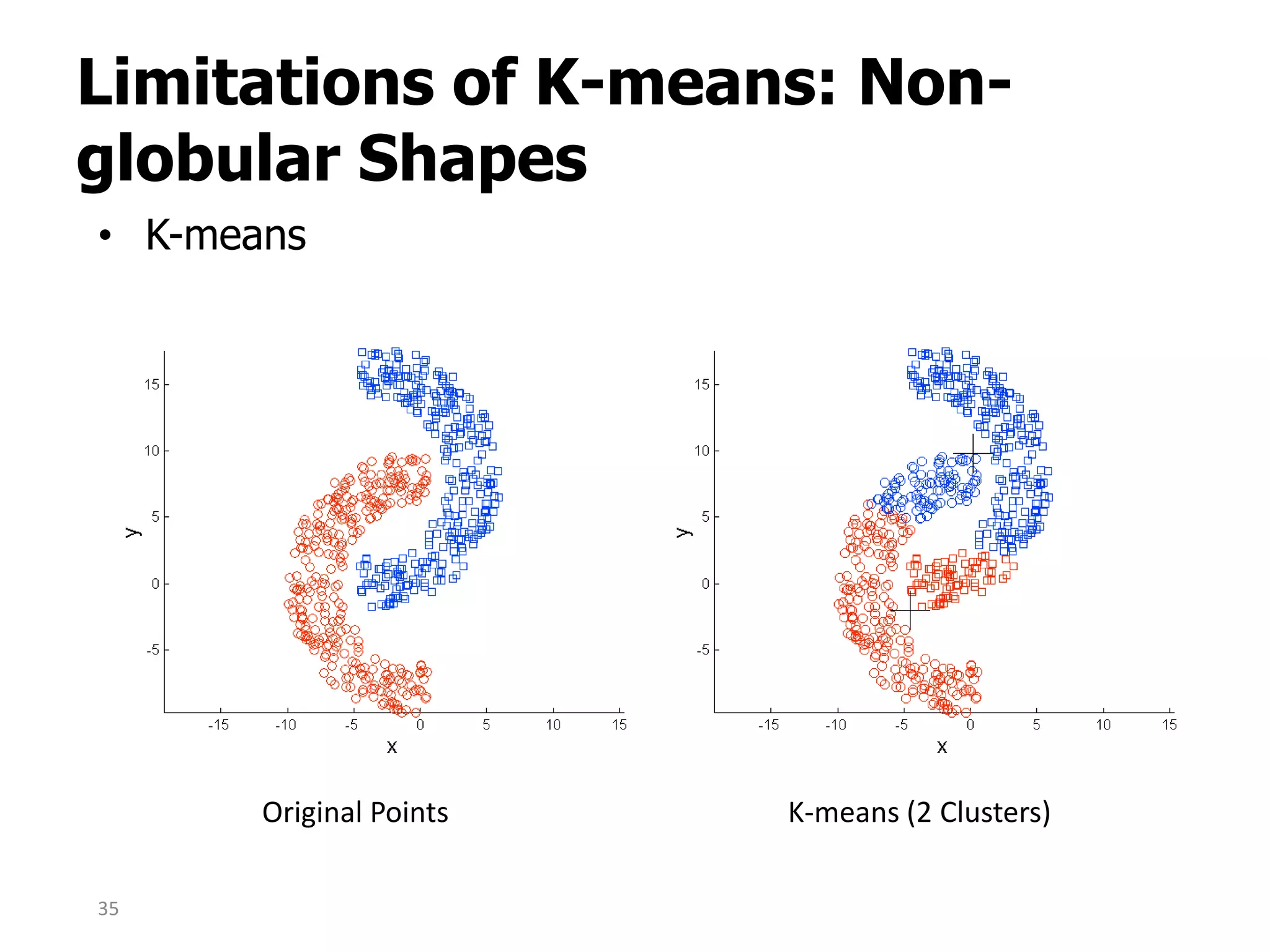
Limitations of K-Mean
• K-means
–Size
–Density
–Shapes
32
Limitations of K-means: Differing
Sizes
• K-means
Original Points K-means (3 Clusters)
33
Limitations of K-means: Differing
Density
• K-means
Original Points K-means (3 Clusters)
34
Limitations of K-means: Non-
globular Shapes
• K-means
Original Points K-means (2 Clusters)
35
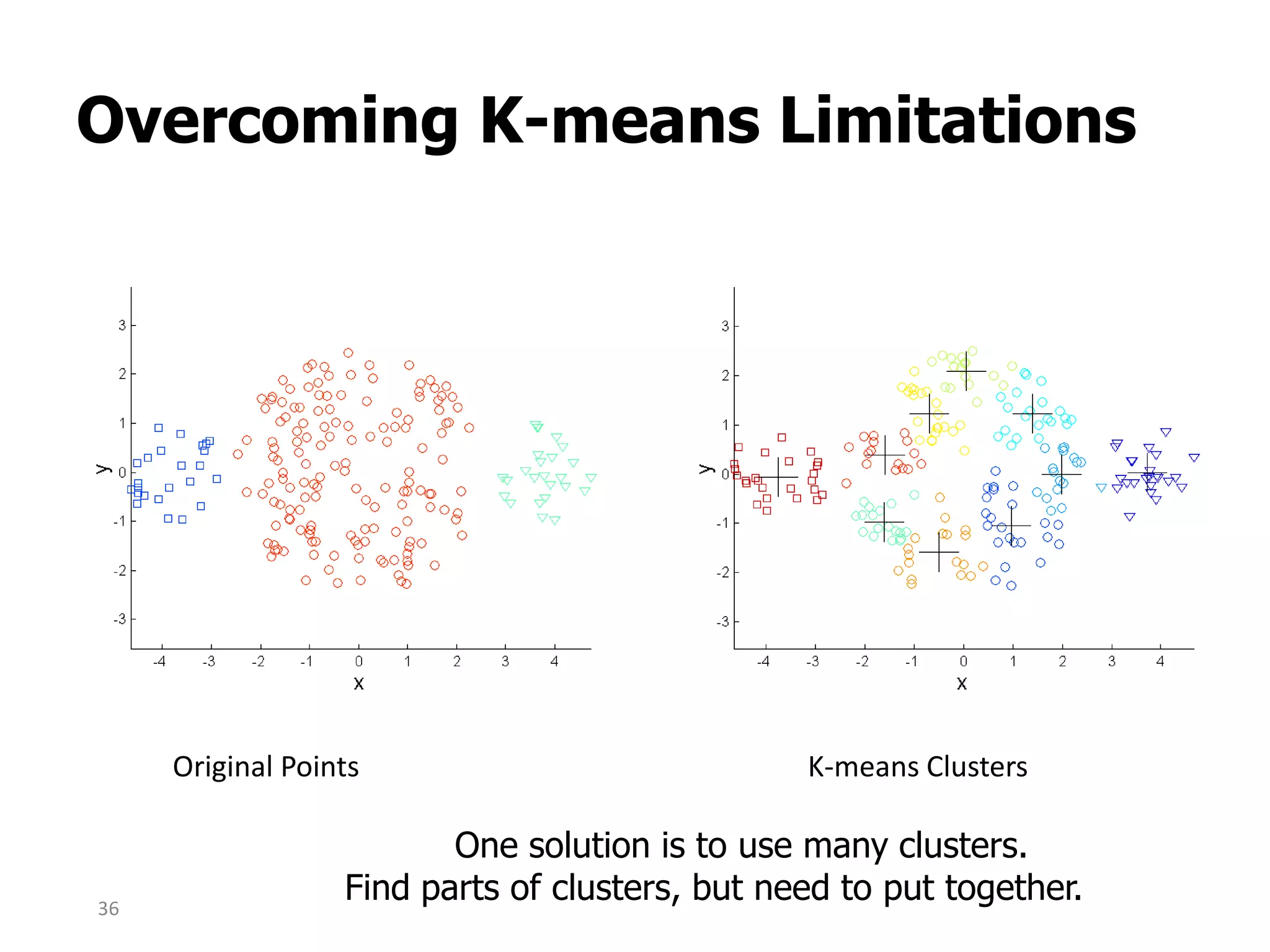
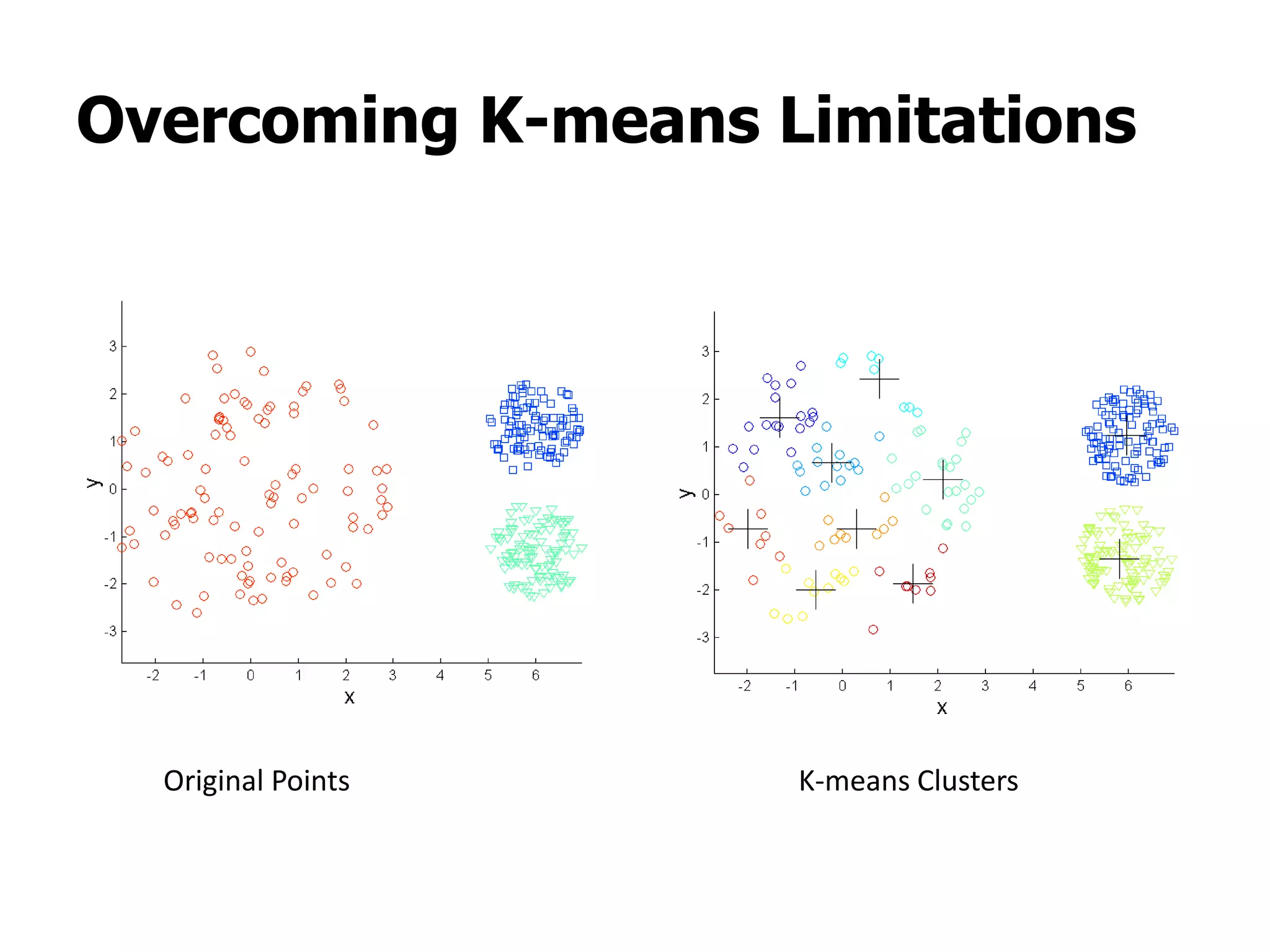
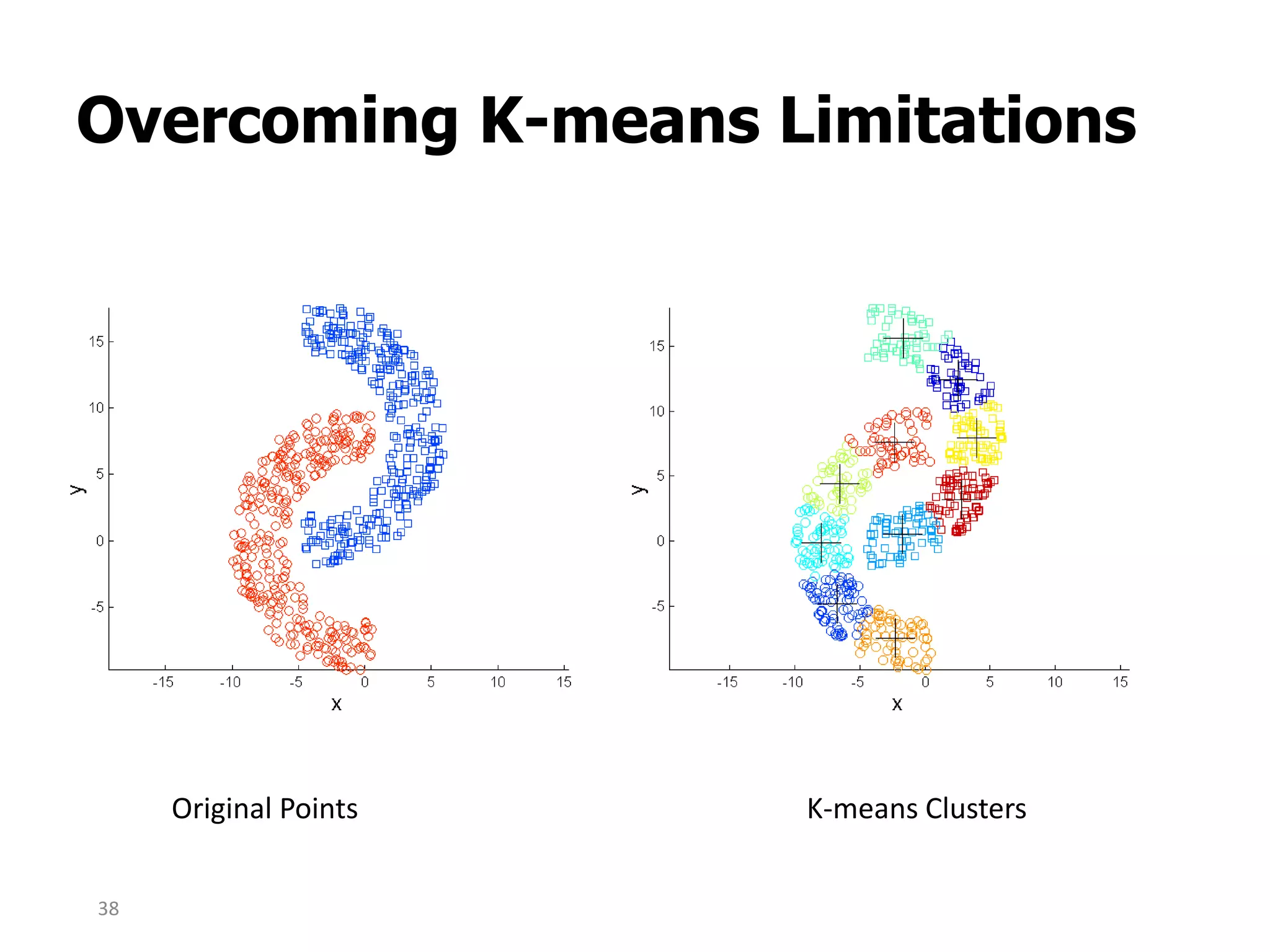
Overcoming K-means Limitations
Original Points K-means Clusters
One solution is to use many clusters.
Find parts of clusters, but need to put together.36
Overcoming K-means Limitations
Original Points K-means Clusters
Overcoming K-means Limitations
Original Points K-means Clusters
38
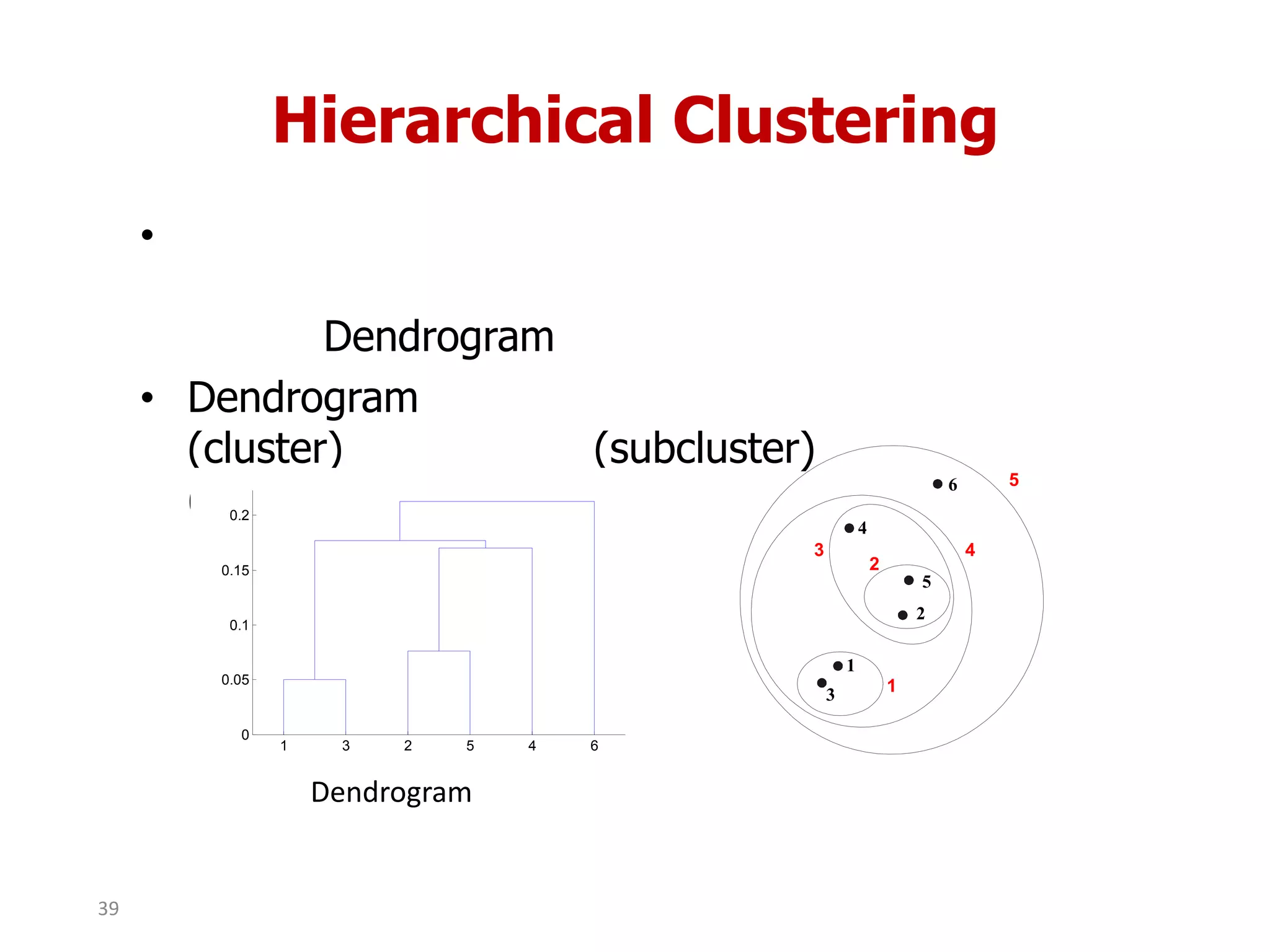
Hierarchical Clustering
•
Dendrogram
• Dendrogram
(cluster) (subcluster)
(cluster)
1 3 2 5 4 6
0
0.05
0.1
0.15
0.2
1
2
3
4
5
6
1
2
3 4
5
Dendrogram
39
Hierarchical Clustering
2
1. Agglomerative ( ) :
Agglomerative
2. Divisive ( ) :
Divisive Agglomerative
(singleton
cluster) cluster
40
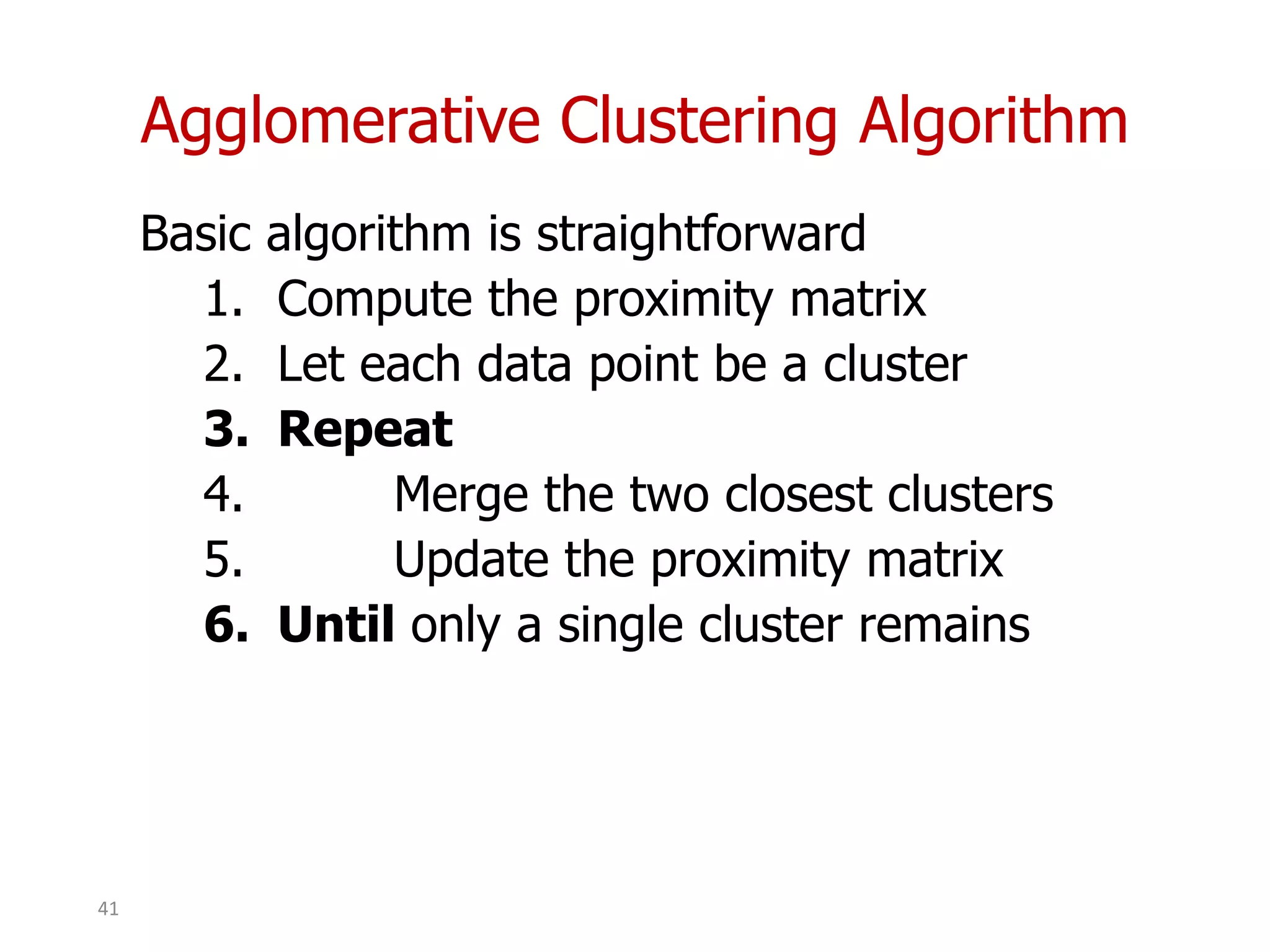
Agglomerative Clustering Algorithm
Basic algorithm is straightforward
1. Compute the proximity matrix
2. Let each data point be a cluster
3. Repeat
4. Merge the two closest clusters
5. Update the proximity matrix
6. Until only a single cluster remains
41
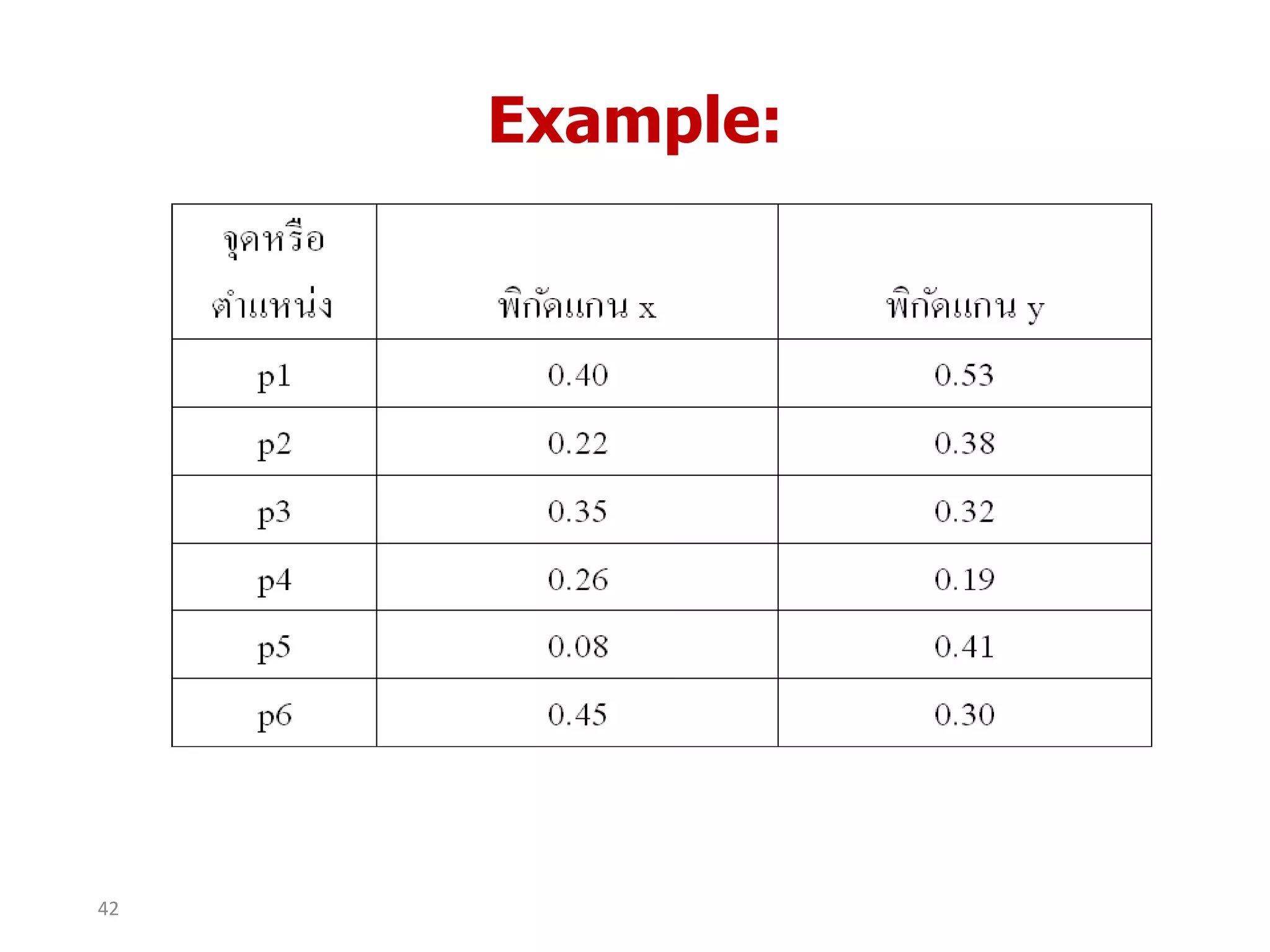
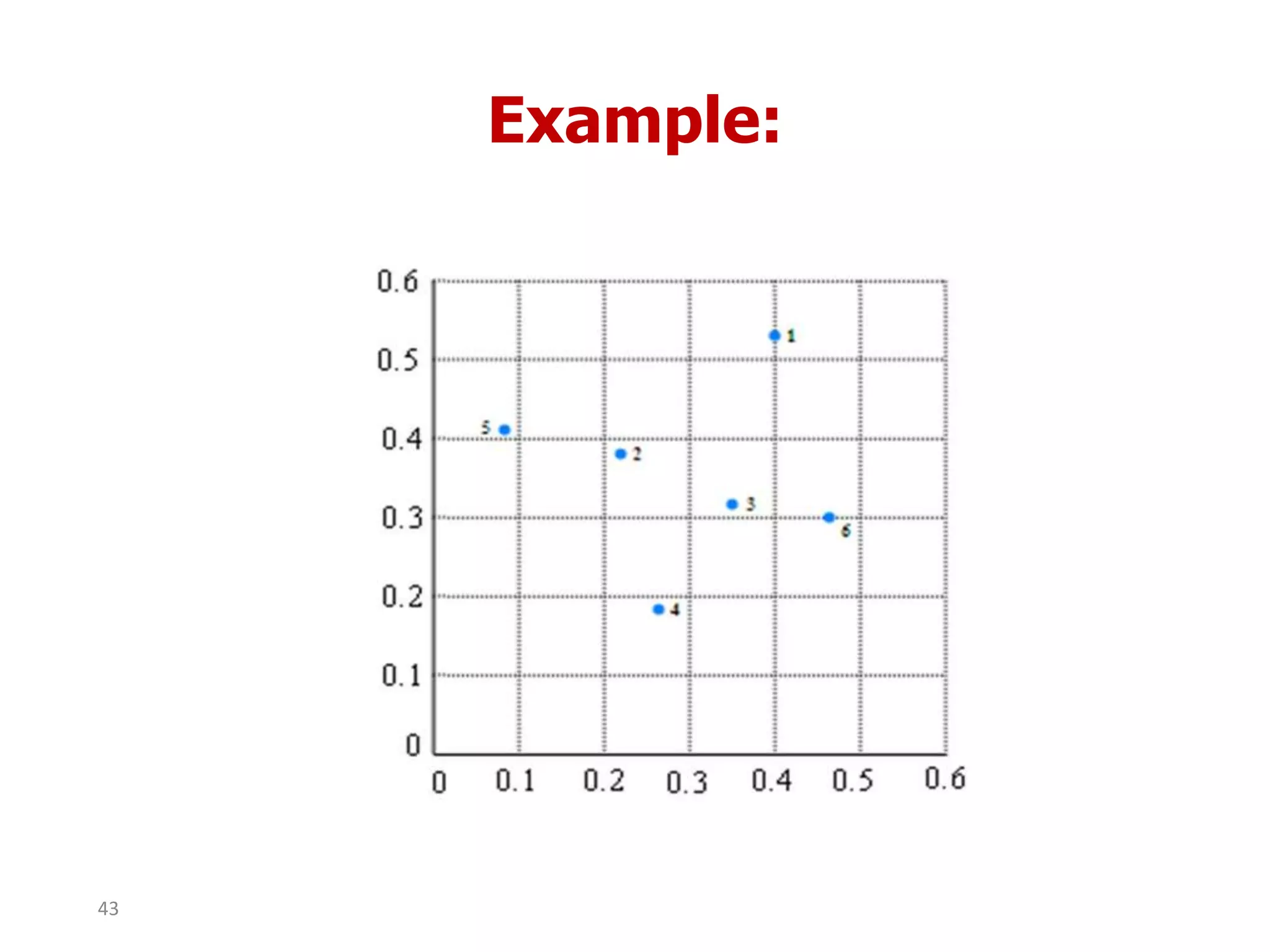
Example:
42
Example:
43
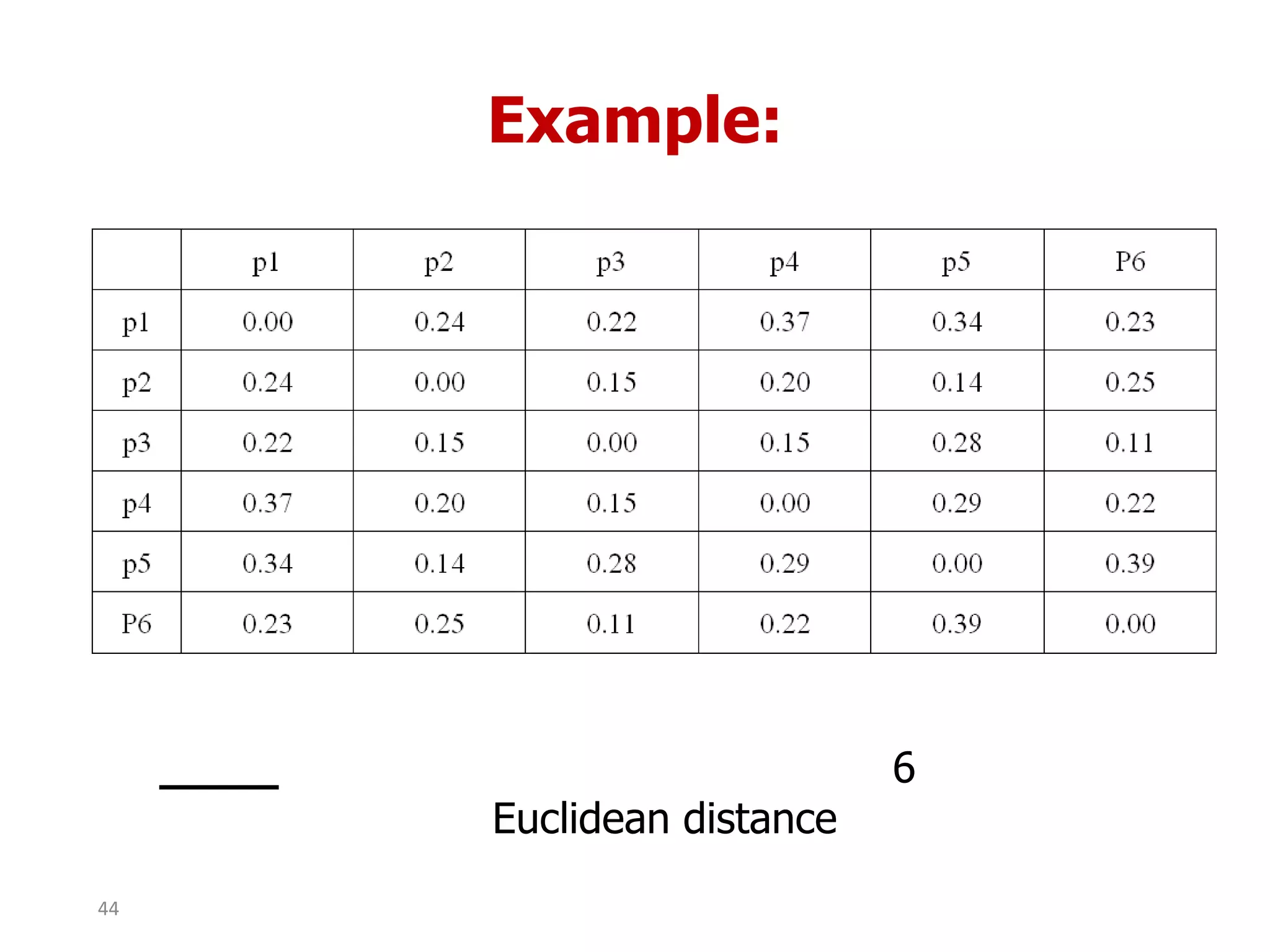
Example:
6
Euclidean distance
44
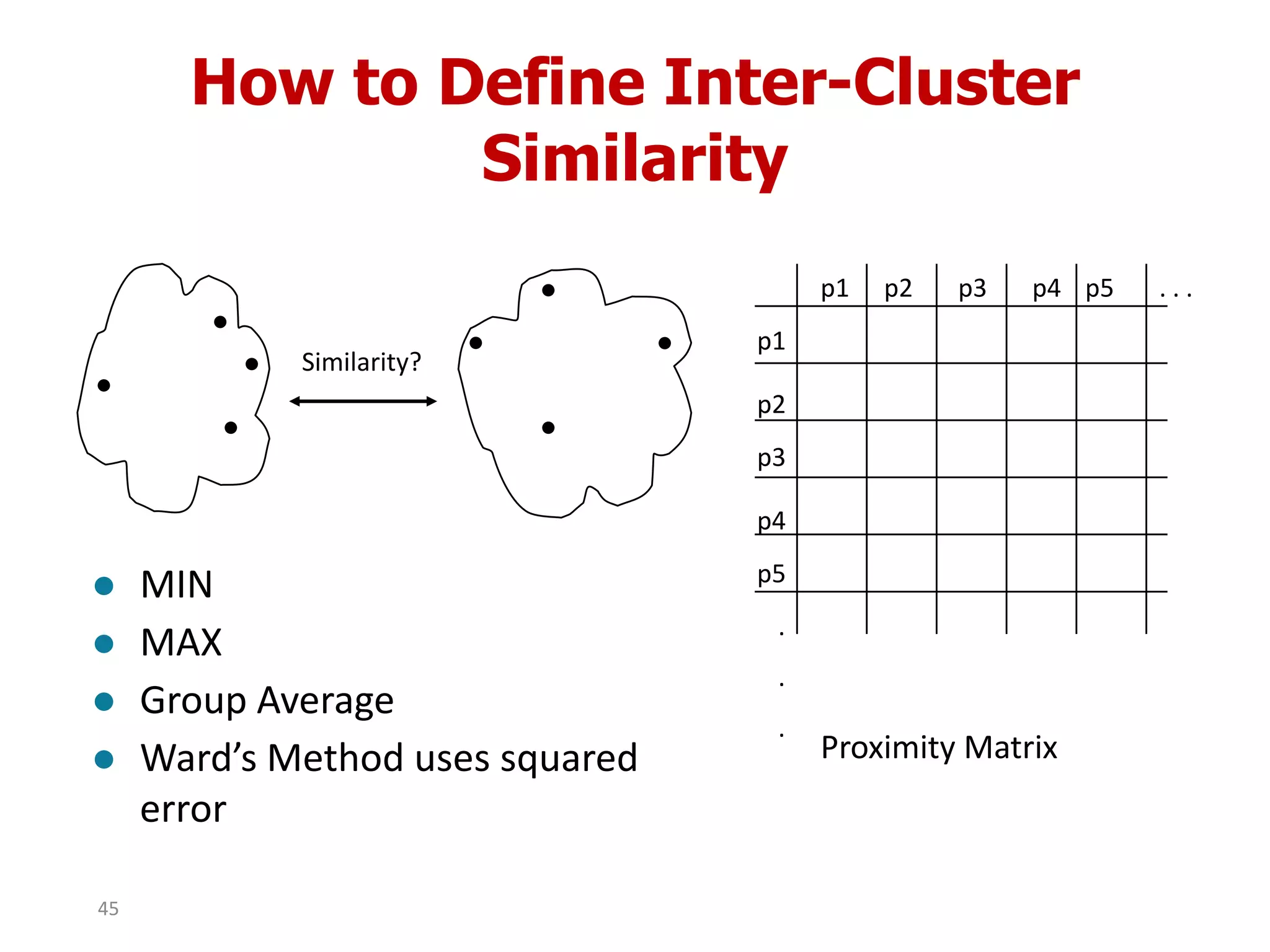
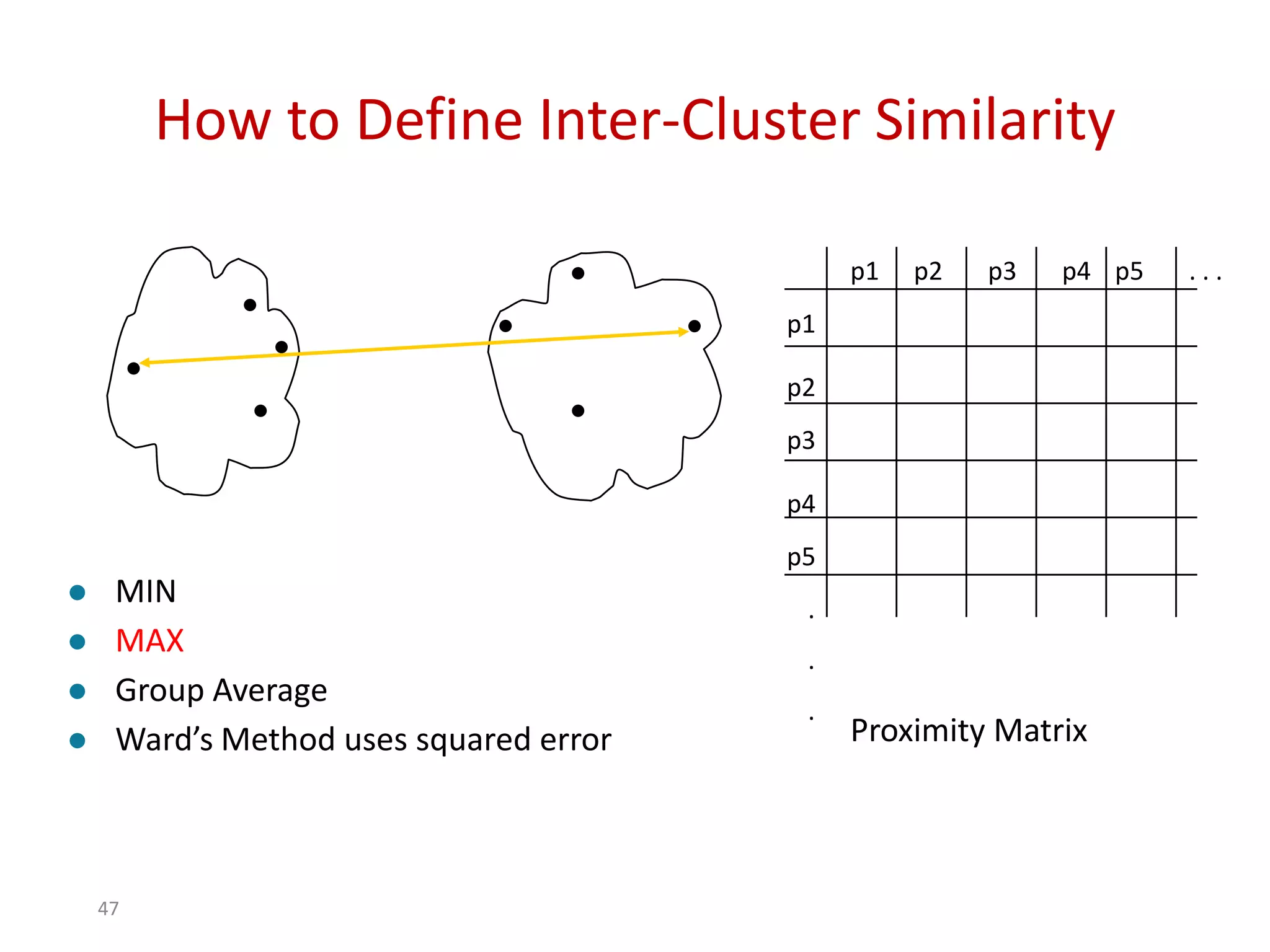
How to Define Inter-Cluster
Similarity
p1
p3
p5
p4
p2
p1 p2 p3 p4 p5 . . .
.
.
.
Similarity?
Proximity Matrix
 MIN
 MAX
 Group Average
 Ward’s Method uses squared
error
45
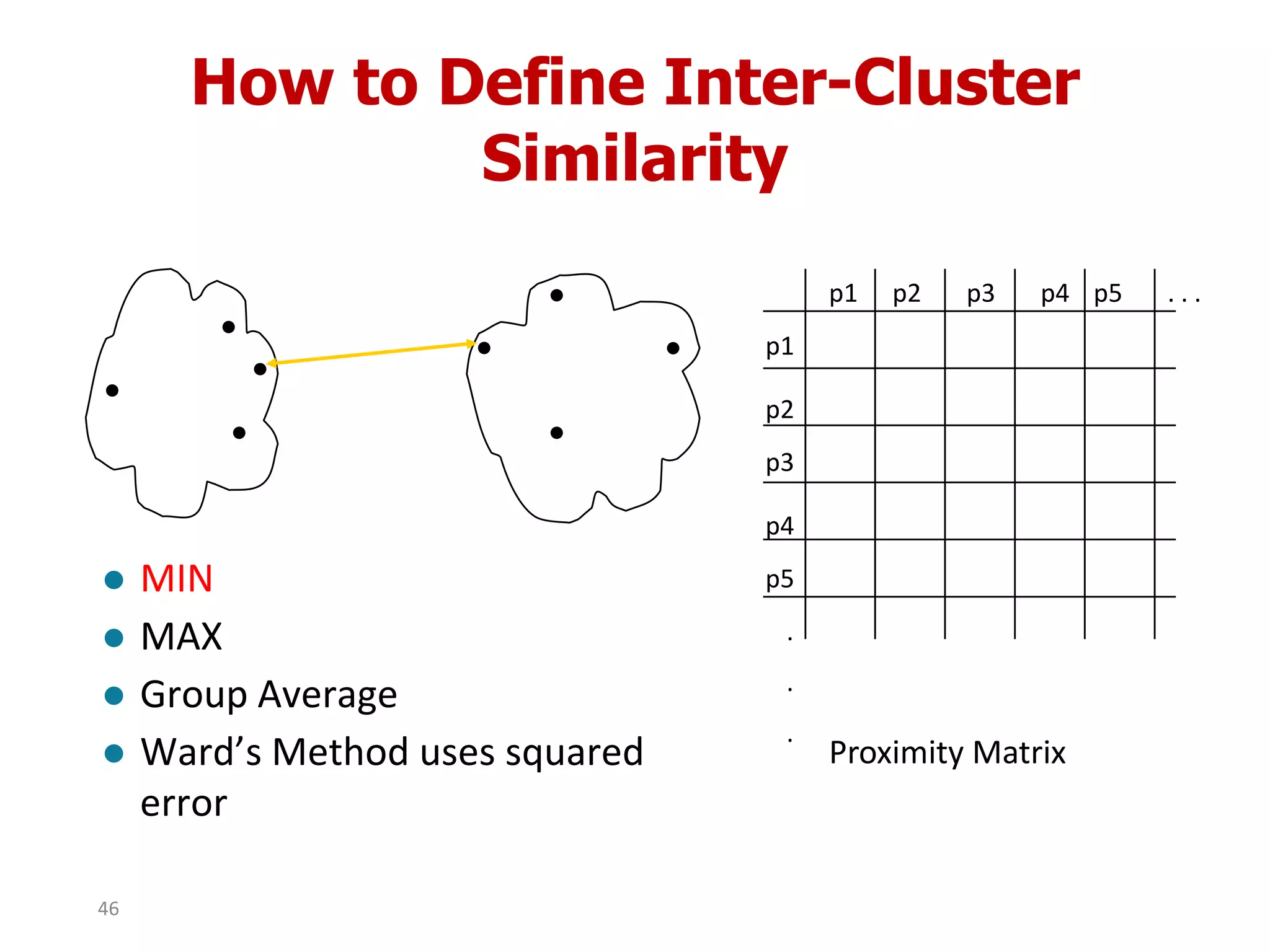
How to Define Inter-Cluster
Similarity
 MIN
 MAX
 Group Average
 Ward’s Method uses squared
error
p1
p3
p5
p4
p2
p1 p2 p3 p4 p5 . . .
.
.
.
Proximity Matrix
46
How to Define Inter-Cluster Similarity
p1
p3
p5
p4
p2
p1 p2 p3 p4 p5 . . .
.
.
.
Proximity Matrix
 MIN
 MAX
 Group Average
 Ward’s Method uses squared error
47
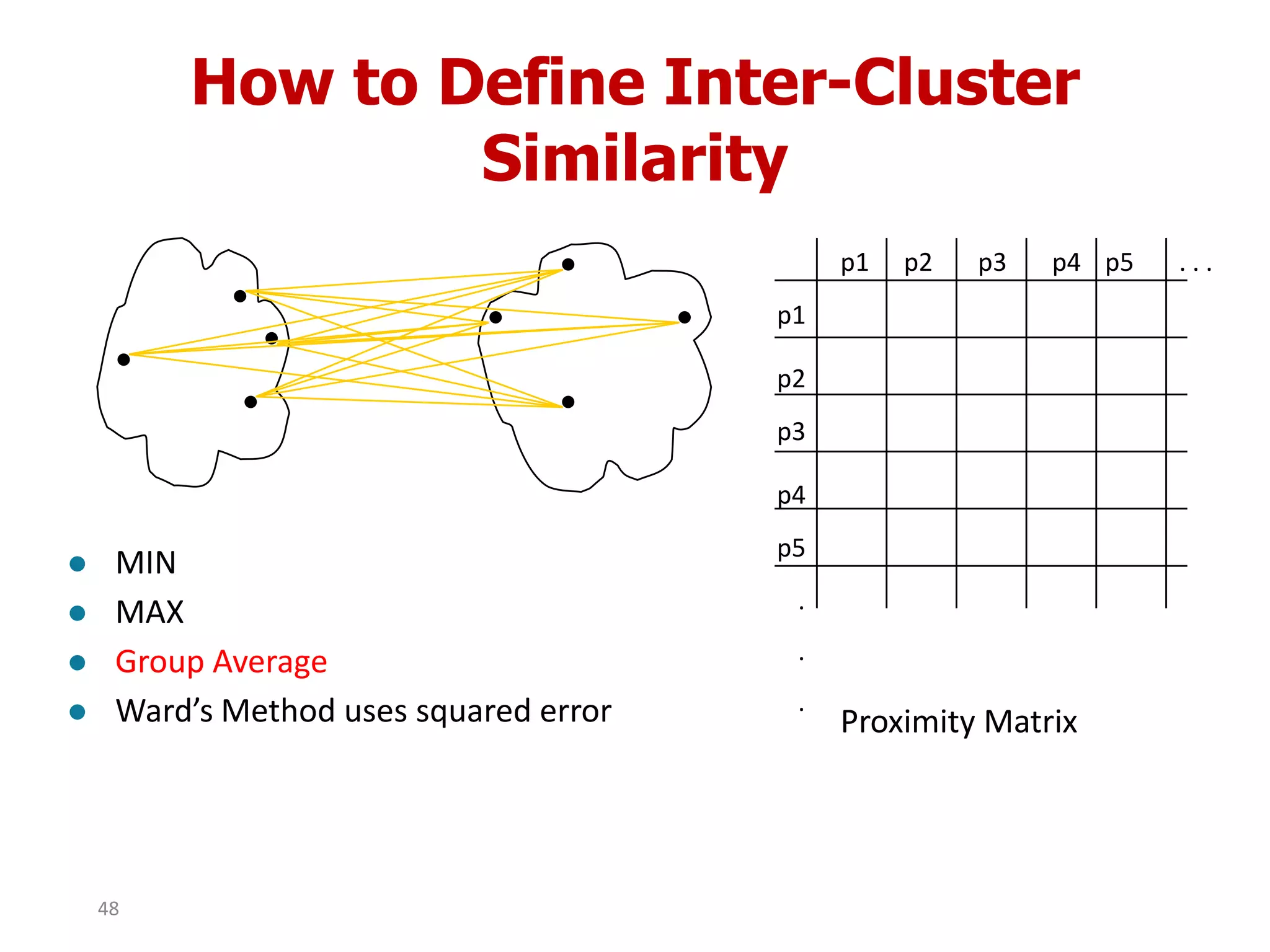
How to Define Inter-Cluster
Similarity
p1
p3
p5
p4
p2
p1 p2 p3 p4 p5 . . .
.
.
.
Proximity Matrix
 MIN
 MAX
 Group Average
 Ward’s Method uses squared error
48
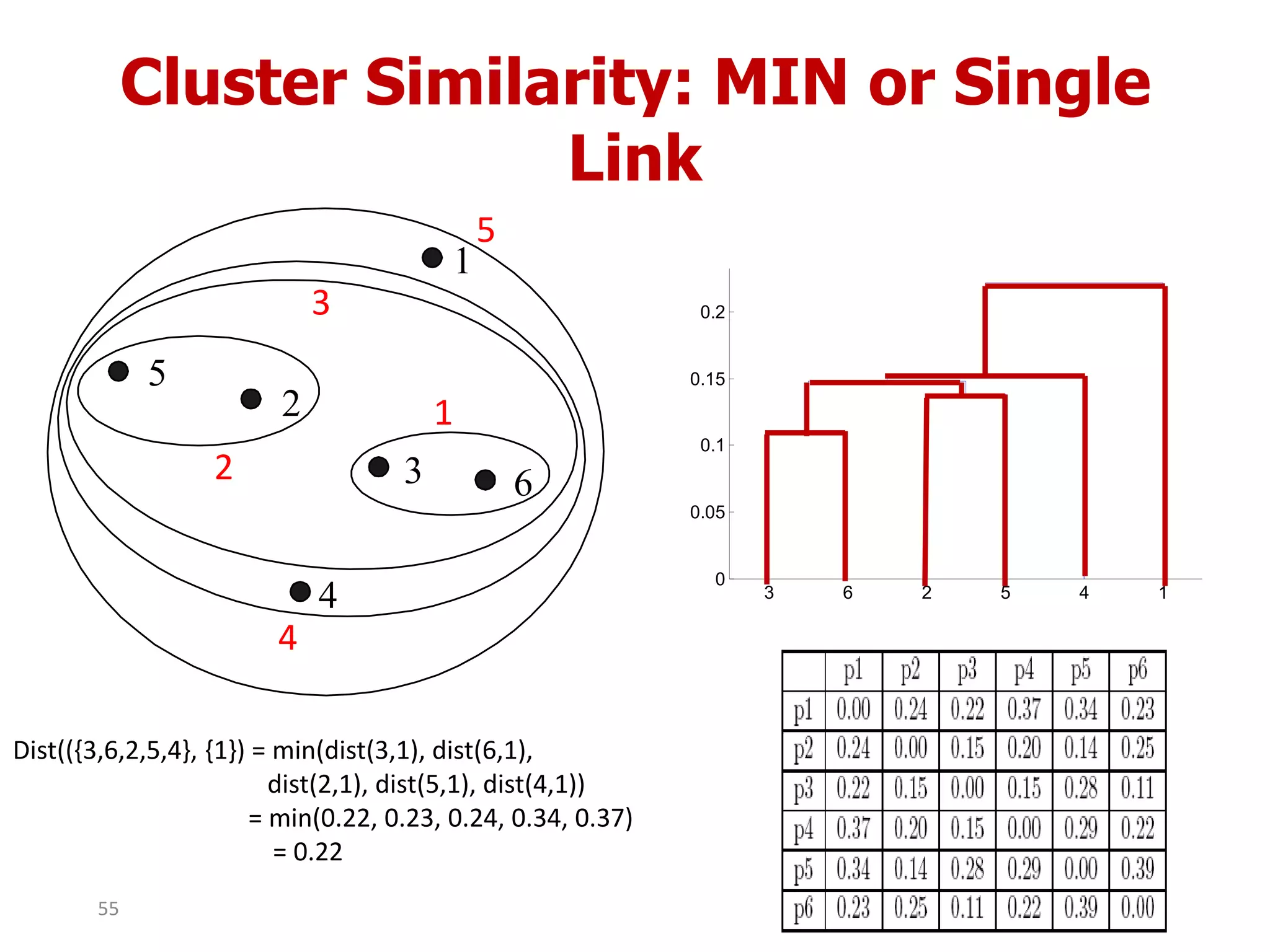
Cluster Similarity: MIN or Single
Link
• Single link MIN
Hierarchical Clustering
2
49
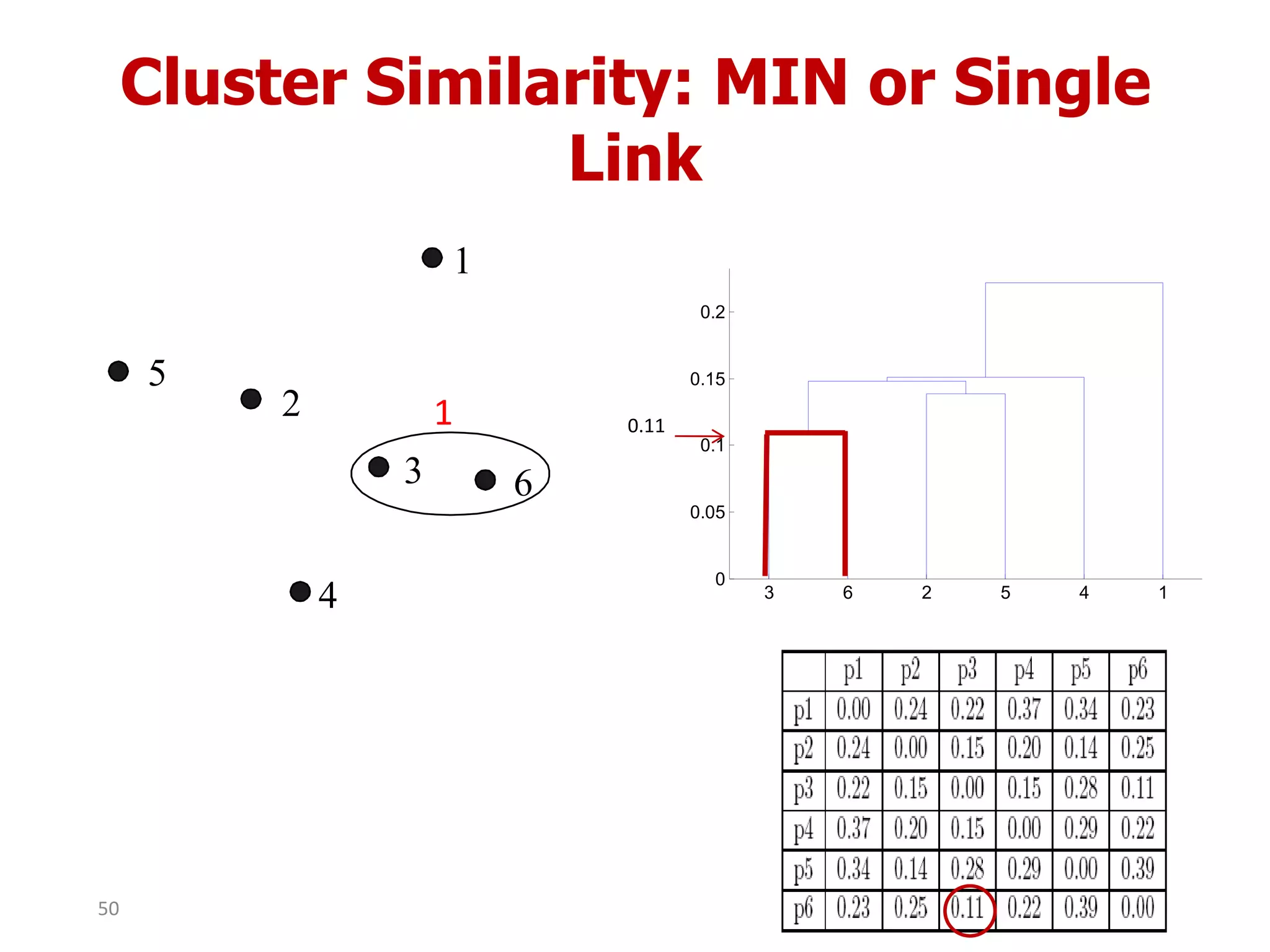
Cluster Similarity: MIN or Single
Link
1
2
3
4
5
6
1
3 6 2 5 4 1
0
0.05
0.1
0.15
0.2
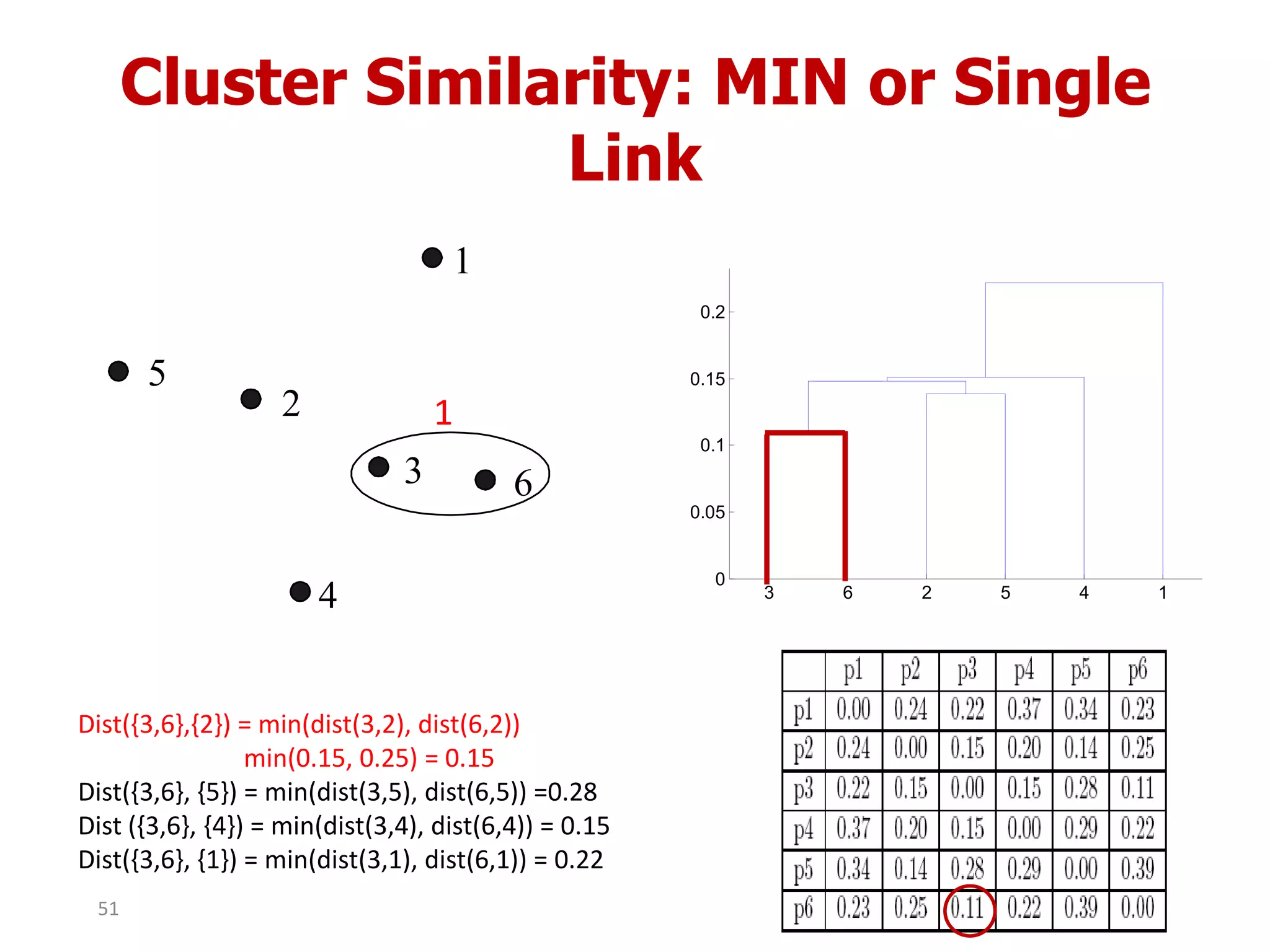
0.11
50
Cluster Similarity: MIN or Single
Link
1
2
3
4
5
6
1
3 6 2 5 4 1
0
0.05
0.1
0.15
0.2
Dist({3,6},{2}) = min(dist(3,2), dist(6,2))
min(0.15, 0.25) = 0.15
Dist({3,6}, {5}) = min(dist(3,5), dist(6,5)) =0.28
Dist ({3,6}, {4}) = min(dist(3,4), dist(6,4)) = 0.15
Dist({3,6}, {1}) = min(dist(3,1), dist(6,1)) = 0.22
51
Cluster Similarity: MIN or Single Link
1
2
3
4
5
6
1
2
3 6 2 5 4 1
0
0.05
0.1
0.15
0.2
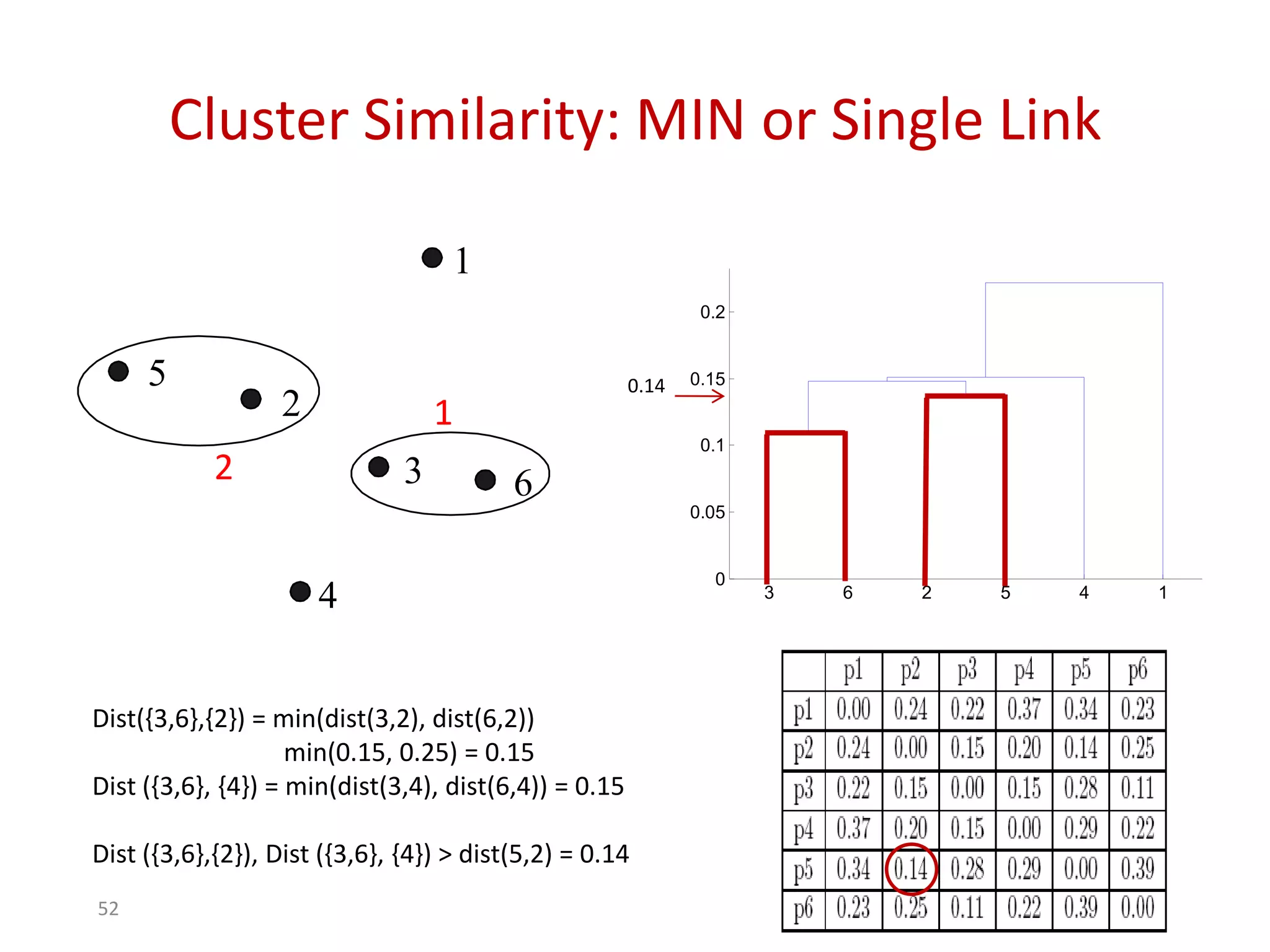
Dist({3,6},{2}) = min(dist(3,2), dist(6,2))
min(0.15, 0.25) = 0.15
Dist ({3,6}, {4}) = min(dist(3,4), dist(6,4)) = 0.15
Dist ({3,6},{2}), Dist ({3,6}, {4}) > dist(5,2) = 0.14
0.14
52
Cluster Similarity: MIN or Single
Link
1
2
3
4
5
6
1
2
3
3 6 2 5 4 1
0
0.05
0.1
0.15
0.2
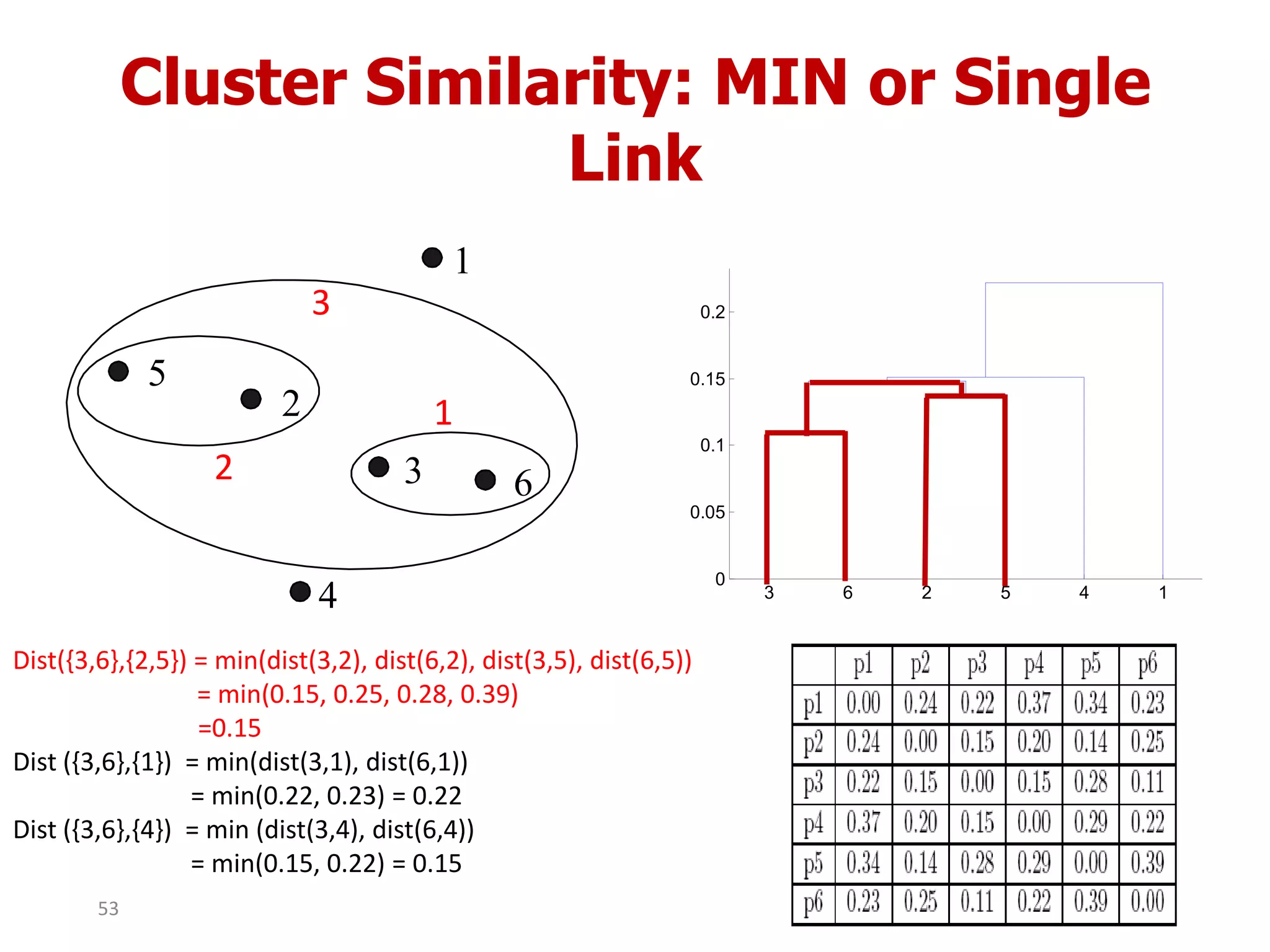
Dist({3,6},{2,5}) = min(dist(3,2), dist(6,2), dist(3,5), dist(6,5))
= min(0.15, 0.25, 0.28, 0.39)
=0.15
Dist ({3,6},{1}) = min(dist(3,1), dist(6,1))
= min(0.22, 0.23) = 0.22
Dist ({3,6},{4}) = min (dist(3,4), dist(6,4))
= min(0.15, 0.22) = 0.15
53
Cluster Similarity: MIN or Single
Link
1
2
3
4
5
6
1
2
3
4
3 6 2 5 4 1
0
0.05
0.1
0.15
0.2
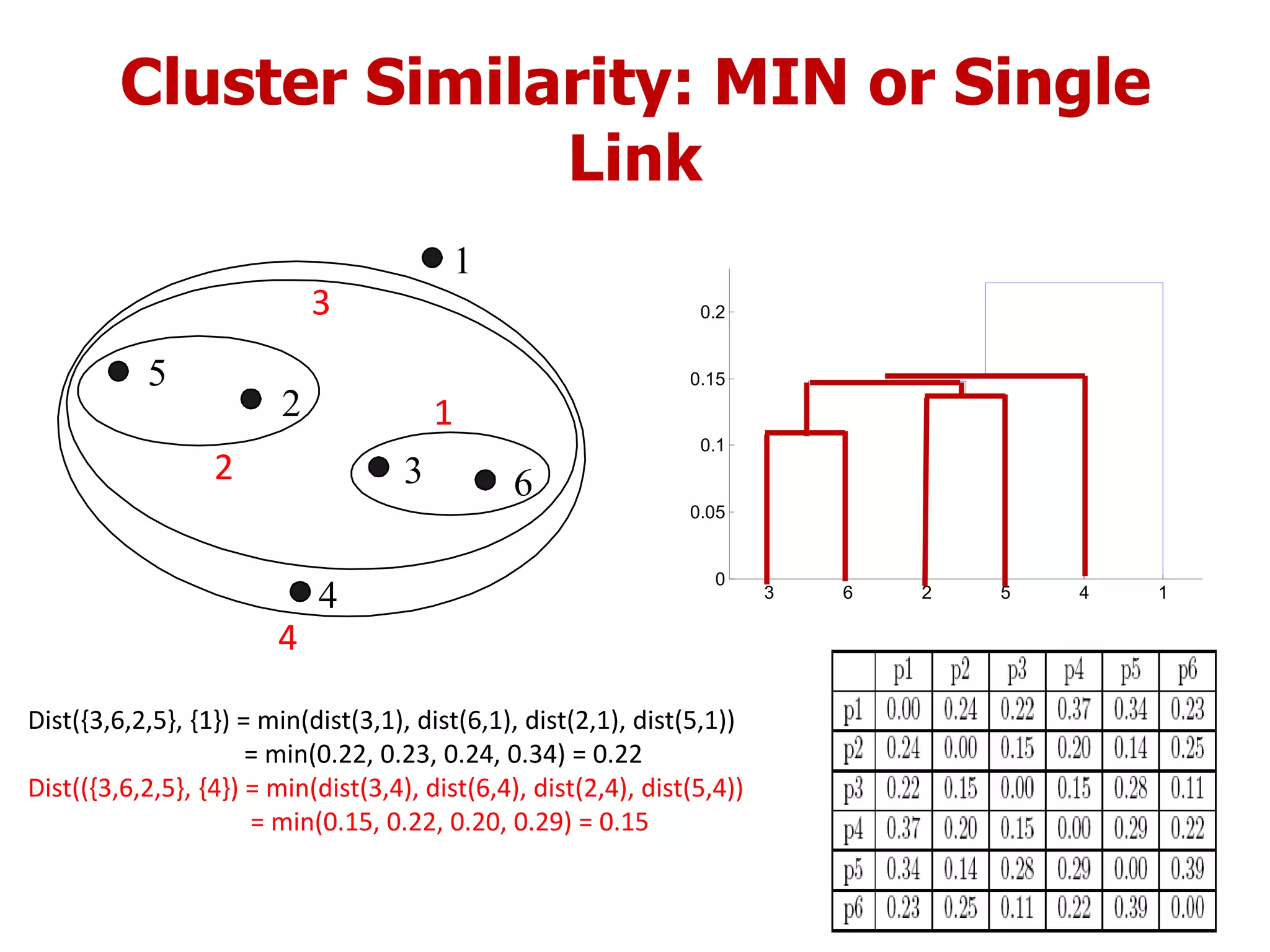
Dist({3,6,2,5}, {1}) = min(dist(3,1), dist(6,1), dist(2,1), dist(5,1))
= min(0.22, 0.23, 0.24, 0.34) = 0.22
Dist(({3,6,2,5}, {4}) = min(dist(3,4), dist(6,4), dist(2,4), dist(5,4))
= min(0.15, 0.22, 0.20, 0.29) = 0.15
Cluster Similarity: MIN or Single
Link
1
2
3
4
5
6
1
2
3
4
5
3 6 2 5 4 1
0
0.05
0.1
0.15
0.2
Dist(({3,6,2,5,4}, {1}) = min(dist(3,1), dist(6,1),
dist(2,1), dist(5,1), dist(4,1))
= min(0.22, 0.23, 0.24, 0.34, 0.37)
= 0.22
55
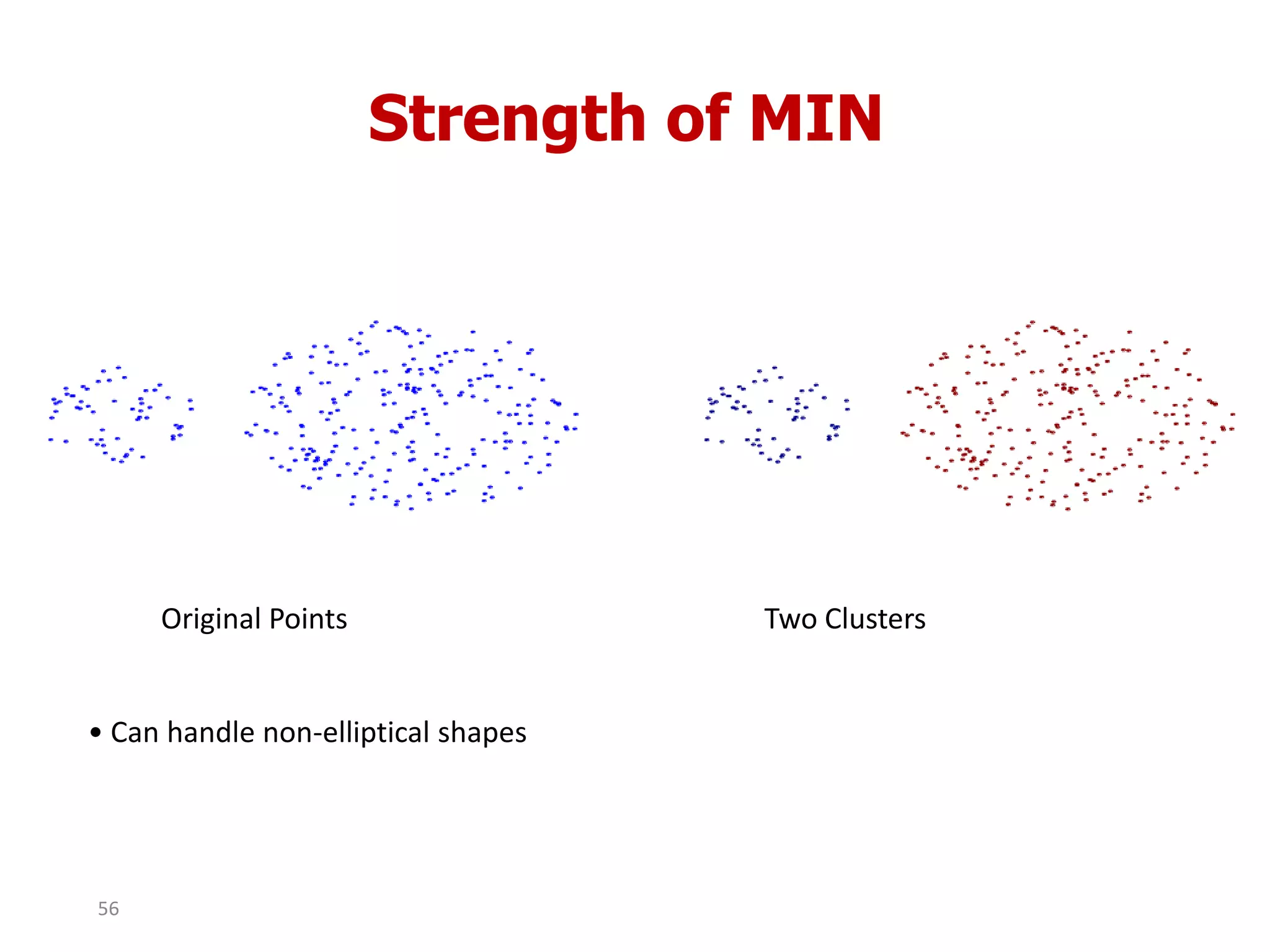
Strength of MIN
Original Points Two Clusters
• Can handle non-elliptical shapes
56
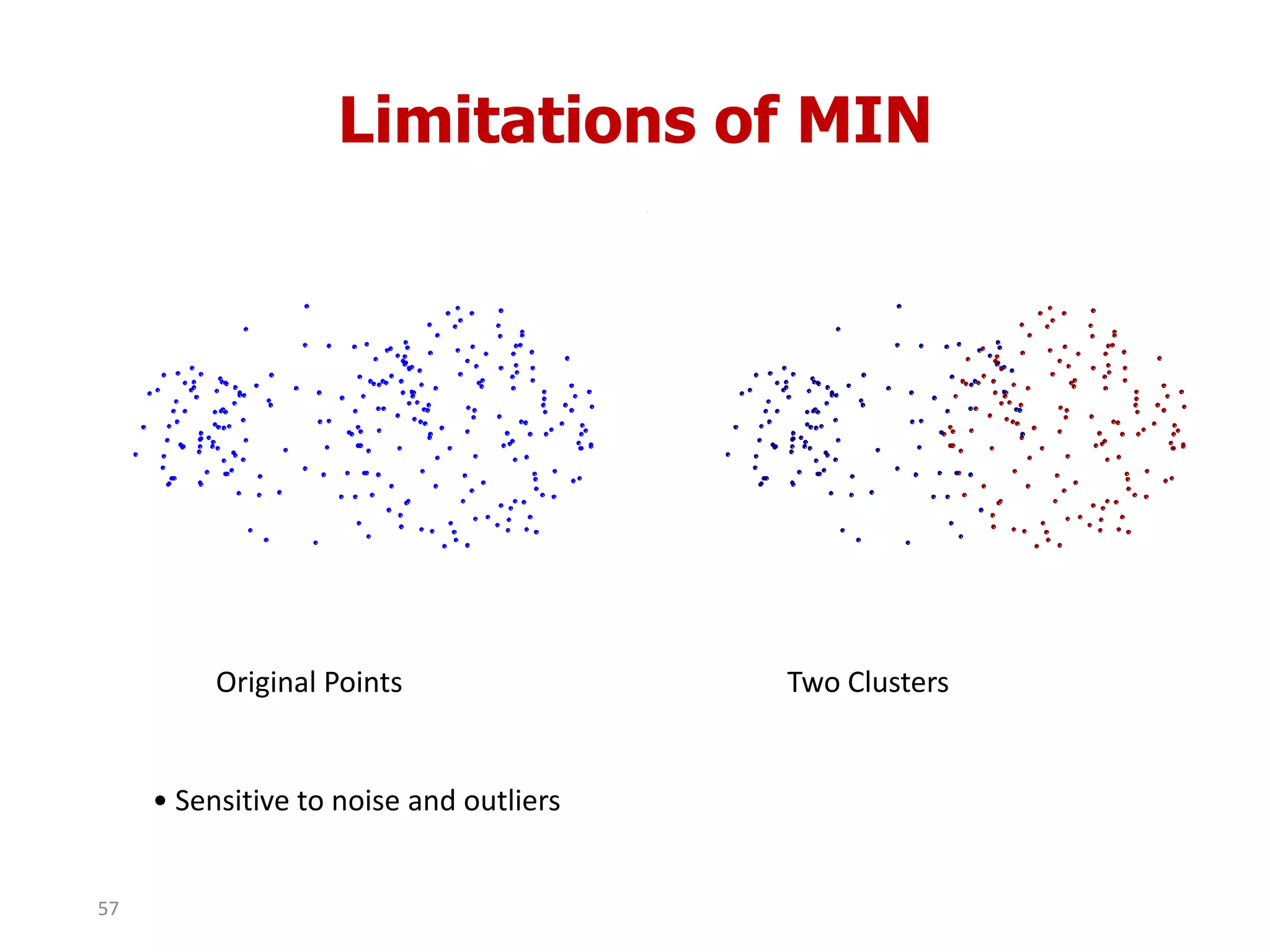
Limitations of MIN
•
Original Points Two Clusters
• Sensitive to noise and outliers
57
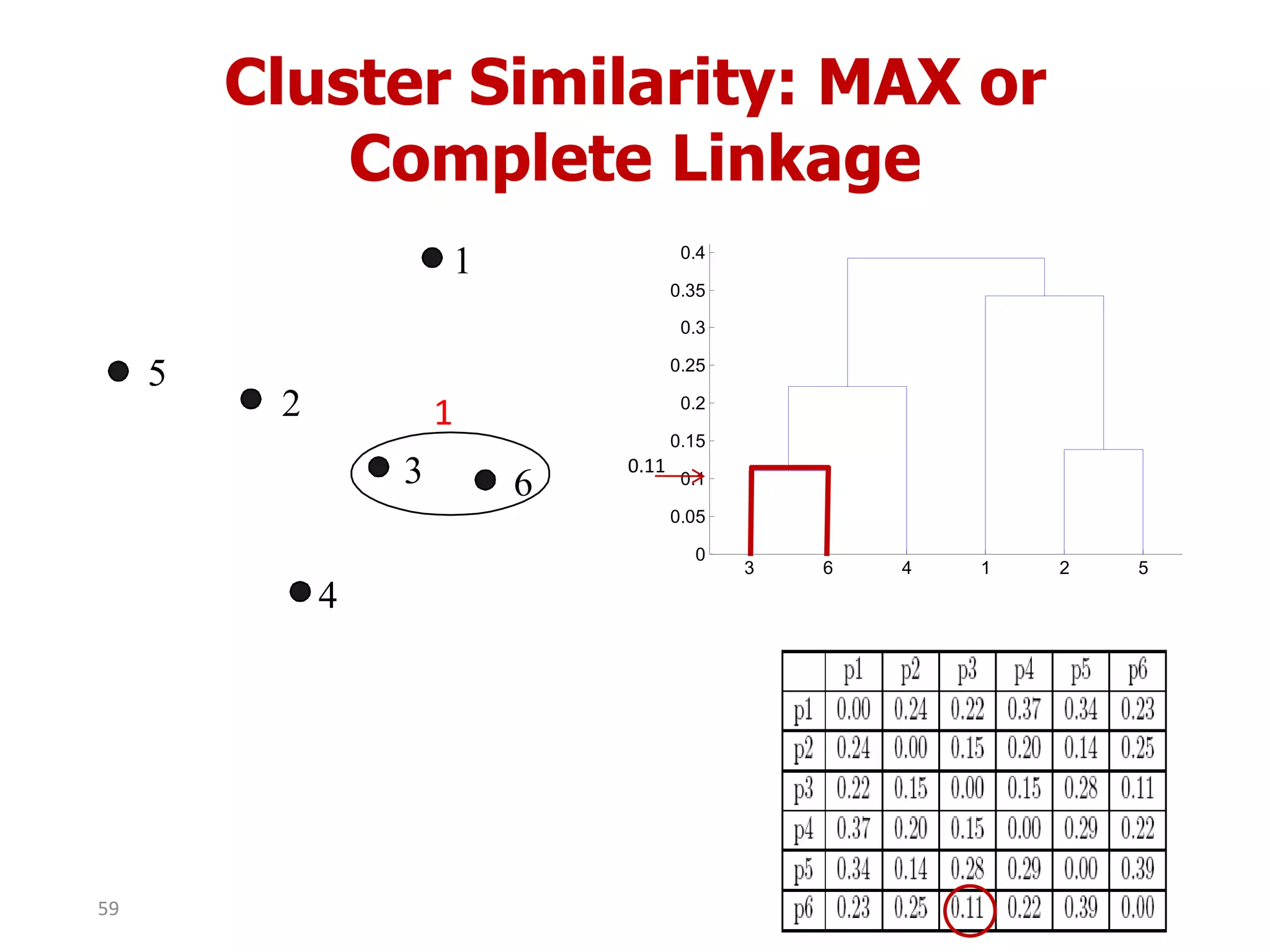
Cluster Similarity: MAX or
Complete Linkage
• Complete link MAX
Hierarchical Clustering
2
58
3 6 4 1 2 5
0
0.05
0.1
0.15
0.2
0.25
0.3
0.35
0.4
Cluster Similarity: MAX or
Complete Linkage
1
2
3
4
5
6
1
0.11
59
Cluster Similarity: MAX or
Complete Linkage
3 6 4 1 2 5
0
0.05
0.1
0.15
0.2
0.25
0.3
0.35
0.4
1
2
3
4
5
6
1
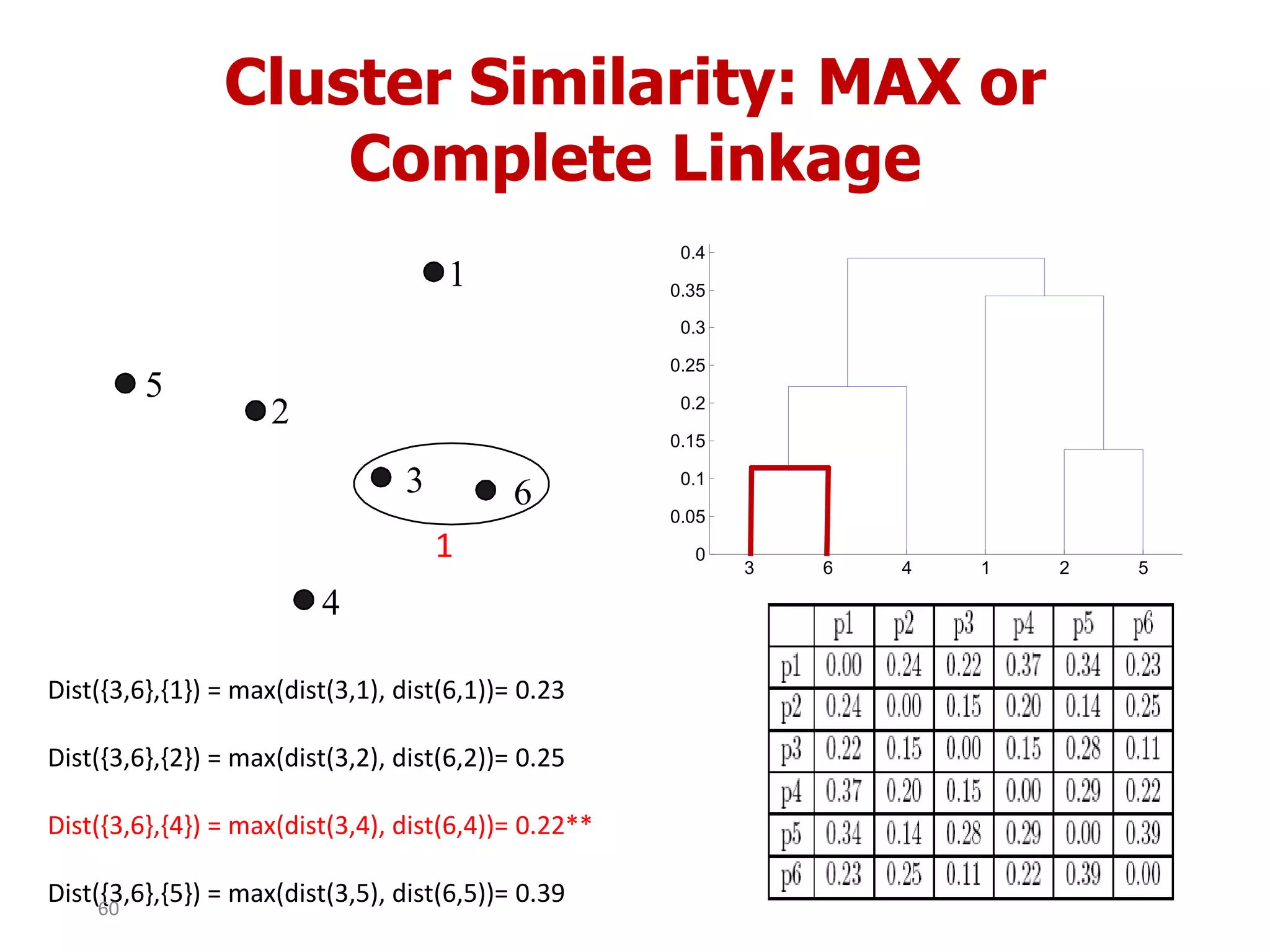
Dist({3,6},{1}) = max(dist(3,1), dist(6,1))= 0.23
Dist({3,6},{2}) = max(dist(3,2), dist(6,2))= 0.25
Dist({3,6},{4}) = max(dist(3,4), dist(6,4))= 0.22**
Dist({3,6},{5}) = max(dist(3,5), dist(6,5))= 0.3960
Cluster Similarity: MAX or
Complete Linkage
3 6 4 1 2 5
0
0.05
0.1
0.15
0.2
0.25
0.3
0.35
0.4
1
2
3
4
5
6
1
2
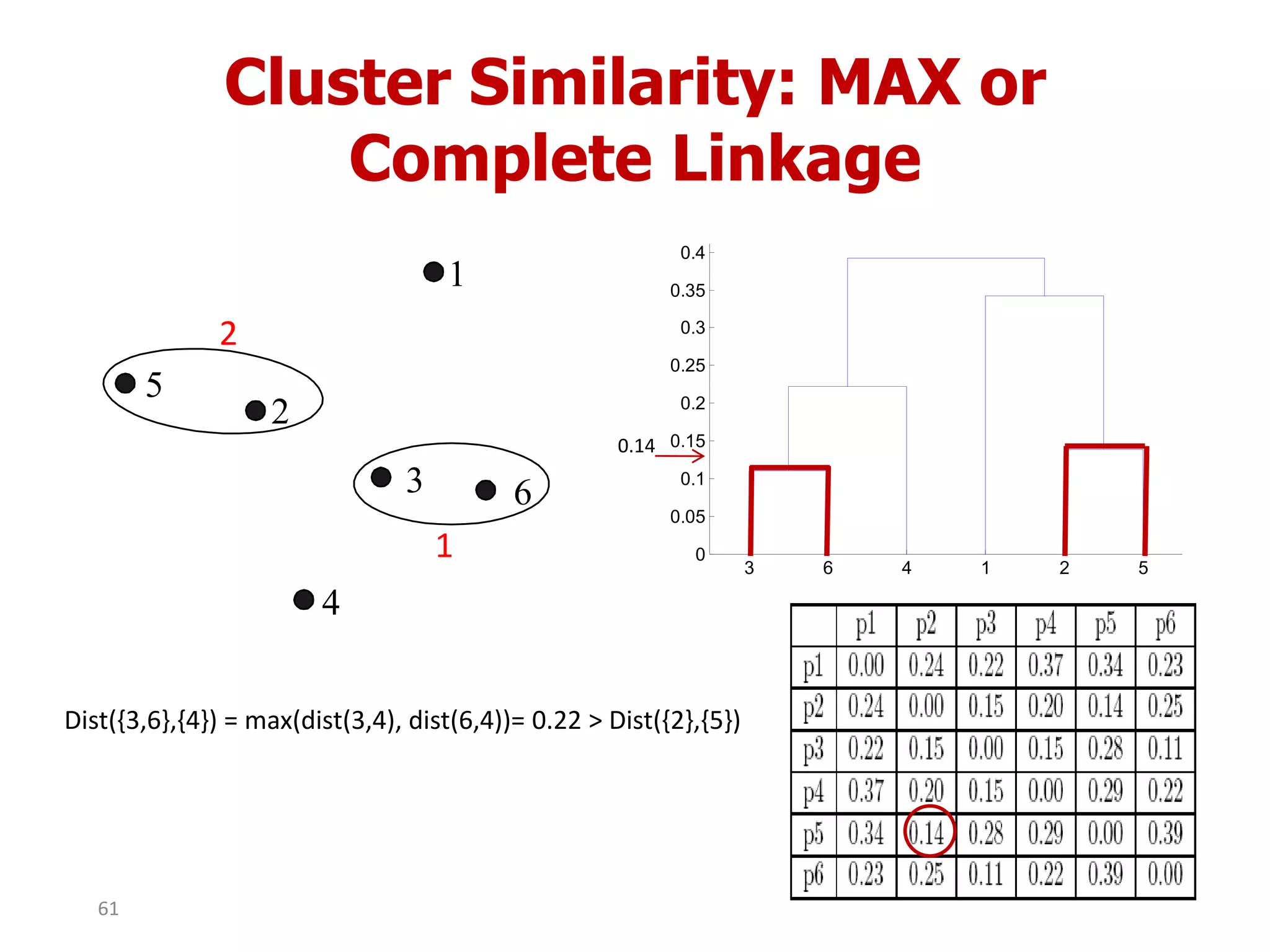
Dist({3,6},{4}) = max(dist(3,4), dist(6,4))= 0.22 > Dist({2},{5})
0.14
61
Cluster Similarity: MAX or
Complete Linkage
3 6 4 1 2 5
0
0.05
0.1
0.15
0.2
0.25
0.3
0.35
0.4
1
2
3
4
5
6
1
3
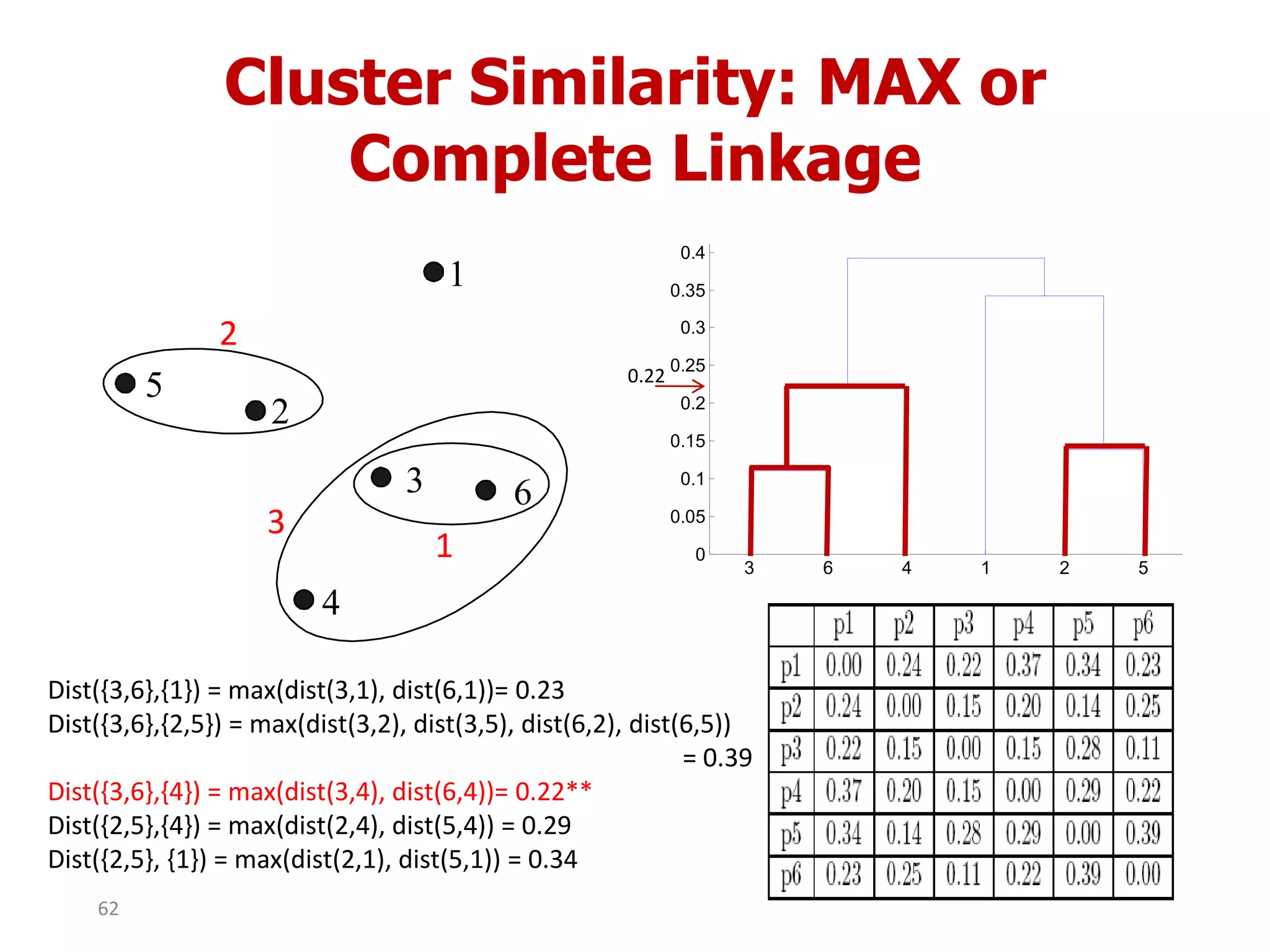
Dist({3,6},{1}) = max(dist(3,1), dist(6,1))= 0.23
Dist({3,6},{2,5}) = max(dist(3,2), dist(3,5), dist(6,2), dist(6,5))
= 0.39
Dist({3,6},{4}) = max(dist(3,4), dist(6,4))= 0.22**
Dist({2,5},{4}) = max(dist(2,4), dist(5,4)) = 0.29
Dist({2,5}, {1}) = max(dist(2,1), dist(5,1)) = 0.34
0.22
2
62
Cluster Similarity: MAX or
Complete Linkage
3 6 4 1 2 5
0
0.05
0.1
0.15
0.2
0.25
0.3
0.35
0.4
1
2
3
4
5
6
1
2
3
4
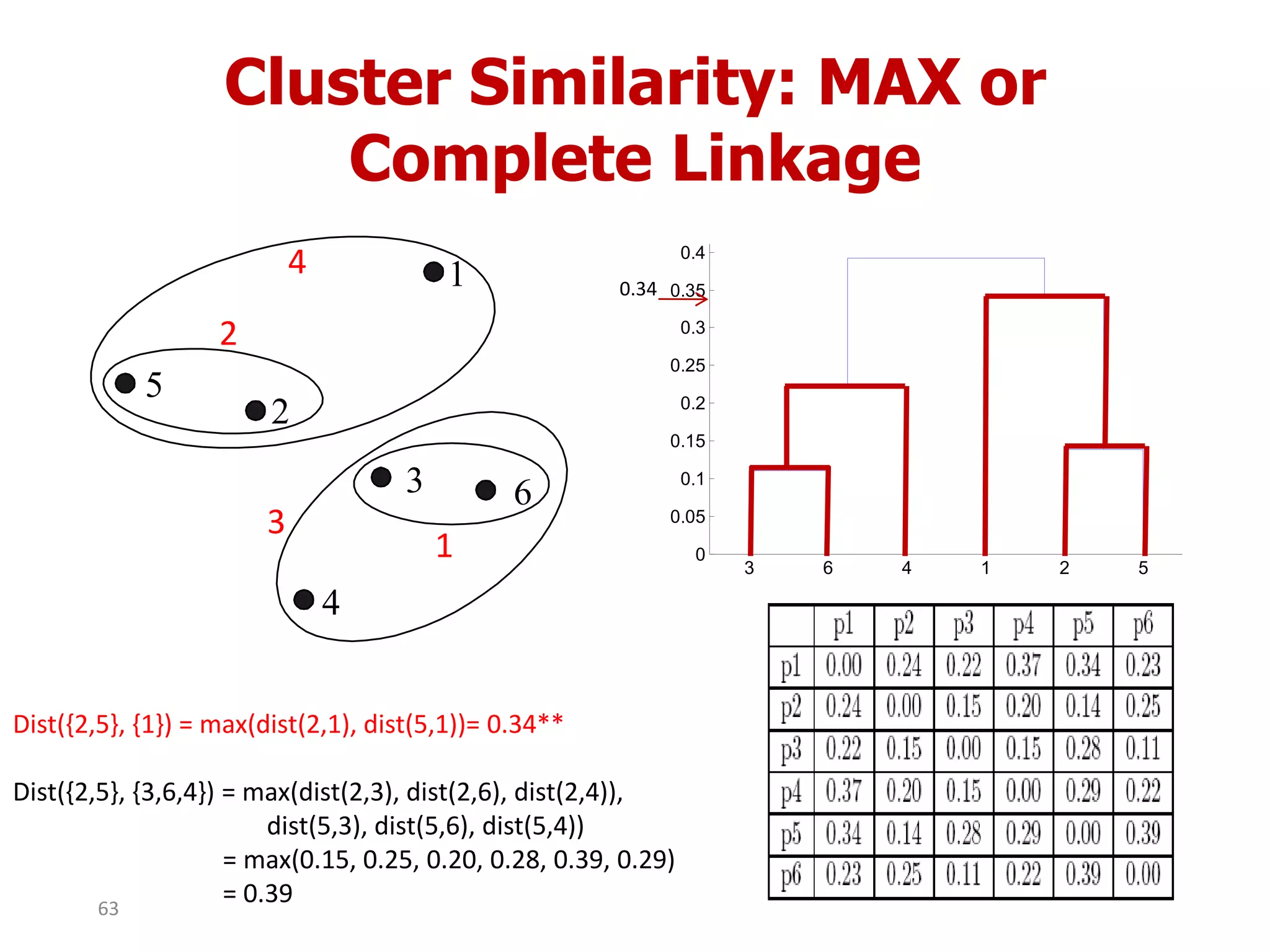
Dist({2,5}, {1}) = max(dist(2,1), dist(5,1))= 0.34**
Dist({2,5}, {3,6,4}) = max(dist(2,3), dist(2,6), dist(2,4)),
dist(5,3), dist(5,6), dist(5,4))
= max(0.15, 0.25, 0.20, 0.28, 0.39, 0.29)
= 0.39
0.34
63
Cluster Similarity: MAX or Complete Linkage
3 6 4 1 2 5
0
0.05
0.1
0.15
0.2
0.25
0.3
0.35
0.4
1
2
3
4
5
6
1
3 5
2
4
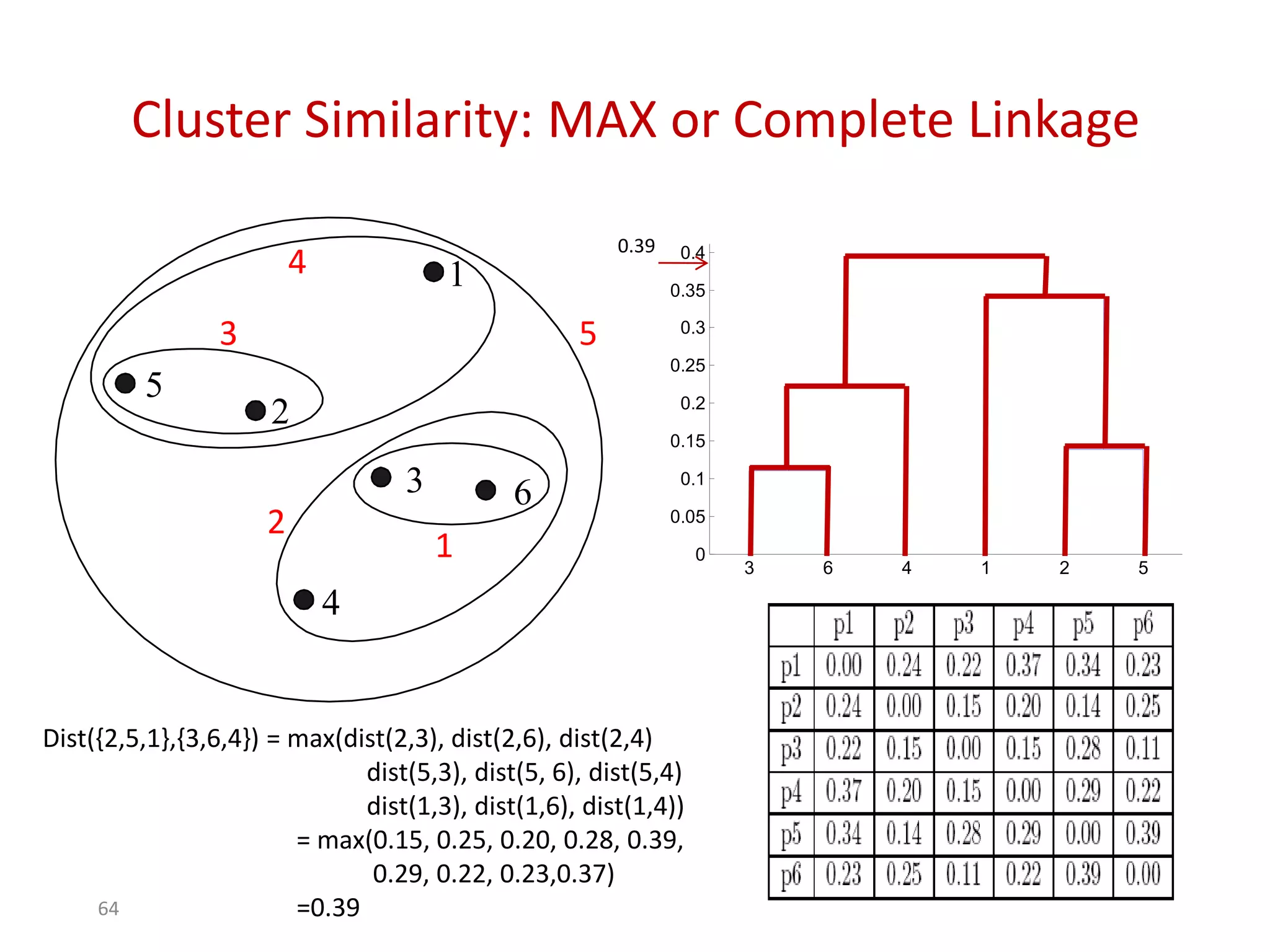
Dist({2,5,1},{3,6,4}) = max(dist(2,3), dist(2,6), dist(2,4)
dist(5,3), dist(5, 6), dist(5,4)
dist(1,3), dist(1,6), dist(1,4))
= max(0.15, 0.25, 0.20, 0.28, 0.39,
0.29, 0.22, 0.23,0.37)
=0.39
0.39
64
Strength of MAX
Original Points Two Clusters
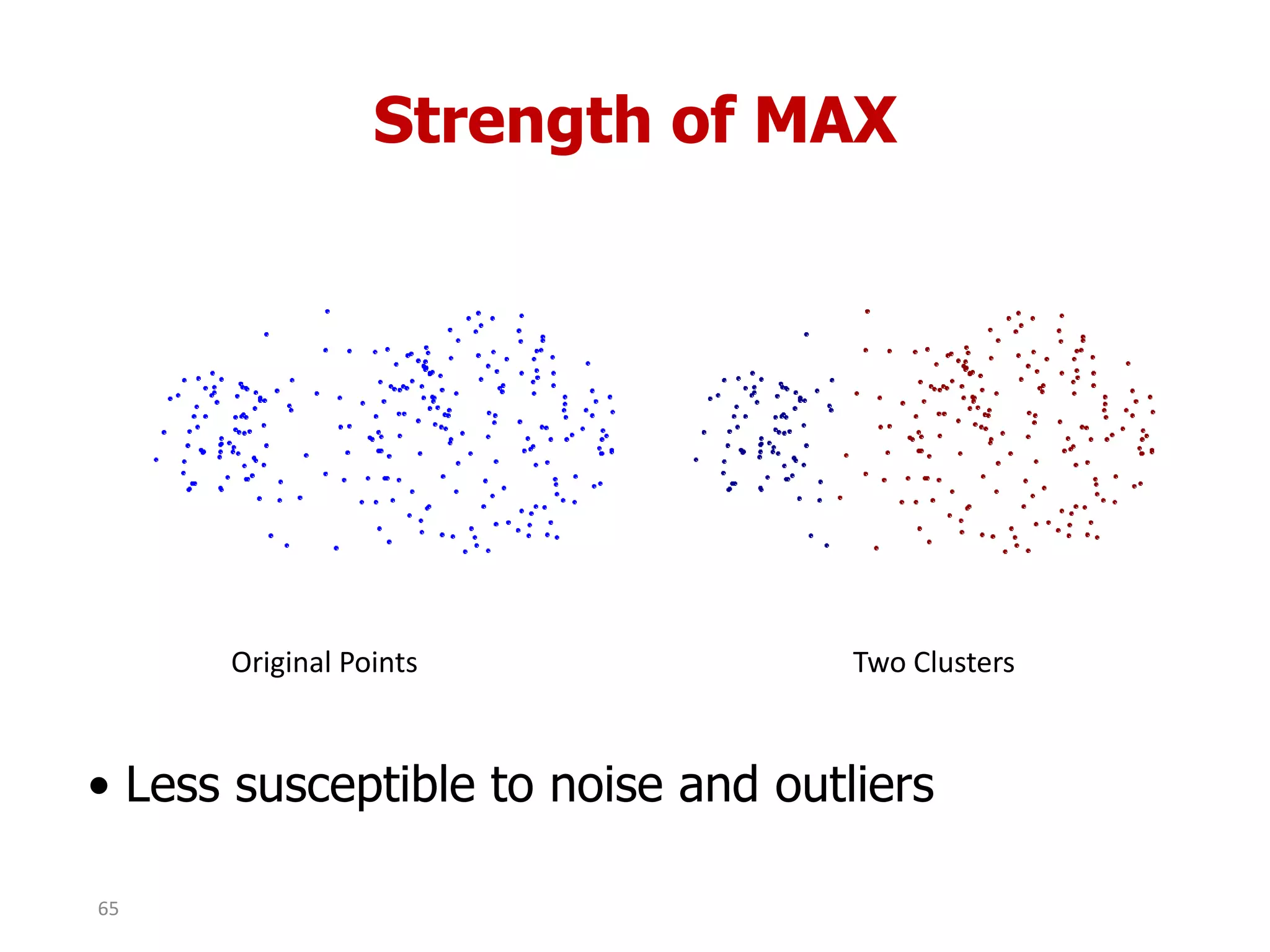
• Less susceptible to noise and outliers
65
Limitations of MAX
Original Points Two Clusters
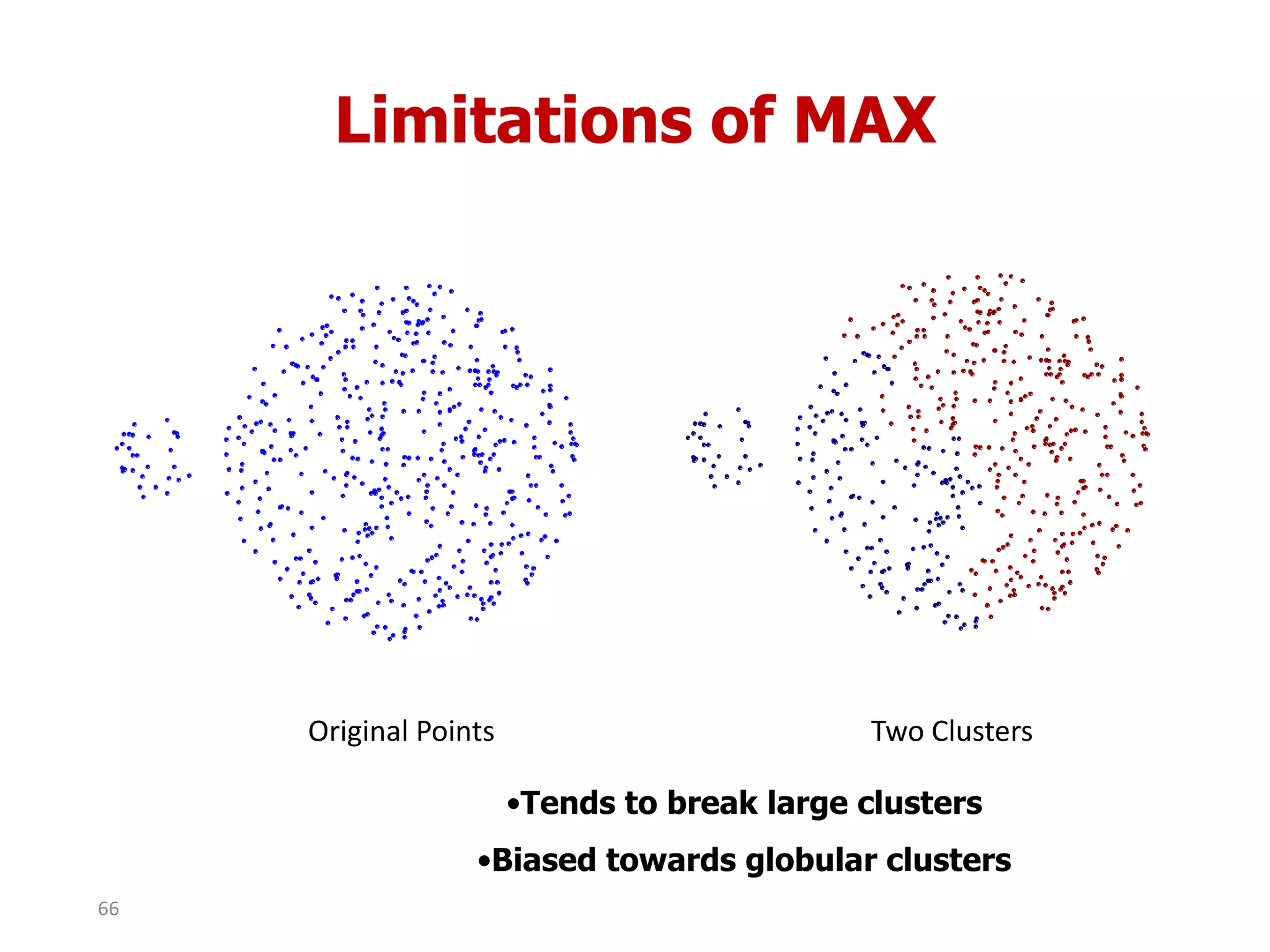
•Tends to break large clusters
•Biased towards globular clusters
66
Cluster Similarity: Group Average
• Group average Hierarchical
Clustering
Single link
compete link
67
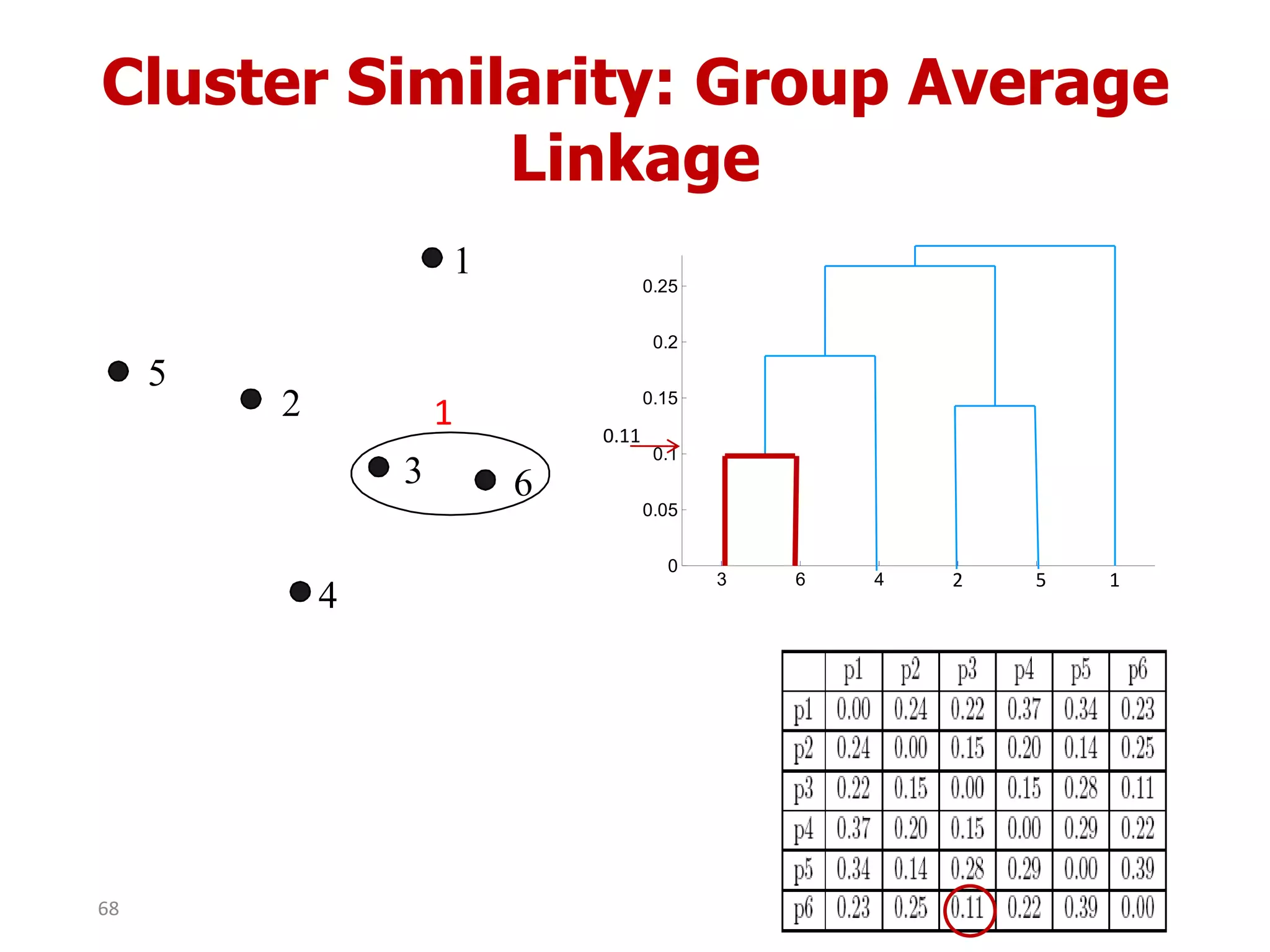
Cluster Similarity: Group Average
Linkage
1
2
3
4
5
6
1
3 6 4 1 2 5
0
0.05
0.1
0.15
0.2
0.25
2 5 1
0.11
68
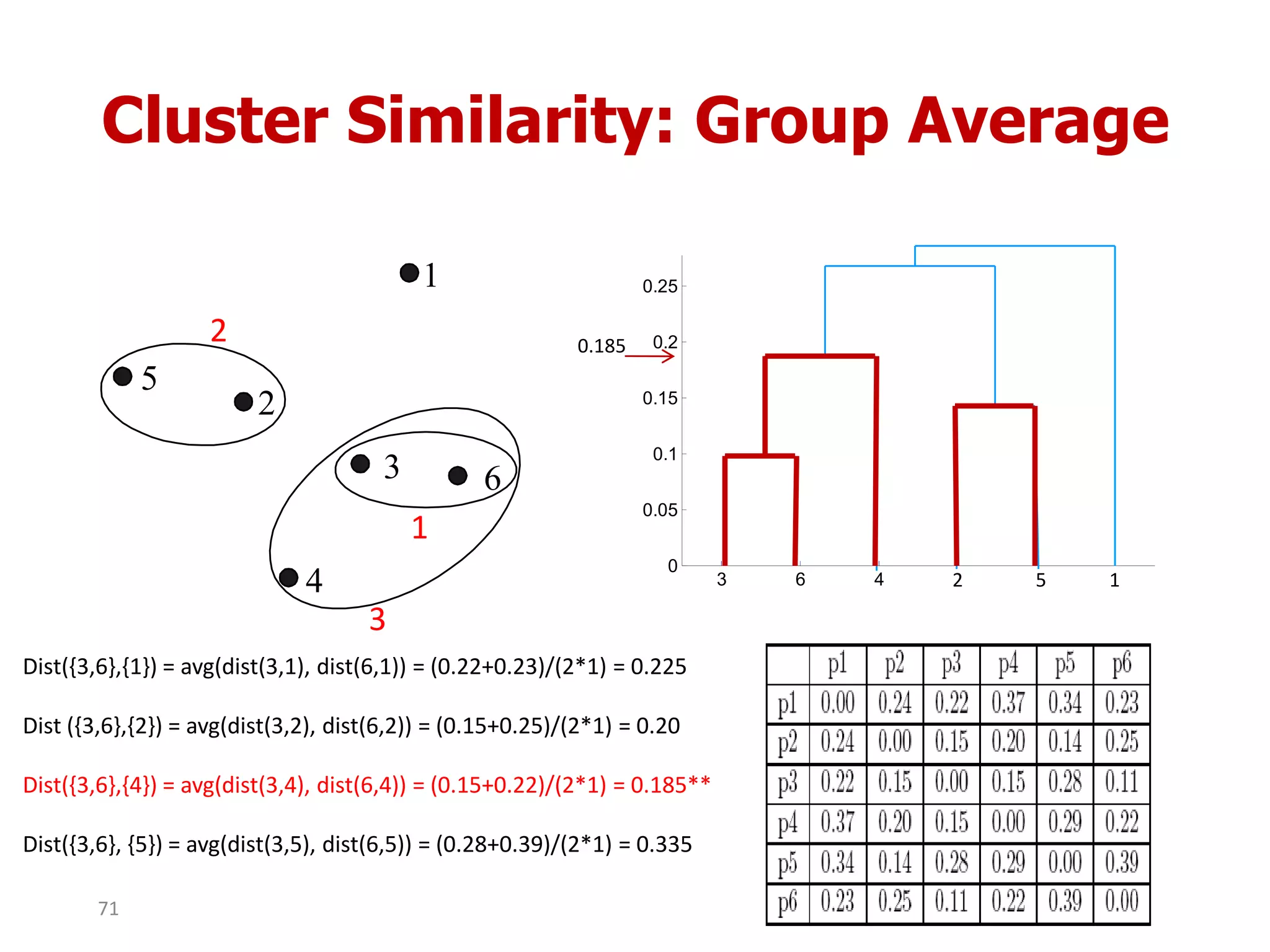
Cluster Similarity: Group Average
1
2
3
4
5
6
1
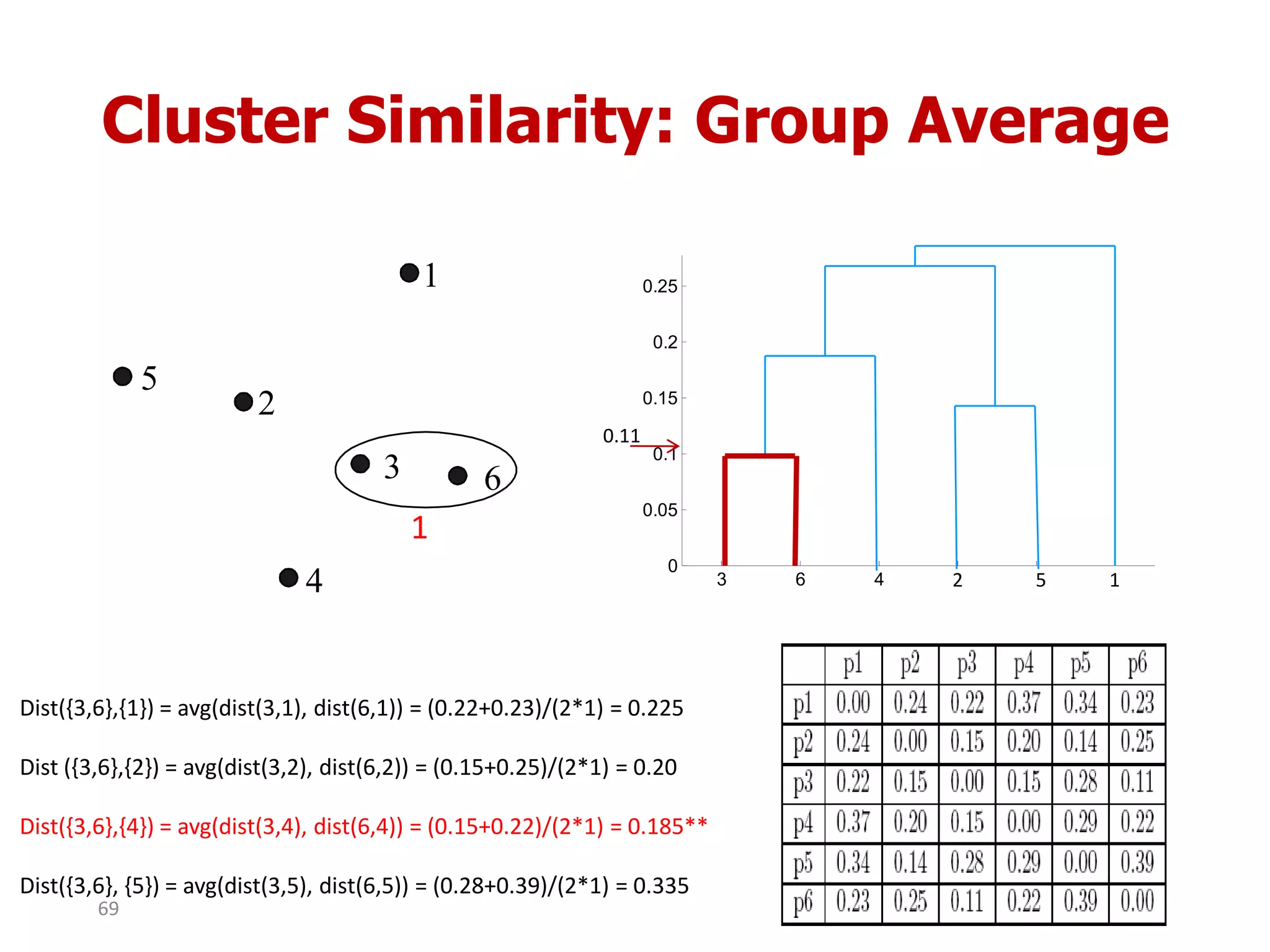
Dist({3,6},{1}) = avg(dist(3,1), dist(6,1)) = (0.22+0.23)/(2*1) = 0.225
Dist ({3,6},{2}) = avg(dist(3,2), dist(6,2)) = (0.15+0.25)/(2*1) = 0.20
Dist({3,6},{4}) = avg(dist(3,4), dist(6,4)) = (0.15+0.22)/(2*1) = 0.185**
Dist({3,6}, {5}) = avg(dist(3,5), dist(6,5)) = (0.28+0.39)/(2*1) = 0.335
3 6 4 1 2 5
0
0.05
0.1
0.15
0.2
0.25
2 5 1
0.11
69
Cluster Similarity: Group Average
1
2
3
4
5
6
1
2
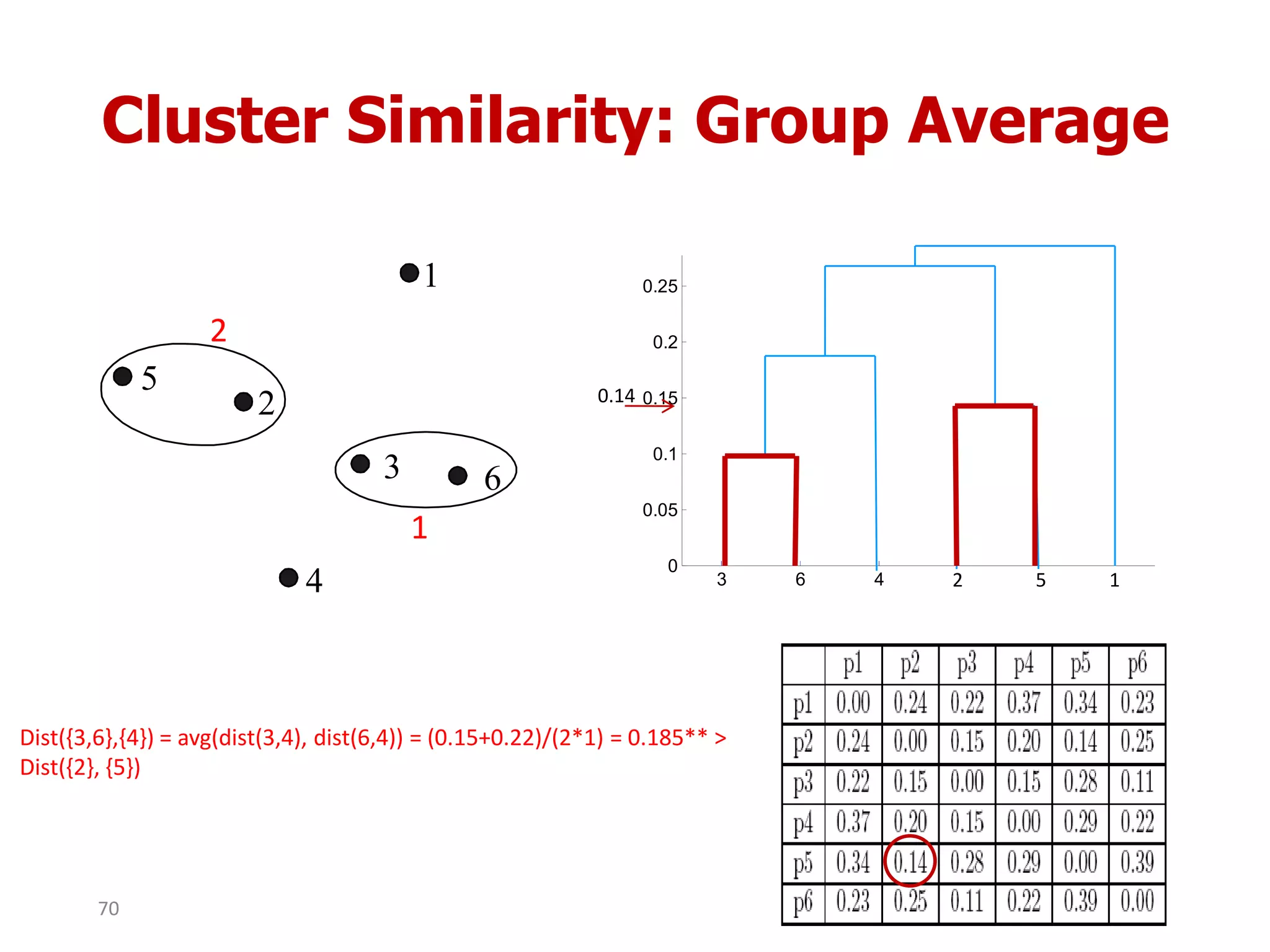
Dist({3,6},{4}) = avg(dist(3,4), dist(6,4)) = (0.15+0.22)/(2*1) = 0.185** >
Dist({2}, {5})
3 6 4 1 2 5
0
0.05
0.1
0.15
0.2
0.25
2 5 1
0.14
70
Cluster Similarity: Group Average
1
2
3
4
5
6
1
2
3
3 6 4 1 2 5
0
0.05
0.1
0.15
0.2
0.25
2 5 1
Dist({3,6},{1}) = avg(dist(3,1), dist(6,1)) = (0.22+0.23)/(2*1) = 0.225
Dist ({3,6},{2}) = avg(dist(3,2), dist(6,2)) = (0.15+0.25)/(2*1) = 0.20
Dist({3,6},{4}) = avg(dist(3,4), dist(6,4)) = (0.15+0.22)/(2*1) = 0.185**
Dist({3,6}, {5}) = avg(dist(3,5), dist(6,5)) = (0.28+0.39)/(2*1) = 0.335
0.185
71
Cluster Similarity: Group Average
1
2
3
4
5
6
1
2
3
3 6 4 1 2 5
0
0.05
0.1
0.15
0.2
0.25
2 5 1
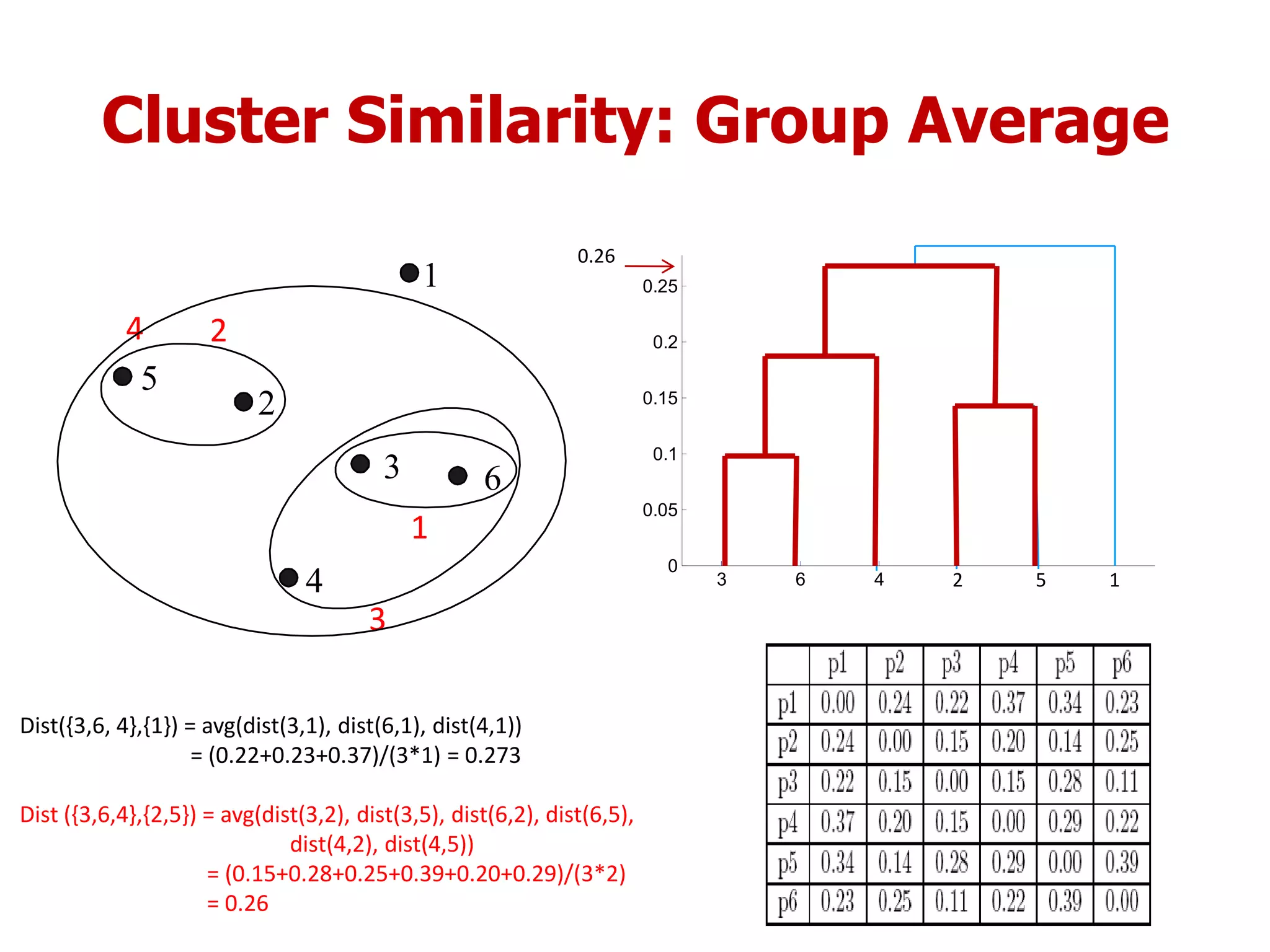
Dist({3,6, 4},{1}) = avg(dist(3,1), dist(6,1), dist(4,1))
= (0.22+0.23+0.37)/(3*1) = 0.273
Dist ({3,6,4},{2,5}) = avg(dist(3,2), dist(3,5), dist(6,2), dist(6,5),
dist(4,2), dist(4,5))
= (0.15+0.28+0.25+0.39+0.20+0.29)/(3*2)
= 0.26
4
0.26
Cluster Similarity: Group Average
1
2
3
4
5
6
1
2
5
3
3 6 4 1 2 5
0
0.05
0.1
0.15
0.2
0.25
2 5 1
4
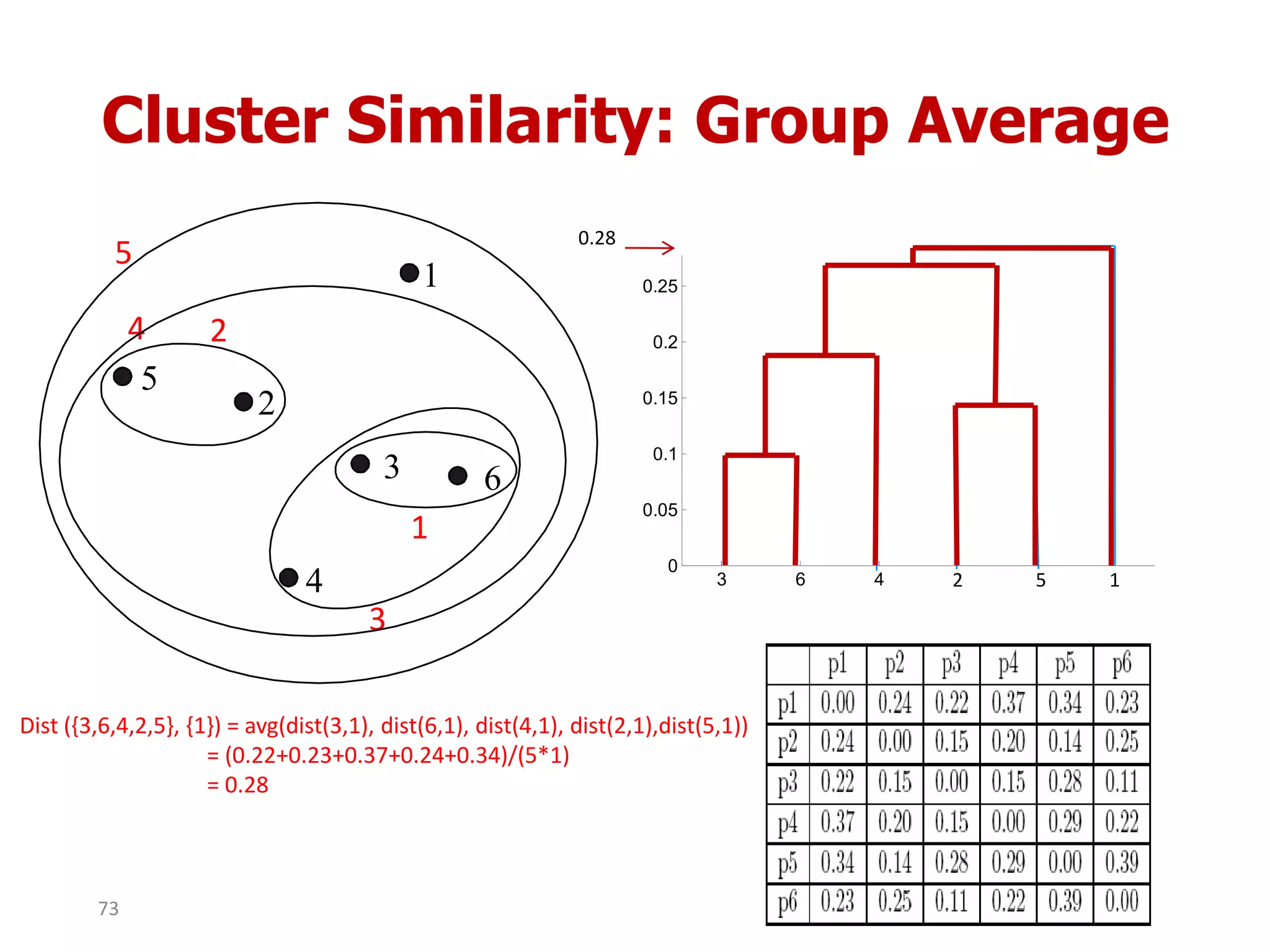
Dist ({3,6,4,2,5}, {1}) = avg(dist(3,1), dist(6,1), dist(4,1), dist(2,1),dist(5,1))
= (0.22+0.23+0.37+0.24+0.34)/(5*1)
= 0.28
0.28
73
Hierarchical Clustering: Group
Average
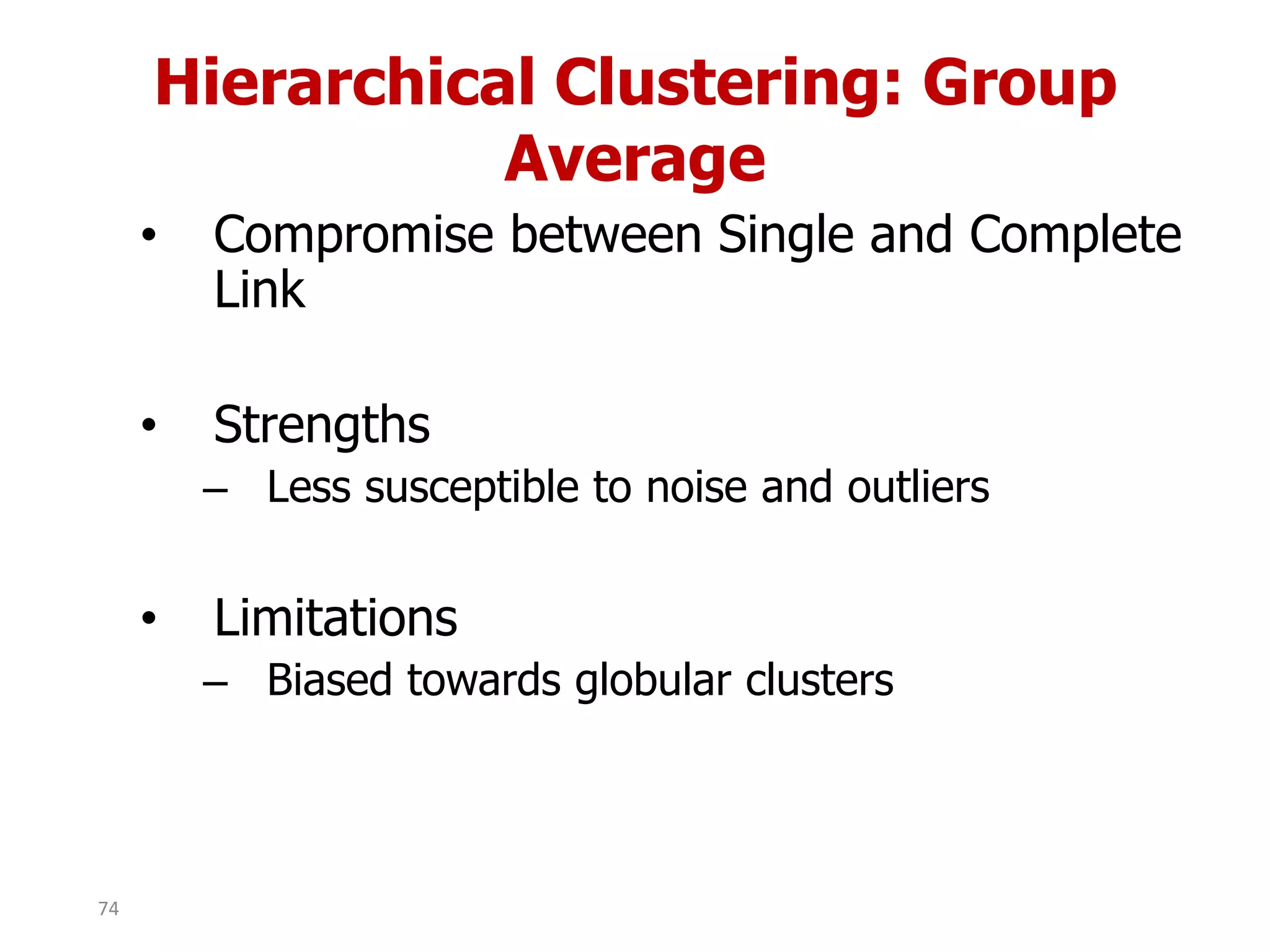
• Compromise between Single and Complete
Link
• Strengths
– Less susceptible to noise and outliers
• Limitations
– Biased towards globular clusters
74
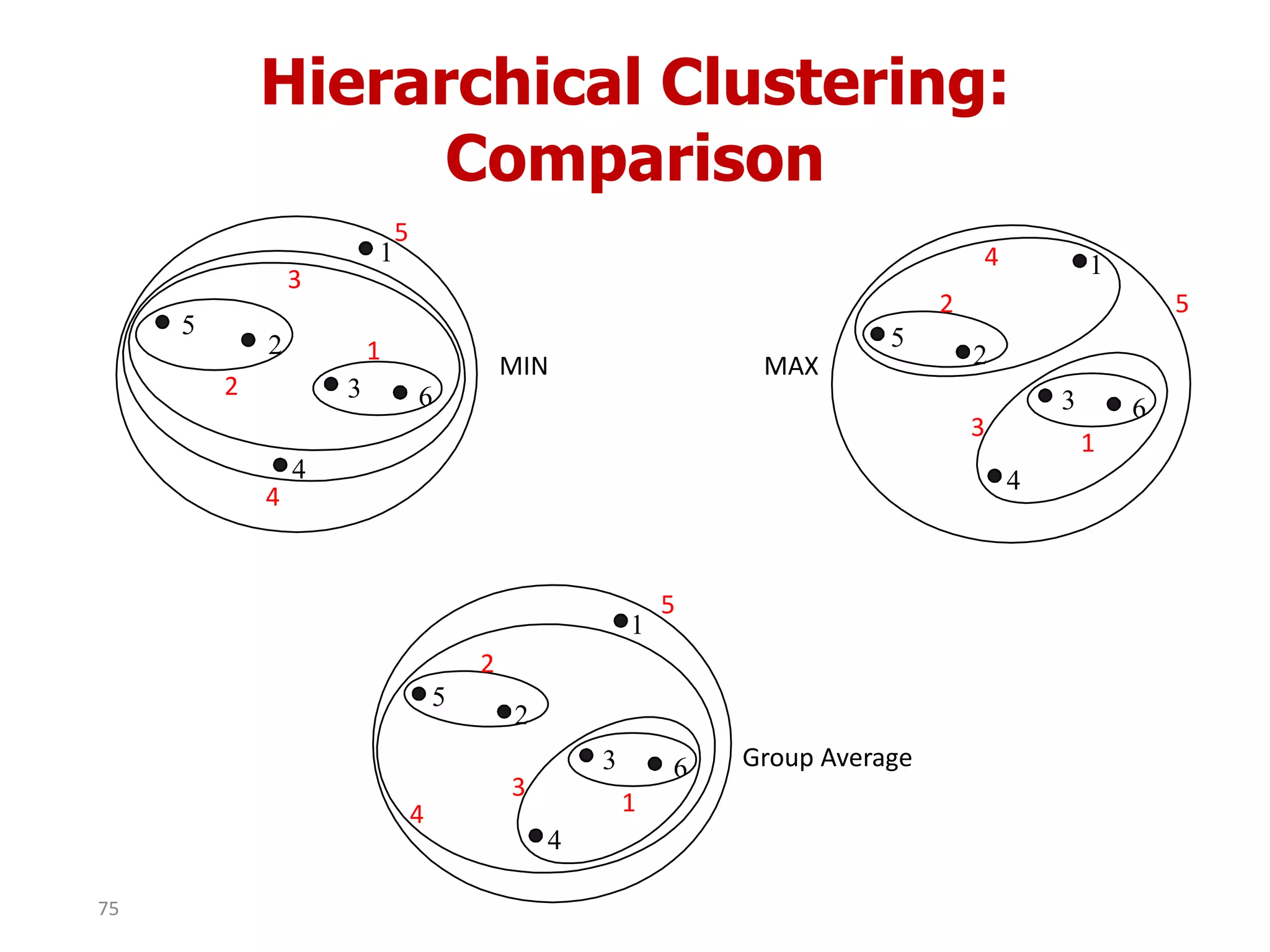
Hierarchical Clustering:
Comparison
Group Average
MIN MAX
1
2
3
4
5
6
1
2
5
3
4
1
2
3
4
5
6
1
2 5
3
41
2
3
4
5
6
1
2
3
4
5
75
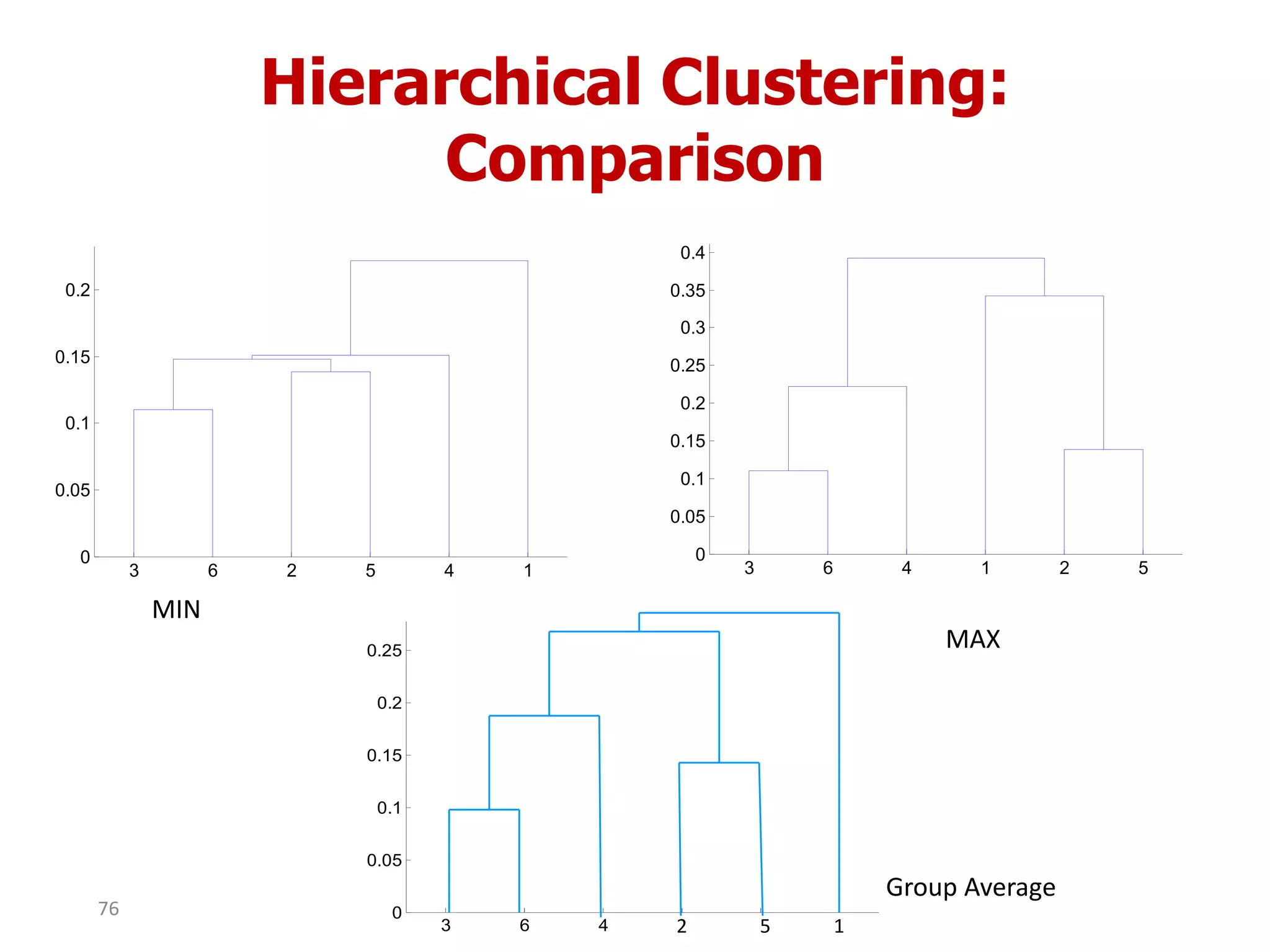
Hierarchical Clustering:
Comparison
3 6 4 1 2 5
0
0.05
0.1
0.15
0.2
0.25
2 5 1
Group Average
3 6 4 1 2 5
0
0.05
0.1
0.15
0.2
0.25
0.3
0.35
0.4
MAX
3 6 2 5 4 1
0
0.05
0.1
0.15
0.2
MIN
76
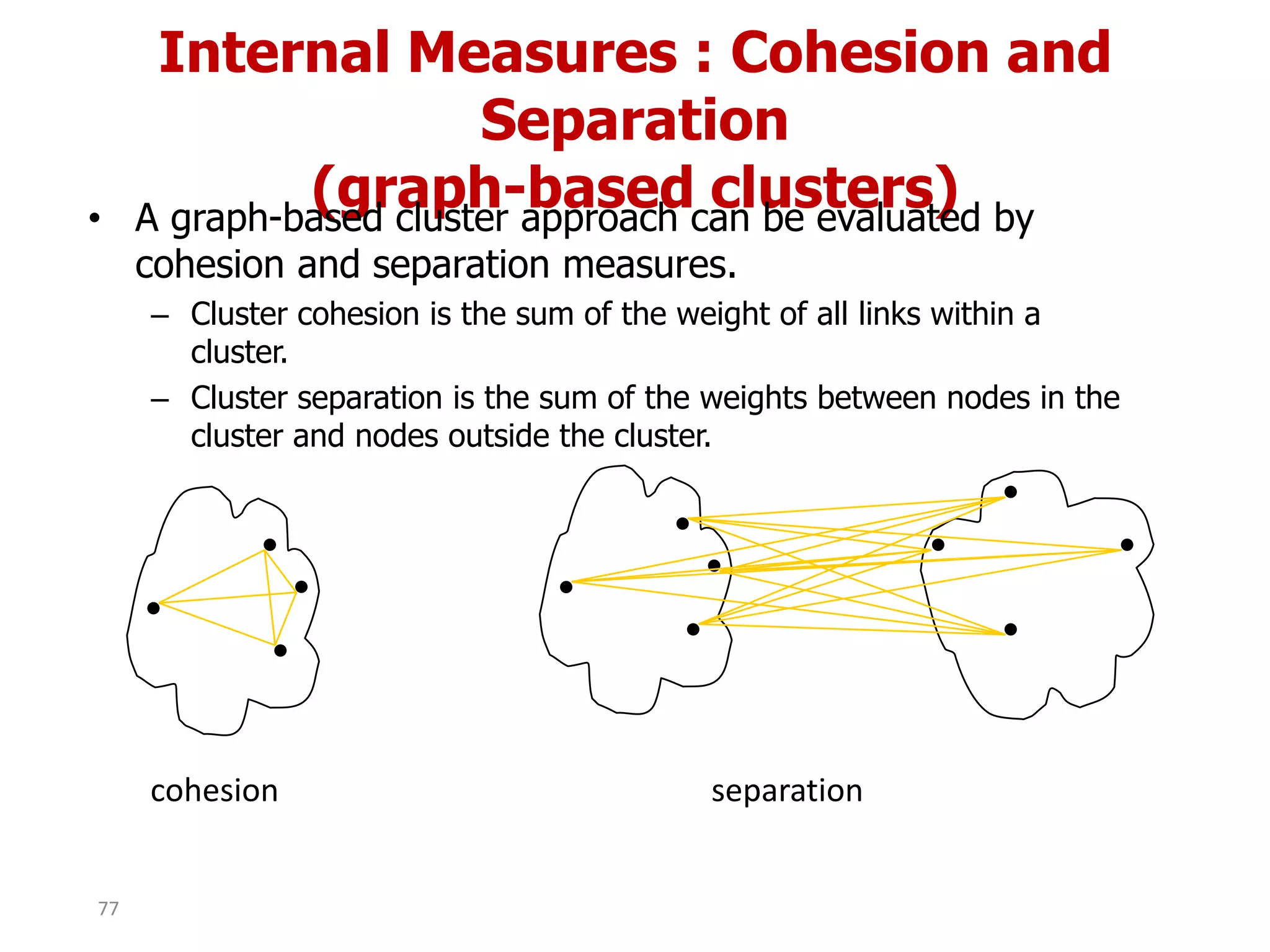
Internal Measures : Cohesion and
Separation
(graph-based clusters)• A graph-based cluster approach can be evaluated by
cohesion and separation measures.
– Cluster cohesion is the sum of the weight of all links within a
cluster.
– Cluster separation is the sum of the weights between nodes in the
cluster and nodes outside the cluster.
cohesion separation
77
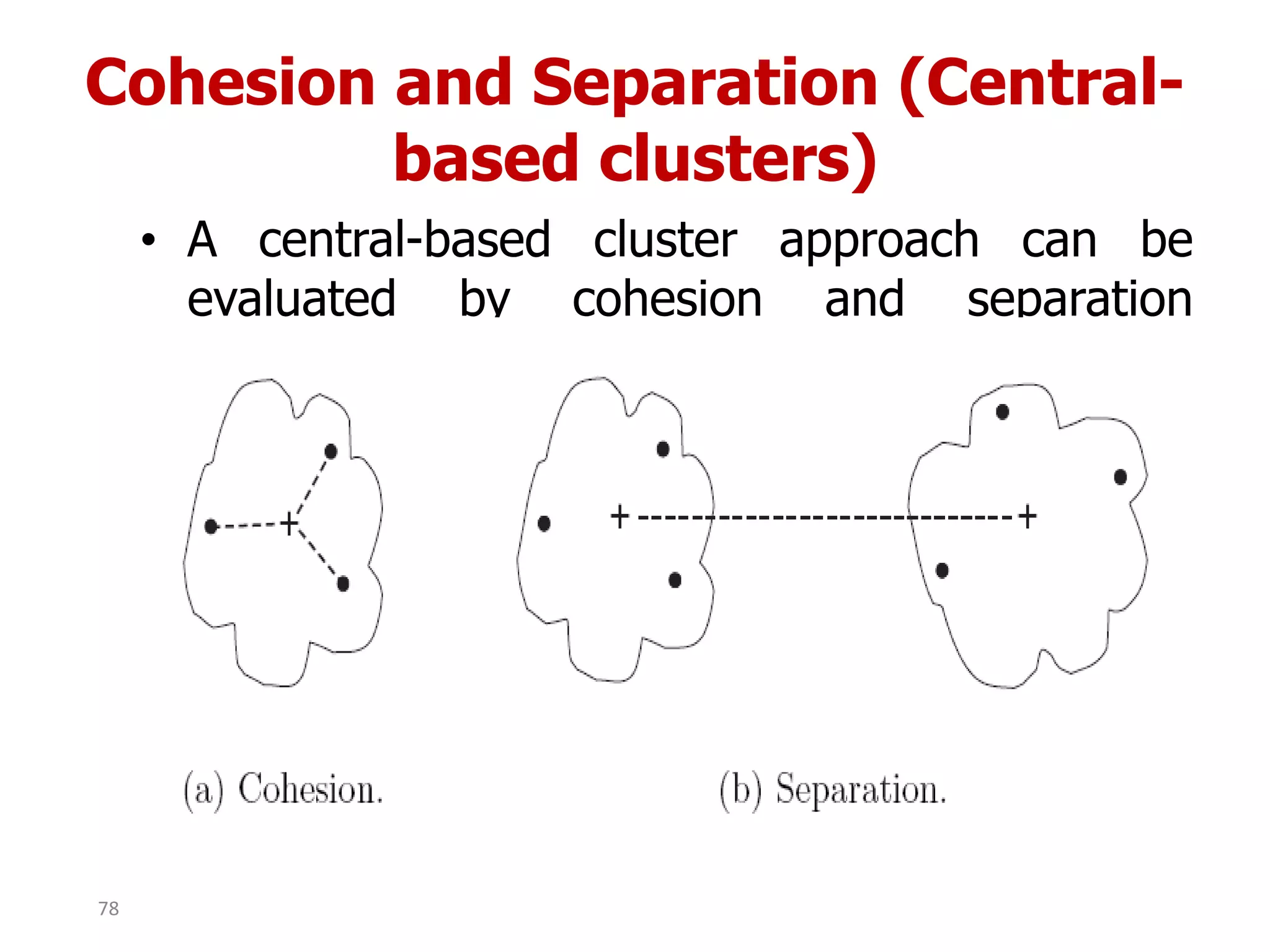
Cohesion and Separation (Central-
based clusters)
• A central-based cluster approach can be
evaluated by cohesion and separation
measures.
78
Cohesion and Separation (Central-
based clustering)
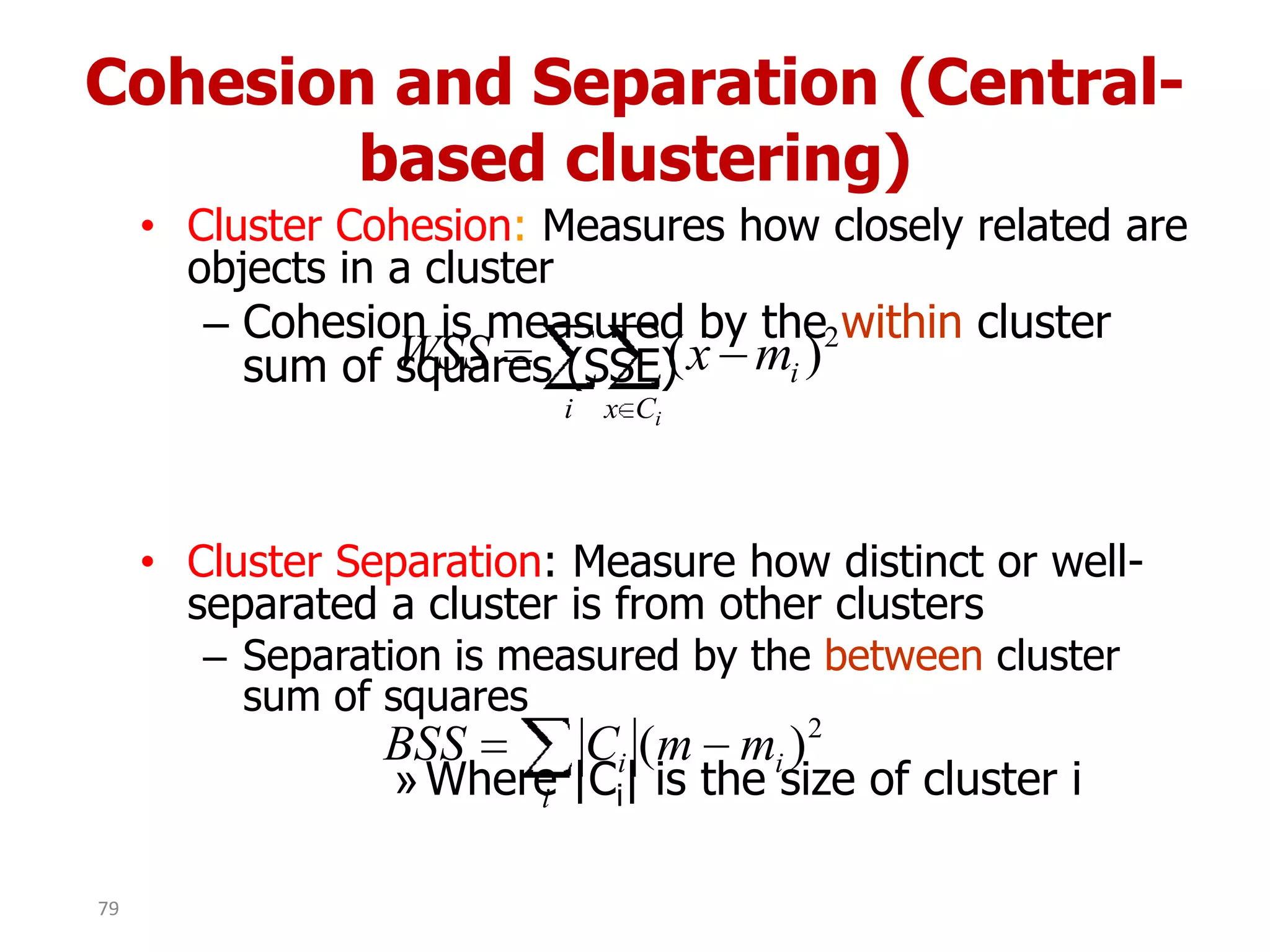
• Cluster Cohesion: Measures how closely related are
objects in a cluster
– Cohesion is measured by the within cluster
sum of squares (SSE)
• Cluster Separation: Measure how distinct or well-
separated a cluster is from other clusters
– Separation is measured by the between cluster
sum of squares
»Where |Ci| is the size of cluster i
i Cx
i
i
mxWSS 2
)(
i
ii mmCBSS 2
)(
79
Example: Cohesion and Separation
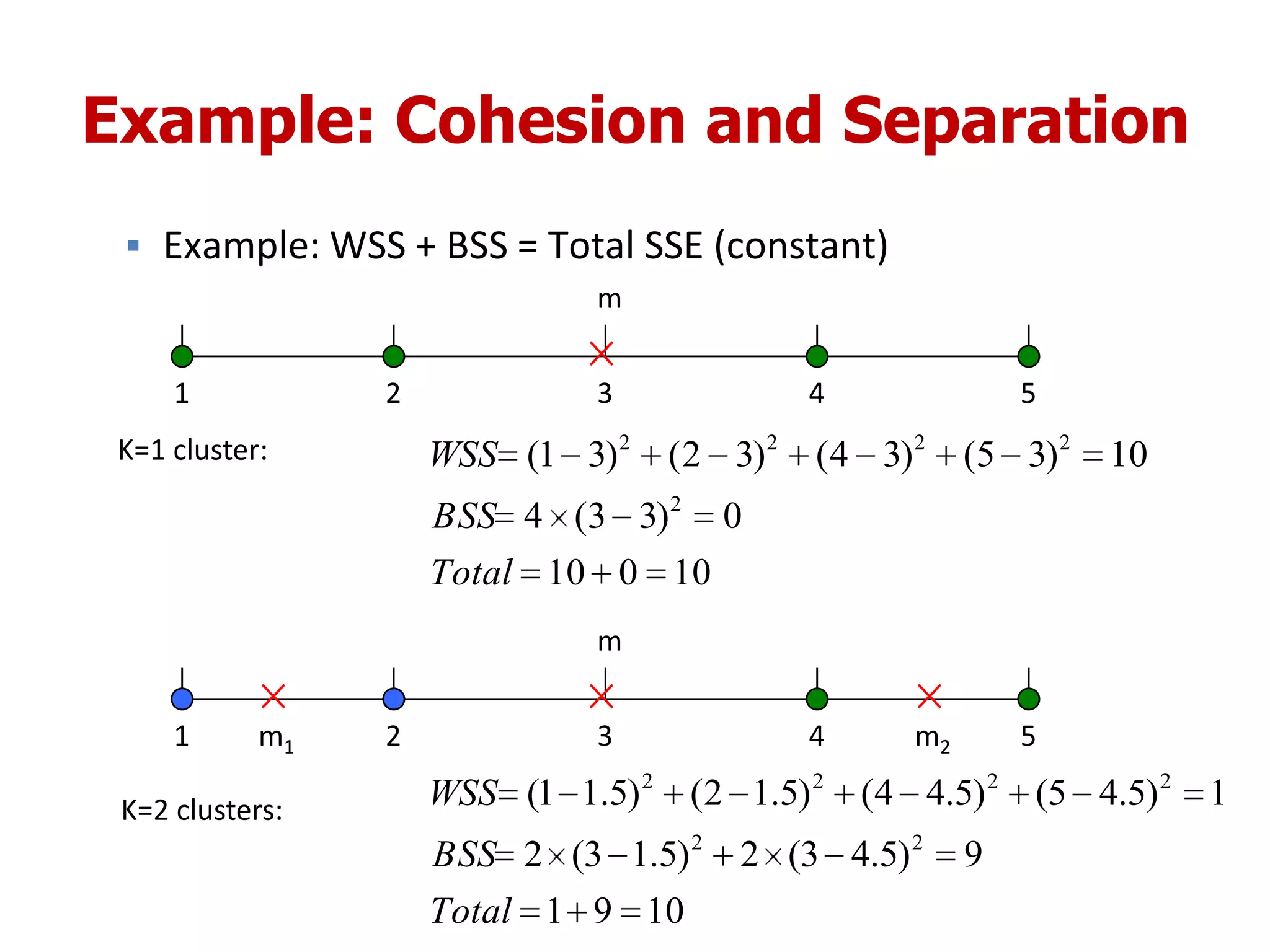
 Example: WSS + BSS = Total SSE (constant)
1 2 3 4 5
m
1091
9)5.43(2)5.13(2
1)5.45()5.44()5.12()5.11(
22
2222
Total
BSS
WSSK=2 clusters:
10010
0)33(4
10)35()34()32()31(
2
2222
Total
BSS
WSSK=1 cluster:
1 2 3 4 5m1 m2
m
HW#8
81
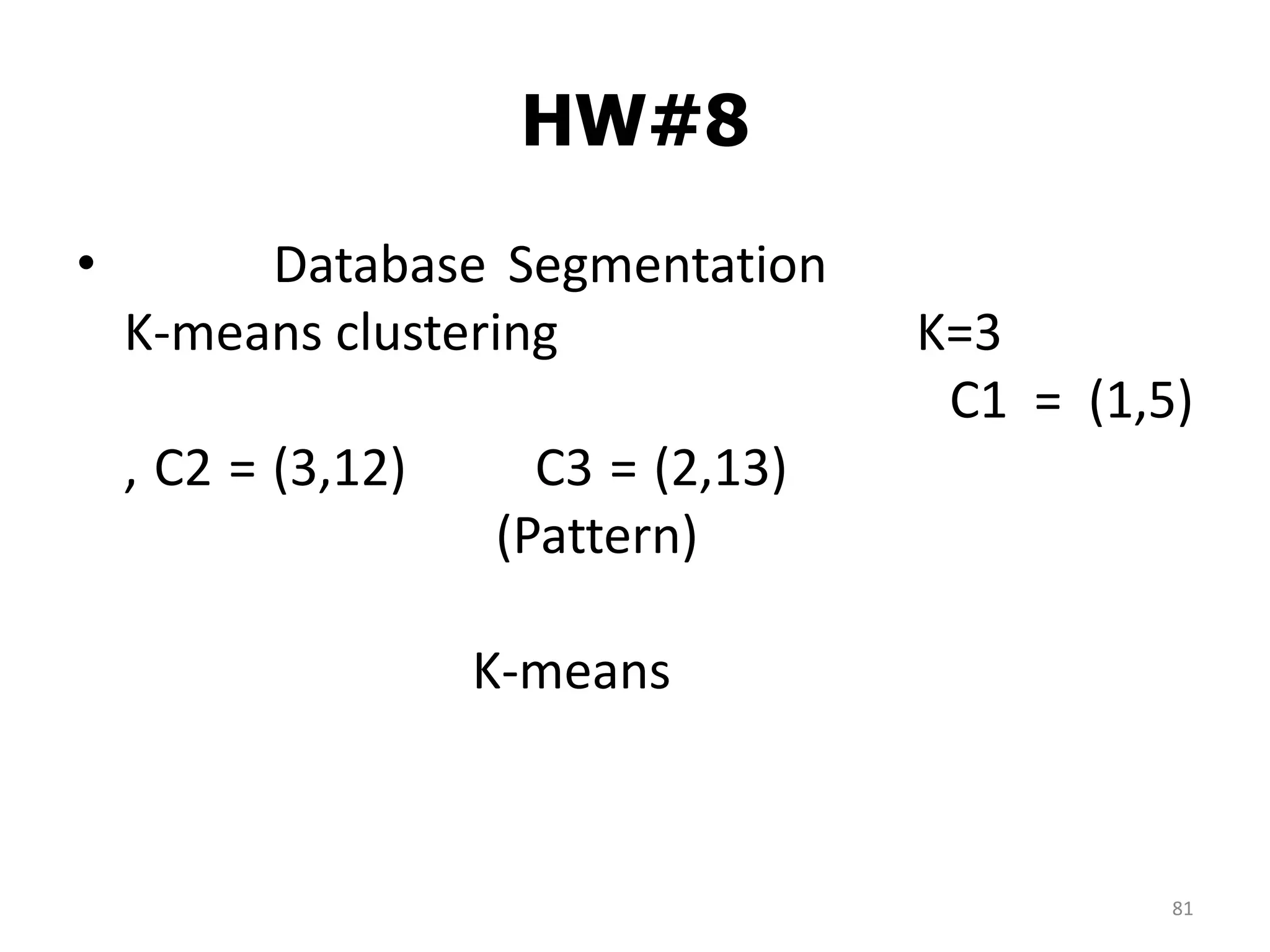
• Database Segmentation
K-means clustering K=3
C1 = (1,5)
, C2 = (3,12) C3 = (2,13)
(Pattern)
K-means
HW#8
82
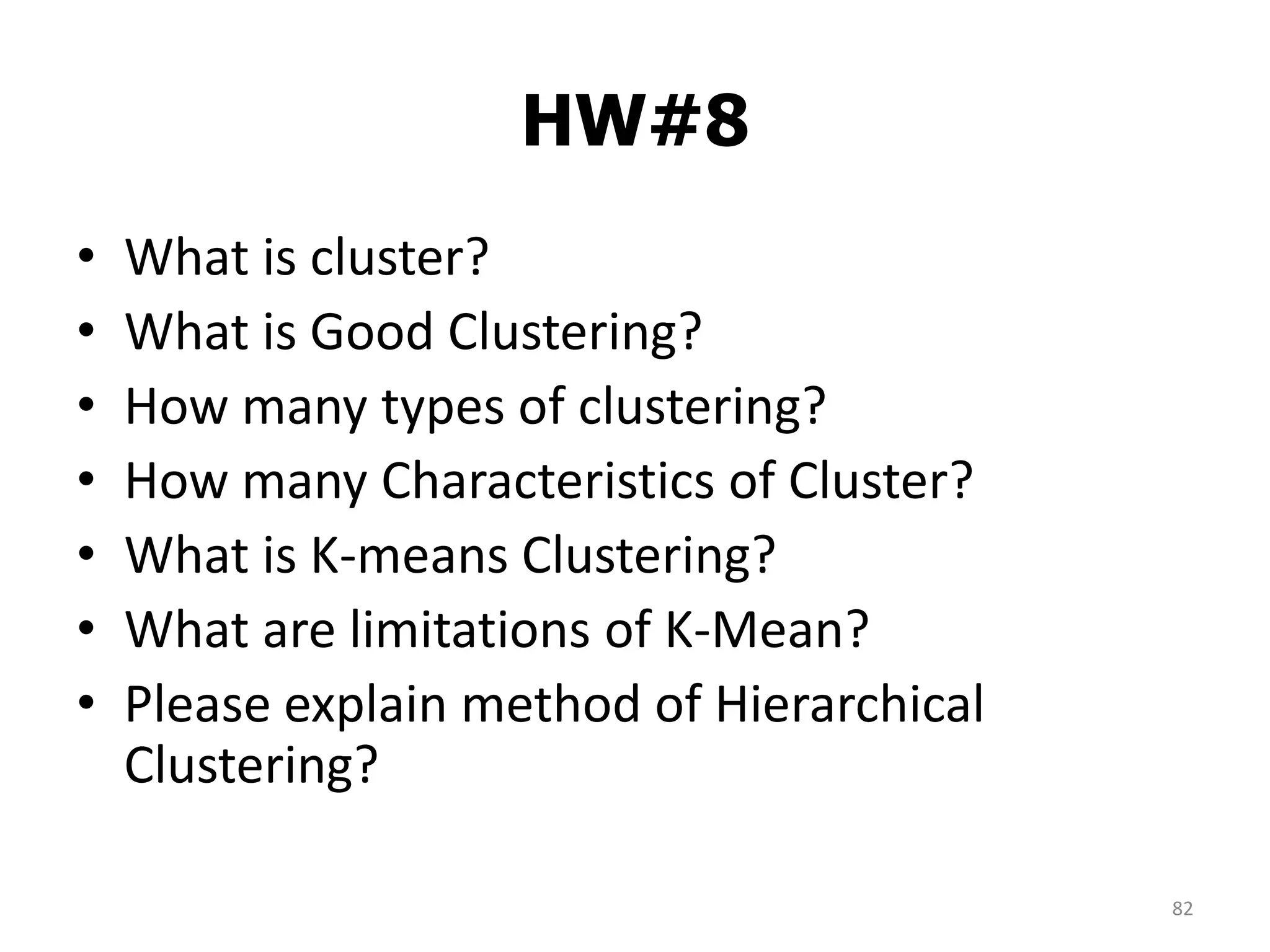
• What is cluster?
• What is Good Clustering?
• How many types of clustering?
• How many Characteristics of Cluster?
• What is K-means Clustering?
• What are limitations of K-Mean?
• Please explain method of Hierarchical
Clustering?
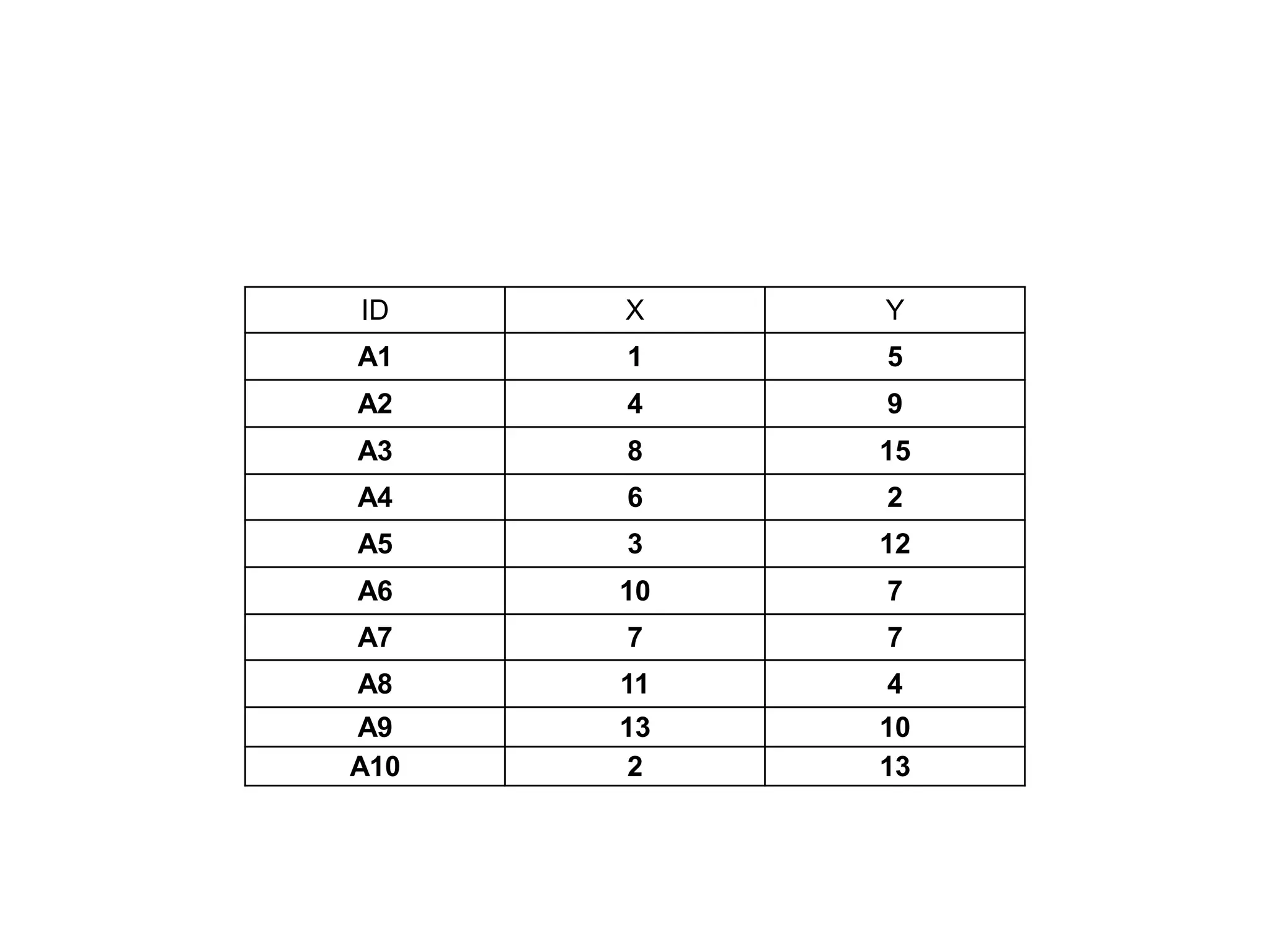
ID X Y
A1 1 5
A2 4 9
A3 8 15
A4 6 2
A5 3 12
A6 10 7
A7 7 7
A8 11 4
A9 13 10
A10 2 13
LAB 8
84
• Use weka program to construct a neural
network classification from the given file.
• Weka Explorer  Open file  bank.arff
• Cluster  Choose button 
SimpleKMeans  Next, click on the text
box to the right of the "Choose" button to
get the pop-up window

08 clustering

  • 1.
  • 2.
    What is Clusteringin Data Mining? • Cluster : (collection) – (Similarity) – (Dissimilarity or Distance) • Cluster Analysis – • Clustering – (Classification) (unsupervised classification) 2
  • 3.
    Cluster Analysis How manyclusters? Four ClustersTwo Clusters Six Clusters 3
  • 4.
    What is GoodClustering? • (Minimize Intra-Cluster Distances) (Maximize Inter-Cluster Distances) Inter-cluster distances are maximized Intra-cluster distances are minimized 4
  • 5.
    Types of Clustering •Partitional Clustering – A division data objects into non-overlapping subsets (clusters) such that each data object is in exactly one subset Original Points A Partitional Clustering 5
  • 6.
    Types of Clustering •Hierarchical clustering – A set of nested clusters organized as a hierarchical tree p4 p1 p3 p2 p4 p1 p3 p2 p4p1 p2 p3 p4p1 p2 p3 Hierarchical Clustering#1 Hierarchical Clustering#2 Traditional Dendrogram 2 Traditional Dendrogram 1 6
  • 7.
    Types of Clustering •Exclusive versus non-exclusive – In non-exclusive clusterings, points may belong to multiple clusters. – Can represent multiple classes or „border‟ points • Fuzzy versus non-fuzzy – In fuzzy clustering, a point belongs to every cluster with some weight between 0 and 1 – Weights must sum to 1 – Probabilistic clustering has similar characteristics • Partial versus complete – In some cases, we only want to cluster some of the data • Heterogeneous versus homogeneous – Cluster of widely different sizes, shapes, and densities 7
  • 8.
    Characteristics of Cluster •Well-Separated Clusters: – A cluster is a set of points such that any point in a cluster is closer (or more similar) to every other point in the cluster than to any point not in the cluster. 3 well-separated clusters 8
  • 9.
    Characteristics of Cluster •Center-based – A cluster is a set of objects such that an object in a cluster is closer (more similar) to the “center” of a cluster, than to the center of any other cluster. – The center of a cluster is often a centroid, the average of all the points in the cluster, or a medoid, the most “representative” point of a cluster. 4 center-based clusters 9
  • 10.
    Characteristics of Cluster •Density-based – A cluster is a dense region of points, which is separated by low-density regions, from other regions of high density. – Used when the clusters are irregular, and when noise and outliers are present. 6 density-based clusters 10
  • 11.
    Characteristics of Cluster •Shared Property or Conceptual Clusters – Finds clusters that share some common property or represent a particular concept. 2 Overlapping Circles 11
  • 12.
    Clustering Algorithms • K-meansclustering • Hierarchical clustering 12
  • 13.
    K-means Clustering • (Partition)n D k ( k) • k-Means k 13
  • 14.
    K-means Clustering Algorithm Algorithm:The k-Means algorithm for partitioning based on the mean value of object in the cluster. Input: The number of cluster k and a database containing n objects. Output: A set of k clusters that mininimizes the squared- error criterion. 14
  • 15.
    K-means Clustering Algorithm Method 1)Randomly choose k object as the initial cluster centers (centroid); 2) Repeat 3) (re)assign each object to the cluster to which the object is the most similar, based on the mean value of the objects in the cluster; 4) Update the cluster mean calculate the mean value of the objects for each cluster; 5) Until centroid (center point) no change; 15
  • 16.
    Example: K-Mean Clustering •Problem: Cluster the following eight points (with (x, y) representing locations) into three clusters A1(2, 10) A2(2, 5) A3(8, 4) A4(5, 8) A5(7, 5) A6(6, 4) A7(1, 2) A8(4, 9). 0 2 4 6 8 10 12 0 1 2 3 4 5 6 7 8 9 16
  • 17.
    Example: K-Mean Clustering •Randomly choose k object as the initial cluster centers; • k =3 ; c1(2, 10), c2(5, 8) and c3(1, 2). 0 2 4 6 8 10 12 0 1 2 3 4 5 6 7 8 9 + + + c1 c2 c3 17
  • 18.
    Example: K-Mean Clustering •The distance function between two points a=(x1, y1) and b=(x2, y2) is defined as: distance(a, b) = |x2 – x1| + |y2 – y1| (2, 10) (5, 8) (1, 2) Point Dist Mean 1 Dist Mean 2 Dist Mean 3 Cluster A1 (2, 10) A2 (2, 5) A3 (8, 4) A4 (5, 8) A5 (7, 5) A6 (6, 4) A7 (1, 2) A8 (4, 9) 18
  • 19.
    Example: K-Mean Clustering •Step 2 Calculate distance by using the distance functionpoint mean1 x1, y1 x2, y2 (2, 10) (2, 10) distance(point, mean1) = |x2 – x1| + |y2 – y1| = |2 – 2| + |10 – 10| = 0 + 0 = 0 point mean2 x1, y1 x2, y2 (2, 10) (5, 8) distance(point, mean2) = |x2 – x1| + |y2 – y1| = |5 – 2| + |8 – 10| = 3 + 2 = 5 point mean3 x1, y1 x2, y2 (2, 10) (1, 2) distance(point, mean3) = |x2 – x1| + |y2 – y1| = |1 – 2| + |2 – 10| = 1 + 8 = 9 19
  • 20.
    Example: K-Mean Clustering (2,10) (5, 8) (1, 2) Point Dist Mean 1 Dist Mean 2 Dist Mean 3 Cluster A1 (2, 10) 0 5 9 1 A2 (2, 5) A3 (8, 4) A4 (5, 8) A5 (7, 5) A6 (6, 4) A7 (1, 2) A8 (4, 9) 20
  • 21.
    Example: K-Mean Clustering •Calculate distance by using the distance function point mean1 x1, y1 x2, y2 (2, 5) (2, 10) distance(point, mean1) = |x2 – x1| + |y2 – y1| = |2 – 2| + |10 – 5| = 0 + 5 = 5 point mean2 x1, y1 x2, y2 (2, 5) (5, 8) distance(point, mean2) = |x2 – x1| + |y2 – y1| = |5 – 2| + |8 – 5| = 3 + 3 = 6 point mean3 x1, y1 x2, y2 (2, 5) (1, 2) distance(point, mean3) = |x2 – x1| + |y2 – y1| = |1 – 2| + |2 – 5| = 1 + 3 = 4 21
  • 22.
    Example: K-Mean Clustering (2,10) (5, 8) (1, 2) Point Dist Mean 1 Dist Mean 2 Dist Mean 3 Cluster A1 (2, 10) 0 5 9 1 A2 (2, 5) 5 6 4 3 A3 (8, 4) A4 (5, 8) A5 (7, 5) A6 (6, 4) A7 (1, 2) A8 (4, 9) 22
  • 23.
    Example: K-Mean Clustering •Iteration#1 (2, 10) (5, 8) (1, 2) Point Dist Mean 1 Dist Mean 2 Dist Mean 3 Cluster A1 (2, 10) 0 5 9 1 A2 (2, 5) 5 6 4 3 A3 (8, 4) 12 7 9 2 A4 (5, 8) 5 0 10 2 A5 (7, 5) 10 5 9 2 A6 (6, 4) 10 5 7 2 A7 (1, 2) 9 10 0 3 A8 (4, 9) 3 2 10 2 23
  • 24.
    Example: K-Mean Clustering Cluster1 Cluster 2 Cluster 3 A1(2, 10) A3(8, 4) A2(2, 5) A4(5, 8) A7(1, 2) A5(7, 5) A6(6, 4) A8(4, 9) 0 2 4 6 8 10 12 0 1 2 3 4 5 6 7 8 9 + + c1 c2 c3 + 24
  • 25.
    Example: K-Mean Clustering •re-compute the new cluster centers (means). We do so, by taking the mean of all points in each cluster. • For Cluster 1, we only have one point A1(2, 10), which was the old mean, so the cluster center remains the same. • For Cluster 2, we have ( (8+5+7+6+4)/5, (4+8+5+4+9)/5 ) = (6, 6) • For Cluster 3, we have ( (2+1)/2, (5+2)/2 ) = (1.5, 3.5) 25
  • 26.
    Example: K-Mean Clustering 0 2 4 6 8 10 12 01 2 3 4 5 6 7 8 9 + + c1 c2 c3 + 26
  • 27.
    Example: K-Mean Clustering •Iteration#2 (2, 10) (6, 6) (1.5, 3.5) Point Dist Mean 1 Dist Mean 2 Dist Mean 3 Cluster A1 (2, 10) A2 (2, 5) A3 (8, 4) A4 (5, 8) A5 (7, 5) A6 (6, 4) A7 (1, 2) A8 (4, 9) 27
  • 28.
    Example: K-Mean Clustering (Iteration#2) Cluster1? Cluster 2? Cluster 3? 0 2 4 6 8 10 12 0 1 2 3 4 5 6 7 8 9 re-compute the new cluster centers (means) C1 = (2+4/2, 10+9/2) = (3, 9.5) C2 = (6.5, 5.25) C3 = (1.5, 3.5) 28
  • 29.
    Example: K-Mean Clustering Iteration#3 Cluster1? Cluster 2? Cluster 3? 0 2 4 6 8 10 12 0 1 2 3 4 5 6 7 8 9 re-compute the new cluster centers (means)?? 29
  • 30.
    Distance functions • • Minkowskidistance • q=1 d Manhattan distance • q=2 d Euclidean distance q q jpip q ji q ji xxxxxxjid )...(),( 2211 jpipjiji xxxxxxjid ...),( 2211 )...(),( 22 22 2 11 jpipjiji xxxxxxjid 30
  • 31.
    Evaluating K-means Clusters •Most common measure is Sum of Squared Error (SSE) – For each point, the error is the distance to the nearest cluster – To get SSE, we square these errors and sum them. where, – x is a data point in cluster Ci – mi is the centroid point for cluster Ci • can show that mi corresponds to the K i Cx i i xmdistSSE 1 2 ),( 31
  • 32.
    Limitations of K-Mean •K-means –Size –Density –Shapes 32
  • 33.
    Limitations of K-means:Differing Sizes • K-means Original Points K-means (3 Clusters) 33
  • 34.
    Limitations of K-means:Differing Density • K-means Original Points K-means (3 Clusters) 34
  • 35.
    Limitations of K-means:Non- globular Shapes • K-means Original Points K-means (2 Clusters) 35
  • 36.
    Overcoming K-means Limitations OriginalPoints K-means Clusters One solution is to use many clusters. Find parts of clusters, but need to put together.36
  • 37.
  • 38.
    Overcoming K-means Limitations OriginalPoints K-means Clusters 38
  • 39.
    Hierarchical Clustering • Dendrogram • Dendrogram (cluster)(subcluster) (cluster) 1 3 2 5 4 6 0 0.05 0.1 0.15 0.2 1 2 3 4 5 6 1 2 3 4 5 Dendrogram 39
  • 40.
    Hierarchical Clustering 2 1. Agglomerative( ) : Agglomerative 2. Divisive ( ) : Divisive Agglomerative (singleton cluster) cluster 40
  • 41.
    Agglomerative Clustering Algorithm Basicalgorithm is straightforward 1. Compute the proximity matrix 2. Let each data point be a cluster 3. Repeat 4. Merge the two closest clusters 5. Update the proximity matrix 6. Until only a single cluster remains 41
  • 42.
  • 43.
  • 44.
  • 45.
    How to DefineInter-Cluster Similarity p1 p3 p5 p4 p2 p1 p2 p3 p4 p5 . . . . . . Similarity? Proximity Matrix  MIN  MAX  Group Average  Ward’s Method uses squared error 45
  • 46.
    How to DefineInter-Cluster Similarity  MIN  MAX  Group Average  Ward’s Method uses squared error p1 p3 p5 p4 p2 p1 p2 p3 p4 p5 . . . . . . Proximity Matrix 46
  • 47.
    How to DefineInter-Cluster Similarity p1 p3 p5 p4 p2 p1 p2 p3 p4 p5 . . . . . . Proximity Matrix  MIN  MAX  Group Average  Ward’s Method uses squared error 47
  • 48.
    How to DefineInter-Cluster Similarity p1 p3 p5 p4 p2 p1 p2 p3 p4 p5 . . . . . . Proximity Matrix  MIN  MAX  Group Average  Ward’s Method uses squared error 48
  • 49.
    Cluster Similarity: MINor Single Link • Single link MIN Hierarchical Clustering 2 49
  • 50.
    Cluster Similarity: MINor Single Link 1 2 3 4 5 6 1 3 6 2 5 4 1 0 0.05 0.1 0.15 0.2 0.11 50
  • 51.
    Cluster Similarity: MINor Single Link 1 2 3 4 5 6 1 3 6 2 5 4 1 0 0.05 0.1 0.15 0.2 Dist({3,6},{2}) = min(dist(3,2), dist(6,2)) min(0.15, 0.25) = 0.15 Dist({3,6}, {5}) = min(dist(3,5), dist(6,5)) =0.28 Dist ({3,6}, {4}) = min(dist(3,4), dist(6,4)) = 0.15 Dist({3,6}, {1}) = min(dist(3,1), dist(6,1)) = 0.22 51
  • 52.
    Cluster Similarity: MINor Single Link 1 2 3 4 5 6 1 2 3 6 2 5 4 1 0 0.05 0.1 0.15 0.2 Dist({3,6},{2}) = min(dist(3,2), dist(6,2)) min(0.15, 0.25) = 0.15 Dist ({3,6}, {4}) = min(dist(3,4), dist(6,4)) = 0.15 Dist ({3,6},{2}), Dist ({3,6}, {4}) > dist(5,2) = 0.14 0.14 52
  • 53.
    Cluster Similarity: MINor Single Link 1 2 3 4 5 6 1 2 3 3 6 2 5 4 1 0 0.05 0.1 0.15 0.2 Dist({3,6},{2,5}) = min(dist(3,2), dist(6,2), dist(3,5), dist(6,5)) = min(0.15, 0.25, 0.28, 0.39) =0.15 Dist ({3,6},{1}) = min(dist(3,1), dist(6,1)) = min(0.22, 0.23) = 0.22 Dist ({3,6},{4}) = min (dist(3,4), dist(6,4)) = min(0.15, 0.22) = 0.15 53
  • 54.
    Cluster Similarity: MINor Single Link 1 2 3 4 5 6 1 2 3 4 3 6 2 5 4 1 0 0.05 0.1 0.15 0.2 Dist({3,6,2,5}, {1}) = min(dist(3,1), dist(6,1), dist(2,1), dist(5,1)) = min(0.22, 0.23, 0.24, 0.34) = 0.22 Dist(({3,6,2,5}, {4}) = min(dist(3,4), dist(6,4), dist(2,4), dist(5,4)) = min(0.15, 0.22, 0.20, 0.29) = 0.15
  • 55.
    Cluster Similarity: MINor Single Link 1 2 3 4 5 6 1 2 3 4 5 3 6 2 5 4 1 0 0.05 0.1 0.15 0.2 Dist(({3,6,2,5,4}, {1}) = min(dist(3,1), dist(6,1), dist(2,1), dist(5,1), dist(4,1)) = min(0.22, 0.23, 0.24, 0.34, 0.37) = 0.22 55
  • 56.
    Strength of MIN OriginalPoints Two Clusters • Can handle non-elliptical shapes 56
  • 57.
    Limitations of MIN • OriginalPoints Two Clusters • Sensitive to noise and outliers 57
  • 58.
    Cluster Similarity: MAXor Complete Linkage • Complete link MAX Hierarchical Clustering 2 58
  • 59.
    3 6 41 2 5 0 0.05 0.1 0.15 0.2 0.25 0.3 0.35 0.4 Cluster Similarity: MAX or Complete Linkage 1 2 3 4 5 6 1 0.11 59
  • 60.
    Cluster Similarity: MAXor Complete Linkage 3 6 4 1 2 5 0 0.05 0.1 0.15 0.2 0.25 0.3 0.35 0.4 1 2 3 4 5 6 1 Dist({3,6},{1}) = max(dist(3,1), dist(6,1))= 0.23 Dist({3,6},{2}) = max(dist(3,2), dist(6,2))= 0.25 Dist({3,6},{4}) = max(dist(3,4), dist(6,4))= 0.22** Dist({3,6},{5}) = max(dist(3,5), dist(6,5))= 0.3960
  • 61.
    Cluster Similarity: MAXor Complete Linkage 3 6 4 1 2 5 0 0.05 0.1 0.15 0.2 0.25 0.3 0.35 0.4 1 2 3 4 5 6 1 2 Dist({3,6},{4}) = max(dist(3,4), dist(6,4))= 0.22 > Dist({2},{5}) 0.14 61
  • 62.
    Cluster Similarity: MAXor Complete Linkage 3 6 4 1 2 5 0 0.05 0.1 0.15 0.2 0.25 0.3 0.35 0.4 1 2 3 4 5 6 1 3 Dist({3,6},{1}) = max(dist(3,1), dist(6,1))= 0.23 Dist({3,6},{2,5}) = max(dist(3,2), dist(3,5), dist(6,2), dist(6,5)) = 0.39 Dist({3,6},{4}) = max(dist(3,4), dist(6,4))= 0.22** Dist({2,5},{4}) = max(dist(2,4), dist(5,4)) = 0.29 Dist({2,5}, {1}) = max(dist(2,1), dist(5,1)) = 0.34 0.22 2 62
  • 63.
    Cluster Similarity: MAXor Complete Linkage 3 6 4 1 2 5 0 0.05 0.1 0.15 0.2 0.25 0.3 0.35 0.4 1 2 3 4 5 6 1 2 3 4 Dist({2,5}, {1}) = max(dist(2,1), dist(5,1))= 0.34** Dist({2,5}, {3,6,4}) = max(dist(2,3), dist(2,6), dist(2,4)), dist(5,3), dist(5,6), dist(5,4)) = max(0.15, 0.25, 0.20, 0.28, 0.39, 0.29) = 0.39 0.34 63
  • 64.
    Cluster Similarity: MAXor Complete Linkage 3 6 4 1 2 5 0 0.05 0.1 0.15 0.2 0.25 0.3 0.35 0.4 1 2 3 4 5 6 1 3 5 2 4 Dist({2,5,1},{3,6,4}) = max(dist(2,3), dist(2,6), dist(2,4) dist(5,3), dist(5, 6), dist(5,4) dist(1,3), dist(1,6), dist(1,4)) = max(0.15, 0.25, 0.20, 0.28, 0.39, 0.29, 0.22, 0.23,0.37) =0.39 0.39 64
  • 65.
    Strength of MAX OriginalPoints Two Clusters • Less susceptible to noise and outliers 65
  • 66.
    Limitations of MAX OriginalPoints Two Clusters •Tends to break large clusters •Biased towards globular clusters 66
  • 67.
    Cluster Similarity: GroupAverage • Group average Hierarchical Clustering Single link compete link 67
  • 68.
    Cluster Similarity: GroupAverage Linkage 1 2 3 4 5 6 1 3 6 4 1 2 5 0 0.05 0.1 0.15 0.2 0.25 2 5 1 0.11 68
  • 69.
    Cluster Similarity: GroupAverage 1 2 3 4 5 6 1 Dist({3,6},{1}) = avg(dist(3,1), dist(6,1)) = (0.22+0.23)/(2*1) = 0.225 Dist ({3,6},{2}) = avg(dist(3,2), dist(6,2)) = (0.15+0.25)/(2*1) = 0.20 Dist({3,6},{4}) = avg(dist(3,4), dist(6,4)) = (0.15+0.22)/(2*1) = 0.185** Dist({3,6}, {5}) = avg(dist(3,5), dist(6,5)) = (0.28+0.39)/(2*1) = 0.335 3 6 4 1 2 5 0 0.05 0.1 0.15 0.2 0.25 2 5 1 0.11 69
  • 70.
    Cluster Similarity: GroupAverage 1 2 3 4 5 6 1 2 Dist({3,6},{4}) = avg(dist(3,4), dist(6,4)) = (0.15+0.22)/(2*1) = 0.185** > Dist({2}, {5}) 3 6 4 1 2 5 0 0.05 0.1 0.15 0.2 0.25 2 5 1 0.14 70
  • 71.
    Cluster Similarity: GroupAverage 1 2 3 4 5 6 1 2 3 3 6 4 1 2 5 0 0.05 0.1 0.15 0.2 0.25 2 5 1 Dist({3,6},{1}) = avg(dist(3,1), dist(6,1)) = (0.22+0.23)/(2*1) = 0.225 Dist ({3,6},{2}) = avg(dist(3,2), dist(6,2)) = (0.15+0.25)/(2*1) = 0.20 Dist({3,6},{4}) = avg(dist(3,4), dist(6,4)) = (0.15+0.22)/(2*1) = 0.185** Dist({3,6}, {5}) = avg(dist(3,5), dist(6,5)) = (0.28+0.39)/(2*1) = 0.335 0.185 71
  • 72.
    Cluster Similarity: GroupAverage 1 2 3 4 5 6 1 2 3 3 6 4 1 2 5 0 0.05 0.1 0.15 0.2 0.25 2 5 1 Dist({3,6, 4},{1}) = avg(dist(3,1), dist(6,1), dist(4,1)) = (0.22+0.23+0.37)/(3*1) = 0.273 Dist ({3,6,4},{2,5}) = avg(dist(3,2), dist(3,5), dist(6,2), dist(6,5), dist(4,2), dist(4,5)) = (0.15+0.28+0.25+0.39+0.20+0.29)/(3*2) = 0.26 4 0.26
  • 73.
    Cluster Similarity: GroupAverage 1 2 3 4 5 6 1 2 5 3 3 6 4 1 2 5 0 0.05 0.1 0.15 0.2 0.25 2 5 1 4 Dist ({3,6,4,2,5}, {1}) = avg(dist(3,1), dist(6,1), dist(4,1), dist(2,1),dist(5,1)) = (0.22+0.23+0.37+0.24+0.34)/(5*1) = 0.28 0.28 73
  • 74.
    Hierarchical Clustering: Group Average •Compromise between Single and Complete Link • Strengths – Less susceptible to noise and outliers • Limitations – Biased towards globular clusters 74
  • 75.
    Hierarchical Clustering: Comparison Group Average MINMAX 1 2 3 4 5 6 1 2 5 3 4 1 2 3 4 5 6 1 2 5 3 41 2 3 4 5 6 1 2 3 4 5 75
  • 76.
    Hierarchical Clustering: Comparison 3 64 1 2 5 0 0.05 0.1 0.15 0.2 0.25 2 5 1 Group Average 3 6 4 1 2 5 0 0.05 0.1 0.15 0.2 0.25 0.3 0.35 0.4 MAX 3 6 2 5 4 1 0 0.05 0.1 0.15 0.2 MIN 76
  • 77.
    Internal Measures :Cohesion and Separation (graph-based clusters)• A graph-based cluster approach can be evaluated by cohesion and separation measures. – Cluster cohesion is the sum of the weight of all links within a cluster. – Cluster separation is the sum of the weights between nodes in the cluster and nodes outside the cluster. cohesion separation 77
  • 78.
    Cohesion and Separation(Central- based clusters) • A central-based cluster approach can be evaluated by cohesion and separation measures. 78
  • 79.
    Cohesion and Separation(Central- based clustering) • Cluster Cohesion: Measures how closely related are objects in a cluster – Cohesion is measured by the within cluster sum of squares (SSE) • Cluster Separation: Measure how distinct or well- separated a cluster is from other clusters – Separation is measured by the between cluster sum of squares »Where |Ci| is the size of cluster i i Cx i i mxWSS 2 )( i ii mmCBSS 2 )( 79
  • 80.
    Example: Cohesion andSeparation  Example: WSS + BSS = Total SSE (constant) 1 2 3 4 5 m 1091 9)5.43(2)5.13(2 1)5.45()5.44()5.12()5.11( 22 2222 Total BSS WSSK=2 clusters: 10010 0)33(4 10)35()34()32()31( 2 2222 Total BSS WSSK=1 cluster: 1 2 3 4 5m1 m2 m
  • 81.
    HW#8 81 • Database Segmentation K-meansclustering K=3 C1 = (1,5) , C2 = (3,12) C3 = (2,13) (Pattern) K-means
  • 82.
    HW#8 82 • What iscluster? • What is Good Clustering? • How many types of clustering? • How many Characteristics of Cluster? • What is K-means Clustering? • What are limitations of K-Mean? • Please explain method of Hierarchical Clustering?
  • 83.
    ID X Y A11 5 A2 4 9 A3 8 15 A4 6 2 A5 3 12 A6 10 7 A7 7 7 A8 11 4 A9 13 10 A10 2 13
  • 84.
    LAB 8 84 • Useweka program to construct a neural network classification from the given file. • Weka Explorer  Open file  bank.arff • Cluster  Choose button  SimpleKMeans  Next, click on the text box to the right of the "Choose" button to get the pop-up window