
Cluster Analysis: Basic Concepts and Algorithms
What is Cluster Analysis?Finding groups of objects such that the objects in a group will be similar (or related) to one another and different from (or unrelated to) the objects in other groups
Applications of Cluster Analysis UnderstandingGroup genes and proteins that have similar functionality, or group stocks with similar price fluctuationsSummarizationReduce the size of large data sets
Types of Clustering A clustering is a set of clusters      Important distinction between hierarchical and partitional sets of clusters  Partitional Clustering  A division data objects into non-overlapping subsets (clusters) such that each data object is in exactly one subset  Hierarchical clustering  A set of nested clusters organized as a hierarchical tree
Clustering AlgorithmsK-means Hierarchical clustering Graph based clustering 
K-means Clustering Partitional clustering approach Each cluster is associated with a centroid (center point) Each point is assigned to the cluster with the closest centroidNumber of clusters, K, must be specified The basic algorithm is very simple
K-means Clustering – Details Initial centroids are often chosen randomly. Clusters produced vary from one run to another. The centroid is (typically) the mean of the points in the cluster. ‘Closeness’ is measured by Euclidean distance, cosine similarity, correlation, etc. K-means will converge for common similarity measures mentioned above
K-means Clustering – Details Most of the convergence happens in the first few iterations. Often the stopping condition is changed to ‘Until relatively few points change clusters’ Complexity is O( n * K * I * d ) n = number of points, K = number of clusters,  I = number of iterations, d = number of attributes
Two different K-means Clusterings Sub-optimal Clustering Optimal Clustering 
Problems with Selecting Initial Points If there are K ‘real’ clusters then the chance of selecting one centroid from each cluster is small. Chance is relatively small when K is large If clusters are the same size, n, then For example, if K = 10, then probability = 10!/1010 = 0.00036 Sometimes the initial centroids will readjust themselves in ‘right’ way, and sometimes they don’t Consider an example of five pairs of clusters
Solutions to Initial Centroids ProblemMultiple runs Helps, but probability is not on your side  Sample and use hierarchical clustering to determine initial centroids Select more than k initial centroids and then select among these initial centroidsSelect most widely separated  Bisecting K-means Not as susceptible to initialization issues
Evaluating K-means Clusters Most common measure is Sum of Squared Error (SSE) For each point, the error is the distance to the nearest cluster To get SSE, we square these errors and sum them.  x is a data point in cluster Ciand mi is the representative point for cluster Cican show that micorresponds to the center (mean) of the cluster
Evaluating K-means Clusters Given two clusters, we can choose the one with the smaller error One easy way to reduce SSE is to increase K, the number of clusters A good clustering with smaller K can have a lower SSE than a poor clustering with higher K
Limitations of K-means K-means has problems when clusters are of differing Sizes Densities Non-globular shapes  K-means has problems when the data contains outliers.  The number of clusters (K) is difficult to determine.
Hierarchical Clustering  Produces a set of nested clusters organized as a hierarchical tree Can be visualized as a dendrogramA tree like diagram that records the sequences of merges or splits
Strengths of Hierarchical Clustering Do not have to assume any particular number of clusters Any desired number of clusters can be obtained by ‘cutting’ the dendogram at the proper level  They may correspond to meaningful taxonomies Example in biological sciences (e.g., animal kingdom, phylogeny reconstruction, …)
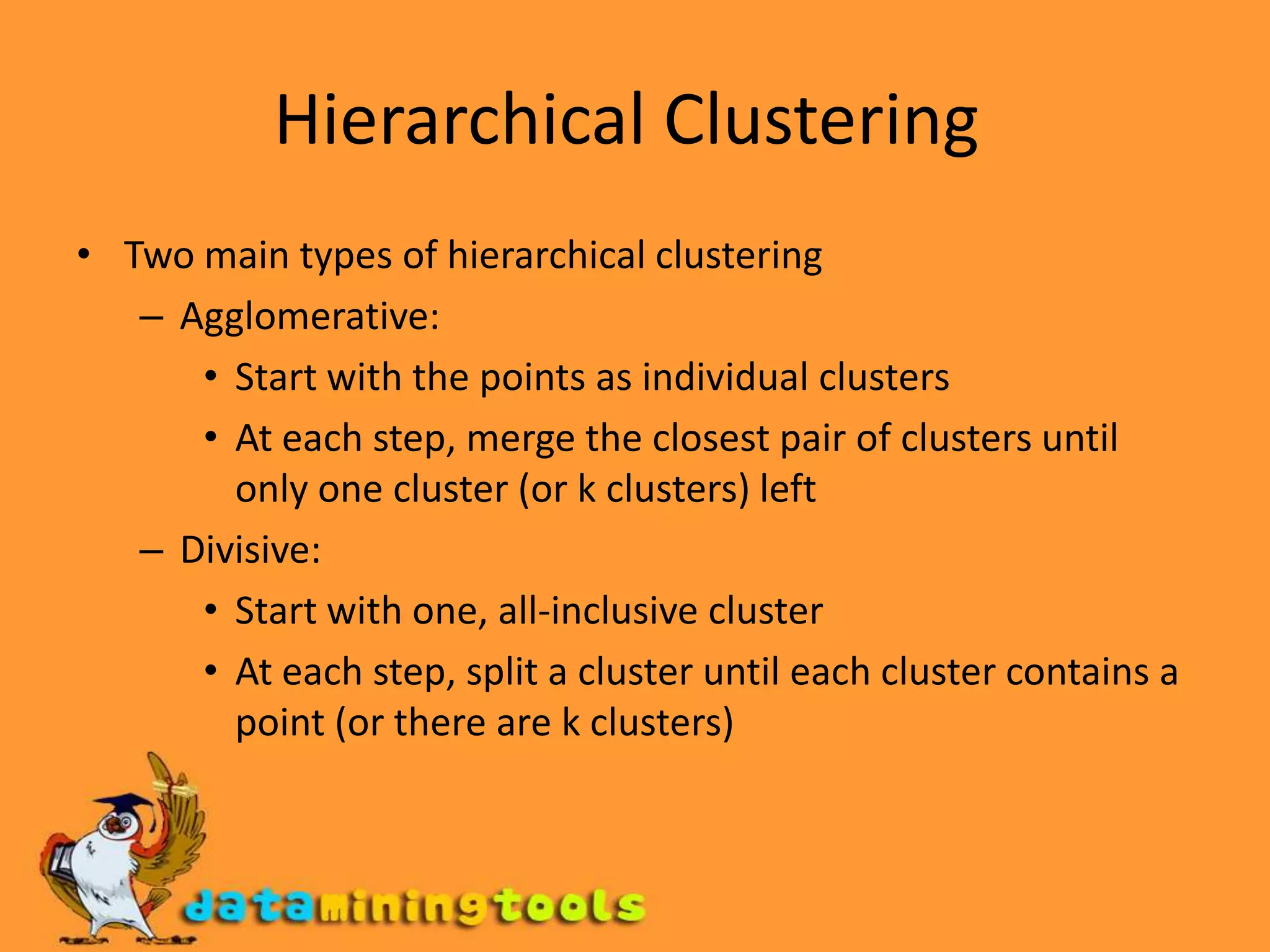
Hierarchical Clustering Two main types of hierarchical clustering Agglomerative: Start with the points as individual clusters At each step, merge the closest pair of clusters until only one cluster (or k clusters) left Divisive: Start with one, all-inclusive cluster At each step, split a cluster until each cluster contains a point (or there are k clusters)
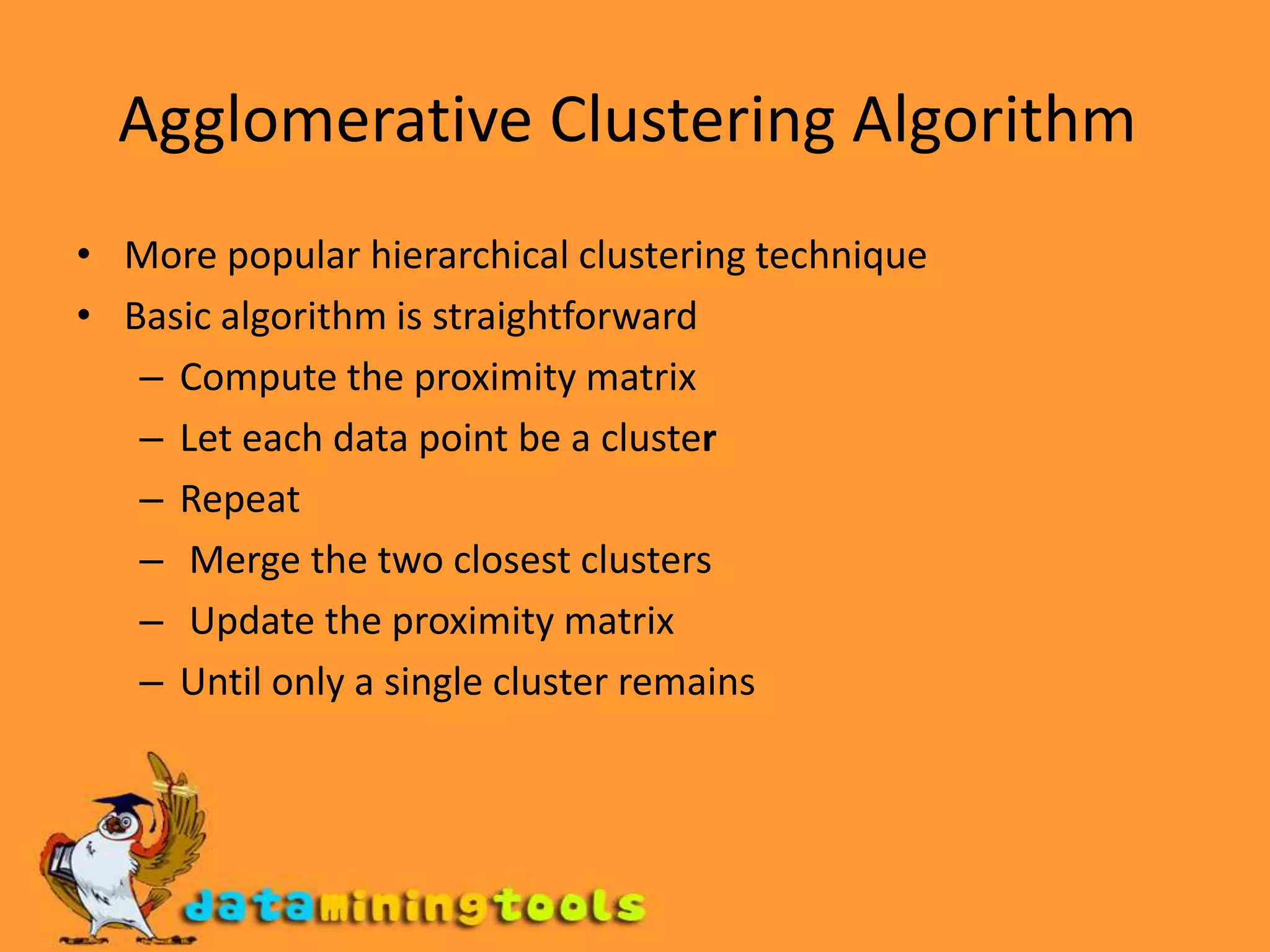
Agglomerative Clustering Algorithm More popular hierarchical clustering technique Basic algorithm is straightforward Compute the proximity matrix Let each data point be a clusterRepeat  Merge the two closest clusters  Update the proximity matrix Until only a single cluster remains
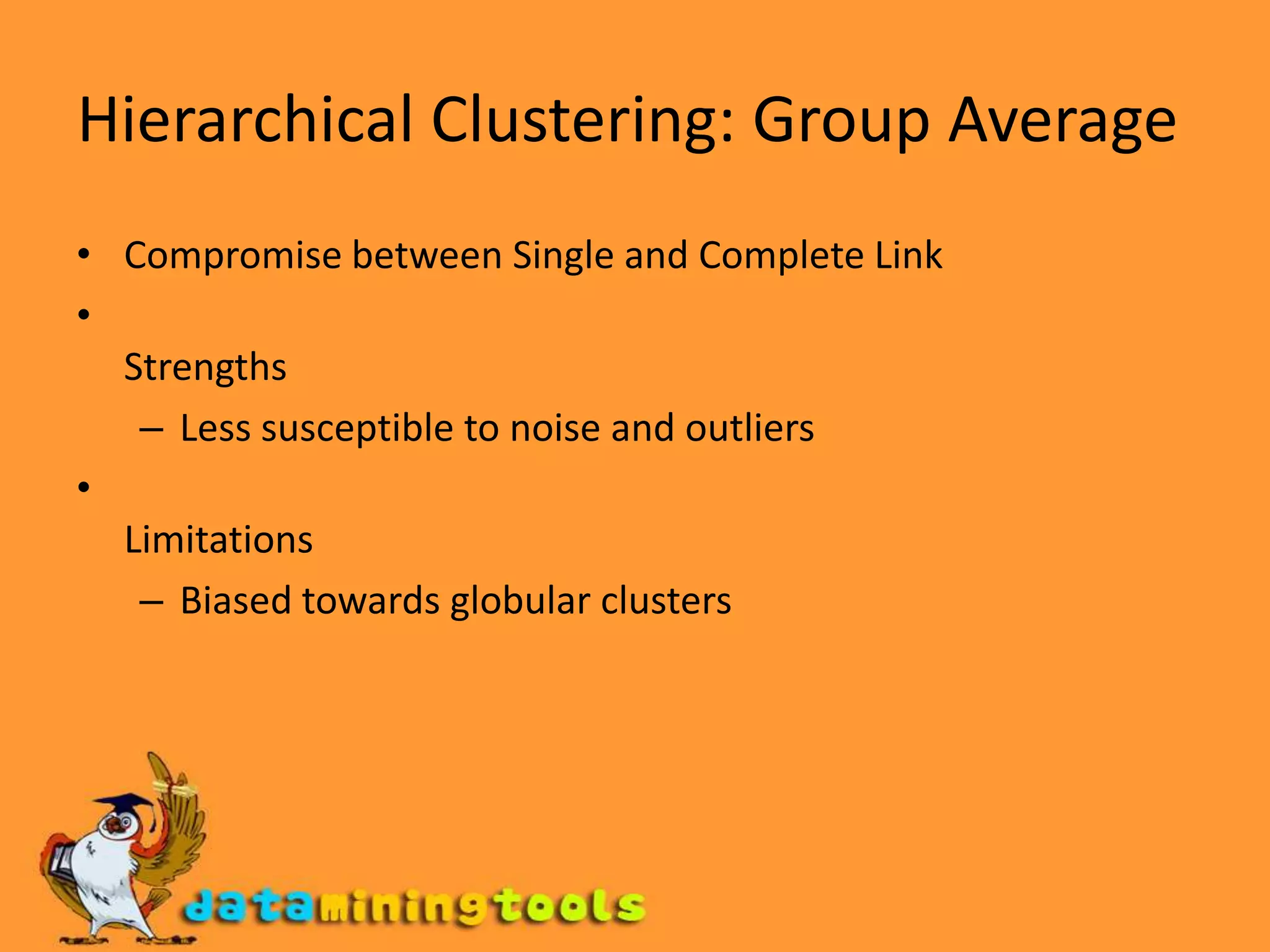
Hierarchical Clustering: Group Average Compromise between Single and Complete Link  Strengths Less susceptible to noise and outliers  Limitations Biased towards globular clusters
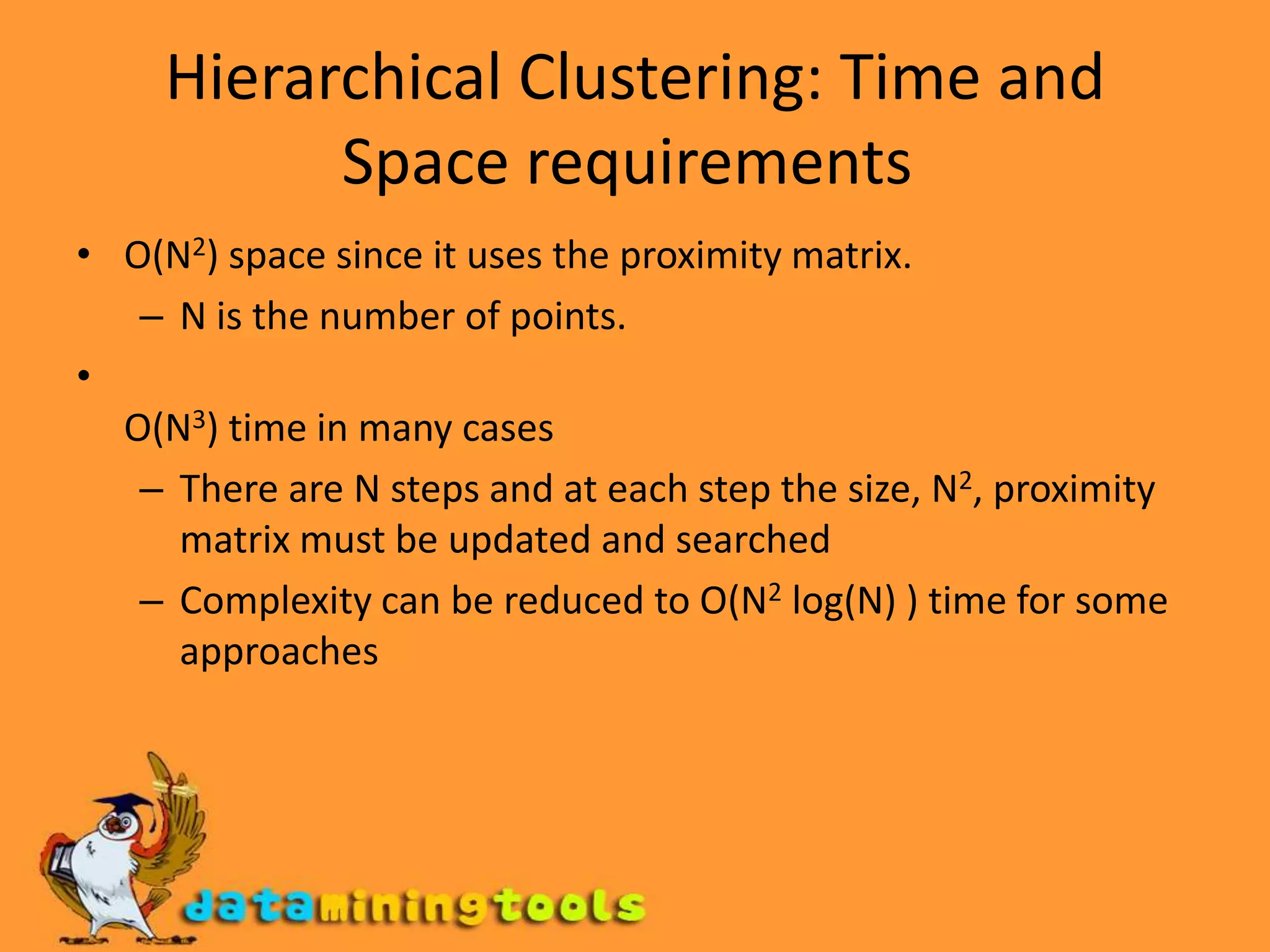
Hierarchical Clustering: Time and Space requirements O(N2) space since it uses the proximity matrix. N is the number of points.  O(N3) time in many cases There are N steps and at each step the size, N2, proximity matrix must be updated and searched Complexity can be reduced to O(N2 log(N) ) time for some approaches
Hierarchical Clustering: Problems and Limitations Once a decision is made to combine two clusters, it cannot be undone No objective function is directly minimized Different schemes have problems with one or more of the following: Sensitivity to noise and outliers (MIN) Difficulty handling different sized clusters and non-convex shapes (Group average, MAX) Breaking large clusters (MAX)
conclusionThe purpose of clustering in data mining and its types are discussed.The k-means and hierarchical algorithm are explained in detail and their pros and cons are analyzed.
Visit more self help tutorialsPick a tutorial of your choice and browse through it at your own pace.The tutorials section is free, self-guiding and will not involve any additional support.Visit us at www.dataminingtools.net

Cluster Analysis

  • 1.
    Cluster Analysis: BasicConcepts and Algorithms
  • 2.
    What is ClusterAnalysis?Finding groups of objects such that the objects in a group will be similar (or related) to one another and different from (or unrelated to) the objects in other groups
  • 3.
    Applications of ClusterAnalysis UnderstandingGroup genes and proteins that have similar functionality, or group stocks with similar price fluctuationsSummarizationReduce the size of large data sets
  • 4.
    Types of Clustering Aclustering is a set of clusters Important distinction between hierarchical and partitional sets of clusters  Partitional Clustering A division data objects into non-overlapping subsets (clusters) such that each data object is in exactly one subset  Hierarchical clustering A set of nested clusters organized as a hierarchical tree
  • 5.
  • 6.
    K-means Clustering Partitional clusteringapproach Each cluster is associated with a centroid (center point) Each point is assigned to the cluster with the closest centroidNumber of clusters, K, must be specified The basic algorithm is very simple
  • 7.
    K-means Clustering –Details Initial centroids are often chosen randomly. Clusters produced vary from one run to another. The centroid is (typically) the mean of the points in the cluster. ‘Closeness’ is measured by Euclidean distance, cosine similarity, correlation, etc. K-means will converge for common similarity measures mentioned above
  • 8.
    K-means Clustering –Details Most of the convergence happens in the first few iterations. Often the stopping condition is changed to ‘Until relatively few points change clusters’ Complexity is O( n * K * I * d ) n = number of points, K = number of clusters,  I = number of iterations, d = number of attributes
  • 9.
    Two different K-meansClusterings Sub-optimal Clustering Optimal Clustering 
  • 10.
    Problems with SelectingInitial Points If there are K ‘real’ clusters then the chance of selecting one centroid from each cluster is small. Chance is relatively small when K is large If clusters are the same size, n, then For example, if K = 10, then probability = 10!/1010 = 0.00036 Sometimes the initial centroids will readjust themselves in ‘right’ way, and sometimes they don’t Consider an example of five pairs of clusters
  • 11.
    Solutions to InitialCentroids ProblemMultiple runs Helps, but probability is not on your side  Sample and use hierarchical clustering to determine initial centroids Select more than k initial centroids and then select among these initial centroidsSelect most widely separated  Bisecting K-means Not as susceptible to initialization issues
  • 12.
    Evaluating K-means Clusters Mostcommon measure is Sum of Squared Error (SSE) For each point, the error is the distance to the nearest cluster To get SSE, we square these errors and sum them.  x is a data point in cluster Ciand mi is the representative point for cluster Cican show that micorresponds to the center (mean) of the cluster
  • 13.
    Evaluating K-means Clusters Giventwo clusters, we can choose the one with the smaller error One easy way to reduce SSE is to increase K, the number of clusters A good clustering with smaller K can have a lower SSE than a poor clustering with higher K
  • 14.
    Limitations of K-means K-meanshas problems when clusters are of differing Sizes Densities Non-globular shapes  K-means has problems when the data contains outliers.  The number of clusters (K) is difficult to determine.
  • 15.
    Hierarchical Clustering  Producesa set of nested clusters organized as a hierarchical tree Can be visualized as a dendrogramA tree like diagram that records the sequences of merges or splits
  • 16.
    Strengths of HierarchicalClustering Do not have to assume any particular number of clusters Any desired number of clusters can be obtained by ‘cutting’ the dendogram at the proper level  They may correspond to meaningful taxonomies Example in biological sciences (e.g., animal kingdom, phylogeny reconstruction, …)
  • 17.
    Hierarchical Clustering Two maintypes of hierarchical clustering Agglomerative: Start with the points as individual clusters At each step, merge the closest pair of clusters until only one cluster (or k clusters) left Divisive: Start with one, all-inclusive cluster At each step, split a cluster until each cluster contains a point (or there are k clusters)
  • 18.
    Agglomerative Clustering Algorithm Morepopular hierarchical clustering technique Basic algorithm is straightforward Compute the proximity matrix Let each data point be a clusterRepeat  Merge the two closest clusters  Update the proximity matrix Until only a single cluster remains
  • 19.
    Hierarchical Clustering: GroupAverage Compromise between Single and Complete Link  Strengths Less susceptible to noise and outliers  Limitations Biased towards globular clusters
  • 20.
    Hierarchical Clustering: Timeand Space requirements O(N2) space since it uses the proximity matrix. N is the number of points.  O(N3) time in many cases There are N steps and at each step the size, N2, proximity matrix must be updated and searched Complexity can be reduced to O(N2 log(N) ) time for some approaches
  • 21.
    Hierarchical Clustering: Problemsand Limitations Once a decision is made to combine two clusters, it cannot be undone No objective function is directly minimized Different schemes have problems with one or more of the following: Sensitivity to noise and outliers (MIN) Difficulty handling different sized clusters and non-convex shapes (Group average, MAX) Breaking large clusters (MAX)
  • 22.
    conclusionThe purpose ofclustering in data mining and its types are discussed.The k-means and hierarchical algorithm are explained in detail and their pros and cons are analyzed.
  • 23.
    Visit more selfhelp tutorialsPick a tutorial of your choice and browse through it at your own pace.The tutorials section is free, self-guiding and will not involve any additional support.Visit us at www.dataminingtools.net