Understanding
Pre-Clinical and Clinical
Trials
Presented By:
Mirza Danish Hussain Barlas (Pharm-D , R.Ph, MBA)
Disclaimer
The information within
this presentation is based on the
References, the Presenter's Interest and
Experience.
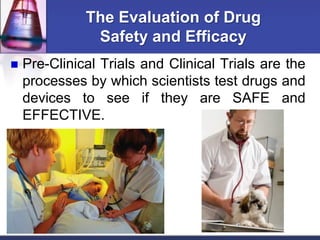
 Pre-Clinical Trials and Clinical Trials are the
processes by which scientists test drugs and
devices to see if they are SAFE and
EFFECTIVE.
The Evaluation of Drug
Safety and Efficacy
The Evaluation of Drug Safety
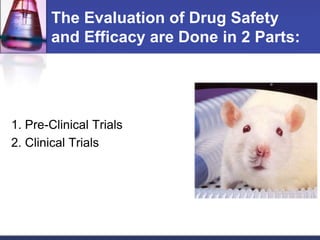
and Efficacy are Done in 2 Parts:
1. Pre-Clinical Trials
2. Clinical Trials
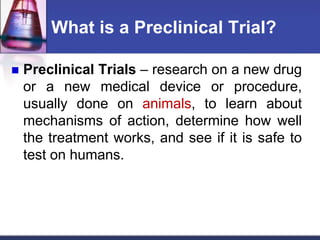
What is a Preclinical Trial?
 Preclinical Trials – research on a new drug
or a new medical device or procedure,
usually done on animals, to learn about
mechanisms of action, determine how well
the treatment works, and see if it is safe to
test on humans.
There are two types of Research:
Basic and Applied
Basic Research: discovering new facts about how things work, how they are
made, or what causes a biological event to occur. Basic research can explore
a topic, explain a topic or describe a topic.
For Example: A researcher discovered that genes can be turned off or on by
small RNA molecules in the body. This study was conducted on worms. It led
to the Nobel Prize in 2006.
“Basic” vs. “Applied”
Research
Applied Research: Taking the information discovered
in basic research and investigating how to use it to
treat and prevent sicknesses.
Example: A researcher uses the information about
turning genes off and on to find a drug that is used to
turn off genes that cause diseases and disorders in
humans.
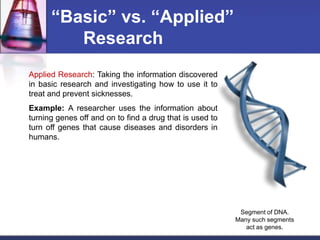
Segment of DNA.
Many such segments
act as genes.
Drug Discovery
In general Drug Discovery is brought about by the
following approaches:
1. Random Screening
2. Molecular Manipulation
3. Molecular Designing
4. Drug Metabolites
5. Serendipity
The main focus however lies on the
Identification a Drug Target-Receptor.
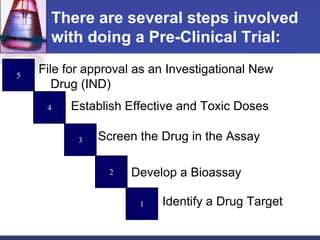
There are several steps involved
with doing a Pre-Clinical Trial:
File for approval as an Investigational New
Drug (IND)
5
4
3
2
1
Establish Effective and Toxic Doses
Screen the Drug in the Assay
Develop a Bioassay
Identify a Drug Target
Steps in Doing a
Pre-Clinical Trial:
 Drugs usually act on either cellular or genetic
chemicals in the body, known as targets,
which are believed to be associated with disease.
 Scientists use a variety of techniques to identify
and isolate individual targets to learn more about
their functions and how they influence disease.
 Compounds are then identified that have various
interactions with the drug targets that might be
helpful in treatment of a specific disease.
Step One: Get an idea for a
drug target.
Step Two: Develop a Bioassay
A Bioassay is a “live” system that can be used to measure drug
effect. "The determination of the relative strength of a substance
(as a drug) by comparing its effect on a test organism with that of a
standard preparation”.
 Bioassays are typically conducted to measure the effects of a
substance on a living organism and are essential in the
development of new drugs. Both are procedures by which the
potency (pharmacology) or the nature of a substance is
estimated by studying its effects on living matter.
 2 Types of Bio Assays:
a. Quantal
b. Graded
Steps in Doing a
Pre-Clinical Trial:
Steps in Doing a
Pre-Clinical Trial:
 Quantal
-A Quantal assay involves an "all or none response". For example: Insulin
induced hypoglycemic convulsive reaction or the cardiac arrest caused by
digitalis. The response is either +ve or -ve, there is no intermediate response
e.g.—either convulsion occurs or doesn't occur; similarly is with cardiac arrest.
(a) Comparison of threshold response
(b) Comparison of (ED50) or (LD50)
 Graded
Graded assays are based on the observation that there is a proportionate
increase in the observed response following an increase in the concentration or
dose. The parameters employed in such bioassays are based on the nature of
the effect the substance is expected to produce. For example: contraction of
smooth muscle preparation for assaying histamine or the study of blood
pressure response in case of adrenaline.
 This is the actual test of the
drug on the chosen bioassay.
 This will determine if the drug
is SAFE and if it is EFFECTIVE
in the bioassay (BEFORE it is
ever tested on humans!)
Steps in Doing a
Pre-Clinical Trial:
Step Three: Screen the
drug in the Bioassay.
 Most drugs have a toxic level or an amount at
which the drug will become
harmful instead of helpful.
Steps in Doing a
Pre-Clinical Trial:
Step Four: Establish what dosage
amount of the drug is safe and what
dosage amount of the drug is toxic.
The IND application must contain information in three broad areas:
 Animal Pharmacology and Toxicology Studies - Preclinical data to
permit an assessment as to whether the product is reasonably safe for
initial testing in humans. Also included are any previous experience with
the drug in humans (often foreign use).
 Manufacturing Information - Information pertaining to the composition,
manufacturer, stability, and controls used for manufacturing the drug
substance and the drug product. This information is assessed to ensure
that the company can adequately produce and supply consistent batches
of the drug.
Steps in Doing a Pre-Clinical Trial:
Investigational New Drug (IND).
Step Five: Application is made to the
Food and Drug Administration (FDA)
as an Investigational New Drug (IND).
Investigational New Drug (IND).
 Clinical Protocols and Investigator Information - Detailed protocols
for proposed clinical studies to assess whether the initial-phase trials
will expose subjects to unnecessary risks. Also, information on the
qualifications of clinical investigators--professionals (generally
physicians) who oversee the administration of the experimental
compound--to assess whether they are qualified to fulfill their clinical
trial duties. Finally, commitments to obtain informed consent from the
research subjects, to obtain review of the study by an institutional
review board (IRB), and to adhere to the investigational new drug
regulations.
 Once the IND is submitted, the sponsor must wait 30 calendar
days before initiating any clinical trials.
 During this time, FDA has an opportunity to review the IND for safety to
assure that research subjects will not be subjected to unreasonable
risk.
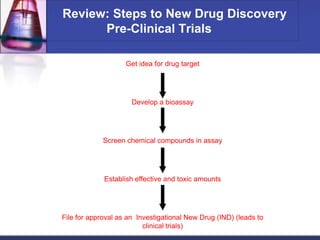
Review: Steps to New Drug Discovery
Pre-Clinical Trials
Get idea for drug target
Develop a bioassay
`
Screen chemical compounds in assay
Establish effective and toxic amounts
File for approval as an Investigational New Drug (IND) (leads to
clinical trials)
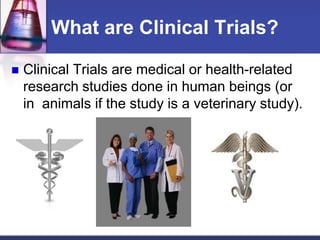
What are Clinical Trials?
 Clinical Trials are medical or health-related
research studies done in human beings (or
in animals if the study is a veterinary study).
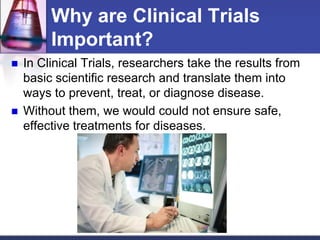
Why are Clinical Trials
Important?
 In Clinical Trials, researchers take the results from
basic scientific research and translate them into
ways to prevent, treat, or diagnose disease.
 Without them, we would could not ensure safe,
effective treatments for diseases.
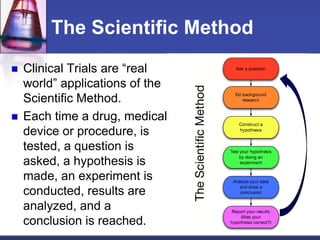
The Scientific Method
 Clinical Trials are “real
world” applications of the
Scientific Method.
 Each time a drug, medical
device or procedure, is
tested, a question is
asked, a hypothesis is
made, an experiment is
conducted, results are
analyzed, and a
conclusion is reached.
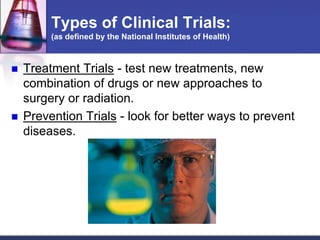
Types of Clinical Trials:
(as defined by the National Institutes of Health)
 Treatment Trials - test new treatments, new
combination of drugs or new approaches to
surgery or radiation.
 Prevention Trials - look for better ways to prevent
diseases.
Types of Clinical Trials:
 Diagnostic Trials - determine
better tests or procedures for
diagnosing a particular disease
or condition.
 Screening Trials - test the best
way to detect or treat diseases.
 Quality of Life Trials - explore
and measure ways to improve
the comfort and quality of life of
people with a chronic illness.
Sponsors
 Clinical trials are usually
sponsored or funded by
companies that make
pharmaceuticals or medical
devices.
 Trials can occur at sites as
varied as hospitals,
universities, doctors’ offices,
community clinics, or in the
offices of clinical-trial
contractors.
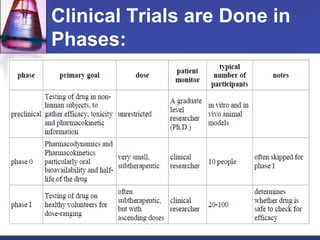
Clinical Trials are Done in
Phases:
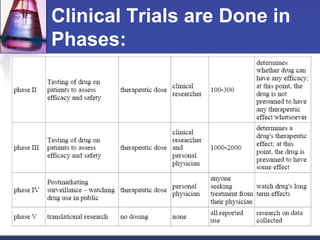
Clinical Trials are Done in
Phases:
Clinical Trials are Done in
Phases:
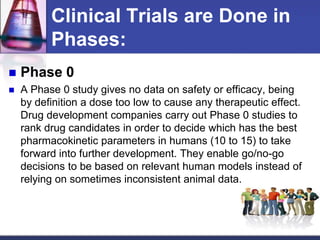
 Phase 0
 A Phase 0 study gives no data on safety or efficacy, being
by definition a dose too low to cause any therapeutic effect.
Drug development companies carry out Phase 0 studies to
rank drug candidates in order to decide which has the best
pharmacokinetic parameters in humans (10 to 15) to take
forward into further development. They enable go/no-go
decisions to be based on relevant human models instead of
relying on sometimes inconsistent animal data.
Clinical Trials are Done in
Phases:
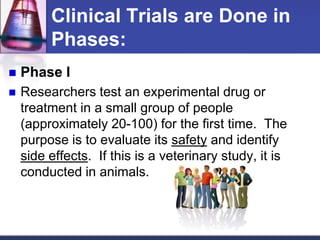
 Phase I
 Researchers test an experimental drug or
treatment in a small group of people
(approximately 20-100) for the first time. The
purpose is to evaluate its safety and identify
side effects. If this is a veterinary study, it is
conducted in animals.
Phases of Clinical Trials:
 Phase II
 The experimental drug or treatment is
administered to a larger group of
people/animals (approximately100-300) to
determine its effectiveness and to further
evaluate its safety.
Phases of Clinical Trials:
 Phase III
 The experimental drug or treatment is administered to
a large group of people/animals (300-3,000 or more)
to confirm its effectiveness, monitor side effects, and
compare it with standard or equivalent treatments.
Research Concepts
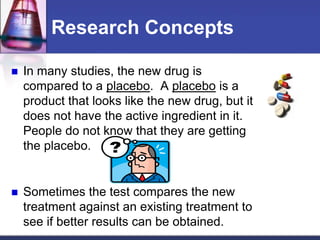
 In many studies, the new drug is
compared to a placebo. A placebo is a
product that looks like the new drug, but it
does not have the active ingredient in it.
People do not know that they are getting
the placebo.
 Sometimes the test compares the new
treatment against an existing treatment to
see if better results can be obtained.
Research Concepts
 Blind and Double Blind Trials are frequently
done.
 A Blind Trial is a trial in which the patients do not
know if they are receiving the treatment or a
placebo.
 A Double Blind Trial is a trial in which the
patients and the researchers do not know who is
receiving the treatment.
 Why would the above be good ideas?
Research Concepts
 Randomization is the process by which patients
are assigned a group for the Clinical Trial.
 Groups are assigned randomly, not purposefully.
 Some people will receive the new treatment, some
may receive an already approved treatment, and
some may receive a placebo.
 If one treatment is found superior, the trial is
stopped so that the fewest patients possible
receive the less beneficial treatment.
New Drug Application (NDA)
 The New Drug Application (NDA) is the vehicle in the United States
through which drug sponsors formally propose that the Food and Drug
Administration (FDA) approve a new pharmaceutical for sale and
marketing. The goals of the NDA are to provide enough information to
permit FDA reviewers to establish the following:
 Is the drug safe and effective in its proposed use(s) when used as
directed, and do the benefits of the drug outweigh the risks?
 Is the drug’s proposed labeling (package insert) appropriate, and what
should it contain?
 Are the methods used in manufacturing (Good Manufacturing Practice,
GMP) the drug and the controls used to maintain the drug’s quality
adequate to preserve the drug’s identity, strength, quality, and purity?
Approval must be gained:
 Once a drug has proven satisfactory after Phase III trials,
the trial results are usually combined into a large document
containing a comprehensive description of the methods
and results of human and animal studies, manufacturing
procedures, formulation details, and shelf life.
 This collection of information makes up the "regulatory
submission" that is provided for review to the appropriate
regulatory authorities like the U.S. Food And Drug
Administration (FDA) so they can then grant the sponsor
approval to market the drug, device or treatment.
The Results!
 For approximately every 5,000 to 10,000
compounds that enter preclinical testing, only
one is approved for marketing.
 Cost of the failures has to be borne by the
price of the one success.
Phases of Clinical Trials:
 Phase IV
 After a drug is licensed (approved by the FDA) or treatment
is launched, researchers track its safety, seeking more
information about a drug or treatment’s risks, benefits, and
optimal use. These long-term studies involve large groups
of participants and are designed to reveal if any unexpected
side effects occur in a small percentage of individuals.
Sep 2015
Phases of Clinical Trials:
 Phase V
 Is a growing term used in the literature of
translational research to refer to comparative
effectiveness research and community-based
research; it is used to signify the integration of a
new clinical treatment into widespread public
health practice.
May 2014
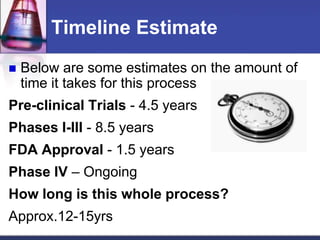
Timeline Estimate
 Below are some estimates on the amount of
time it takes for this process
Pre-clinical Trials - 4.5 years
Phases I-III - 8.5 years
FDA Approval - 1.5 years
Phase IV – Ongoing
How long is this whole process?
Approx.12-15yrs
Costs
 On average, pharmaceutical
companies are spending anywhere
between $100 (100x96=9600PKR)
and $800 (800x96=76800PKR)
million per each drug tested!
 Spending on clinical trials in the
U.S. is forecasted to rise to $32
(32x96=3072PKR) billion.
References
Information from this presentation comes from:
 http:clinicalresearch.nih.gov/how.html
 http://clinicaltrials.gov/ct2/info/understand
 http://www.dddmag.com/the-cost-of-clinical-trials.aspx
 http://www.fda.gov
 http://www.fda.gov/downloads/AboutFDA/ReportsManualsForm
s/Forms/UCM082348.pdf

Clinical Trials

  • 1.
    Understanding Pre-Clinical and Clinical Trials PresentedBy: Mirza Danish Hussain Barlas (Pharm-D , R.Ph, MBA)
  • 2.
    Disclaimer The information within thispresentation is based on the References, the Presenter's Interest and Experience.
  • 3.
     Pre-Clinical Trialsand Clinical Trials are the processes by which scientists test drugs and devices to see if they are SAFE and EFFECTIVE. The Evaluation of Drug Safety and Efficacy
  • 4.
    The Evaluation ofDrug Safety and Efficacy are Done in 2 Parts: 1. Pre-Clinical Trials 2. Clinical Trials
  • 5.
    What is aPreclinical Trial?  Preclinical Trials – research on a new drug or a new medical device or procedure, usually done on animals, to learn about mechanisms of action, determine how well the treatment works, and see if it is safe to test on humans.
  • 6.
    There are twotypes of Research: Basic and Applied Basic Research: discovering new facts about how things work, how they are made, or what causes a biological event to occur. Basic research can explore a topic, explain a topic or describe a topic. For Example: A researcher discovered that genes can be turned off or on by small RNA molecules in the body. This study was conducted on worms. It led to the Nobel Prize in 2006.
  • 7.
    “Basic” vs. “Applied” Research AppliedResearch: Taking the information discovered in basic research and investigating how to use it to treat and prevent sicknesses. Example: A researcher uses the information about turning genes off and on to find a drug that is used to turn off genes that cause diseases and disorders in humans. Segment of DNA. Many such segments act as genes.
  • 8.
    Drug Discovery In generalDrug Discovery is brought about by the following approaches: 1. Random Screening 2. Molecular Manipulation 3. Molecular Designing 4. Drug Metabolites 5. Serendipity The main focus however lies on the Identification a Drug Target-Receptor.
  • 9.
    There are severalsteps involved with doing a Pre-Clinical Trial: File for approval as an Investigational New Drug (IND) 5 4 3 2 1 Establish Effective and Toxic Doses Screen the Drug in the Assay Develop a Bioassay Identify a Drug Target
  • 10.
    Steps in Doinga Pre-Clinical Trial:  Drugs usually act on either cellular or genetic chemicals in the body, known as targets, which are believed to be associated with disease.  Scientists use a variety of techniques to identify and isolate individual targets to learn more about their functions and how they influence disease.  Compounds are then identified that have various interactions with the drug targets that might be helpful in treatment of a specific disease. Step One: Get an idea for a drug target.
  • 11.
    Step Two: Developa Bioassay A Bioassay is a “live” system that can be used to measure drug effect. "The determination of the relative strength of a substance (as a drug) by comparing its effect on a test organism with that of a standard preparation”.  Bioassays are typically conducted to measure the effects of a substance on a living organism and are essential in the development of new drugs. Both are procedures by which the potency (pharmacology) or the nature of a substance is estimated by studying its effects on living matter.  2 Types of Bio Assays: a. Quantal b. Graded Steps in Doing a Pre-Clinical Trial:
  • 12.
    Steps in Doinga Pre-Clinical Trial:  Quantal -A Quantal assay involves an "all or none response". For example: Insulin induced hypoglycemic convulsive reaction or the cardiac arrest caused by digitalis. The response is either +ve or -ve, there is no intermediate response e.g.—either convulsion occurs or doesn't occur; similarly is with cardiac arrest. (a) Comparison of threshold response (b) Comparison of (ED50) or (LD50)  Graded Graded assays are based on the observation that there is a proportionate increase in the observed response following an increase in the concentration or dose. The parameters employed in such bioassays are based on the nature of the effect the substance is expected to produce. For example: contraction of smooth muscle preparation for assaying histamine or the study of blood pressure response in case of adrenaline.
  • 13.
     This isthe actual test of the drug on the chosen bioassay.  This will determine if the drug is SAFE and if it is EFFECTIVE in the bioassay (BEFORE it is ever tested on humans!) Steps in Doing a Pre-Clinical Trial: Step Three: Screen the drug in the Bioassay.
  • 14.
     Most drugshave a toxic level or an amount at which the drug will become harmful instead of helpful. Steps in Doing a Pre-Clinical Trial: Step Four: Establish what dosage amount of the drug is safe and what dosage amount of the drug is toxic.
  • 15.
    The IND applicationmust contain information in three broad areas:  Animal Pharmacology and Toxicology Studies - Preclinical data to permit an assessment as to whether the product is reasonably safe for initial testing in humans. Also included are any previous experience with the drug in humans (often foreign use).  Manufacturing Information - Information pertaining to the composition, manufacturer, stability, and controls used for manufacturing the drug substance and the drug product. This information is assessed to ensure that the company can adequately produce and supply consistent batches of the drug. Steps in Doing a Pre-Clinical Trial: Investigational New Drug (IND). Step Five: Application is made to the Food and Drug Administration (FDA) as an Investigational New Drug (IND).
  • 16.
    Investigational New Drug(IND).  Clinical Protocols and Investigator Information - Detailed protocols for proposed clinical studies to assess whether the initial-phase trials will expose subjects to unnecessary risks. Also, information on the qualifications of clinical investigators--professionals (generally physicians) who oversee the administration of the experimental compound--to assess whether they are qualified to fulfill their clinical trial duties. Finally, commitments to obtain informed consent from the research subjects, to obtain review of the study by an institutional review board (IRB), and to adhere to the investigational new drug regulations.  Once the IND is submitted, the sponsor must wait 30 calendar days before initiating any clinical trials.  During this time, FDA has an opportunity to review the IND for safety to assure that research subjects will not be subjected to unreasonable risk.
  • 17.
    Review: Steps toNew Drug Discovery Pre-Clinical Trials Get idea for drug target Develop a bioassay ` Screen chemical compounds in assay Establish effective and toxic amounts File for approval as an Investigational New Drug (IND) (leads to clinical trials)
  • 18.
    What are ClinicalTrials?  Clinical Trials are medical or health-related research studies done in human beings (or in animals if the study is a veterinary study).
  • 19.
    Why are ClinicalTrials Important?  In Clinical Trials, researchers take the results from basic scientific research and translate them into ways to prevent, treat, or diagnose disease.  Without them, we would could not ensure safe, effective treatments for diseases.
  • 20.
    The Scientific Method Clinical Trials are “real world” applications of the Scientific Method.  Each time a drug, medical device or procedure, is tested, a question is asked, a hypothesis is made, an experiment is conducted, results are analyzed, and a conclusion is reached.
  • 21.
    Types of ClinicalTrials: (as defined by the National Institutes of Health)  Treatment Trials - test new treatments, new combination of drugs or new approaches to surgery or radiation.  Prevention Trials - look for better ways to prevent diseases.
  • 22.
    Types of ClinicalTrials:  Diagnostic Trials - determine better tests or procedures for diagnosing a particular disease or condition.  Screening Trials - test the best way to detect or treat diseases.  Quality of Life Trials - explore and measure ways to improve the comfort and quality of life of people with a chronic illness.
  • 23.
    Sponsors  Clinical trialsare usually sponsored or funded by companies that make pharmaceuticals or medical devices.  Trials can occur at sites as varied as hospitals, universities, doctors’ offices, community clinics, or in the offices of clinical-trial contractors.
  • 24.
    Clinical Trials areDone in Phases:
  • 25.
    Clinical Trials areDone in Phases:
  • 26.
    Clinical Trials areDone in Phases:  Phase 0  A Phase 0 study gives no data on safety or efficacy, being by definition a dose too low to cause any therapeutic effect. Drug development companies carry out Phase 0 studies to rank drug candidates in order to decide which has the best pharmacokinetic parameters in humans (10 to 15) to take forward into further development. They enable go/no-go decisions to be based on relevant human models instead of relying on sometimes inconsistent animal data.
  • 27.
    Clinical Trials areDone in Phases:  Phase I  Researchers test an experimental drug or treatment in a small group of people (approximately 20-100) for the first time. The purpose is to evaluate its safety and identify side effects. If this is a veterinary study, it is conducted in animals.
  • 28.
    Phases of ClinicalTrials:  Phase II  The experimental drug or treatment is administered to a larger group of people/animals (approximately100-300) to determine its effectiveness and to further evaluate its safety.
  • 29.
    Phases of ClinicalTrials:  Phase III  The experimental drug or treatment is administered to a large group of people/animals (300-3,000 or more) to confirm its effectiveness, monitor side effects, and compare it with standard or equivalent treatments.
  • 30.
    Research Concepts  Inmany studies, the new drug is compared to a placebo. A placebo is a product that looks like the new drug, but it does not have the active ingredient in it. People do not know that they are getting the placebo.  Sometimes the test compares the new treatment against an existing treatment to see if better results can be obtained.
  • 31.
    Research Concepts  Blindand Double Blind Trials are frequently done.  A Blind Trial is a trial in which the patients do not know if they are receiving the treatment or a placebo.  A Double Blind Trial is a trial in which the patients and the researchers do not know who is receiving the treatment.  Why would the above be good ideas?
  • 32.
    Research Concepts  Randomizationis the process by which patients are assigned a group for the Clinical Trial.  Groups are assigned randomly, not purposefully.  Some people will receive the new treatment, some may receive an already approved treatment, and some may receive a placebo.  If one treatment is found superior, the trial is stopped so that the fewest patients possible receive the less beneficial treatment.
  • 33.
    New Drug Application(NDA)  The New Drug Application (NDA) is the vehicle in the United States through which drug sponsors formally propose that the Food and Drug Administration (FDA) approve a new pharmaceutical for sale and marketing. The goals of the NDA are to provide enough information to permit FDA reviewers to establish the following:  Is the drug safe and effective in its proposed use(s) when used as directed, and do the benefits of the drug outweigh the risks?  Is the drug’s proposed labeling (package insert) appropriate, and what should it contain?  Are the methods used in manufacturing (Good Manufacturing Practice, GMP) the drug and the controls used to maintain the drug’s quality adequate to preserve the drug’s identity, strength, quality, and purity?
  • 34.
    Approval must begained:  Once a drug has proven satisfactory after Phase III trials, the trial results are usually combined into a large document containing a comprehensive description of the methods and results of human and animal studies, manufacturing procedures, formulation details, and shelf life.  This collection of information makes up the "regulatory submission" that is provided for review to the appropriate regulatory authorities like the U.S. Food And Drug Administration (FDA) so they can then grant the sponsor approval to market the drug, device or treatment.
  • 35.
    The Results!  Forapproximately every 5,000 to 10,000 compounds that enter preclinical testing, only one is approved for marketing.  Cost of the failures has to be borne by the price of the one success.
  • 36.
    Phases of ClinicalTrials:  Phase IV  After a drug is licensed (approved by the FDA) or treatment is launched, researchers track its safety, seeking more information about a drug or treatment’s risks, benefits, and optimal use. These long-term studies involve large groups of participants and are designed to reveal if any unexpected side effects occur in a small percentage of individuals. Sep 2015
  • 37.
    Phases of ClinicalTrials:  Phase V  Is a growing term used in the literature of translational research to refer to comparative effectiveness research and community-based research; it is used to signify the integration of a new clinical treatment into widespread public health practice. May 2014
  • 38.
    Timeline Estimate  Beloware some estimates on the amount of time it takes for this process Pre-clinical Trials - 4.5 years Phases I-III - 8.5 years FDA Approval - 1.5 years Phase IV – Ongoing How long is this whole process? Approx.12-15yrs
  • 39.
    Costs  On average,pharmaceutical companies are spending anywhere between $100 (100x96=9600PKR) and $800 (800x96=76800PKR) million per each drug tested!  Spending on clinical trials in the U.S. is forecasted to rise to $32 (32x96=3072PKR) billion.
  • 40.
    References Information from thispresentation comes from:  http:clinicalresearch.nih.gov/how.html  http://clinicaltrials.gov/ct2/info/understand  http://www.dddmag.com/the-cost-of-clinical-trials.aspx  http://www.fda.gov  http://www.fda.gov/downloads/AboutFDA/ReportsManualsForm s/Forms/UCM082348.pdf