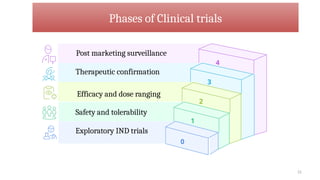
Phases of ClinicalTrials
Dr Revathi Kalthoti
Post Graduate
Department of Pharmacology
2.
Contents
• Introduction
• Definition
•Objectives of Clinical Trials
• Good Clinical Practice
• Investigational New drug (IND) application
• Ethics Committee
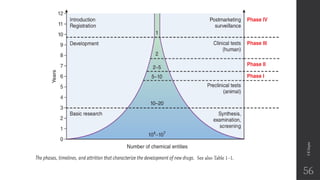
• Phases of Clinical Trials(0,1,2,3,4)
• Summary
2
Introduction
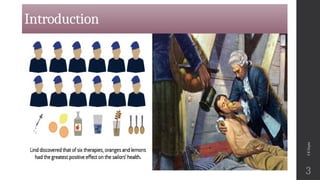
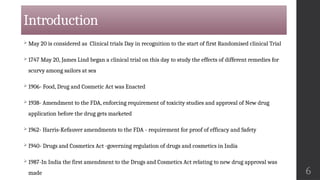
1747- On May20, James Lind began a clinical trial to study the effects of
different remedies for scurvy among sailors at sea
May 20 is considered as Clinical trials Day in recognition to the start of first
Randomised clinical Trial, by James Lind
1906- Food, Drug and Cosmetic Act was Enacted
1938- Amendment to the FDA, enforcing requirement of toxicity studies and
approval of New drug application before the drug gets marketed
4
5.
5
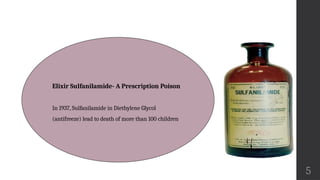
Elixir Sulfanilamide- APrescription Poison
In 1937, Sulfanilamide in Diethylene Glycol
(antifreeze) lead to death of more than 100 children
6.
Introduction
May 20is considered as Clinical trials Day in recognition to the start of first Randomised clinical Trial
1747 May 20, James Lind began a clinical trial on this day to study the effects of different remedies for
scurvy among sailors at sea
1906- Food, Drug and Cosmetic Act was Enacted
1938- Amendment to the FDA, enforcing requirement of toxicity studies and approval of New drug
application before the drug gets marketed
1962- Harris-Kefauver amendments to the FDA - requirement for proof of efficacy and Safety
I940- Drugs and Cosmetics Act -governing regulation of drugs and cosmetics in India
1987-In India the first amendment to the Drugs and Cosmetics Act relating to new drug approval was
made 6
7.
According to WHO:
“AClinical trial is any research study that prospectively
assigns human participation or groups of humans to one
or more health- related interventions to evaluate the
effects on health out comes”
WHO, International clinical trial registry Platform
7
Clinical trial- Definition
8.
Clinical trial
It isa systematic study of a new drug or investigational new drug (IND) in human
participants to generate data for discovering or verifying its, -
(i) Clinical effects
(ii) Pharmacological effects
(iii) Adverse effects,
Aim: To determine
Safety
Efficacy
Tolerance
8
9.
Objectives
• Clinical trialsare designed to intervene with health related outcomes with
one or more of the following objectives
To diagnose or detect disease
To treat an existing disorder
To prevent disease or early death
To change behaviour, habits or other lifestyle factors
9
10.
Good Clinical Practice(GCP)
The trials should comply with an elaborate code known as “Good Clinical
Practice”(GCP) prescribed by the International Conference on Harmonization
(ICH) and Declaration of Helsinki.
The fundamental principle of Good Clinical Research is to ensure that the
interest of science and society should not take precedence over the
considerations of the human subject participating in the study
10
11.
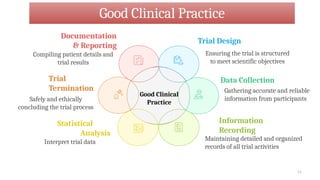
Maintaining detailed andorganized
records of all trial activities
Ensuring the trial is structured
to meet scientific objectives
Compiling patient details and
trial results
Trial Design
Trial
Termination
Data Collection
Good Clinical
Practice
Gathering accurate and reliable
information from participants
Safely and ethically
concluding the trial process
Documentation
& Reporting
Statistical
Analysis
Information
Recording
Interpret trial data
GCP
Good Clinical Practice
11
12.
Investigational New Drug(IND)
Definition:
It is a new chemical or biological entity or substance that has not been approved for
marketing as a drug in any country
IND application:
Once the pre clinical testing is over, the manufacturer need to submit Investigational
New Drug Application to the drug regulatory authority of respective country.
In India it has to get approved from Drug Controller General of India, New Delhi
12
13.
The following datashould be included in IND application:
Preclinical data - to permit an assessment, whether the product is reasonably safe
for initial testing in humans
Manufacturing Information - Composition, manufacturer, stability, and controls
used for manufacturing the drug
Clinical Protocols - Detailed protocols for proposed clinical studies to assess the
potential risks
Investigator Information - qualifications of clinical investigator (generally
physicians) who oversee the administration of the experimental compound
Informed consent documents to be reviewed by the Institutional Review Board
13
14.
Ethical considerations
In India,the ICMR (2006) has brought out ‘Ethical guidelines, for biomedical
research on human participants’
A proper written Informed consent of the patient/trial subject must be obtained
The ethics committee has to ensure that the study does not breach the ethical
principles of:
Autonomy
Beneficence
Non-maleficence
Justice 14
15.
Informed consent
Informed consentshould be voluntary and be signed by the participant after receiving
information, understanding it and discussing with family/friends (if required).
Appropriate ICD should be prepared for differently abled participants.
In case of research involving children, in addition to parental consent, verbal (7-12 years) or
simplified written (>12 – 18 years) assent should also be taken from the participant.
15
16.
Informed consent
The LegallyAuthorized Representative (LAR) consent is required in case a participant is
Incompetent
Incapacitated
A Minor
Unconscious or Cognitively impaired
S
K
Gupta
16
No Observed AdverseEffect Level (NOAEL)
• No observed adverse effect level (NOAEL): The highest dose tested in an animal species
that does not produce a significant increase in adverse effects in comparison to the control
group.
• Adverse effects that are biologically significant, should be considered in determining NOAEL
• There are essentially three types of findings in nonclinical toxicology studies that can be
used to determine the NOAEL:
• (1) Overt toxicity (e.g., clinical signs or gross pathological changes);
• (2) Surrogate markers of toxicity (e.g., elevated serum creatinine levels); and
• (3) Exaggerated pharmacodynamic effects
18
19.
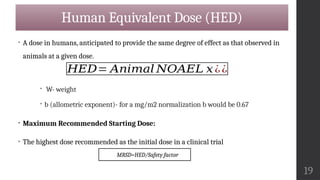
Human Equivalent Dose(HED)
• A dose in humans, anticipated to provide the same degree of effect as that observed in
animals at a given dose.
W- weight
b (allometric exponent)- for a mg/m2 normalization b would be 0.67
• Maximum Recommended Starting Dose:
• The highest dose recommended as the initial dose in a clinical trial
19
𝐻𝐸𝐷= 𝐴𝑛𝑖𝑚𝑎𝑙 𝑁𝑂𝐴𝐸𝐿 𝑥¿¿
MRSD=HED/Safety factor
20.
Randomization
The processby which each participant has the same probability of being included in either of the
two groups (Test or control)
The subjects are allocated to either group using a preselected random number table or
computer programme, so that any subject has equal chance of being assigned to the test or
the control group.
Purpose :
Removes potential allocation bias.
Produce groups that are comparable in terms of prognostic factors, both known and unknown
Ensures that the statistical test used will have valid levels of significance.
•
20
21.
Blinding
This refers toconcealment of the nature of treatment (test or control) from the subject
(single blind) or both the subject as well as the investigator (double blind)
Knowledge of the intervention effects the psychological or physical responses of participants.
Randomized controlled double blind trial (RCT) is the most credible method of obtaining
evidence of efficacy, safety or comparative value of treatments.
21
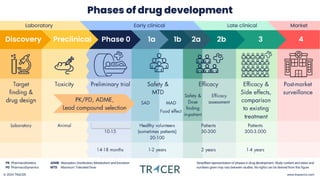
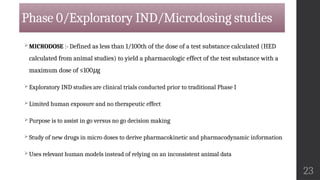
Phase 0/Exploratory IND/Microdosingstudies
MICRODOSE :- Defined as less than 1/100th of the dose of a test substance calculated (HED
calculated from animal studies) to yield a pharmacologic effect of the test substance with a
maximum dose of ≤100 g
𝜇
Exploratory IND studies are clinical trials conducted prior to traditional Phase I
Limited human exposure and no therapeutic effect
Purpose is to assist in go versus no go decision making
Study of new drugs in micro doses to derive pharmacokinetic and pharmacodynamic information
Uses relevant human models instead of relying on an inconsistent animal data
23
24.
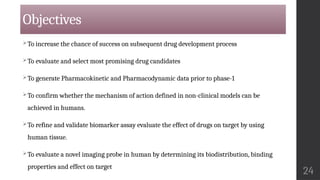
Objectives
To increase thechance of success on subsequent drug development process
To evaluate and select most promising drug candidates
To generate Pharmacokinetic and Pharmacodynamic data prior to phase-1
To confirm whether the mechanism of action defined in non-clinical models can be
achieved in humans.
To refine and validate biomarker assay evaluate the effect of drugs on target by using
human tissue.
To evaluate a novel imaging probe in human by determining its biodistribution, binding
properties and effect on target
24
25.
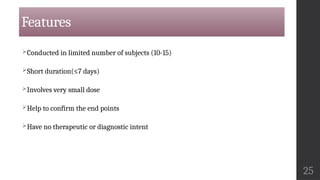
Features
Conducted in limitednumber of subjects (10-15)
Short duration(≤7 days)
Involves very small dose
Help to confirm the end points
Have no therapeutic or diagnostic intent
25
26.
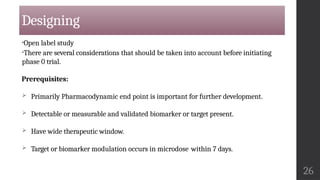
Designing
•Open label study
•Thereare several considerations that should be taken into account before initiating
phase 0 trial.
Prerequisites:
Primarily Pharmacodynamic end point is important for further development.
Detectable or measurable and validated biomarker or target present.
Have wide therapeutic window.
Target or biomarker modulation occurs in microdose within 7 days.
26
27.
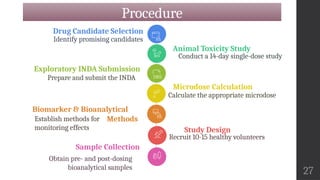
Conduct a 14-daysingle-dose study
Animal Toxicity Study
Exploratory INDA Submission
Prepare and submit the INDA
Identify promising candidates
Microdose Calculation
Calculate the appropriate microdose
Biomarker & Bioanalytical
Methods
Establish methods for
monitoring effects
Drug Candidate Selection
Study Design
Recruit 10-15 healthy volunteers
Sample Collection
Obtain pre- and post-dosing
bioanalytical samples
Procedure
27
28.
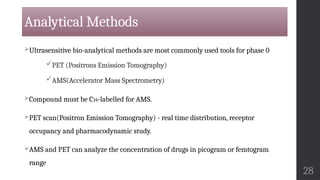
Analytical Methods
Ultrasensitive bio-analyticalmethods are most commonly used tools for phase 0
PET (Positrons Emission Tomography)
AMS(Accelerator Mass Spectrometry)
Compound must be C14-labelled for AMS.
PET scan(Positron Emission Tomography) - real time distribution, receptor
occupancy and pharmacodynamic study.
AMS and PET can analyze the concentration of drugs in picogram or femtogram
range
28
29.
Types of Phase0 studies
Type Primary goal Analytical Method
Microdosing Pharmacokinetic assessment Plasma/tissue drug levels
Imaging Visualize biodistribution PET/AMS imaging data
Pharmacodynamics Biomarker Evaluate target engagement Biomarker modulation
Comparative Pharmacokinetic Compare pharmacokinetics of
related compounds
Pharmacokinetic parameters (like
AUC, Cmax)
Mechanistic Validate mechanism of action Molecular imaging or cellular
response
29
30.
Benefits
Resource Optimization
Reduced PatientRequirements Improved Success Rate
Phase 0
Optimized Starting Doses Go/No-Go Decisions
Expedited Clinical Development Enhanced Study Design
Candidate Selection Tool
Less Preclinical Testing
30
Benefits
31.
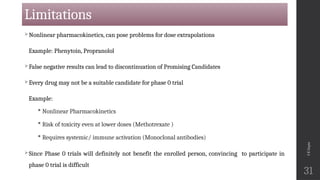
Limitations
Nonlinear pharmacokinetics, canpose problems for dose extrapolations
Example: Phenytoin, Propranolol
False negative results can lead to discontinuation of Promising Candidates
Every drug may not be a suitable candidate for phase 0 trial
Example:
Nonlinear Pharmacokinetics
Risk of toxicity even at lower doses (Methotrexate )
Requires systemic/ immune activation (Monoclonal antibodies)
Since Phase 0 trials will definitely not benefit the enrolled person, convincing to participate in
phase 0 trial is difficult
31
S
K
Gupta
32.
Phase-1
Traditional first stageof drug testing in human beings
To determine appropriate dose range with regard to safety and toxicity
Usually done in healthy volunteers, except in certain conditions like anticancer
therapy, HIV etc
Limited number of subjects (20-100)
Objectives:
Safety and tolerability
Pharmacokinetics
Pharmacodynamics
32
33.
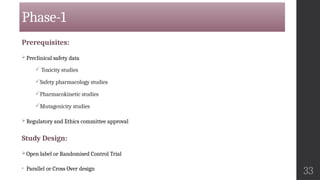
Prerequisites:
Preclinical safetydata
Toxicity studies
Safety pharmacology studies
Pharmacokinetic studies
Mutagenicity studies
Regulatory and Ethics committee approval
Study Design:
Open label or Randomised Control Trial
• Parallel or Cross Over design
33
Phase-1
34.
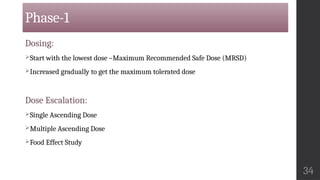
Dosing:
Start with thelowest dose –Maximum Recommended Safe Dose (MRSD)
Increased gradually to get the maximum tolerated dose
Dose Escalation:
Single Ascending Dose
Multiple Ascending Dose
Food Effect Study
34
Phase-1
35.
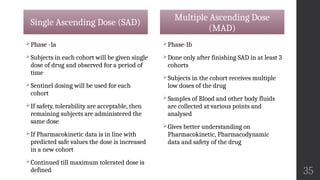
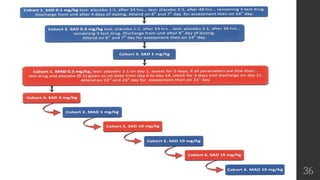
Single Ascending Dose(SAD)
Phase -1a
Subjects in each cohort will be given single
dose of drug and observed for a period of
time
Sentinel dosing will be used for each
cohort
If safety, tolerability are acceptable, then
remaining subjects are administered the
same dose
If Pharmacokinetic data is in line with
predicted safe values the dose is increased
in a new cohort
Continued till maximum tolerated dose is
defined
Multiple Ascending Dose
(MAD)
Phase-1b
Done only after finishing SAD in at least 3
cohorts
Subjects in the cohort receives multiple
low doses of the drug
Samples of Blood and other body fluids
are collected at various points and
analysed
Gives better understanding on
Pharmacokinetic, Pharmacodynamic
data and safety of the drug
35
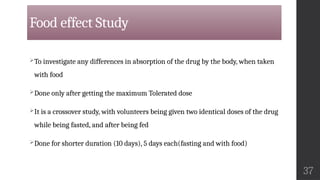
Food effect Study
Toinvestigate any differences in absorption of the drug by the body, when taken
with food
Done only after getting the maximum Tolerated dose
It is a crossover study, with volunteers being given two identical doses of the drug
while being fasted, and after being fed
Done for shorter duration (10 days), 5 days each(fasting and with food)
37
38.
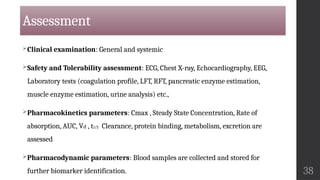
Assessment
Clinical examination: Generaland systemic
Safety and Tolerability assessment: ECG, Chest X-ray, Echocardiography, EEG,
Laboratory tests (coagulation profile, LFT, RFT, pancreatic enzyme estimation,
muscle enzyme estimation, urine analysis) etc.,
Pharmacokinetics parameters: Cmax , Steady State Concentration, Rate of
absorption, AUC, Vd , t1/2 Clearance, protein binding, metabolism, excretion are
assessed
Pharmacodynamic parameters: Blood samples are collected and stored for
further biomarker identification. 38
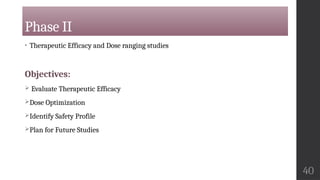
Phase II
• TherapeuticEfficacy and Dose ranging studies
Objectives:
Evaluate Therapeutic Efficacy
Dose Optimization
Identify Safety Profile
Plan for Future Studies
40
41.
Prerequisites:
Preclinical studies
Toxicitystudies
Mutagenicity studies
Pharmacokinetic studies
Phase I trial data
Regulatory authority and Ethical committee approval
41
Phase II
42.
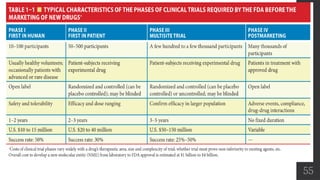
Subjects:
50-300 participants
Subjects arepatient population with confirmed diagnosis
Patients with comorbidities, substance abuse, participants of other clinical trials are
excluded
Study design:
Open label
Randomised and controlled
42
Phase II
43.
Phase IIa
Drug discovery&Clinical Research-S K Gupta
43
Pilot clinical studies
Evaluate efficacy and safety in specific patient populations
Objective:
Focus on dose-response, dosing frequency, and safety/efficacy characteristics.
Decision to proceed or halt is made here.
Study Design:
Open label or
Randomized, single-blinded, placebo-controlled or standard-controlled, parallel
group with a small number of patients
Study Population: upto 200 patients
44.
Advantages:
Fewer patients requiredcompared to Phase IIb.
Study can be terminated early if drug shows poor results.
More cost-effective than Phase IIb.
44
Phase IIa
45.
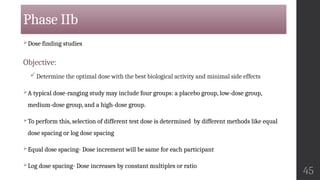
Phase IIb
Dose findingstudies
Objective:
Determine the optimal dose with the best biological activity and minimal side effects
A typical dose-ranging study may include four groups: a placebo group, low-dose group,
medium-dose group, and a high-dose group.
To perform this, selection of different test dose is determined by different methods like equal
dose spacing or log dose spacing
Equal dose spacing- Dose increment will be same for each participant
Log dose spacing- Dose increases by constant multiples or ratio
45
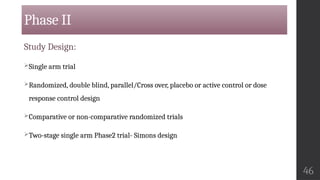
46.
Study Design:
Single armtrial
Randomized, double blind, parallel/Cross over, placebo or active control or dose
response control design
Comparative or non-comparative randomized trials
Two-stage single arm Phase2 trial- Simons design
46
Phase II
47.
Single Arm Trial:
Only eligible patients receive the new intervention.
Primary endpoint assessed at the end of the trial.
Common in oncology or diseases with no cure
Randomized, Double-Blind Trials:
Double-blinded: Both patient and investigator are blinded.
Designs: Parallel/crossover, placebo/ active control, or dose-response control.
Dose-response control: Compares low-dose vs high-dose of investigational product
47
Phase II
48.
Phase II
Comparative vsNon-Comparative Randomized Trials:
Non-comparative randomized trials: Patients are randomized to multiple experimental arms
without a concurrent control arm.
Comparative randomized trials: Compares test drug with standard treatment between two
groups.
Two-Stage Single Arm Phase 2 Trial (Simons Design):
Stage 1: Small group receives test drug. Interim analysis assess primary endpoints to decide
whether to stop, declare ineffectiveness, or continue to Stage 2.
Stage 2: Conclusion is made based on response data. The design minimizes patient exposure to
toxic agents
48
49.
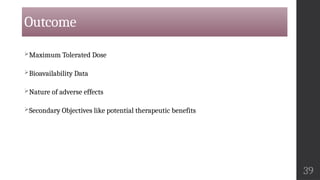
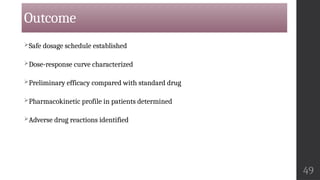
Outcome
Safe dosage scheduleestablished
Dose-response curve characterized
Preliminary efficacy compared with standard drug
Pharmacokinetic profile in patients determined
Adverse drug reactions identified
49
50.
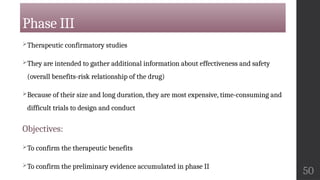
Phase III
Therapeutic confirmatorystudies
They are intended to gather additional information about effectiveness and safety
(overall benefits-risk relationship of the drug)
Because of their size and long duration, they are most expensive, time-consuming and
difficult trials to design and conduct
Objectives:
To confirm the therapeutic benefits
To confirm the preliminary evidence accumulated in phase II
50
51.
Phase III
Secondary Objectives:
Determinethe optimum dosage schedule
Study on special population such as renal and hepatic insufficiency, lactating
women, elderly
Special studies like drug interactions
Study on Health Related Quality of Life and Pharmacoeconomics
Subjects:
Patient population 500-5000 plus with broader inclusion criteria
51
52.
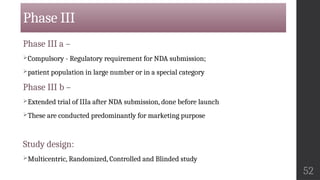
Phase III a–
Compulsory - Regulatory requirement for NDA submission;
patient population in large number or in a special category
Phase III b –
Extended trial of IIIa after NDA submission, done before launch
These are conducted predominantly for marketing purpose
Study design:
Multicentric, Randomized, Controlled and Blinded study
52
Phase III
53.
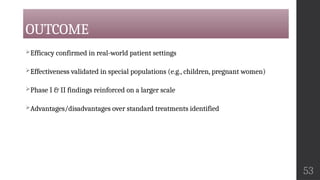
OUTCOME
Efficacy confirmed inreal-world patient settings
Effectiveness validated in special populations (e.g., children, pregnant women)
Phase I & II findings reinforced on a larger scale
Advantages/disadvantages over standard treatments identified
53
54.
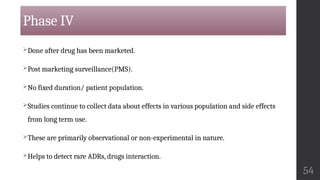
Phase IV
Done afterdrug has been marketed.
Post marketing surveillance(PMS).
No fixed duration/ patient population.
Studies continue to collect data about effects in various population and side effects
from long term use.
These are primarily observational or non-experimental in nature.
Helps to detect rare ADRs, drugs interaction.
54
Summary
S
K
Gupta
57
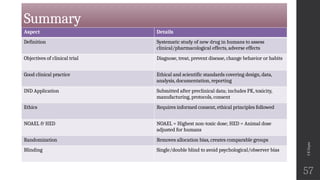
Aspect Details
Definition Systematicstudy of new drug in humans to assess
clinical/pharmacological effects, adverse effects
Objectives of clinical trial Diagnose, treat, prevent disease, change behavior or habits
Good clinical practice Ethical and scientific standards covering design, data,
analysis, documentation, reporting
IND Application Submitted after preclinical data; includes PK, toxicity,
manufacturing, protocols, consent
Ethics Requires informed consent, ethical principles followed
NOAEL & HED NOAEL = Highest non-toxic dose; HED = Animal dose
adjusted for humans
Randomization Removes allocation bias, creates comparable groups
Blinding Single/double blind to avoid psychological/observer bias
58.
Summary
S
K
Gupta
58
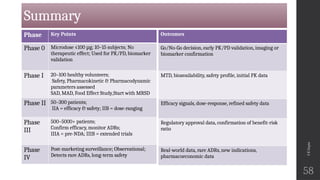
Outcomes
Go/No-Go decision, earlyPK/PD validation, imaging or
biomarker confirmation
MTD, bioavailability, safety profile, initial PK data
Efficacy signals, dose-response, refined safety data
Regulatory approval data, confirmation of benefit-risk
ratio
Real-world data, rare ADRs, new indications,
pharmacoeconomic data
Phase Key Points
Phase 0 Microdose ≤100 g; 10–15 subjects; No
μ
therapeutic effect; Used for PK/PD, biomarker
validation
Phase I 20–100 healthy volunteers;
Safety, Pharmacokinetic & Pharmacodynamic
parameters assessed
SAD, MAD, Food Effect Study,Start with MRSD
Phase II 50–300 patients;
IIA = efficacy & safety; IIB = dose-ranging
Phase
III
500–5000+ patients;
Confirm efficacy, monitor ADRs;
IIIA = pre-NDA; IIIB = extended trials
Phase
IV
Post-marketing surveillance; Observational;
Detects rare ADRs, long-term safety
59.
References
Goodman &Gillman’s- The Pharmacological Basis Of Therapeutics, Fourteenth Edition
Essentials of Medical Pharmacology- 8th Edition-KDT
Post Graduate Pharmacology- Sougata Sarkar, Vartika Srivastav
Drug discovery& Clinical Research-S K Gupta
FDA and Clinical Trials- Small History
FDA-Guidance for Industry, Investigators, and Reviewers Exploratory IND Studies
www.who.int/clinical-trials-registry-platform
CDSCO-Indian GCP guideline_19.08.24 V1-Circular
Gupta UC, Bhatia S, Garg A, Sharma A, Choudhary V. Phase 0 clinical trials in oncology new drug
development. Perspect Clin Res. 2011 Jan;2(1):13-22. doi: 10.4103/2229-3485.76285. PMID:
21584177; PMCID: PMC3088951.
S
K
Gupta
59