Non-Clinical and
Clinical Trials
Presented By :
Samim Ahamad
M. Pharm 1st
Sem.
Enrolment No. : GGV/24/06356
(Pharmaceutics)
Submitted To :
Dr. K. P. Meena
Associate Professor
GURU GHASIDAS VISHWAVIDYALAYA
BILASPUR (C. G.)
Stages of Drug Development
• Discovery
• Preclinical Studies (Non-Clinical Trials)
• Clinical Trials
• Approval and Post-Market Surveillance
Non-Clinical Trials
• Definition: The non-clinical (or pre-clinical) development phase primarily aims to identify which
candidate therapy has the greatest probability of success, assess its safety, and build solid scientific
foundations before transition to the clinical development phase. Also, during the non-clinical
development phase, the candidate compound should meet non-medical objectives. including
defining the intellectual property rights and making enough medicinal product available for clinical
trials. The non-clinical development of a medicine is complex and regulatory-driven.
• Tests on cells, tissues, and animals before human trials.
• Purpose:
• Evaluate safety.
• Understand drug behavior (pharmacokinetics and pharmacodynamics).
Types of Non-Clinical Studies
• 1. In silico: 'performed on computer or via computer
simulation', e.g. predicting the toxicology profile of a product
using its chemical structure from data-based approaches.
• 2. In vitro (Latin for 'within the glass'): performing a
procedure in a controlled environment outside of a living
organism, e.g. use of hepatocyte (cells from the liver) cultures
for metabolism studies.
• 3 In vivo (Latin for 'within the living'): experimentation
using a whole, living organism as opposed to tissues or cells, i.e.
animals, humans or plants.
Importance of Non-Clinical
Trials
• Identify potential risks.
• Ensure ethical consideration for human trials.
• Regulatory approval to proceed to clinical stages.
Clinical Trials
• Introduction: Clinical trial is a systematic investigation in human subjects for
evaluating the safety & efficacy of any new drug.
• Clinical trials are a set of tests in medical research and drug development that
generate safety and efficacy data for health interventions in human beings.
• Clinical trials are conducted only when,
satisfactory information has been gathered on the quality of the nonclinical safety.
health authority/ethics committee approval is granted in the country where approval
of the drug is sought.
• Clinical Trial is the mainstay for bringing out New Drugs to the Market.
Phases of Clinical Trials
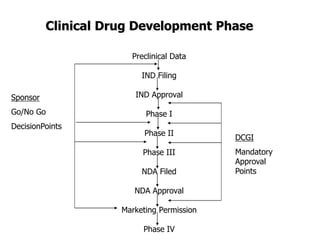
1. Phase 0: Stage of micro dosing.
2. Phase I: Small group; tests safety and dosage.
3. Phase II: Larger group; tests effectiveness and side
effects.
4. Phase III: Large-scale; confirms efficacy and
monitors adverse effects.
5. Phase IV: Post-marketing studies.
Phase 0 study /
Microdosing
• Study of new drug in microdoses to derive
PK information in human before
undertaking phase I studies is called PHASE
0.
• Microdose: Less than 1/100 of the dose of a
test substance calculated to produce
pharmacological effect with a max dose
100 micrograms.
≤
• Objective: To obtain preliminary
Pharmacokinetic data.
Phase I
• First stage of testing in human subjects
• Designed to assess the safety, tolerability, PK and
PD of drug.
• 20-25 healthy volunteers
• Patients: Anticancer drugs, AIDS therapy
• Duration: 6-12 months
Phase II
• Therapeutic Exploratory Trial
• 20-300 Subjects
• To confirm effectiveness, monitor side effects, &
further evaluate safety
• First in patients (who have the disease that the drug
is expected to treat)
• Duration: 6 months to several years.
Phase III
• Therapeutic confirmatory trials.
• Large scale, multicenter, Randomized, Controlled
trials.
• Target population: several 100's to 3000 patients.
• Takes a long time: up to 5 years
• To establish efficacy of the drug against existing
therapy in larger number of patients, method of
usage, & to collect safety data etc.
Phase IV
Done after drug has been marketed
• Post Marketing Surveillance (PMS).
• No fixed duration / patient population
studies continue to collect data about effects in
various populations & side effects from long
term use.
• These are primarily observational or non-
experimental in nature.
Ethical Considerations
• Informed Consent: Voluntary participation.
• Safety Measures: Monitoring side effects.
• Compliance: Follow guidelines by regulatory bodies
(e.g., FDA, EMA).
Conclusion
• - Non-clinical and clinical trials are essential steps in
drug development.
• - Ensure safety, efficacy, and quality of new
treatments.
• - Ethical and regulatory compliance is critical for
success.
References
1. Booth, B & Zemmel, R. Prospects for productivity. Nature
Rev. Drug Discov. 3, 451–456 (2004).
2. Gilbert, J., Henske, P. & Singh, A. Rebuilding big pharma’s
business model. In Vivo 21, 1−4 (2003).
3. Kola, I. & Landis, J. Can the pharmaceutical industry reduce
attrition rates? Nature Rev. Drug Discov. 3, 711–716 (2004).
4. Budget US Govt., App., FY 1993–2003.
5. Parexel’s Pharmaceutical R&D Statistical Sourcebook
2002/2003 (Parexel International, Waltham, USA, 2003).
Non_Clinical_and_Clinical_Trials_Presentation.pptx