The Application of the
 Scientific Method:
  Preclinical Trials
           Copyright 2010. PEER.tamu.edu
What do you think?

   Have you ever had to take a medicine to
    treat an illness?

   Have you ever wondered how researchers
    determine if the medicines you take are safe
    or not?
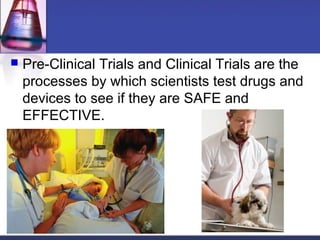
   Pre-Clinical Trials and Clinical Trials are the
    processes by which scientists test drugs and
    devices to see if they are SAFE and
    EFFECTIVE.
What is a Preclinical Trial?

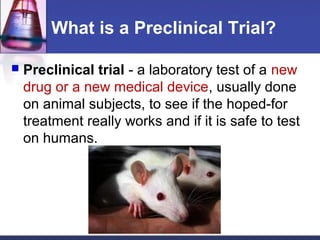
   Preclinical trial - a laboratory test of a new
    drug or a new medical device, usually done
    on animal subjects, to see if the hoped-for
    treatment really works and if it is safe to test
    on humans.
There are two types of Research:
      Basic and Applied
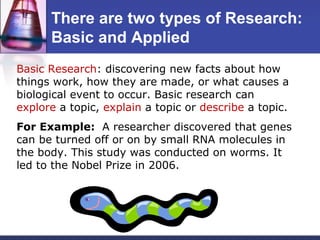
Basic Research: discovering new facts about how
things work, how they are made, or what causes a
biological event to occur. Basic research can
explore a topic, explain a topic or describe a topic.
For Example: A researcher discovered that genes
can be turned off or on by small RNA molecules in
the body. This study was conducted on worms. It
led to the Nobel Prize in 2006.
“Basic” vs. “Applied”
       Research

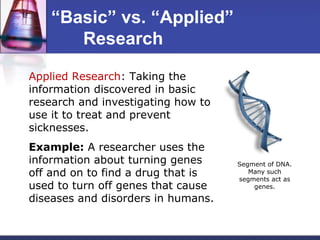
Applied Research: Taking the
information discovered in basic
research and investigating how to
use it to treat and prevent
sicknesses.
Example: A researcher uses the
information about turning genes     Segment of DNA.
off and on to find a drug that is      Many such
                                    segments act as
used to turn off genes that cause       genes.

diseases and disorders in humans.
Where Do We Get New Ideas For
            Research?
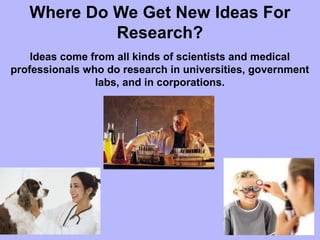
    Ideas come from all kinds of scientists and medical
professionals who do research in universities, government
                labs, and in corporations.
Take a Minute to Discuss:

   What is a Pre-Clinical Trial?

   What is the difference between basic
    research and applied research?

   What sickness or disease would you like to
    see an effective treatment for?
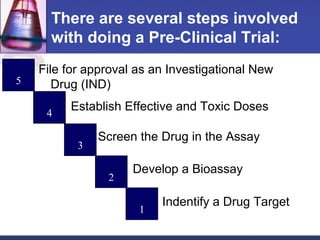
There are several steps involved
      with doing a Pre-Clinical Trial:
    File for approval as an Investigational New
5      Drug (IND)

     4
         Establish Effective and Toxic Doses

               Screen the Drug in the Assay
           3

                     Develop a Bioassay
                2

                          Indentify a Drug Target
                      1
Steps in Doing a
         Pre-Clinical Trial:
Step One: Get an idea for a
drug target.
   Drugs usually act on either cellular or genetic
    chemicals in the body, known as targets,
    which are believed to be associated with disease.
   Scientists use a variety of techniques to identify
    and isolate individual targets to learn more about
    their functions and how they influence disease.
   Compounds are then identified that have various
    interactions with the drug targets that might be
    helpful in treatment of a specific disease.
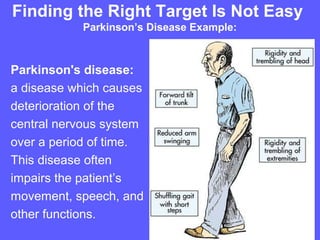
Finding the Right Target Is Not Easy
           Parkinson’s Disease Example:


Parkinson's disease:
a disease which causes
deterioration of the
central nervous system
over a period of time.
This disease often
impairs the patient’s
movement, speech, and
other functions.
How is Parkinson’s treated? Where should the
                  focus be?
   Tremors or shaking occurs when cells in one part of brain die. These
    cells communicate using a chemical called dopamine.
   Drugs that replace dopamine work only for a few years.
   Other Parkinson’s symptoms (depression, sleep disorder, digestive
    problems, loss of brain function) have other causes.
   Another sign of Parkinson’s disease: many cells have deposits of a
    protein, synuclein.
      Four drug companies are developing drugs to counter synuclein,
        even though nobody knows if it is a cause or a consequence of
        Parkinson’s.
      Synuclein could be like a tombstone—a marker, not a cause of cell
        death.
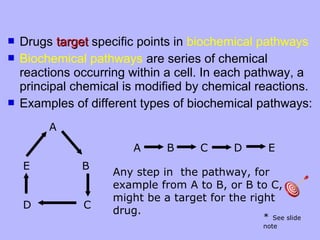
   Drugs target specific points in biochemical pathways
   Biochemical pathways are series of chemical
    reactions occurring within a cell. In each pathway, a
    principal chemical is modified by chemical reactions.
   Examples of different types of biochemical pathways:
         A
                        A     B     C     D      E
    E          B
                    Any step in the pathway, for
                    example from A to B, or B to C,
                    might be a target for the right
    D          C
                    drug.
                                                *  See slide
                                                note
Steps in Doing a
        Pre-Clinical Trial:
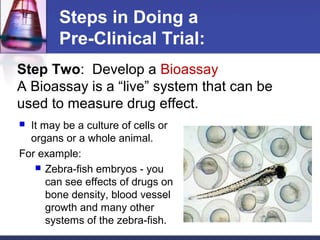
Step Two: Develop a Bioassay
A Bioassay is a “live” system that can be
used to measure drug effect.
 It may be a culture of cells or
  organs or a whole animal.
For example:
    Zebra-fish embryos - you
      can see effects of drugs on
      bone density, blood vessel
      growth and many other
      systems of the zebra-fish.
Steps in Doing a
        Pre-Clinical Trial:
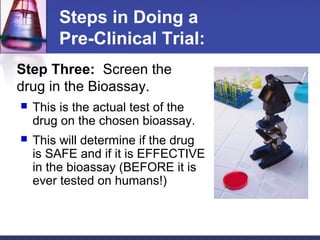
Step Three: Screen the
drug in the Bioassay.
   This is the actual test of the
    drug on the chosen bioassay.
   This will determine if the drug
    is SAFE and if it is EFFECTIVE
    in the bioassay (BEFORE it is
    ever tested on humans!)
Steps in Doing a
        Pre-Clinical Trial:
Step Four: Establish what dosage
amount of the drug is safe and what
dosage amount of the drug is toxic.
   Most drugs have a toxic level or an amount at
    which the drug will become
    harmful instead of helpful.
Steps in Doing a
         Pre-Clinical Trial:
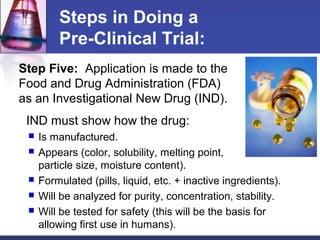
Step Five: Application is made to the
Food and Drug Administration (FDA)
as an Investigational New Drug (IND).
 IND must show how the drug:
    Is manufactured.
    Appears (color, solubility, melting point,
     particle size, moisture content).
    Formulated (pills, liquid, etc. + inactive ingredients).
    Will be analyzed for purity, concentration, stability.
    Will be tested for safety (this will be the basis for
     allowing first use in humans).
Think Break:


 How are these steps like the steps of the
  Scientific Method?
 Why would research scientists use a
  Bioassay instead of a human subject to
  test a new drug?
 What percentage of drugs do you think get
  this far in the process?
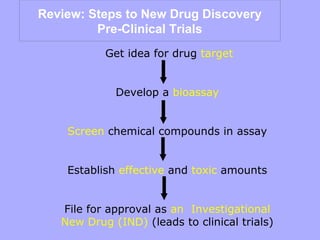
Review: Steps to New Drug Discovery
         Pre-Clinical Trials
           Get idea for drug target


             Develop a bioassay


    Screen chemical compounds in assay


    Establish effective and toxic amounts


   File for approval as an Investigational
   New Drug (IND) (leads to clinical trials)
Can you summarize the
     process?
With a partner or your group, write a summary of
the Pre-Clinical Trial Process. Use the following
words to help you:
         Drug
         Safe
         Effective
         Basic Research
         Applied Research
         Target
         Biochemical Pathway
         Bioassay
         Toxic
         Investigational New Drug (IND)
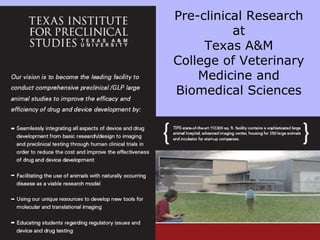
Pre-clinical Research
          at
     Texas A&M
College of Veterinary
    Medicine and
Biomedical Sciences

Preclinical trials

  • 1.
    The Application ofthe Scientific Method: Preclinical Trials Copyright 2010. PEER.tamu.edu
  • 2.
    What do youthink?  Have you ever had to take a medicine to treat an illness?  Have you ever wondered how researchers determine if the medicines you take are safe or not?
  • 3.
    Pre-Clinical Trials and Clinical Trials are the processes by which scientists test drugs and devices to see if they are SAFE and EFFECTIVE.
  • 4.
    What is aPreclinical Trial?  Preclinical trial - a laboratory test of a new drug or a new medical device, usually done on animal subjects, to see if the hoped-for treatment really works and if it is safe to test on humans.
  • 5.
    There are twotypes of Research: Basic and Applied Basic Research: discovering new facts about how things work, how they are made, or what causes a biological event to occur. Basic research can explore a topic, explain a topic or describe a topic. For Example: A researcher discovered that genes can be turned off or on by small RNA molecules in the body. This study was conducted on worms. It led to the Nobel Prize in 2006.
  • 6.
    “Basic” vs. “Applied” Research Applied Research: Taking the information discovered in basic research and investigating how to use it to treat and prevent sicknesses. Example: A researcher uses the information about turning genes Segment of DNA. off and on to find a drug that is Many such segments act as used to turn off genes that cause genes. diseases and disorders in humans.
  • 7.
    Where Do WeGet New Ideas For Research? Ideas come from all kinds of scientists and medical professionals who do research in universities, government labs, and in corporations.
  • 8.
    Take a Minuteto Discuss:  What is a Pre-Clinical Trial?  What is the difference between basic research and applied research?  What sickness or disease would you like to see an effective treatment for?
  • 9.
    There are severalsteps involved with doing a Pre-Clinical Trial: File for approval as an Investigational New 5 Drug (IND) 4 Establish Effective and Toxic Doses Screen the Drug in the Assay 3 Develop a Bioassay 2 Indentify a Drug Target 1
  • 10.
    Steps in Doinga Pre-Clinical Trial: Step One: Get an idea for a drug target.  Drugs usually act on either cellular or genetic chemicals in the body, known as targets, which are believed to be associated with disease.  Scientists use a variety of techniques to identify and isolate individual targets to learn more about their functions and how they influence disease.  Compounds are then identified that have various interactions with the drug targets that might be helpful in treatment of a specific disease.
  • 11.
    Finding the RightTarget Is Not Easy Parkinson’s Disease Example: Parkinson's disease: a disease which causes deterioration of the central nervous system over a period of time. This disease often impairs the patient’s movement, speech, and other functions.
  • 12.
    How is Parkinson’streated? Where should the focus be?  Tremors or shaking occurs when cells in one part of brain die. These cells communicate using a chemical called dopamine.  Drugs that replace dopamine work only for a few years.  Other Parkinson’s symptoms (depression, sleep disorder, digestive problems, loss of brain function) have other causes.  Another sign of Parkinson’s disease: many cells have deposits of a protein, synuclein.  Four drug companies are developing drugs to counter synuclein, even though nobody knows if it is a cause or a consequence of Parkinson’s.  Synuclein could be like a tombstone—a marker, not a cause of cell death.
  • 13.
    Drugs target specific points in biochemical pathways  Biochemical pathways are series of chemical reactions occurring within a cell. In each pathway, a principal chemical is modified by chemical reactions.  Examples of different types of biochemical pathways: A A B C D E E B Any step in the pathway, for example from A to B, or B to C, might be a target for the right D C drug. * See slide note
  • 14.
    Steps in Doinga Pre-Clinical Trial: Step Two: Develop a Bioassay A Bioassay is a “live” system that can be used to measure drug effect.  It may be a culture of cells or organs or a whole animal. For example:  Zebra-fish embryos - you can see effects of drugs on bone density, blood vessel growth and many other systems of the zebra-fish.
  • 15.
    Steps in Doinga Pre-Clinical Trial: Step Three: Screen the drug in the Bioassay.  This is the actual test of the drug on the chosen bioassay.  This will determine if the drug is SAFE and if it is EFFECTIVE in the bioassay (BEFORE it is ever tested on humans!)
  • 16.
    Steps in Doinga Pre-Clinical Trial: Step Four: Establish what dosage amount of the drug is safe and what dosage amount of the drug is toxic.  Most drugs have a toxic level or an amount at which the drug will become harmful instead of helpful.
  • 17.
    Steps in Doinga Pre-Clinical Trial: Step Five: Application is made to the Food and Drug Administration (FDA) as an Investigational New Drug (IND). IND must show how the drug:  Is manufactured.  Appears (color, solubility, melting point, particle size, moisture content).  Formulated (pills, liquid, etc. + inactive ingredients).  Will be analyzed for purity, concentration, stability.  Will be tested for safety (this will be the basis for allowing first use in humans).
  • 18.
    Think Break:  Howare these steps like the steps of the Scientific Method?  Why would research scientists use a Bioassay instead of a human subject to test a new drug?  What percentage of drugs do you think get this far in the process?
  • 19.
    Review: Steps toNew Drug Discovery Pre-Clinical Trials Get idea for drug target Develop a bioassay Screen chemical compounds in assay Establish effective and toxic amounts File for approval as an Investigational New Drug (IND) (leads to clinical trials)
  • 20.
    Can you summarizethe process? With a partner or your group, write a summary of the Pre-Clinical Trial Process. Use the following words to help you: Drug Safe Effective Basic Research Applied Research Target Biochemical Pathway Bioassay Toxic Investigational New Drug (IND)
  • 21.
    Pre-clinical Research at Texas A&M College of Veterinary Medicine and Biomedical Sciences

Editor's Notes

  • #6 See “MicroRNAs make big impression in disease after disease,” Science. 28 March 2008 and other papers in the Special Section on Gene Regulation
  • #9 1. Preclinical trial - a laboratory test of a new drug or a new medical device , usually done on animal subjects, to see if that drug or device is safe to test on humans. Basic research is discovering facts by exploring, describing or explaining. Applied research is using the information from basic research to find treatments and preventions for illnesses. Answers will vary. Examples: Lung cancer, diabetes, heart disease….
  • #11 This information is from the website: http://www.ppdi.com/about_ppd/drug_development.htm#2
  • #12 Picture from: http://curetal.com/curcuminparkinsons.html
  • #14 In a biochemical pathway, each step usually involves either adding atoms (synthesis) or taking certain atoms away (degradation) to produce a different compound. These steps are often enabled by enzymes that are specific for that step. Drug development can be aimed at blocking or enhancing the enzyme or directly reacting the drug with the compounds in the pathway.
  • #15 Picture from: http://www.ceb.utk.edu/images/zebra4.jpg
  • #19 They really are the APPLIED steps of the scientific method. State the Problem: Will a new drug be effective and safe? Gather Background Information: The scientist will rely on past research and the basic research done before their proposed trial. Form a Hypothesis: For new drugs, the hypothesis is that the drug will be effective and safe, otherwise, the scientist would not spend the time and effort on the Pre-Clinical Trial. Conduct an Experiment: This involves screening the drug in the Bioassay. Analyze Data: Determining Safe and Toxic Doses and whether the drug was Effective. Forming a Conclusion: Will it be advantageous to continue testing the drug or not? Is it safe to continue on and test the drug on humans next? 2. Many times, the risks associated with using humans outweigh the potential benefits. Using a Bioassay like cells or fish embryos prevents unnecessary harm to people and pets. 3. Out of every 5,000 new compounds identified during the discovery process, only five are considered safe for testing in human volunteers after preclinical evaluations.