Dr. Dhruva Kumar Sharma
Department of Pharmacology
SMU/SMIMS
Saturday, the 23rd Of Aug, 2014
Clinical Trials: Phases And Types
2
Protocol:
โ€ข Definition
โ€ข Aims and Objectives
โ€ข History
โ€ข Drug development process and Phases
โ€ข CRO
โ€ข Phases of clinical Trials
โ€ข Types of clinical trials
3
โ€ข Clinical trials are prospective biomedical or
behavioral research studies on human
subjects that are designed to answer
specific questions about biomedical or
behavioral interventions (novel vaccines,
drugs, treatments, devices or new ways of
using known interventions), generating
safety and efficacy data
4
AIMS AND OBJECTIVES OF
PERFORMING CLINICAL TRIALS
โ— Discovering and confirming the role of new
drugs for the future pharmacotherapy of
mankind as a whole
โ— To evaluate safety and efficacy of
experimental drug relative to its adverse
drug reactions both in healthy volunteers
and concerned patients
โ— Licensure process of a new drug
A short history of the clinical trial-562BC
โ€ข The evolution of clinical research traverses
a long and fascinating journey
โ€ข The first documented experiment
resembling a clinical trial - military leader
โ€œKing Nebuchadnezzarโ€
6
โ€ข The experiment looked at two groups who
either partook of โ€œthe Kingโ€™s meatโ€ and
wine at the royal table, or did not
(vegetables and water only), over a trial
period of ten days
โ€ข After ten days, the โ€œvegetables and water
groupโ€ looked healthier and much more
physically fit
7
โ€ข Not exactly a randomized, double-
blinded, placebo-controlled clinical
trial, but the modest experiment may
have been one of the first times in
human history that a medical test,
however rudimentary, guided a
decision about public health
8
โ€ข In 1747: One of the most famous clinical
trials was James Lind's demonstration
that citrus fruits cure scurvy
โ€ข He compares the effects of various acidic
substances, ranging from vinegar to cider,
on groups of afflicted sailors
โ€ข His study concluded that within six days,
the group who were given oranges and
lemons had largely recovered from scurvy
9
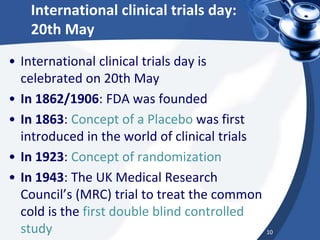
International clinical trials day:
20th May
โ€ข International clinical trials day is
celebrated on 20th May
โ€ข In 1862/1906: FDA was founded
โ€ข In 1863: Concept of a Placebo was first
introduced in the world of clinical trials
โ€ข In 1923: Concept of randomization
โ€ข In 1943: The UK Medical Research
Councilโ€™s (MRC) trial to treat the common
cold is the first double blind controlled
study 10
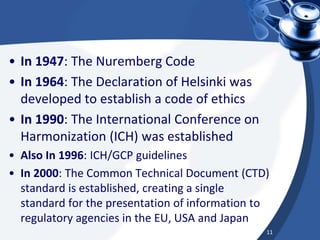
โ€ข In 1947: The Nuremberg Code
โ€ข In 1964: The Declaration of Helsinki was
developed to establish a code of ethics
โ€ข In 1990: The International Conference on
Harmonization (ICH) was established
โ€ข Also In 1996: ICH/GCP guidelines
โ€ข In 2000: The Common Technical Document (CTD)
standard is established, creating a single
standard for the presentation of information to
regulatory agencies in the EU, USA and Japan
11
12
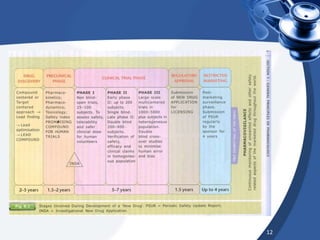
Drug development process: 3 phases
1. DRUG DISCOVERY PHASE:
-During which the candidate molecules are chosen on
the basis of their pharmacological properties
2. PRECLINICAL PHASE:
-During which a wide range of animal studies are
performed, e.g., pharmacokinetic, pharmacodynamic
and toxicity studies
3. CLINICAL TRIAL PHASE:
-During which the lead compound is evaluated for
efficacy, safety, and adverse effects in human
volunteers and patients
Pre-clinical evaluation phase (Animal
studies)
โ€ข Wide range of animals studies are performed
โ€ข Involves screening, evaluation, pharmacokinetics
and short-term toxicity in animals
โ€ข The aim during this phase of development is to
satisfy all the requirements that are needed
before a compound is considered fit to be tested
for first time in humans
โ€ข Pre-clinical phase usually require โ€“ 2 to 4 yrs. for
completion
Pre-clinical evaluation phase
The major areas are-
โ€ข Pharmacodynamic studies
โ€ข Toxicological studies
โ€ข Pharmacokinetic studies
โ€ข Assessment of safety index
TOXICOLOGICAL STUDIES-
โ€ข The aim is to determine safety of the
compound in at least two animals species
(rat & dog) by oral or parenteral routes
a) Acute toxicity-
- single doses /small groups of animals
observed for overt effects and mortality
for 1-3 days.
- LD 50 is calculated
SUB-ACUTE TOXICITY-
โ€ข Identify target organs susceptible to drugs
toxicity
โ€ข Three doses are used on two animal species
โ€ข Animals maintained at the max. tolerated
doses for a minimum period of 4 weeks to a
max. period of 3 months
โ€ข Finally ,the animals are killed and subjected to
histopathological examination.
Chronic toxicity-
โ€ข Goals are same as for sub-acute toxicity.
Usually two animal species (one rodent and one non-rodent)
Duration- 1-2 years
May run simultaneously with clinical trials
Special toxicity-
โ€ข Effects on reproductive performance
โ€ข Teratogenicity
โ€ข Carcinogenicity
โ€ข Mutagenicity
โ€ข Local toxicity
โ€ข When the new drug passes the pre-clinical
pharmacological screening, the manufacturer
may file a
โ€˜Preclinical New Drugโ€™
Or
โ€˜Investigational New Drugโ€™ (IND)
application to an authorized drug control body of
the respective country
โ€ข In UK- CSM (Committee on Safety of Medicine)
โ€ข In USA- FDA (Food and Drug administration)
โ€ข In INDIA- Drugs Controller General, Govt. of India,
New Delhi
โ€ข The IND application must contain the
following information about the test drug in
question-
1. The chemical structure, source,
manufacturing data with details of its purity.
2. The preclinical data about
pharmacodynamics, pharmacokinetics and
toxicological studies with ED50 and LD50 data.
3. Specifications of the dosage forms in
which it has to be administered to the
human beings.
4. A detailed description of the
investigational protocol to be undertaken
(including the dose and route of
administration )
21
5. The names and qualifications of each
investigator and the facilities available to
them
6. An agreement from the sponsors to submit
annual progress report regularly
7. A certification that โ€œinformed consentโ€ will be
obtained from human volunteers and that
โ€˜Ethics of research of human beingsโ€™ will be
strictly followed
โ€ข Clinical trials are conducted only after
satisfactory information has been gathered
that satisfies health authority/ethics
committee
โ€ข Depending on product type and development
stage, investigators initially enrol volunteers
and/or patients into small pilot studies, and
subsequently conduct progressively larger
scale comparative studies
23
โ€ข As positive safety and efficacy data are
gathered, the number of patients typically
increases
โ€ข Clinical trials can vary in size, and can
involve a single research entity in one
country or multiple entities in multiple
countries
24
โ€ข Hence, a full series of trials may cost
hundreds of million dollars
โ€ข The burden of paying is usually borne by
the sponsor, which may be a
๏ถ governmental organization
๏ถ Pharmaceutical industry
๏ถ Biotechnology
๏ถ medical device company
25
CRO
26
โ€ข A contract research organization (CRO) is an
organization that provides support to
the pharmaceutical, biotechnology, and medical
device industries in the form of research
services outsourced on a contract basis
โ€ข A CRO may provide such services as
biopharmaceutical development, biologic assay
development, commercialization, preclinical
research, clinical research, clinical trials
management, and pharmacovigilance
โ€ข Many CROs specifically provide clinical-
study and clinical-trial support for drugs
and/or medical devices
โ€ข CROs range from large, international full-
service organizations to small, niche
specialty groups
27
โ€ข CROs that specialize in clinical-trials services can
offer their clients the expertise of moving a new
drug or device from its conception
to FDA marketing approval, without the drug
sponsor having to maintain a staff for these
services
โ€ข There are over 1,100 CROs in the world
โ€ข The largest CROs, according to Industry Standard
Research, are Quintiles, Parexel, Covance, Pharm
aceutical Product Development (PPD), Icon, INC
Research, and inVentiv Health Clinical
28
โ€ข With regulatory approval, human testing
may then go forward (usually in three
phases)
โ€ข Drug is formulated into a suitable dosage
form and clinical trials are conducted in a
โ€œLOGICAL PHASED MANNERโ€
โ€ข A fourth phase of data gathering and
safety monitoring is becoming increasingly
important and follows after approval for
marketing
โ€ข Once approved, the great majority of drugs
become available for use by any appropriately
licensed practitioner
โ€ข Highly toxic drugs that are nevertheless
considered valuable in lethal diseases may be
approved for restricted use by practitioners
who have undergone special training in their
use and who maintain detailed records
โ€ข Enormous costs: $150 million to several
billion, are involved in the development of
a single new drug that reaches the
marketplace
โ€ข Less than one third of the drugs tested in
clinical trials reach the market place
โ€ข Only 2 of 10 marketed drugs return their
research and development (R&D)
investments, thus providing considerable
motivation to develop โ€œblockbuster drugsโ€
โ€ข Increasing regulatory challenges and litigation
resulting from real or suspected drug toxicity
after approval further increase the cost of
developing new drugs
โ€ข Unfortunately, only 10โ€“15% of the new drugs
that achieve marketing approval represent
significant advances in safety and
effectiveness
โ€ข The remainder are merely molecular variants
(โ€œme-too drugsโ€) on true breakthrough drugs
Clinical Trials: IND (for Phase I,II,III)
Ethical Considerations
โ€ข In each of the three formal phases of clinical
trials, volunteers or patients must be
informed of the investigational status of the
drug as well as the possible risks and must be
allowed to decline or to consent to participate
and receive the drug
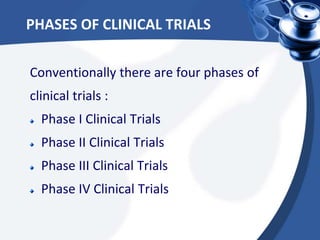
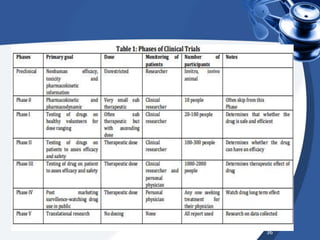
PHASES OF CLINICAL TRIALS
Conventionally there are four phases of
clinical trials :
Phase I Clinical Trials
Phase II Clinical Trials
Phase III Clinical Trials
Phase IV Clinical Trials
Additions :
Phase 0 โ€“ Microdosing Stategy
Phase V Clinical Trials โ€“ mainly an extension of
Phase IV Clinical Trials.
36
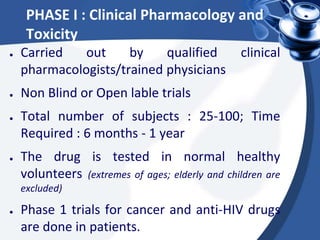
PHASE I : Clinical Pharmacology and
Toxicity
โ— Carried out by qualified clinical
pharmacologists/trained physicians
โ— Non Blind or Open lable trials
โ— Total number of subjects : 25-100; Time
Required : 6 months - 1 year
โ— The drug is tested in normal healthy
volunteers (extremes of ages; elderly and children are
excluded)
โ— Phase 1 trials for cancer and anti-HIV drugs
are done in patients.
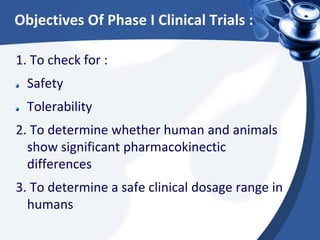
Objectives Of Phase I Clinical Trials :
1. To check for :
Safety
Tolerability
2. To determine whether human and animals
show significant pharmacokinectic
differences
3. To determine a safe clinical dosage range in
humans
For safe clinical dosage range
Begin with 1/5th or 1/10th the maximum tolerated dose
(mg/kg) in animals and calculate it for an average
human body weight of 70 kg.
The drug is then given in small increments till
therapeutically effective dose is obtained.
4. To determine pharmacokinetics of the
drug in humans.
5. To detect any predictable toxicity
There are different kinds of Phase I trial
SAD - Single Ascending Dose studies
โ— Features :
โ— - small groups of subjects are given a single
dose of the drug
โ— - they are observed and tested for a period
of time
โ— No adverse effects observed, the dose is
escalated, and a new group of subjects are
then given a higher dose than previous
group
โ— This is continued until intolerable side
effects or adverse effects start showing up
[at which point the drug is said to have
reached the Maximum tolerated dose
(MTD)].
2) MAD - Multiple Ascending Dose
studies
Features -
To understand better the pharmacokinetics &
pharmacodynamics of multiple doses of the
drug
A group of patients receives multiple low doses
of the drug, while samples are collected at
various time points and analyzed to acquire
information on how the drug is processed within
the body. The dose is subsequently escalated for
further groups, up to a predetermined level.
3) Food effect
A short trial designed to investigate any
differences in absorption of the drug by the
body, caused by eating before the drug is
given
โ— These studies are usually run as a crossover
study, with volunteers being given two
identical doses of the drug while fasted, and
after being fed
Phase II trials
Or
Safety and efficacy (SE) trials
44
Phase II : Therapeutic Exploration and
Dose Ranging
โ— Conducted by Physicians who are trained as
Clinical Investigators
โ— Last an average of 2 years.
โ— Number of subjects: 100-400; Volunteer
patients, selected according to specific
inclusion and exclusion criteria
โ— Multicentered Randomised controlled Trials
of the new drug is undertaken
Obective:
To Estabilish -
- Final formulation
- Dose of the drug
-Statistical End Points that represent
the targeted favourable outcome of
the study
End points may be:
a) Definitive End Point โ€“ which measures the
drug effect directly
b) Surrogate End Point โ€“ which is
predictive of the definitive end point
Phase II Clinical Trials are divided into
EARLY and LATE PHASES
EARLY PHASE II
[Establish Dose range]
โ— Usually a Randomised Single Blind Design
โ— A small number of patients upto 200
โ— Potential therapeutic benefits, side effects
and adverse effects are observed
โ— Main obejective โ€“ to estabilish a dose range
for more definitive trials to be undertaken in
the next late phase here
Late Phase II
[Efficacy]
โ— Randomized Double Blind Design
โ— Larger number of patients: 200-400
โ— Specifically designed to study efficacy (how
well the drug wroks at prescribed doses)
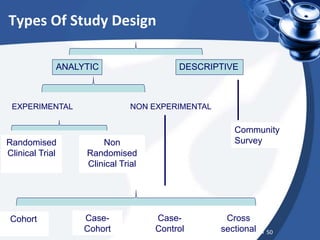
Types Of Study Design
50
ANALYTIC DESCRIPTIVE
EXPERIMENTAL NON EXPERIMENTAL
Randomised
Clinical Trial
Non
Randomised
Clinical Trial
Community
Survey
Case-
Control
Cross
sectional
Case-
Cohort
Cohort
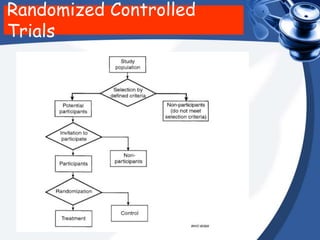
Randomized Controlled
Trials
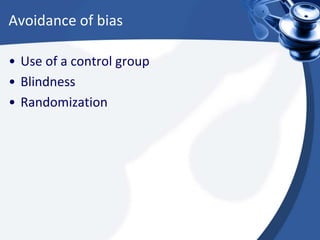
Avoidance of bias
โ€ข Use of a control group
โ€ข Blindness
โ€ข Randomization
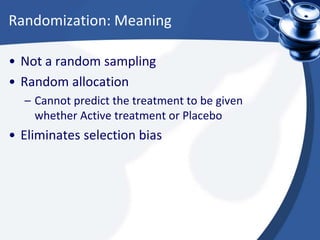
Randomization: Meaning
โ€ข Not a random sampling
โ€ข Random allocation
โ€“ Cannot predict the treatment to be given
whether Active treatment or Placebo
โ€ข Eliminates selection bias
Randomization
โ€ข We want to assign a group of subjects to
one of two groupsโ€”Treatment A or
Treatment B
โ€“ How can we do this in a random manner?
Randomization
Random assignment
โ€ข Flip a coin
โ€“ โ€œHeadsโ€โ€”Tx A
โ€“ โ€œTailsโ€โ€”Tx B
Randomization
Random assignment
โ€ข Roll a six-sided dice
โ€“ Even numberโ€”Tx A
โ€“ Odd numberโ€”Tx B
Randomization
Random assignment
โ€ข Table of random numbers
โ€ข Computer generated list
Random assignments
Random assignment
โ€ข Alphabetical
โ€“ Tx A = patients with last name Aโ€“M
โ€“ Tx B = patients with last name Nโ€“Z
โ€ข Telephone number/social security number
โ€“ Tx A = last digit odd
โ€“ Tx B = last digit even
โ€ข Sequential
โ€“ Tx A = morning patients
โ€“ Tx B = afternoon patients
โ€ข Bed number
โ€“ Tx A = odd bed number
โ€“ Tx B = even bed number
59
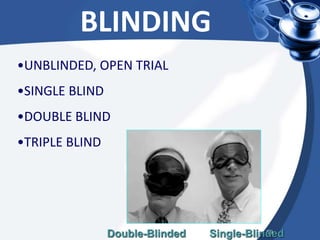
โ€ขUNBLINDED, OPEN TRIAL
โ€ขSINGLE BLIND
โ€ขDOUBLE BLIND
โ€ขTRIPLE BLIND
BLINDING
Double-Blinded Single-Blinded
โ€ข Open Trial:
- both the researcher and the subject knows
the full detail of the treatment
Blind Trials:
โ€ข Method of โ€œcontrol experimentationโ€
โ€ข One / both parties are not informed of the
treatment being given
โ€ข Reduces bias arising from the treatment
knowledge
61
Reduces bias like
โ€ข Recruitment and treatment allocation
โ€ข Patient care
โ€ข Attitudes of patients to treatments
โ€ข Assessment of endpoints
โ€ข Handling of discontinuations
โ€ข Exclusion of data from the analysis
62
โ€ข Single-Blind Trial (Subject is blinded)
โ€ข Bouble Blind Trial (Investigator + Subject are Blinded)
โ€ข Triple-blind trial (Researcher + Investigator + subject
are blinded)
63
Phase III Trials
Or
Comparative Efficacy Trials
64
Phase III : Therapeutic confirmation /
comparison
โ— Large Scale Multicentred (heterogenous
population) randomised double blind study,
carried out by several physicians.
โ— Number of patients โ€“ 1000 โ€“ 5000 plus.
โ— Lasts an average of 5 โ€“ 6 years.
โ— Further estabilish safety and efficacy and
possible drug and food interactions.
โ— Designed to verify the efficacy of the new
drug with the current 'gold standard'
treatment; and to minimise errors in the
information gathered in Phase I and Phase II
trials.
โ— Therefore these trials are made using
DOUBLE BLIND CROSSOVER STUDIES
โ— Most expensive, time-consuming and
difficult trials to design and run
โ— At the end of the trial โ€“ Statistical analysis of
data is performed to determine the
significance of the results
โ— P-value of < 0.5% is taken as significant
New Drug Application
โ— On satisfactory completion of Phase III trials
a 'New Drug Application' is filed with the
Drug Control Authorities of the country
โ— It contains :
- Complete detailed monograph of the
product including information about dose,
dosage forms, dosage schedule, routes of
drug administration, side effects, adverse
effects
- Results of the trials
- Proposed registered name of the product
- Package insert
โ— If documentation is acceptable and is in
compliance with the regulations, the drug
control authorities can allow the drug to
enter the market with 'New Drug Status'
Phase IV : Post Marketing
Surveillance/studies
โ— It is the post licensing phase
โ— No fixed duration
โ— Performance of the drug is monitored for
several years
โ— After the drug has been marketed for
general use, data is collected on a pre
structured proforma about the efficacy,
acceptibility and adverse effects
โ€ข Data obtained from general practioners
and physicians of both hospital and private
set up
โ€ข Data is collected to discover any
rare/unique side effects or adverse effects;
or previously unknown therapeutic
benefits of the drug / its active metabolite
71
โ— It is a global report
โ— During the 'New Drug Status' period the
manufacturer is supposed to report any new
information about the drug concerning its
safety
โ— Periodic Safety update Report (PSUR) is to
be submitted every 6 months for first 2
years and then annually for the next 2 years
โ— Further therapeutic trials involving special
groups like children, elderly, pregnant
/lactating women, patients with renal/hepatic
disease, etc. (which are generally excluded
during clinical trials) may be undertaken at
this stage
โ— Modified release dosage forms, additional
routes of administration, fixed dose drug
combinations, etc. may be explored
Phase 0 : Micro Dosing Strategy in
Clinical Trials
โ— New strategy to reduce the cost and time of
the drug developement process
โ— These are designed to speed up the
development of promising drugs or imaging
agents by establishing very early on whether
the drug or agent behaves in human
subjects as was expected from preclinical
studies
โ— Duration โ€“ 4-6 months
โ— Involves administration of single subtherapeutic
doses(< 1/100th of the dose) of the study drug to a
small number of healthy volunteers (10 to 15) and
pharmacokinetics is worked out using highly
sophisticated instrumentation, such as Accelerator
mass spectrometry with radiolabelled drug, LC tandem
mass spectrometry to measure ultra low dose levels
โ— Primary goal โ€“ to inform decision making regarding
further development of relevant compounds
โ— Knowing the pharmacokinetics of the drug
can also help in selection of the ideal
candidates for the study
โ— Especially important for oncology , as
anticancer drugs are therapeutically toxic,
and microdosing studies are therefore more
helpful here to decide the appropriate drug
to be studied
โ— May reduce overall cost of clinical trials
Limitations of Phase 0 Clinical Trials
โ— Gives no data on safety or efficacy
โ— By definition a dose too low to cause any
therapeutic effect
โ— But questions still have been raised by
experts about whether Phase 0 trials are
useful, ethically acceptable, feasible, speed
up the drug development process or save
money, and whether there is room for
improvement
Phase V Clinical Trials
โ— Extension of Phase IV Clinical trials
โ— Phase V is a growing term used in the
literature of translational research
โ— It refers to comparative effectiveness
research and community-based research
โ— It is used to signify the integration of a new
clinical treatment into widespread public
health practice
Types Of Clinical Trials
โ€ข Cancer clinical trials differ according
to their primary purpose
โ€ข They include the following types:
โ€“ Treatment. These trials test the
effectiveness of new treatments or new
ways of using current treatments in
people who have cancer
80
โ€ข The treatments tested may include new
drugs or new combinations of currently
used drugs, new surgery or radiation
therapy techniques, and vaccines or other
treatments that stimulate a
personโ€™s immune system to fight cancer
โ€ข Combinations of different treatment types
may also be tested in these trials
81
โ€ข Prevention: These trials test new
interventions that may lower the risk of
developing certain types of cancer
โ€ข Most cancer prevention trials involve
people who have a higher than average
risk of developing a specific type of cancer
82
โ€ข Some cancer prevention trials involve
people who have had cancer in the past;
these trials test interventions that may
help prevent the return (recurrence) of the
original cancer or reduce the chance of
developing a new type of cancer
83
โ€ข Screening: These trials test new ways of
finding cancer early
โ€ข Cancer screening trials usually involve
people who do not have any signs or
symptoms of cancer but have a higher than
average risk of developing a certain type of
cancer because they have a family history
or history of exposure to cancer-causing
substances (e.g., cigarette smoke).
84
โ€ข Diagnostic. These trials study new tests or
procedures that may help identify, or
diagnose, cancer more accurately
โ€ข Diagnostic trials usually involve people
who have some signs or symptoms of
cancer
85
โ€ข Quality of life or supportive care: These
trials focus on the comfort and quality of
life of cancer patients and cancer survivors
โ€ข New ways to decrease the number or
severity of side effects of cancer or its
treatment
โ€ข How a specific type of cancer or its
treatment affects a personโ€™s everyday life
may also be studied
86
Sibling Clinical Trial
โ€ข This study will examine families in which
one sibling of a sibling pair, or twin pair,
has developed a systemic rheumatic
disease and one has not, to see if and how
the two differ in the following:
โ€ข Blood cell metabolism
โ€ข Types of cells in the blood
โ€ข Environmental exposures or genetic
factors that might explain why one
developed disease and the other did not
87
โ€ข Families in which one sibling has
developed a systemic rheumatic disease,
rheumatoid arthritis, systemic lupus
erythematosus, scleroderma,
dermatomyositis, or myositis, and the
other has not, are eligible for this study
88
โ€ข The siblings may or may not be twins,
but must be of the same gender and
be within a 3-year age difference
โ€ข Biological parents, or, in some cases,
children, will also be included in the
study
โ€ข Normal, healthy volunteers will serve
as control subjects
89
References:
๏ถ Katzung โ€“ Basic & Clinical Pharmacology,
12th Edition
๏ถ Sharma โ€“ Priciples of Pharmacology,
2nd Edition
๏ถ K.D Tripathi
๏ถ www.fda.gov
๏ถ www.clinicaltrial.gov
๏ถ www.icmr.nic.in/guidelines/GCLP
๏ถ www.cdsco.nic.in/
๏ถ Fundamentals of clinical operations, Health care
sciences,SMU, MR0001
๏ถ Regulatory Affairs-I,Health care sciences,SMU, MR0002
91

Clinical trials dhruva

  • 1.
    Dr. Dhruva KumarSharma Department of Pharmacology SMU/SMIMS Saturday, the 23rd Of Aug, 2014
  • 2.
  • 3.
    Protocol: โ€ข Definition โ€ข Aimsand Objectives โ€ข History โ€ข Drug development process and Phases โ€ข CRO โ€ข Phases of clinical Trials โ€ข Types of clinical trials 3
  • 4.
    โ€ข Clinical trialsare prospective biomedical or behavioral research studies on human subjects that are designed to answer specific questions about biomedical or behavioral interventions (novel vaccines, drugs, treatments, devices or new ways of using known interventions), generating safety and efficacy data 4
  • 5.
    AIMS AND OBJECTIVESOF PERFORMING CLINICAL TRIALS โ— Discovering and confirming the role of new drugs for the future pharmacotherapy of mankind as a whole โ— To evaluate safety and efficacy of experimental drug relative to its adverse drug reactions both in healthy volunteers and concerned patients โ— Licensure process of a new drug
  • 6.
    A short historyof the clinical trial-562BC โ€ข The evolution of clinical research traverses a long and fascinating journey โ€ข The first documented experiment resembling a clinical trial - military leader โ€œKing Nebuchadnezzarโ€ 6
  • 7.
    โ€ข The experimentlooked at two groups who either partook of โ€œthe Kingโ€™s meatโ€ and wine at the royal table, or did not (vegetables and water only), over a trial period of ten days โ€ข After ten days, the โ€œvegetables and water groupโ€ looked healthier and much more physically fit 7
  • 8.
    โ€ข Not exactlya randomized, double- blinded, placebo-controlled clinical trial, but the modest experiment may have been one of the first times in human history that a medical test, however rudimentary, guided a decision about public health 8
  • 9.
    โ€ข In 1747:One of the most famous clinical trials was James Lind's demonstration that citrus fruits cure scurvy โ€ข He compares the effects of various acidic substances, ranging from vinegar to cider, on groups of afflicted sailors โ€ข His study concluded that within six days, the group who were given oranges and lemons had largely recovered from scurvy 9
  • 10.
    International clinical trialsday: 20th May โ€ข International clinical trials day is celebrated on 20th May โ€ข In 1862/1906: FDA was founded โ€ข In 1863: Concept of a Placebo was first introduced in the world of clinical trials โ€ข In 1923: Concept of randomization โ€ข In 1943: The UK Medical Research Councilโ€™s (MRC) trial to treat the common cold is the first double blind controlled study 10
  • 11.
    โ€ข In 1947:The Nuremberg Code โ€ข In 1964: The Declaration of Helsinki was developed to establish a code of ethics โ€ข In 1990: The International Conference on Harmonization (ICH) was established โ€ข Also In 1996: ICH/GCP guidelines โ€ข In 2000: The Common Technical Document (CTD) standard is established, creating a single standard for the presentation of information to regulatory agencies in the EU, USA and Japan 11
  • 12.
  • 13.
    Drug development process:3 phases 1. DRUG DISCOVERY PHASE: -During which the candidate molecules are chosen on the basis of their pharmacological properties 2. PRECLINICAL PHASE: -During which a wide range of animal studies are performed, e.g., pharmacokinetic, pharmacodynamic and toxicity studies 3. CLINICAL TRIAL PHASE: -During which the lead compound is evaluated for efficacy, safety, and adverse effects in human volunteers and patients
  • 14.
    Pre-clinical evaluation phase(Animal studies) โ€ข Wide range of animals studies are performed โ€ข Involves screening, evaluation, pharmacokinetics and short-term toxicity in animals โ€ข The aim during this phase of development is to satisfy all the requirements that are needed before a compound is considered fit to be tested for first time in humans โ€ข Pre-clinical phase usually require โ€“ 2 to 4 yrs. for completion
  • 15.
    Pre-clinical evaluation phase Themajor areas are- โ€ข Pharmacodynamic studies โ€ข Toxicological studies โ€ข Pharmacokinetic studies โ€ข Assessment of safety index
  • 16.
    TOXICOLOGICAL STUDIES- โ€ข Theaim is to determine safety of the compound in at least two animals species (rat & dog) by oral or parenteral routes a) Acute toxicity- - single doses /small groups of animals observed for overt effects and mortality for 1-3 days. - LD 50 is calculated
  • 17.
    SUB-ACUTE TOXICITY- โ€ข Identifytarget organs susceptible to drugs toxicity โ€ข Three doses are used on two animal species โ€ข Animals maintained at the max. tolerated doses for a minimum period of 4 weeks to a max. period of 3 months โ€ข Finally ,the animals are killed and subjected to histopathological examination.
  • 18.
    Chronic toxicity- โ€ข Goalsare same as for sub-acute toxicity. Usually two animal species (one rodent and one non-rodent) Duration- 1-2 years May run simultaneously with clinical trials Special toxicity- โ€ข Effects on reproductive performance โ€ข Teratogenicity โ€ข Carcinogenicity โ€ข Mutagenicity โ€ข Local toxicity
  • 19.
    โ€ข When thenew drug passes the pre-clinical pharmacological screening, the manufacturer may file a โ€˜Preclinical New Drugโ€™ Or โ€˜Investigational New Drugโ€™ (IND) application to an authorized drug control body of the respective country โ€ข In UK- CSM (Committee on Safety of Medicine) โ€ข In USA- FDA (Food and Drug administration) โ€ข In INDIA- Drugs Controller General, Govt. of India, New Delhi
  • 20.
    โ€ข The INDapplication must contain the following information about the test drug in question- 1. The chemical structure, source, manufacturing data with details of its purity. 2. The preclinical data about pharmacodynamics, pharmacokinetics and toxicological studies with ED50 and LD50 data.
  • 21.
    3. Specifications ofthe dosage forms in which it has to be administered to the human beings. 4. A detailed description of the investigational protocol to be undertaken (including the dose and route of administration ) 21
  • 22.
    5. The namesand qualifications of each investigator and the facilities available to them 6. An agreement from the sponsors to submit annual progress report regularly 7. A certification that โ€œinformed consentโ€ will be obtained from human volunteers and that โ€˜Ethics of research of human beingsโ€™ will be strictly followed
  • 23.
    โ€ข Clinical trialsare conducted only after satisfactory information has been gathered that satisfies health authority/ethics committee โ€ข Depending on product type and development stage, investigators initially enrol volunteers and/or patients into small pilot studies, and subsequently conduct progressively larger scale comparative studies 23
  • 24.
    โ€ข As positivesafety and efficacy data are gathered, the number of patients typically increases โ€ข Clinical trials can vary in size, and can involve a single research entity in one country or multiple entities in multiple countries 24
  • 25.
    โ€ข Hence, afull series of trials may cost hundreds of million dollars โ€ข The burden of paying is usually borne by the sponsor, which may be a ๏ถ governmental organization ๏ถ Pharmaceutical industry ๏ถ Biotechnology ๏ถ medical device company 25
  • 26.
    CRO 26 โ€ข A contractresearch organization (CRO) is an organization that provides support to the pharmaceutical, biotechnology, and medical device industries in the form of research services outsourced on a contract basis โ€ข A CRO may provide such services as biopharmaceutical development, biologic assay development, commercialization, preclinical research, clinical research, clinical trials management, and pharmacovigilance
  • 27.
    โ€ข Many CROsspecifically provide clinical- study and clinical-trial support for drugs and/or medical devices โ€ข CROs range from large, international full- service organizations to small, niche specialty groups 27
  • 28.
    โ€ข CROs thatspecialize in clinical-trials services can offer their clients the expertise of moving a new drug or device from its conception to FDA marketing approval, without the drug sponsor having to maintain a staff for these services โ€ข There are over 1,100 CROs in the world โ€ข The largest CROs, according to Industry Standard Research, are Quintiles, Parexel, Covance, Pharm aceutical Product Development (PPD), Icon, INC Research, and inVentiv Health Clinical 28
  • 29.
    โ€ข With regulatoryapproval, human testing may then go forward (usually in three phases) โ€ข Drug is formulated into a suitable dosage form and clinical trials are conducted in a โ€œLOGICAL PHASED MANNERโ€ โ€ข A fourth phase of data gathering and safety monitoring is becoming increasingly important and follows after approval for marketing
  • 30.
    โ€ข Once approved,the great majority of drugs become available for use by any appropriately licensed practitioner โ€ข Highly toxic drugs that are nevertheless considered valuable in lethal diseases may be approved for restricted use by practitioners who have undergone special training in their use and who maintain detailed records
  • 31.
    โ€ข Enormous costs:$150 million to several billion, are involved in the development of a single new drug that reaches the marketplace โ€ข Less than one third of the drugs tested in clinical trials reach the market place โ€ข Only 2 of 10 marketed drugs return their research and development (R&D) investments, thus providing considerable motivation to develop โ€œblockbuster drugsโ€
  • 32.
    โ€ข Increasing regulatorychallenges and litigation resulting from real or suspected drug toxicity after approval further increase the cost of developing new drugs โ€ข Unfortunately, only 10โ€“15% of the new drugs that achieve marketing approval represent significant advances in safety and effectiveness โ€ข The remainder are merely molecular variants (โ€œme-too drugsโ€) on true breakthrough drugs
  • 33.
    Clinical Trials: IND(for Phase I,II,III) Ethical Considerations โ€ข In each of the three formal phases of clinical trials, volunteers or patients must be informed of the investigational status of the drug as well as the possible risks and must be allowed to decline or to consent to participate and receive the drug
  • 34.
    PHASES OF CLINICALTRIALS Conventionally there are four phases of clinical trials : Phase I Clinical Trials Phase II Clinical Trials Phase III Clinical Trials Phase IV Clinical Trials
  • 35.
    Additions : Phase 0โ€“ Microdosing Stategy Phase V Clinical Trials โ€“ mainly an extension of Phase IV Clinical Trials.
  • 36.
  • 37.
    PHASE I :Clinical Pharmacology and Toxicity โ— Carried out by qualified clinical pharmacologists/trained physicians โ— Non Blind or Open lable trials โ— Total number of subjects : 25-100; Time Required : 6 months - 1 year โ— The drug is tested in normal healthy volunteers (extremes of ages; elderly and children are excluded) โ— Phase 1 trials for cancer and anti-HIV drugs are done in patients.
  • 38.
    Objectives Of PhaseI Clinical Trials : 1. To check for : Safety Tolerability 2. To determine whether human and animals show significant pharmacokinectic differences 3. To determine a safe clinical dosage range in humans
  • 39.
    For safe clinicaldosage range Begin with 1/5th or 1/10th the maximum tolerated dose (mg/kg) in animals and calculate it for an average human body weight of 70 kg. The drug is then given in small increments till therapeutically effective dose is obtained. 4. To determine pharmacokinetics of the drug in humans. 5. To detect any predictable toxicity There are different kinds of Phase I trial
  • 40.
    SAD - SingleAscending Dose studies โ— Features : โ— - small groups of subjects are given a single dose of the drug โ— - they are observed and tested for a period of time
  • 41.
    โ— No adverseeffects observed, the dose is escalated, and a new group of subjects are then given a higher dose than previous group โ— This is continued until intolerable side effects or adverse effects start showing up [at which point the drug is said to have reached the Maximum tolerated dose (MTD)].
  • 42.
    2) MAD -Multiple Ascending Dose studies Features - To understand better the pharmacokinetics & pharmacodynamics of multiple doses of the drug A group of patients receives multiple low doses of the drug, while samples are collected at various time points and analyzed to acquire information on how the drug is processed within the body. The dose is subsequently escalated for further groups, up to a predetermined level.
  • 43.
    3) Food effect Ashort trial designed to investigate any differences in absorption of the drug by the body, caused by eating before the drug is given โ— These studies are usually run as a crossover study, with volunteers being given two identical doses of the drug while fasted, and after being fed
  • 44.
    Phase II trials Or Safetyand efficacy (SE) trials 44
  • 45.
    Phase II :Therapeutic Exploration and Dose Ranging โ— Conducted by Physicians who are trained as Clinical Investigators โ— Last an average of 2 years. โ— Number of subjects: 100-400; Volunteer patients, selected according to specific inclusion and exclusion criteria โ— Multicentered Randomised controlled Trials of the new drug is undertaken
  • 46.
    Obective: To Estabilish - -Final formulation - Dose of the drug -Statistical End Points that represent the targeted favourable outcome of the study
  • 47.
    End points maybe: a) Definitive End Point โ€“ which measures the drug effect directly b) Surrogate End Point โ€“ which is predictive of the definitive end point Phase II Clinical Trials are divided into EARLY and LATE PHASES
  • 48.
    EARLY PHASE II [EstablishDose range] โ— Usually a Randomised Single Blind Design โ— A small number of patients upto 200 โ— Potential therapeutic benefits, side effects and adverse effects are observed โ— Main obejective โ€“ to estabilish a dose range for more definitive trials to be undertaken in the next late phase here
  • 49.
    Late Phase II [Efficacy] โ—Randomized Double Blind Design โ— Larger number of patients: 200-400 โ— Specifically designed to study efficacy (how well the drug wroks at prescribed doses)
  • 50.
    Types Of StudyDesign 50 ANALYTIC DESCRIPTIVE EXPERIMENTAL NON EXPERIMENTAL Randomised Clinical Trial Non Randomised Clinical Trial Community Survey Case- Control Cross sectional Case- Cohort Cohort
  • 51.
  • 52.
    Avoidance of bias โ€ขUse of a control group โ€ข Blindness โ€ข Randomization
  • 53.
    Randomization: Meaning โ€ข Nota random sampling โ€ข Random allocation โ€“ Cannot predict the treatment to be given whether Active treatment or Placebo โ€ข Eliminates selection bias
  • 54.
    Randomization โ€ข We wantto assign a group of subjects to one of two groupsโ€”Treatment A or Treatment B โ€“ How can we do this in a random manner?
  • 55.
    Randomization Random assignment โ€ข Flipa coin โ€“ โ€œHeadsโ€โ€”Tx A โ€“ โ€œTailsโ€โ€”Tx B
  • 56.
    Randomization Random assignment โ€ข Rolla six-sided dice โ€“ Even numberโ€”Tx A โ€“ Odd numberโ€”Tx B
  • 57.
    Randomization Random assignment โ€ข Tableof random numbers โ€ข Computer generated list
  • 58.
    Random assignments Random assignment โ€ขAlphabetical โ€“ Tx A = patients with last name Aโ€“M โ€“ Tx B = patients with last name Nโ€“Z โ€ข Telephone number/social security number โ€“ Tx A = last digit odd โ€“ Tx B = last digit even โ€ข Sequential โ€“ Tx A = morning patients โ€“ Tx B = afternoon patients โ€ข Bed number โ€“ Tx A = odd bed number โ€“ Tx B = even bed number
  • 59.
    59 โ€ขUNBLINDED, OPEN TRIAL โ€ขSINGLEBLIND โ€ขDOUBLE BLIND โ€ขTRIPLE BLIND BLINDING Double-Blinded Single-Blinded
  • 61.
    โ€ข Open Trial: -both the researcher and the subject knows the full detail of the treatment Blind Trials: โ€ข Method of โ€œcontrol experimentationโ€ โ€ข One / both parties are not informed of the treatment being given โ€ข Reduces bias arising from the treatment knowledge 61
  • 62.
    Reduces bias like โ€ขRecruitment and treatment allocation โ€ข Patient care โ€ข Attitudes of patients to treatments โ€ข Assessment of endpoints โ€ข Handling of discontinuations โ€ข Exclusion of data from the analysis 62
  • 63.
    โ€ข Single-Blind Trial(Subject is blinded) โ€ข Bouble Blind Trial (Investigator + Subject are Blinded) โ€ข Triple-blind trial (Researcher + Investigator + subject are blinded) 63
  • 64.
  • 65.
    Phase III :Therapeutic confirmation / comparison โ— Large Scale Multicentred (heterogenous population) randomised double blind study, carried out by several physicians. โ— Number of patients โ€“ 1000 โ€“ 5000 plus. โ— Lasts an average of 5 โ€“ 6 years. โ— Further estabilish safety and efficacy and possible drug and food interactions.
  • 66.
    โ— Designed toverify the efficacy of the new drug with the current 'gold standard' treatment; and to minimise errors in the information gathered in Phase I and Phase II trials. โ— Therefore these trials are made using DOUBLE BLIND CROSSOVER STUDIES โ— Most expensive, time-consuming and difficult trials to design and run
  • 67.
    โ— At theend of the trial โ€“ Statistical analysis of data is performed to determine the significance of the results โ— P-value of < 0.5% is taken as significant
  • 68.
    New Drug Application โ—On satisfactory completion of Phase III trials a 'New Drug Application' is filed with the Drug Control Authorities of the country โ— It contains : - Complete detailed monograph of the product including information about dose, dosage forms, dosage schedule, routes of drug administration, side effects, adverse effects
  • 69.
    - Results ofthe trials - Proposed registered name of the product - Package insert โ— If documentation is acceptable and is in compliance with the regulations, the drug control authorities can allow the drug to enter the market with 'New Drug Status'
  • 70.
    Phase IV :Post Marketing Surveillance/studies โ— It is the post licensing phase โ— No fixed duration โ— Performance of the drug is monitored for several years โ— After the drug has been marketed for general use, data is collected on a pre structured proforma about the efficacy, acceptibility and adverse effects
  • 71.
    โ€ข Data obtainedfrom general practioners and physicians of both hospital and private set up โ€ข Data is collected to discover any rare/unique side effects or adverse effects; or previously unknown therapeutic benefits of the drug / its active metabolite 71
  • 72.
    โ— It isa global report โ— During the 'New Drug Status' period the manufacturer is supposed to report any new information about the drug concerning its safety โ— Periodic Safety update Report (PSUR) is to be submitted every 6 months for first 2 years and then annually for the next 2 years
  • 73.
    โ— Further therapeutictrials involving special groups like children, elderly, pregnant /lactating women, patients with renal/hepatic disease, etc. (which are generally excluded during clinical trials) may be undertaken at this stage โ— Modified release dosage forms, additional routes of administration, fixed dose drug combinations, etc. may be explored
  • 74.
    Phase 0 :Micro Dosing Strategy in Clinical Trials โ— New strategy to reduce the cost and time of the drug developement process โ— These are designed to speed up the development of promising drugs or imaging agents by establishing very early on whether the drug or agent behaves in human subjects as was expected from preclinical studies โ— Duration โ€“ 4-6 months
  • 75.
    โ— Involves administrationof single subtherapeutic doses(< 1/100th of the dose) of the study drug to a small number of healthy volunteers (10 to 15) and pharmacokinetics is worked out using highly sophisticated instrumentation, such as Accelerator mass spectrometry with radiolabelled drug, LC tandem mass spectrometry to measure ultra low dose levels โ— Primary goal โ€“ to inform decision making regarding further development of relevant compounds
  • 76.
    โ— Knowing thepharmacokinetics of the drug can also help in selection of the ideal candidates for the study โ— Especially important for oncology , as anticancer drugs are therapeutically toxic, and microdosing studies are therefore more helpful here to decide the appropriate drug to be studied โ— May reduce overall cost of clinical trials
  • 77.
    Limitations of Phase0 Clinical Trials โ— Gives no data on safety or efficacy โ— By definition a dose too low to cause any therapeutic effect โ— But questions still have been raised by experts about whether Phase 0 trials are useful, ethically acceptable, feasible, speed up the drug development process or save money, and whether there is room for improvement
  • 78.
    Phase V ClinicalTrials โ— Extension of Phase IV Clinical trials โ— Phase V is a growing term used in the literature of translational research โ— It refers to comparative effectiveness research and community-based research โ— It is used to signify the integration of a new clinical treatment into widespread public health practice
  • 79.
    Types Of ClinicalTrials โ€ข Cancer clinical trials differ according to their primary purpose โ€ข They include the following types: โ€“ Treatment. These trials test the effectiveness of new treatments or new ways of using current treatments in people who have cancer 80
  • 80.
    โ€ข The treatmentstested may include new drugs or new combinations of currently used drugs, new surgery or radiation therapy techniques, and vaccines or other treatments that stimulate a personโ€™s immune system to fight cancer โ€ข Combinations of different treatment types may also be tested in these trials 81
  • 81.
    โ€ข Prevention: Thesetrials test new interventions that may lower the risk of developing certain types of cancer โ€ข Most cancer prevention trials involve people who have a higher than average risk of developing a specific type of cancer 82
  • 82.
    โ€ข Some cancerprevention trials involve people who have had cancer in the past; these trials test interventions that may help prevent the return (recurrence) of the original cancer or reduce the chance of developing a new type of cancer 83
  • 83.
    โ€ข Screening: Thesetrials test new ways of finding cancer early โ€ข Cancer screening trials usually involve people who do not have any signs or symptoms of cancer but have a higher than average risk of developing a certain type of cancer because they have a family history or history of exposure to cancer-causing substances (e.g., cigarette smoke). 84
  • 84.
    โ€ข Diagnostic. Thesetrials study new tests or procedures that may help identify, or diagnose, cancer more accurately โ€ข Diagnostic trials usually involve people who have some signs or symptoms of cancer 85
  • 85.
    โ€ข Quality oflife or supportive care: These trials focus on the comfort and quality of life of cancer patients and cancer survivors โ€ข New ways to decrease the number or severity of side effects of cancer or its treatment โ€ข How a specific type of cancer or its treatment affects a personโ€™s everyday life may also be studied 86
  • 86.
    Sibling Clinical Trial โ€ขThis study will examine families in which one sibling of a sibling pair, or twin pair, has developed a systemic rheumatic disease and one has not, to see if and how the two differ in the following: โ€ข Blood cell metabolism โ€ข Types of cells in the blood โ€ข Environmental exposures or genetic factors that might explain why one developed disease and the other did not 87
  • 87.
    โ€ข Families inwhich one sibling has developed a systemic rheumatic disease, rheumatoid arthritis, systemic lupus erythematosus, scleroderma, dermatomyositis, or myositis, and the other has not, are eligible for this study 88
  • 88.
    โ€ข The siblingsmay or may not be twins, but must be of the same gender and be within a 3-year age difference โ€ข Biological parents, or, in some cases, children, will also be included in the study โ€ข Normal, healthy volunteers will serve as control subjects 89
  • 89.
    References: ๏ถ Katzung โ€“Basic & Clinical Pharmacology, 12th Edition ๏ถ Sharma โ€“ Priciples of Pharmacology, 2nd Edition ๏ถ K.D Tripathi ๏ถ www.fda.gov ๏ถ www.clinicaltrial.gov ๏ถ www.icmr.nic.in/guidelines/GCLP ๏ถ www.cdsco.nic.in/ ๏ถ Fundamentals of clinical operations, Health care sciences,SMU, MR0001 ๏ถ Regulatory Affairs-I,Health care sciences,SMU, MR0002
  • 90.

Editor's Notes

  • #7ย โ€œKing Nebuchadnezzarโ€, who ruled Babylon for almost 60 years, his reign ending in 562 BC
  • #32ย Definition of 'Blockbuster Drug' An extremely popular drug that generates annual sales of at least $1 billion for the company that creates it. Examples of blockbuster drugs include Vioxx, Lipitor and Zoloft. Blockbuster drugs are commonly used to treat common medical problems like high cholesterol, diabetes, high blood pressure, asthma and cancer.ย 
  • #34ย Once a new drug is judged ready to be studied in humans, a Notice of Claimed Investigational Exemption for a New Drug (IND) must be filed with the FDA ( Figure 5โ€“1 ). The IND includes: (1) Information on the composition and source of the drug (2) Chemical and manufacturing information (3) All data from animal studies (4) Proposed plans for clinical trials The names and credentials of physicians who will conduct the clinical Trials (6) Compilation of the key data relevant to study of the drug in humans that has been made available to investigators and their institutional review boards.
  • #38ย Non Blind or Open lable trials:both the investigators and the subject know what is being given
  • #39ย Sharma pg 101
  • #68ย Some tests used are - Student t โ€“ test - Chi โ€“ square test - Non parametric tests - Analysis of variance with confidence limits and covariance
  • #80ย Pragmatic means Practical or logical
  • #87ย Government agencies, such as NCI and other parts of the National Institutes of Health (NIH), the Department of Defense, and the Department of Veterans Affairs, sponsor and conduct clinical trials. In addition, organizations or individuals, including physicians, academic medical centers, foundations, volunteer groups, and biotechnology and pharmaceutical companies, also sponsor cancer clinical trials. NCI sponsors a large number of clinical trials each year, and it has developed a variety of programs to make cancer clinical trials widely available in the United States and elsewhere. These programs include the following:
  • #90ย Participants will undergo some or all of the following tests and procedures: Medical history and physical examination. Participants will also be asked permission to obtain medical records for review. Questionnaires about environmental exposures at work, at home, and elsewhere. Probands (participants with rheumatic disease) and their healthy siblings will also answer questions about infections, vaccinations, medications or dietary supplements, sun exposure, and stressful events during the year before disease diagnosis in the affected sibling. Blood and urine collection for the following tests: Routine blood chemistries and other studies to rule out certain diseases or medical problems; Evidence of past toxic exposures and certain infections; Presence of cells from the mother in the child s blood and vice versa. (Recent studies suggest that during pregnancy or delivery, cells from the mother and baby may be exchanged and circulate in the body for many years, possibly causing problems); In twin or sibling pairs, presence of certain genes that may be more common in patients with systematic rheumatic diseases as compared with their unaffected siblings and normal volunteers; In identical twins, comparison of their blood cell metabolism to see if and how the metabolism differs in people with rheumatic disease. Participants may be asked for permission to have some of their blood and urine samples stored and to obtain previously collected blood or tissue biopsy specimens that are no longer needed for clinical care, for research purposes. They may also be asked to give additional blood or urine samples. Participants will be followed every year for 5 years (either in person or by questionnaire) to evaluate any changes in their condition. The final 5-year evaluation will repeat some of the questionnaires and procedures described above.