HERBAL DRUG
REGULATION IN INDIA
Prepared By: Guided By:
Chandani Tripathi Dr. Gayatri Patel
17MPHRA010 Associate Professor
Table of Content
• Introduction
• Types of Herbal Drug Formulations
• Advantages of Herbal Drugs
• Statics of the Market
• Schedules
• Rules
• Ayush Regulations
• Clinical Trials
• Problems in promotion
Table of Content
• IPR Issues
• Regulation in India v/s EU
• Regulation in India v/s USA
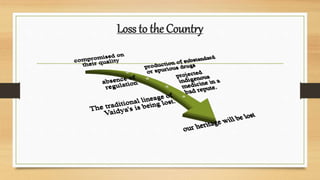
• Loss to the Countries
• Future Prospects
• Case Study
• Summary
• References
Introduction
• Herbal Medicines are being used in India since Vedic age and it has been
documented in Rig-Veda. It has been mentioned in Charaka Samhita.
• In India herbal medicines are used in Ayurveda, Siddha, Unani and
homoeopathic system of Medicine.
• Ayurvedic system is practiced since 6000 B.C., Chinese
herbal medicines is being practiced since 5000 B.C., Where
as the modern system of medicine started since 1800 A.D.
Introduction
• We have around 45000 plants in the Indian Continents out of which 15000
– 20,000 have proven medicinal value.
• Herbal products has been attracting the world since last few decades not only
in underdeveloped or developing but also in developed countries.
What is Herbal Medicine ?
• Herbal medicines are “plant-derived materials or products with
therapeutic or other human health benefits which contain either raw or
processed ingredients from one or more plants”.
• As per WHO definition, --------there are three kinds of herbal medicines:
I. Raw plant materials,
II. Processed plant materials and
III.Medicinal herbal products.
What is the basic difference ?
HERBS
Crude plant material such as leaves, flowers, fruit, seed,
stems, wood, bark, roots, rhizomes or other plant parts,
which may be entire, fragmented or powdered.
HERBAL DRUGS
Finished labeled products that contain active ingredients such
as aerial or underground parts of plant or other plant material
or combinations thereof, whether in the crude state or as
plant preparations.
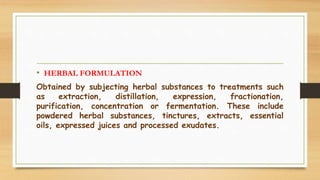
• HERBAL FORMULATION
Obtained by subjecting herbal substances to treatments such
as extraction, distillation, expression, fractionation,
purification, concentration or fermentation. These include
powdered herbal substances, tinctures, extracts, essential
oils, expressed juices and processed exudates.
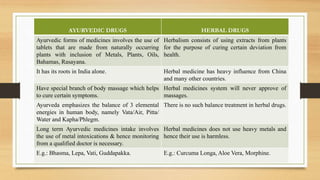
AYURVEDIC DRUGS HERBAL DRUGS
Ayurvedic forms of medicines involves the use of
tablets that are made from naturally occurring
plants with inclusion of Metals, Plants, Oils,
Bahamas, Rasayana.
Herbalism consists of using extracts from plants
for the purpose of curing certain deviation from
health.
It has its roots in India alone. Herbal medicine has heavy influence from China
and many other countries.
Have special branch of body massage which helps
to cure certain symptoms.
Herbal medicines system will never approve of
massages.
Ayurveda emphasizes the balance of 3 elemental
energies in human body, namely Vata/Air, Pitta/
Water and Kapha/Phlegm.
There is no such balance treatment in herbal drugs.
Long term Ayurvedic medicines intake involves
the use of metal intoxications & hence monitoring
from a qualified doctor is necessary.
Herbal medicines does not use heavy metals and
hence their use is harmless.
E.g.: Bhasma, Lepa, Vati, Guddapakka. E.g.: Curcuma Longa, Aloe Vera, Morphine.
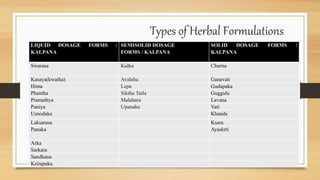
Types of Herbal Formulations
LIQUID DOSAGE FORMS /
KALPANA
SEMISOLID DOSAGE
FORMS / KALPANA
SOLID DOSAGE FORMS /
KALPANA
Swarasa Kalka Churna
Kasaya(kwatha) Avaleha Ganavati
Hima Lepa Gudapaka
Phantha Siktha Taila Guggulu
Pramathya Malahara Lavana
Paniya Upanaha Vati
Usnodaka Khanda
Laksarasa Ksara
Panaka Ayaskrti
Arka
Sarkara
Sandhana
Ksirapaka
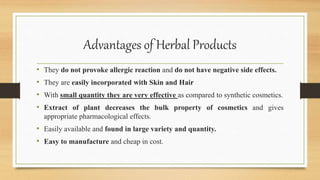
Advantages of Herbal Products
• They do not provoke allergic reaction and do not have negative side effects.
• They are easily incorporated with Skin and Hair
• With small quantity they are very effective as compared to synthetic cosmetics.
• Extract of plant decreases the bulk property of cosmetics and gives
appropriate pharmacological effects.
• Easily available and found in large variety and quantity.
• Easy to manufacture and cheap in cost.
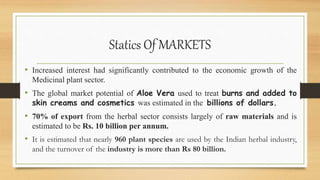
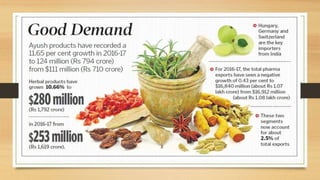
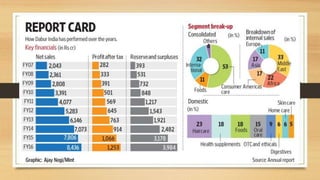
Statics Of MARKETS
• Increased interest had significantly contributed to the economic growth of the
Medicinal plant sector.
• The global market potential of Aloe Vera used to treat burns and added to
skin creams and cosmetics was estimated in the billions of dollars.
• 70% of export from the herbal sector consists largely of raw materials and is
estimated to be Rs. 10 billion per annum.
• It is estimated that nearly 960 plant species are used by the Indian herbal industry,
and the turnover of the industry is more than Rs 80 billion.
Salient features of Indian Regulations
• IMCC(Central Council of Indian Medicine) Act, Research Councils like (ICMR &
CSIR), Dept. of AYUSH and Drug & Cosmetic Act 1940 regulates herbal medicines in
India.

• They must follow the DCGI’s Regulations. (Drug Controller General of India).
• In 1st amendment of D & C Act Rules 2008--------Introduced Schedule TA for record of
utilization of raw material by herbal drugs.
• In 2nd amendment of D & C Act Rules 2008--------They permitted the use of
excipients in the herbal formulations.
QUALITYCONTROL AYURVEDICDRUGS
(Drugs & Cosmetics Act,
1940 & Rules, 1945)
• Separate Chapter for Ayurveda, Siddha & Unani medicines introduced in Chapter IV
A.
• SCHEDULE M: Good manufacturing practices and requirements of premises,
plant and equipments for pharmaceutical products.
• SCHEDULE M I: Requirements of factory premises for manufacture of
homoeopathic (ASU) preparation.
• SCHEDULE M II: Requirement of factory premises for manufacture of
cosmetics.
Schedules for Herbal Drugs in
CDSCO
• First Schedule substituted by act 13 of 1964 came into force w.e.f---
-- 1-2-1969. for manufacturing Ayurveda, Siddha and Unani drugs.
About 57 books of Ayurveda (with insertion in 1987, 1994, 2002), 29
of Siddha (1987) and 13 of Unani Tabb system are listed.
• SCHEDULE-E (1): List of poisonous substances under the
Ayurvedic (including Siddha) and Unani System of Medicine
(Added by Notifn. No. 1-23/67-D dt. 2-2-1970) differentiated into
vegetable, animals and mineral origin.
Schedules for Herbal Drugs in CDSCO
• SCHEDULE T: Good Manufacturing Practice (GMP) for Ayurvedic,
Siddha and Unani medicines. (Ins by G.S.R. 561 (E) dt. 23-06-2000 and subs.
by G.S.SR. 198(E), dt. 7.3.2003.). Under Schedule “T” of the drugs and
cosmetics act 1940, the government has made it mandatory for all
manufacturing units to adhere to GMP.
• SCHEDULE Q: No Cosmetic shall contain Dyes, Colours and Pigments
other than those specified by the Bureau of Indian Standards (IS:4707 Part 1
as amended)
• 33 C - Separate Drug Technical Advisory Board under Drugs & Cosmetics
Act, 1940 for Indian Systems of Medicines to advise Government on all
aspects related to quality control and drug standardization.
• 33EEB - Regulation of manufacture for sale of Ayurvedic drugs through
drug license system.
Rules
• Rules: Part XVI (Parts XVI, XVII and XVII added by S.O. 642, dt. the
2-2-1970 ( w.e.f. 21.2.1970) Manufacture for sale of Ayurvedic (including
siddha) or Unani drugs. It notifies about how to acquire license, loan for
establishing a unit and also on the identification of raw materials and
its purity.
• Part XVIA: Approval of the institutions for carrying out tests on
Ayurvedic, siddha and Unani drugs and raw materials used in their
manufacture on behalf of licensees for manufacture of sale of Ayurvedic,
siddha and Unani drugs (Ins. By G.S.R. 701(E), dt. 27-7-2001 and subs.
by G.S.R.73 (E), dt. 31-01-2003.)
Rules
• Part XVII: Labelling, packing and limit of alcohol in Ayurvedic
(including siddha) or Unani drugs. (Subs. by G.S.R. 904 (E), dt. 2.11.1992.)
• Part XVIII: Government analysts and inspectors for Ayurvedic (including
siddha) or Unani drugs.
• Part XIX: Standards of Ayurvedic, Siddha and Unani drugs (Ins. By
G.S.R. 519(E), dt. 26.6.1995.)
AYUSH Regulates
• Control of Drug Quality
• Laying down Pharmacopoeial Standards
• Overseeing working of PLIM
• QCI---Quality Council of India
• Oversees functioning of IMPCL (Indian Medicine Pharmaceutical Company
Limited.
• Also enforcement of GMP
• Regulates Common facilities -----implementing Drug Quality Control.
AYUSH Product
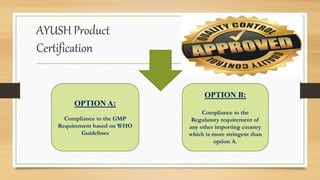
Certification
OPTION A:
Compliance to the GMP
Requirement based on WHO
Guidelines
OPTION B:
Compliance to the
Regulatory requirement of
any other importing country
which is more stringent than
option A.
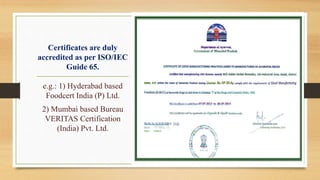
Certificates are duly
accredited as per ISO/IEC
Guide 65.
• Certificates.
e.g.: 1) Hyderabad based
Foodcert India (P) Ltd.
2) Mumbai based Bureau
VERITAS Certification
(India) Pvt. Ltd.
New regulatory guidelines by Dept. of AYUSH
GAPs
• Also known as Good Agriculture Practice.
• To promote the agriculture practice of herbal drugs.
GACPs
• Also known as Good Agriculture collection practice.
• For cultivation and collection of herbal drugs.
GAFCPs
• Also known as Good Agriculture and field collection practice.
• For better field selection and harvesting.
Clinical TRIALS
Phases for Clinical Trials
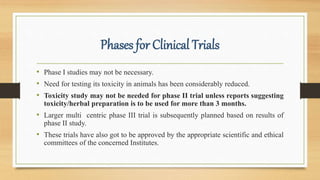
• Phase I studies may not be necessary.
• Need for testing its toxicity in animals has been considerably reduced.
• Toxicity study may not be needed for phase II trial unless reports suggesting
toxicity/herbal preparation is to be used for more than 3 months.
• Larger multi centric phase III trial is subsequently planned based on results of
phase II study.
• These trials have also got to be approved by the appropriate scientific and ethical
committees of the concerned Institutes.
Regulatory Requirement for Clinical Trials of Herbal Drugs
• The procedures laid down by the office of the DCGI for allopathic drugs
should be followed for all traditional and herbal products to enter into
clinical trials for any therapeutic condition.
• Co-investigators/collaborators of the expert group are from the associations
of physicians from the concerned system for designing and evaluating the
Study.
Problems to Promote
• Quality Issues:
• Processing and harvesting issues:
• Quality control related issues:
• Administrative issues:
• Infrastructure related issue:
• Pharmacovigilance:
• Clinical trial:
• IPR and bio piracy:
• Irrational use:
• R&D:
• Other issues:
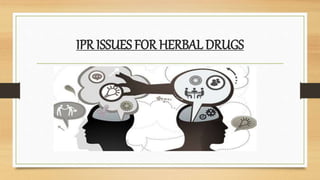
IPR ISSUES FOR HERBAL DRUGS
• India’s patent laws with the Amendment Act of 2005 which contains provisions for
mandatory disclosure of source and geographical origin of the biological materials used in the
invention while applying for patents and also allowed the composition of a drug to be patented.
• The Indian Biodiversity act 2002 which follows the convention for Biological Diversity’s
guidelines regarding benefits sharing.
• India has established a central authority “National Biodiversity Authority” to monitor
and control foreign access to Indian biological resources including traditional medicines.
• Development of a database called “Traditional Knowledge Digital Library” (TKDL) that
will documents as well as established the prior art to hinder patenting Indian Knowledge.
This task has been entrusted to NISCAIR, a CSIR Laboratory.
V/S
Comparison with regulations
of EUROPE
 Most Stringent
For marketing authorization------bibliographic evidence & preclinical
safety data. As per traditional herbal medicinal product directive
(2004/24/EC).
For registration------ Quantitative and Qualitative Documents as per
[ Article 8 (3) (a) to , (h) (j)(k) ] & [Article 11 (4) of Directive
2001/83/EC] a summary of product characteristics.
Expensive for Indian Herbal Manufacturer
V/S
Comparison with regulations
of USA
 Indian herbal drugs are marketed as dietary supplements under Dietary
Supplement Health & Education Act of 1994.
No need to provide Safety and efficacy data-------responsibility on
manufacturer.
No need to register in FDA.
No health claim towards a particular disease or disorder is allowed.
Loss to the Country
FUTURE PROSPECTS
• Awareness regarding GAP, GACP, and GSP (Good Storage Practice)
among growers and manufacturers.
• Implementation and regulation of the D&C Act.
• Development of unified protocols, defined timelines, and specific
guidelines defining the meetings with regulators.
• Capacity building and knowledge sharing within small to medium
enterprises.
• Financial assistance.
• Promotion of AYUSH education, with emphasis on technical education in
AYUSH
• Popularization and promotion of Indian system of medicine in foreign countries
• Elaborate guidelines on quality control of herbal medicines
• Development of monographs and reference standards for marker-based analysis
for all the plants used in medicinal preparations
• Supply of standardized and certified raw materials and extracts, sustainable
cultivation of medicinal plants by identifying suitable zones
CASE STUDY
Background: The Himalaya Drug Company is a leading multinational medicinal drug
company.
• Their products are prescribed by 400,000 doctors worldwide and millions of customers
trust them for their health and personal care needs.
Challenges: Himalaya's state-of-art factory in Bengaluru, its existing finished goods
warehouse of approximately 16,000 square feet area faced issues of high temperature
during the summer season and high humidity during the monsoon season.
• Adverse effect on the stored finished goods resulting in the reduction of
their shelf life.
• The ideal environment : 26°C throughout the year and relative humidity
(RH) levels between 55% and 60% in the monsoon season.
Solution: HMX carried out an extensive study of the seasonal weather
conditions in Bengaluru and found out that the HMX-Ambiator on its own
was capable of maintaining the desired conditions for 70% time of the year.
• HMX came out with the proposal of fresh air air-conditioning (FAAC). It is
Indirect Direct Evaporative Cooling and refrigerated air-conditioning and
installed this unit.
• This unit works in evaporative cooling mode when the outside
weather is hot and dry and in air-conditioning mode during the
monsoon season. The switch between the two modes is
automatic, based on the ambient weather conditions.
Results:
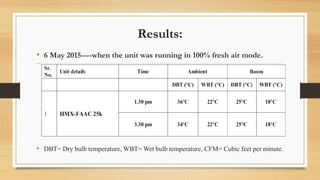
• 6 May 2015----when the unit was running in 100% fresh air mode.
• DBT= Dry bulb temperature, WBT= Wet bulb temperature, CFM= Cubic feet per minute.
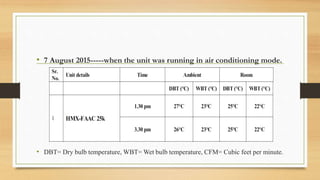
• 7 August 2015-----when the unit was running in air conditioning mode.
• DBT= Dry bulb temperature, WBT= Wet bulb temperature, CFM= Cubic feet per minute.
Summary
• The legal status and the practice of use of herbal drug products vary
significantly from one country to another thus making it difficult for the free
circulation of such products.
• Indian regulations are still at nascent stage when compared to
regulations of Europe and US. Harmonization of regulations, like that
in European Countries could overcome the barrier for efficient trade as
well as uniform standards for herbal medicinal products.
References
• THE JOURNAL OF ALTERNATIVE AND COMPLEMENTARY
MEDICINE Volume 19, Number 12, 2013, pp. 957–963 Mary Ann Liebert,
Inc. DOI: 10.1089/acm.2012.0275 Niharika Sahoo, PhD, 1 and
Padmavati Manchikanti, PhD2
• International Journal of Herbal Medicine 2013: Regulation and Practice in
Europe, United States and India ISSN 2321-2187 IJHM 2013; 1 (4): 1-5
Nitin Verma School of Pharmacy and Emerging Science (SPES), Baddi
University of Emerging Science and Technology.
• Cental Drug standard control organization. www.cdsco.co.in
Herbal regulations

Herbal regulations

  • 1.
    HERBAL DRUG REGULATION ININDIA Prepared By: Guided By: Chandani Tripathi Dr. Gayatri Patel 17MPHRA010 Associate Professor
  • 3.
    Table of Content •Introduction • Types of Herbal Drug Formulations • Advantages of Herbal Drugs • Statics of the Market • Schedules • Rules • Ayush Regulations • Clinical Trials • Problems in promotion
  • 4.
    Table of Content •IPR Issues • Regulation in India v/s EU • Regulation in India v/s USA • Loss to the Countries • Future Prospects • Case Study • Summary • References
  • 5.
    Introduction • Herbal Medicinesare being used in India since Vedic age and it has been documented in Rig-Veda. It has been mentioned in Charaka Samhita. • In India herbal medicines are used in Ayurveda, Siddha, Unani and homoeopathic system of Medicine. • Ayurvedic system is practiced since 6000 B.C., Chinese herbal medicines is being practiced since 5000 B.C., Where as the modern system of medicine started since 1800 A.D.
  • 6.
    Introduction • We havearound 45000 plants in the Indian Continents out of which 15000 – 20,000 have proven medicinal value. • Herbal products has been attracting the world since last few decades not only in underdeveloped or developing but also in developed countries.
  • 8.
    What is HerbalMedicine ? • Herbal medicines are “plant-derived materials or products with therapeutic or other human health benefits which contain either raw or processed ingredients from one or more plants”. • As per WHO definition, --------there are three kinds of herbal medicines: I. Raw plant materials, II. Processed plant materials and III.Medicinal herbal products.
  • 9.
    What is thebasic difference ? HERBS Crude plant material such as leaves, flowers, fruit, seed, stems, wood, bark, roots, rhizomes or other plant parts, which may be entire, fragmented or powdered. HERBAL DRUGS Finished labeled products that contain active ingredients such as aerial or underground parts of plant or other plant material or combinations thereof, whether in the crude state or as plant preparations.
  • 10.
    • HERBAL FORMULATION Obtainedby subjecting herbal substances to treatments such as extraction, distillation, expression, fractionation, purification, concentration or fermentation. These include powdered herbal substances, tinctures, extracts, essential oils, expressed juices and processed exudates.
  • 11.
    AYURVEDIC DRUGS HERBALDRUGS Ayurvedic forms of medicines involves the use of tablets that are made from naturally occurring plants with inclusion of Metals, Plants, Oils, Bahamas, Rasayana. Herbalism consists of using extracts from plants for the purpose of curing certain deviation from health. It has its roots in India alone. Herbal medicine has heavy influence from China and many other countries. Have special branch of body massage which helps to cure certain symptoms. Herbal medicines system will never approve of massages. Ayurveda emphasizes the balance of 3 elemental energies in human body, namely Vata/Air, Pitta/ Water and Kapha/Phlegm. There is no such balance treatment in herbal drugs. Long term Ayurvedic medicines intake involves the use of metal intoxications & hence monitoring from a qualified doctor is necessary. Herbal medicines does not use heavy metals and hence their use is harmless. E.g.: Bhasma, Lepa, Vati, Guddapakka. E.g.: Curcuma Longa, Aloe Vera, Morphine.
  • 12.
    Types of HerbalFormulations LIQUID DOSAGE FORMS / KALPANA SEMISOLID DOSAGE FORMS / KALPANA SOLID DOSAGE FORMS / KALPANA Swarasa Kalka Churna Kasaya(kwatha) Avaleha Ganavati Hima Lepa Gudapaka Phantha Siktha Taila Guggulu Pramathya Malahara Lavana Paniya Upanaha Vati Usnodaka Khanda Laksarasa Ksara Panaka Ayaskrti Arka Sarkara Sandhana Ksirapaka
  • 14.
    Advantages of HerbalProducts • They do not provoke allergic reaction and do not have negative side effects. • They are easily incorporated with Skin and Hair • With small quantity they are very effective as compared to synthetic cosmetics. • Extract of plant decreases the bulk property of cosmetics and gives appropriate pharmacological effects. • Easily available and found in large variety and quantity. • Easy to manufacture and cheap in cost.
  • 15.
    Statics Of MARKETS •Increased interest had significantly contributed to the economic growth of the Medicinal plant sector. • The global market potential of Aloe Vera used to treat burns and added to skin creams and cosmetics was estimated in the billions of dollars. • 70% of export from the herbal sector consists largely of raw materials and is estimated to be Rs. 10 billion per annum. • It is estimated that nearly 960 plant species are used by the Indian herbal industry, and the turnover of the industry is more than Rs 80 billion.
  • 19.
    Salient features ofIndian Regulations • IMCC(Central Council of Indian Medicine) Act, Research Councils like (ICMR & CSIR), Dept. of AYUSH and Drug & Cosmetic Act 1940 regulates herbal medicines in India. • They must follow the DCGI’s Regulations. (Drug Controller General of India). • In 1st amendment of D & C Act Rules 2008--------Introduced Schedule TA for record of utilization of raw material by herbal drugs. • In 2nd amendment of D & C Act Rules 2008--------They permitted the use of excipients in the herbal formulations.
  • 20.
    QUALITYCONTROL AYURVEDICDRUGS (Drugs &Cosmetics Act, 1940 & Rules, 1945) • Separate Chapter for Ayurveda, Siddha & Unani medicines introduced in Chapter IV A. • SCHEDULE M: Good manufacturing practices and requirements of premises, plant and equipments for pharmaceutical products. • SCHEDULE M I: Requirements of factory premises for manufacture of homoeopathic (ASU) preparation. • SCHEDULE M II: Requirement of factory premises for manufacture of cosmetics.
  • 21.
    Schedules for HerbalDrugs in CDSCO • First Schedule substituted by act 13 of 1964 came into force w.e.f--- -- 1-2-1969. for manufacturing Ayurveda, Siddha and Unani drugs. About 57 books of Ayurveda (with insertion in 1987, 1994, 2002), 29 of Siddha (1987) and 13 of Unani Tabb system are listed. • SCHEDULE-E (1): List of poisonous substances under the Ayurvedic (including Siddha) and Unani System of Medicine (Added by Notifn. No. 1-23/67-D dt. 2-2-1970) differentiated into vegetable, animals and mineral origin.
  • 22.
    Schedules for HerbalDrugs in CDSCO • SCHEDULE T: Good Manufacturing Practice (GMP) for Ayurvedic, Siddha and Unani medicines. (Ins by G.S.R. 561 (E) dt. 23-06-2000 and subs. by G.S.SR. 198(E), dt. 7.3.2003.). Under Schedule “T” of the drugs and cosmetics act 1940, the government has made it mandatory for all manufacturing units to adhere to GMP. • SCHEDULE Q: No Cosmetic shall contain Dyes, Colours and Pigments other than those specified by the Bureau of Indian Standards (IS:4707 Part 1 as amended)
  • 23.
    • 33 C- Separate Drug Technical Advisory Board under Drugs & Cosmetics Act, 1940 for Indian Systems of Medicines to advise Government on all aspects related to quality control and drug standardization. • 33EEB - Regulation of manufacture for sale of Ayurvedic drugs through drug license system.
  • 24.
    Rules • Rules: PartXVI (Parts XVI, XVII and XVII added by S.O. 642, dt. the 2-2-1970 ( w.e.f. 21.2.1970) Manufacture for sale of Ayurvedic (including siddha) or Unani drugs. It notifies about how to acquire license, loan for establishing a unit and also on the identification of raw materials and its purity. • Part XVIA: Approval of the institutions for carrying out tests on Ayurvedic, siddha and Unani drugs and raw materials used in their manufacture on behalf of licensees for manufacture of sale of Ayurvedic, siddha and Unani drugs (Ins. By G.S.R. 701(E), dt. 27-7-2001 and subs. by G.S.R.73 (E), dt. 31-01-2003.)
  • 25.
    Rules • Part XVII:Labelling, packing and limit of alcohol in Ayurvedic (including siddha) or Unani drugs. (Subs. by G.S.R. 904 (E), dt. 2.11.1992.) • Part XVIII: Government analysts and inspectors for Ayurvedic (including siddha) or Unani drugs. • Part XIX: Standards of Ayurvedic, Siddha and Unani drugs (Ins. By G.S.R. 519(E), dt. 26.6.1995.)
  • 26.
    AYUSH Regulates • Controlof Drug Quality • Laying down Pharmacopoeial Standards • Overseeing working of PLIM • QCI---Quality Council of India • Oversees functioning of IMPCL (Indian Medicine Pharmaceutical Company Limited. • Also enforcement of GMP • Regulates Common facilities -----implementing Drug Quality Control.
  • 27.
    AYUSH Product Certification OPTION A: Complianceto the GMP Requirement based on WHO Guidelines OPTION B: Compliance to the Regulatory requirement of any other importing country which is more stringent than option A.
  • 28.
    Certificates are duly accreditedas per ISO/IEC Guide 65. • Certificates. e.g.: 1) Hyderabad based Foodcert India (P) Ltd. 2) Mumbai based Bureau VERITAS Certification (India) Pvt. Ltd.
  • 29.
    New regulatory guidelinesby Dept. of AYUSH GAPs • Also known as Good Agriculture Practice. • To promote the agriculture practice of herbal drugs. GACPs • Also known as Good Agriculture collection practice. • For cultivation and collection of herbal drugs. GAFCPs • Also known as Good Agriculture and field collection practice. • For better field selection and harvesting.
  • 30.
  • 31.
    Phases for ClinicalTrials • Phase I studies may not be necessary. • Need for testing its toxicity in animals has been considerably reduced. • Toxicity study may not be needed for phase II trial unless reports suggesting toxicity/herbal preparation is to be used for more than 3 months. • Larger multi centric phase III trial is subsequently planned based on results of phase II study. • These trials have also got to be approved by the appropriate scientific and ethical committees of the concerned Institutes.
  • 32.
    Regulatory Requirement forClinical Trials of Herbal Drugs • The procedures laid down by the office of the DCGI for allopathic drugs should be followed for all traditional and herbal products to enter into clinical trials for any therapeutic condition. • Co-investigators/collaborators of the expert group are from the associations of physicians from the concerned system for designing and evaluating the Study.
  • 34.
    Problems to Promote •Quality Issues: • Processing and harvesting issues: • Quality control related issues: • Administrative issues: • Infrastructure related issue:
  • 35.
    • Pharmacovigilance: • Clinicaltrial: • IPR and bio piracy: • Irrational use: • R&D: • Other issues:
  • 36.
    IPR ISSUES FORHERBAL DRUGS
  • 37.
    IPR ISSUES FORHERBAL DRUGS • India’s patent laws with the Amendment Act of 2005 which contains provisions for mandatory disclosure of source and geographical origin of the biological materials used in the invention while applying for patents and also allowed the composition of a drug to be patented. • The Indian Biodiversity act 2002 which follows the convention for Biological Diversity’s guidelines regarding benefits sharing. • India has established a central authority “National Biodiversity Authority” to monitor and control foreign access to Indian biological resources including traditional medicines. • Development of a database called “Traditional Knowledge Digital Library” (TKDL) that will documents as well as established the prior art to hinder patenting Indian Knowledge. This task has been entrusted to NISCAIR, a CSIR Laboratory.
  • 38.
  • 39.
    Comparison with regulations ofEUROPE  Most Stringent For marketing authorization------bibliographic evidence & preclinical safety data. As per traditional herbal medicinal product directive (2004/24/EC). For registration------ Quantitative and Qualitative Documents as per [ Article 8 (3) (a) to , (h) (j)(k) ] & [Article 11 (4) of Directive 2001/83/EC] a summary of product characteristics. Expensive for Indian Herbal Manufacturer
  • 40.
  • 41.
    Comparison with regulations ofUSA  Indian herbal drugs are marketed as dietary supplements under Dietary Supplement Health & Education Act of 1994. No need to provide Safety and efficacy data-------responsibility on manufacturer. No need to register in FDA. No health claim towards a particular disease or disorder is allowed.
  • 42.
    Loss to theCountry
  • 43.
    FUTURE PROSPECTS • Awarenessregarding GAP, GACP, and GSP (Good Storage Practice) among growers and manufacturers. • Implementation and regulation of the D&C Act. • Development of unified protocols, defined timelines, and specific guidelines defining the meetings with regulators. • Capacity building and knowledge sharing within small to medium enterprises. • Financial assistance.
  • 45.
    • Promotion ofAYUSH education, with emphasis on technical education in AYUSH • Popularization and promotion of Indian system of medicine in foreign countries • Elaborate guidelines on quality control of herbal medicines • Development of monographs and reference standards for marker-based analysis for all the plants used in medicinal preparations • Supply of standardized and certified raw materials and extracts, sustainable cultivation of medicinal plants by identifying suitable zones
  • 46.
    CASE STUDY Background: TheHimalaya Drug Company is a leading multinational medicinal drug company. • Their products are prescribed by 400,000 doctors worldwide and millions of customers trust them for their health and personal care needs. Challenges: Himalaya's state-of-art factory in Bengaluru, its existing finished goods warehouse of approximately 16,000 square feet area faced issues of high temperature during the summer season and high humidity during the monsoon season. • Adverse effect on the stored finished goods resulting in the reduction of their shelf life.
  • 47.
    • The idealenvironment : 26°C throughout the year and relative humidity (RH) levels between 55% and 60% in the monsoon season. Solution: HMX carried out an extensive study of the seasonal weather conditions in Bengaluru and found out that the HMX-Ambiator on its own was capable of maintaining the desired conditions for 70% time of the year. • HMX came out with the proposal of fresh air air-conditioning (FAAC). It is Indirect Direct Evaporative Cooling and refrigerated air-conditioning and installed this unit. • This unit works in evaporative cooling mode when the outside weather is hot and dry and in air-conditioning mode during the monsoon season. The switch between the two modes is automatic, based on the ambient weather conditions.
  • 48.
    Results: • 6 May2015----when the unit was running in 100% fresh air mode. • DBT= Dry bulb temperature, WBT= Wet bulb temperature, CFM= Cubic feet per minute.
  • 49.
    • 7 August2015-----when the unit was running in air conditioning mode. • DBT= Dry bulb temperature, WBT= Wet bulb temperature, CFM= Cubic feet per minute.
  • 50.
    Summary • The legalstatus and the practice of use of herbal drug products vary significantly from one country to another thus making it difficult for the free circulation of such products. • Indian regulations are still at nascent stage when compared to regulations of Europe and US. Harmonization of regulations, like that in European Countries could overcome the barrier for efficient trade as well as uniform standards for herbal medicinal products.
  • 51.
    References • THE JOURNALOF ALTERNATIVE AND COMPLEMENTARY MEDICINE Volume 19, Number 12, 2013, pp. 957–963 Mary Ann Liebert, Inc. DOI: 10.1089/acm.2012.0275 Niharika Sahoo, PhD, 1 and Padmavati Manchikanti, PhD2 • International Journal of Herbal Medicine 2013: Regulation and Practice in Europe, United States and India ISSN 2321-2187 IJHM 2013; 1 (4): 1-5 Nitin Verma School of Pharmacy and Emerging Science (SPES), Baddi University of Emerging Science and Technology. • Cental Drug standard control organization. www.cdsco.co.in