Regulations
Guidelines
&
Ethics
in Clinical Research
Dr. Harisha.S
ICBio Clinical Research Pvt. Ltd
An Overview of
“A Clinical Trial (Clinical Research) is
controlled by the Regulations (laws) and is
Conducted based on the prescribed Guidelines
and ethical considerations”.
Anonymous
Regulations :
 The act of controlling, managing or directing according to the rules led by
the laws
 Governed by the Regulatory bodies
Guidelines:
 The written instructions to be followed for the credible and standardized act
 Prescribed by different Organizations
Ethics:
 “Whatever our society accepts; after all we are human beings"
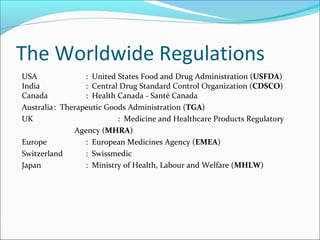
The Worldwide Regulations
USA : United States Food and Drug Administration (USFDA)
India : Central Drug Standard Control Organization (CDSCO)
Canada : Health Canada - Santé Canada
Australia: Therapeutic Goods Administration (TGA)
UK : Medicine and Healthcare Products Regulatory
Agency (MHRA)
Europe : European Medicines Agency (EMEA)
Switzerland : Swissmedic
Japan : Ministry of Health, Labour and Welfare (MHLW)
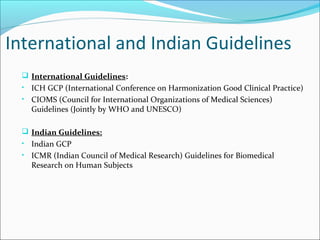
International and Indian Guidelines
 International Guidelines:
• ICH GCP (International Conference on Harmonization Good Clinical Practice)
• CIOMS (Council for International Organizations of Medical Sciences)
Guidelines (Jointly by WHO and UNESCO)
 Indian Guidelines:
• Indian GCP
• ICMR (Indian Council of Medical Research) Guidelines for Biomedical
Research on Human Subjects
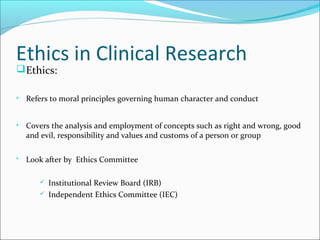
Ethics in Clinical Research
Ethics:
• Refers to moral principles governing human character and conduct
• Covers the analysis and employment of concepts such as right and wrong, good
and evil, responsibility and values and customs of a person or group
• Look after by Ethics Committee
 Institutional Review Board (IRB)
 Independent Ethics Committee (IEC)
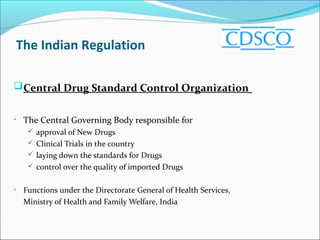
The Indian Regulation
Central Drug Standard Control Organization
• The Central Governing Body responsible for
 approval of New Drugs
 Clinical Trials in the country
 laying down the standards for Drugs
 control over the quality of imported Drugs
• Functions under the Directorate General of Health Services,
Ministry of Health and Family Welfare, India
• CDSCO office is located at Nirman Bhawan, New Delhi 110011
• Head of the CDSCO: Drug Controller General of India (DCGI)
(Current DCGI : Dr. G N Singh)
• Has four Zonal Offices (Mumbai, Kolkata, Chennai, and Ghaziabad) Central
Drugs Laboratories (CDL) Kolkata, Central Drugs Testing Laboratories
(CDTL) (Chennai, Mumbai and Guwahati) and Central Indian
Pharmacopoeia Laboratory (CIPL), Ghaziabad.
Schedule Y
• Law for permission to import and / or manufacture of new drugs for sale or
to undertake clinical trials
• The Schedule Y laws have rooted out from the Drugs and Cosmetics Act of
1940 and are based on Rules 122A, 122B, 122D, 122DA, 122DAA and 122E of
Drugs and Cosmetics Act,1940
• Schedule Y has 12 appendices starting with roman letters I to XII
• Form44 : Application form to be submitted to the DCGI office for the grant
of permission to import or manufacture a new drug or to undertake clinical
trial.
Contd..
Schedule Y
APPENDIX I:
DATA TO BE SUBMITTED ALONG WITH THE APPLICATION TO CONDUCT
CLINICAL TRIALS / IMPORT / MANUFACTURE OF NEW DRUGS FOR MARKETING IN
THE COUNTRY.
APPENDIX I-A:
DATA REQUIRED TO BE SUBMITTED BY AN APPLICANT FOR GRANT OF
PERMISSION TO IMPORT AND / OR MANUFACTURE A NEW DRUG ALREADY
APPROVED IN THE COUNTRY.
APPENDIX II:
STRUCTURE, CONTENTS AND FORMAT FOR CLINICAL STUDY REPORTS
Contd..
APPENDIX III:
ANIMAL TOXICOLOGY (NON-CLINICAL TOXICITY STUDIES)
APPENDIX IV:
ANIMAL PHARMACOLOGY
Appendix V:
INFORMED CONSENT
Contd..
APPENDIX VI:
FIXED DOSE COMBINATIONS (FDCs)
APPENDIX VII:
UNDERTAKING BY THE INVESTIGATOR
APPENDIX VIII:
ETHICS COMMITTEE
APPENDIX IX:
STABILITY TESTING OF NEW DRUGS
APPENDIX X:
CONTENTS OF THE PROPOSED PROTOCOL FOR CONDUCTING
CLINICAL TRIALS
APPENDIX XI:
DATA ELEMENTS FOR REPORTING SERIOUS ADVERSE EVENTS
OCCURING IN A CLINICAL TRIAL
The International RegulationFood and Drug Administration (FDA)
 An agency of the United States Department of Health and Human Services
(DHHS / HHS)
 Responsible for regulating:
 Food
 Dietary supplements
 Drugs
 Biological medical products
 Blood products
 medical devices
 Radiation-emitting devices
 Veterinary products
 Cosmetics
Central Evaluation Laboratories under FDA
 The Center for Drug Evaluation and Research (CDER)
 The Center for Biologics Evaluation and Research (CBER)
FDA Laws:
 Code of Federal Regulations (CFR)
 Rooted out from Food, Drug and Cosmetic Act, chapter 1, Title 21(So called 21
CFR)
 21 CFR is divided into total 1499 parts starting from 1.
 Some important regulations of FDA required for conduction of
Clinical Trial and Drug Approval Process are:
 21 CFR Part-11: ELECTRONIC RECORDS;
ELECTRONIC SIGNATURE
 21 CFR Part-50: PROTECTION OF HUMAN SUBJECTS
 21 CFR Part-54: FINANCIAL DISCLOSURE BY CLINICAL
INVESTIGATORS
 21 CFR Part-56: INSTITUTIONAL REVIEW BOARDS
 21 CFR Part-312:INVESTIGATIONAL NEW DRUG
APPLICATION
 21 CFR Part-314: APPLICATIONS FOR FDA APPROVAL TO
MARKET A NEW DRUG
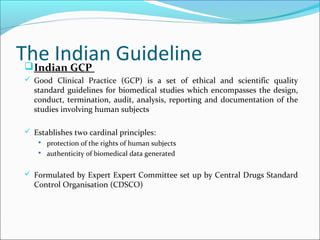
The Indian GuidelineIndian GCP
 Good Clinical Practice (GCP) is a set of ethical and scientific quality
standard guidelines for biomedical studies which encompasses the design,
conduct, termination, audit, analysis, reporting and documentation of the
studies involving human subjects
 Establishes two cardinal principles:
 protection of the rights of human subjects
 authenticity of biomedical data generated
 Formulated by Expert Expert Committee set up by Central Drugs Standard
Control Organisation (CDSCO)
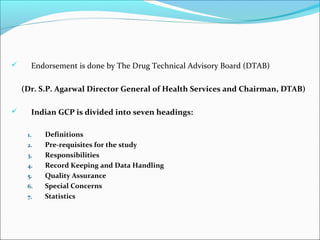
 Endorsement is done by The Drug Technical Advisory Board (DTAB)
(Dr. S.P. Agarwal Director General of Health Services and Chairman, DTAB)
 Indian GCP is divided into seven headings:
1. Definitions
2. Pre-requisites for the study
3. Responsibilities
4. Record Keeping and Data Handling
5. Quality Assurance
6. Special Concerns
7. Statistics

Regulations, guidelines & ethics in clinical research

  • 1.
    Regulations Guidelines & Ethics in Clinical Research Dr.Harisha.S ICBio Clinical Research Pvt. Ltd An Overview of
  • 2.
    “A Clinical Trial(Clinical Research) is controlled by the Regulations (laws) and is Conducted based on the prescribed Guidelines and ethical considerations”. Anonymous
  • 3.
    Regulations :  Theact of controlling, managing or directing according to the rules led by the laws  Governed by the Regulatory bodies Guidelines:  The written instructions to be followed for the credible and standardized act  Prescribed by different Organizations Ethics:  “Whatever our society accepts; after all we are human beings"
  • 4.
    The Worldwide Regulations USA: United States Food and Drug Administration (USFDA) India : Central Drug Standard Control Organization (CDSCO) Canada : Health Canada - Santé Canada Australia: Therapeutic Goods Administration (TGA) UK : Medicine and Healthcare Products Regulatory Agency (MHRA) Europe : European Medicines Agency (EMEA) Switzerland : Swissmedic Japan : Ministry of Health, Labour and Welfare (MHLW)
  • 5.
    International and IndianGuidelines  International Guidelines: • ICH GCP (International Conference on Harmonization Good Clinical Practice) • CIOMS (Council for International Organizations of Medical Sciences) Guidelines (Jointly by WHO and UNESCO)  Indian Guidelines: • Indian GCP • ICMR (Indian Council of Medical Research) Guidelines for Biomedical Research on Human Subjects
  • 6.
    Ethics in ClinicalResearch Ethics: • Refers to moral principles governing human character and conduct • Covers the analysis and employment of concepts such as right and wrong, good and evil, responsibility and values and customs of a person or group • Look after by Ethics Committee  Institutional Review Board (IRB)  Independent Ethics Committee (IEC)
  • 7.
    The Indian Regulation CentralDrug Standard Control Organization • The Central Governing Body responsible for  approval of New Drugs  Clinical Trials in the country  laying down the standards for Drugs  control over the quality of imported Drugs • Functions under the Directorate General of Health Services, Ministry of Health and Family Welfare, India
  • 8.
    • CDSCO officeis located at Nirman Bhawan, New Delhi 110011 • Head of the CDSCO: Drug Controller General of India (DCGI) (Current DCGI : Dr. G N Singh) • Has four Zonal Offices (Mumbai, Kolkata, Chennai, and Ghaziabad) Central Drugs Laboratories (CDL) Kolkata, Central Drugs Testing Laboratories (CDTL) (Chennai, Mumbai and Guwahati) and Central Indian Pharmacopoeia Laboratory (CIPL), Ghaziabad.
  • 9.
    Schedule Y • Lawfor permission to import and / or manufacture of new drugs for sale or to undertake clinical trials • The Schedule Y laws have rooted out from the Drugs and Cosmetics Act of 1940 and are based on Rules 122A, 122B, 122D, 122DA, 122DAA and 122E of Drugs and Cosmetics Act,1940 • Schedule Y has 12 appendices starting with roman letters I to XII • Form44 : Application form to be submitted to the DCGI office for the grant of permission to import or manufacture a new drug or to undertake clinical trial. Contd..
  • 10.
    Schedule Y APPENDIX I: DATATO BE SUBMITTED ALONG WITH THE APPLICATION TO CONDUCT CLINICAL TRIALS / IMPORT / MANUFACTURE OF NEW DRUGS FOR MARKETING IN THE COUNTRY. APPENDIX I-A: DATA REQUIRED TO BE SUBMITTED BY AN APPLICANT FOR GRANT OF PERMISSION TO IMPORT AND / OR MANUFACTURE A NEW DRUG ALREADY APPROVED IN THE COUNTRY. APPENDIX II: STRUCTURE, CONTENTS AND FORMAT FOR CLINICAL STUDY REPORTS Contd..
  • 11.
    APPENDIX III: ANIMAL TOXICOLOGY(NON-CLINICAL TOXICITY STUDIES) APPENDIX IV: ANIMAL PHARMACOLOGY Appendix V: INFORMED CONSENT Contd..
  • 12.
    APPENDIX VI: FIXED DOSECOMBINATIONS (FDCs) APPENDIX VII: UNDERTAKING BY THE INVESTIGATOR APPENDIX VIII: ETHICS COMMITTEE
  • 13.
    APPENDIX IX: STABILITY TESTINGOF NEW DRUGS APPENDIX X: CONTENTS OF THE PROPOSED PROTOCOL FOR CONDUCTING CLINICAL TRIALS APPENDIX XI: DATA ELEMENTS FOR REPORTING SERIOUS ADVERSE EVENTS OCCURING IN A CLINICAL TRIAL
  • 14.
    The International RegulationFoodand Drug Administration (FDA)  An agency of the United States Department of Health and Human Services (DHHS / HHS)  Responsible for regulating:  Food  Dietary supplements  Drugs  Biological medical products  Blood products  medical devices  Radiation-emitting devices  Veterinary products  Cosmetics
  • 15.
    Central Evaluation Laboratoriesunder FDA  The Center for Drug Evaluation and Research (CDER)  The Center for Biologics Evaluation and Research (CBER) FDA Laws:  Code of Federal Regulations (CFR)  Rooted out from Food, Drug and Cosmetic Act, chapter 1, Title 21(So called 21 CFR)  21 CFR is divided into total 1499 parts starting from 1.
  • 16.
     Some importantregulations of FDA required for conduction of Clinical Trial and Drug Approval Process are:  21 CFR Part-11: ELECTRONIC RECORDS; ELECTRONIC SIGNATURE  21 CFR Part-50: PROTECTION OF HUMAN SUBJECTS  21 CFR Part-54: FINANCIAL DISCLOSURE BY CLINICAL INVESTIGATORS  21 CFR Part-56: INSTITUTIONAL REVIEW BOARDS  21 CFR Part-312:INVESTIGATIONAL NEW DRUG APPLICATION  21 CFR Part-314: APPLICATIONS FOR FDA APPROVAL TO MARKET A NEW DRUG
  • 17.
    The Indian GuidelineIndianGCP  Good Clinical Practice (GCP) is a set of ethical and scientific quality standard guidelines for biomedical studies which encompasses the design, conduct, termination, audit, analysis, reporting and documentation of the studies involving human subjects  Establishes two cardinal principles:  protection of the rights of human subjects  authenticity of biomedical data generated  Formulated by Expert Expert Committee set up by Central Drugs Standard Control Organisation (CDSCO)
  • 18.
     Endorsement isdone by The Drug Technical Advisory Board (DTAB) (Dr. S.P. Agarwal Director General of Health Services and Chairman, DTAB)  Indian GCP is divided into seven headings: 1. Definitions 2. Pre-requisites for the study 3. Responsibilities 4. Record Keeping and Data Handling 5. Quality Assurance 6. Special Concerns 7. Statistics