BY:-Shivprasad H. Chilkar
M.Pharm Ist year
(Pharmacology)
 Definition
 Objective
 Key Word
 Protocol
 Scientific Aspect of Clinical Trial
 Participating Parties in Clinical Trial
The great tragedy of science.. the slaying of a beautiful
hypothesis by an ugly fact.
Thomas Henry Huxley
WHAT EXACTLY ARE CLINICAL TRIALS?
 Clinical trials are scientific investigations that examine
and evaluate safety and efficacy of different therapies
in human subjects.
.
Objectives:-
 Developing/Writing a protocol.
 Developing an Investigator Site File (ISF) –
Regulatory Binder.
 Screening, Recruitment, Enrollment and Retention.
 Safety reporting .
 Interim and Annual Reports.
 End of Study Visit.
THE THREE IMPORTANT KEY WORDS
 Experimental Unit
An experimental unit is usually referred to as a subject from a targeted
population under study. For example, the intended population could be
patients with certain diseases at certain stages or healthy human subjects.
 Treatment
In clinical trials a treatment can be a placebo or any combinations of a new
pharmaceutical identity (e.g., a compound or drug), a new diet, a surgical
procedure, a diagnostic test, a medial device, a health education program,
or no treatment.
 Evaluation
In addition to the traditional evaluation of effectiveness and safety of a test
treatment, clinical trials are also designed to assess quality of life,
pharmacogenomics, and pharmaco-economics such as cost-minimization,
cost-effectiveness, and cost-benefit analyses to human subjects associated
with the treatment under study.
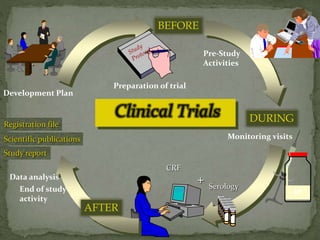
Monitoring visits
Serology
CRF
Data analysis +
Development Plan
Preparation of trial
Study report
Registration file
Scientific publications
IP
Pre-Study
Activities
BEFORE
DURING
AFTER
End of study
activity
Clinical Trials
ļ‚— Title & Abstract
ļ‚— Introduction
ļ‚— General statement of purpose
ļ‚— Complete Preclinical results on animal study
ļ‚— Clinical data if available
ļ‚— Time frame
ļ‚— Goals: Primary & secondary objectives
ļ‚— Study Design:
ļ‚— Type of study
ļ‚— Recruitment criteria : Exclusion & Inclusion criteria
ļ‚— Randomisation criteria and Sample size
ļ‚— Duration of study
ļ‚— Data Analysis:
ļ‚— Case report forms, Statistical Analysis, Bibliography
SPONSORS FOR CLINICAL TRIALS IN THE U.S.
 Pharmaceutical and Biotechnology companies – which
must prove the safety and effectiveness of their medicines
before they can be marketed
National Institutes of Health (NIH) – which are funded by
the US Government. The National Cancer Institute (NCI),
which is a part of the NIH, sponsors a good portion of the
thousands of cancer clinical trials going on at any point of
time.
Other government agencies, including parts of the
Department of Veterans Affairs and the Department
of Defence, also sponsor cancer clinical trials.
 University Medical Schools and Hospitals, or any
other medical research centers.
 Some non-profit organizations and even individual
or group of physicians also sometimes sponsor clinical
trials.
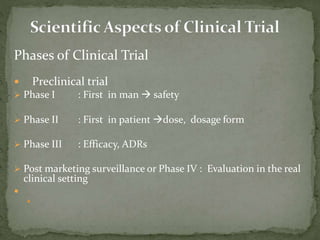
Phases of Clinical Trial
ļ‚— Preclinical trial
 Phase I : First in man  safety
 Phase II : First in patient dose, dosage form
 Phase III : Efficacy, ADRs
 Post marketing surveillance or Phase IV : Evaluation in the real
clinical setting
ļ‚—
ļ‚—
ļ‚— Research on a new drug or a new
medical device , usually done on
animals, to learn about mechanisms of
action, determine how well the
treatment works, and see if it is safe to
test on humans.
ļ‚— Objectives
1. To assess a safe & tolerated dose
2. To see if pharmacokinetics differ much
from animal to man
3. To see if kinetics show proper absorption,
bioavailability
4. To detect effects unrelated to the expected
action
5. To detect any predictable toxicity
ļ‚— Healthy volunteers : Uniformity of subjects:
age, sex, nutritional status [Informed consent
a must]
ļ‚— Exception: Patients only for toxic drugs
eg:- Anti HIV, Anticancer
– Exclusion criteria
ļ‚— Women of child bearing age, children,
ļ‚— First in patient [ different from healthy volunteer]
ļ‚— Early phase [20 – 200 patients with relevant disease]
ļ‚— Therapeutic benefits & ADRs evaluated
ļ‚— Establish a dose range to be used in late phase
ļ‚— Single blind [Only patient knows] comparison with
standard drug
ļ‚— Late phase [ 50 – 500]
ļ‚— Double blind
ļ‚— Compared with a placebo or standard drug
ļ‚— Assesses efficacy against a defined therapeutic
endpoint
ļ‚— Detailed Pharmacokinetic & Pharmacodynamic
data
ļ‚— Establishes a dose & a dosage form for future
trials
ļ‚— Takes 6 months to 2 years [ 35% success rate]
ļ‚— Large scale, Randomised, Controlled trials
ļ‚— Target population: 250 – 1000 patients
ļ‚— Performed by Clinicians in the hospital
ļ‚— Minimises errors of phases I and II
ļ‚— Methods
ļ‚— Multicentric  Ensures geographic & ethnic variations
ļ‚— Diff patient subgroups Eg pediatric, geriatric, renal impaired
ļ‚— Randomised allocation of test drug /placebo / standard drug
ļ‚— Double blinded:
ļ‚— Cross over design
ļ‚— Vigilant recording of all adverse drug reactions
ļ‚— Rigorous statistical evaluation of all clinical data
ļ‚— Takes a long time: up to 5 years [25% success]
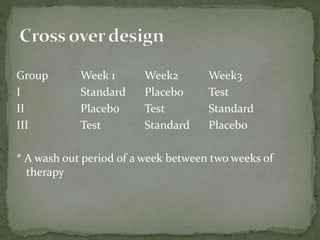
Group Week 1 Week2 Week3
I Standard Placebo Test
II Placebo Test Standard
III Test Standard Placebo
* A wash out period of a week between two weeks of
therapy
ļ‚— No fixed duration / patient population
ļ‚— Starts immediately after marketing
ļ‚— Report all ADRs
ļ‚— Helps to detect
ļ‚— rare ADRs
ļ‚— Drug interactions
ļ‚— Also new uses for drugs [Sometimes called Phase V]
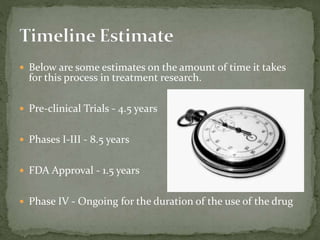
ļ‚— Below are some estimates on the amount of time it takes
for this process in treatment research.
ļ‚— Pre-clinical Trials - 4.5 years
ļ‚— Phases I-III - 8.5 years
ļ‚— FDA Approval - 1.5 years
ļ‚— Phase IV - Ongoing for the duration of the use of the drug
1. Patient / Healthy volunteer
2. Clinical Pharmacologist, Clinical
Investigator & team: [Qualified and
competent]
3. Institution where trials are held :
[Approval required]
4. Ethical Review Board or Institutional
Ethical Committee:
5. Sponsor
6. Regulatory Authorities
ļ‚— Patient / Healthy volunteer : Subject of
the trial
ļ‚— Clinical Pharmacologist, Clinical
Investigator & team:
– Conducts the clinical trial; reports all
adverse events
–
ļ‚— Institution where trials are held :
– Provides all facilities [Approval required]
Clinical trial

Clinical trial

  • 1.
    BY:-Shivprasad H. Chilkar M.PharmIst year (Pharmacology)
  • 2.
     Definition  Objective Key Word  Protocol  Scientific Aspect of Clinical Trial  Participating Parties in Clinical Trial
  • 3.
    The great tragedyof science.. the slaying of a beautiful hypothesis by an ugly fact. Thomas Henry Huxley
  • 4.
    WHAT EXACTLY ARECLINICAL TRIALS?  Clinical trials are scientific investigations that examine and evaluate safety and efficacy of different therapies in human subjects. .
  • 5.
    Objectives:-  Developing/Writing aprotocol.  Developing an Investigator Site File (ISF) – Regulatory Binder.  Screening, Recruitment, Enrollment and Retention.  Safety reporting .  Interim and Annual Reports.  End of Study Visit.
  • 6.
    THE THREE IMPORTANTKEY WORDS  Experimental Unit An experimental unit is usually referred to as a subject from a targeted population under study. For example, the intended population could be patients with certain diseases at certain stages or healthy human subjects.  Treatment In clinical trials a treatment can be a placebo or any combinations of a new pharmaceutical identity (e.g., a compound or drug), a new diet, a surgical procedure, a diagnostic test, a medial device, a health education program, or no treatment.  Evaluation In addition to the traditional evaluation of effectiveness and safety of a test treatment, clinical trials are also designed to assess quality of life, pharmacogenomics, and pharmaco-economics such as cost-minimization, cost-effectiveness, and cost-benefit analyses to human subjects associated with the treatment under study.
  • 7.
    Monitoring visits Serology CRF Data analysis+ Development Plan Preparation of trial Study report Registration file Scientific publications IP Pre-Study Activities BEFORE DURING AFTER End of study activity Clinical Trials
  • 8.
    ļ‚— Title &Abstract ļ‚— Introduction ļ‚— General statement of purpose ļ‚— Complete Preclinical results on animal study ļ‚— Clinical data if available ļ‚— Time frame ļ‚— Goals: Primary & secondary objectives ļ‚— Study Design: ļ‚— Type of study ļ‚— Recruitment criteria : Exclusion & Inclusion criteria ļ‚— Randomisation criteria and Sample size ļ‚— Duration of study ļ‚— Data Analysis: ļ‚— Case report forms, Statistical Analysis, Bibliography
  • 9.
    SPONSORS FOR CLINICALTRIALS IN THE U.S.  Pharmaceutical and Biotechnology companies – which must prove the safety and effectiveness of their medicines before they can be marketed National Institutes of Health (NIH) – which are funded by the US Government. The National Cancer Institute (NCI), which is a part of the NIH, sponsors a good portion of the thousands of cancer clinical trials going on at any point of time.
  • 10.
    Other government agencies,including parts of the Department of Veterans Affairs and the Department of Defence, also sponsor cancer clinical trials.  University Medical Schools and Hospitals, or any other medical research centers.  Some non-profit organizations and even individual or group of physicians also sometimes sponsor clinical trials.
  • 11.
    Phases of ClinicalTrial ļ‚— Preclinical trial  Phase I : First in man  safety  Phase II : First in patient dose, dosage form  Phase III : Efficacy, ADRs  Post marketing surveillance or Phase IV : Evaluation in the real clinical setting ļ‚— ļ‚—
  • 12.
    ļ‚— Research ona new drug or a new medical device , usually done on animals, to learn about mechanisms of action, determine how well the treatment works, and see if it is safe to test on humans.
  • 13.
    ļ‚— Objectives 1. Toassess a safe & tolerated dose 2. To see if pharmacokinetics differ much from animal to man 3. To see if kinetics show proper absorption, bioavailability 4. To detect effects unrelated to the expected action 5. To detect any predictable toxicity
  • 14.
    ļ‚— Healthy volunteers: Uniformity of subjects: age, sex, nutritional status [Informed consent a must] ļ‚— Exception: Patients only for toxic drugs eg:- Anti HIV, Anticancer – Exclusion criteria ļ‚— Women of child bearing age, children,
  • 15.
    ļ‚— First inpatient [ different from healthy volunteer] ļ‚— Early phase [20 – 200 patients with relevant disease] ļ‚— Therapeutic benefits & ADRs evaluated ļ‚— Establish a dose range to be used in late phase ļ‚— Single blind [Only patient knows] comparison with standard drug ļ‚— Late phase [ 50 – 500] ļ‚— Double blind ļ‚— Compared with a placebo or standard drug
  • 16.
    ļ‚— Assesses efficacyagainst a defined therapeutic endpoint ļ‚— Detailed Pharmacokinetic & Pharmacodynamic data ļ‚— Establishes a dose & a dosage form for future trials ļ‚— Takes 6 months to 2 years [ 35% success rate]
  • 17.
    ļ‚— Large scale,Randomised, Controlled trials ļ‚— Target population: 250 – 1000 patients ļ‚— Performed by Clinicians in the hospital ļ‚— Minimises errors of phases I and II ļ‚— Methods ļ‚— Multicentric  Ensures geographic & ethnic variations ļ‚— Diff patient subgroups Eg pediatric, geriatric, renal impaired ļ‚— Randomised allocation of test drug /placebo / standard drug ļ‚— Double blinded: ļ‚— Cross over design ļ‚— Vigilant recording of all adverse drug reactions ļ‚— Rigorous statistical evaluation of all clinical data ļ‚— Takes a long time: up to 5 years [25% success]
  • 18.
    Group Week 1Week2 Week3 I Standard Placebo Test II Placebo Test Standard III Test Standard Placebo * A wash out period of a week between two weeks of therapy
  • 19.
    ļ‚— No fixedduration / patient population ļ‚— Starts immediately after marketing ļ‚— Report all ADRs ļ‚— Helps to detect ļ‚— rare ADRs ļ‚— Drug interactions ļ‚— Also new uses for drugs [Sometimes called Phase V]
  • 20.
    ļ‚— Below aresome estimates on the amount of time it takes for this process in treatment research. ļ‚— Pre-clinical Trials - 4.5 years ļ‚— Phases I-III - 8.5 years ļ‚— FDA Approval - 1.5 years ļ‚— Phase IV - Ongoing for the duration of the use of the drug
  • 21.
    1. Patient /Healthy volunteer 2. Clinical Pharmacologist, Clinical Investigator & team: [Qualified and competent] 3. Institution where trials are held : [Approval required] 4. Ethical Review Board or Institutional Ethical Committee: 5. Sponsor 6. Regulatory Authorities
  • 22.
    ļ‚— Patient /Healthy volunteer : Subject of the trial ļ‚— Clinical Pharmacologist, Clinical Investigator & team: – Conducts the clinical trial; reports all adverse events – ļ‚— Institution where trials are held : – Provides all facilities [Approval required]