PHARMACEUTICAL
MANUFACTURING
What is pharmaceutical
manufacturing
• it is the process of industrial scale
synthesis of pharmaceutical drug by
pharmaceutical companies.
• The process can be broken down into a
series of unit operations such as milling,
drying , compression ,and coating
Dr. ibtihal O. Alkarim 2
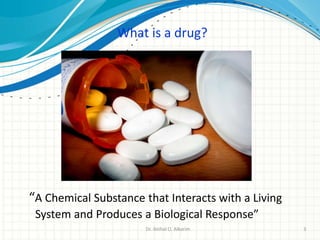
What is a drug?
“A Chemical Substance that Interacts with a Living
System and Produces a Biological Response”
Dr. ibtihal O. Alkarim 3
4
Drug
A drug product consists of therapeutics
(API) and excipients combined in a delivery
system.
A drug product’s success lies in its ability
to deliver the drug at a certain rate in a
certain environment in the body.
Dr. ibtihal O. Alkarim
discovery manufacturing
delivery
Dr. ibtihal O. Alkarim 5
regulations
Dr. ibtihal O. Alkarim 6
7
Regulations
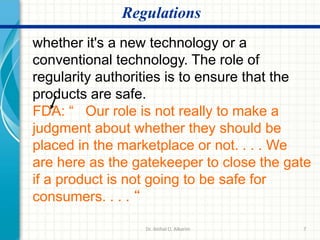
whether it's a new technology or a
conventional technology. The role of
regularity authorities is to ensure that the
products are safe.
FDA: “ Our role is not really to make a
judgment about whether they should be
placed in the marketplace or not. . . . We
are here as the gatekeeper to close the gate
if a product is not going to be safe for
consumers. . . . “
Dr. ibtihal O. Alkarim
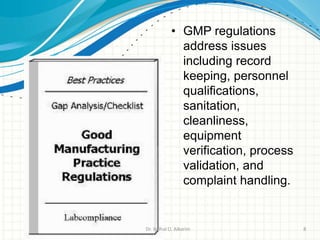
• GMP regulations
address issues
including record
keeping, personnel
qualifications,
sanitation,
cleanliness,
equipment
verification, process
validation, and
complaint handling.
Dr. ibtihal O. Alkarim 8
Dr. ibtihal O. Alkarim 9
Pharmaceutical
market
Dr. ibtihal O. Alkarim 10
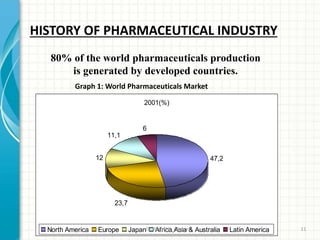
HISTORY OF PHARMACEUTICAL INDUSTRY
Graph 1: World Pharmaceuticals Market
2001(%)
47,2
23,7
12
11,1
6
North America Europe Japan Africa,Asia & Australia Latin America
80% of the world pharmaceuticals production
is generated by developed countries.
Dr. ibtihal O. Alkarim 11
12
World Pharmaceutical Market
Dr. ibtihal O. Alkarim
13
Growth of Pharmaceutical Industry in USA
US Sales
Dr. ibtihal O. Alkarim
14
Comparison of Annual Sales Per Person
ANNUAL SALES PER PERSON OF PHARMACEUTICALS (2004, £ )
Dr. ibtihal O. Alkarim
15
Growth of Pharmaceutical R&D Expenditure
http://www.pharmafocusasia.com/knowledge_bank/articles/images/graph1.gif
Dr. ibtihal O. Alkarim
16
Comparison of Pharmaceutical R&D
WORLD VOLUME OF PHARMACEUTICAL R&D (2004 £m)
http://www.abpi.org.uk/publications/publication_details/annualReview2005/ar2005_leader.aspDr. ibtihal O. Alkarim
New drug
discovery
Dr. ibtihal O. Alkarim 17
18
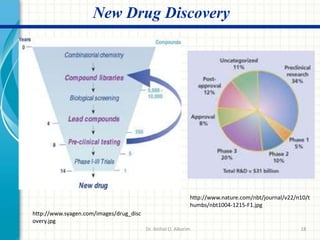
New Drug Discovery
http://www.syagen.com/images/drug_disc
overy.jpg
http://www.nature.com/nbt/journal/v22/n10/t
humbs/nbt1004-1215-F1.jpg
Dr. ibtihal O. Alkarim
19
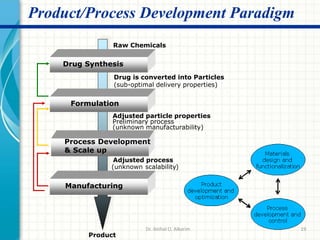
Product/Process Development Paradigm
Adjusted particle properties
Preliminary process
(unknown manufacturability)
Drug is converted into Particles
(sub-optimal delivery properties)
Drug Synthesis
Raw Chemicals
Formulation
Process Development
& Scale up
Adjusted process
(unknown scalability)
Manufacturing
Product
Dr. ibtihal O. Alkarim
20
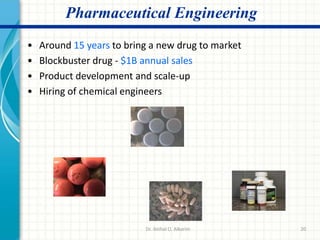
Pharmaceutical Engineering
• Around 15 years to bring a new drug to market
• Blockbuster drug - $1B annual sales
• Product development and scale-up
• Hiring of chemical engineers
Dr. ibtihal O. Alkarim
21
Synthesis
Improvement in organic synthesis allow us
to make larger and larger molecules.
http://www.u-tokyo.ac.jp/coe/images/pic_list03_004.JPG
http://www.chemsoc.org/chembytes/ezine/images/1999/persp_apr99_2.jpg
Dr. ibtihal O. Alkarim
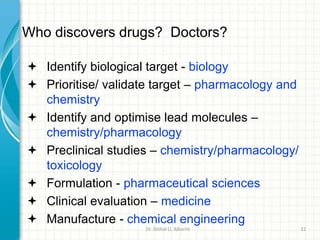
Who discovers drugs? Doctors?
 Identify biological target - biology
 Prioritise/ validate target – pharmacology and
chemistry
 Identify and optimise lead molecules –
chemistry/pharmacology
 Preclinical studies – chemistry/pharmacology/
toxicology
 Formulation - pharmaceutical sciences
 Clinical evaluation – medicine
 Manufacture - chemical engineering
Dr. ibtihal O. Alkarim 22
 For EACH DRUG approved, an average of 7500
compounds will have been made
 Of this 7500, an average of 21 will be tested for sub-acute
toxicology, 6.5 will be tested in humans and 2.5 will reach
Phase 3 – 1 then gets to market………
 Entire process takes on average 12 years
 Costs $138M (1975); $800M (2000); $1.6Bn (2008)
 Development costs do NOT include pre-launch marketing
which can DOUBLE costs
Dr. ibtihal O. Alkarim 23
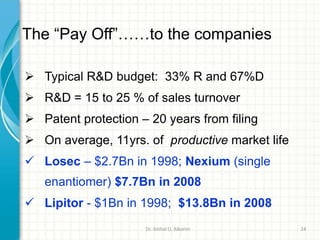
The “Pay Off”……to the companies
 Typical R&D budget: 33% R and 67%D
 R&D = 15 to 25 % of sales turnover
 Patent protection – 20 years from filing
 On average, 11yrs. of productive market life
 Losec – $2.7Bn in 1998; Nexium (single
enantiomer) $7.7Bn in 2008
 Lipitor - $1Bn in 1998; $13.8Bn in 2008
Dr. ibtihal O. Alkarim 24
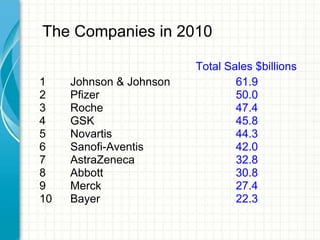
The Companies in 2010
Total Sales $billions
1 Johnson & Johnson 61.9
2 Pfizer 50.0
3 Roche 47.4
4 GSK 45.8
5 Novartis 44.3
6 Sanofi-Aventis 42.0
7 AstraZeneca 32.8
8 Abbott 30.8
9 Merck 27.4
10 Bayer 22.3
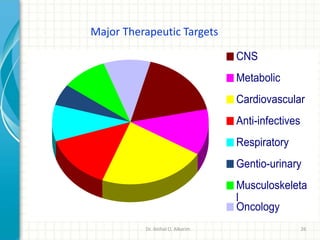
Major Therapeutic Targets
CNS
Metabolic
Cardiovascular
Anti-infectives
Respiratory
Gentio-urinary
Musculoskeleta
l
Oncology
Dr. ibtihal O. Alkarim 26
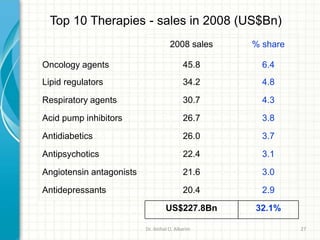
Top 10 Therapies - sales in 2008 (US$Bn)
2008 sales % share
Oncology agents 45.8 6.4
Lipid regulators 34.2 4.8
Respiratory agents 30.7 4.3
Acid pump inhibitors 26.7 3.8
Antidiabetics 26.0 3.7
Antipsychotics 22.4 3.1
Angiotensin antagonists 21.6 3.0
Antidepressants 20.4 2.9
US$227.8Bn 32.1%
Dr. ibtihal O. Alkarim 27
Stages of
pharmaceutical
manufacturing
Dr. ibtihal O. Alkarim 28
29
Dosage Forms
Tablets/Capsules
http://www.avmed.com/im
ages/c_rx-capsule.jpg
Injectables
http://www.indiamart
.com/cscpharma/gifs/i
njectable.jpg
Inhalants
http://www.bath.ac.uk/
pr/releases/images/vec
tura-inhale.gif
http://www.life-
tech.com/pm/nb1app3.j
pg
Transdermal products
and implants
Skin
Drug
Dr. ibtihal O. Alkarim
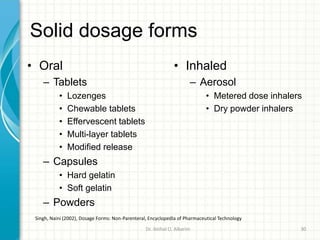
Solid dosage forms
• Oral
– Tablets
• Lozenges
• Chewable tablets
• Effervescent tablets
• Multi-layer tablets
• Modified release
– Capsules
• Hard gelatin
• Soft gelatin
– Powders
• Inhaled
– Aerosol
• Metered dose inhalers
• Dry powder inhalers
Singh, Naini (2002), Dosage Forms: Non-Parenteral, Encyclopedia of Pharmaceutical Technology
Dr. ibtihal O. Alkarim 30
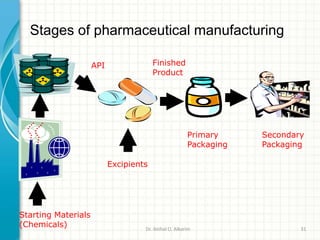
Stages of pharmaceutical manufacturing
API
Excipients
Primary
Packaging
Secondary
Packaging
API Finished
Product
Starting Materials
(Chemicals) Dr. ibtihal O. Alkarim 31
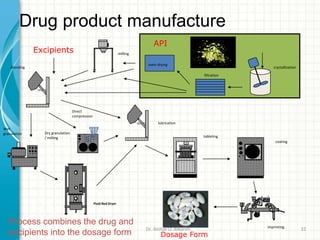
Drug product manufacture
Dosage Form
Wet
granulation
milling
blending
Fluid Bed Dryer
lubrication
tableting
coating
imprinting
Process combines the drug and
excipients into the dosage form
Excipients
API
crystallization
filtration
oven drying
Dry granulation
/ milling
Direct
compression
Dr. ibtihal O. Alkarim 32
Solid dosage processing
• Dosage forms
– Quality factors
• Excipients
• Particle properties
• Processing routes
• Unit operations
Dr. ibtihal O. Alkarim 33
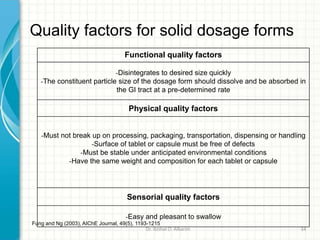
Quality factors for solid dosage forms
Functional quality factors
-Disintegrates to desired size quickly
-The constituent particle size of the dosage form should dissolve and be absorbed in
the GI tract at a pre-determined rate
Physical quality factors
-Must not break up on processing, packaging, transportation, dispensing or handling
-Surface of tablet or capsule must be free of defects
-Must be stable under anticipated environmental conditions
-Have the same weight and composition for each tablet or capsule
Sensorial quality factors
-Easy and pleasant to swallow
Fung and Ng (2003), AIChE Journal, 49(5), 1193-1215
Dr. ibtihal O. Alkarim 34
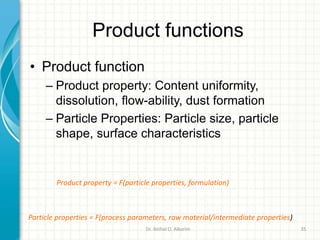
Product functions
• Product function
– Product property: Content uniformity,
dissolution, flow-ability, dust formation
– Particle Properties: Particle size, particle
shape, surface characteristics
Product property = F(particle properties, formulation)
Particle properties = F(process parameters, raw material/intermediate properties)
Dr. ibtihal O. Alkarim 35
Process function
• Process parameters: Type of unit
operation, operational parameters
Dr. ibtihal O. Alkarim 36
excipients
Dr. ibtihal O. Alkarim 37
Excipients
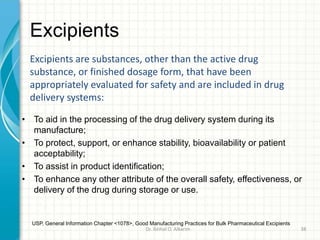
• To aid in the processing of the drug delivery system during its
manufacture;
• To protect, support, or enhance stability, bioavailability or patient
acceptability;
• To assist in product identification;
• To enhance any other attribute of the overall safety, effectiveness, or
delivery of the drug during storage or use.
Excipients are substances, other than the active drug
substance, or finished dosage form, that have been
appropriately evaluated for safety and are included in drug
delivery systems:
USP, General Information Chapter <1078>, Good Manufacturing Practices for Bulk Pharmaceutical Excipients
Dr. ibtihal O. Alkarim 38
Excipient functions
Component Function Examples
Fillers Increase size and weight of final
dosage form
Microcrystalline
cellulose, sucrose
Binders Promote particle aggregation Pregelatinized starch,
hydroxypropyl
methylcellulose
Disintegrants Promote break down of aggregates Sodium starch glycolate
Flow Aids Reduce interaction between particles Talc
Lubricants Reduce interactions between particles
and surfaces of processing equipment
Magnesium stearate
Surfactants Promotes wetting Sodium lauryl sulfate,
Polysorbate
Modified
Release
Agents
Influences the release of active Hydroxypropyl
methylcellulose,
Surelease,
Hlinak (2005)
Dr. ibtihal O. Alkarim 39
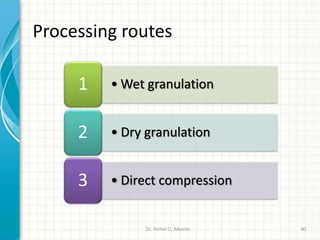
• Wet granulation1
• Dry granulation2
• Direct compression3
Processing routes
Dr. ibtihal O. Alkarim 40
Processing routes
Fill die
Coating, Packaging etc..
Compress Tablet
Direct Compression
Drug
Diluent
Glidant
Disintegrant
Lubricant Mixing
Mixing
Dry Granulation
Disintegrant
Glidant
Lubricant
Drug
Diluent
Lubricant
Mixing
Compression
Comminution
Screening
Mixing
Mixing
Wetting
Granulation
Drying
Screening
Mixing
Drug
Diluent
Binder
Solvent
Disintegrant
Glidant
Lubricant
Wet Granulation
Other Routes
Fluidized bed granulation
Extrusion / rotary granulation
Tablet
Compression
Dr. ibtihal O. Alkarim 41
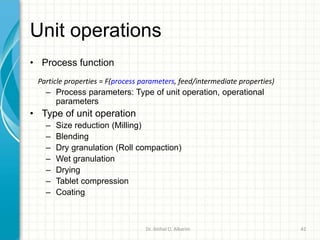
Unit operations
• Process function
– Process parameters: Type of unit operation, operational
parameters
• Type of unit operation
– Size reduction (Milling)
– Blending
– Dry granulation (Roll compaction)
– Wet granulation
– Drying
– Tablet compression
– Coating
Particle properties = F(process parameters, feed/intermediate properties)
Dr. ibtihal O. Alkarim 42
43
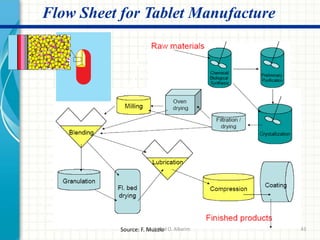
Flow Sheet for Tablet Manufacture
Source: F. MuzzioDr. ibtihal O. Alkarim

Pharmaceutical industry and unit process

  • 1.
  • 2.
    What is pharmaceutical manufacturing •it is the process of industrial scale synthesis of pharmaceutical drug by pharmaceutical companies. • The process can be broken down into a series of unit operations such as milling, drying , compression ,and coating Dr. ibtihal O. Alkarim 2
  • 3.
    What is adrug? “A Chemical Substance that Interacts with a Living System and Produces a Biological Response” Dr. ibtihal O. Alkarim 3
  • 4.
    4 Drug A drug productconsists of therapeutics (API) and excipients combined in a delivery system. A drug product’s success lies in its ability to deliver the drug at a certain rate in a certain environment in the body. Dr. ibtihal O. Alkarim
  • 5.
  • 6.
  • 7.
    7 Regulations whether it's anew technology or a conventional technology. The role of regularity authorities is to ensure that the products are safe. FDA: “ Our role is not really to make a judgment about whether they should be placed in the marketplace or not. . . . We are here as the gatekeeper to close the gate if a product is not going to be safe for consumers. . . . “ Dr. ibtihal O. Alkarim
  • 8.
    • GMP regulations addressissues including record keeping, personnel qualifications, sanitation, cleanliness, equipment verification, process validation, and complaint handling. Dr. ibtihal O. Alkarim 8
  • 9.
    Dr. ibtihal O.Alkarim 9
  • 10.
  • 11.
    HISTORY OF PHARMACEUTICALINDUSTRY Graph 1: World Pharmaceuticals Market 2001(%) 47,2 23,7 12 11,1 6 North America Europe Japan Africa,Asia & Australia Latin America 80% of the world pharmaceuticals production is generated by developed countries. Dr. ibtihal O. Alkarim 11
  • 12.
  • 13.
    13 Growth of PharmaceuticalIndustry in USA US Sales Dr. ibtihal O. Alkarim
  • 14.
    14 Comparison of AnnualSales Per Person ANNUAL SALES PER PERSON OF PHARMACEUTICALS (2004, £ ) Dr. ibtihal O. Alkarim
  • 15.
    15 Growth of PharmaceuticalR&D Expenditure http://www.pharmafocusasia.com/knowledge_bank/articles/images/graph1.gif Dr. ibtihal O. Alkarim
  • 16.
    16 Comparison of PharmaceuticalR&D WORLD VOLUME OF PHARMACEUTICAL R&D (2004 £m) http://www.abpi.org.uk/publications/publication_details/annualReview2005/ar2005_leader.aspDr. ibtihal O. Alkarim
  • 17.
  • 18.
  • 19.
    19 Product/Process Development Paradigm Adjustedparticle properties Preliminary process (unknown manufacturability) Drug is converted into Particles (sub-optimal delivery properties) Drug Synthesis Raw Chemicals Formulation Process Development & Scale up Adjusted process (unknown scalability) Manufacturing Product Dr. ibtihal O. Alkarim
  • 20.
    20 Pharmaceutical Engineering • Around15 years to bring a new drug to market • Blockbuster drug - $1B annual sales • Product development and scale-up • Hiring of chemical engineers Dr. ibtihal O. Alkarim
  • 21.
    21 Synthesis Improvement in organicsynthesis allow us to make larger and larger molecules. http://www.u-tokyo.ac.jp/coe/images/pic_list03_004.JPG http://www.chemsoc.org/chembytes/ezine/images/1999/persp_apr99_2.jpg Dr. ibtihal O. Alkarim
  • 22.
    Who discovers drugs?Doctors?  Identify biological target - biology  Prioritise/ validate target – pharmacology and chemistry  Identify and optimise lead molecules – chemistry/pharmacology  Preclinical studies – chemistry/pharmacology/ toxicology  Formulation - pharmaceutical sciences  Clinical evaluation – medicine  Manufacture - chemical engineering Dr. ibtihal O. Alkarim 22
  • 23.
     For EACHDRUG approved, an average of 7500 compounds will have been made  Of this 7500, an average of 21 will be tested for sub-acute toxicology, 6.5 will be tested in humans and 2.5 will reach Phase 3 – 1 then gets to market………  Entire process takes on average 12 years  Costs $138M (1975); $800M (2000); $1.6Bn (2008)  Development costs do NOT include pre-launch marketing which can DOUBLE costs Dr. ibtihal O. Alkarim 23
  • 24.
    The “Pay Off”……tothe companies  Typical R&D budget: 33% R and 67%D  R&D = 15 to 25 % of sales turnover  Patent protection – 20 years from filing  On average, 11yrs. of productive market life  Losec – $2.7Bn in 1998; Nexium (single enantiomer) $7.7Bn in 2008  Lipitor - $1Bn in 1998; $13.8Bn in 2008 Dr. ibtihal O. Alkarim 24
  • 25.
    The Companies in2010 Total Sales $billions 1 Johnson & Johnson 61.9 2 Pfizer 50.0 3 Roche 47.4 4 GSK 45.8 5 Novartis 44.3 6 Sanofi-Aventis 42.0 7 AstraZeneca 32.8 8 Abbott 30.8 9 Merck 27.4 10 Bayer 22.3
  • 26.
  • 27.
    Top 10 Therapies- sales in 2008 (US$Bn) 2008 sales % share Oncology agents 45.8 6.4 Lipid regulators 34.2 4.8 Respiratory agents 30.7 4.3 Acid pump inhibitors 26.7 3.8 Antidiabetics 26.0 3.7 Antipsychotics 22.4 3.1 Angiotensin antagonists 21.6 3.0 Antidepressants 20.4 2.9 US$227.8Bn 32.1% Dr. ibtihal O. Alkarim 27
  • 28.
  • 29.
  • 30.
    Solid dosage forms •Oral – Tablets • Lozenges • Chewable tablets • Effervescent tablets • Multi-layer tablets • Modified release – Capsules • Hard gelatin • Soft gelatin – Powders • Inhaled – Aerosol • Metered dose inhalers • Dry powder inhalers Singh, Naini (2002), Dosage Forms: Non-Parenteral, Encyclopedia of Pharmaceutical Technology Dr. ibtihal O. Alkarim 30
  • 31.
    Stages of pharmaceuticalmanufacturing API Excipients Primary Packaging Secondary Packaging API Finished Product Starting Materials (Chemicals) Dr. ibtihal O. Alkarim 31
  • 32.
    Drug product manufacture DosageForm Wet granulation milling blending Fluid Bed Dryer lubrication tableting coating imprinting Process combines the drug and excipients into the dosage form Excipients API crystallization filtration oven drying Dry granulation / milling Direct compression Dr. ibtihal O. Alkarim 32
  • 33.
    Solid dosage processing •Dosage forms – Quality factors • Excipients • Particle properties • Processing routes • Unit operations Dr. ibtihal O. Alkarim 33
  • 34.
    Quality factors forsolid dosage forms Functional quality factors -Disintegrates to desired size quickly -The constituent particle size of the dosage form should dissolve and be absorbed in the GI tract at a pre-determined rate Physical quality factors -Must not break up on processing, packaging, transportation, dispensing or handling -Surface of tablet or capsule must be free of defects -Must be stable under anticipated environmental conditions -Have the same weight and composition for each tablet or capsule Sensorial quality factors -Easy and pleasant to swallow Fung and Ng (2003), AIChE Journal, 49(5), 1193-1215 Dr. ibtihal O. Alkarim 34
  • 35.
    Product functions • Productfunction – Product property: Content uniformity, dissolution, flow-ability, dust formation – Particle Properties: Particle size, particle shape, surface characteristics Product property = F(particle properties, formulation) Particle properties = F(process parameters, raw material/intermediate properties) Dr. ibtihal O. Alkarim 35
  • 36.
    Process function • Processparameters: Type of unit operation, operational parameters Dr. ibtihal O. Alkarim 36
  • 37.
  • 38.
    Excipients • To aidin the processing of the drug delivery system during its manufacture; • To protect, support, or enhance stability, bioavailability or patient acceptability; • To assist in product identification; • To enhance any other attribute of the overall safety, effectiveness, or delivery of the drug during storage or use. Excipients are substances, other than the active drug substance, or finished dosage form, that have been appropriately evaluated for safety and are included in drug delivery systems: USP, General Information Chapter <1078>, Good Manufacturing Practices for Bulk Pharmaceutical Excipients Dr. ibtihal O. Alkarim 38
  • 39.
    Excipient functions Component FunctionExamples Fillers Increase size and weight of final dosage form Microcrystalline cellulose, sucrose Binders Promote particle aggregation Pregelatinized starch, hydroxypropyl methylcellulose Disintegrants Promote break down of aggregates Sodium starch glycolate Flow Aids Reduce interaction between particles Talc Lubricants Reduce interactions between particles and surfaces of processing equipment Magnesium stearate Surfactants Promotes wetting Sodium lauryl sulfate, Polysorbate Modified Release Agents Influences the release of active Hydroxypropyl methylcellulose, Surelease, Hlinak (2005) Dr. ibtihal O. Alkarim 39
  • 40.
    • Wet granulation1 •Dry granulation2 • Direct compression3 Processing routes Dr. ibtihal O. Alkarim 40
  • 41.
    Processing routes Fill die Coating,Packaging etc.. Compress Tablet Direct Compression Drug Diluent Glidant Disintegrant Lubricant Mixing Mixing Dry Granulation Disintegrant Glidant Lubricant Drug Diluent Lubricant Mixing Compression Comminution Screening Mixing Mixing Wetting Granulation Drying Screening Mixing Drug Diluent Binder Solvent Disintegrant Glidant Lubricant Wet Granulation Other Routes Fluidized bed granulation Extrusion / rotary granulation Tablet Compression Dr. ibtihal O. Alkarim 41
  • 42.
    Unit operations • Processfunction – Process parameters: Type of unit operation, operational parameters • Type of unit operation – Size reduction (Milling) – Blending – Dry granulation (Roll compaction) – Wet granulation – Drying – Tablet compression – Coating Particle properties = F(process parameters, feed/intermediate properties) Dr. ibtihal O. Alkarim 42
  • 43.
    43 Flow Sheet forTablet Manufacture Source: F. MuzzioDr. ibtihal O. Alkarim